Electrical Power Engineering FAQs
Get expert answers to the most common electrical power engineering questions from substation design to interconnection and NERC compliance.


About Keentel Engineering
Your Trusted Partner in Electrical Engineering and Power Systems
At Keentel Engineering, we deliver electrical power engineering services built on 30 years of experience and a commitment to excellence. Our clients include utilities, developers, EPCs, and public agencies across the U.S.
Unlike firms that sacrifice technical depth to chase billable hours, we prioritize precision, compliance, and value engineering. From transmission services and relay modeling to winterization and SCADA planning, we never compromise on quality.
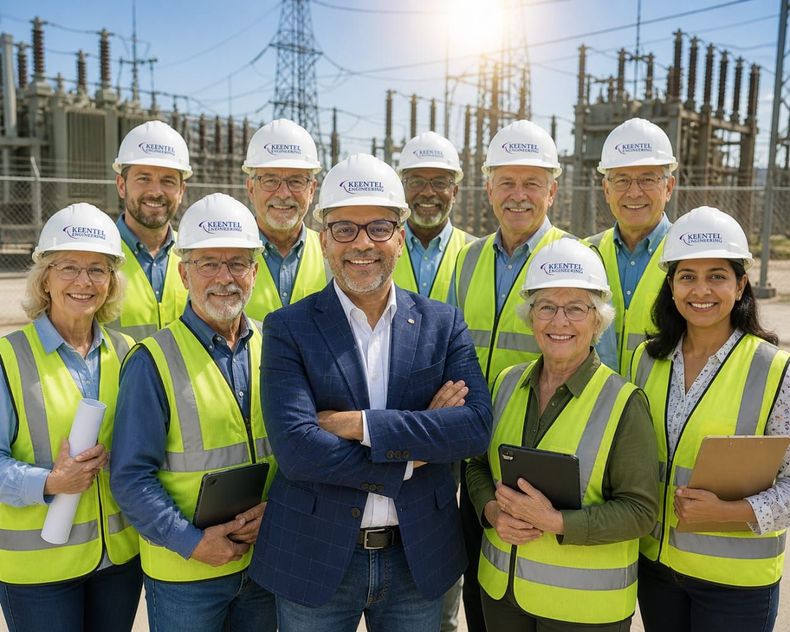
Why Choose Keentel Engineering?
Client-Focused Work Approach
At Keentel Engineering, we take pride in being the go-to electrical power engineering firm for power and utility system planning, substation design, protection, control, and power system analysis. The following attributes distinguish our team in utility-grade substation engineering and compliance-driven project delivery.
30
30 Years of Experience
With three decades of hands-on project delivery, we bring unmatched expertise in substation layout design, substation electrical and civil engineering, relay protection, and grid-tie solutions. Our experience includes projects in complex terrain, urban retrofit environments, and utility-scale renewable integrations.
Quality with Innovation
Our engineering process applies AutoCAD 3D, BIM modeling, and system-level substation design practices to ensure accurate planning, reduced errors, and efficient coordination across all project stakeholders.
Our workflow includes 3D substation design, enabling clash-free coordination between structural, electrical, and civil disciplines.
Attention to Detail
From grounding grid studies to relay protection settings, we engineer every detail to improve system reliability, performance, and operational safety. Our rigorous QA/QC process ensures compliance with IEEE, NFPA, and ISO/TSO interconnection standards.
Among leading electrical substation design companies, Keentel Engineering stands out for 30+ years of proven high-voltage and utility-grade project delivery.
Keentel Engineering video
Accreditations and memberships




Contact details
Tell Us About Your Project
1 business day replyFirst name, email and what you're interested in are all we need to get moving. Everything else, including drawings or an RFP, is optional.
We reply within one business day. Sending this does not create a contract or an engineer and client relationship.
POI Interconnection Engineering Support
Technical questions — from project concept to energization.
01
What does POI interconnection engineering support include from start to finish?
POI interconnection engineering covers the full technical path from project concept to energization. Keentel typically supports: feasibility review, utility/ISO technical coordination, POI substation concept and detailed design, protection and control philosophy, grounding, equipment specifications, study support (load flow, short-circuit, coordination, harmonics/power quality), construction drawing packages, commissioning support, and utility acceptance documentation. The goal is to ensure the facility can interconnect safely, meet grid code requirements, and pass utility witness testing without redesign.
02
How does Keentel help reduce interconnection delays and study rework?
Delays often come from missing data, unrealistic assumptions, or design/study misalignment. Keentel reduces rework by validating key inputs early — equipment ratings, transformer impedance, inverter/turbine controls, grounding parameters — aligning the protection philosophy with utility expectations, and confirming that study assumptions match the actual design. We also help clients respond to ISO/utility comments quickly with technically defensible revisions.
03
What are the most common POI risks for solar, wind, and BESS projects?
Common risks include insufficient short-circuit strength (weak grid), reactive power/voltage control gaps, harmonic or flicker violations, miscoordinated protection settings, transformer energization impacts, telecom/SCADA integration issues, and grounding noncompliance. Keentel addresses these through targeted studies, design improvements, and coordinated protection and control schemes.
04
What drawings and deliverables are typically required at the POI?
Deliverables often include the POI single line diagram, general arrangement/layout, grounding plan, conduit/cable schedules, AC/DC station service design, protection and control schematics, relay I/O and logic, metering schematics, telecom/SCADA architecture, equipment specifications, and commissioning test procedures. Keentel packages these in a utility-ready format and supports technical submittals.
05
How does Keentel approach protection and control at the POI?
Keentel starts with a protection philosophy aligned with system configuration and utility practices — line protection, bus protection, transformer protection, breaker failure, transfer trip, synch-check, interlocking. We then perform coordination studies, confirm CT/PT sizing, validate relay settings, and ensure schemes integrate correctly with SCADA and metering. The outcome is a reliable, selective protection system that avoids nuisance trips while meeting interconnection requirements.
06
How do you support commissioning and energization readiness?
Keentel supports commissioning by creating test plans, reviewing FAT/SAT procedures, verifying relay settings files, checking point-to-point wiring, validating SCADA signals, and supporting utility witness tests. We also help confirm energization sequence steps — transformer energization, breaker close interlocks, telecom readiness — and close out punch lists.
07
What software platforms does Keentel use for interconnection engineering?
Depending on ISO/utility preference and study type, Keentel uses tools such as ETAP (short-circuit, coordination, arc flash, harmonics), PSSE (transmission planning and dynamics), PSCAD (EMT/transients), and other industry-standard platforms. The selected toolchain is matched to the project's requirements and acceptance criteria.
08
What makes Keentel's POI support different from typical design firms?
Keentel provides engineering that is interconnection-driven: we combine substation design, protection and control, and study expertise under one team. That reduces coordination gaps and ensures the design, settings, and study assumptions are consistent — improving approval speed, reducing field changes, and increasing the likelihood of a smooth energization.
Substation Design Services
AIS and GIS substation design across MV, HV, and EHV voltage levels.
01
What types of substations does Keentel design?
Keentel designs AIS and GIS substations across MV, HV, and EHV levels, including POI substations, collector substations, switching stations, distribution substations, and retrofit/expansion projects. We support indoor and outdoor configurations and adapt designs to site constraints, environmental conditions, and utility standards.
02
What is included in a complete substation design package?
A complete package typically includes: basis of design, one-lines and three-lines, equipment layouts, grounding design, lightning protection, control house layouts, conduit/cable schedules, AC/DC auxiliary systems, protection & control drawings, communications/SCADA integration, bill of materials, and construction specifications. Keentel can also support procurement by producing equipment specifications and technical bid evaluations.
03
How does Keentel ensure safety in substation designs?
Safety is built in through grounding grid compliance (step/touch), arc-flash considerations, equipment spacing and working clearances, lockout/tagout-friendly layouts, interlocking/switching procedures, and code compliance (IEEE/NEC/NESC and utility standards). We also emphasize maintainability and safe access routes to reduce operational hazards.
04
How do you design grounding systems in difficult soil conditions?
In high-resistivity soils, Keentel performs detailed soil testing review and grounding analysis to meet step-and-touch limits. We evaluate options such as deeper ground rods, ground enhancement materials, additional grid conductors, counterpoise conductors, or segmented grounding designs. The final grounding system is optimized for compliance, constructability, and long-term performance.
05
How do you select between AIS and GIS solutions?
AIS is typically lower cost but requires more land and clearances. GIS is compact and ideal for urban/space-limited sites, but has different maintenance practices and transient considerations (like VFTO). Keentel evaluates footprint, environmental exposure, reliability targets, outage constraints, lifecycle cost, and utility preferences to recommend the best-fit solution.
06
Can Keentel support retrofit and expansion projects with minimal outage windows?
Yes. For brownfield retrofits, we plan phasing carefully: temporary bypass arrangements, cutover sequencing, staged commissioning, and protection coordination updates. We design to keep critical loads online and minimize outage duration while maintaining safety and compliance.
07
Do you handle protection and control design as part of substation design?
Yes. Keentel provides full P&C: relay selection, one-lines, schematics, wiring diagrams, AC/DC design, relay logic, communications architecture, metering integration, and coordination studies. This integrated approach prevents the common disconnect between physical design and protection performance.
08
What are typical project risks in substation construction and how do you mitigate them?
Risks include scope creep, equipment lead times, layout clashes, grounding compliance issues, and late utility comments. Keentel mitigates these through early standards alignment, constructability reviews, coordinated 3D/2D layouts, clear specifications, and disciplined change management with owners and EPC teams.
EHV, HV & MV Power System Studies
Load flow, short-circuit, coordination, arc flash, harmonics, and more.
01
Which power system studies does Keentel perform?
Keentel performs load flow, contingency, short-circuit/duty, protection coordination, arc-flash, harmonic/power quality, motor starting, voltage drop, transient stability (where applicable), and grounding studies. We tailor the study set to the system voltage class (EHV/HV/MV), facility type, and regulatory/utility requirements.
02
Why are short-circuit studies critical for EHV/HV/MV systems?
Short-circuit studies confirm equipment interrupting ratings and momentary withstand capabilities. They also define protective device settings, ensure breaker duty compliance, and reduce risk of catastrophic equipment failure. This is often required for utility approval and safe operation.
03
What is the difference between coordination studies and arc-flash studies?
Coordination studies ensure protective devices operate selectively and quickly for faults. Arc-flash studies estimate incident energy exposure and define PPE boundaries and labeling. Coordination impacts arc-flash values — so Keentel typically performs these as an integrated workflow to balance safety and selectivity.
04
How does Keentel evaluate harmonics and power quality?
We model harmonic sources (inverters, VFDs, large rectifiers), calculate distortion levels at key buses, and verify compliance with applicable limits (often IEEE 519 or utility requirements). If mitigation is needed, we evaluate filter options, transformer configurations, and system impedance changes.
05
Can Keentel study weak grid and inverter-based resource interconnections?
Yes. Weak grid conditions affect voltage stability, fault response, and protection performance. Keentel evaluates short-circuit ratio, reactive margin, voltage regulation, and control interactions to recommend mitigation such as STATCOMs, synchronous condensers, or tuned control strategies.
06
What data does Keentel need to begin a study?
Typically: one-lines, equipment ratings, transformer impedances and tap settings, cable/conductor data, protective device details, load profiles, generator/inverter parameters, and utility source equivalents. Keentel can also work with partial data early and refine models as detailed design progresses.
07
How do you ensure study results are defensible for utility/ISO review?
Keentel documents assumptions, model sources, and validation checks. We provide clear base case descriptions, sensitivity runs, and traceable references to equipment data sheets. Deliverables are formatted to match common utility and ISO expectations to reduce review cycles.
08
How are study results converted into actionable design changes?
We translate results into specific design actions: breaker upgrades, relay setting updates, CT/PT changes, cable sizing adjustments, reactive compensation sizing, filter selection, or layout modifications. The value is not just the report — it's the engineering decisions supported by the analysis.
Owner's Engineer Services
Independent technical oversight — EPC review, procurement, and commissioning.
01
What does Keentel do as Owner's Engineer?
Keentel represents the owner's technical interests by reviewing EPC design deliverables, validating study assumptions, ensuring requirements compliance, supporting procurement evaluations, and verifying construction/commissioning quality. We act as the independent technical authority that protects the owner from hidden design and execution risks.
02
When should an Owner's Engineer be engaged?
Ideally at project initiation — before major procurement and before interconnection milestones. Early involvement helps set technical requirements, prevent misaligned designs, and reduce change orders later in the project.
03
What EPC deliverables does Keentel typically review?
We review basis of design, SLDs, layouts, grounding, P&C drawings, equipment specifications, telecom/SCADA architecture, system studies, commissioning procedures, and as-built packages. Reviews focus on compliance, constructability, maintainability, and long-term reliability.
04
How does Keentel reduce owner cost exposure?
We catch design gaps early (before procurement), prevent scope drift, reduce rework, and minimize change orders by ensuring requirements are clear and met. We also support technical bid evaluations to ensure owners buy the right equipment — not just the lowest price.
05
How do you support schedules and milestones?
Keentel tracks technical dependencies that often impact schedule: utility submittals, study approvals, equipment lead times, commissioning readiness, and cutover sequencing. We align technical deliverables with critical path milestones.
06
Do you support construction and commissioning?
Yes. We provide field engineering support, witness testing, review test results, validate relay settings, support energization readiness, and manage punch list closure from an owner's perspective.
07
How do you manage interfaces among owner, EPC, utility, and OEMs?
We lead technical coordination meetings, manage comment resolution logs, track decisions, and document action items. This prevents miscommunication and ensures consistent technical direction across all stakeholders.
08
What makes Keentel a strong Owner's Engineer partner?
Keentel combines substation design, protection and control, studies, and compliance knowledge — allowing us to review EPC deliverables with depth and anticipate utility/ISO expectations. That translates into fewer surprises, faster approvals, and stronger project outcomes.
NERC O&P 693 Compliance Services
Engineering-driven NERC compliance — gap assessments, audit preparation, evidence traceability.
01
What does "NERC O&P 693 compliance" cover?
NERC O&P standards under NERC 693 govern planning and operations performance expectations, including protection, modeling, facility ratings, disturbance reporting, and programmatic requirements. Keentel supports the engineering work that underpins compliance evidence — settings, studies, models, and technical documentation.
02
How does Keentel help clients prepare for NERC audits?
We perform gap assessments, identify evidence weaknesses, develop remediation plans, update technical documentation, and assemble audit-ready packages. We also support mock interviews and evidence trail organization so compliance teams can respond confidently.
03
Which NERC standards do you most commonly support?
Common engineering-heavy standards include PRC-005, PRC-019, PRC-024, PRC-025, PRC-027, MOD-025/026/027, FAC-008, and TPL-related engineering scope. Support is tailored to the client's registration and asset types.
04
What is "engineering-driven compliance" and why does it matter?
Engineering-driven compliance means the technical foundation is correct — models validated, settings justified, studies traceable — so compliance evidence is defensible. This reduces the risk of findings that arise when documentation exists but the technical basis is weak or inconsistent.
05
How do you support model validation requirements?
Keentel supports generator and plant model validation by comparing model response to actual event data, tuning parameters, documenting methodology, and preparing submissions consistent with applicable requirements and utility/ISO expectations.
06
Can Keentel support compliance for inverter-based resources?
Yes. IBR compliance requires careful review of inverter protection settings, ride-through logic, control tuning, and evidence documentation. Keentel bridges OEM-specific controls with compliance and interconnection requirements.
07
How do you handle evidence traceability?
We structure deliverables so each requirement has linked evidence: settings files, study reports, test records, change logs, and approvals. This reduces audit scramble and ensures repeatable compliance processes.
08
What results can clients expect from NERC compliance support?
Clients typically gain reduced audit risk, faster evidence retrieval, improved technical performance (fewer misoperations), and clearer alignment between engineering teams and compliance teams. The compliance program becomes sustainable — not a last-minute scramble.
Utility-Scale Solar Farm Engineering
Collector design, controls, grid compliance, and post-COD support.
01
What services does Keentel provide for utility-scale solar farms?
Keentel provides collector system design, inverter/transformer integration, substation and POI engineering, protection and controls, grounding, system studies, and interconnection support. We can support developers, EPCs, and owners throughout design, construction, and commissioning.
02
How do you design MV collector systems for reliability and loss reduction?
We optimize feeder routing, conductor sizing, voltage drop, and protection segmentation to reduce losses and improve maintainability. We also account for thermal limits, ampacity, and future expansion needs to avoid redesign.
03
How do you ensure solar plant compliance with grid requirements?
We validate reactive power capability, voltage control strategy, ride-through behavior, harmonics, and POI protection coordination. We align plant settings and control modes with utility/ISO requirements and support technical submittals.
04
Do you support plant-level controller (PPC) and inverter control coordination?
Yes. We coordinate PPC control modes (voltage, VAR, PF, power curtailment) with inverter settings and POI requirements. This is critical to avoid voltage instability or control hunting in weak grid conditions.
05
What studies are commonly required for solar projects?
Typical studies include load flow, short-circuit, relay coordination, arc flash (where applicable), harmonics, flicker/RVC (as required), and grounding studies. For challenging interconnections, additional dynamic or EMT studies may be required.
06
How do you address transformer energization and inrush concerns?
We evaluate transformer inrush impacts, potential voltage dips, and protection sensitivity. Mitigations can include controlled switching, pre-insertion resistors (where applicable), protection setting refinement, or operational energization procedures.
07
How does Keentel support construction and commissioning for solar?
We review shop drawings, support RFI responses, validate relay settings, assist with commissioning plans, and support utility witness testing. We also help ensure as-built documentation is complete for long-term operations.
08
What makes Keentel valuable for solar owners after COD?
We support ongoing reliability with studies for modifications, protection updates, compliance documentation, and performance troubleshooting. Owners benefit from an engineering partner who understands the plant's original design intent and grid requirements.
Utility-Scale BESS Engineering
Protection, controls, studies, and grid compliance for battery energy storage systems.
01
What does Keentel's BESS engineering scope include?
Keentel supports electrical design, protection and control, POI integration, grounding, auxiliary power, system studies, and interconnection requirements for utility-scale BESS projects. We also support hybrid configurations (solar + storage, wind + storage).
02
Why are BESS protection and controls more complex than traditional generation?
BESS introduces fast controls, bidirectional flow, and multiple operating modes. Protection must account for inverter limits, fault contribution behavior, and coordination with POI relays. Controls must manage voltage/VAR support, frequency response, charge/discharge constraints, and operational transitions.
03
What key studies are most important for BESS projects?
Common studies include short-circuit, protection coordination, harmonics, voltage/reactive power analysis, flicker/RVC (where required), and grounding. For challenging systems, EMT studies may be needed to evaluate transient behaviors and control interactions.
04
How do you support compliance and grid services requirements for BESS?
Keentel verifies BESS capability and settings to meet interconnection requirements (ride-through, reactive power, voltage control). We also support documentation for compliance programs when applicable and ensure settings align with utility acceptance criteria.
05
How do you manage the integration of PCS, transformers, and MV systems?
We coordinate equipment ratings, transformer impedance selection, grounding configuration, cable sizing, and protection interfaces to ensure safe operation and reliable performance. Integration includes auxiliary loads and station service design to prevent operational issues.
06
What are common causes of BESS commissioning delays and how do you prevent them?
Delays often come from signal mapping errors, SCADA point failures, mismatched settings between PCS/PPC/POI relays, and incomplete test procedures. Keentel prevents these through early interface definition, validation checklists, and commissioning readiness reviews.
07
Do you support BESS retrofits and augmentation projects?
Yes. We study augmentation impacts on protection, harmonics, thermal limits, and controls. We also support re-rating studies and updated one-lines and documentation after modifications.
08
How does Keentel help BESS owners improve reliability post-COD?
We support performance troubleshooting, protection misoperation analysis, control tuning recommendations, and ongoing study updates as the grid changes. This improves uptime and reduces forced outages.
Utility-Scale Wind Farm Engineering
MV collector design, grid compliance, and interconnection support for wind plants.
01
What electrical engineering services does Keentel provide for wind farms?
Keentel provides MV collector system design, substation and POI design, protection and controls, grounding, system studies, and interconnection support. We also coordinate turbine electrical interfaces and plant-level controller requirements.
02
What unique electrical challenges exist for wind farms?
Wind farms often involve long collector circuits, variable generation, power quality concerns, and complex control coordination. They may also face weak grid issues requiring careful voltage and reactive power management.
03
How do you design MV collector systems for wind projects?
We optimize feeder routing, cable sizing, switchgear placement, and protection segmentation to minimize losses and improve maintainability. We also account for thermal limits and ensure the design supports turbine operational constraints.
04
How does Keentel support grid compliance for wind plants?
We verify reactive power performance, voltage regulation strategy, ride-through behavior, harmonics (as applicable), and POI protection coordination. We align plant controls with utility/ISO requirements to reduce interconnection risk.
05
Do you support turbine GSU and main transformer integration?
Yes. We coordinate transformer ratings, impedances, grounding configurations, and protection schemes to ensure reliable fault response and compliance with utility expectations.
06
What studies are common for wind plants?
Typical studies include load flow, short-circuit, coordination, harmonics/power quality (as needed), grounding, and voltage/reactive power assessments. For complex interconnections, dynamic or EMT studies may be required.
07
How do you support commissioning and utility energization for wind?
We support relay settings validation, wiring checks, SCADA point verification, commissioning procedures, and utility witness testing. We also help owners close commissioning punch lists and finalize as-built documentation.
08
Why choose Keentel Engineering for wind farm projects?
Keentel combines interconnection expertise, substation engineering, and study capability with practical field-ready design. This reduces risk, improves approval timelines, and supports reliable wind plant operation over the full lifecycle.
MEP Engineering Services
Electrical, HVAC, fire protection, and lifecycle-optimized facility designs.
01
What types of facilities does Keentel support with MEP engineering?
Keentel supports industrial, commercial, mission-critical, and specialized facilities requiring coordinated HVAC, electrical, plumbing, and fire protection designs. We tailor solutions to occupancy, process loads, code requirements, and reliability needs.
02
What is included in Keentel's electrical MEP scope?
Electrical MEP typically includes service sizing, distribution design, lighting and controls, grounding/bonding, emergency/standby power, load calculations, panel schedules, and coordination with utility service requirements and permitting.
03
How do you ensure designs meet local codes and permitting needs?
We design to NEC and applicable codes and coordinate with AHJ permitting requirements. Deliverables are prepared as permit-ready drawing sets with clear specifications, notes, and schedules.
04
How do you handle coordination between HVAC and electrical systems?
HVAC loads often drive electrical service sizing and emergency power requirements. Keentel coordinates equipment selections, feeder sizing, motor starting impacts, and controls integration early — reducing RFIs and field changes.
05
Can Keentel support fire protection and life safety integration?
Yes. We coordinate fire alarm power needs, emergency lighting, egress requirements, and system interfaces to ensure code compliance and reliable performance.
06
Do you provide energy-efficient and lifecycle-optimized designs?
Yes. We evaluate energy-efficient equipment selections, control strategies, and system layouts that reduce operational costs while maintaining maintainability and compliance.
07
What documentation do clients receive for construction?
Clients receive coordinated plans, one-lines, riser diagrams, equipment schedules, details, and specifications that contractors can build from. We also support construction administration through RFI responses and submittal reviews.
08
What makes Keentel's MEP services different?
Keentel brings a power-systems mindset to facility design — especially valuable for industrial and mission-critical projects. We ensure electrical infrastructure aligns with reliability, safety, and future expansion needs.
Who We've Served
Serving utilities, EPCs, developers, and infrastructure organizations supporting critical power systems nationwide.