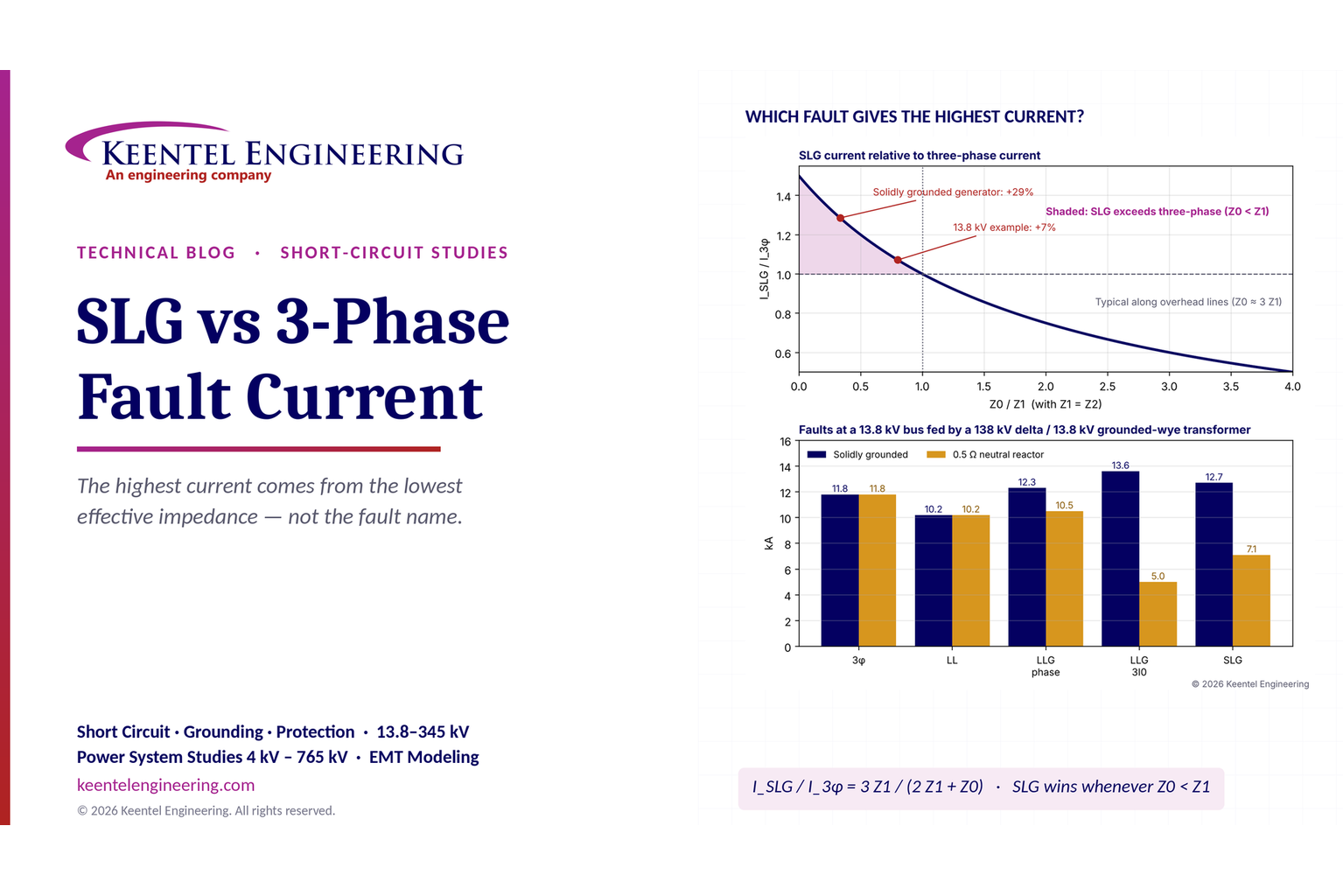



We’re Ready to Take Charge of Your EHV, HV & MV  Electrical Power Engineering  Needs

At Keentel Engineering, Our mission is to deliver sustainable, innovative, and high-quality electrical power engineering solutions tailored to your unique project requirements.

From substation design and POI interconnection engineering support to utility-scale solar, wind, and BESS engineering, we’re your trusted partner in delivering NERC-compliant, future-ready infrastructure across the U.S.

As a leader in electrical power engineering, we help utilities, developers, and EPCs across the U.S. overcome modern grid challenges. Our expert electrical engineering team specializes in grid reliability, interconnection, and compliance.

A person in a white lab coat using a pipette to transfer liquid into a clear glass vial in a laboratory setting.
A black and white close-up shows a human eye, focusing intensely on the iris with distinct, radial patterns.
An aerial view of a white, heart-shaped island surrounded by a calm, turquoise ocean.
A golden-brown, crispy fried chicken breast fillet sandwich on a toasted bun with pickles and sauce.

About Keentel Engineering
Your Trusted Partner in Electrical Engineering and Power Systems

At Keentel Engineering, we deliver electrical power engineering services built on 30 years of experience and a commitment to excellence. Our clients include utilities, developers, EPCs, and public agencies across the U.S.


Unlike firms that sacrifice technical depth to chase billable hours, we prioritize precision, compliance, and value engineering. From transmission services and relay modeling to winterization and SCADA planning, we never compromise on quality.
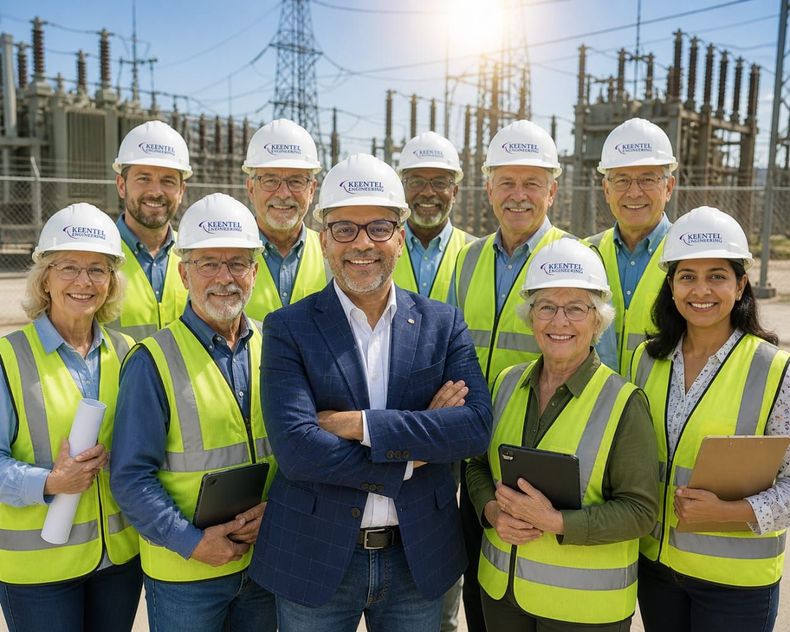
Let's Discuss How to Optimize Your Next Project

Submit

Our Electrical Engineering Services

Our Electrical engineering team offers a wide range of services. We are a U.S. based electrical engineering and power engineering company with a focus on engineering, procurement, construction and associated regulatory compliance. We provide full-spectrum electrical engineering services focused on grid modernization, power system reliability, and renewable energy integration. Our electrical power engineering team supports projects from design through commissioning, helping clients meet NERC, IEEE, and state-level standards efficiently.

POI Interconnection Engineering Support
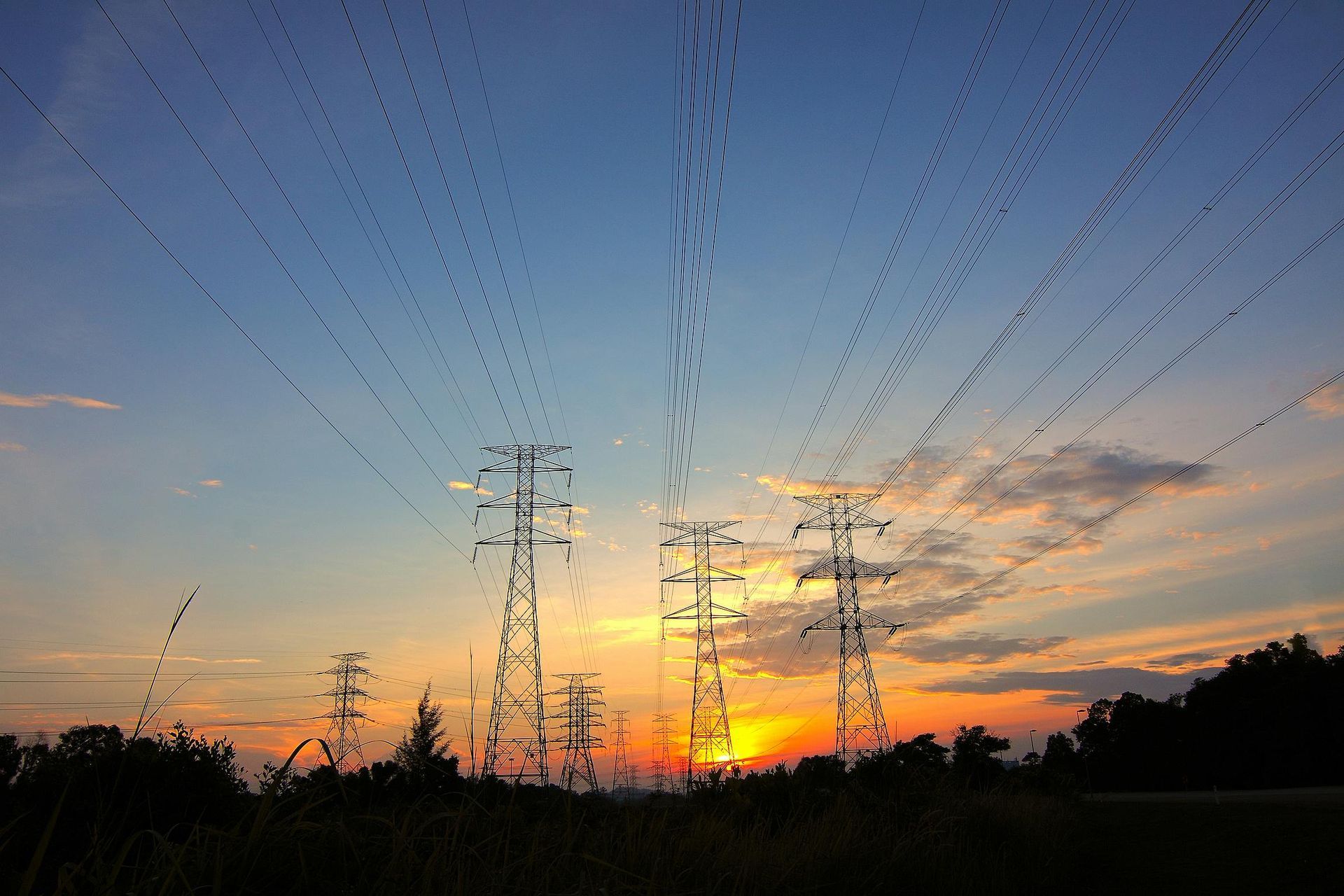
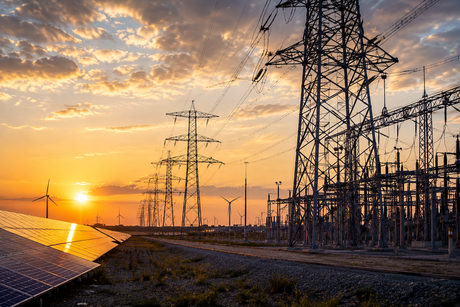
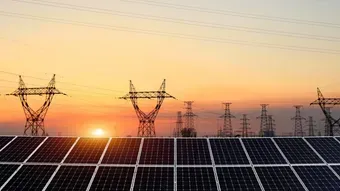
Silhouette of power lines and towers against a sunset with orange and blue sky.

Our skilled and knowledgeable engineering team has a rich history in designing, developing and commissioning various substation and interconnection engineering support projects.
LEARN MORE
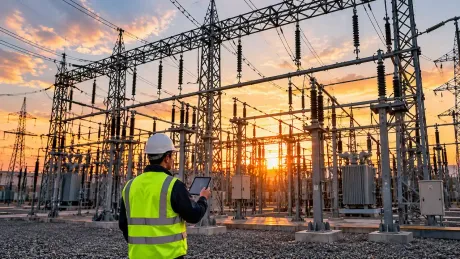
Man in hard hat and safety vest using a tablet near an electrical tower.

POI Interconnection Engineering Support

Our skilled and knowledgeable engineering team has a rich history in designing, developing and commissioning various substation and interconnection engineering support projects.
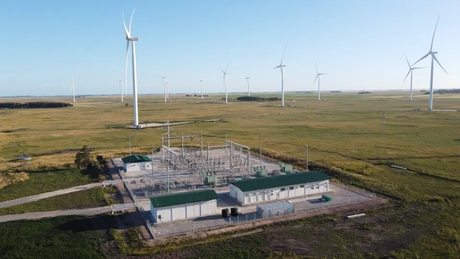
Wind turbines in a field with a substation; blue sky overhead.

Substation Design
Services

At Keentel Engineering, we are experts in substation and interconnection engineering support services. Our experienced and knowledgeable team has a solid history in engineering, developing,…

Solar panels with power lines against a sunset.

EHV, HV. MV Power System Studies

Ensure electrical safety, minimize downtime, and meet compliance standards with our expert power system studies across Extra High Voltage (EHV), High Voltage (HV), and Medium…

POI Interconnection Engineering Support

Silhouette of power lines and towers against a sunset with orange and blue sky.

Our skilled and knowledgeable engineering team has a rich history in designing, developing and commissioning various substation and interconnection engineering support projects.


LEARN MORE
Wind turbines silhouetted against a brilliant orange sunset over a field.

Owner’s Engineer
Services

At Keentel Engineering, we specialize in providing comprehensive owner's engineer services tailored to meet your project's unique needs. With a commitment to
excellence and a…

Two electricians in hard hats inspecting equipment with a laptop in a control room.

NERC O&P 693 Compliance Services

At Keentel Engineering, our NERC compliance consultants specialize in helping power sector clients meet NERC 693 standards, including all aspects of O&P and RSAW
requirements.…

Vast solar panel farm under a clear blue sky, generating renewable energy in an open field.

Utility-Scale Renewable Energy

Engineering support for solar, wind, and BESS projects — from POI studies and IEEE 2800 compliance to grid integration and NERC reliability support.

Powering Reliable Energy Infrastructure

From power system studies and substation design to grid interconnection, NERC compliance, renewable energy, and owner’s engineering, Keentel delivers expert support across the complete project lifecycle.

Electrical Power System Engineering with Precision, Compliance & Results

At Keentel Engineering, we don’t just design systems—we engineer certainty. With over 27 years of experience in electrical engineering and power systems engineering, our firm supports critical infrastructure across the U.S., helping GOs, TOs, utilities, developers, EPCs, and public agencies meet the evolving demands of a modern grid.

We specialize in solving complex power challenges—bringing together compliance, technical depth, and engineering accuracy to every MV, HV, and EHV project. Whether you're advancing renewable energy, integrating utility-scale generation, or strengthening transmission assets, our expertise ensures performance under pressure.

As a leading electrical systems engineering company, Keentel is trusted nationwide for:

  • Grid-ready designs rooted in field experience
  • Deep understanding of IEEE, NERC, and PJM standards
  • Expert modeling with ETAP, SKM, PSCAD, and GIS tools
  • Real-world insights into winterization, emergency support, and public-sector operations

From power system engineering design to fault studies and relay coordination, Keentel combines engineering fundamentals with cutting-edge simulation and automation.

We support compliance and modeling services for:

  • NERC Alerts and RSAW audits
  • IEC 61850 implementation and SCADA integration
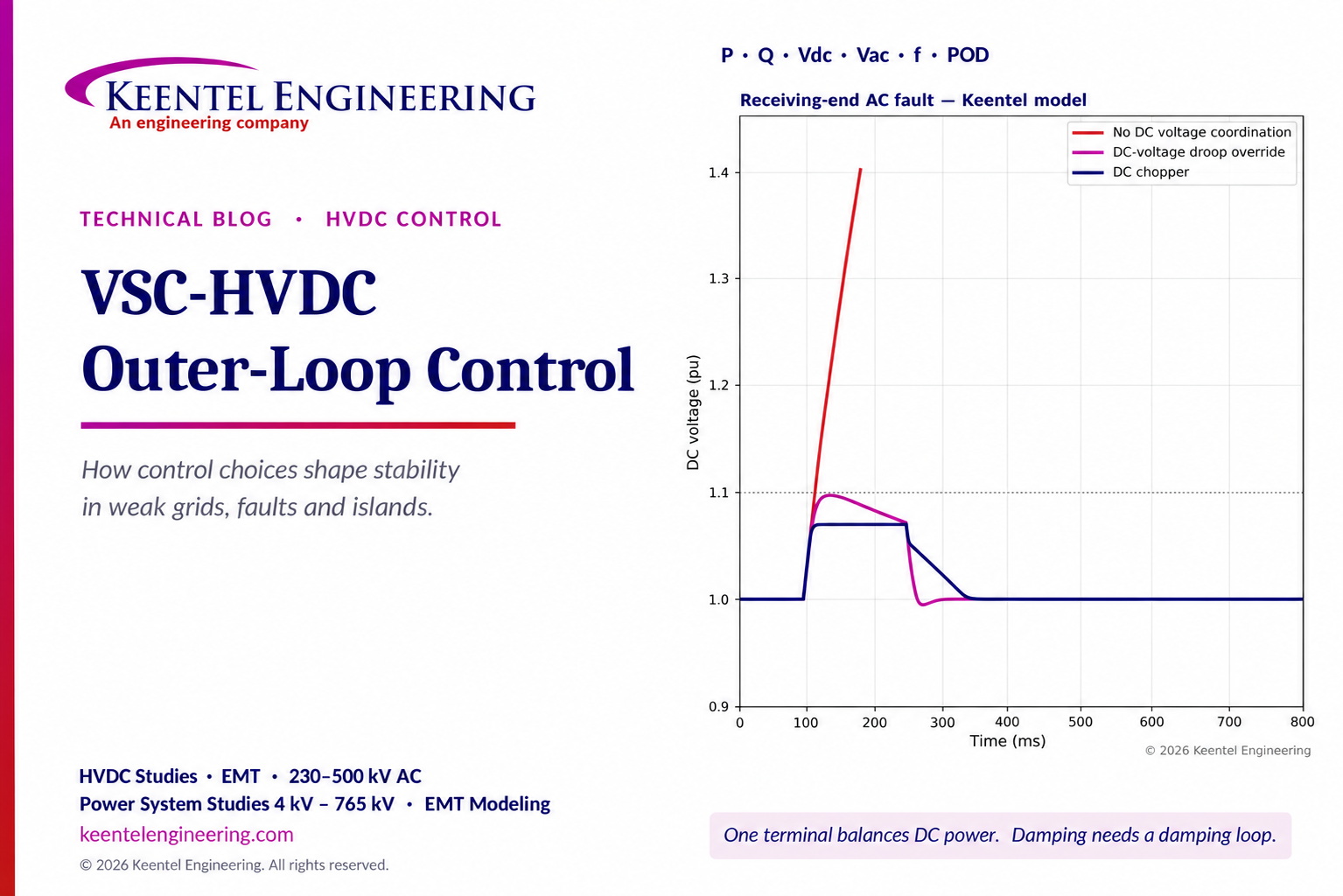
  • HVDC system consulting for modernized transmission
  • Grid interconnection queue navigation for utility-scale solar, wind, and BESS
  • ETAP and SKM load study services aligned with utility and code requirements

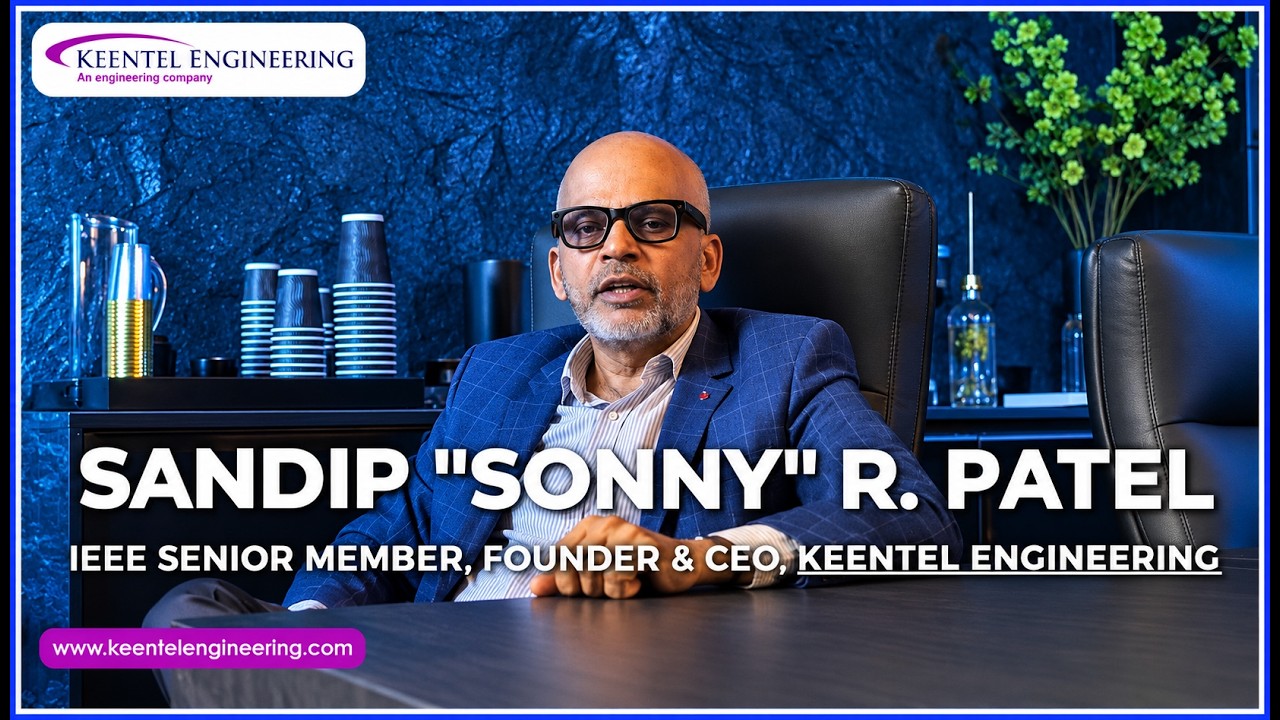
Power systems, plainly explained.

Field-tested engineering insights covering NERC, PJM, ERCOT, IBR modeling, data-center interconnection and modern power-system studies — delivered directly through the Keentel Engineering channel.
Subscribe on YouTube
Add your custom HTML here

Why Choose Keentel Engineering?

At Keentel Engineering, we take pride in being the go-to Electrical Power engineering firm for power and utility system planning, design, control, and analysis. Some of the many attributes of our company that set us apart are:

Person in crosshairs.

Client-Focused Work Approach

We work collaboratively from design and modeling to commissioning, ensuring we understand your goals and deliver tailored power system engineering services.

Person with a badge icon, indicating achievement or excellence.

30 Years of Experience

Our team brings decades of success in power system interconnection, transmission line design, and renewable energy engineering — including BESS, solar PV, and wind.

Magnifying glass focusing on a sequence of shapes.

Attention-to-Detail

We approach each project with detailed modeling, relay coordination, and fault analysis, delivering results that meet or exceed regulatory and performance benchmarks.

Black and white badge with a star inside a circle.

Quality with Innovation + Compliance

Whether you need ETAP, PSCAD, or SKM load studies, DIgSILENT simulations, or IEC 61850 automation solutions, we provide cutting-edge support with a compliance-first mindset.

Keentel – Software Capabilities FAQ

Our Software Capabilities

PSS®E PSS®E

ETAP ETAP

PSCAD PSCAD
PowerWorld PowerWorld

SKM SKM PTW
AutoCAD Electrical AutoCAD Elec.
ASPEN ASPEN
General FAQs
What is PSS®E software?
PSS®E (Power System Simulator for Engineering) is a power system simulation software developed by Siemens for analyzing and planning electrical transmission networks. It allows engineers to model large-scale power systems and perform detailed studies related to grid reliability and system performance.
What is PSS®E used for in power system studies?
PSS®E is used for transmission planning, interconnection studies, contingency analysis, stability simulations, and grid expansion planning.
Who uses PSS®E software?
Electric utilities, transmission planners, system operators, renewable energy developers, consulting firms, and research institutions.
Can PSS®E be used for renewable energy integration?
Yes. PSS®E supports modeling of inverter‑based resources such as solar plants, wind farms, and battery storage.
Why is PSS®E widely used in transmission planning?
It supports very large power system models (up to 200,000 buses), advanced dynamic simulations, and automated workflows.
Technical FAQs
How does PSS®E perform contingency analysis?
Simulates outage scenarios (line/generator/transformer failures) and identifies voltage or thermal violations.
What dynamic simulations can be performed?
Transient stability, generator dynamics, renewable inverter response, and disturbance ride‑through.
What is PV / QV analysis?
Evaluates voltage stability margins and determines the system's ability to maintain voltage under increasing load.
How does PSS®E support large models?
Optimized numerical algorithms and sparse matrix techniques allow simulation of networks with up to 200,000 buses.
Can PSS®E simulations be automated?
Yes, via extensive Python APIs for contingency automation, batch simulations, and custom workflows.
General FAQs
What is ETAP software?
ETAP is an electrical power system engineering platform for design, simulation, analysis, and operation of industrial and utility networks.
What studies can ETAP perform?
Power flow, short circuit, arc flash, protection coordination, harmonic, and dynamic stability.
What industries use ETAP?
Utilities, renewable plants, data centers, oil & gas, industrial manufacturing, and infrastructure.
What is ETAP Electrical Digital Twin?
A virtual model that mirrors the physical network for predictive simulation and real‑time monitoring.
Why is ETAP widely used?
Integrated design, simulation, monitoring, and optimization in one platform.
Technical FAQs
How does ETAP perform short circuit analysis?
Uses ANSI/IEEE C37 and IEC 60909 standards to evaluate fault currents and equipment ratings.
What is ETAP arc flash analysis?
Calculates incident energy and safety boundaries per IEEE 1584 and NFPA 70E.
How does ETAP perform protection coordination?
Uses TCC curves to evaluate relay/breaker/fuse coordination for selective fault isolation.
Can ETAP simulate renewables?
Yes – solar PV, wind generators, battery storage, and microgrids.
What dynamic simulations are available?
Generator trips, faults, motor starting, switching events, and transient stability.
General FAQs
What is PSCAD?
Electromagnetic transient (EMT) simulation software for fast electrical phenomena in power systems.
What is PSCAD used for?
HVDC studies, converter modeling, inverter simulations, lightning surge analysis, and EMT studies.
Who uses PSCAD?
Utilities, renewable developers, manufacturers, consultants, and research institutions.
Why is PSCAD important for renewables?
Simulates inverter‑based resources and complex electromagnetic interactions.
What systems can PSCAD model?
Transmission networks, HVDC, renewable plants, power electronics, and protection systems.
Technical FAQs
What is EMT simulation?
High‑frequency analysis of switching, lightning, and converter transients.
How does PSCAD model transmission lines?
Distributed parameter models capture traveling wave behavior.
What time steps are used?
Microseconds to tens of microseconds, depending on system complexity.
Can PSCAD simulate HVDC?
Yes, detailed models for LCC and VSC HVDC systems.
How does PSCAD simulate inverters?
Uses detailed converter control models for grid‑forming/following behavior.
General FAQs
What is PowerWorld?
Power system visualization and simulation software for transmission networks.
What is PowerWorld Simulator?
Interactive tool for power flow, contingency analysis, and voltage stability.
Who uses PowerWorld?
Utilities, transmission planners, operators, consultants, universities.
What studies can be performed?
Power flow, contingency, OPF, voltage stability, fault analysis.
What makes PowerWorld unique?
Interactive animated one‑line diagrams and geographic displays.
Technical FAQs
How does contingency analysis work?
Simulates outage scenarios and flags overloads or voltage violations.
What numerical method is used?
Newton‑Raphson for efficient large‑system power flow.
What is PV/QV analysis?
Determines voltage stability margins and collapse points.
What is OPF?
Optimal Power Flow – minimizes cost while respecting constraints.
How large a system can it handle?
Up to approximately 250,000 buses.
General FAQs
What is SKM PowerTools?
Electrical engineering platform for power system design, analysis, and safety.
What studies can SKM perform?
Load flow, short circuit, arc flash, coordination, harmonics, grounding.
What industries use SKM?
Utilities, industrial plants, data centers, oil & gas, commercial buildings.
What is SKM CAPTOR?
Protective device coordination module using TCC curves.
Why is SKM widely used?
Integrated modules allow multiple studies in one platform.
Technical FAQs
How does SKM perform short circuit analysis?
Uses ANSI/IEC standards, calculates symmetrical/asymmetrical fault currents.
What is arc flash analysis in SKM?
Incident energy and boundaries per IEEE 1584 / NFPA 70E.
How does SKM perform load flow?
Calculates voltage levels, power flows, and system losses.
Can SKM simulate harmonics?
Yes, HI_WAVE module evaluates distortion from non‑linear loads.
How does SKM evaluate protection coordination?
Analyzes TCC curves to ensure selective fault isolation.
General FAQs
Difference between AutoCAD and AutoCAD Electrical?
AutoCAD Electrical provides intelligent automation: wire numbering, component tagging, error checking.
Suitable for substation design?
Yes – protection schematics, relay panels, AC/DC diagrams.
NERC compliance?
Supports traceable documentation, tagging, and QA/QC processes.
Relay protection design?
Create relay logic, trip/close circuits, CT/PT connections, custom vendor symbols.
How does it improve productivity?
Automated wire numbering, component tagging, report generation, error checking.
Technical FAQs
Automatic BOM generation?
Yes, extracts real‑time data for BOM, panel schedules, cable lists.
Useful for industrial control?
Widely used for PLC, MCC, SCADA, and factory automation.
Multi‑user collaboration?
Yes, shared project databases + Autodesk Vault integration.
Supports IEC / ANSI standards?
Built‑in symbol libraries for IEC, ANSI, JIC; switchable standards.
Which industries use it?
Power utilities, renewables, oil & gas, manufacturing, infrastructure.
General FAQs
What makes ASPEN OneLiner essential for protection engineers?
ASPEN OneLiner provides advanced short circuit analysis and relay coordination capabilities, enabling engineers to simulate faults, validate protection schemes, and ensure compliance with ANSI, IEC, and NERC standards.
How does ASPEN Power Flow support transmission planning?
It allows engineers to analyze voltage profiles, system losses, and contingency conditions, helping utilities plan system expansions and ensure operational reliability.
Why is phase-domain modeling important in DistriView?
Phase-domain modeling captures unbalanced conditions in distribution systems, providing more accurate results compared to traditional sequence-based methods.
How does the Breaker Rating Module ensure equipment safety?
It simulates worst-case faults, calculates adjusted currents using X/R ratios, and compares them against breaker ratings per ANSI/IEC standards.
What role does the Line Database play in system studies?
It provides highly accurate impedance and capacitance parameters, which are critical inputs for fault and load flow calculations.
Technical FAQs
How does Power Flow handle voltage control?
It uses automatic algorithms for generators, LTC transformers, shunts, and phase shifters.
What is the importance of X/R ratio in breaker studies?
It affects the asymmetrical current and determines the actual interrupting duty on breakers.
How does DistriView perform harmonic analysis?
It includes frequency scan and harmonic load flow capabilities to evaluate system distortion.
What is the advantage of ASPEN’s relay modeling?
It supports detailed manufacturer-specific relay logic, improving study accuracy.
How does ASPEN support renewable integration?
It models inverter-based resources such as solar, wind, and BESS systems.
Frequently Asked Questions

ABOUT KEENTEL ENGINEERING

  • 1. What does Keentel Engineering actually do?

    Keentel Engineering is a U.S. electrical power engineering firm specializing in extra high voltage (EHV), high voltage (HV) and medium voltage (MV) systems. We take generation and transmission projects from the earliest interconnection screening all the way through energization and long-term NERC compliance. Our work falls into six core service lines:


    • POI interconnection engineering support — queue strategy, application support, and independent verification of transmission provider study results.
    • Substation design services — full physical and electrical design packages from 4.16 kV collector stations to 500 kV switchyards.
    • EHV, HV and MV power system studies — load flow, short circuit, arc flash, stability, harmonics, grounding, protection coordination and EMT analysis.
    • Owner’s engineer services — independent technical representation of the asset owner across design review, procurement, construction and commissioning.
    • NERC O&P 693 compliance services — RSAW evidence packages, gap analysis, model verification and audit support.
    • Utility-scale renewable engineering — solar, wind and battery energy storage, including collector systems, MEP and balance-of-plant design.

    We are headquartered in Tampa, Florida, with regional offices in Austin, Sacramento and Baltimore, giving us working familiarity with ERCOT, CAISO, WECC, PJM, MISO, SPP, SERC and the Florida Reliability Coordinating Council.

  • 2. Who do you typically work with, and what size projects do you take on?

    Our clients are independent power producers, renewable energy developers, investor-owned utilities, municipal utilities and electric cooperatives, EPC contractors, industrial facility owners and public agencies. On the developer side, we routinely support projects from 5 MW distribution-connected community solar through 500 MW-plus transmission-connected solar-plus-storage portfolios.


    We are equally comfortable being your entire engineering department on a single asset or acting as a specialist bench that plugs into an existing in-house team — for example, running the EMT modeling and interconnection studies while your team handles civil and procurement. Portfolio developers often engage us on a program basis across a fleet of projects so that models, drawing standards, relay philosophies and compliance evidence stay consistent from site to site, which materially reduces cost and review time on each subsequent project.


    Because we work across four time zones and four offices, we can also support geographically dispersed portfolios without losing continuity in the engineering of record.

  • 3. What are your engineering credentials, and are your engineers licensed?

    Keentel brings more than 30 years of hands-on experience in industrial and utility power systems. Our technical staff includes 21 licensed electrical engineers organized into three specialized groups so that every project is staffed by people who do that specific work every day:


    • Power System Design Group (6 engineers) — physical and electrical design in AutoCAD, Revit, ETAP and PVsyst.
    • Power System Studies Group (7 engineers) — steady-state and dynamic analysis in PSCAD, PSS®E and DIgSILENT PowerFactory.
    • Regulatory Compliance Group (5 engineers) — OSHA, NFPA 70 (NEC), IEEE and NERC/FERC standards.

    Our deliverables are stamped by Professional Engineers licensed in the states where our projects are built, and we maintain licensure across our active markets. Keentel is a member of the National Society of Professional Engineers, holds IEEE Senior Member status, is D-U-N-S registered and is BBB accredited. If your lender, offtaker or interconnecting utility requires specific licensure, insurance limits or a qualification package, we can provide that documentation before contract.

INTERCONNECTION & THE QUEUE

  • 4. We have a project in the interconnection queue. Where does Keentel fit in?

    Most developers engage us at one of four moments, and the earlier the better.


    • Before you file. We run pre-application screening — preliminary load flow and short circuit analysis on the candidate POI, review of available headroom, and a realistic view of likely network upgrades. This is the cheapest engineering you will ever buy, because it tells you whether a site is worth a deposit at all.
    • At application. We prepare and quality-check the technical exhibits: single-line diagrams, plant configuration, generator and inverter data sheets, PSS®E and PSCAD models, and the reactive capability documentation. Deficient technical data is one of the most common reasons requests are cured or dropped.
    • During the study. We independently reproduce the transmission provider’s results, identify constraints that are driving your assigned upgrades, and prepare technically credible comments during the customer engagement window.
    • After the study. We take the interconnection facilities defined in your LGIA and design them — substation, POI, protection, metering and telecom — through construction and energization.
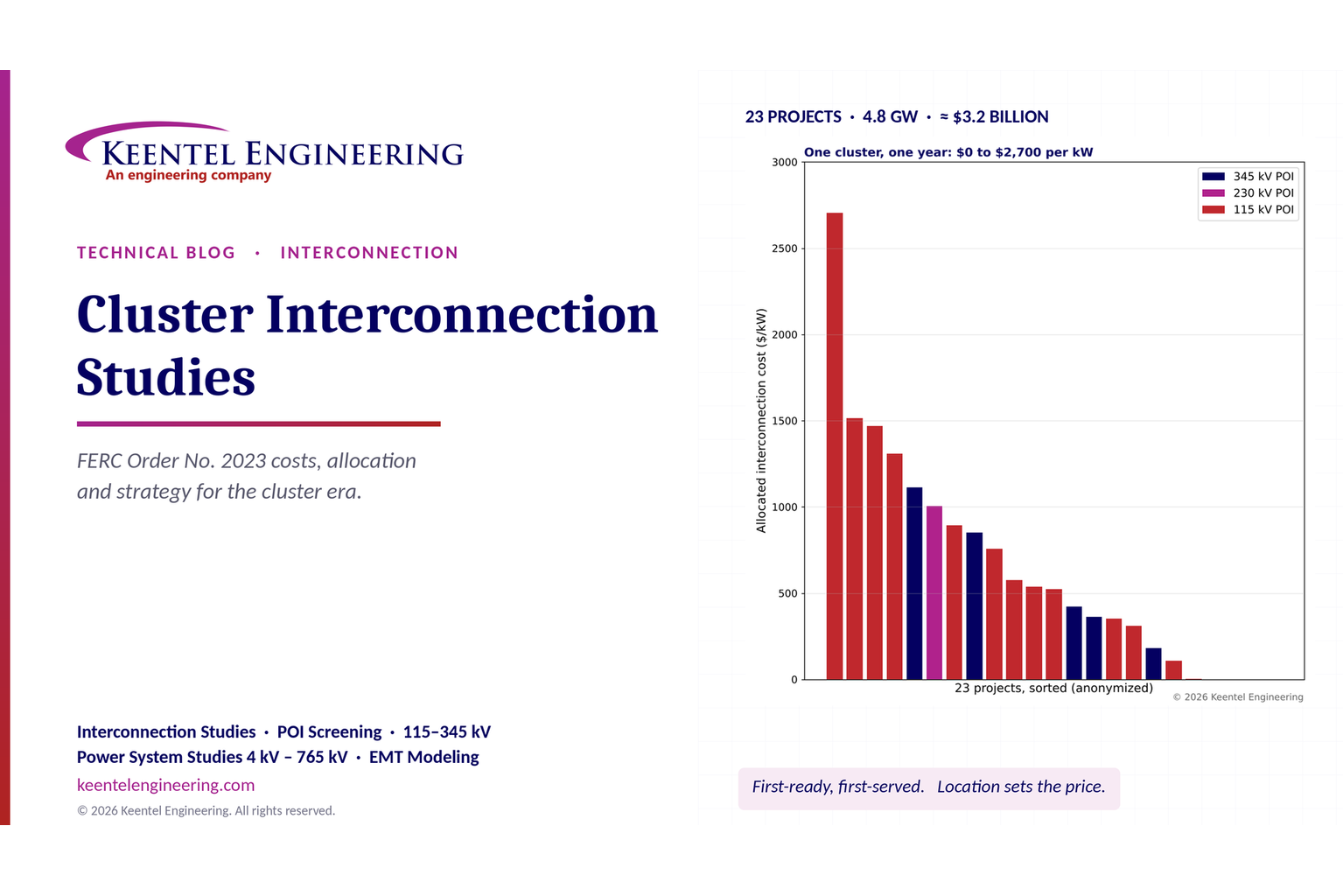
  • 5. How does the FERC Order No. 2023 cluster study process work, and where do projects get into trouble?

    Order No. 2023 replaced the old first-come, first-served serial process with a first-ready, first-served cluster process. Projects are studied in groups on a defined calendar rather than one at a time, with firm deadlines and financial penalties on transmission providers that miss them. In broad strokes the cycle runs through a 45-day cluster request window, a 60-day customer engagement window that includes a single group scoping meeting, a cluster study targeted at roughly 150 days, potential restudies triggered by higher-queued withdrawals, and then the facilities study.


    The rule also raised the bar on readiness. Interconnection customers must demonstrate 90% site control at the time of request and 100% site control when the facilities study agreement is executed, post commercial readiness and study deposits, and provide a deposit tied to a percentage of estimated network upgrade costs at LGIA execution. Withdrawal penalties escalate the later you exit.


    Where projects get hurt: incomplete or non-conforming models that trigger a deficiency notice; unrealistic plant configurations that produce inflated upgrade costs; site control that cannot be evidenced on the transmission provider’s timeline; and, most often, discovering a fatal constraint months after the deposit was already at risk. Our role is to compress those unknowns to the front of the process, when they are still cheap to solve. Confirm the exact windows, deposit amounts and penalty structure in your transmission provider’s FERC-approved tariff — compliance filings differ by region.

  • 6. Our study came back with very large network upgrade costs. Is there anything we can do?

    Often, yes — but only if the assignment is examined technically rather than accepted at face value. We start by reproducing the study to understand exactly which contingency, thermal limit or voltage violation is driving the cost, and whether your project is genuinely the cause or simply the last request in the cluster to be assigned a shared constraint.


    From there the realistic levers include: resizing or re-phasing the project so it falls under a binding threshold; adding or repositioning reactive support to resolve a voltage-driven upgrade at a fraction of the cost of a line rebuild; adopting an energy storage or hybrid configuration that changes the injection profile; accepting a provisional, conditional or surplus interconnection service arrangement; proposing a control scheme or curtailment agreement in place of physical steel; or reallocating cost among cluster participants where the shared-upgrade math is demonstrably wrong.


    Not every project can be rescued, and we will tell you plainly when the constraint is structural. But an independent second look before you withdraw is inexpensive relative to a forfeited deposit and a lost site.

POWER SYSTEM STUDIES & MODELING

  • 7. What power system studies does my project actually need, and what does each one prove?

    The required set depends on voltage class, interconnection agreement and jurisdiction, but a transmission-connected generating facility typically needs most of the following:


    • Load flow / power flow — confirms thermal and voltage performance under normal and contingency conditions; drives most network upgrade findings.
    • Short circuit and device duty — establishes available fault current and verifies breaker and equipment interrupting ratings.
    • Protection coordination and relay setting — ensures selective, dependable clearing of faults and correct coordination with the utility’s scheme.
    • Transient stability / dynamic analysis — demonstrates the plant rides through and recovers from system disturbances.
    • EMT (electromagnetic transient) analysis — required for most inverter-based plants; captures control interactions that phasor tools cannot.
    • Reactive power capability and voltage control — proves compliance with the power factor range and voltage schedule in your agreement.
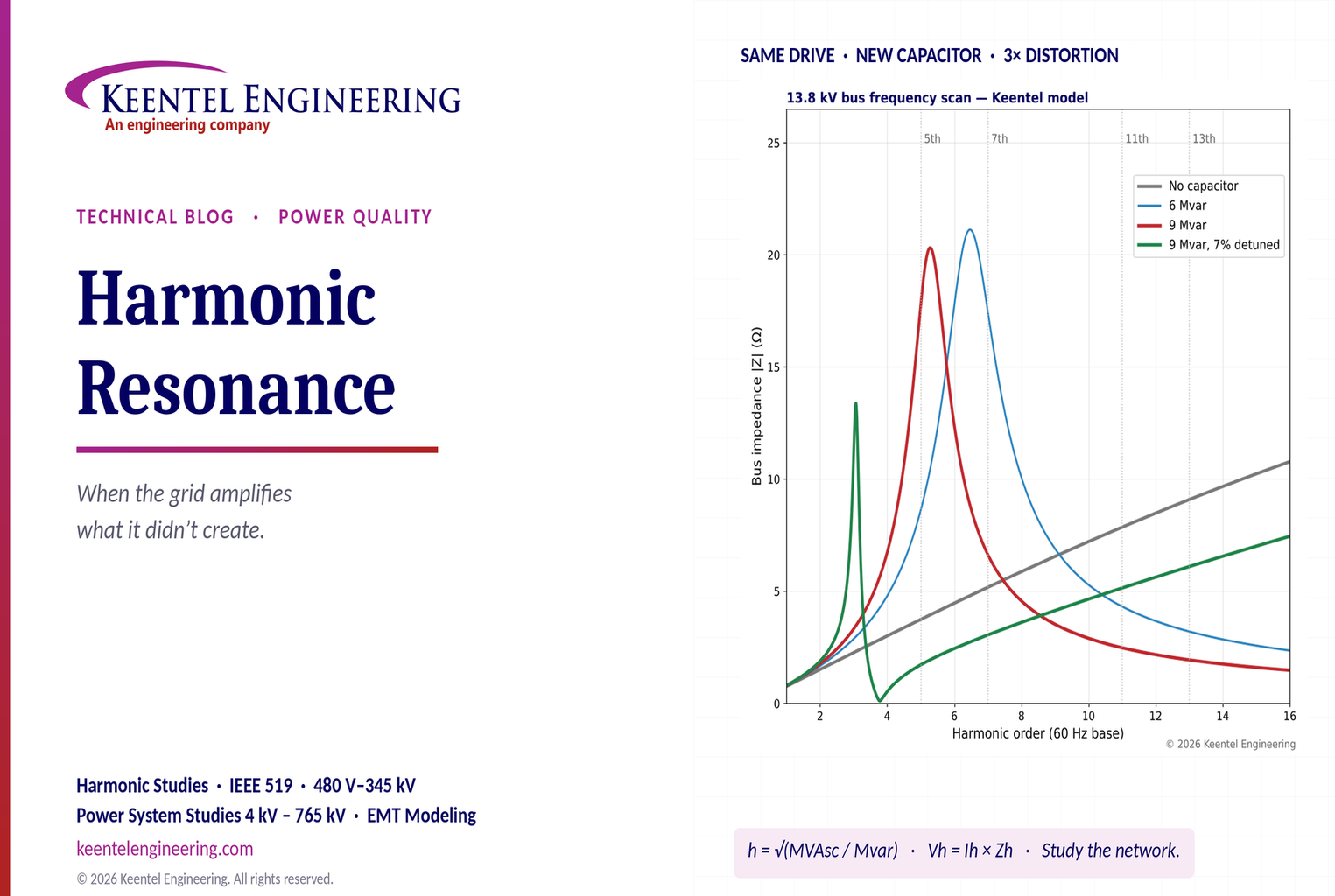
    • Harmonics and power quality — evaluates distortion against IEEE 519 limits; increasingly scrutinized on large inverter-based plants.
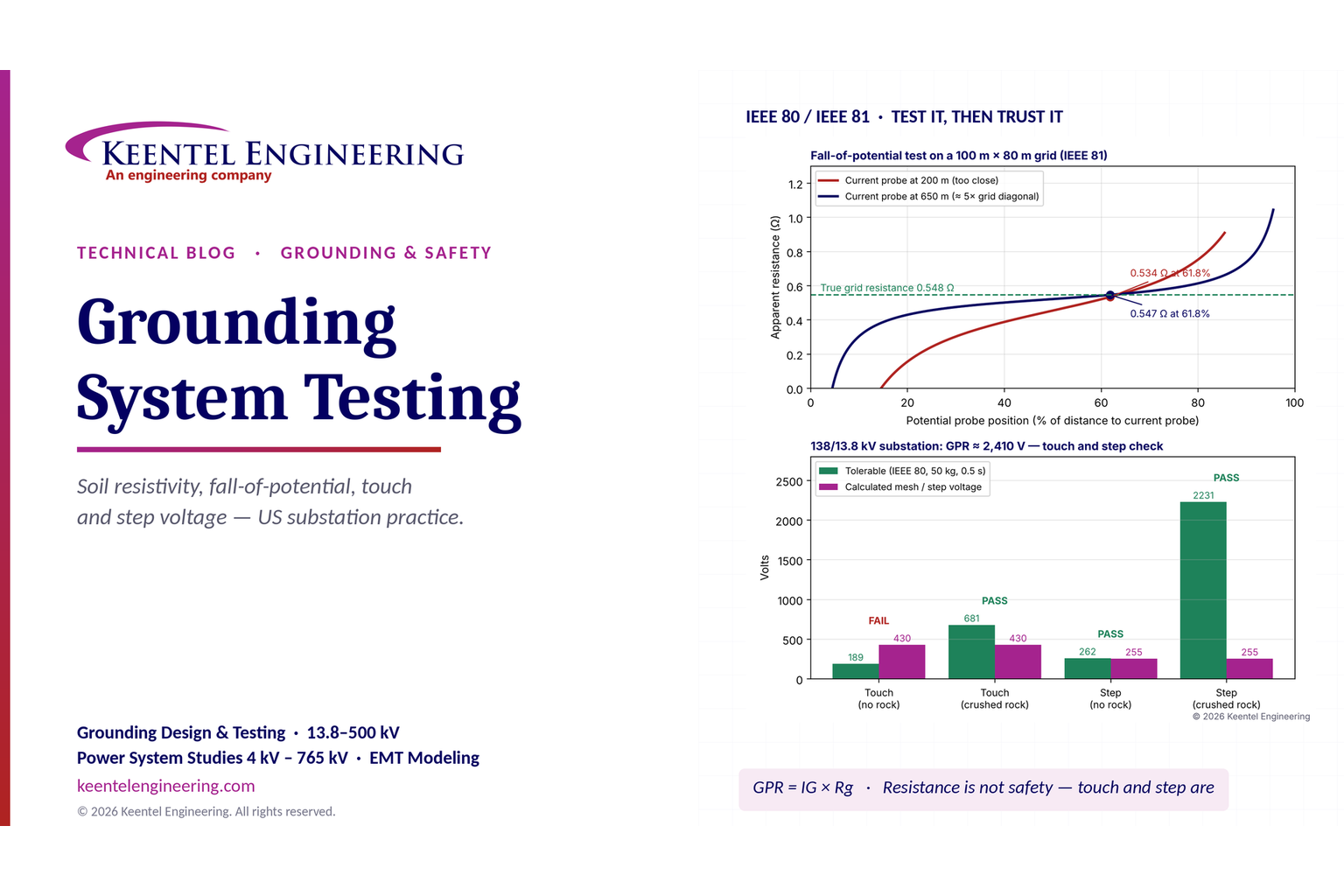
    • Grounding grid design per IEEE Std 80 — verifies step and touch potentials are within safe limits.
    • Arc flash and incident energy per IEEE Std 1584 — required for worker safety, labeling and NFPA 70E compliance.
    • Insulation coordination and surge protection — sizes arresters and confirms BIL margins.

    On solar, wind and BESS projects we also commonly perform sub-synchronous oscillation screening, plant-level controller tuning studies, and collector system loss and ampacity analysis.

  • 8. When do we need a PSCAD/EMT model, and why do transmission providers keep rejecting ours?

    EMT modeling in PSCAD is now standard practice for inverter-based resources — solar PV, wind and battery storage — in most ISO and RTO territories, and it is frequently required for any plant of meaningful size interconnecting at transmission voltage. Positive-sequence tools such as PSS®E simply cannot represent the fast inner-loop controls of a modern inverter, and it is exactly those controls that produce the sub-synchronous and control interaction phenomena grid operators are now screening for.


    Models get rejected for predictable reasons: the OEM-supplied black-box model does not match the actual firmware revision or the settings you intend to deploy; plant controller and inverter models are not integrated so plant-level volt/VAR response is wrong; collector system and transformer impedances are simplified past the point of usefulness; initialization fails or the model will not run to a stable flat start; or the submitted model does not reproduce the behavior claimed in the accompanying report.


    We build, integrate, benchmark and validate these models — including reconciling PSCAD behavior against the PSS®E and PowerFactory representations of the same plant — so what you submit survives review the first time. A rejected model does not merely cost a resubmittal fee; in a cluster process it can cost you a study cycle.

  • 9. Does IEEE Std 2800-2022 apply to our project, and how do we demonstrate compliance?

    IEEE Std 2800-2022 is the industry standard for interconnection and interoperability of inverter-based resources connecting to transmission systems. It sets minimum performance requirements for voltage and frequency ride-through, reactive power capability, active power control, power quality, protection, and modeling and validation. It is not self-executing federal law — it becomes binding on your project when a transmission provider, ISO/RTO or state adopts it into a tariff, interconnection agreement or planning manual, which a growing number have done or are actively moving to do.


    Practically, if you are developing a transmission-connected solar, wind or storage plant today, you should assume some form of IEEE 2800-aligned performance requirement will apply and design for it rather than retrofit to it. Demonstrating compliance generally means a combination of equipment certification and datasheets from the inverter OEM, plant-level studies and simulations showing the aggregate plant meets each requirement at the POI, validated EMT and phasor models, and commissioning test evidence.


    Keentel performs IEEE 2800 gap assessments, plant-level compliance studies and the supporting model validation, and we can tell you early whether your selected inverter and plant controller can meet the requirement at all — which is a procurement decision, not just an engineering one.


DESIGN, CONSTRUCTION & PROJECT DELIVERY

  • 10. What is included in a Keentel substation design package?

    We deliver complete, construction-ready substation and switchyard packages from 4.16 kV up through 500 kV, covering both the physical and electrical scope. A typical full package includes general arrangement and plan and section drawings; equipment layout with clearances per NESC and applicable standards; foundation and structure loading criteria coordinated with the structural engineer; grounding grid design per IEEE Std 80; lightning and direct stroke shielding; raceway, conduit and cable schedules with sizing calculations; AC and DC auxiliary systems including station service and battery/charger sizing; one-line, three-line and relay AC/DC schematic diagrams; wiring and connection diagrams; protection and control panel design with relay settings; SCADA, RTU and communications interfaces; metering and revenue metering design; and a bill of materials with technical specifications for procurement.


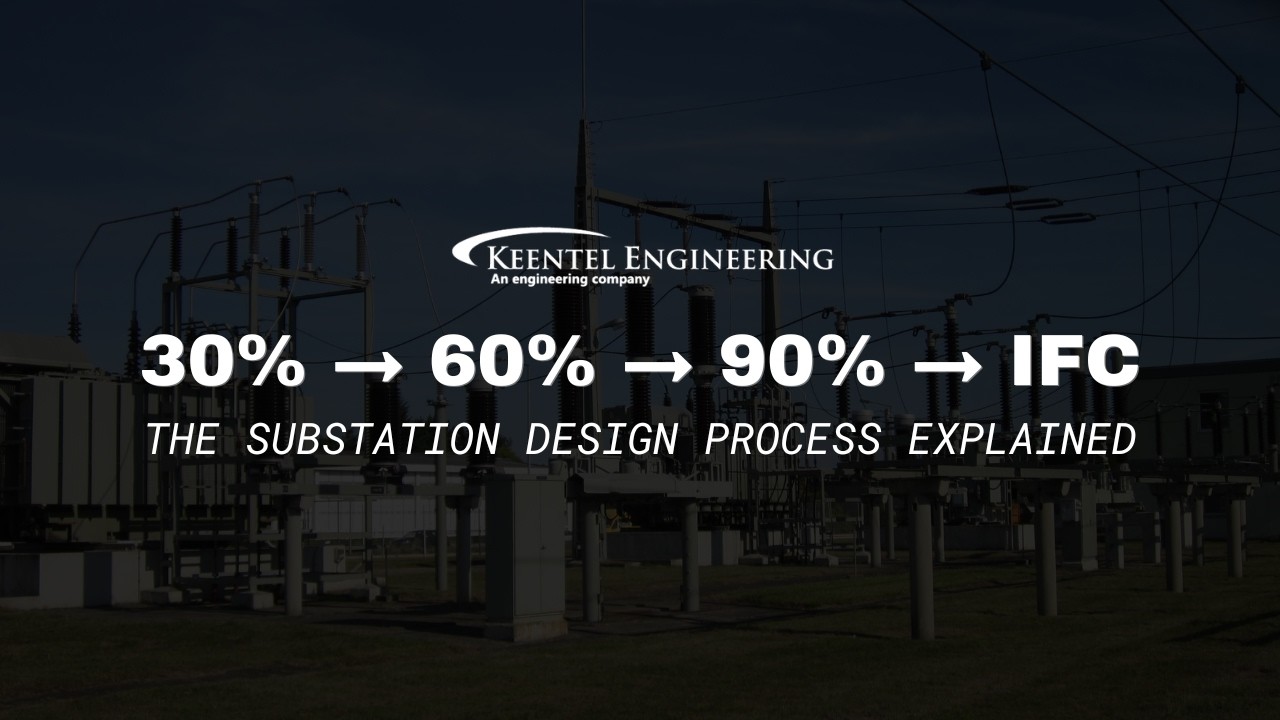
    We work at whatever stage you need — conceptual and feasibility layouts for budgeting, 30/60/90% design development, issued-for-construction drawings, or as-built reconciliation. We also support factory acceptance testing, field commissioning, and energization sequencing, and we can develop or update a client’s substation design standards so future projects start from a consistent baseline.

  • 11. What is an Owner’s Engineer, and do we need one if we already have an EPC contractor?

    An Owner’s Engineer is your independent technical representative — an engineer whose only obligation is to the asset owner. Your EPC contractor is a capable partner, but its commercial incentives are to build to the contract at the lowest cost, on the fastest schedule. Those incentives are not always aligned with the 30-year performance of the asset you will own, or with the technical representations you made to your lenders and offtaker.


    As Owner’s Engineer, Keentel typically performs technology and equipment selection support; review of the EPC’s design deliverables against the contract, applicable standards and the interconnection agreement; specification and bid package development; bid evaluation and vendor technical due diligence; energy yield and performance model review; construction monitoring and site inspections; punch list management; witness of factory and field acceptance testing; commissioning oversight; and substantial and final completion certification.


    The value is asymmetric. Owner’s engineering usually runs a small fraction of project capex, while a single missed protection setting, undersized transformer or unverified performance test can cost multiples of that in remediation or lost production. Lenders and tax equity investors increasingly expect an independent engineer to be in the room regardless.

  • 12. What do you provide specifically for utility-scale solar, wind and battery storage projects?

    We support renewable and storage assets across the full lifecycle. On the electrical side that includes DC and AC collector system design and optimization, string and combiner layout, inverter and MV transformer sizing and placement, cable ampacity and voltage drop analysis, collector substation and POI design, plant controller and SCADA architecture, and the balance-of-plant MEP scope — auxiliary power, lighting, grounding, fire alarm, HVAC for equipment enclosures and control buildings.


    For battery energy storage specifically, we address the issues that distinguish BESS from PV: augmentation and capacity fade planning, round-trip efficiency and auxiliary load accounting, thermal management and enclosure power, NFPA 855 and UL 9540A considerations in coordination with the fire protection engineer, protection of a bidirectional resource, and controls for the specific value streams the asset is contracted to provide.


    On the analysis side we run the interconnection and compliance studies these plants need — EMT and stability, reactive capability at the POI across the operating range, harmonics, ride-through verification, and grounding and arc flash for the collector and substation equipment. We also perform independent review of energy yield models and support commissioning and capacity testing.

NERC COMPLIANCE

  • 13. Do we have to register with NERC? We are a 100 MW solar farm that never registered before.

    Very possibly, and this is the compliance issue catching the most owners off guard right now. Historically many inverter-based plants sat below the Bulk Electric System registration thresholds and carried no mandatory reliability obligations. Following FERC Order No. 901, NERC has been implementing an initiative to identify and register previously unregistered inverter-based resources that materially affect the Bulk Power System.


    The screening criterion generally applied is an aggregate nameplate capacity of 20 MVA or more delivered to a common point of connection at 60 kV or above. A 100 MW plant interconnected at transmission voltage sits well inside that. Newly registered entities are brought in as Generator Owner and Generator Operator functions, with Reliability Standard obligations phasing in on a published compliance date schedule that NERC updates periodically.


    The practical consequence is that plants designed and built with no compliance program now need one — protection system maintenance programs, facility ratings, model verification, disturbance monitoring, ride-through documentation and evidence retention. Keentel performs applicability assessments, builds the compliance program from scratch, and produces the technical evidence. Confirm your specific status and dates with your Regional Entity, as thresholds and schedules continue to be refined.

  • 14. What is NERC O&P 693 compliance, and how do you support us through an audit?

    “693” refers to the FERC order that made NERC’s Operations and Planning Reliability Standards mandatory and enforceable. For a generation asset owner, the practical scope spans the PRC family (protection system maintenance and testing, misoperations, coordination, disturbance monitoring, ride-through), FAC (facility ratings, connection requirements, system operating limits), MOD (generator model verification and data reporting), VAR (voltage and reactive control), and portions of COM, EOP, PER and TPL. Non-compliance carries real financial penalties, but the more common cost is the disruption of an audit finding and mitigation plan on an operating asset.


    Our support model has four parts. First, applicability and gap analysis — what actually applies to your registered functions, and where you stand today. Second, remediation — the underlying engineering that the standards require, including relay maintenance programs, facility ratings calculations, MOD-025/026/027 model verification testing, PRC-019 and PRC-024/029 coordination and ride-through studies, and PRC-002 disturbance monitoring design. Third, evidence — building RSAW responses and the documented, dated, retrievable proof auditors expect, not just correct engineering. Fourth, audit support — mock audits, Align portal submissions, live participation during the audit, and mitigation plan development if a finding lands.

WORKING WITH US

  • 15. How do we engage Keentel what does it cost, how long does it take, and what do you need from us?

    Start with a no-cost consultation. Tell us the project — technology, size, POI voltage, interconnecting utility or ISO, queue position and current status — and we will tell you candidly what engineering it needs, in what order, and where the schedule and cost risks sit. That conversation is useful to you whether or not you engage us.


    Commercially, we structure work three ways depending on how defined the scope is: fixed-fee for well-defined deliverables such as a specific study or a substation design package; time-and-materials for advisory, owner’s engineering and open-ended support; and retainer or master service agreements for developers with a portfolio, which is usually the most economical route for repeat work. Fees depend on voltage class, project complexity and jurisdiction rather than a published rate card, so we quote per scope.


    Timelines vary with scope: a focused study can turn in a few weeks, a full substation design package typically runs several months through IFC, and compliance and owner’s engineering engagements track the life of the project. To scope accurately we generally need your single-line diagram or site plan, POI details and voltage, equipment datasheets or a shortlist, your interconnection agreement or study reports if issued, and your target milestone dates.

Blog and Updates

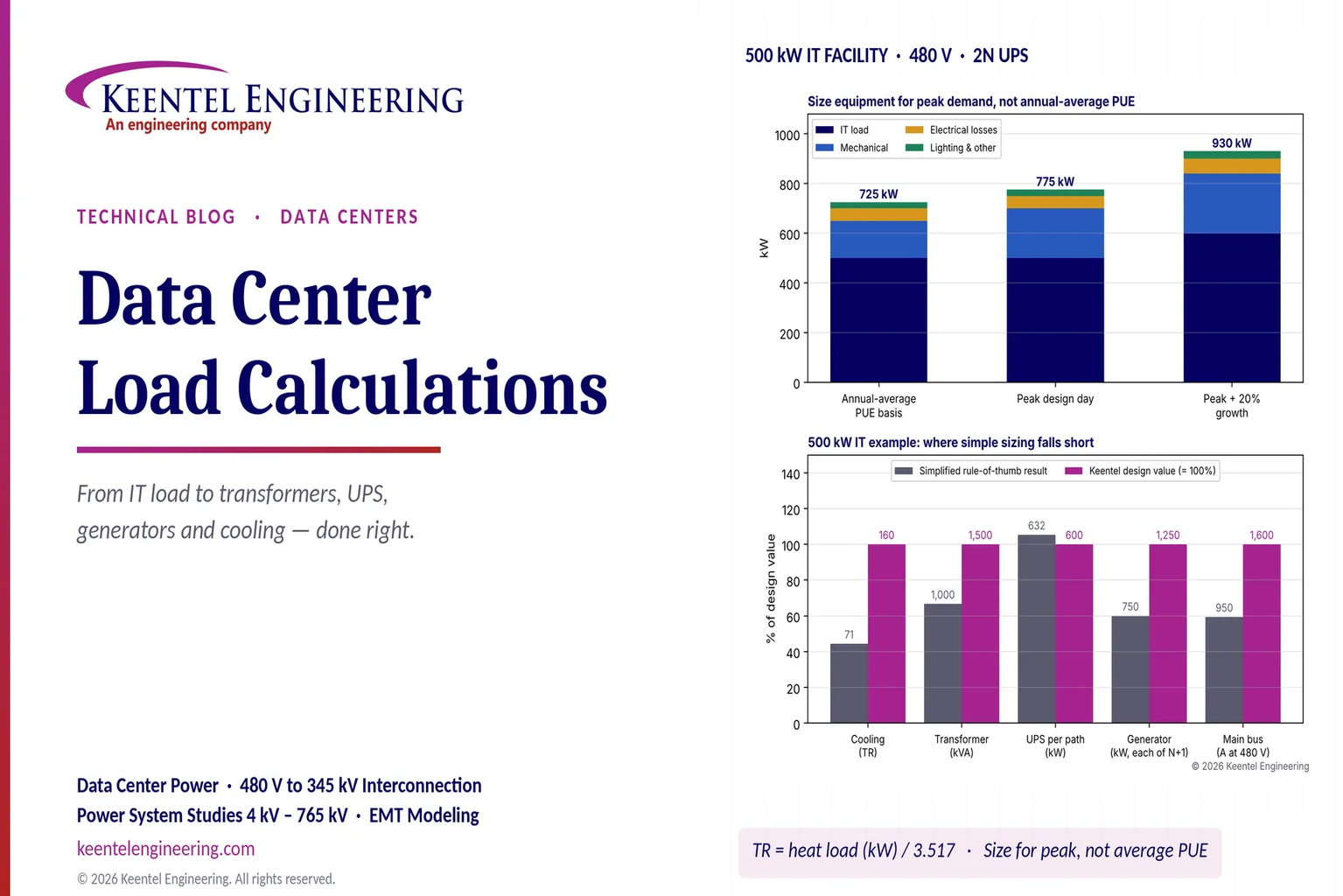
12.47 kV pole-mounted distribution transformer assembly designed for U.S. IEEE and NESC utility stan
By SANDIP R PATEL August 20, 2026
Learn U.S. pole-mounted transformer design requirements, including IEEE, ANSI, and NESC standards, voltage classes, grounding, protection, and DER considerations.
Neutral grounding resistor sizing guide for HRG and LRG power system grounding applications
By SANDIP R PATEL August 20, 2026
Learn how to size neutral grounding resistors using IEEE and NEC practices, including HRG/LRG selection, fault current calculations, duty ratings, and examples.
PRC-023-6 BESS relay loadability compliance guide
By SANDIP R PATEL August 19, 2026
Understand PRC-023-6 for utility-scale BESS: applicability, the 39-month rule, relay loadability, setting criteria, Category 2 IBRs, and audit evidence.
PRC-029-1 voltage ride-through envelope for inverter-based resources.
By SANDIP R PATEL August 18, 2026
Learn PRC-029-1 compliance requirements for inverter-based resources, including voltage and frequency ride-through, EMT studies, protection settings, and testing.
Solar plant electrical testing and commissioning for utility-scale PV systems
By SANDIP R PATEL August 17, 2026
A technical guide to solar plant electrical testing, commissioning, I-V curves, thermography, insulation testing, cable tests and performance acceptance.
Alt Text: Gas-insulated substation engineering guide covering GIS safety, reliability, VFTO, partial
By SANDIP R PATEL August 16, 2026
Explore GIS substation engineering, including design, SF6 safety, VFTO, grounding, commissioning, testing, GIS vs AIS, and IEEE/IEC standards.
Cable testing before energization engineering guide
By SANDIP R PATEL August 16, 2026
Learn the correct cable testing sequence before energization, including VLF, AC/DC withstand, sheath testing, partial discharge, tan delta, and standards.
substation drawing sets
By SANDIP R PATEL August 16, 2026
Explore how substation drawing sets are developed, reviewed and controlled through engineering studies, design milestones, QA/QC and final construction release.
Grid-forming vs grid-following BESS inverters
By SANDIP R PATEL August 15, 2026
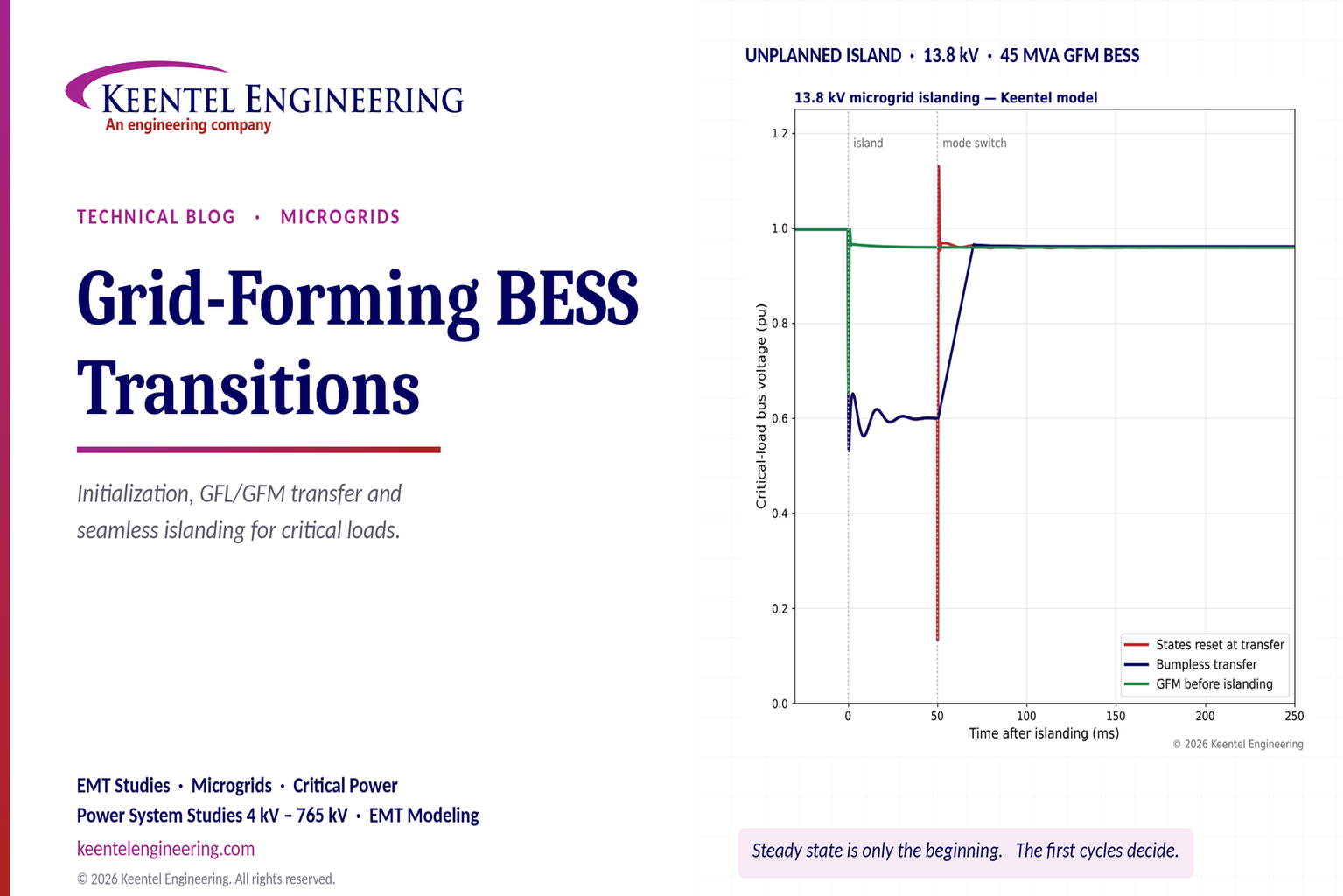
Compare grid-forming vs grid-following BESS inverters, control loops, weak-grid stability, protection, compliance, and interconnection study impacts.
MOD-025 and MOD-026 post-COD verification testing with PSS E and PSCAD dynamic model validation
By SANDIP R PATEL August 15, 2026
Learn MOD-025 and MOD-026 post-COD requirements for generator capability verification, PSS®E and PSCAD model validation, IBR testing, and NERC compliance.
Substation inspection checklist engineering guide
By SANDIP R PATEL August 15, 2026
Use this substation inspection checklist to verify QA/QC, grounding, protection, commissioning, documentation, and current IEEE/NETA standards.
Types of earthing systems
By SANDIP R PATEL August 14, 2026
Explore 9 types of earthing, their applications, selection criteria, and grounding practices for substations, industrial sites, and renewable energy systems.

Keentel Engineering is your trusted partner for reliable and compliant power system solutions across the U.S. Whether you're searching for electrical engineers, power system engineering services, or transmission and relay support, our experienced team delivers expert consulting in wind, solar, BESS, and substation design. We specialize in NERC compliance, winterization, and modeling support to meet your project’s most critical technical and regulatory needs.

Keentel Engineering at RE+ Las Vegas 2026!

We’re proud to announce that Keentel Engineering will be showcasing our expertise in renewable energy, substation design, NERC compliance, and advanced power system studies at RE+ 2026 in Las Vegas, November 16–19, 2026. Visit us at Booth C4995 to learn how we’re powering the future of reliable and compliant energy systems.