Add your custom HTML here
Keentel Engineering Newsletter
AI Power Surge Reshaping Data Center Infrastructure in 2026
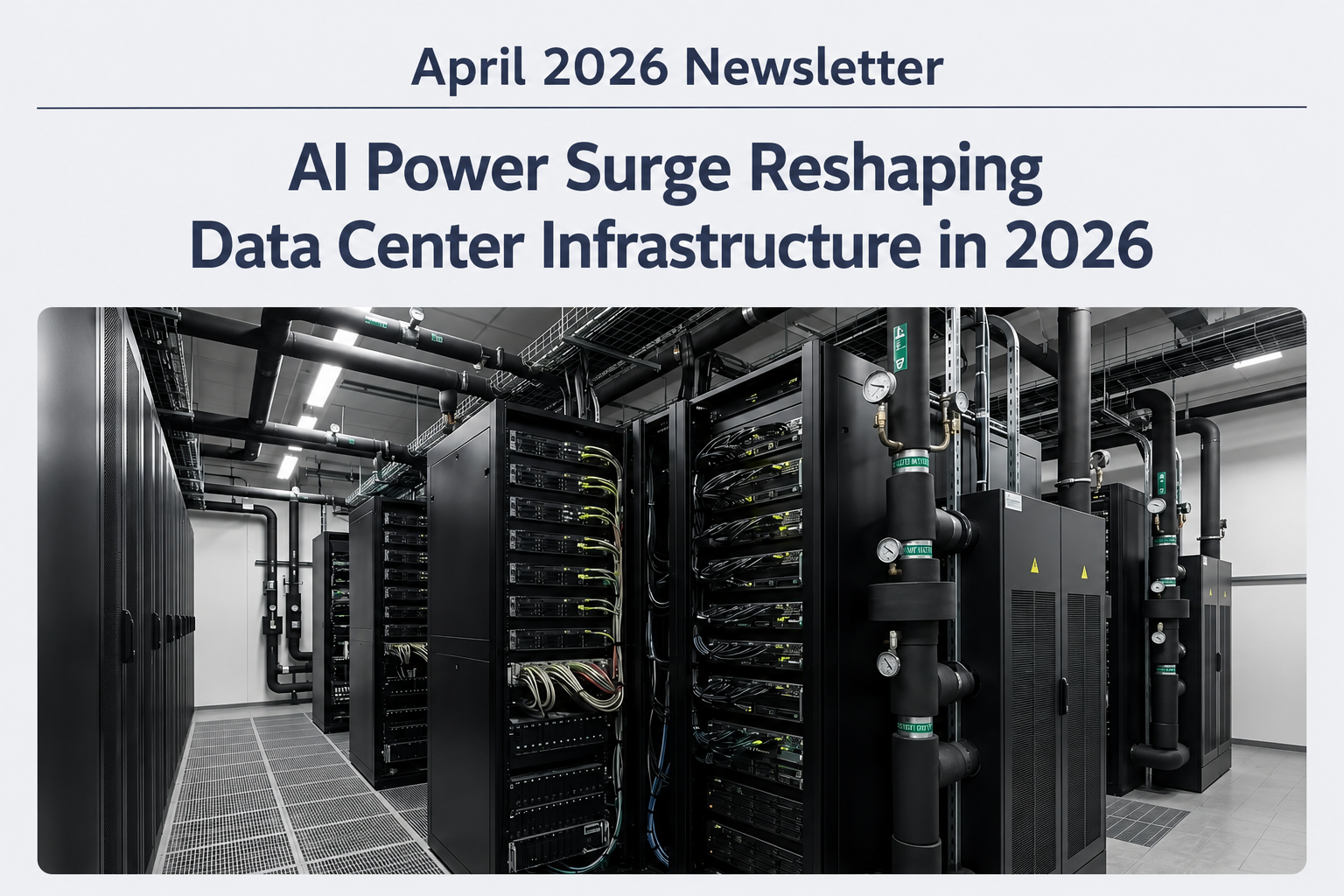
Keentel Engineering Industry Insight – April 1, 2026
The global data center industry is undergoing a fundamental transformation driven by artificial intelligence, unprecedented power demand, and large-scale infrastructure investments. What was once a real-estate-driven market has now become a power-first engineering challenge, redefining how projects are designed, financed and executed.
Record-Breaking Growth Driven by AI
Data center expansion has accelerated at historic levels, with global capital investment exceeding hundreds of billions annually. AI workloads are the primary catalyst, pushing facilities toward gigawatt-scale campuses and significantly increasing energy consumption.
Keentel Engineering observes that:
- AI-driven facilities are evolving into “intelligence factories” rather than traditional data centers
- Power demand is growing at multiples of historical industrial loads
- Large hyperscale operators now dominate infrastructure expansion
By the end of the decade,
data centers are expected to represent a significant share of total electrical demand, forcing utilities and developers to rethink grid capacity and system planning.
Shift Toward Mega-Scale and Hyperscale Development
- Mega campuses exceeding 500+ acres
- Multi-gigawatt load requirements per project
- Pre-leased developments driven by hyperscalers
Recent market behavior shows that over 70% of new capacity commitments are controlled by large-scale operators, indicating consolidation and long-term infrastructure planning.
This shift is forcing engineering firms like Keentel to focus on:
- High-voltage interconnection strategies
- Load flow and dynamic stability studies
- Scalable substation and transmission design
Behind-the-Meter (BTM) Power: The New Standard
One of the most important industry changes is the rapid rise of Behind-the-Meter (BTM) power systems, where data centers develop their own dedicated energy infrastructure.
This includes:
- On-site gas generation
- Solar + battery storage systems
- Small modular nuclear reactors (SMRs)
- Hybrid microgrid configurations
BTM solutions are no longer optional they are becoming essential due to:
- Long interconnection queue delays (often 4–7 years)
- Grid congestion in major markets
- Reliability requirements for AI workloads
Keentel notes that modern data centers are increasingly designed as self-sufficient energy ecosystems, capable of operating independently from the grid when required.
Regional Engineering Trends Across the U.S.
The U.S. continues to lead global development, with several key regional shifts:
Virginia
- Remains the largest data center hub
- Experiencing continued expansion into rural areas
- Strong alignment with renewable energy targets
Texas (ERCOT Market)
- Rapid growth driven by flexible interconnection models
- Major increase in BTM and large-load projects
- Emerging as a leader in gigawatt-scale developments
California
- Focus on high-efficiency and regulated growth
- Increased emphasis on sustainability and reporting
- Longer interconnection timelines due to constraints
Emerging Markets
- Midwest, Arizona, Georgia, and Pennsylvania gaining momentum
- Driven by land availability, power access, and incentives
- Supporting large-scale AI campuses and hyperscale expansion
These regional dynamics are reshaping
transmission planning interconnection strategies, and long-term grid reliability requirements.
Engineering Challenges Defining 2026
The industry is facing critical bottlenecks that require advanced engineering solutions:
1. Power Availability
Energy has become the primary limiting factor. Many utilities report demand levels far exceeding historical forecasts.
2. Interconnection Delays
Queue timelines now exceed construction timelines, reversing traditional project sequencing.
3. Equipment Constraints
Lead times for:
- Transformers
- Switchgear
- HV equipment
now extend beyond 24–36 months.
4. Labor Shortages
Specialized high-voltage workforce demand is increasing, driving costs and project delays.
5. Community and Regulatory Pressure
Projects must now address:
- Noise
- Water usage
- Environmental impact
- Zoning restrictions
Keentel Engineering emphasizes that successful projects now require integrated planning across power, permitting, and environmental compliance.
Next-Generation Data Center Design
Modern facilities are evolving rapidly with advanced engineering innovations:
- Liquid cooling and immersion systems replacing air cooling
- Rack densities reaching 50–100 kW per rack
- AI-optimized chips increasing power density requirements
- Deployment of 800V architectures and high-efficiency power systems
Cooling is now becoming AI-optimized itself, with real-time energy management and adaptive load control.
Investment and Market Outlook
The scale of investment continues to grow dramatically:
- Multi-billion-dollar projects are now standard
- Infrastructure funds and private capital are entering aggressively
- Data centers are emerging as a core asset class
Large-scale AI infrastructure programs are setting new benchmarks, with hundreds of billions allocated toward energy and digital infrastructure development.
Keentel Engineering Perspective
At Keentel Engineering we see 2026 as a turning point where:
- Power engineering becomes the foundation of digital infrastructure
- Grid integration and BTM design will define project success
- Advanced modeling (PSSE, PSCAD, TSAT) is critical for compliance and performance
- HV/EHV system design will be the backbone of AI-driven growth
The convergence of energy and technology is creating a new era where engineering expertise is the key differentiator.
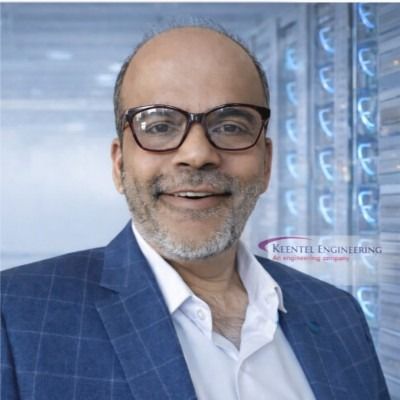
About the Author:
Sandip "Sonny" R. Patel, P.E.
IEEE Senior Member · Founder & CEO, Keentel Engineering
In 1995, Sonny Patel earned his Electrical Engineering degree from the University of Illinois. But degrees don't build legacies — action does.For three decades, he has worked the power industry from every side of the table: 16 years as a utility engineer at Exelon/Commonwealth Edison; generation leadership across hydroelectric, industrial steam turbine, and a 9 GW renewable fleet; NERC Regional Entity Senior Compliance Engineer and Audit Team Lead, auditing some of the nation's largest utilities; and testing and commissioning lead on equipment up to 765 kV — the very top of the North American grid.Utility. Generator. Regulator. Consultant. Few engineers have seen all four seats. Fewer still have sat in them.
His experience spans nuclear, hydro, conventional generation, renewables, oil and gas, mining — and today's data centers, where he is authoring a three-book series on data center design. He is a Licensed Professional Engineer in six states and a Licensed Electrical Contractor in Florida (Unlimited EC) — he doesn't just design the work; he's qualified to stand behind its execution.Today, as Founder and CEO of Keentel Engineering, Sonny leads a nationwide team of engineers delivering substation design, power system studies, NERC compliance, and commissioning — done right, coast to coast.Three decades. Every side of the table. One standard: accountable engineering.
Services

Let's Discuss Your Project
Let's book a call to discuss your electrical engineering project that we can help you with.
About the Author:
Sandip "Sonny" R. Patel, P.E.
IEEE Senior Member · Founder & CEO, Keentel Engineering
In 1995, Sonny Patel earned his Electrical Engineering degree from the University of Illinois. But degrees don't build legacies — action does.For three decades, he has worked the power industry from every side of the table: 16 years as a utility engineer at Exelon/Commonwealth Edison; generation leadership across hydroelectric, industrial steam turbine, and a 9 GW renewable fleet; NERC Regional Entity Senior Compliance Engineer and Audit Team Lead, auditing some of the nation's largest utilities; and testing and commissioning lead on equipment up to 765 kV — the very top of the North American grid.Utility. Generator. Regulator. Consultant. Few engineers have seen all four seats. Fewer still have sat in them.
His experience spans nuclear, hydro, conventional generation, renewables, oil and gas, mining — and today's data centers, where he is authoring a three-book series on data center design. He is a Licensed Professional Engineer in six states and a Licensed Electrical Contractor in Florida (Unlimited EC) — he doesn't just design the work; he's qualified to stand behind its execution.
Today, as Founder and CEO of Keentel Engineering, Sonny leads a nationwide team of engineers delivering substation design, power system studies, NERC compliance, and commissioning — done right, coast to coast.Three decades. Every side of the table. One standard: accountable engineering.