

A Coordinated Electric System Interconnection Review—the utility’s deep-dive on technical and cost impacts of your project.

Challenge: Frequent false tripping using conventional electromechanical relays
Solution: SEL-487E integration with multi-terminal differential protection and dynamic inrush restraint
Result: 90% reduction in false trips, saving over $250,000 in downtime

Data Center Growth & Grid Readiness – Engineering Solutions by Keentel

Calendar icon. D

August 15, 2025 | Blog

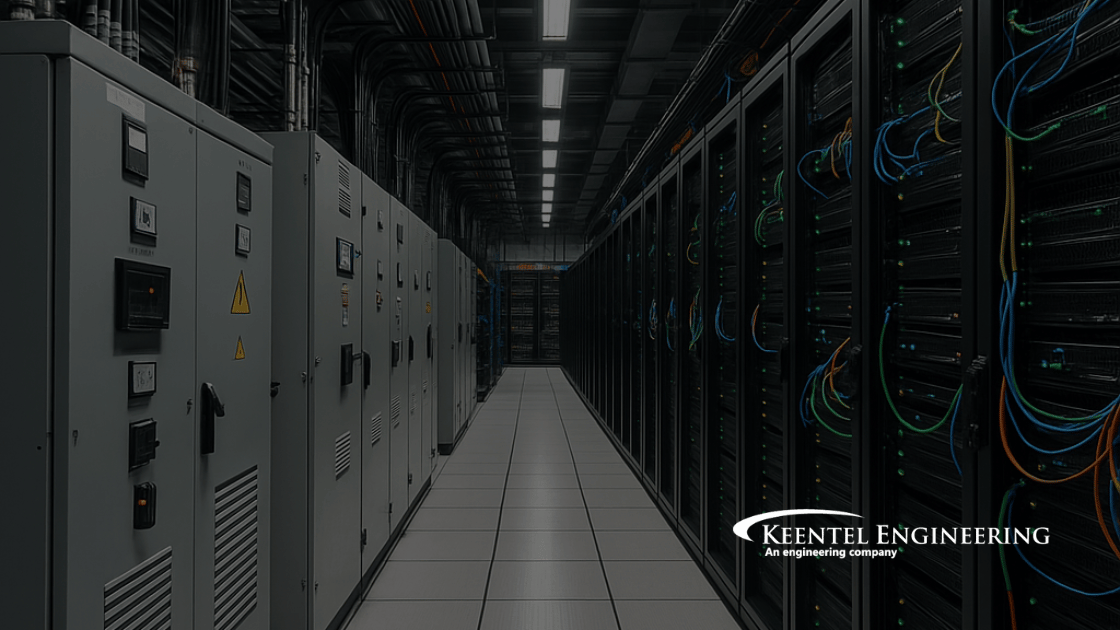
Data center server racks and control panels in a long hallway; dim lighting.

Introduction

Data centers are no longer just part of the digital economy—they are one of its fastest-growing drivers of electricity demand. With hyperscale facilities exceeding 1 GW in capacity and artificial intelligence (AI) workloads pushing rack densities to over 60 kW per rack, the implications for grid planning, interconnection, and operations are profound. Keentel Engineering leverages insights from the IEEE PES TR131 report to guide utilities, developers, and regulators in addressing these challenges. Our expertise in HV/EHV transmission design, NERC compliance, and power system studies positions us at the forefront of this transformation. Our Keentel Engineering solutions combine transmission planning, compliance modeling, and power system studies to support long-term data center growth and grid readiness.


Why Data Center Load Growth Is Different

Unlike traditional industrial loads, data centers:

  • Operate with nonlinear, power-electronic loads that can cause harmonics, voltage flicker, and dynamic power swings.
  • Require uninterrupted, high-quality power, making them sensitive to grid disturbances.
  • Can scale to hundreds or thousands of MW, impacting resource adequacy, transmission planning, and real-time system stability.

Key Engineering Challenges

  • Load Forecasting and Uncertainty
    Forecasts for U.S. data center electricity demand by 2028 range from 6.7% to 12% of total generation. Confidential project pipelines, rapid AI adoption, and edge computing trends make precise forecasting difficult. Keentel addresses this by combining statistical modeling with utility interconnection intelligence.
  • Interconnection and Transmission Constraints
    Some planned facilities exceed grid contingency limits, requiring multi-billion-dollar transmission upgrades. Keentel provides feasibility studies, breaker duty analysis, and high-fidelity dynamic models to expedite interconnection while maintaining NERC PRC compliance.
  • Dynamic Performance and Fault Ride-Through
    AI and cloud workloads cause rapid power swings during both training and inference states. Poorly tuned protection systems risk mass load tripping during faults, as seen in the 2024 Virginia event where 1,500 MW of data center load disconnected. Keentel engineers ride-through-compliant settings and dynamic load models to prevent such events.
  • Resource Adequacy and Backup Systems
    Many data centers rely on diesel gensets for backup—raising environmental concerns and air permitting limits. Keentel assists in integrating renewable + storage microgrids to meet sustainability and resiliency goals.

Operational Solutions

  • Demand Response Integration
    Flexible AI or crypto workloads can participate in peak load reduction programs, reducing strain on the grid while monetizing load flexibility.
  • Blackstart and Load Shedding Coordination
    Keentel designs Load Criticality Index classifications and segmentation schemes for controlled restoration, supporting utility and
    power system studies.
  • High-Resolution Monitoring
    We deploy waveform measurement units (WMUs) to capture sub-millisecond load dynamics, supporting NERC MOD-032/033 model validation and improving model accuracy for planning and operations.

Engineering Innovations for Grid Readiness

  • Standardized Substation Templates
    Reducing lead times and ensuring compliance with utility specifications, leveraging our substation design expertise.
  • Gas-Insulated Substations (GIS)
    Minimizing footprint near urban hyperscale sites while meeting reliability and safety standards. Keentel’s experience with GIS solutions supports complex interconnection needs for rapidly expanding data center clusters.
  • Advanced Protection Coordination
    Aligning UPS and generator protection with utility reclosing and ride-through curves. These efforts connect directly to Keentel Engineering relay services and broader compliance and modeling support, ensuring resilient performance under dynamic grid conditions.
  • Continuous Waveform Recording
    Real-time analysis of fast transients to prevent oscillations and instability, supporting proactive grid management.

Conclusion

The unprecedented scale and complexity of modern data centers demand equally advanced engineering and policy solutions. Keentel Engineering bridges the gap between data center developers, utilities, and regulators—ensuring that grid readiness is achieved without compromising reliability, sustainability, or cost efficiency.


Technical FAQs – Data Center & Grid Engineering

  • Q1: Why is data center growth a grid concern?

    A: Hyperscale facilities can consume hundreds of megawatts, straining resource adequacy, transmission capacity, and overall grid stability.

  • Q2: What makes AI data centers different from traditional ones?

    A: AI workloads cause rapid power swings and higher rack densities, creating dynamic stress on the power system.

  • Q3: How can you forecast data center loads accurately?

    A: By combining public utility data, interconnection queue analysis, and AI workload modeling for precision forecasting.

  • Q4: What is “fault ride-through” for data centers?

    A: The ability to stay connected during short voltage or frequency disturbances without tripping.

  • Q5: Why are protection settings critical?

    A: Incorrect coordination can cause mass simultaneous tripping, leading to large-scale grid instability.

  • Q6: How can demand response work for data centers?

    A: Flexible workloads (e.g., AI training, crypto mining) can be curtailed during peak demand for financial incentives.

  • Q7: What role do UPS systems play in grid interaction?

    A: They provide instant backup power but also affect fault current and ride-through performance.

  • Q8: How do blackstart plans involve data centers?

    A: Critical facilities are restored in a priority sequence based on size, fuel reserves, and service criticality.

  • Q9: What causes harmonics in data centers?

    A: High concentrations of AC/DC switching converters in IT equipment power supplies.

  • Q10: Can data centers operate as microgrids?

    A: Yes—integrating renewable energy and battery storage improves resilience and sustainability.

  • Q11: What is “edge computing” and its grid impact?

    A: Processing data closer to users; this shifts demand toward distributed facilities, changing load patterns.

  • Q12: How do utilities avoid stranded infrastructure costs?

    A: By requiring financial deposits and milestone commitments before building major grid upgrades.

  • Q13: What high-resolution monitoring is recommended?

    A: Waveform Measurement Units (WMUs) with 1 kS/s sampling to capture sub-millisecond load dynamics.

  • Q14: How do co-location facilities affect reliability?

    A: Shared infrastructure with generation can speed interconnection, but requires careful reliability planning.

  • Q15: What does PUE mean?

    A: Power Usage Effectiveness = Total facility energy ÷ IT equipment energy (lower is better).

  • Q16: Why are transformer lead times a challenge?

    A: Global supply chain delays can push deliveries 24–36 months, delaying projects.

  • Q17: How are voltage sags managed?

    A: Through motor ride-through studies, reactive power support, and FIDVR mitigation.

  • Q18: What standards govern data center interconnection?

    A: IEEE 519 (harmonics), IEEE 2800 (IBR performance), and NERC PRC standards for reliability.

  • Q19: What is the Load Criticality Index?

    A: A classification system for prioritizing load restoration during blackstart events.

  • Q20: How can Keentel Engineering help?

    A: Delivering end-to-end engineering—from feasibility studies and interconnection design to compliance and commissioning.


 We deploy waveform measurement units (WMUs) to capture sub-millisecond load dynamics, supporting NERC MOD-032/033 model validation and strengthening planning accuracy. This monitoring capability complements our data center engineering solutions, including electrical studies, MEP engineering for AI data centers, and reliability assessments. Keentel also supports utilities through enhanced transmission services, addressing the rising interconnection pressures driven by large AI and cloud facilities.

Don’t wait for grid challenges to delay your project. Contact Keentel Engineering for a consultation and discover how our proven expertise can streamline your data center interconnection, ensure NERC compliance, and future-proof your operations.


Man in a blazer and open shirt, looking at the camera, against a blurred background.

About the Author:

Sonny Patel P.E. EC

IEEE Senior Member

In 1995, Sandip (Sonny) R. Patel earned his Electrical Engineering degree from the University of Illinois, specializing in Electrical Engineering . But degrees don’t build legacies—action does. For three decades, he’s been shaping the future of engineering, not just as a licensed Professional Engineer across multiple states (Florida, California, New York, West Virginia, and Minnesota), but as a doer. A builder. A leader. Not just an engineer. A Licensed Electrical Contractor in Florida with an Unlimited EC license. Not just an executive. The founder and CEO of KEENTEL LLC—where expertise meets execution. Three decades. Multiple states. Endless impact.

Four workers in safety vests and helmets stand with arms crossed near wind turbines.

Let's Discuss Your Project

Let's book a call to discuss your electrical engineering project that we can help you with.

Man in a blazer and open shirt, looking at the camera, against a blurred background.

About the Author:

Sonny Patel P.E. EC

IEEE Senior Member

In 1995, Sandip (Sonny) R. Patel earned his Electrical Engineering degree from the University of Illinois, specializing in Electrical Engineering . But degrees don’t build legacies—action does. For three decades, he’s been shaping the future of engineering, not just as a licensed Professional Engineer across multiple states (Florida, California, New York, West Virginia, and Minnesota), but as a doer. A builder. A leader. Not just an engineer. A Licensed Electrical Contractor in Florida with an Unlimited EC license. Not just an executive. The founder and CEO of KEENTEL LLC—where expertise meets execution. Three decades. Multiple states. Endless impact.

Leave a Comment

Related Posts

Electrical substation with high-voltage equipment, wires, and insulators against a blue sky.
By SANDIP R PATEL November 26, 2025
Learn how to stay compliant with NERC PRC-004-6 and MIDAS reporting. Keentel Engineering provides misoperation analysis, CAP support, and audit-ready documentation.
ISO-NE DDMS Guide
By SANDIP R PATEL November 26, 2025
Technical guide to ISO-NE’s DDMS for power system engineers — model submissions, file formats (RAW/DYR), certification workflow, and annual recertification for MOD-032, MOD-026, MOD-027.
Learn how PRC-004-6 misoperations and MIDAS reporting work.
By SANDIP R PATEL November 15, 2025
Learn how PRC-004-6 misoperations and MIDAS reporting work. A complete NERC compliance guide from Keentel Engineering for utilities and power entities.
Solar panels field and power plant with smokestacks on a cloudy day.
By SANDIP R PATEL October 30, 2025
Learn how Generator and Transmission Owners meet PJM MOD-032 data submission requirements using Gen Model, Model on Demand, and ASPEN tools for NERC compliance.
An aerial view of a large battery storage facility with numerous white shipping container-like units. Wind turbines in background.
By SANDIP R PATEL October 27, 2025
Learn how utility-scale BESS meet IEEE 2800 voltage and frequency ride-through requirements with simulation, validation, and compliance reporting.
Diagram of a redundant power distribution system with utility, UPS, and critical/non-critical loads.
By SANDIP R PATEL October 19, 2025
Explore NERC’s 2025 review on simultaneous voltage-sensitive load reductions amid industrial electrification, data center growth, and crypto mining.
Diagram showing frequency monitoring and point of interconnection with a Tesla 400E box.
By SANDIP R PATEL October 16, 2025
Discover how the TESLA 4000 IED enables precise frequency monitoring at the Point of Interconnection for reliable, compliant grid operations.
Electrical diagram showing power distribution with utilities, switchgear, generators, and UPS systems.
By SANDIP R PATEL October 10, 2025
Discover how data centers, crypto, and EV hubs impact grid stability—and how Keentel Engineering mitigates emerging load risks.
An industrial power plant with multiple smokestacks at sunset.
By SANDIP R PATEL October 10, 2025
Learn how Keentel Engineering enhances industrial reliability and safety through power system analysis — including short-circuit, coordination, load-flow, stability, and grounding studies. Discover why these analyses are essential for optimized power performance.