A Coordinated Electric System Interconnection Review—the utility’s deep-dive on technical and cost impacts of your project.
Challenge: Frequent false tripping using conventional electromechanical relays
Solution: SEL-487E integration with multi-terminal differential protection and dynamic inrush restraint
Result: 90% reduction in false trips, saving over $250,000 in downtime
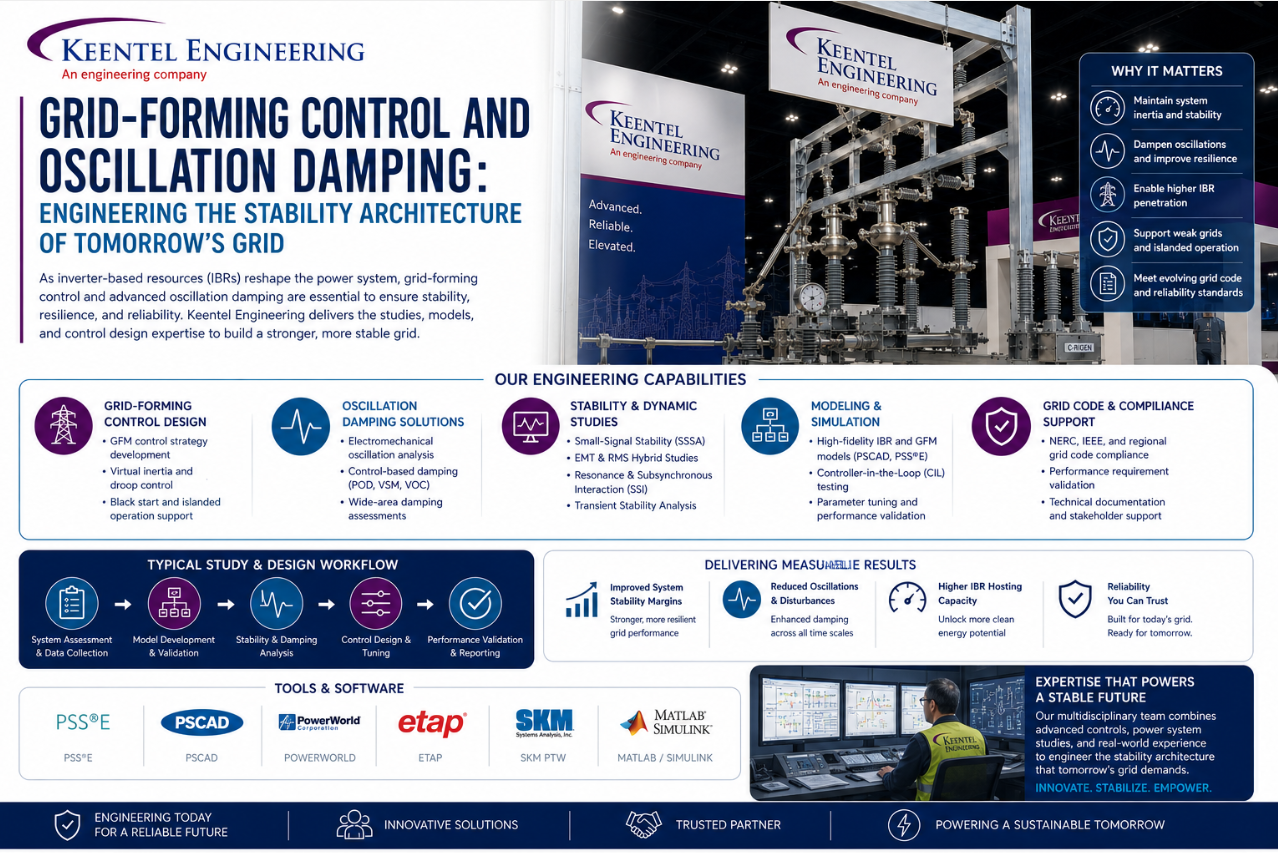
Grid Forming Control for Power System Oscillation Damping
May 16, 2026 | Blog
Introduction: A Stability Challenge Two Decades in the Making
Power system oscillations are not new. Inter-area oscillation modes — lightly damped swings of active power exchanged between large regions of an interconnected system — have been studied since the earliest days of wide-area transmission. The analytical tools are mature. The physics is well understood. And yet, in April 2024, the Iberian Peninsula experienced a catastrophic blackout whose root cause traced directly back to unstable inter-area oscillations — a phenomenon that had been measurable and observable in that system for years.
At Keentel Engineering, we have spent significant effort analyzing the technical sequence of this event and what it reveals about the stability risks embedded in systems undergoing rapid renewable energy transition. The lessons are not unique to southern Europe. They apply to every power system in the world that is retiring synchronous generation and replacing it with inverter-based resources. The question is not whether your system will face these challenges — it is whether your planning, operations, and control frameworks will be ready when it does.
This brief covers the physics of what happened, why conventional countermeasures failed, and what the engineering community must do to prevent recurrence — centered on the emerging technology of grid-forming control with integrated power system stabilizer functionality.
Understanding the Blackout Sequence: Three Windows of Instability
The Iberian blackout did not occur instantaneously. It unfolded across three distinct phases, each revealing a different layer of system vulnerability. Understanding each phase is essential for designing effective preventive strategies.
Window 1: Local Mode Oscillation — Spain vs. Portugal
In the period leading up to the event, high-resolution frequency measurement data revealed a classic electromechanical oscillation developing between Spain and Portugal. Frequency in Portugal rose while frequency in Malaga, southern Spain, fell — then reversed — in a clear oscillatory pattern. Modal analysis of this data showed eigenvalues approaching and crossing the stability boundary, with a dominant frequency of approximately 0.6 Hz.
This is the signature of a local oscillation mode — one in which nearby generators or regional areas swing against each other. The eigenvalue analysis confirmed what the waveforms showed: the system was at the edge of instability, with at least one mode in the positive real half-plane. The Iberian Peninsula was in distress before any protective action was taken.
Technical Definition — Local vs. Inter-Area Oscillation Modes
Local oscillation modes (0.7–2.0 Hz) involve one or a few generators swinging against the rest of the local system. Inter-area oscillation modes (0.1–0.7 Hz) involve large portions of the interconnected system — entire countries or regions — swinging against each other. Both are electromechanical phenomena involving the exchange of kinetic energy between rotating masses. Inter-area modes are generally more difficult to damp because they involve larger system inertias and longer electrical distances.
Window 2: Inter-Area Mode Escalation — Iberian Peninsula vs. Central Europe
The system operator, following established operating procedures, took countermeasures for the oscillation problem. Additional transmission lines were switched in. Power flow between Spain and France was reduced. The HVDC interconnection was operated in fixed power control mode. These actions were appropriate responses to transient angle stability concerns — but they were not the right tool for the electromechanical oscillation problem that was actually driving the event.
The consequence was significant. Switching in additional lines with reduced power flow created conditions analogous to the Ferranti effect — low load on high-capacitance transmission infrastructure, causing voltage to rise. Simultaneously, the reduced power flow changed the system's operating point in a way that transformed the local oscillation into an inter-area oscillation, now involving the entire Iberian Peninsula swinging against Central European generators. The dominant frequency shifted to approximately 0.2 Hz — the classic signature of a European inter-area mode. The right eigenvector analysis confirmed that the oscillation was now peninsula-versus-continent in character.
Engineering Alert
This is the critical lesson: countermeasures designed for transient angle stability — switching in lines, reducing power flow — can actually worsen electromechanical oscillation stability. The two phenomena require different diagnoses and different treatments. Conflating them is operationally dangerous.
Window 3: Voltage Cascade and Blackout
The voltage rise triggered by the Ferranti-like conditions caused generator trips. A 355 MW loss at a substation in Granada was followed by a 720 MW loss at Badajoz — together exceeding one gigawatt of generation removed from an already stressed system. The remaining lines, now even more lightly loaded, contributed even more reactive charging power. Voltage rose further.
Wind farms and solar parks began tripping on high-voltage protection. The cascade accelerated and the blackout followed.
What makes the post-blackout period particularly instructive is what did not fail. With the main interconnection to Central Europe severed, Spain operated as an island grid. At that moment, approximately 84–85% of generation on the system was inverter-based renewables — hydro, gas turbine, and other synchronous generation constituted less than 16% of total output. Despite this extraordinarily high inverter penetration, the system continued to operate. It synchronized. It was stable. The frequency was controlled, albeit with elevated rate-of-change-of-frequency (RoCoF) due to low inertia.
This observation is simultaneously reassuring and challenging. Reassuring, because it demonstrates that high-IBR systems can operate stably. Challenging, because it reveals that the system's stability in the island mode depended critically on the small fraction of synchronous machines that remained — machines providing the inertia and voltage reference that allowed the grid-following inverters to synchronize and operate. As synchronous penetration falls further, this implicit backstop diminishes.
The Oscillation Problem: Physics, History, and Modern Complexity
Why Electromechanical Oscillations Persist
Electromechanical oscillations in power systems arise from the exchange of kinetic energy between rotating synchronous generators. When a generator accelerates relative to the rest of the system — due to a disturbance, a change in power flow, or a control action — it begins to swing. If the system's damping mechanisms are insufficient to dissipate this kinetic energy faster than it is injected, the oscillation grows.
Historically, the primary source of oscillation damping was the natural electromagnetic damping of synchronous machines, supplemented by Power System Stabilizers (PSS) — supplementary control loops that modulate generator excitation in response to rotor speed or power deviations to inject negative damping torque aligned with the oscillation.
Two trends are reducing the effectiveness of this traditional damping architecture. First, as synchronous generators are retired and replaced by renewable inverter-based resources, the aggregate PSS-equipped generator capacity declines. Each decommissioned generator takes its PSS damping contribution with it. Second, the PSS settings on remaining generators were tuned for a specific network topology and power flow pattern. As the system changes — new lines, new generation locations, different load patterns, changed power flows — the PSS tuning becomes suboptimal. In some cases, poorly tuned PSS can actually inject negative damping, worsening the oscillation problem.
Historical Context — The Scaling Oscillation Problem
Inter-area oscillations between France and Germany were first studied and mitigated using detailed modal analysis and targeted PSS installation nearly two decades ago. At that time, amplitude was approximately 150 MW and events lasted only 10–11 seconds before natural damping attenuated them. By 2016, a similar oscillation on the Spain-France tie line had grown to 450 MW amplitude and persisted for nearly six minutes before damping. The 2024 blackout represents the next point on this trajectory. The trend is clear: as renewable penetration increases and synchronous inertia declines, inter-area oscillations are growing larger and more persistent.
Why Conventional PSS Cannot Solve the Modern Problem
The conventional PSS attached to a synchronous generator is hardware — an analog or digital control loop physically integrated with the excitation system. When the generator retires, the PSS goes with it. This creates a fundamental structural problem: the damping infrastructure is embedded in the assets that energy transition is systematically removing from the system.
Additionally, the participation factor of any individual PSS in a given oscillation mode depends on the electrical coupling between that generator and the oscillating mode. As system topology changes, so does participation. A PSS tuned based on one generation dispatch pattern may have very different effectiveness — or even negative effectiveness — under a different pattern. Continuous re-tuning of PSS on all remaining synchronous generators as the system evolves is a significant and ongoing operational challenge.
Grid-Forming Control: Architecture, Capability, and the PSS Extension
Grid-Following vs. Grid-Forming: The Fundamental Distinction
The dominant mode of operation for inverter-based resources today is grid-following control. A grid-following inverter uses a Phase-Locked Loop (PLL) to track the voltage waveform at its point of connection, and injects current in proportion to an external reference. The PLL requires a pre-existing voltage waveform to synchronize against — it cannot create a voltage reference; it can only follow one. In a system with adequate synchronous generation providing a stable voltage reference, this works well. In a system where the voltage reference itself is weak, oscillatory, or absent — as in a high-IBR island — PLL-based grid-following control can become unstable or fail to synchronize.
Grid-forming control inverts this relationship. Instead of following an existing voltage waveform, a grid-forming inverter establishes a voltage waveform internally and drives output to match it. It behaves, from the grid's perspective, like a voltage source rather than a current source. This fundamental shift in control architecture has profound implications for system stability: a grid-forming inverter can provide a voltage reference, support weak grids, and operate in island conditions where no synchronous machine is available to establish a reference.
Virtual Synchronous Generator (VSG) Control
Among several grid-forming control strategies — including droop control, virtual oscillator control, and matching control — the Virtual Synchronous Generator approach is particularly well-suited for oscillation damping applications. The VSG replicates the swing equation of a synchronous generator in software, creating virtual inertia and virtual damping that the converter emulates in its power exchange with the grid.
The VSG control structure includes two primary control loops. The active power loop replicates the mechanical dynamics of a synchronous generator rotor — including virtual moment of inertia (emulating rotational inertia) and a virtual damping coefficient. The reactive power loop replicates the voltage regulation behavior of a generator's automatic voltage regulator and excitation system. Together, these loops allow the converter to behave dynamically like a synchronous machine, providing inertia support, frequency regulation, and voltage control without any physical rotating mass.
Key VSG Parameters and Their System Effects
Virtual inertia (H_v): Determines how rapidly the converter's virtual rotor angle responds to power imbalances. Higher virtual inertia reduces RoCoF during frequency events but can slightly reduce system damping — a trade-off that must be analyzed for each application. Virtual damping coefficient (D_v): Provides frequency-proportional damping. Larger values increase damping of frequency deviations but can restrict the converter's ability to respond to deliberate dispatch changes — similar to the effect of very high mechanical damping in a synchronous machine. Droop coefficient: Governs steady-state frequency-power relationship. These parameters interact and must be co-optimized through eigenvalue analysis of the specific system configuration.
Adding PSS Functionality to the VSG
The VSG framework provides a natural integration point for Power System Stabilizer functionality — and this integration is the central engineering innovation for addressing inter-area oscillation damping with renewable resources. Just as a conventional PSS modulates the excitation of a synchronous generator to inject damping torque aligned with the oscillation mode, a VSG-PSS modulates either the active or reactive power reference of the grid-forming converter to achieve the same effect.
The choice of which loop to inject the PSS signal — active or reactive — is not arbitrary. It must be determined by modal participation factor analysis. The loop that has the highest participation in the target oscillation mode provides the most effective injection point. In many practical cases, the reactive power loop has higher participation in inter-area modes, making it the preferred injection point. However, this is system-specific and must be determined analytically for each application.
The PSS structure itself mirrors the conventional form: a gain block, a washout filter to suppress steady-state offsets, and lead-lag compensation blocks to phase-shift the stabilizing signal into alignment with the oscillation. The critical design parameter is the lead-lag time constant.
Lead-Lag Design: The Residue Method
The objective of the lead-lag compensation is to align the phase of the PSS output signal with the phase required to move the target eigenvalue directly to the left in the complex plane — maximizing the damping contribution per unit of PSS gain. This alignment is determined by computing the residue of the eigenvalue with respect to the PSS input-output transfer function.
The residue is a complex number. Its argument gives the angle by which the PSS signal must be phase-shifted to achieve ideal damping injection. If this angle is approximately 180 degrees — as in the case of the Iberian Peninsula inter-area mode analysis — the PSS signal is already in the correct phase, and no lead-lag compensation is required; only a gain is needed. If the required phase shift is significantly different from 180 degrees, lead-lag blocks must be designed to provide the compensating phase shift.
The gain is then selected based on a root locus analysis: as the gain increases from zero, the eigenvalue traces a path in the complex plane. The gain is set to move the eigenvalue to the desired damping ratio — typically 5–10% — without causing other eigenvalues to become unstable. This is an optimization problem, and both linear and nonlinear optimization methods are well-established for solving it.
Engineering Alert
The lead-lag parameters are safety-critical. A PSS with incorrect lead-lag settings does not merely fail to damp oscillations — it can actively inject negative damping, moving eigenvalues toward instability. Installing PSS on grid-forming converters without rigorous residue-based design and eigenvalue verification is potentially more dangerous than no PSS at all. Coordination of VSG-PSS settings with conventional PSS on remaining synchronous generators is mandatory.
Simulation Validation: Four-Machine Two-Area Test System
The effectiveness of the VSG-PSS has been demonstrated through simulation in the standard four-machine, two-area test system — the benchmark configuration for inter-area oscillation studies. In this configuration, a portion of the synchronous generation in one area is replaced by a grid-forming converter with VSG-PSS. The remaining synchronous generators have their conventional PSS disabled to isolate the contribution of the VSG-PSS.
Results show that the VSG-PSS effectively damps both local and inter-area oscillation modes following a simulated short-circuit disturbance. The damping provided compares favorably with conventional PSS on synchronous machines and, in some scenarios, exceeds it — reflecting the converter's faster response capability and the absence of the saturation and excitation system lag that limits conventional PSS effectiveness.
The Participation Factor Framework: Determining Where to Install VSG-PSS
Not every converter needs VSG-PSS, and installing it everywhere without coordination could be counterproductive. The correct approach is to identify which converters — or which generators — have the highest participation in the target oscillation mode, and to install or tune stabilizers on those assets first.
Participation factor analysis is performed on the system's state matrix. For each eigenvalue (oscillation mode), the participation factor of each state variable (each generator's rotor angle, rotor speed, excitation state, and converter control state) indicates how strongly that state contributes to and is affected by that mode. High participation means a change in that state variable has a large effect on the eigenvalue — making it an effective location for stabilizer action.
For grid-following converters, modal analysis often shows very low participation factors — sometimes below 0.01 on a normalized scale — because the PLL-based control decouples the converter from the electromechanical dynamics that drive inter-area oscillations. This is why grid-following converters with PSS are generally ineffective for inter-area oscillation damping: the control architecture simply has no meaningful connection to the oscillation mode. Grid-forming converters, by contrast, have participation factors comparable to synchronous generators, making them effective PSS locations.
The Droop Control Question
A frequently asked question is whether droop-based grid-forming control can provide oscillation damping without a dedicated PSS structure. The answer is nuanced and technically important.
Droop control governs the steady-state relationship between frequency deviation and active power output — distributing the regulation burden among generators proportionally to their droop coefficients. During a frequency event, droop control redistributes active power. But droop control does not inject a signal specifically aligned with the oscillation mode's phase. During oscillations, the droop controller responds to instantaneous frequency deviations and oscillates in phase with them — but without the lead-lag compensation that shifts the response to inject maximum damping torque. The result is that droop control can reduce oscillation amplitude somewhat through its active power response, but it does not provide the targeted, phase-aligned damping that a properly tuned PSS delivers.
This distinction is analogous to the difference between a governor response (which droop resembles) and a PSS response on a synchronous generator. Both help — but the PSS, with its specifically designed phase compensation, provides dramatically more damping per unit of controller effort.
PSS Coordination in Evolving Systems: An Ongoing Engineering Obligation
The installation of VSG-PSS on grid-forming converters does not complete the stability engineering task — it begins an ongoing one. As the generation mix continues to evolve, as new converters are added, as load patterns shift, and as transmission topology changes, the participation factors of all controllers change. PSS settings that were optimal for one system configuration may be suboptimal or even destabilizing for another.
This is a known challenge with conventional PSS — system operators periodically re-evaluate and re-tune PSS settings on synchronous generators as system conditions change. The same discipline must be applied to VSG-PSS on converter-based resources. The difference is that converter PSS tuning is entirely in software — there is no hardware modification required. This makes re-tuning more flexible but also potentially more frequent, as grid-forming converter parameters can be adjusted remotely.
A particular concern is the interaction between VSG-PSS on converters and conventional PSS on remaining synchronous generators. These stabilizers share the same power system state — they all influence the same eigenvalues. If they are tuned independently without considering their interactions, they may interfere. Coordinated multi-machine PSS design methods — well established for conventional generators — must be extended to include converter-based stabilizers.
PMU Data: The Foundation of Real-Time Oscillation Monitoring
Effective oscillation management — both for post-event analysis and for real-time situational awareness — depends on high-resolution synchronized measurement data. Phasor Measurement Units (PMUs) reporting at 20–120 samples per second provide the time-stamped voltage and current phasor data needed for modal analysis, eigenvalue estimation, and oscillation mode identification.
The application of prony analysis and other modal identification algorithms to PMU data streams allows system operators and engineers to track the damping ratio of dominant oscillation modes in near real-time. A mode whose damping ratio is decreasing — even if it has not yet crossed into instability — is a warning signal that demands investigation and, potentially, PSS re-tuning.
Advanced PMU networks, capable of reporting at up to several kilohertz, provide even richer data for identifying higher-frequency phenomena including subsynchronous oscillations and converter-driven instabilities. The ability to observe oscillations continuously — not only following events — enables a proactive stability management posture rather than a reactive one. Systems that looked calm at daily resolution revealed persistent oscillations when examined at one-minute resolution, which in turn resolved into clearer mode structures at even finer timescales. Stability monitoring must match the resolution of the phenomena being monitored.
Keentel Engineering's Perspective: What Power Systems Engineers Must Do Now
The technical findings from the Iberian blackout and the subsequent research into grid-forming PSS lead Keentel Engineering to five concrete engineering priorities for system planners, asset owners, and control engineers:
- Audit PSS settings on all remaining synchronous generators. The settings were tuned for a different system. As generation mix and power flows change, re-validation against the current system model is not optional — it is a safety obligation.
- Deploy high-resolution PMU monitoring at critical inter-area interfaces. Oscillation modes should be tracked continuously, not inferred from post-event analysis. Declining damping ratios are a warning that should trigger engineering review before a crisis.
- Apply participation factor analysis to identify which grid-forming converters have the highest effectiveness for PSS installation. Do not install PSS on all converters indiscriminately — uncoordinated, improperly tuned stabilizers are dangerous.
- Design VSG-PSS lead-lag parameters using the residue method and validate through eigenvalue root locus analysis. Commissioning testing must verify that the installed PSS moves target eigenvalues in the correct direction.
- Establish a system-level PSS coordination program that treats converter-based and synchronous-machine-based stabilizers as a unified portfolio — co-optimized as a system rather than tuned individually.
The good news — and there is genuine good news — is that renewable energy resources can be made not just grid-compatible, but actively stability-improving. A grid-forming converter with a well-designed VSG-PSS can provide damping that exceeds what a synchronous machine of equivalent rating delivers. The converter's speed advantage, its controllability, and its programmability are engineering assets. The task is to design control architectures that deploy these assets in service of system stability.
CASE STUDIES
Grid-Forming PSS Engineering: Three Keentel Engineering Engagements
The following case studies describe how Keentel Engineering has applied grid-forming control and power system stabilizer engineering to real system stability challenges.
Inter-Area Oscillation Damping via VSG-PSS on an Offshore HVDC Wind Farm
Designing and commissioning a virtual synchronous generator power system stabilizer to damp a persistent 0.22 Hz inter-area mode in a high-IBR coastal system
Background
A transmission system operator in a coastal region with high offshore wind penetration engaged Keentel Engineering to address a persistent inter-area oscillation that had been growing in amplitude and reducing in damping ratio over a three-year period. The oscillation, centered at 0.22 Hz, involved the offshore generation pocket — connected to the mainland via two 220 kV AC cables and one VSC-HVDC link — swinging against the mainland synchronous generation.
PMU data analyzed by Keentel Engineering showed the mode's damping ratio had declined from approximately 8% three years prior to 3.1% at the time of engagement — a trajectory that, if continued, would breach the 3% stability margin threshold in under two years and approach unstable territory within four. The declining damping was attributed to the retirement of two large synchronous generators (total 900 MW) in the coastal pocket, both of which had been equipped with well-tuned PSS. Their retirement removed approximately 60% of the local damping contribution to the 0.22 Hz mode.
Technical Approach
Step 1: Modal Analysis and Participation Factor Assessment
Keentel Engineering performed linearized modal analysis on the system model updated to reflect the current generation mix. Eigenvalue computation confirmed the 0.22 Hz mode with 3.1% damping ratio. Participation factor analysis across all system state variables identified three candidate assets for PSS installation: the VSC-HVDC converter (1,200 MW rating), the large offshore wind farm aggregated converter model (850 MW), and a remaining onshore combined-cycle gas turbine (400 MW). Normalized participation factors were 0.87, 0.64, and 0.31 respectively. The HVDC converter's high participation and large rating made it the primary PSS installation target; the offshore wind farm aggregate was selected as secondary.
Step 2: Residue Computation and Lead-Lag Design
Residue computation for the 0.22 Hz eigenvalue with respect to the HVDC converter's active power modulation input yielded an angle of approximately +22 degrees — requiring a phase advance of approximately 158 degrees from the lead-lag compensation to achieve ideal alignment. Two cascaded lead-lag stages were designed to provide this compensation at 0.22 Hz with less than 5 degrees of error, using the standard algebraic design procedure. The washout time constant was set to 8 seconds. For the offshore wind farm PSS, using reactive power loop injection (higher participation factor than active power loop for this mode), the residue angle was approximately -8 degrees, requiring 188 degrees of advance — achieved with three lead-lag stages.
Step 3: Coordinated Gain Selection
Root locus analysis across the combined PSS gain space showed that the HVDC and wind farm PSS gains could be set to move the 0.22 Hz eigenvalue to a damping ratio of 9.2% without destabilizing any other mode in the model. The nearest mode to instability during gain optimization was a 1.4 Hz local mode, whose damping remained above 6% throughout the gain sweep.
Step 4: Commissioning
Staged commissioning followed the four-stage protocol described in the FAQ section. PMU monitoring during staged activation confirmed the predicted eigenvalue trajectory. A disturbance test — a 50 MW step in the HVDC power reference — showed settling time reduction of 68% compared to the pre-PSS baseline, consistent with the predicted damping ratio improvement.
Results
| Pre-PSS damping ratio | 3.1% (declining trajectory) |
|---|---|
| Post-PSS damping ratio | 9.2% (stable, within HVDC and wind farm operational limits) |
| PSS installation points | VSC-HVDC converter (primary) + offshore wind farm aggregated converter (secondary) |
| Lead-lag stages (HVDC) | 2 cascaded stages, 158° phase advance at 0.22 Hz |
| Lead-lag stages (wind) | 3 cascaded stages, 188° phase advance at 0.22 Hz |
| Disturbance settling time | 68% reduction vs. pre-PSS baseline |
| Non-target mode damping | All modes maintained above 6% across design operating range |
The VSG-PSS installation restored the system's inter-area damping to well above regulatory thresholds and created margin sufficient to accommodate the planned retirement of the remaining onshore CCGT within the next planning period. The system operator incorporated the Keentel Engineering VSG-PSS design specifications into its grid code requirements for future offshore wind farm connections.
PSS Re-Tuning Audit Following Large-Scale Synchronous Generator Retirement
Systematic re-evaluation and re-tuning of power system stabilizers across a regional grid following 2.4 GW of synchronous generator retirement
Background
A regional grid operator commissioned Keentel Engineering to conduct a comprehensive PSS audit following an 18-month period in which 2.4 GW of coal and gas synchronous generation retired — representing approximately 22% of the region's total synchronous capacity. The operator's stability team had observed that several previously damped oscillation modes were showing increased amplitude in PMU data, and that the system's response to disturbances had become noticeably more oscillatory even under normal operating conditions.
The concern was that the retired generators had each carried PSS settings tuned for the system configuration existing at the time of their commissioning — a configuration that had evolved significantly over 15–20 years of operation. With their retirement, not only was direct damping contribution lost, but the modal structure of the remaining system had changed, meaning the PSS settings on all remaining generators needed re-evaluation for the new configuration.
Scope and Methodology
Keentel Engineering's audit covered 34 synchronous generators across the region, ranging from 80 MW to 650 MW, all with existing PSS installations. The work proceeded in three phases:
Phase 1: System Model Update and Baseline Modal Analysis
The regional system model was updated to reflect all retirements, network changes, and new IBR additions since the most recent PSS tuning exercise. Full eigenvalue analysis was performed across 12 representative dispatch scenarios spanning seasonal load variation and renewable output variability. This identified six distinct oscillation modes of interest: two inter-area modes (0.19 Hz and 0.31 Hz) and four local modes (0.68 Hz, 0.84 Hz, 1.12 Hz, and 1.47 Hz). Damping ratios were computed for each mode across all dispatch scenarios.
Phase 2: PSS Effectiveness Assessment
For each of the 34 generators and their existing PSS settings, Keentel Engineering computed the effective damping contribution to each of the six modes — the change in mode damping ratio attributable to that specific PSS. Results were concerning. Eleven generators were found to have PSS settings that provided negative damping contribution to at least one mode under at least one dispatch scenario — meaning their PSS was actively destabilizing those modes. Four generators showed positive damping contribution to the target mode but at the wrong phase, partially canceling the contributions of correctly-tuned PSS on other generators. Only 19 of 34 PSS installations were providing consistently positive damping contributions across the analyzed scenarios.
Phase 3: Coordinated Re-Tuning
Using a coordinated multi-machine PSS design algorithm, Keentel Engineering determined new PSS settings for all 34 generators simultaneously, targeting minimum 8% damping ratio across all six modes for all 12 dispatch scenarios. The coordinated solution required significant changes to 23 of 34 PSS installations — primarily to lead-lag time constants and gains. Two generators required the addition of a second PSS channel (reactive power loop PSS in addition to existing speed input PSS) to provide adequate participation in specific modes.
Results
| Audit scope | 34 synchronous generators, 6 oscillation modes, 12 dispatch scenarios |
|---|---|
| Pre-audit findings | 11 generators with negative damping contribution in at least one mode; 4 with phase-canceling effects |
| PSS settings requiring change | 23 of 34 installations (68%) |
| New additional PSS channels | 2 generators (reactive power loop channel added) |
| Post-re-tuning minimum damping | 8.3% (worst mode, worst dispatch scenario) vs. pre-audit minimum of 2.7% |
| Worst-case improvement | 0.19 Hz inter-area mode: 2.7% → 8.6% damping ratio |
| Implementation timeline | Staged field implementation over 14 months with PMU validation at each stage |
Outcome
The PSS re-tuning restored adequate damping margins across the system and eliminated the 11 cases of PSS-induced negative damping. The audit findings also highlighted the need for regular PSS re-validation — at minimum every two to three years, or following any significant change in generation mix exceeding 5% of total synchronous capacity. This schedule has been incorporated into the operator's grid stability management program.
Post-Blackout Stability Engineering: Grid-Forming Control Roadmap for an Island System Recovery
Developing a comprehensive grid-forming control deployment strategy and PSS coordination framework for a system recovering from a high-voltage cascade blackout
Background
Following a regional blackout caused by a cascade sequence involving inter-area oscillation escalation, high-voltage generation trips, and insufficient reactive power management — a sequence structurally similar to the Iberian event — a system operator retained Keentel Engineering to develop a forward-looking stability engineering roadmap. The immediate technical question was: how should grid-forming control be deployed across the region's growing IBR fleet to prevent recurrence?
The system had approximately 67% inverter-based generation at the time of the blackout, with nearly all IBR operating in grid-following mode. Post-event analysis by Keentel Engineering confirmed that the oscillation that triggered the cascade had been growing for at least 18 months — visible in archived PMU data — but had not been identified as a precursor to instability because the monitoring system flagged individual measurement anomalies rather than tracking modal damping trends.
Roadmap Components
Component 1: Oscillation Monitoring Infrastructure Upgrade
The first priority was deploying the measurement infrastructure needed to observe and track oscillation modes continuously. Keentel Engineering specified PMU upgrades at 24 critical interface buses, moving from 10 fps reporting to 30 fps with enhanced time-tagging accuracy. A real-time modal identification system — implementing continuous prony analysis on the PMU data stream — was specified to track damping ratios of all identified modes with a 15-minute update cycle, with automated alerts when any mode's damping fell below 5%.
Component 2: IBR Grid-Forming Conversion Prioritization
Not all of the system's IBR fleet could immediately transition to grid-forming control — both due to OEM equipment constraints and the need for coordinated commissioning. Keentel Engineering performed participation factor analysis across the IBR fleet for the three most critical oscillation modes identified in the post-event system model. Based on this analysis, a priority list was compiled: 8 large utility-scale solar farms (total 1.9 GW), 3 wind farms (total 680 MW), and the regional HVDC interconnector (800 MW) were identified as the highest-priority assets for VSG-PSS implementation, accounting for over 90% of the available damping contribution for all three critical modes.
Component 3: VSG-PSS Design and Coordinated Commissioning
Keentel Engineering designed VSG-PSS for each priority asset, using the residue method applied to the post-event system model. Designs were validated in a hardware-in-the-loop simulation environment before field commissioning. Coordinated commissioning proceeded in sequence — HVDC first (highest participation, highest leverage), then wind farms, then solar — with PMU-based verification at each stage confirming predicted eigenvalue improvement.
Component 4: Conventional PSS Re-Tuning
With VSG-PSS now contributing damping to all critical modes, the optimal settings for conventional PSS on remaining synchronous generators changed. A coordinated re-tuning exercise — the second of two PSS audits Keentel Engineering performed for this client — determined new settings for the synchronous machine PSS that complemented the converter-based stabilizers, maximizing the combined damping contribution while minimizing the risk of interference.
Component 5: Operating Procedure Development
The post-event investigation had revealed that the operational response to the developing oscillation — switching in additional lines and reducing power flow — had been counterproductive. Keentel Engineering developed revised operating procedures specifically for oscillation events, distinguishing between electromechanical oscillation responses (primarily involving stabilizer activation and operating point adjustment to improve mode damping) and transient angle stability responses (switching and power flow adjustment). The procedures specified mode-dependent response protocols and defined the escalation thresholds that trigger different response levels.
Results
| SystemSystem IBR penetration at blackout IBR penetration at blackout | 67% (nearly all grid-following) |
|---|---|
| Priority assets for VSG-PSS | 8 solar farms (1.9 GW) + 3 wind farms (680 MW) + HVDC (800 MW) |
| PMU infrastructure upgraded | 24 critical interface buses, 30 fps reporting, real-time modal tracking |
| Critical mode damping — pre-roadmap | 2.1% (worst mode, post-blackout system model) |
| Critical mode damping — post-roadmap | 11.4% (worst mode across all design scenarios) |
| Conventional PSS re-tuned | 18 synchronous generators |
| Oscillation alert threshold | 5% damping ratio — automated PMU-based alerting system |
| Revised operating procedures | Mode-specific oscillation response protocols distinguishing electromechanical vs. electromagnetic stability |
Long-Term Outcome
The comprehensive roadmap restored stability margins well above regulatory thresholds and established an ongoing monitoring and management framework. The real-time damping ratio tracking system detected two subsequent oscillation mode deterioration events — both caught at above 5% damping and remediated through operating point adjustments before approaching instability. In the 24 months following full implementation, no stability-limiting oscillation events occurred. The system operator has subsequently incorporated the VSG-PSS design methodology and coordinated commissioning framework into its standard technical requirements for all new IBR interconnections above 50 MW.
ADVANCED TECHNICAL FAQ
Grid-Forming Control and Power System Oscillation Damping: Advanced Technical FAQ
Keentel Engineering's power systems stability and controls engineering team answers the most technically demanding questions on grid-forming control, VSG-PSS design, modal analysis, and oscillation management in high-IBR systems.
Q1. What is the fundamental difference between electromechanical oscillation instability and electromagnetic transient instability, and why does this distinction matter for choosing countermeasures?
A: Electromechanical oscillation instability involves the slow (0.1–2 Hz) exchange of kinetic energy between rotating masses — synchronous generator rotors — in an interconnected system. The relevant physics is governed by the swing equation, and the timescale is hundreds of milliseconds to minutes. Electromagnetic transient instability involves fast (tens of Hz to kHz) phenomena associated with converter control dynamics, PLL behavior, subsynchronous resonance, or capacitor-inductor interactions — timescales of milliseconds to cycles. The distinction matters critically for countermeasures because the tools for one are ineffective or counterproductive for the other. Switching in additional transmission lines reduces series impedance, which improves transient angle stability margins but can worsen electromechanical oscillation damping by changing the mode shapes and participation factors of oscillating generators. Reducing inter-area power flow improves transient stability but can alter the operating point in ways that push oscillation eigenvalues toward instability. The Iberian blackout is a textbook example of operators applying transient stability tools to an electromechanical oscillation problem — with catastrophic results. Accurate diagnosis of stability category must precede countermeasure selection.
Q2. How is modal analysis performed in a system with significant black-box inverter-based resources, and what state variables are required from the OEM?
A: Modal analysis of a system containing black-box converter models requires access to the system's linearized state matrix, which in turn requires knowledge of the state variables internal to each converter. Two practical approaches exist. The first is state variable export: request that the OEM expose selected internal state variables at the model interface — typically the phase angle, frequency, active power, reactive power, and key control loop states. With these available, the system state matrix can be assembled by numerical linearization — perturbing each state variable slightly and measuring the resulting changes in all other state variables. This yields the A matrix numerically, from which eigenvalues, eigenvectors, and participation factors can be computed. The second approach is measurement-based modal identification: using PMU data from operating events or injected test signals, apply prony analysis, ERA (Eigensystem Realization Algorithm), or similar subspace identification methods to extract mode frequencies, damping ratios, and approximate mode shapes from the observed response. This approach does not require internal model access but provides less information about participation factors. For practical stability assessment, Keentel Engineering uses both approaches in combination: measurement-based identification to characterize observed modes, and model-based analysis for design and validation of control interventions.
Q3. Walk through the mathematical procedure for determining the optimal lead-lag time constants for a VSG-PSS using the residue method.
A: The residue method proceeds in five steps. Step 1 — Identify the target mode: Compute or measure the complex eigenvalue lambda_0 = sigma + j*omega of the inter-area or local mode to be damped. The damping ratio is zeta = -sigma / |lambda_0|. Step 2 — Compute the residue: For the closed-loop transfer function G(s) from the PSS input signal (e.g., reactive power deviation) to the PSS output injection point, evaluate the residue R = C * (lambda_0*I - A)^(-1) * B, where A, B, C are the state-space matrices of the system model. R is a complex number. Step 3 — Determine required phase compensation: The ideal PSS signal phase is angle(R) + phi_comp = 180 degrees, so phi_comp = 180 - angle(R). This is the phase advance (or retard) that must be provided by the lead-lag network. Step 4 — Design lead-lag time constants: For a single lead-lag block with transfer function (1 + s*T1)/(1 + s*T2), the phase contribution at frequency omega_0 is phi = arctan(omega_0*T1) - arctan(omega_0*T2). Solve for T1 and T2 given phi = phi_comp and the oscillation frequency omega_0. Typically T1 > T2 for phase advance. Multiple lead-lag stages may be needed for large required phase shifts. Step 5 — Select gain via root locus: Sweep PSS gain K from zero upward and track the motion of all eigenvalues. Select K to achieve the target damping ratio for the critical mode while ensuring all other eigenvalues remain in the left half-plane with adequate stability margin. In the specific case of the Iberian inter-area mode analysis, the required phase compensation was approximately 180 degrees, meaning the residue angle was approximately 0 degrees — and no lead-lag blocks were needed, only a proportional gain. This is a favorable but not universal situation.
Q4. What is the relationship between virtual inertia in a VSG and system damping, and how should virtual inertia be specified in a system with mixed synchronous and converter-based generation?
A: The relationship between virtual inertia and damping in a VSG is analogous to — but not identical to — the relationship in synchronous machines, and contains an important counter-intuitive trade-off. In a synchronous machine, higher inertia reduces the rate of change of frequency (RoCoF) following a power imbalance but does not inherently increase damping — the swing equation separates inertia (which governs acceleration) from damping (which dissipates oscillatory energy). In a VSG, this separation also exists but with an added complication: higher virtual inertia increases the energy exchange during oscillations, which can interact unfavorably with the system's existing damping mechanisms, effectively reducing the net damping ratio of oscillation modes. This means specifying virtual inertia is not simply a matter of 'more is better.' The optimal virtual inertia depends on the target oscillation mode's frequency, the system's existing damping from other sources, and the VSG's own damping coefficient. For systems with multiple VSGs or mixed VSG and synchronous machine generation, the virtual inertia settings must be co-optimized across all units — a poorly chosen combination can create new oscillation modes or worsen existing ones. Keentel Engineering recommends specifying virtual inertia through eigenvalue sensitivity analysis, evaluating how each unit's inertia setting affects all relevant mode damping ratios, not just the target mode.
Q5. Why is the participation factor of grid-following converters typically very low for inter-area oscillation modes, and under what circumstances could it be significant?
A: Grid-following converters operate as controlled current sources whose output is determined by an external power reference filtered through a PLL. The PLL tracks the voltage waveform at the point of connection at a bandwidth typically of 10–100 Hz — far above the 0.1–0.8 Hz frequency range of inter-area modes. This high bandwidth means the PLL effectively decouples the converter's internal states from the slow dynamics of inter-area oscillations. The converter's active power output is controlled to follow a reference with a closed-loop bandwidth that similarly exceeds the oscillation frequency. As a result, the converter states contribute little to the system's A matrix at the relevant oscillation frequencies — hence low participation factors. However, two circumstances can elevate grid-following converter participation. First, if the converter's active power reference is derived from a grid signal that contains the oscillation frequency — for example, if the reference is linked to a frequency measurement with insufficient filtering — the converter can couple into the oscillation and its participation factor rises. Second, in very weak grid conditions where the PLL bandwidth effectively decreases (because the voltage signal is noisy and oscillatory), the PLL dynamics can couple to lower-frequency modes. In these cases, grid-following converters can contribute negative damping, worsening oscillation stability. This is an important and underappreciated risk in high-penetration IBR systems with weak grid conditions.
Q6. How should the washout filter in a VSG-PSS be designed, and what happens if its time constant is too large or too small?
A: The washout filter — a high-pass filter typically implemented as s*T_w / (1 + s*T_w) — serves a critical function in PSS design: it removes the steady-state component of the input signal, ensuring the PSS output is zero at DC and responds only to dynamic deviations. If the washout time constant T_w is too small (say, less than 1 second), the washout filter attenuates the oscillation-frequency component of the input signal — the very component the PSS is supposed to amplify. This reduces PSS effectiveness and, in the worst case, causes the PSS to respond to the wrong frequency content. If T_w is too large (say, greater than 10–15 seconds), the washout filter passes very slow system variations — including deliberate dispatch changes — that the PSS should ignore. This can cause the PSS to modulate converter output during normal ramp events, interfering with energy management and causing unintended power fluctuations. The standard design practice is to choose T_w in the range of 5–10 seconds for inter-area mode PSS applications. This provides adequate attenuation of DC and very slow variations while passing the oscillation frequency (0.1–0.8 Hz) with near-unity gain and minimal phase shift. The washout filter's phase contribution at the target oscillation frequency must be included in the total phase budget when designing the lead-lag compensation.
Q7. What PMU reporting rates are required to observe different categories of power system oscillations, and how should a PMU monitoring network be designed for oscillation detection?
A: Different oscillation phenomena require different measurement resolutions. Inter-area oscillations (0.1–0.5 Hz) can be adequately characterized with PMU reporting rates of 10–30 frames per second — the standard synchrophasor reporting rates. Local mode oscillations (0.5–2.0 Hz) benefit from rates of 30–60 frames per second to capture the waveform with adequate temporal resolution. Subsynchronous oscillations (5–50 Hz) require rates of 100–1000 frames per second or higher — beyond standard synchrophasor capability and requiring either high-speed PMUs or digital fault recorder data. For a comprehensive oscillation monitoring network, Keentel Engineering recommends a tiered architecture: standard synchrophasors (30–60 fps) at all major inter-area interfaces and large generator buses for inter-area and local mode monitoring; high-speed PMUs or digital fault recorders at points of high IBR concentration and at generator buses with known torsional sensitivities for subsynchronous monitoring; and Phasor Data Concentrators (PDCs) at regional and inter-regional levels to aggregate, time-align, and archive the data. Network design must consider latency requirements — for real-time control applications, total latency from measurement to actuator must be below one to two cycles of the oscillation period, which for a 0.2 Hz mode means the latency budget is 250–500 ms. For monitoring and alarming, latency requirements are less stringent, with 2–5 second data availability adequate for operator situational awareness.
Q8. How should PSS settings on existing synchronous generators be re-evaluated when grid-forming converters with VSG-PSS are added to the system?
A: The addition of grid-forming converters with VSG-PSS to a system changes the effective damping contributions at each oscillation mode and can shift eigenvalue locations. Re-evaluation of existing PSS settings must treat the conventional generators and the converter-based stabilizers as a coupled system. The recommended procedure has four steps. Step 1 — Update the system model: Add the grid-forming converter models with their VSG-PSS to the linearized system model. Recompute all eigenvalues, eigenvectors, and participation factors for the updated system. Step 2 — Evaluate current PSS effectiveness: For each existing PSS, compute its participation factor in each target mode for the updated system. Compare with the pre-converter baseline. If participation factors have changed significantly, the PSS settings need re-evaluation. Step 3 — Check for interference: Compute the phase angle of each existing PSS's contribution to each eigenvalue in the updated system. If any PSS is injecting out-of-phase signals relative to the target mode — i.e., contributing negative damping — the settings must be revised. Step 4 — Coordinated optimization: Use multi-machine PSS coordinated design algorithms — such as simultaneous eigenvalue assignment or sequential optimization methods — to determine settings for all stabilizers (both conventional and converter-based) that maximize damping of all target modes without degrading non-target modes. This is computationally intensive for large systems but is essential for ensuring that the combined stabilizer portfolio performs reliably across the expected range of system operating conditions.
Q9. What are the risks and engineering requirements for implementing VSG-PSS on HVDC interconnectors, and how does this differ from wind farm VSG-PSS?
A: HVDC interconnectors with Voltage Source Converter (VSC) technology are well-suited for VSG-PSS implementation for two reasons: they are typically large-capacity assets with high participation in inter-area modes, and the VSC control system can be modified in software to implement VSG-PSS without hardware changes. The engineering requirements and risks differ from wind farm applications in several important respects. Capacity and stability leverage: An HVDC converter rated at several hundred to over a thousand MW has a large stabilizing influence per unit of PSS gain. This also means that improperly tuned VSG-PSS on HVDC can have a large destabilizing influence — the risk scales with capacity. Rigorous residue-based design and hardware-in-the-loop validation before field deployment are mandatory. Bidirectional operation: HVDC interconnectors can operate in both power export and import directions. The PSS design must be validated across both operating modes, as the participation factor and required phase compensation may differ depending on power flow direction and magnitude. Interaction with AC system stability: The HVDC converter's power oscillation damping function interacts with both AC systems it connects. In the event of a disturbance on either side, the PSS must be designed to provide net positive damping contribution without creating adverse interactions between the two interconnected AC systems. For wind farm VSG-PSS, the challenges center on fleet coordination — determining what fraction of turbines should be grid-forming and how to coordinate VSG-PSS settings across hundreds of individual converters with individual point-of-connection characteristics.
Q10. How can PSS be designed and validated when the full system model is confidential and cannot be published or shared with the stabilizer designer?
A: Confidentiality constraints on detailed system models are a practical reality in the power industry, and several engineering approaches allow PSS design and validation while respecting them. Transfer function measurement: Rather than requiring the full system model, the stabilizer designer can work with the utility or system operator to design and execute specific measurement tests — step responses, swept-frequency injections, or ambient data analysis — that allow identification of the relevant transfer functions at the PSS installation point. These transfer functions contain sufficient information for residue computation and lead-lag design without revealing the full system model. Equivalenced models: The system operator provides a simplified equivalenced model of the broader system as seen from the PSS installation point — a Thevenin equivalent with representative dynamic elements. PSS design proceeds on the equivalent; final validation is performed by the system operator using the full confidential model. Hardware-in-the-loop validation: The designed PSS controller is implemented in a real-time simulation environment. The system operator connects the real-time model to the utility's system simulation using appropriate interface conditions. Final eigenvalue verification is performed within the confidential system simulation environment, with the designer receiving only the go/no-go validation result and key performance metrics. Staged field commissioning: PSS gains are introduced progressively in the field, with PMU-based oscillation monitoring at each gain step to confirm that eigenvalues are moving in the correct direction before the full design gain is applied. This provides empirical validation without requiring full model disclosure.
Q11. What is the interaction between high VSG damping coefficient settings and normal operational ramp events, and how should this be managed?
A: The VSG damping coefficient D_v governs the relationship between rotor speed deviation (or, equivalently, frequency deviation) and active power output in the virtual synchronous machine model. A high D_v value causes the converter to respond strongly to any frequency deviation, including deliberate dispatch ramps during normal operation. During a dispatch ramp — a scheduled increase or decrease in the converter's active power output — the VSG's internal virtual rotor angle changes. If D_v is very large, this angle change is resisted strongly, slowing the ramp rate and potentially preventing the converter from reaching its new set-point efficiently. This is directly analogous to the effect of very large mechanical damping in a synchronous machine: the machine becomes very stiff against speed changes, which stabilizes oscillations but also makes it sluggish to respond to governor commands. The resolution is the PSS's washout filter. By implementing the damping contribution through a washout-filtered input rather than through the static D_v term alone, the stabilizing damping can be made frequency-selective: active only in the oscillation frequency range and inactive for the very slow (DC to 0.01 Hz) changes associated with dispatch ramps. This is precisely why the washout filter exists in the PSS structure — it separates the selective oscillation damping function from the steady-state frequency response. The washout time constant must be carefully chosen to provide this separation: long enough to block DC and very slow variations, short enough to pass the target oscillation frequency with adequate gain and minimal phase distortion.
Q12. What fraction of a wind farm's turbines should be configured as grid-forming, and what factors determine the optimal mix?
A: The optimal fraction of grid-forming turbines in a wind farm is an open research question without a universal answer, but the key engineering factors that drive the determination are well understood. System strength at the point of interconnection: In very weak grid conditions (low short circuit ratio), a higher fraction of grid-forming control provides more voltage reference stability and reduces PLL synchronization risk for grid-following turbines. In strong grid conditions, a smaller fraction of grid-forming turbines may be sufficient. Mode participation: Only turbines with significant participation in the target oscillation mode contribute effectively to PSS damping. Not all turbines in a large farm have equal participation — those closest to the high-voltage bus typically have higher participation. Energy yield impact: Grid-forming control may impose slightly different operating constraints on turbines compared to maximum power point tracking in grid-following mode. The energy yield implications must be assessed for each site. Redundancy and reliability: If only a few turbines are grid-forming and they experience control faults, the farm's damping contribution disappears. A sufficient number of grid-forming units provides redundancy. Current industry practice, where it exists at all, ranges from requiring 10–30% of turbines to be grid-forming in systems with high IBR penetration, to requiring all turbines to have grid-forming capability in isolated or near-isolated grid applications. As standards develop, Keentel Engineering anticipates convergence toward performance-based requirements — specifying the required damping contribution from the farm rather than a fixed fractional mandate.
Q13. How does the Spain-France HVDC interconnector operating in fixed power control mode contribute to oscillation instability, and what operating mode would have been preferable?
A: A VSC-HVDC interconnector operating in fixed power (P-set) control mode maintains a constant scheduled power flow regardless of AC system conditions. In this mode, the HVDC acts as a controlled current source from the perspective of the AC system, injecting or absorbing a fixed quantity of active power that does not vary in response to frequency or voltage deviations at its terminals. From an oscillation damping perspective, fixed power control is equivalent to removing the interconnector from participation in the electromechanical dynamics of the system. It neither helps nor actively harms oscillation damping, but it foregoes the stabilizing contribution the interconnector could provide. The preferable operating mode for oscillation management is power oscillation damping (POD) control — a mode in which the HVDC modulates its active power output in response to measured frequency or power oscillations, effectively acting as a large PSS. Modern VSC-HVDC interconnectors are technically capable of this mode, which can provide substantial inter-area mode damping given the large converter ratings involved. In the Iberian context, had the HVDC been operating in POD mode and providing active power modulation in response to the developing oscillation, its contribution to damping the 0.2 Hz inter-area mode could have been significant — potentially sufficient to arrest the escalation. The decision to operate HVDC in fixed power mode during a period of known system stress is an operational policy that should be re-evaluated in light of this analysis.
Q14. What are the implications of renewable energy's reactive power capability for voltage stability during oscillation events, and how does this compare to synchronous generator reactive power output?
A: Modern inverter-based renewable resources — wind turbines and solar PV with full-converter or partial-converter architecture — have reactive power capability that in certain respects exceeds that of synchronous generators. A synchronous generator requires mechanical power input (and hence fuel or wind/water resource) to produce reactive power at rated voltage — at zero real power output, most synchronous machines have significantly reduced reactive power capability due to thermal and excitation system limits. A VSC-interfaced converter, by contrast, can provide reactive power at its rated MVAr capacity independently of active power output. In conditions of very low wind or solar resource — precisely the conditions that may contribute to system stress — the converter's full reactive power capability remains available for voltage support, even as active power output falls toward zero. This is a significant advantage that was not exploited optimally during the Iberian event. Rather than deploying shunt reactors to manage the voltage rise (a passive, fixed element), the reactive power absorption capability of the renewable plants — which were generating significant active power at the time — could have been used to absorb reactive power and control voltage dynamically. This would have been faster, more precise, and would not have required switching operations that introduced additional transients. The prerequisite is that the renewable plants must have active reactive power control enabled and must be operating with appropriate reactive power headroom — neither operating at unity power factor with no headroom nor at maximum reactive power injection with no absorption capability.
Q15. How should commissioning tests be designed to verify that an installed VSG-PSS provides positive damping and does not create new instabilities?
A: VSG-PSS commissioning tests must verify three things: that the stabilizer is operational, that it provides positive damping contribution to target modes, and that it does not destabilize non-target modes. A structured commissioning test protocol consists of four stages. Stage 1 — Open-loop verification: With the PSS gain set to zero (PSS disabled), verify that the washout filter and lead-lag blocks have the correct parameters by injecting a known test signal at the PSS input and measuring the output. Confirm the phase and magnitude response matches design specifications at the target oscillation frequency. Stage 2 — Staged gain application with PMU monitoring: Enable the PSS at a fraction (typically 10–25%) of the design gain. Monitor PMU data at the installation point and at key inter-area interfaces for a period of several hours covering normal operational variations. Confirm that no new oscillation modes appear and that measured damping ratios of observed modes are consistent with predictions. Stage 3 — Disturbance test: Apply a small, controlled disturbance — a brief step in the converter's power reference — and observe the system response on PMU data. Fit the observed transient response to extract modal damping ratios. Compare with the pre-PSS baseline response from the same disturbance type. A positive result shows improved damping (shorter settling time, lower oscillation amplitude) compared to baseline. Stage 4 — Full gain activation: Advance the PSS to full design gain, repeating the monitoring and disturbance test procedures. If all stages pass, the PSS is fully commissioned. If any stage shows unexpected behavior — including the appearance of new oscillations or reduced damping of non-target modes — the PSS gain is reduced and a re-design cycle is initiated.
About Keentel Engineering
Keentel Engineering provides advanced power system stability analysis, grid-forming control design, PSS engineering, and oscillation monitoring services to transmission system operators, generation developers, and regulatory bodies. Our engineers combine rigorous analytical methods with practical field experience across high-IBR and transitioning power systems globally.

About the Author:
Sandip "Sonny" R. Patel, P.E.
IEEE Senior Member · Founder & CEO, Keentel Engineering
In 1995, Sonny Patel earned his Electrical Engineering degree from the University of Illinois. But degrees don't build legacies — action does.
For three decades, he has worked the power industry from every side of the table: 16 years as a utility engineer at Exelon/Commonwealth Edison; generation leadership across hydroelectric, industrial steam turbine, and a 9 GW renewable fleet; NERC Regional Entity Senior Compliance Engineer and Audit Team Lead, auditing some of the nation's largest utilities; and testing and commissioning lead on equipment up to 765 kV — the very top of the North American grid.Utility. Generator. Regulator. Consultant. Few engineers have seen all four seats. Fewer still have sat in them.
His experience spans nuclear, hydro, conventional generation, renewables, oil and gas, mining — and today's data centers, where he is authoring a three-book series on data center design. He is a Licensed Professional Engineer in six states and a Licensed Electrical Contractor in Florida (Unlimited EC) — he doesn't just design the work; he's qualified to stand behind its execution.Today, as Founder and CEO of Keentel Engineering, Sonny leads a nationwide team of engineers delivering substation design, power system studies, NERC compliance, and commissioning — done right, coast to coast.Three decades. Every side of the table. One standard: accountable engineering.
Services

Let's Discuss Your Project
Let's book a call to discuss your electrical engineering project that we can help you with.
About the Author:
Sandip "Sonny" R. Patel, P.E.
IEEE Senior Member · Founder & CEO, Keentel Engineering
In 1995, Sonny Patel earned his Electrical Engineering degree from the University of Illinois. But degrees don't build legacies — action does.
For three decades, he has worked the power industry from every side of the table: 16 years as a utility engineer at Exelon/Commonwealth Edison; generation leadership across hydroelectric, industrial steam turbine, and a 9 GW renewable fleet; NERC Regional Entity Senior Compliance Engineer and Audit Team Lead, auditing some of the nation's largest utilities; and testing and commissioning lead on equipment up to 765 kV — the very top of the North American grid.
Utility. Generator. Regulator. Consultant. Few engineers have seen all four seats. Fewer still have sat in them.
His experience spans nuclear, hydro, conventional generation, renewables, oil and gas, mining — and today's data centers, where he is authoring a three-book series on data center design. He is a Licensed Professional Engineer in six states and a Licensed Electrical Contractor in Florida (Unlimited EC) — he doesn't just design the work; he's qualified to stand behind its execution.
Today, as Founder and CEO of Keentel Engineering, Sonny leads a nationwide team of engineers delivering substation design, power system studies, NERC compliance, and commissioning — done right, coast to coast.Three decades. Every side of the table. One standard: accountable engineering.
Leave a Comment
Thank you for contacting us.
We will get back to you as soon as possible.
We will get back to you as soon as possible.
Oops, there was an error sending your message.
Please try again later.
Please try again later.
Related Posts
By SANDIP R PATEL
•
October 23, 2026
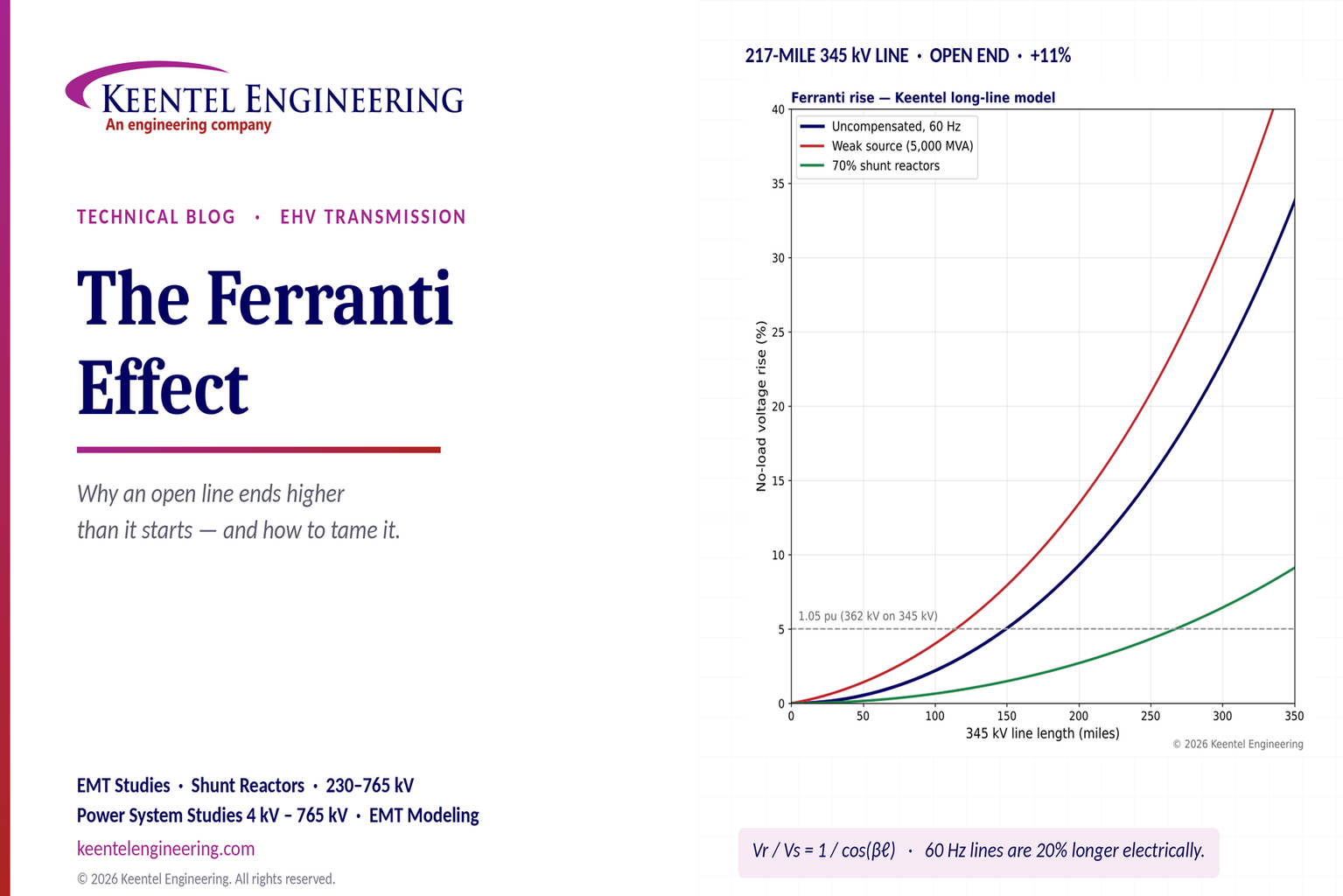
Explore the Ferranti effect in EHV transmission lines: voltage rise, 345 kV examples, switching overvoltages, shunt reactor sizing and mitigation.
By SANDIP R PATEL
•
October 21, 2026
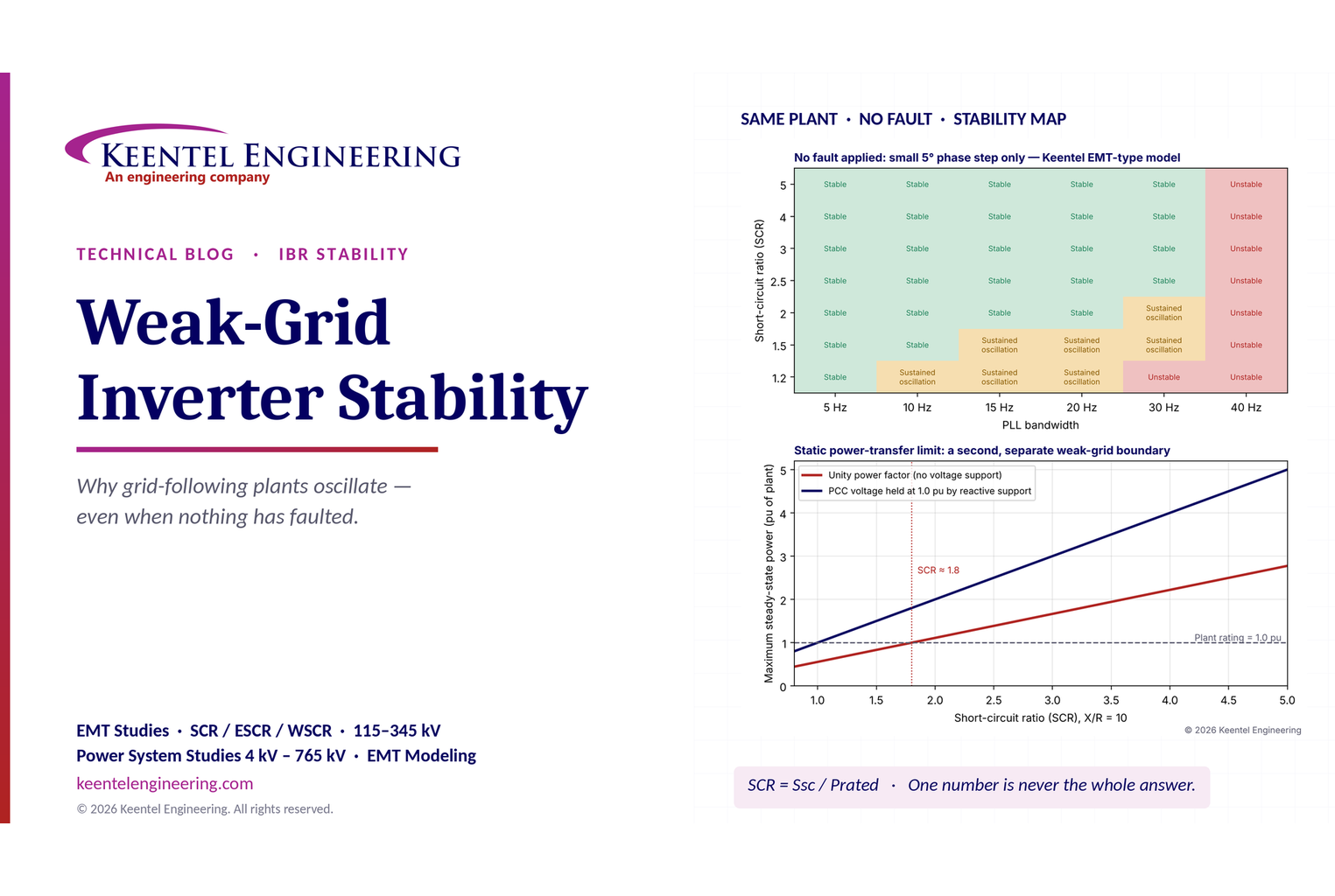
Learn why grid-following inverters become unstable without grid faults. Explore SCR, PLL interactions, EMT studies, grid strength, and mitigation.
By SANDIP R PATEL
•
October 21, 2026
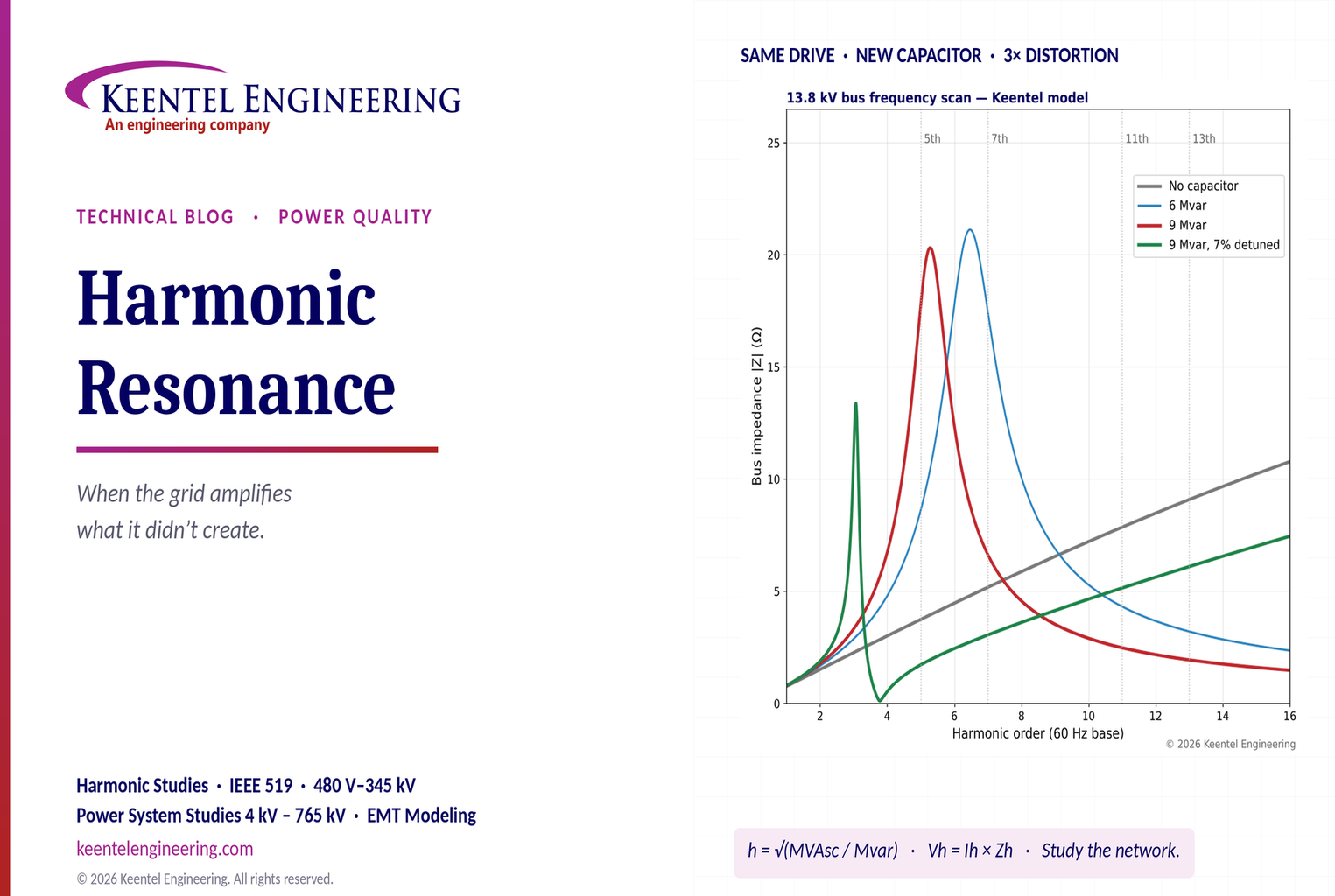
Learn how harmonic resonance amplifies distortion in power systems. Explore capacitor banks, detuned reactors, frequency scans, and IEEE 519 solutions.
By SANDIP R PATEL
•
October 20, 2026
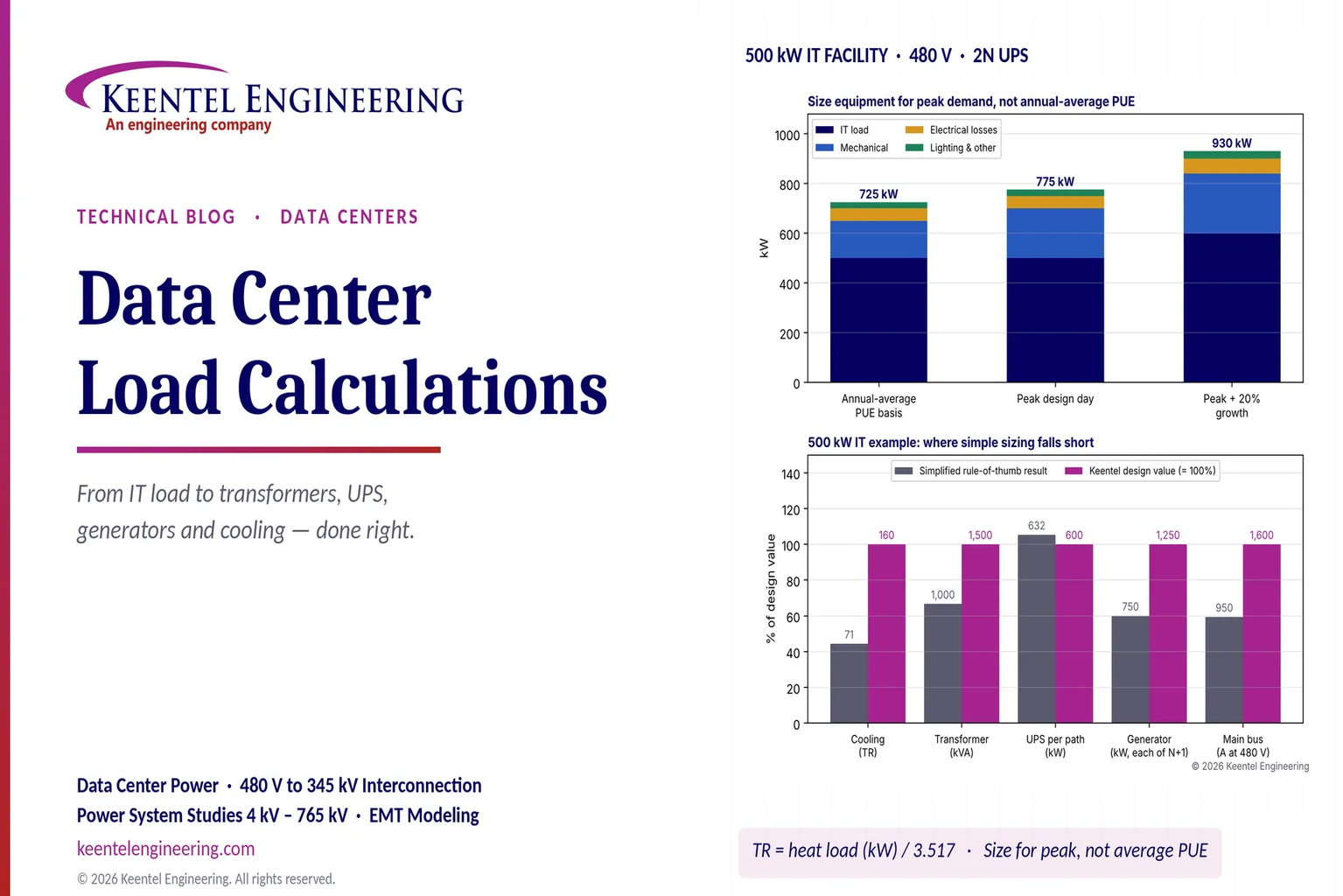
Learn data center electrical load calculations, including IT demand, PUE, UPS and generator sizing, cooling loads, redundancy, and worked US examples.
By SANDIP R PATEL
•
October 20, 2026
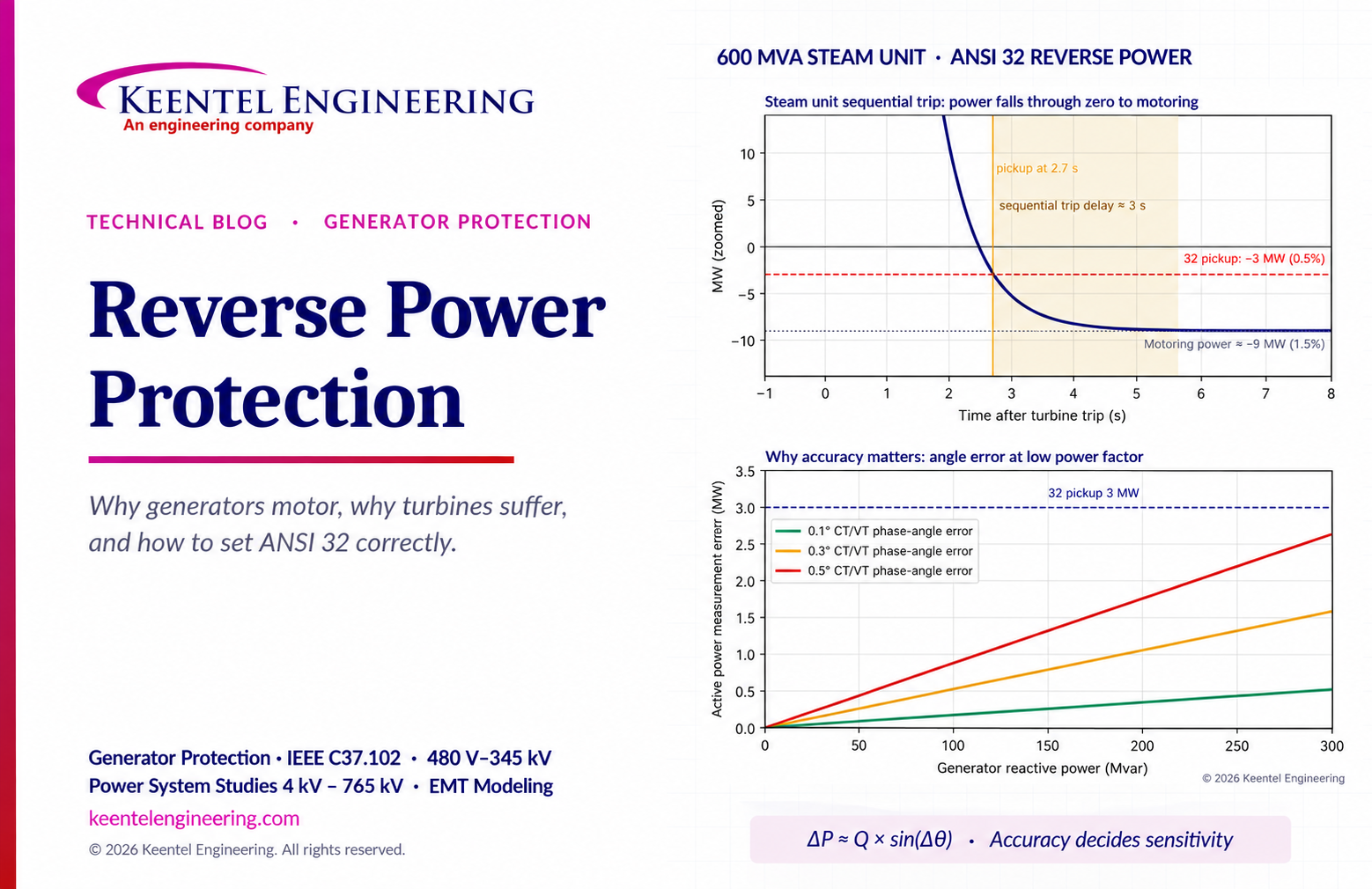
Learn reverse power protection (ANSI 32), generator motoring, relay pickup settings, time delays, sequential tripping and testing for US power plants.
Copy
By Team 2 Dexora
•
October 20, 2026
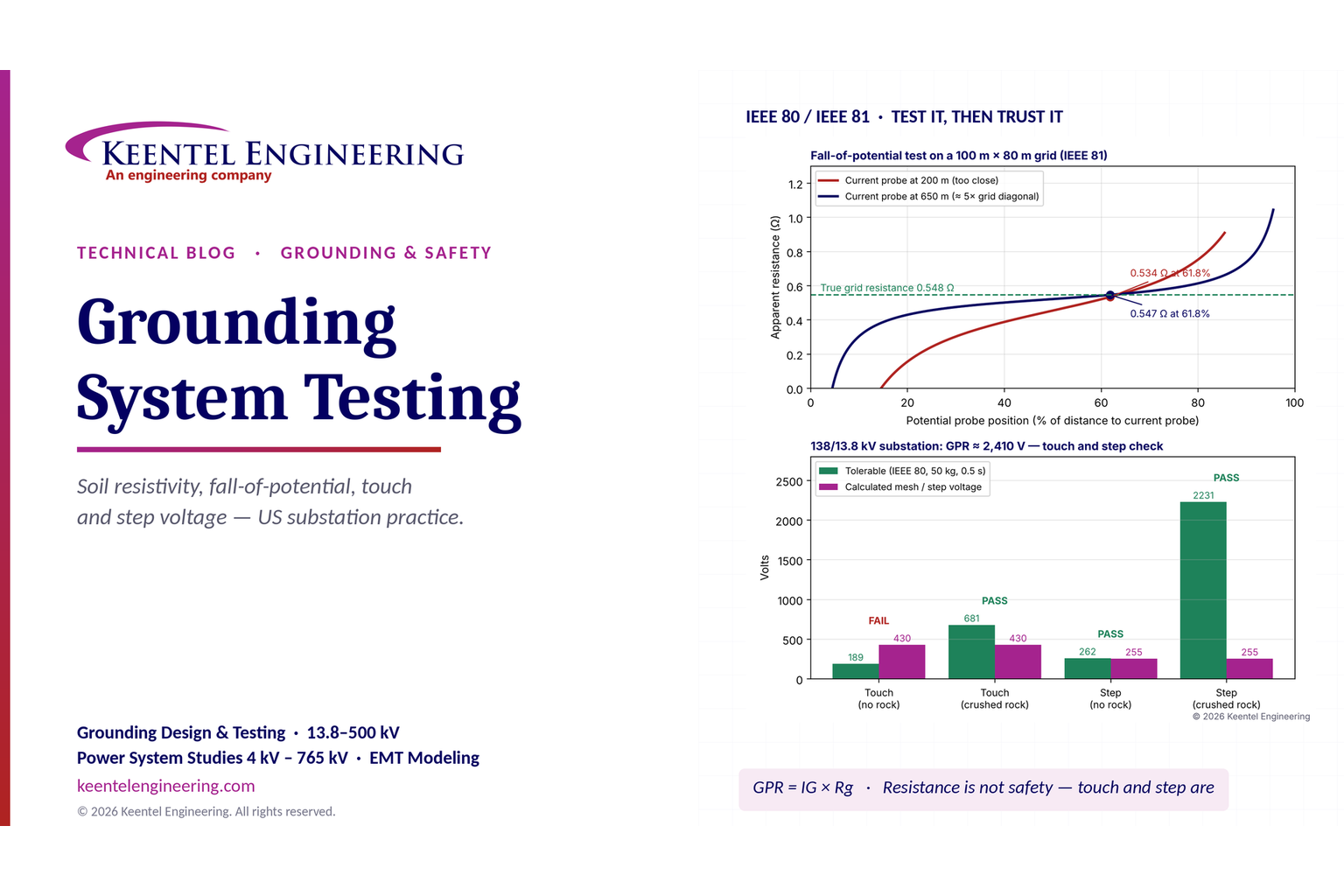
Explore grounding system testing with Keentel Engineering. Learn IEEE 80/81 methods, soil resistivity, ground resistance, and touch and step voltage safety.
By SANDIP R PATEL
•
October 13, 2026
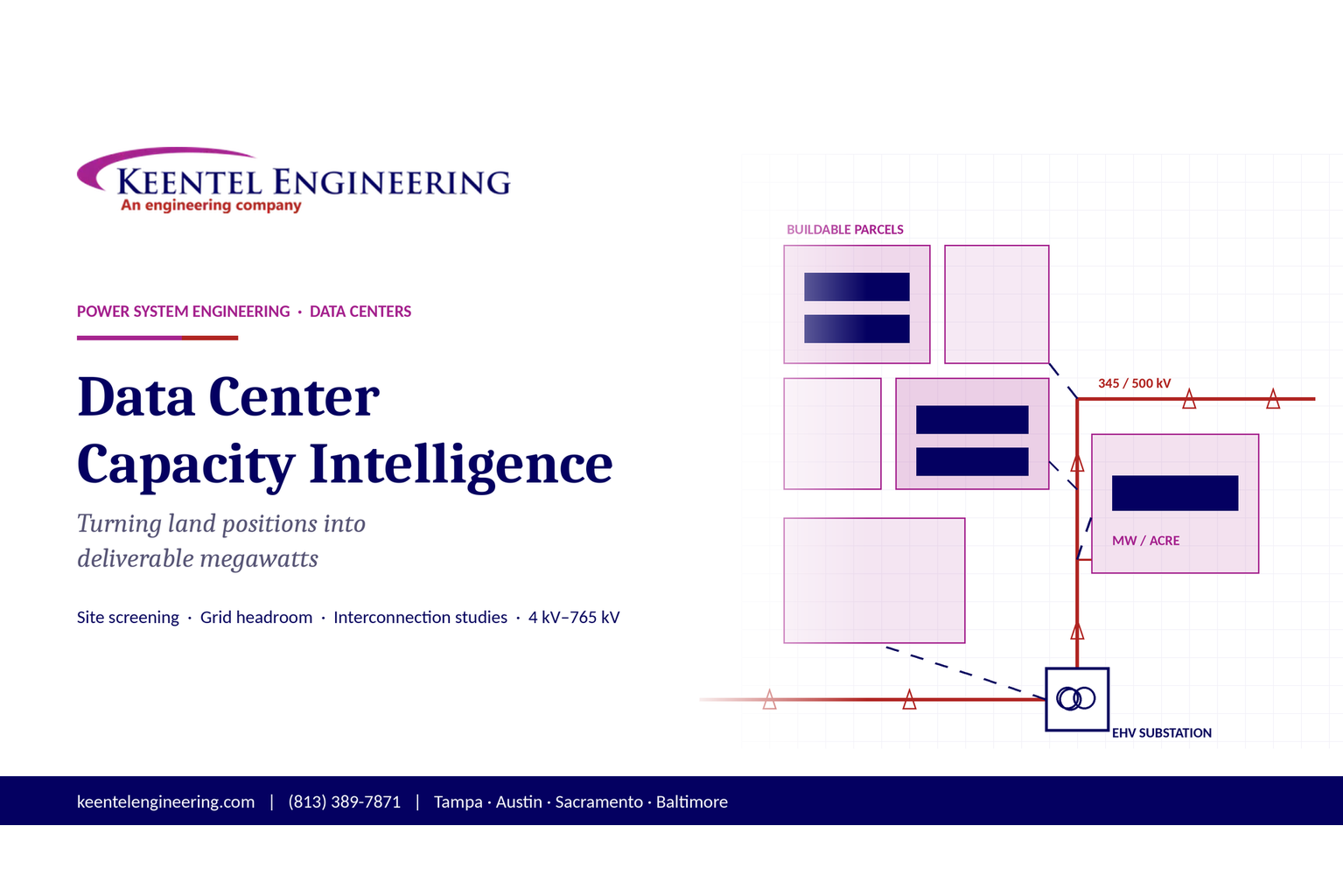
Plan data center capacity with land screening, MW-per-acre estimates, grid power availability and interconnection feasibility studies from Keentel Engineering.
By SANDIP R PATEL
•
October 11, 2026
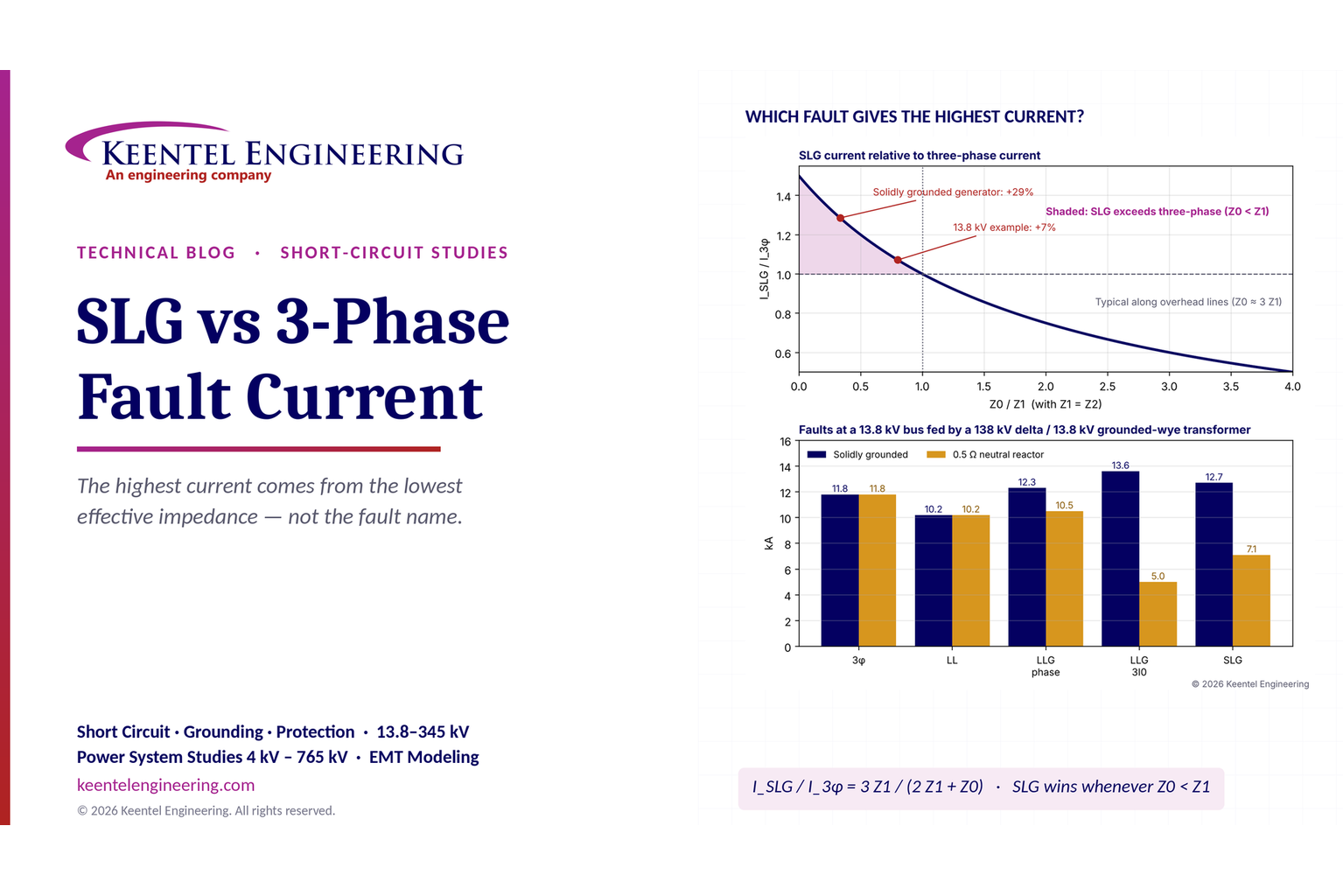
Learn which fault produces the highest current at a bus, why SLG faults can exceed three-phase faults, and how symmetrical components determine fault duty.
By SANDIP R PATEL
•
October 11, 2026
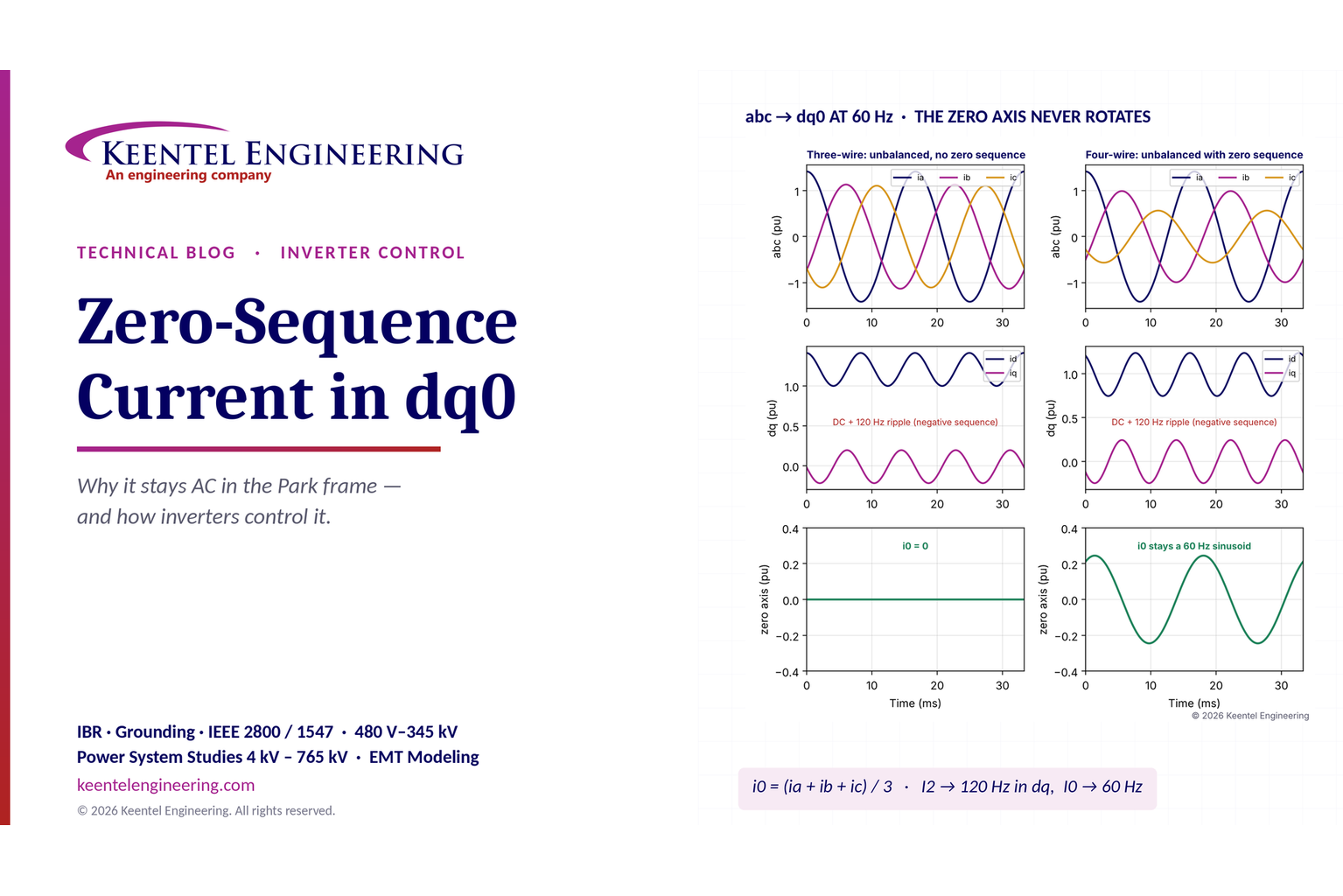
Learn why zero-sequence current pulsates in the dq0 frame, how Park's transformation works, and how inverter controls handle unbalance and ground faults.