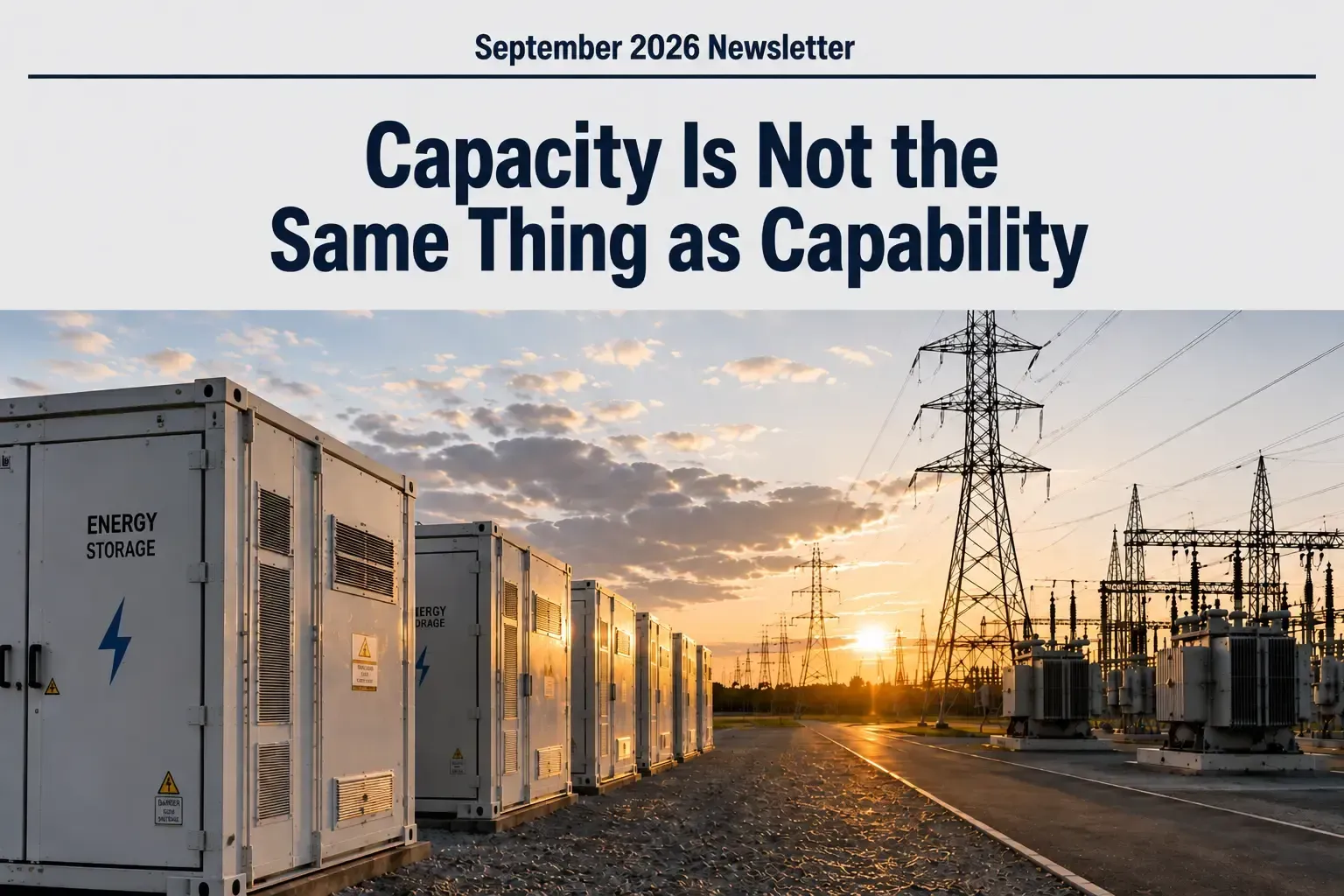
Ford has entered grid‑scale storage through a new energy division, converting Kentucky cell manufacturing capacity from electric‑vehicle LFP production toward stationary storage. The flagship product is a liquid‑cooled 20‑foot DC block built on 512 Ah LFP cells, rated at 5.45 MWh, offered in two‑hour and four‑hour configurations, with a 1040–1500 V DC operating window, IP55 enclosure rating, roughly 43.5 tonnes container weight and operation to 4,000 m altitude without derating. The company has indicated 20 GWh of annual manufacturing capacity, with first customer deliveries expected in late 2027. Because the units are assembled domestically, they are positioned as compliant with foreign entity of concern and prohibited foreign entity restrictions and as eligible for domestic content adders.
Why the cell capacity number matters at the site, not just on the datasheet
Most fielded storage still uses 280 Ah or 314 Ah cells. The industry has been migrating toward a 587–628 Ah class, which is now approaching volume production at several manufacturers. Ford is entering above the old standard but below the emerging one, and at the container level that difference is material: competing blocks in the 587–588 Ah class are rated near 6.25 MWh against Ford’s 5.45 MWh.
For a 400 MWh project that is roughly a dozen additional containers. Additional containers mean additional foundations or piers, additional DC collection runs and combiner terminations, more medium‑voltage transformer positions, a larger fenced footprint, longer AC collection, and a proportional increase in the number of thermal management and fire suppression systems to commission and maintain. Cell capacity is not a procurement detail. It propagates into civil layout, collection design, land acquisition and the commissioning schedule.
| Parameter |
Ford Energy |
587–628 Ah class (industry range) |
Engineering consequence |
| Cell capacity |
512 Ah |
587–628 Ah |
Sets cells per module and module count per rack |
| Container energy |
5.45 MWh |
≈ 5.0–6.26 MWh (typically 6.25 MWh at 587–588 Ah) |
Drives container count, pad count and MV transformer positions |
| Duration offered |
2 h and 4 h |
2 h, 4 h and 6 h depending on manufacturer |
Determines inverter sizing and ancillary service eligibility |
| Container weight |
≈ 43.5 tonnes |
Generally managed below the 45‑tonne transport ceiling |
Governs crane selection, road permits and foundation loading |
| Operating range |
−35 °C to +55 °C |
Upper limits commonly +60 °C to +70 °C |
Ambient derate risk in hot‑climate siting |
| Round‑trip efficiency |
Not published |
Typically stated 94–96.5% |
Unstated RTE is an unclosed variable in the revenue model |
| Cycle life |
Not published; 20‑year calendar life stated |
Commonly 8,000–12,000 cycles to 70–80% SOH |
Calendar life without cycle life is not a warranty basis |
Comparative positioning based on publicly announced manufacturer specifications. Figures are as published by the respective manufacturers and have not been independently verified by Keentel Engineering.
Three items an owner’s engineer should press on
- The thermal ceiling.
An upper operating limit of +55 °C is below much of the competing field. In West Texas, Arizona, the Central Valley or the Gulf Coast, the governing number is not shade ambient — it is enclosure surface temperature under solar gain with the liquid cooling system already working. Ask for the derate curve, not the operating range.
- Undisclosed round‑trip efficiency and cycle life.
These are the two inputs a storage revenue model is most sensitive to. Where they are not published, they should be contractual: guaranteed RTE at defined conditions, and a capacity maintenance schedule with defined augmentation obligations.
- No fielded operating history.
A first‑deliveries date of late 2027 means no MOD‑026 or MOD‑027 validation record, no established generic model stack in the transmission planning libraries, and no EMT model with a track record of matching field response. For a project inside a cluster study, that is a schedule risk before it is a performance risk. Learn more about NERC compliance services
Domestic assembly is not the same as compliance
Final assembly in the United States supports a domestic content position, but prohibited foreign entity determinations under the 2025 tax legislation turn on material assistance cost ratios and on effective control tests — not on the location of the final assembly line. Cell chemistry sourcing, licensed technology, and the ownership structure behind the manufacturing entity all remain in scope. Treat vendor compliance statements as the beginning of diligence, not the end of it.