
Add your custom HTML here
Keentel Engineering Newsletter
Navigating NERC Compliance in the Era of Inverter-Based Resources
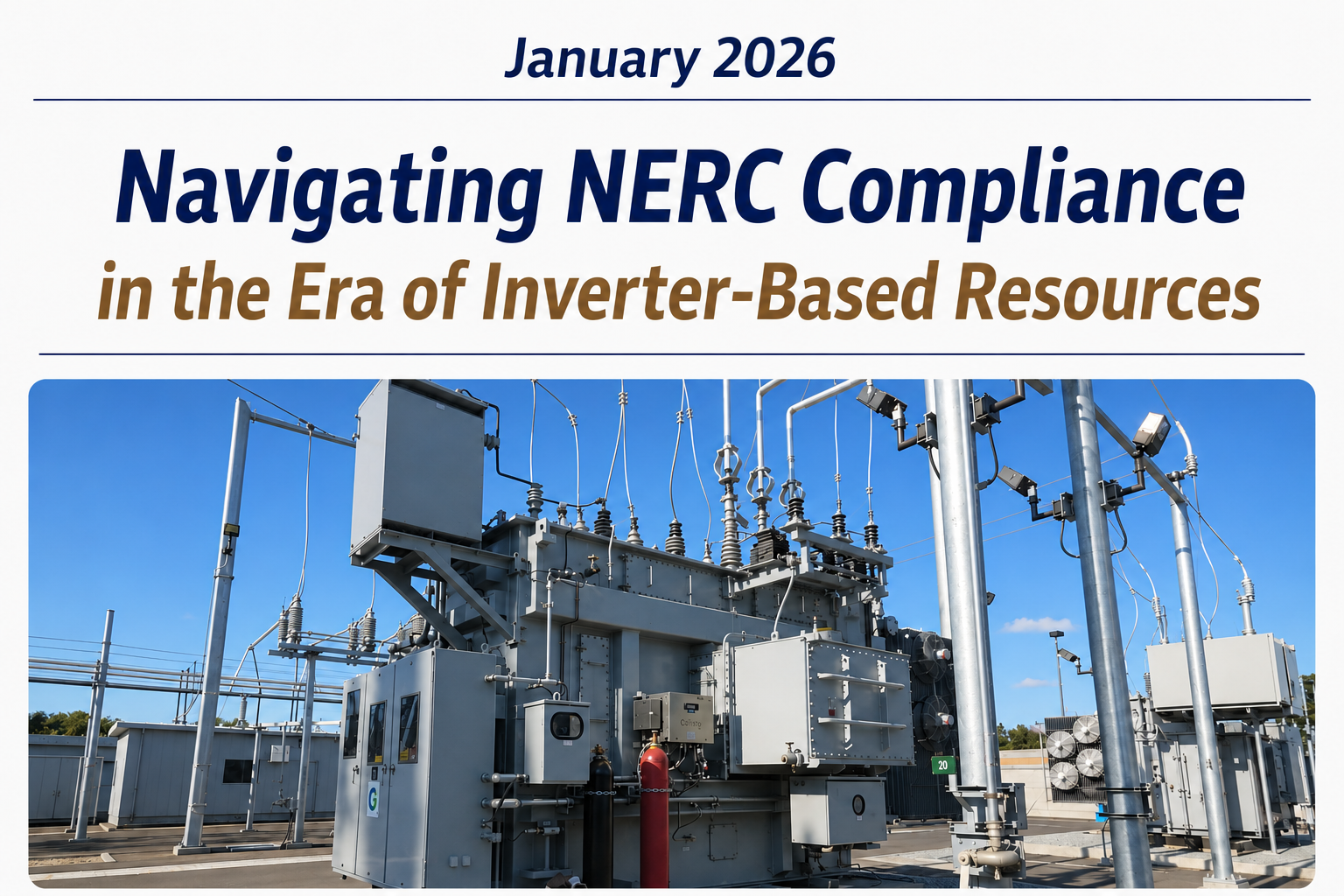
January 2026 Edition
Introduction: A Turning Point for Grid Reliability
The North American electric grid is undergoing one of the most significant transitions in its history. Rapid growth in inverter-based resources (IBRs), including solar, wind, and battery energy storage systems (BESS), has fundamentally changed how the Bulk Power System (BPS) behaves during disturbances, extreme weather events, and cybersecurity incidents.
In response, the North American Electric Reliability Corporation (NERC) has accelerated regulatory actions across planning, protection, operations, and cybersecurity, culminating in:
- The IBR Registration Initiative
- Multiple new PRC, CIP, TPL, TOP, and BAL standards
- Expanded enforcement readiness beginning in 2026
This newsletter provides a comprehensive overview of what has changed, what is coming, and what asset owners must do now to remain compliant.
The IBR Registration Initiative: From Outreach to Enforcement
Why the Initiative Exists.
Historically, many inverter-based resources were:
- Below traditional size thresholds
- Interconnected at transmission or sub-transmission voltage levels
- Outside formal NERC registration requirements
However, multiple large-scale IBR disturbances, including events that resulted in the simultaneous tripping of thousands of megawatts, exposed systemic reliability risks related to:
- Frequency ride-through performance
- Voltage control interactions
- Limited operational visibility and reporting
- Inconsistent protection and control settings
In response to these risks, the Federal Energy Regulatory Commission directed NERC in 2022 to close the IBR registration gap and strengthen oversight of inverter-based generation.
Key Milestones
- 2023 – Initiative launched with industry outreach and awareness efforts
- 2024 – Education, data collection, and identification of impacted entities
- May 2025 – Entry into the third and final milestone: formal registration
As of this final phase, eligible IBR owners and operators are required to register as:
- Category 2 Generator Owners (GO)
- Category 2 Generator Operators (GOP)
What Registration Means in Practice
Once registered, entities may become subject to a range of NERC reliability and cybersecurity requirements, including:
- PRC standards governing protection coordination and ride-through performance
- CIP standards addressing cyber assets, communications, and access control
- EOP standards related to disturbance reporting and event analysis
- Ongoing model validation and data submittal obligations
- Audit readiness, evidence retention, and compliance documentation
For many renewable developers and independent power producers, this represents their first direct exposure to formal NERC compliance obligations.
To see real-world examples of how modeling, protection validation, and ISO-facing data submissions support NERC registration and compliance, review Keentel Engineering’s Point-of-Interconnection interconnection support case studies.
New and Upcoming NERC Reliability Standards
IBR-Focused Reliability Standards
PRC-029-1 — Frequency and Voltage Ride-Through (Effective October 1, 2026)
PRC-029-1 establishes mandatory frequency and voltage ride-through performance requirements for inverter-based resources, ensuring that IBRs remain connected during grid disturbances rather than contributing to widespread tripping events.
Key implications include
- Verification of inverter control and protection settings
- EMT-based validation of dynamic ride-through behavior
- Coordination with transmission planners and operators to confirm system-level performance
This standard represents a significant shift toward performance-based validation of inverter behavior under disturbance conditions.
To see how EMT-based ride-through validation is performed in practice, explore Keentel Engineering’s PSCAD power system studies case studies.
PRC-030-1 — Unexpected IBR Event Mitigation (Effective Oct 1, 2026)
PRC-030-1 requires registered entities to:
- Analyze unexpected IBR tripping events
- Identify root causes
- Implement corrective actions to prevent recurrence
This standard introduces a new compliance paradigm—post-event engineering accountability.
PRC-024-4 — Protection Settings Updates
Expands applicability and coordination requirements for:
- Type 1 and Type 2 wind resources
- Synchronous condensers
- Certain generator configurations interacting with IBRs
Cybersecurity Expansion: CIP Standards
CIP-003-9
Strengthens governance, policies, and management controls—often the entry point for newly registered entities.
CIP-012-2
Enhances requirements for secure communications between control centers, impacting:
- SCADA links
- Remote monitoring systems
- Third-party communication paths
CIP-015-1 (Effective Oct 1, 2028)
Introduces internal network security monitoring, significantly raising expectations for:
- Detection capabilities
- Continuous monitoring
- Incident response readiness
Planning & Operations Standards
TPL-008-1
Requires planners to assess extreme temperature events, reflecting lessons learned from recent heat waves and cold weather emergencies.
BAL-007-1
Introduces near-term energy reliability assessments, increasing coordination between planning and operations.
TOP-003-7
Strengthens data exchange requirements between Transmission Operators and Balancing Authorities.
Industry Engagement: Ballots, Comment Periods, and Events
NERC has emphasized active industry participation through:
- Ballots for EOP-004 IBR Event Reporting
- Ballots and comments on CIP-015 Internal Network Security Monitoring
- Draft white papers on third-party cloud risk management
January 2026 features numerous:
- Standards committee meetings
- Drafting team sessions
- Industry webinars
- Resource and frequency working group meetings
These forums provide early insight into enforcement expectations and implementation challenges.
What Asset Owners Should Be Doing Now
Entities impacted by the IBR Registration Initiative should already be taking the following actions:
- Confirming Generator Owner and Generator Operator applicability
- Reviewing PRC-029 and PRC-030 frequency and voltage ride-through performance requirements
- Validating dynamic and EMT-based power system models used for compliance and interconnection
- Assessing cyber asset scope and communications pathways under applicable CIP standards
- Establishing repeatable event analysis, reporting, and documentation processes
- Preparing proactively for audit readiness and future enforcement activities
Waiting until these standards become enforceable significantly increases compliance risk, project cost, and operational exposure.
Keentel Engineering: Your Compliance Partner
With over 30 years of power system engineering experience, Keentel Engineering helps asset owners navigate the full lifecycle of NERC compliance for inverter-based resources, from registration and modeling to audit readiness.
Our Services Include
- IBR applicability and Category 2 GO/GOP registration support
- EMT and dynamic modeling using PSSE, TSAT, and PSCAD for ride-through validation
- PRC-029 and PRC-030 readiness and protection compliance reviews
- CIP gap assessments and cybersecurity compliance support
- Ongoing advisory services for audits and enforcement preparedness
Our Related Services and Industry Updates

About the Author:
Sandip "Sonny" R. Patel, P.E.
IEEE Senior Member · Founder & CEO, Keentel Engineering
In 1995, Sonny Patel earned his Electrical Engineering degree from the University of Illinois. But degrees don't build legacies — action does.For three decades, he has worked the power industry from every side of the table: 16 years as a utility engineer at Exelon/Commonwealth Edison; generation leadership across hydroelectric, industrial steam turbine, and a 9 GW renewable fleet; NERC Regional Entity Senior Compliance Engineer and Audit Team Lead, auditing some of the nation's largest utilities; and testing and commissioning lead on equipment up to 765 kV — the very top of the North American grid.Utility. Generator. Regulator. Consultant. Few engineers have seen all four seats. Fewer still have sat in them.
His experience spans nuclear, hydro, conventional generation, renewables, oil and gas, mining — and today's data centers, where he is authoring a three-book series on data center design. He is a Licensed Professional Engineer in six states and a Licensed Electrical Contractor in Florida (Unlimited EC) — he doesn't just design the work; he's qualified to stand behind its execution.Today, as Founder and CEO of Keentel Engineering, Sonny leads a nationwide team of engineers delivering substation design, power system studies, NERC compliance, and commissioning — done right, coast to coast.Three decades. Every side of the table. One standard: accountable engineering.
Services

Let's Discuss Your Project
Let's book a call to discuss your electrical engineering project that we can help you with.
About the Author:
Sandip "Sonny" R. Patel, P.E.
IEEE Senior Member · Founder & CEO, Keentel Engineering
In 1995, Sonny Patel earned his Electrical Engineering degree from the University of Illinois. But degrees don't build legacies — action does.For three decades, he has worked the power industry from every side of the table: 16 years as a utility engineer at Exelon/Commonwealth Edison; generation leadership across hydroelectric, industrial steam turbine, and a 9 GW renewable fleet; NERC Regional Entity Senior Compliance Engineer and Audit Team Lead, auditing some of the nation's largest utilities; and testing and commissioning lead on equipment up to 765 kV — the very top of the North American grid.Utility. Generator. Regulator. Consultant. Few engineers have seen all four seats. Fewer still have sat in them.
His experience spans nuclear, hydro, conventional generation, renewables, oil and gas, mining — and today's data centers, where he is authoring a three-book series on data center design. He is a Licensed Professional Engineer in six states and a Licensed Electrical Contractor in Florida (Unlimited EC) — he doesn't just design the work; he's qualified to stand behind its execution.
Today, as Founder and CEO of Keentel Engineering, Sonny leads a nationwide team of engineers delivering substation design, power system studies, NERC compliance, and commissioning — done right, coast to coast.Three decades. Every side of the table. One standard: accountable engineering.





