A Coordinated Electric System Interconnection Review—the utility’s deep-dive on technical and cost impacts of your project.
Integrative Applications of IEEE C57 Series Standards for Reliable and Compliant Substation Design
May 21, 2025 | Blog
Executive Summary
Modern substation design must meet stringent requirements for performance, reliability, safety, and predictive diagnostics. The IEEE C57 series standards form the backbone of ieee substation standards used to ensure transformer reliability and system performance.
of engineering protocols governing power transformers and instrument transformers used in substations. This white paper explores six key IEEE standards and highlights how IEEE substation standards support transformer reliability, diagnostics, and regulatory compliance aligned with NERC and utility guidelines.
IEEE C57.127-2018: Acoustic Emissions Detection
Purpose: Enables the detection and localization of acoustic emissions from partial discharges in liquid-insulated transformers and reactors.
Applications in Substation Design:
Provides non-invasive, real-time transformer condition diagnostics.
Supports condition-based maintenance strategies in utility substations.
Enables early identification of insulation degradation before catastrophic failure.
Key Design Integration:
Strategic placement of acoustic transducers to enhance partial discharge localization accuracy.
Correlation of acoustic emission data with dissolved gas analysis to strengthen transformer health assessment and transformer IEEE compliance verification.
IEEE C57.13.5-2019: High Voltage Instrument Transformer Testing
Purpose: Specifies testing criteria for instrument transformers operating at 115 kV and higher.
Applications in Substation Design:
Ensures dielectric strength and arc resistance of current and voltage transformers.
Guides proper selection of equipment for EHV metering and protective relaying.
Mandates specialized testing including partial discharge detection, arc-proofing, and gas-tightness verification.
Key Design Integration:
Alignment with insulation coordination requirements.
Verification of short-circuit withstand capability and wind-resistance performance in harsh substation environments.
IEEE C57.135-2019: Diagnostic Guide for Transformers
Purpose: Provides standardized procedures for diagnosing power transformer failures.
Applications in Substation Design:
Facilitates forensic analysis during transformer outages.
Utilizes dissolved gas analysis, power factor testing, and polarization index measurements to assess transformer condition.
Key Design Integration:
Substation layouts optimized for sensor access and oil sampling.
SCADA integration supporting real-time transformer diagnostics and alarm generation as part of IEEE compliant substation engineering practices.
IEEE C57.1200-2021: General Requirements for Transformers
Purpose: Establishes fundamental electrical and mechanical requirements for liquid-immersed transformers.
Applications in Substation Design:
Ensures consistency in tank construction, grounding, insulation systems, and nameplate data.
Provides a compliance baseline for procurement, commissioning, and long-term operation.
Key Design Integration:
Supports fleet-wide interchangeability and standardization.
Verifies transformer performance against short-circuit forces, thermal limits, and voltage withstand criteria critical to substation transformers IEEE standards compliance.
IEEE C57.13-2016: Instrument Transformer Performance Standards
IEEE C57.13 plays a critical role in defining accuracy and performance requirements for instrument transformers in substation design.
Purpose: Defines performance metrics and testing requirements for current and voltage transformers.
Applications in Substation Design:
Validates accuracy classes for revenue metering and protection schemes.
Requires withstand testing for short-duration voltage and current stresses.
Key Design Integration:
Defines burden ratings, ratio accuracy, polarity, and marking conventions.
Supports high-accuracy measurement and protective relaying systems essential to system integrity.
IEEE C57.91-2011: Loading Guide for Mineral-Oil-Immersed Transformers
Purpose: Provides guidance for safely operating transformers beyond nameplate ratings.
Applications in Substation Design:
Defines acceptable loading limits for seasonal and emergency operating conditions.
Assists utilities in managing overload scenarios without compromising asset life.
Key Design Integration:
Addresses cooling system performance and thermal aging behavior.
Informs load tap changer operation during transient and emergency loading conditions and helps answer which substation transformers meet IEEE standards under real-world loading scenarios.
Conclusion
The integration of IEEE C57 series standards is essential for
IEEE-compliant substation engineering
and reliable transformer performance.
is essential to achieving reliable, safe, and compliant substation designs. These standards establish a comprehensive framework for transformer diagnostics, loading behavior, insulation performance, and measurement accuracy. By applying IEEE guidance throughout design, testing, and operation, utilities can enhance transformer longevity, reduce unplanned outages, and maintain regulatory alignment. Keentel Engineering applies these standards to deliver technically sound, utility-grade substation solutions that support long-term system resilience and IEEE substation standards compliance.
Why Choose Keentel Engineering
Keentel Engineering applies IEEE C57 series standards as an integrated part of substation design, transformer diagnostics, and utility compliance strategies. Our approach goes beyond referencing standards by embedding their requirements into practical engineering decisions that improve reliability, safety, and long-term asset performance.
Our team has hands-on experience applying IEEE C57 guidance across transformer specification, testing, loading analysis, and condition monitoring. By combining diagnostic techniques such as acoustic emissions, dissolved gas analysis, thermal modeling, and SCADA integration, we help utilities and asset owners translate standards into actionable design and operational outcomes.
Keentel Engineering supports clients through the full lifecycle of substation projects, from design and procurement review to commissioning support and compliance documentation. This standards-driven methodology ensures transformer systems meet regulatory expectations while remaining resilient under real-world operating and loading conditions.
Frequently Asked Questions
1. What is the scope of IEEE C57.127-2018?
This guide addresses detection, location, and interpretation of acoustic emissions (AEs) from electrical discharges in power transformers and reactors. It supports PD diagnostics through AE sensor placement and signal interpretation.
2. What testing method is recommended for PD location using AE?
AE testing involves placing sensors at strategic locations based on transformer geometry to isolate PD sources. Arrangements are based on transformer phase locations and physical access constraints.
3. What does IEEE C57.13.5-2019 specify for high-voltage instrument transformers?
It provides performance and testing requirements for instrument transformers above 115 kV, including test sequences for routine and type tests and insulation coordination.
4. Which type tests are mandatory under IEEE C57.13.5-2019?
Type tests include impulse voltage withstand, RIV, temperature rise, mechanical endurance, and accuracy performance tests.
5. What is the significance of the creepage distance in high-voltage instrument transformers?
Creepage distance ensures insulation reliability. It’s measured with a gum tape along the insulator surface and must comply with Table 2 in the standard.
6. How does IEEE C57.13-2016 define transformer accuracy classes?
Accuracy classes are defined for metering and relaying applications, based on limits of ratio error and phase angle deviation under specific burden and power factor conditions.
7. What tests are included in the IEEE C57.13 routine test schedule?
Routine tests cover ratio, polarity, insulation resistance, excitation, burden, and accuracy to validate the transformer’s compliance with design specifications.
8. What defines a standard burden in transformer accuracy testing?
Standard burden represents the impedance connected to the secondary winding and is used to evaluate transformer accuracy under defined operating conditions.
9. What are the key updates in IEEE C57.1200-2021?
Revisions include clearer BIL nameplate instructions, revised temperature calculation equations, added partial discharge test for core grounding, and updated sound level references.
10. What are the service condition limits under IEEE C57.1200?
Air-cooled transformers must operate below 40°C max and 30°C average ambient temperature, while liquid temperatures should not go below −20°C.
11. What does IEEE C57.135-2019 specify?
This standard focuses on guide requirements for the evaluation of gas-insulated transformers (GIT), including test recommendations and aging characteristics.
12. What are short-time thermal rating calculations based on?
They rely on IEEE C57.13 clauses and determine stray conductor loss and short-circuit current densities to confirm compliance with thermal withstand criteria.
13. What internal arc protection measures are discussed in IEEE C57.13.5-2019?
The document outlines criteria for classifying arc-resistant designs and performance thresholds during simulated internal fault conditions.
14. What transformer life criteria does IEEE C57.91-2011 use?
Life is assessed based on insulation aging curves, with equations allowing calculation of percent loss of insulation life over loading scenarios.
15. How does IEEE C57.91 handle ambient temperature?
It provides temperature adjustment factors and approximations for air- and water-cooled systems to ensure safe loading decisions.
16. What does the guide say about overloading beyond nameplate?
IEEE C57.91-2011 supports planned and emergency overloading with evaluation criteria for insulation aging, thermal capability, and long/short duration profiles.
17. What calculations are given for hot-spot temperatures?
The standard gives equations for top-oil, average winding, and hottest-spot temperature, considering transient loading and cooling behavior.
18. What loading guidance is provided for voltage regulators?
Clause 8.4 of IEEE C57.91-2011 outlines voltage regulator-specific aging and temperature models based on duty cycle and ambient conditions.
19. How is percent loss of insulation life calculated?
It is determined using aging acceleration factors and life consumption equations derived from winding temperature over time.
20. Are there guidelines for cold-load pickup?
Yes, Annex F of IEEE C57.91 includes ratios, durations, and response recommendations for transformers under cold-start demand surges.
21. How does IEEE C57.1200 define angular displacement?
For Y-Δ and Δ-Y connections, a 30° lag is specified for the low-voltage side; for Δ-Δ and Y-Y, it’s zero, unless otherwise marked on the nameplate.
22. What dielectric coordination is required by C57.1200?
It mandates coordinated impulse and low-frequency insulation levels at terminals, factoring in BIL and system voltage requirements.
23. How does IEEE C57.127 describe sensor placement for PD?
It outlines specific placement strategies (top/middle/bottom) per transformer phase to isolate discharge sources accurately using AE data.
24. What temperature rise thresholds are acceptable for instrument transformers per IEEE C57.13.5-2019?
Typical temperature rise is ~10°C or less; calculations may substitute heat run tests if validated by prior results.
25. What type of test verifies gas sealing integrity in instrument transformers?
A low-temperature leakage test using gas-filled enclosures with known volumes and pressure monitoring is conducted per Annex A.

About the Author:
Sandip "Sonny" R. Patel, P.E.
IEEE Senior Member · Founder & CEO, Keentel Engineering
In 1995, Sonny Patel earned his Electrical Engineering degree from the University of Illinois. But degrees don't build legacies — action does.
For three decades, he has worked the power industry from every side of the table: 16 years as a utility engineer at Exelon/Commonwealth Edison; generation leadership across hydroelectric, industrial steam turbine, and a 9 GW renewable fleet; NERC Regional Entity Senior Compliance Engineer and Audit Team Lead, auditing some of the nation's largest utilities; and testing and commissioning lead on equipment up to 765 kV — the very top of the North American grid.Utility. Generator. Regulator. Consultant. Few engineers have seen all four seats. Fewer still have sat in them.
His experience spans nuclear, hydro, conventional generation, renewables, oil and gas, mining — and today's data centers, where he is authoring a three-book series on data center design. He is a Licensed Professional Engineer in six states and a Licensed Electrical Contractor in Florida (Unlimited EC) — he doesn't just design the work; he's qualified to stand behind its execution.Today, as Founder and CEO of Keentel Engineering, Sonny leads a nationwide team of engineers delivering substation design, power system studies, NERC compliance, and commissioning — done right, coast to coast.Three decades. Every side of the table. One standard: accountable engineering.
Services

Let's Discuss Your Project
Let's book a call to discuss your electrical engineering project that we can help you with.
About the Author:
Sandip "Sonny" R. Patel, P.E.
IEEE Senior Member · Founder & CEO, Keentel Engineering
In 1995, Sonny Patel earned his Electrical Engineering degree from the University of Illinois. But degrees don't build legacies — action does.
For three decades, he has worked the power industry from every side of the table: 16 years as a utility engineer at Exelon/Commonwealth Edison; generation leadership across hydroelectric, industrial steam turbine, and a 9 GW renewable fleet; NERC Regional Entity Senior Compliance Engineer and Audit Team Lead, auditing some of the nation's largest utilities; and testing and commissioning lead on equipment up to 765 kV — the very top of the North American grid.
Utility. Generator. Regulator. Consultant. Few engineers have seen all four seats. Fewer still have sat in them.
His experience spans nuclear, hydro, conventional generation, renewables, oil and gas, mining — and today's data centers, where he is authoring a three-book series on data center design. He is a Licensed Professional Engineer in six states and a Licensed Electrical Contractor in Florida (Unlimited EC) — he doesn't just design the work; he's qualified to stand behind its execution.
Today, as Founder and CEO of Keentel Engineering, Sonny leads a nationwide team of engineers delivering substation design, power system studies, NERC compliance, and commissioning — done right, coast to coast.Three decades. Every side of the table. One standard: accountable engineering.
Leave a Comment
Thank you for contacting us.
We will get back to you as soon as possible.
We will get back to you as soon as possible.
Oops, there was an error sending your message.
Please try again later.
Please try again later.
Related Posts
By SANDIP R PATEL
•
October 20, 2026
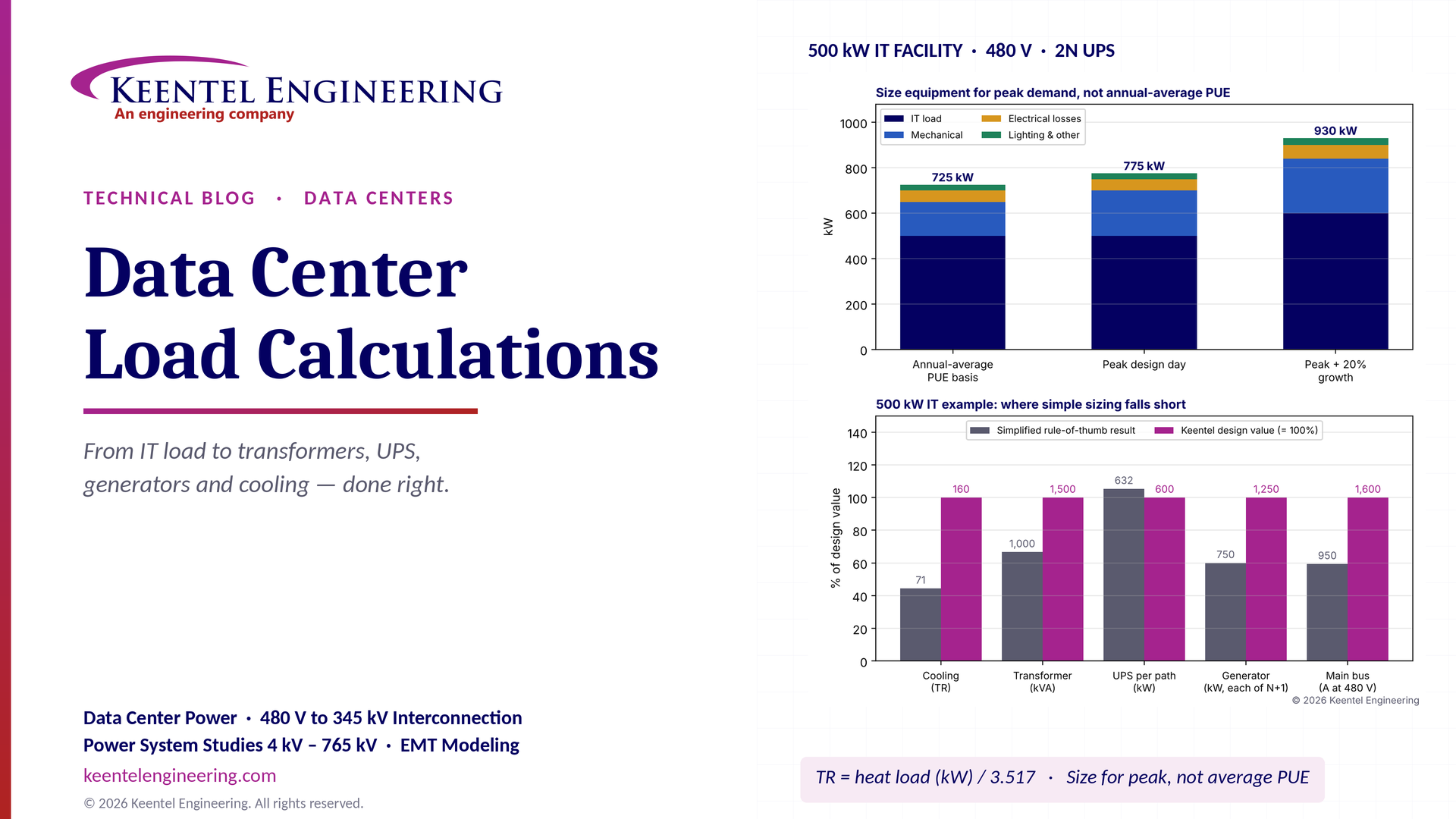
Learn data center electrical load calculations, including IT demand, PUE, UPS and generator sizing, cooling loads, redundancy, and worked US examples.
By SANDIP R PATEL
•
October 20, 2026
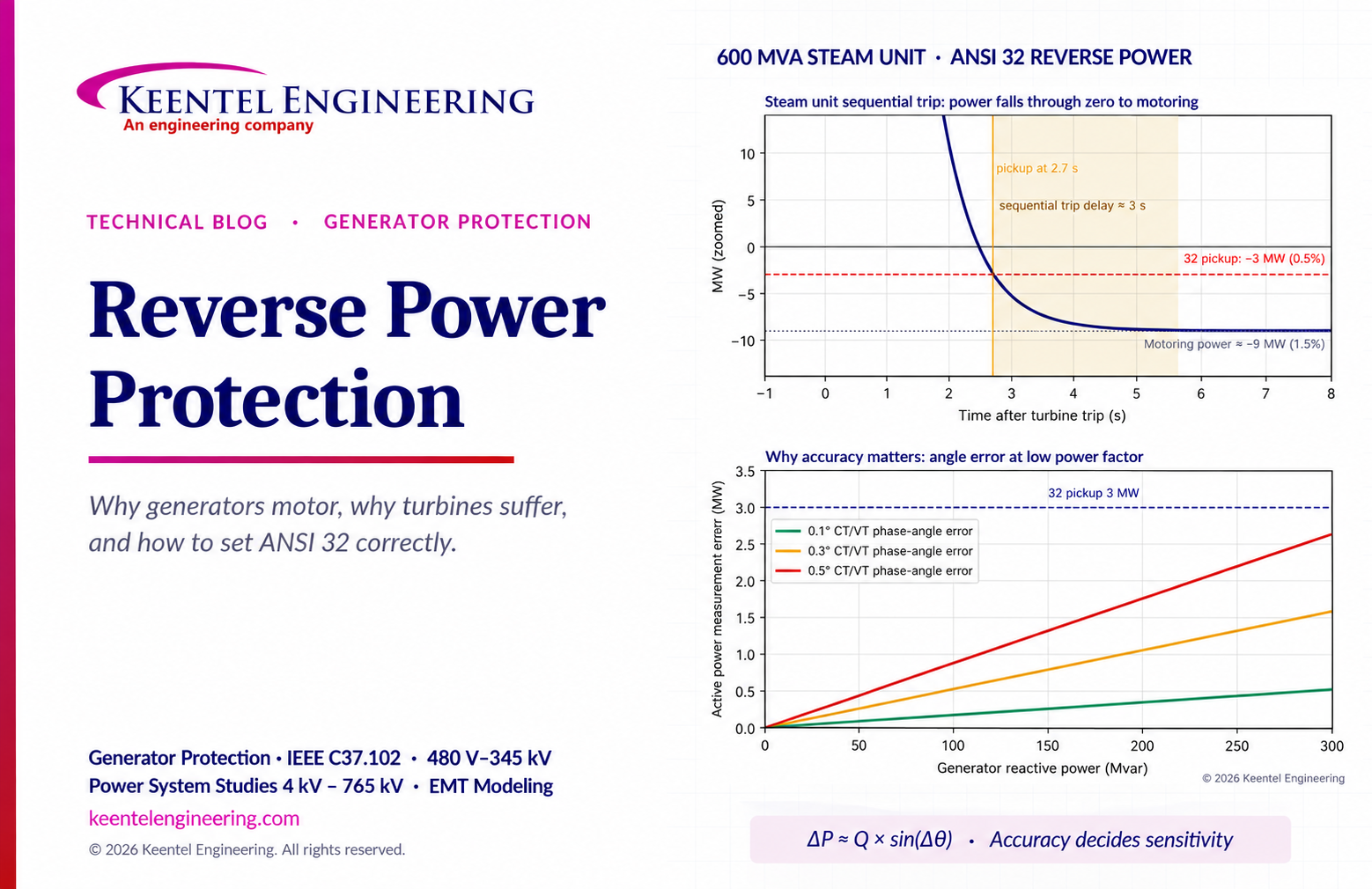
Learn reverse power protection (ANSI 32), generator motoring, relay pickup settings, time delays, sequential tripping and testing for US power plants.
Copy
By Team 2 Dexora
•
October 20, 2026
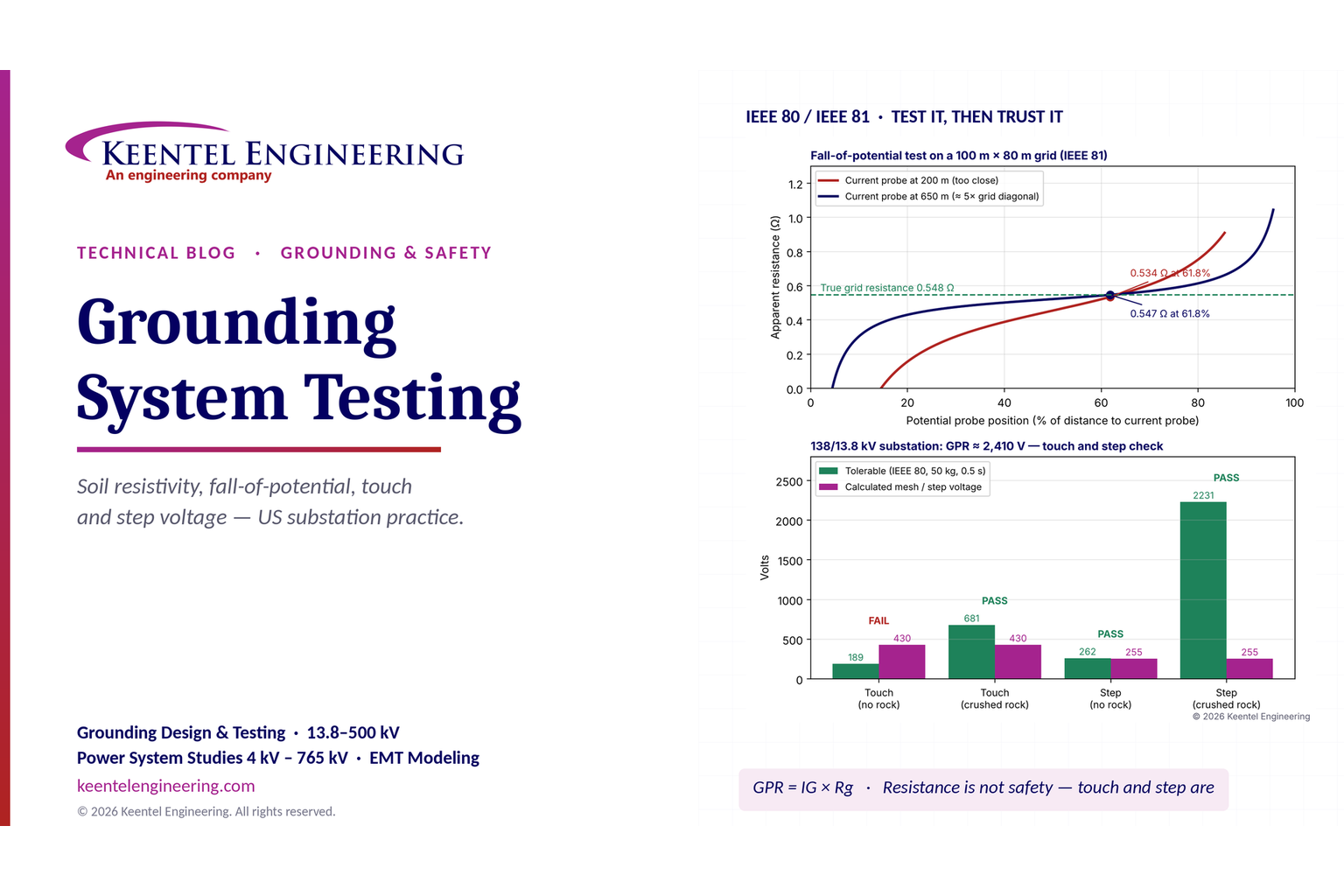
Explore grounding system testing with Keentel Engineering. Learn IEEE 80/81 methods, soil resistivity, ground resistance, and touch and step voltage safety.
By SANDIP R PATEL
•
October 13, 2026
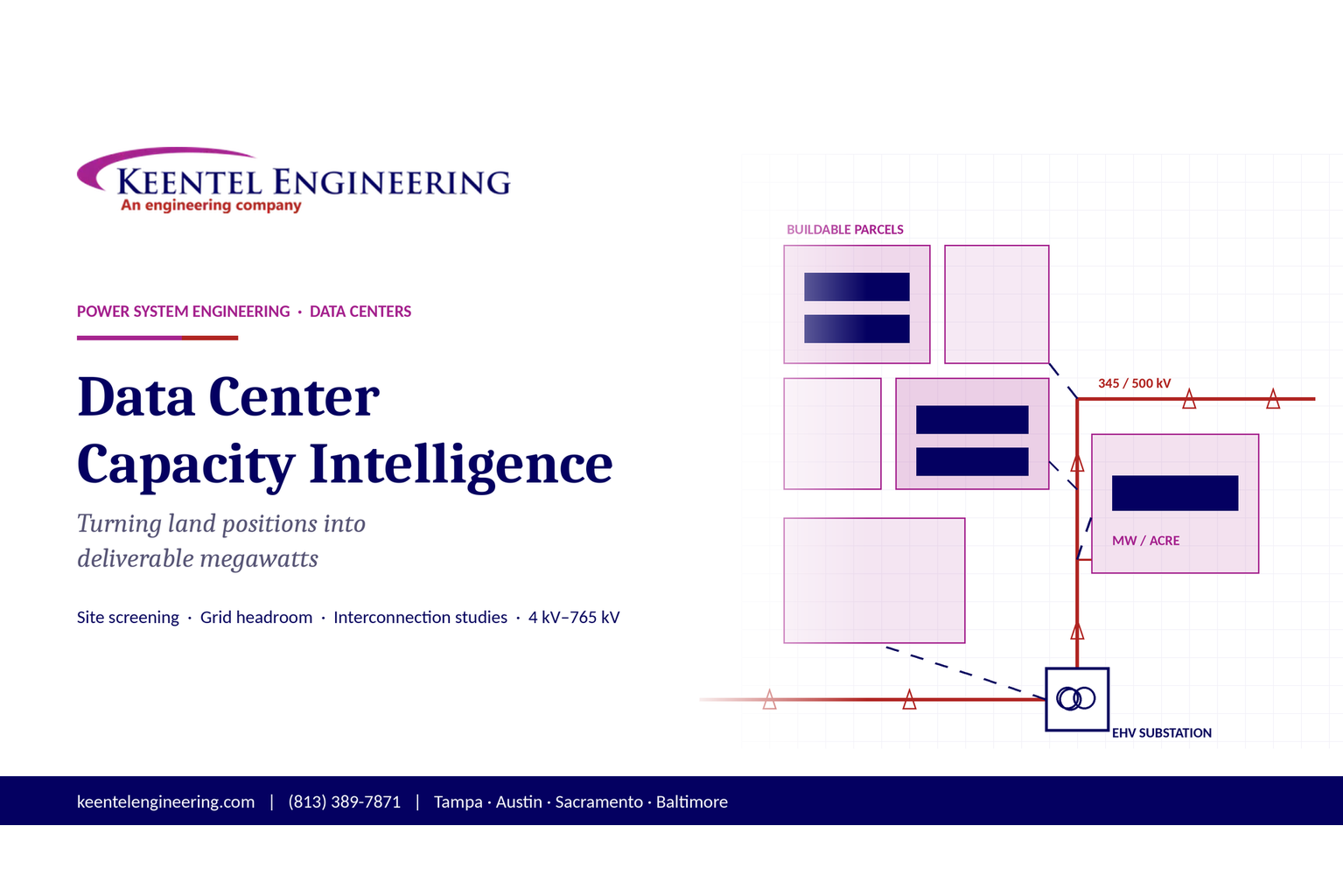
Plan data center capacity with land screening, MW-per-acre estimates, grid power availability and interconnection feasibility studies from Keentel Engineering.
By SANDIP R PATEL
•
October 11, 2026
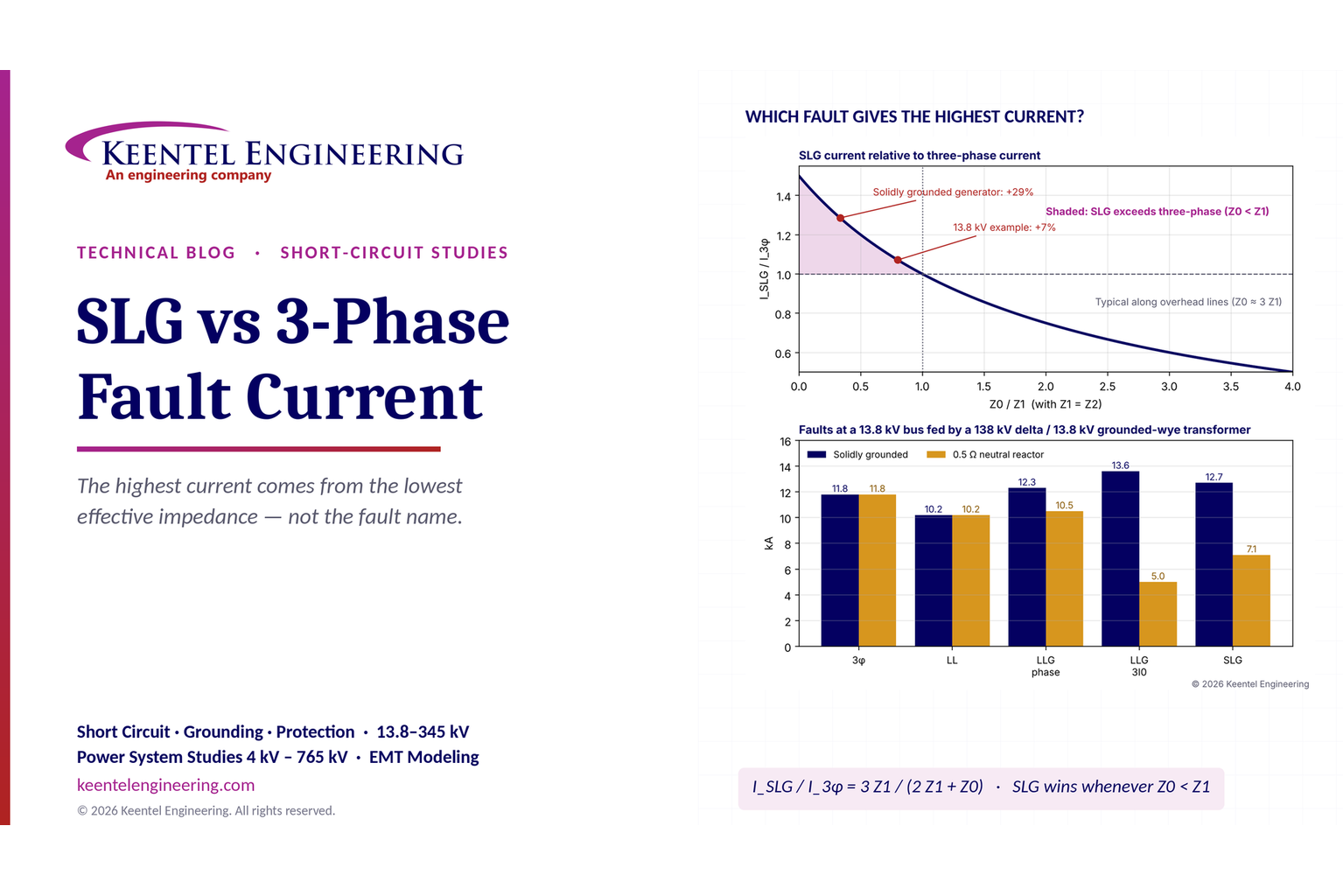
Learn which fault produces the highest current at a bus, why SLG faults can exceed three-phase faults, and how symmetrical components determine fault duty.
By SANDIP R PATEL
•
October 11, 2026
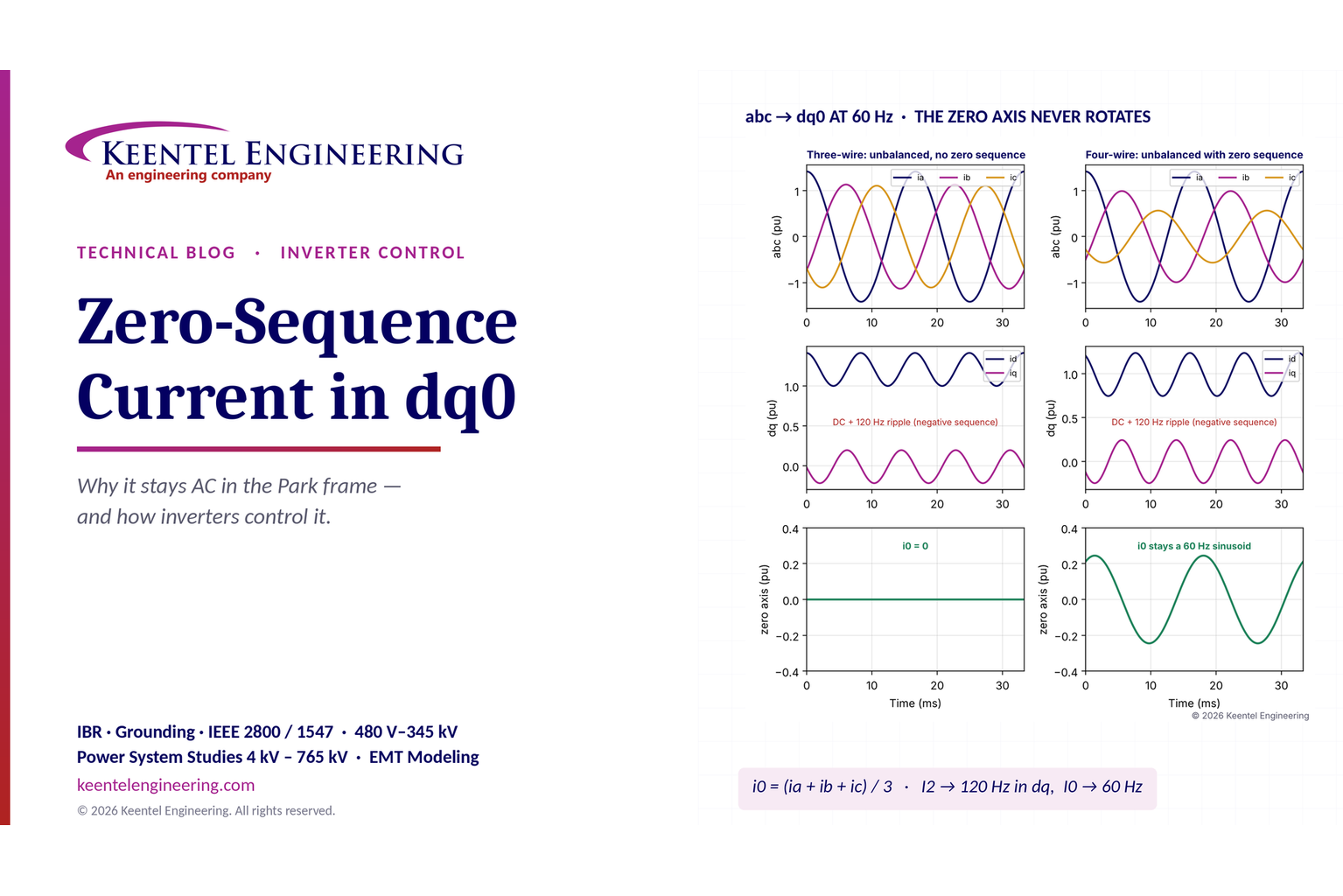
Learn why zero-sequence current pulsates in the dq0 frame, how Park's transformation works, and how inverter controls handle unbalance and ground faults.
By SANDIP R PATEL
•
October 11, 2026
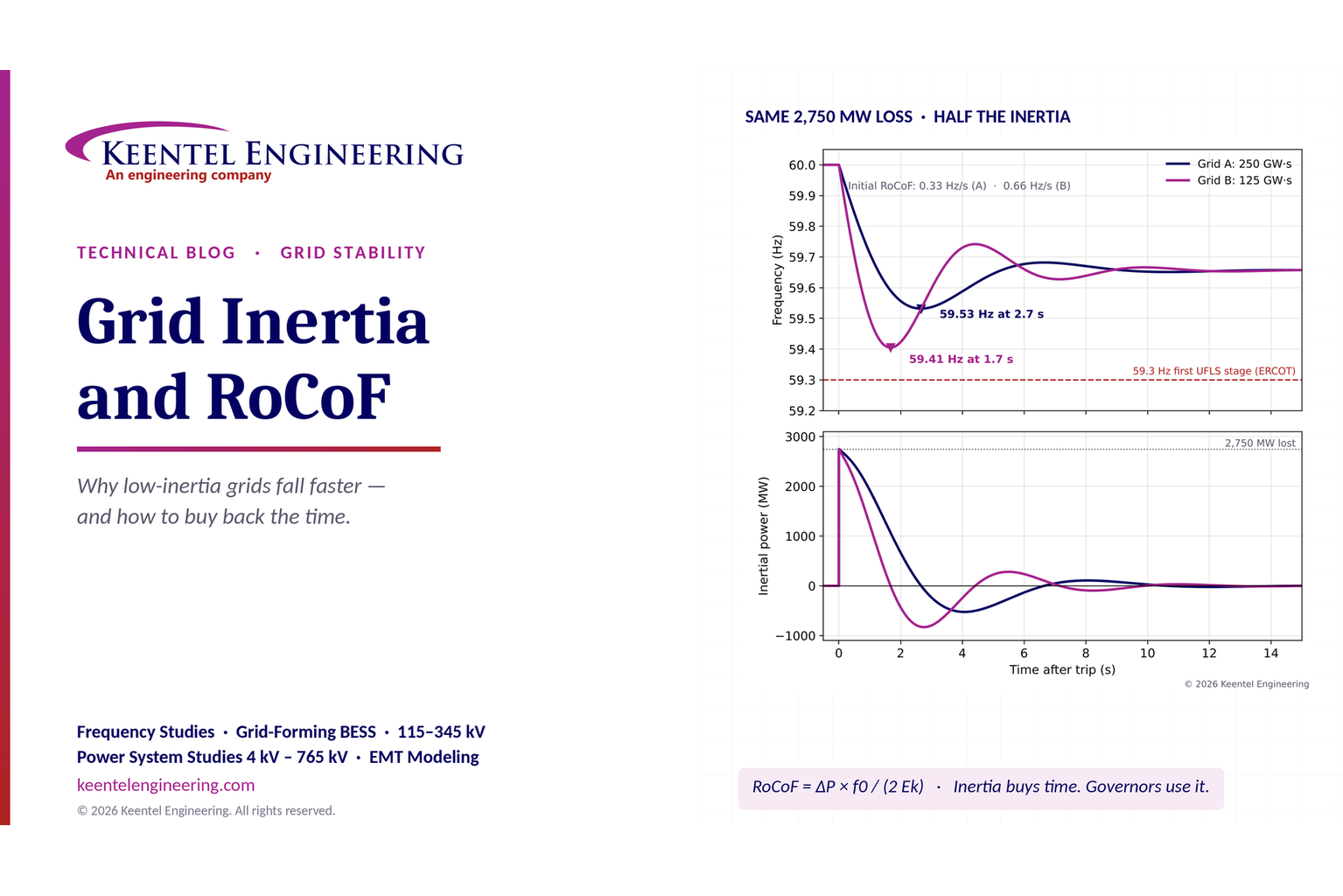
Explore grid inertia, RoCoF and frequency response, with swing equation calculations, frequency nadir analysis and US power system simulation examples.
By SANDIP R PATEL
•
October 11, 2026
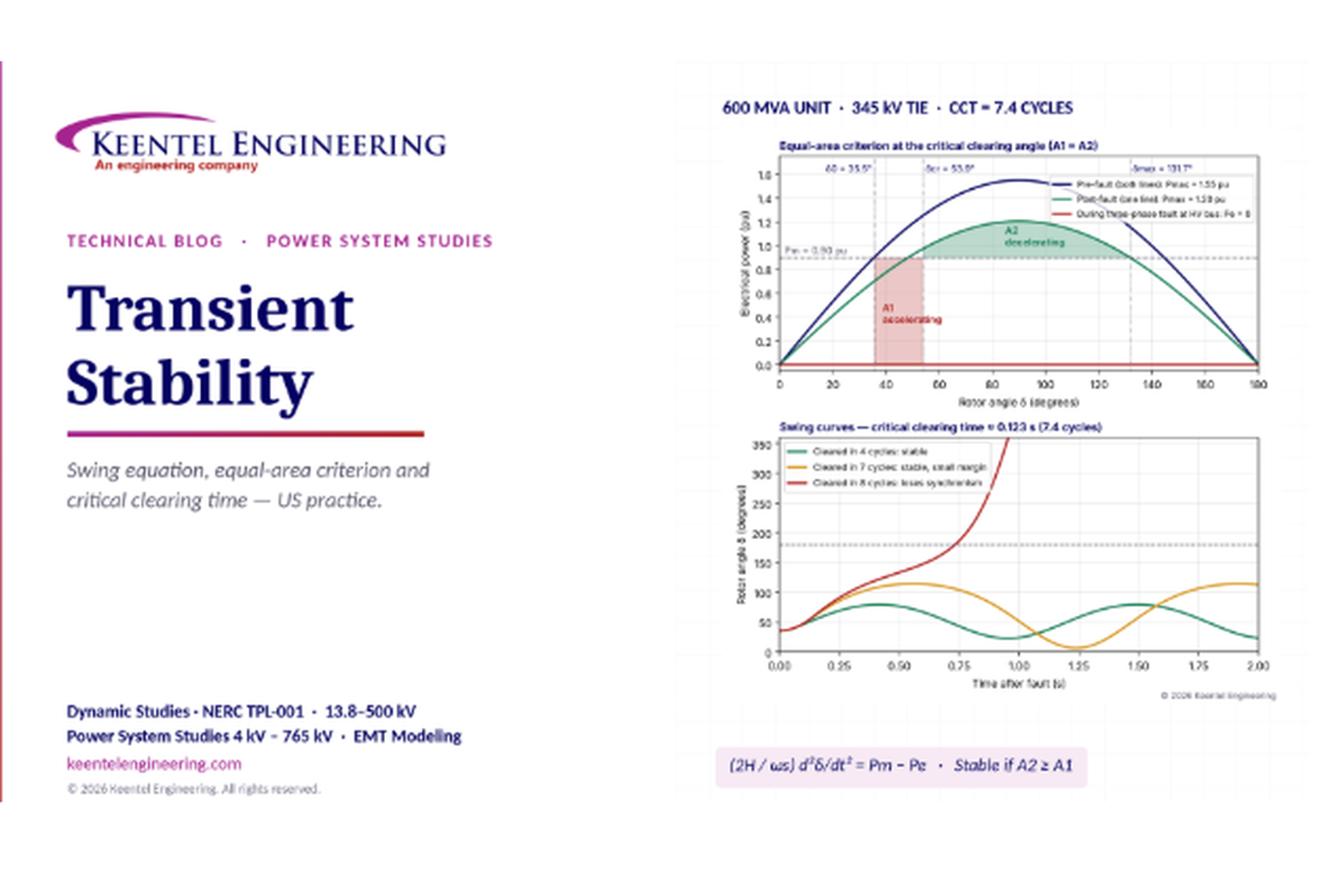
Learn transient stability analysis, swing equation, equal-area criterion and critical clearing time with a 345 kV worked example and NERC TPL-001 guidance.
By SANDIP R PATEL
•
October 11, 2026
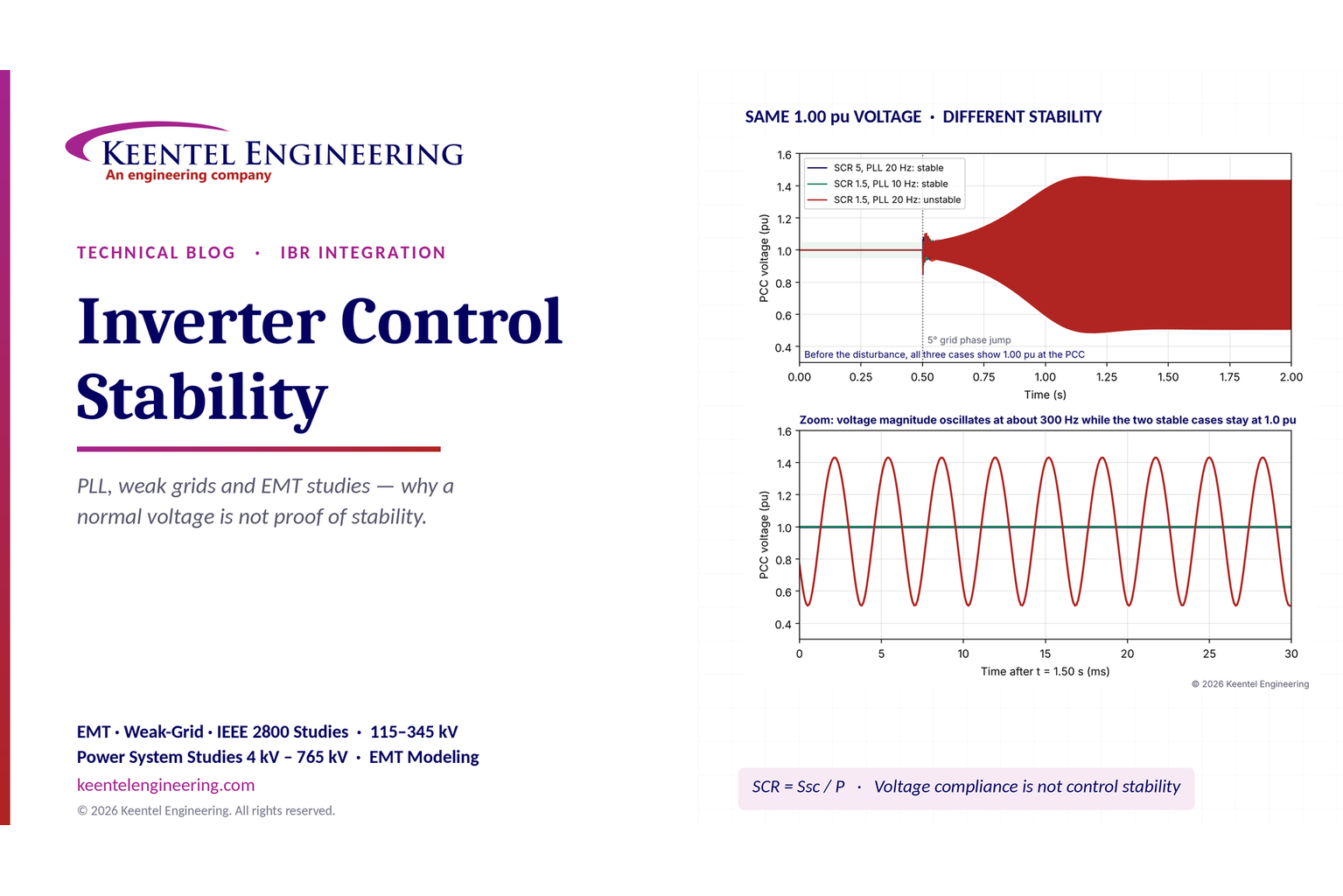
Learn why inverter controls become unstable in weak grids, how PLL bandwidth and SCR affect stability, and how PSCAD EMT studies identify and mitigate oscillations.