

A Coordinated Electric System Interconnection Review—the utility’s deep-dive on technical and cost impacts of your project.

Challenge: Frequent false tripping using conventional electromechanical relays
Solution: SEL-487E integration with multi-terminal differential protection and dynamic inrush restraint
Result: 90% reduction in false trips, saving over $250,000 in downtime

Category Metric
VPP capacity (Lunar Energy) 650 MW
Lunar funding raised US$232 million
Data center BESS example 31 MW / 62 MWh
ERCOT grid-scale batteries 15+ GW
LDES tenders (H1 2026) Up to 9.3 GW
Lithium-ion share of LDES by 2030 77%
FEOC initial threshold 55%
BESS tariff rate (2026) ~55%
Capacity gain from analytics 5–15%

ERCOT Dynamic Model Improvements Under PGRR 085:

Raising the Standard for Model Accuracy, Validation, and Hardware Benchmarking in ERCOT

KeenTel Engineering branded image of an electrical substation with battery storage units, wind turbines, transmission lines, and dynamic grid modeling displayed on a laptop and tablet at sunset
Calendar icon. D

February 18, 2026 | Blog

Executive Overview

Accurate dynamic models are the foundation of reliable grid planning and operations. With increasing penetration of inverter-based resources (IBRs), energy storage resources (ESRs), and advanced transmission equipment, modeling errors no longer result in minor study discrepancies — they can create real operational risks.


PGRR 085 – Dynamic Model Improvements strengthens ERCOT Planning Guide Sections 5.7.1 and 6.2 by introducing:

  • Mandatory model quality testing
  • PSCAD hardware benchmarking
  • Parameter verification reports
  • Defined submission timelines
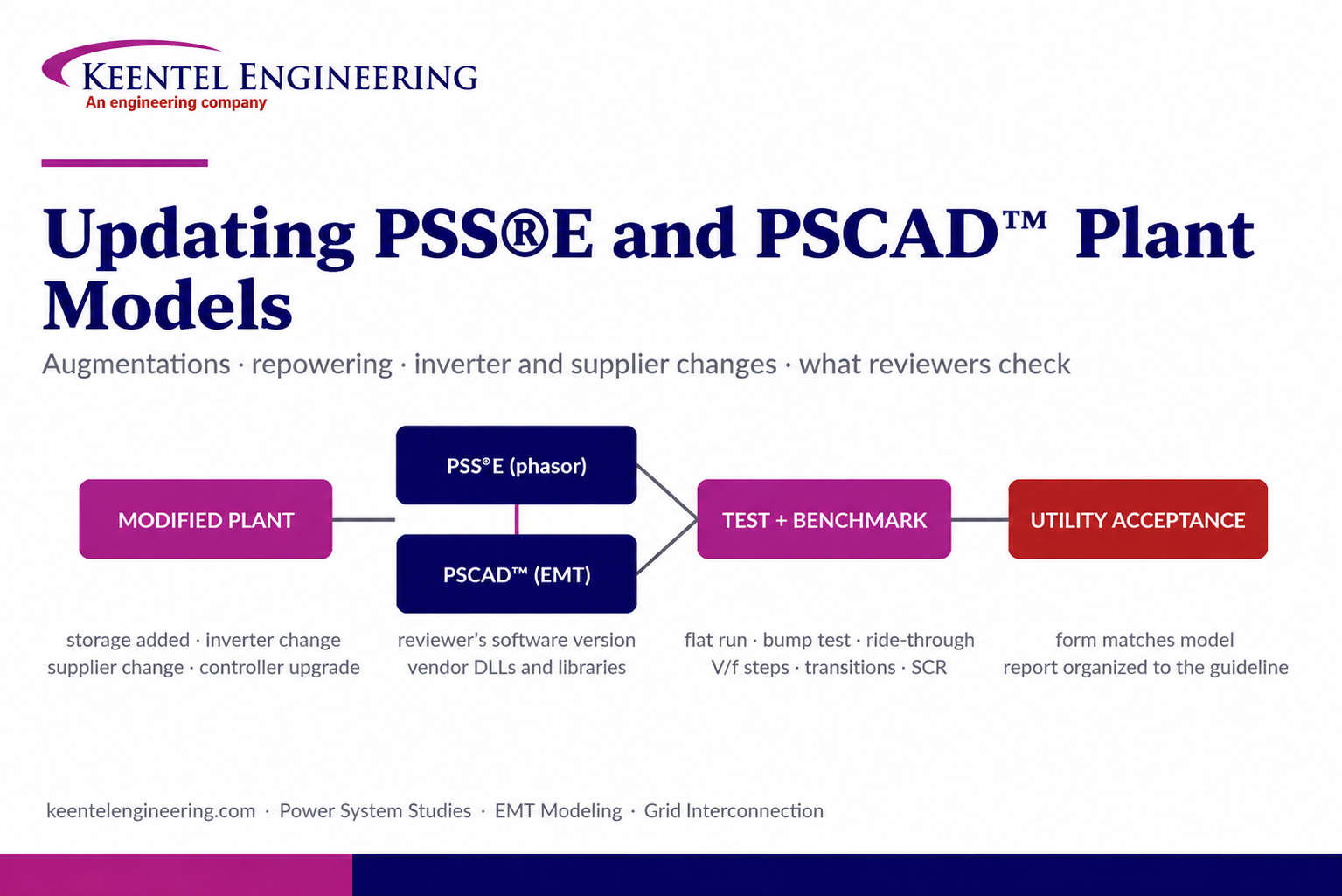
  • Cross-platform consistency requirements (PSS®E and PSCAD)


This revision directly supports Reliability and Operations Subcommittee (ROS) goals to improve dynamic modeling processes 


Why PGRR 085 Was Necessary

Historically, planning models often differed from:

  • Actual field-implemented settings
  • Hardware performance
  • Behavior across simulation platforms


ERCOT uses:

  • PSS®E for general planning stability studies
  • PSCAD for weak grid and subsynchronous resonance (SSR) analysis

PGRR 085 formally establishes the expectation that model response shall be consistent across platforms to the extent of platform capability 


The business case identifies three major goals 

  1. Ensure consistency between model software platforms
  2. Ensure accuracy between models and actual hardware
  3. Ensure ERCOT uses high-quality, accurate system models


Major Requirements Introduced by PGRR 085

1. Dynamic Model Submittals During FIS

Under Section 5.7.1, Interconnecting Entities (IEs) must provide:


If no compatible model exists:

  • The IE must work with vendors or consultants
  • The model must be incorporated into standard libraries 


This eliminates proprietary black-box barriers to system-wide modeling.

2. Model Quality Testing (Section 6.2)

Whenever a new or updated dynamic model is submitted, model quality testing is required.


Required Tests


A. Flat Start Test

Validates:

  • Proper initialization
  • No oscillations under no-disturbance conditions


B. Small Voltage Disturbance Test

Applies:

  • Step increase and decrease at POI
    Demonstrates voltage control and reactive response.


C. Large Voltage Disturbance Test

  • For IBRs/ESRs → Apply VRT profile
  • For synchronous machines → Apply fault at POI 


D. Small Frequency Disturbance Test

Step change in frequency to test governor/active power response.


E. System Strength Test

IBRs must be tested under varying short circuit ratios .

This ensures:

  • Stability under weak grid conditions
  • Robust inverter controls

3. PSCAD Hardware Benchmarking for IBRs

IBRs must provide unit model validation results demonstrating that the PSCAD model accurately represents inverter hardware behavior through structured PSCAD model validation for inverter-based resources.


Required PSCAD validation tests include:

  • Voltage step response
  • VRT testing
  • System strength testing
  • Phase angle jump test
  • Subsynchronous test 


These tests are hardware-type based and may be reused across projects using the same inverter model.

This is a major reliability enhancement.

4. Parameter Verification Reports

Facility owners must provide verification reports confirming:

  • Model parameters match field-implemented settings
  • Site-specific tuning values are documented 


Required Timeline


For Generation Resources and ESRs 

  • At commissioning
  • 12–24 months after commissioning
  • Every 10 years minimum
  • After settings changes


For Transmission Elements:

  • Within 2 years of energization
  • Every 10 years thereafter

5. Ongoing Obligations

Resource Entities must provide updated dynamics data when:

  • Equipment is replaced
  • Settings are changed
  • Field tests indicate model inaccuracies 

Implications for Inverter-Based Resources (IBRs)

IBRs face the most rigorous requirements:

  • PSCAD hardware validation
  • System strength testing
  • Aggregated modeling requirements
  • VRT performance validation
  • Cross-platform consistency


Given the grid’s shift toward inverter dominance, this is both necessary and overdue


Implications for Transmission Service Providers (TSPs)

TSPs must provide dynamic models for:

  • Load shedding relays
  • FACTS devices (SVC, STATCOM)
  • DC ties
  • VFTs
  • Tap-changing transformers 


This creates modeling parity between generation and transmission.


Why This Matters for Reliability

Poor dynamic modeling can result in:

  • Undetected instability
  • Overestimated short circuit strength
  • Inaccurate SSR analysis
  • Improper reactive planning
  • Misleading stability margins


PGRR 085 directly addresses these risks.


Engineering Best Practices for Compliance

To align with PGRR 085:

  1. Maintain a model governance program
  2. Track site-specific tuning parameters
  3. Align commissioning reports with model parameters
  4. Maintain PSCAD and PSS®E version control
  5. Develop repeatable model test scripts
  6. Schedule periodic model audits

The Long-Term Impact

PGRR 085 moves ERCOT toward:

  • Hardware-aligned modeling
  • Cross-platform validation
  • Lifecycle compliance
  • Stronger weak-grid analysis
  • Higher confidence in interconnection studies


As IBR penetration increases, these requirements will become industry standard.


25 Technical FAQs on PGRR 085 Dynamic Model Improvements

  • 1. What is the primary purpose of PGRR 085?

    To improve model accuracy, hardware validation, and cross-platform consistency in ERCOT planning studies 

  • 2. Which sections of the Planning Guide were revised?

    Sections 5.7.1 and 6.2 

  • 3. Are PSCAD models mandatory for IBRs?

    Yes, including unit model validation benchmarking 

  • 4. What is a model quality test?

    Simulation tests verifying correct initialization and dynamic response under disturbances 


  • 5. What is a flat start test?

    A no-disturbance initialization validation test 


  • 6. What is required for large disturbance testing?

    VRT testing for IBRs; POI fault testing for synchronous resources 

  • 7. How often are plant verification reports required?

    At commissioning, within 12–24 months, and every 10 years 

  • 8. Do Transmission Owners have model requirements?

    Yes, including dynamic device models and verification reports 

  • 9. What is the system strength test?

    Testing IBR models under varying short circuit ratios 

  • 10. Must models match field settings?

    Yes  parameter verification documentation is required 

  • 11. Are user written models allowed?

    Yes, with required manuals and unrestricted machine ID allocation 

  • 12. What if no compatible model exists?

    The IE must work with vendors to develop one

  • 13. When must dynamic models be submitted?

    During the FIS process 

  • 14. Are aggregated IRR models allowed?

    Yes, if compliant with Protocol Section 3.10.7.2 

  • 15. What happens if equipment settings change?

    Updated models and verification reports must be submitted 

  • 16. Is dynamics data confidential?

    Yes, considered Protected Information 

  • 17. What is PSCAD hardware benchmarking?

    Validation comparing model output to actual inverter test results 

  • 18. What is the phase angle jump test?

    A PSCAD validation test verifying inverter dynamic response 

  • 19. Are sensitivities required?

    Yes  voltage setpoint, real power, and reactive power sensitivities must be assessed 

  • 20. Are simulation files required?

    Yes, associated files must accompany test results 

  • 21. What planning tools must models support?

    PSS®E and PSCAD environments 

  • 22. When are transmission device reports required?

    Within two years of energization and every 10 years thereafter 

  • 23. What happens if data is not submitted?

    It may delay studies or result in cancellation 

  • 24. Are model updates required during operations?

    Yes, when field conditions or equipment change

  • 25. Why is cross-platform consistency critical?

    ERCOT uses different tools for different study types; inconsistent models undermine study credibilit


Man in a blazer and open shirt, looking at the camera, against a blurred background.

About the Author:

Sonny Patel P.E. EC

IEEE Senior Member

In 1995, Sandip (Sonny) R. Patel earned his Electrical Engineering degree from the University of Illinois, specializing in Electrical Engineering . But degrees don’t build legacies—action does. For three decades, he’s been shaping the future of engineering, not just as a licensed Professional Engineer across multiple states (Florida, California, New York, West Virginia, and Minnesota), but as a doer. A builder. A leader. Not just an engineer. A Licensed Electrical Contractor in Florida with an Unlimited EC license. Not just an executive. The founder and CEO of KEENTEL LLC—where expertise meets execution. Three decades. Multiple states. Endless impact.

Four workers in safety vests and helmets stand with arms crossed near wind turbines.

Let's Discuss Your Project

Let's book a call to discuss your electrical engineering project that we can help you with.

Man in a blazer and open shirt, looking at the camera, against a blurred background.

About the Author:

Sonny Patel P.E. EC

IEEE Senior Member

In 1995, Sandip (Sonny) R. Patel earned his Electrical Engineering degree from the University of Illinois, specializing in Electrical Engineering . But degrees don’t build legacies—action does. For three decades, he’s been shaping the future of engineering, not just as a licensed Professional Engineer across multiple states (Florida, California, New York, West Virginia, and Minnesota), but as a doer. A builder. A leader. Not just an engineer. A Licensed Electrical Contractor in Florida with an Unlimited EC license. Not just an executive. The founder and CEO of KEENTEL LLC—where expertise meets execution. Three decades. Multiple states. Endless impact.

Leave a Comment

Related Posts

Blog banner showing data centers, utility-scale battery storage, and power transmission infrastructu
By SANDIP R PATEL February 10, 2026
Analysis of how hyperscale data centers and gigawatt-scale loads are transforming U.S. power systems, driving new tariffs, transmission upgrades, and critical power system studies.
Blog banner showing virtual power plants, utility-scale battery storage, solar panels, and wind turb
By SANDIP R PATEL February 10, 2026
Industry update on virtual power plants, large-scale energy storage, long-duration systems, and grid resilience trends reshaping the U.S. power system in 2026.
Aerial view of a large-scale 700 MWh battery energy storage facility with grid-connected solar panel
By SANDIP R PATEL February 10, 2026
Statistical insights into Alliant Energy’s 700 MWh utility-scale battery storage deployment across Wisconsin and Iowa, analyzing grid reliability, EMS integration, solar firming, and decarbonization impact.
Keentel Engineering branded image showing electrical control panels with wiring and network equipmen
By SANDIP R PATEL February 8, 2026
Learn best practices for substation secondary systems design—covering protection and control, DC systems, relay panels, CT/VT circuits, redundancy, and compliant substation engineering.
Keentel Engineering blog banner featuring a modern data center facility, electrical substation
By SANDIP R PATEL February 8, 2026
How AI data centers and gigawatt-scale loads are reshaping U.S. grid planning, tariffs, transmission upgrades, and utility regulation.
Keentel Engineering blog banner showing renewable energy grid infrastructure with solar panels, wind
By SANDIP R PATEL February 8, 2026
Virtual power plants and energy storage boosting grid resilience in 2026 through flexibility and smart resource planning.
Keentel Engineering featured image for NYISO Interconnection Modeling Guidelines Explained showing p
By SANDIP R PATEL February 7, 2026
A comprehensive engineering guide to NYISO interconnection modeling requirements, including steady-state, short-circuit, and dynamic studies.
Keentel Engineering featured image illustrating AI data centers, grid stress, and large-load regulat
By SANDIP R PATEL February 7, 2026
Data-driven analysis of AI data center load growth, large-load tariffs, transmission planning, and ratepayer protection shaping U.S. power systems.
Keentel Engineering banner featuring a panoramic view of a nuclear power plant overlaid with a detai
By SANDIP R PATEL February 3, 2026
Explore the critical design of Class 1E electrical systems in nuclear plants. Learn about safety compliance, redundancy, emergency power, and grid interfaces.