

A Coordinated Electric System Interconnection Review—the utility’s deep-dive on technical and cost impacts of your project.
Challenge: Frequent false tripping using conventional electromechanical relays
Solution: SEL-487E integration with multi-terminal differential protection and dynamic inrush restraint
Result: 90% reduction in false trips, saving over $250,000 in downtime
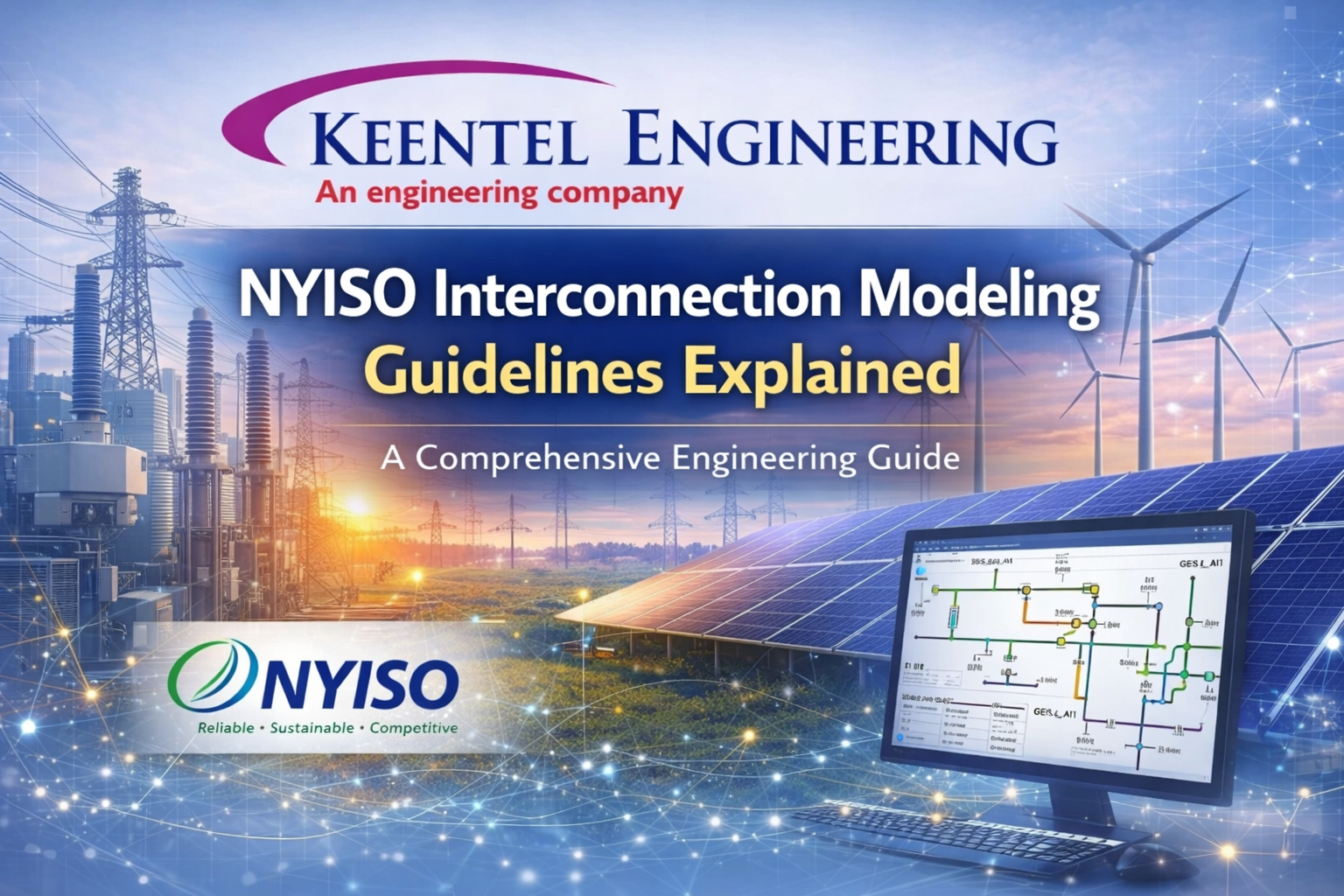
NYISO Interconnection Modeling Guidelines Explained: A Comprehensive Engineering Guide
February 07, 2026 | Blog
Introduction
Interconnecting new generation, energy storage, and hybrid resources to the New York Independent System Operator (NYISO) transmission system requires rigorous power system modeling that meets strict technical and compliance standards. The NYISO Modeling Guideline for Interconnection Data (Version 10, July 1, 2024) establishes detailed requirements for steady-state, short-circuit, and dynamic stability models submitted as part of the NYISO Cluster Study process under Attachment HH of the NYISO Open Access Transmission Tariff (OATT) .
For project developers, inaccurate or incomplete modeling is one of the most common causes of study delays, deficiency notices, and re-submittals. For engineering firms, it requires deep familiarity not only with software tools such as PSS®E and ASPEN OneLiner, but also with NERC standards, NYISO-specific conventions, and Transmission Owner (TO) requirements.
This article provides a comprehensive, engineering-level explanation of NYISO interconnection modeling requirements, focusing on what is required, why it matters, and how projects can successfully navigate the NYISO cluster study process.
Purpose and Scope of the NYISO Modeling Guideline
The NYISO Modeling Guideline was developed to standardize the data, structure, and performance expectations for interconnection project models entering NYISO Cluster Studies, including Transitional Cluster Studies.
Core Objectives
- Ensure consistent and usable models across all interconnection requests
- Support accurate thermal, voltage, short-circuit, and stability analysis
- Reduce modeling ambiguity between Interconnection Customers, NYISO, and Connecting Transmission Owners (CTOs)
Modeling Deliverables Required
Each interconnection request must include:
- One-line diagram
- Steady-state (power flow) model
- Short-circuit model
- Dynamic (stability) model
- Model usability testing compliance
One-Line Diagram Requirements
The one-line diagram is not a conceptual sketch—it is an engineering document that must accurately represent the project configuration.
Key requirements include:
- Professionally prepared engineering drawing
- Clear labeling of the Point of Interconnection (POI) using NYISO-recognized station or line names
- Representation of all major components:
- Generators or inverter blocks
- GSUs and PSUs
- Collector systems
- FACTS devices (STATCOM, SVC)
- HVDC components, if applicable
The one-line diagram must be fully consistent with all submitted models. Any mismatch is grounds for rejection.
Steady-State Modeling Requirements (PSS®E)
Steady-state models form the foundation of NYISO power flow analysis and must be compatible with PSS®E version 35.3.3 .
Aggregation Philosophy
NYISO strongly prefers aggregated modeling:
- One equivalent generator per resource type
- Separate equivalents only when technically necessary (e.g., different PSUs)
This reduces simulation complexity while preserving system behavior.
Bus Modeling and Naming Conventions
All project buses must:
- Use bus numbers 888000–888999
- Default voltage: 1.0 p.u.
- Default angle: 0 degrees
- Area, Owner, Zone set to 1
NYISO enforces strict bus naming conventions, such as:
- C####_POI
- C####_GSU1
- C####_PSU1
- C####_COL1
- C####_G1
These conventions allow NYISO to automatically integrate project models into Cluster Project Assessment (CPA) cases.
Generator Modeling Requirements
Control Modes
- Synchronous machines: Control mode 0
- Inverter-based resources (IBRs): Control mode 1 or 2, depending on reactive capability treatment
Reactive Capability
- Projects must meet ±0.95 power factor
- Measured at:
- POI for synchronous machines
- PSU high side for inverter-based resources
Active Power Settings
- Pgen set to 0 (NYISO dispatches generation)
- Pmax ≥ ERIS + losses
- Storage resources must properly represent both charging and discharging states
Transformer Modeling (GSU and PSU)
Transformers must be modeled explicitly—implicit transformers are not allowed.
Key requirements:
- Correct winding configuration (2- or 3-winding)
- Accurate R/X values on correct MVA base
- Proper tap changer settings and control modes
- Ratings must reflect nameplate or cooling stage, as applicable
Transformer errors are a frequent cause of NYISO model rejection.
Shunt Devices, STATCOMs, and SVCs
- Fixed and switched shunts must include realistic voltage control ranges
- STATCOMs are modeled as shunt FACTS devices in PSS®E
- SVCs are modeled as generators with zero real power capability
Voltage control buses must match between steady-state and dynamic models.
Short-Circuit Modeling Requirements (ASPEN OneLiner)
Short-circuit models must be compatible with ASPEN OneLiner version 15.7 .
General Principles
- Loads and shunts are excluded
- Synchronous generators modeled conventionally
- Inverter-based resources modeled as Voltage Controlled Current Sources (VCCS)
Fault Performance Expectations
The project must inject reactive current for:
- Single line-to-ground faults
- Line-to-line faults
- Three-phase faults
No network anomalies or non-convergence are permitted.
Transformer and Line Modeling
- Exact winding configurations and vector groups are mandatory
- Zero-sequence data must be explicitly defined
- Line impedances must include both positive and zero-sequence values
Incorrect grounding assumptions are a common modeling deficiency.
Stability Modeling Requirements (Dynamic Models)
Dynamic models must be compatible with PSS®E version 35.3.3 and rely on standard library models wherever possible .
Inverter-Based Resource Model Structure
A complete IBR dynamic model includes:
- Protection models (voltage and frequency)
- Generator model (e.g., REGCA1)
- Electrical control model (e.g., REECA1)
- Plant controller (e.g., REPCA1)
- Optional STATCOM or auxiliary controls
All protection must comply with NERC PRC-024 ride-through requirements.
Synchronous Resource Model Structure
Includes:
- Generator model
- Governor model
- Exciter model (simplified exciters discouraged)
- Stabilizer model
- Protection models
NYISO explicitly discourages oversimplified excitation systems.
Model Usability Testing
NYISO performs strict usability testing to confirm model reliability.
Required Tests
- 20-second flat run test
- 9-cycle three-phase fault test
- Protection compliance verification
- Primary frequency response and droop checks
Failure of any test results in model rejection.
Ride-Through and Recovery Performance
- No tripping during faults
- Active power recovery to ≥90%
- Voltage recovery to ≥0.9 p.u. within 5 seconds
- Compliance with NERC PRC-024 voltage and frequency curves
Transmission Owner–specific criteria (e.g., LIPA) may impose stricter limits.
Conclusion
NYISO interconnection modeling is not a formality—it is a highly technical engineering deliverable that directly impacts project schedules, costs, and feasibility. Successful projects require:
- Deep familiarity with NYISO conventions
- Accurate, consistent modeling across tools
- Compliance with NERC and TO-specific requirements
- Rigorous internal validation before submission
Engineering expertise and attention to detail are the difference between smooth cluster progression and months of costly delays.
25 Frequently Asked Questions (FAQs)
1. What PSS®E versions are accepted by NYISO?
NYISO requires steady-state models in PSS®E 35.3.3 and dynamic models compatible with PSS®E 35.5.3, ensuring consistency across cluster studies.
2. Why does NYISO require aggregated generator models?
Aggregation improves simulation performance while preserving system-level behavior, reducing unnecessary complexity in large cluster cases.
3. Are implicit GSUs allowed in NYISO models?
No. All GSUs must be explicitly modeled with correct electrical parameters.
4. How are inverter-based resources modeled in short-circuit studies?
IBRs must be represented as VCCS models, injecting reactive current only.
5. What happens if bus naming conventions are not followed?
NYISO may reject the model, as automated case integration depends on strict naming rules.
6. Is PRC-024 compliance mandatory for all projects?
Yes. All dynamic protection models must comply with PRC-024 voltage and frequency ride-through criteria.
7. Can user-written dynamic models be submitted?
Only if no standard library model exists and the model series has been accepted by NYISO’s MMWG.
8. How is energy storage charging represented?
Charging is modeled as negative generation (withdrawal) at the POI, with defined Pmin values.
9. Are loads included in short-circuit models?
No. Loads and shunts are excluded per NYISO TEI Manual guidance.
10. What is the most common reason for model rejection?
Inconsistencies between the one-line diagram, steady-state, short-circuit, and dynamic models.
11. How are STATCOMs represented dynamically?
Using standard STATCOM models (e.g., SVSMO3T2) with voltage control at the designated bus.
12. Do GSUs and PSUs use the same MVA base?
No. GSUs use nameplate MVA; PSUs use self-cooled or cooling-stage ratings.
13. What is the 20-second flat run test?
A no-disturbance dynamic simulation verifying numerical stability and proper initialization.
14. What fault duration is used for ride-through testing?
A 9-cycle (0.15 s) three-phase fault at the POI, unless limited by critical clearing time.
15. Can projects trip during testing?
No. Any tripping results in test failure.
16. How is frequency droop evaluated?
Droop must be ≤5% and enabled in governor or plant controller models.
17. Are hybrid resources modeled as a single generator?
Typically yes, but separate equivalents may be required depending on configuration.
18. What are NYISO bus number requirements?
Project buses must use numbers between 888000 and 888999.
19. Are HVDC projects treated differently?
Yes. Each converter end is modeled separately, with detailed control specifications.
20. What happens after model submission?
NYISO performs validation, testing, and integration into CPA cases.
21. Can TOs impose stricter requirements?
Yes. CTO-specific criteria (e.g., LIPA) may exceed PRC-024 requirements.
22. How is voltage recovery evaluated?
Voltages must recover to ≥0.9 p.u. within 5 seconds after fault clearing.
23. Are simplified excitation models allowed?
NYISO discourages overly simplified exciters due to accuracy concerns.
24. Why is internal validation critical before submission?
Errors discovered during NYISO review cause delays and re-study cycles.
25. How can engineering expertise reduce interconnection risk?
Experienced engineers anticipate NYISO expectations, align models correctly, and avoid costly rework.

About the Author:
Sonny Patel P.E. EC
IEEE Senior Member
In 1995, Sandip (Sonny) R. Patel earned his Electrical Engineering degree from the University of Illinois, specializing in Electrical Engineering . But degrees don’t build legacies—action does. For three decades, he’s been shaping the future of engineering, not just as a licensed Professional Engineer across multiple states (Florida, California, New York, West Virginia, and Minnesota), but as a doer. A builder. A leader. Not just an engineer. A Licensed Electrical Contractor in Florida with an Unlimited EC license. Not just an executive. The founder and CEO of KEENTEL LLC—where expertise meets execution. Three decades. Multiple states. Endless impact.
Services

Let's Discuss Your Project
Let's book a call to discuss your electrical engineering project that we can help you with.

About the Author:
Sonny Patel P.E. EC
IEEE Senior Member
In 1995, Sandip (Sonny) R. Patel earned his Electrical Engineering degree from the University of Illinois, specializing in Electrical Engineering . But degrees don’t build legacies—action does. For three decades, he’s been shaping the future of engineering, not just as a licensed Professional Engineer across multiple states (Florida, California, New York, West Virginia, and Minnesota), but as a doer. A builder. A leader. Not just an engineer. A Licensed Electrical Contractor in Florida with an Unlimited EC license. Not just an executive. The founder and CEO of KEENTEL LLC—where expertise meets execution. Three decades. Multiple states. Endless impact.
Leave a Comment
We will get back to you as soon as possible.
Please try again later.