

A Coordinated Electric System Interconnection Review—the utility’s deep-dive on technical and cost impacts of your project.

Challenge: Frequent false tripping using conventional electromechanical relays
Solution: SEL-487E integration with multi-terminal differential protection and dynamic inrush restraint
Result: 90% reduction in false trips, saving over $250,000 in downtime

2025–2026 Winter Reliability Assessment: What It Means for Grid Reliability, Compliance, and Engineering Strategy

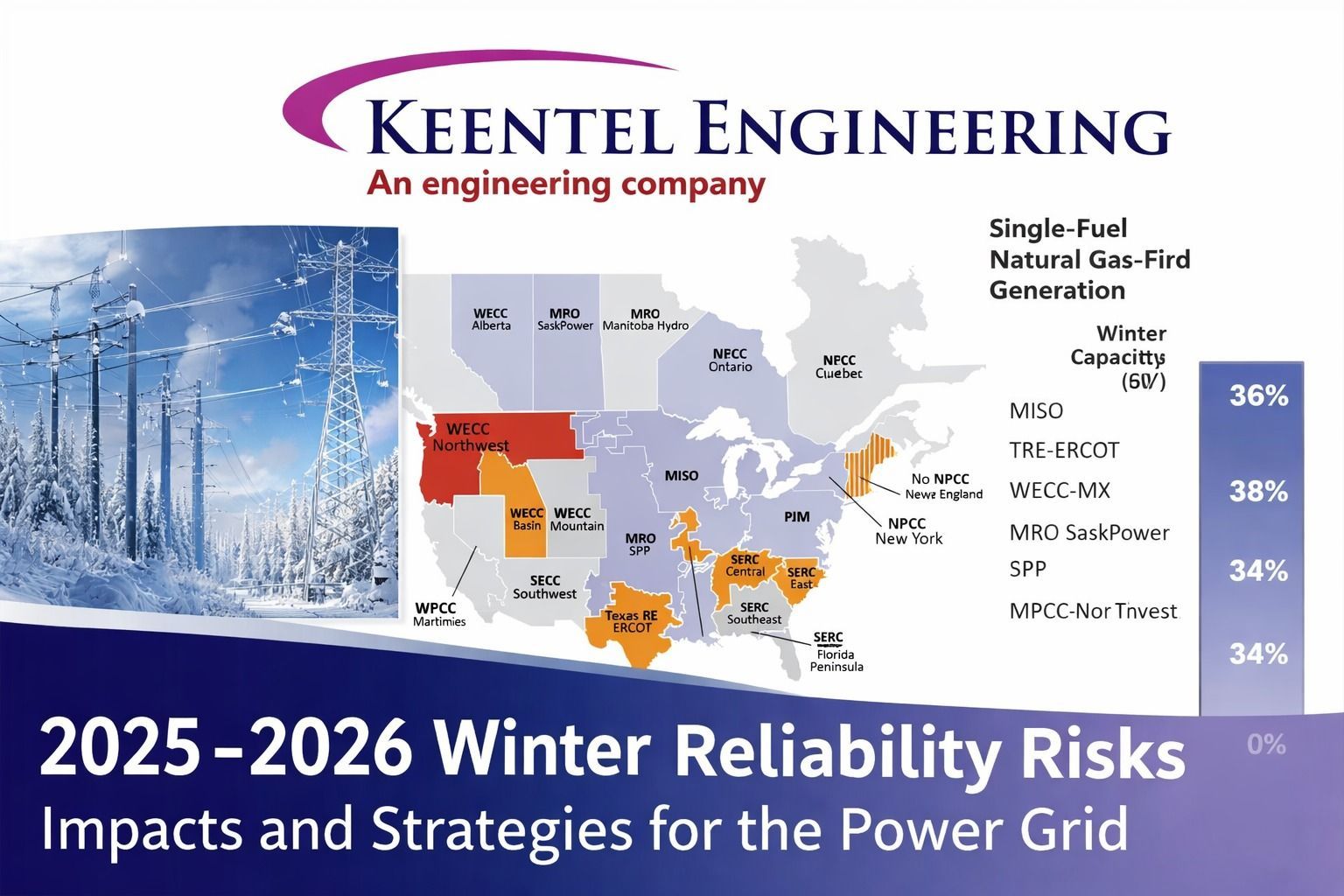
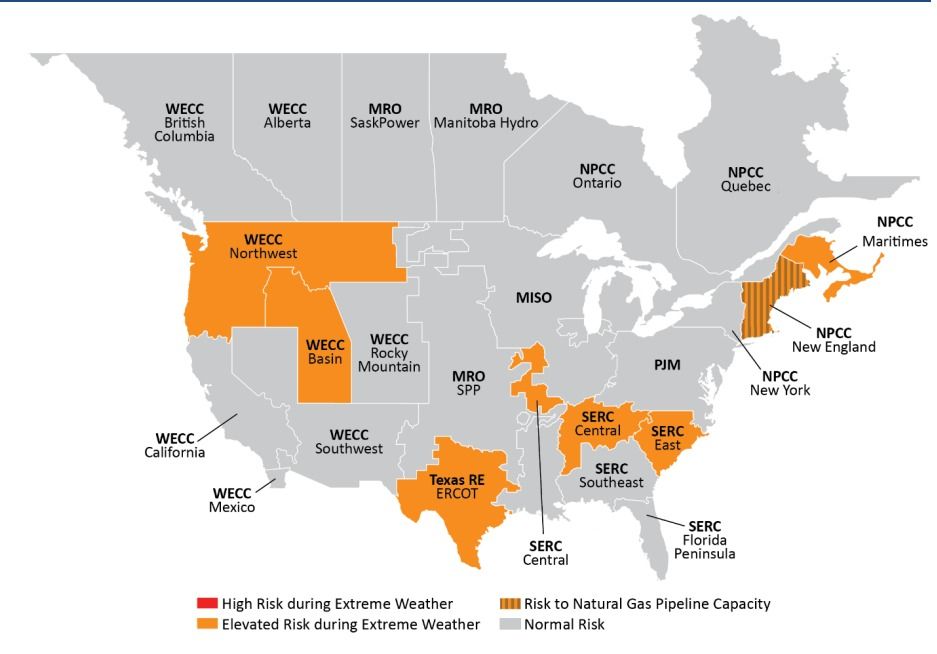
Map of 2025-2026 Winter Reliability Risks for the power grid with Keentel Engineering logo.
Calendar icon. D

january 29, 2026 | Blog

Introduction: Why the Winter Reliability Assessment Matters

Each year, the North American Electric Reliability Corporation (NERC) publishes its Winter Reliability Assessment (WRA) to evaluate whether the Bulk Power System (BPS) can reliably meet electricity demand during the winter season. The 2025–2026 Winter Reliability Assessment is particularly important because it reflects a power system undergoing rapid transformation. This includes rising winter demand, accelerated electrification, large data-center load growth, the retirement of conventional thermal generation, and increasing reliance on inverter-based resources (IBRs), battery energy storage systems (BESS), and demand response programs.

For utilities, Generator Owners (GOs), Transmission Owners (TOs), Balancing Authorities (BAs), and large load developers, the WRA is not just an informational report—it is a risk signal. It highlights where winter reliability margins are tightening, where operational mitigations may be required, and where compliance, planning, and engineering rigor will be critical to avoid Energy Emergency Alerts (EEAs) or load shedding.

For utilities, Generator Owners (GOs), Transmission Owners (TOs), Balancing Authorities (BAs), and large load developers, the WRA is not just an informational report—it is a risk signal. It highlights where winter reliability margins are tightening, where operational mitigations may be required, and where compliance, planning, and engineering rigor will be critical to avoid Energy Emergency Alerts (EEAs) or load shedding.

At Keentel Engineering, we view the WRA as a roadmap for proactive engineering, compliance alignment, and risk-informed system design. This blog breaks down the key findings of the 2025–2026 WRA and explains what they mean from an engineering, planning, and NERC compliance perspective.


Big Picture Trends Driving Winter Reliability Risk

Winter Demand Is Rising Faster Than Resources

One of the most striking findings in the 2025–2026 WRA is the rapid growth in winter peak demand. After years of relatively flat load growth, aggregate winter peak demand across NERC assessment areas has increased by approximately 20 GW (about 2.5%) year-over-year.

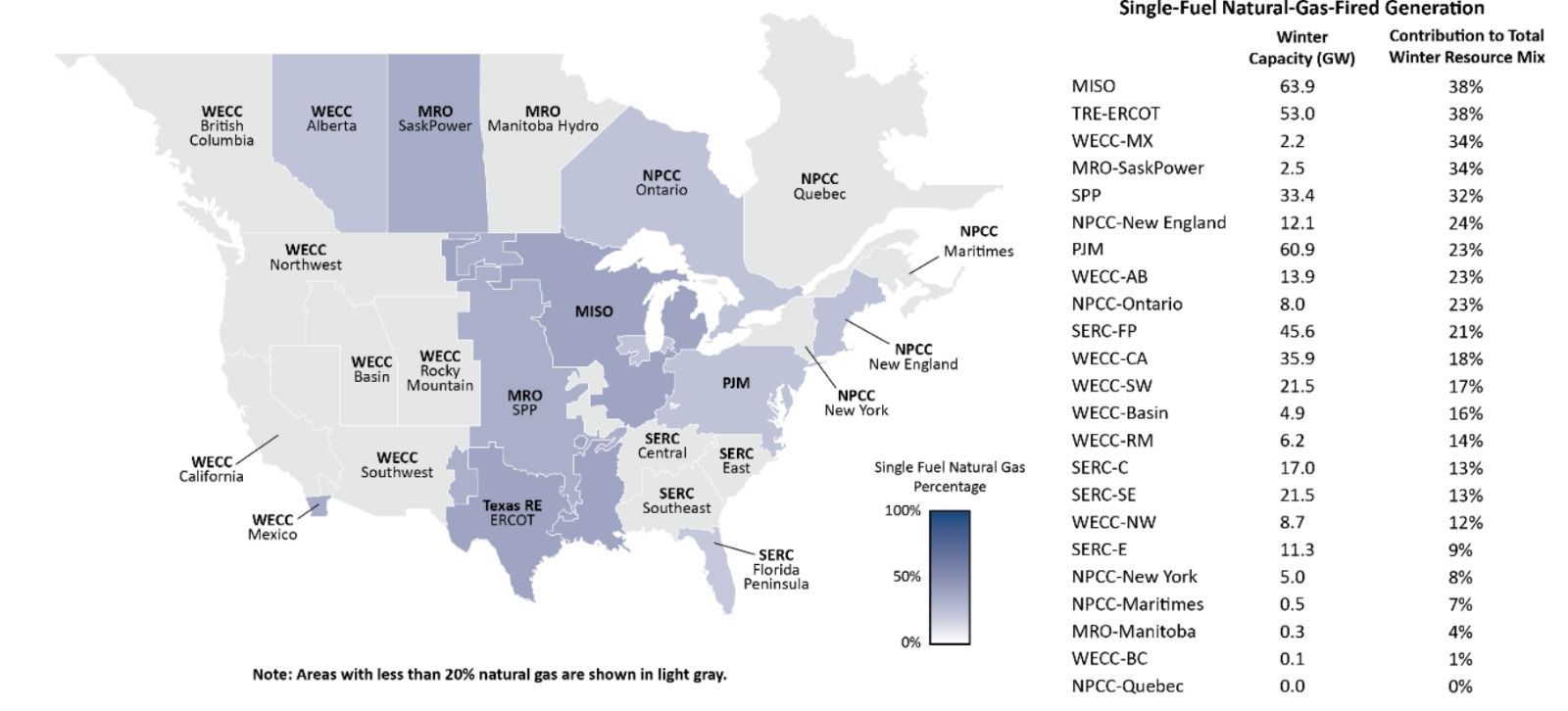
Map showing regions with Single-Fuel Natural Gas-Fired Generation for the 2025-2026 winter, highlighting capacity and resource mix.

Key drivers include:

  • Large-scale data center development, particularly in ERCOT, PJM, and the Pacific Northwest
  • Electrification of space heating, shifting traditionally summer-peaking systems toward dual- or winter-peaking behavior
  • Industrial electrification and round-the-clock loads that flatten daily load curves

While total resources have increased, the pace of resource growth (≈9.4 GW) is significantly lower than demand growth, creating tighter reserve margins during winter risk hours.


The Resource Mix Is Changing—And That Changes Risk Profiles

The WRA confirms a continued shift away from traditional thermal generation toward:

While these resources provide important flexibility and decarbonization benefits, they introduce new operational and planning challenges:

  • Solar output is minimal during winter peak hours, which often occur before sunrise or after sunset
  • Wind output can be highly variable during extreme cold weather
  • Battery systems are energy-limited and depend on state-of-charge management during multi-day cold events
  • Demand response is constrained by contractual limits on duration and frequency of use

    From an engineering standpoint, this means capacity adequacy alone is no longer sufficient energy adequacy, endurance, and fuel security must also be evaluated.


Natural Gas Remains the Backbone—and the Bottleneck

Natural-gas-fired generation continues to play a critical role in meeting winter peak demand across much of North America. However, the WRA again highlights gas-electric interdependencies as a dominant winter reliability risk:

  • Gas production and delivery infrastructure is vulnerable to freeze-offs during extreme cold
  • Many generators rely on non-firm gas transportation, increasing curtailment risk
  • Misalignment between gas and electric market timelines complicates fuel procurement
  • Natural gas infrastructure winterization remains largely voluntary outside of Texas

Although improvements have been observed since Winter Storms Uri and Elliott, fuel assurance remains one of the most consequential winter reliability challenges.


Regional Risk Highlights: Where Winter Reliability Is Most Challenged

The WRA assesses each NERC region using Anticipated Reserve Margins (ARM), deterministic stress scenarios, and probabilistic risk metrics such as LOLH and EUE. While all regions are adequate under normal conditions, several areas face elevated risk under extreme cold scenarios:

  • ERCOT (Texas): Continued exposure to reserve shortages during extreme winter conditions, despite improved winterization and growing battery deployment
  • NPCC-Maritimes: Reserve margins below reference levels under certain scenarios, with likely reliance on emergency operating procedures
  • SERC-East and SERC-Central: Transitioning toward winter or dual-peaking behavior due to electrification trends
  • WECC-Basin and WECC-Northwest: Increased reliance on imports during extreme cold, which may not be available during wide-area events

For these regions, engineering preparedness and operational readiness are critical risk mitigators.


Cold Weather Reliability Standards: A Major Step Forward

A major development reflected in the 2025–2026 WRA is the implementation of enhanced cold weather Reliability Standards. In late 2025, FERC approved updates to EOP-012, establishing enforceable requirements for:

  • Generator freeze protection measures
  • Cold weather preparedness plans
  • Corrective action tracking
  • Operator training and readiness

Initial data indicates that the vast majority of winter capacity can operate at or below defined Extreme Cold Weather Temperatures (ECWTs). This represents a meaningful improvement in baseline winter readiness, but compliance effectiveness will depend on robust engineering implementation, documentation, and ongoing verification.


What This Means for Engineering and Compliance

The 2025–2026 WRA reinforces several critical engineering imperatives:

  • Winter is now a planning season equal to summer
  • Energy adequacy matters as much as capacity adequacy
  • Fuel security must be engineered, not assumed
  • IBR integration requires advanced modeling and scenario analysis
  • NERC compliance must be embedded into design and operations

At Keentel Engineering, we help clients translate these insights into actionable solutions through:

  • Winter reliability and extreme weather studies
  • Gas-electric coordination assessments
  • BESS endurance and state-of-charge analysis
  • Probabilistic resource adequacy evaluations
  • NERC EOP, PRC, and TPL compliance support

Related Articles


Frequently Asked Questions (FAQ)

  • What is the purpose of NERC’s Winter Reliability Assessment?

    The WRA evaluates whether the Bulk Power System has sufficient resources and operational flexibility to meet winter peak demand under normal and extreme weather conditions. It identifies regional risks, emerging trends, and areas requiring heightened preparedness.

  • Why is winter reliability becoming more challenging than in the past?

    Winter demand is increasing due to electrification and data centers, while the resource mix is shifting toward variable and energy-limited resources. At the same time, fuel supply risks—especially for natural gas—remain significant during extreme cold events.

  • What are Anticipated Reserve Margins (ARM)?

    ARM represents the percentage by which anticipated resources exceed forecast net internal demand under normal peak conditions. It is a core metric used to assess resource adequacy.

  • Why can regions with high reserve margins still face reliability risk?

    Reserve margins are calculated under normal assumptions. Extreme cold, correlated outages, fuel supply disruptions, and low renewable output can quickly erode available reserves.

  • How do batteries contribute to winter reliability?

    Batteries provide fast-responding capacity and contingency support, but their contribution is limited by stored energy and recharge opportunities during prolonged cold events.

  • Why is natural gas such a critical winter reliability issue?

    Natural gas supplies a large portion of winter generation, but it cannot be easily stored on-site. Freeze-offs, pipeline constraints, and non-firm contracts increase outage risk.

  • What are Energy Emergency Alerts (EEAs)?

    EEAs are declared when a BA faces insufficient resources to meet demand and reserves. They range from EEA-1 (all resources in use) to EEA-3 (firm load shedding).

  • How does electrification affect winter peak demand?

    Electrification of heating increases demand during cold mornings and evenings, shifting peak load from summer afternoons to winter risk hours.

  • What role does demand response play in winter reliability?

    Demand response can reduce peak demand, but its availability is limited by contractual duration, notification requirements, and customer participation.

  • What is EOP-012 and why is it important?

    EOP-012 is a NERC Reliability Standard focused on cold weather preparedness for generators, requiring freeze protection, planning, and training.


Final Thoughts

The 2025–2026 Winter Reliability Assessment sends a clear message: winter reliability risk is increasing, not decreasing. Success will depend on proactive engineering, rigorous modeling, disciplined compliance, and a deep understanding of how modern resource portfolios behave under extreme conditions.

Keentel Engineering stands ready to help utilities, generators, and developers turn these risks into resilient, compliant, and reliable power system solutions.


Man in a blazer and open shirt, looking at the camera, against a blurred background.

About the Author:

Sonny Patel P.E. EC

IEEE Senior Member

In 1995, Sandip (Sonny) R. Patel earned his Electrical Engineering degree from the University of Illinois, specializing in Electrical Engineering . But degrees don’t build legacies—action does. For three decades, he’s been shaping the future of engineering, not just as a licensed Professional Engineer across multiple states (Florida, California, New York, West Virginia, and Minnesota), but as a doer. A builder. A leader. Not just an engineer. A Licensed Electrical Contractor in Florida with an Unlimited EC license. Not just an executive. The founder and CEO of KEENTEL LLC—where expertise meets execution. Three decades. Multiple states. Endless impact.

Four workers in safety vests and helmets stand with arms crossed near wind turbines.

Let's Discuss Your Project

Let's book a call to discuss your electrical engineering project that we can help you with.

Man in a blazer and open shirt, looking at the camera, against a blurred background.

About the Author:

Sonny Patel P.E. EC

IEEE Senior Member

In 1995, Sandip (Sonny) R. Patel earned his Electrical Engineering degree from the University of Illinois, specializing in Electrical Engineering . But degrees don’t build legacies—action does. For three decades, he’s been shaping the future of engineering, not just as a licensed Professional Engineer across multiple states (Florida, California, New York, West Virginia, and Minnesota), but as a doer. A builder. A leader. Not just an engineer. A Licensed Electrical Contractor in Florida with an Unlimited EC license. Not just an executive. The founder and CEO of KEENTEL LLC—where expertise meets execution. Three decades. Multiple states. Endless impact.

Leave a Comment

Related Posts

Lifecycle management of T&D switchgear using condition monitoring data, showing engineers analyzing
By SANDIP R PATEL January 24, 2026
Learn how utilities use condition monitoring data to manage T&D switchgear lifecycles, reduce failure risk, extend asset life, and enable condition-based maintenance.
Frequency response characteristics of voltage measurement systems illustrated with substation and wa
By SANDIP R PATEL January 21, 2026
Explore frequency response characteristics of voltage measurement systems used in power substations and grid analysis by Keentel Engineering.
Keentel Engineering white paper cover on reevaluating IEEE and IEC substation standards for increase
By SANDIP R PATEL January 21, 2026
Professional white paper cover by Keentel Engineering on reevaluating IEEE and IEC substation standards, featuring an electrical substation under fault conditions.
Learn how PJM D-Curve reactive capability testing is performed for wind farms and inverter-based res
By SANDIP R PATEL January 15, 2026
Learn how PJM D-Curve reactive capability testing is performed for wind farms and inverter-based resources, including testing requirements, measurement basis, and eDART submission support.
Energy sector integration showing power grids, wind turbines, solar energy, and multi-energy system
By SANDIP R PATEL January 1, 2026
Explore how energy sector integration reshapes modern power grids, improving decarbonization, resilience, and system planning based on CIGRE TB 973 insights.
Diagram illustrating real-code EMT modeling for HVDC, FACTS, and inverter-based resources in power s
By SANDIP R PATEL January 1, 2026
Learn how IEEE/CIGRE real-code EMT modeling improves HVDC, FACTS, and inverter-based resource studies with higher fidelity, compliance accuracy, and tool-independent simulation.
A practical guide to upcoming NERC Reliability Standards (2026–2028), key effective dates, and compl
By SANDIP R PATEL December 29, 2025
A practical guide to upcoming NERC Reliability Standards (2026–2028), key effective dates, and compliance readiness for inverter-based resource owners.
Cover of a guide on ERCOT Model Quality Tests for IBR owners and developers, wit
By SANDIP R PATEL December 26, 2025
Complete technical guide to ERCOT Model Quality Tests (MQT) for inverter-based resources. Covers PRC-029-1, IEEE 2800-2022, PSCAD, SCR testing, and pass/fail criteria.
Graphic for PRC-030-1, event analysis for inverter-based resources. Solar farm, technicians monitoring data, equipment.
By SANDIP R PATEL December 26, 2025
PRC-030-1 compliance guide for Generator Owners covering IBR event analysis, corrective action plans, audit requirements, and post-disturbance obligations.