A Coordinated Electric System Interconnection Review—the utility’s deep-dive on technical and cost impacts of your project.
Challenge: Frequent false tripping using conventional electromechanical relays
Solution: SEL-487E integration with multi-terminal differential protection and dynamic inrush restraint
Result: 90% reduction in false trips, saving over $250,000 in downtime
| Category | Metric |
|---|---|
| VPP capacity (Lunar Energy) | 650 MW |
| Lunar funding raised | US$232 million |
| Data center BESS example | 31 MW / 62 MWh |
| ERCOT grid-scale batteries | 15+ GW |
| LDES tenders (H1 2026) | Up to 9.3 GW |
| Lithium-ion share of LDES by 2030 | 77% |
| FEOC initial threshold | 55% |
| BESS tariff rate (2026) | ~55% |
| Capacity gain from analytics | 5–15% |
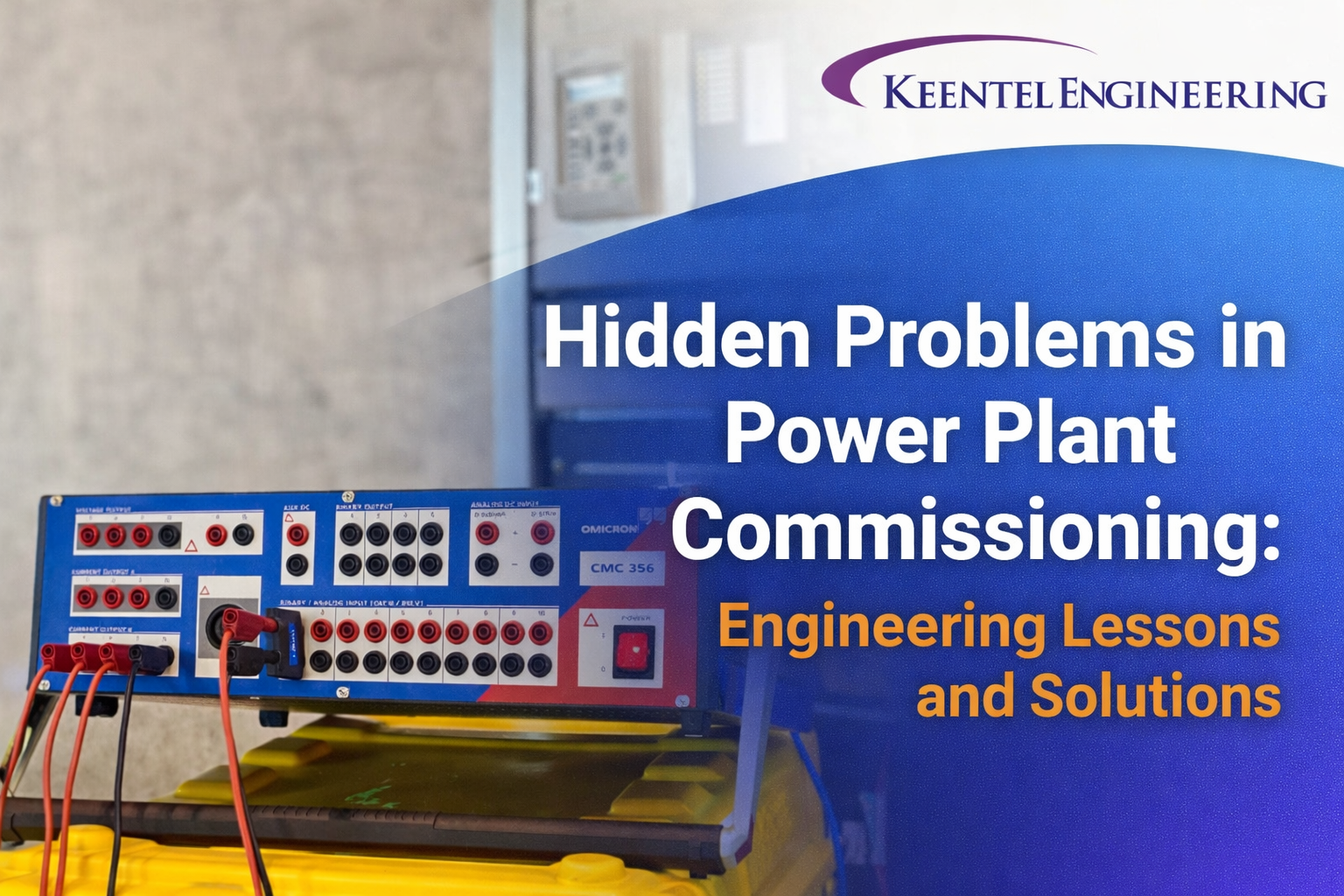
Hidden Problems in Power Plant Commissioning: Engineering Lessons and Solutions
March 11, 2026 | blog
How Advanced Commissioning Expertise Prevents Failures in Power Generation Projects
Commissioning a power plant is one of the most critical phases of any power generation project. While design, procurement, and construction may take years, the final step commissioning and testing the plant before operation often determines whether the facility performs reliably or suffers from costly operational failures.
Many engineers assume commissioning is simply the final stage of construction where equipment is energized and tested. In reality, commissioning is a complex engineering discipline involving electrical testing, control system verification, protection coordination, safety validation, and operational performance evaluation.
Industry experience shows that most commissioning challenges are not visible during design or construction. Hidden wiring issues, incorrect protection logic, instrumentation failures, communication faults, or control system errors frequently emerge only when the plant operates under real conditions.
electrical-engineering-portal.c…
For power utilities, renewable developers, and industrial facilities, these hidden issues can cause:
- Unexpected plant trips
- Generator instability
- Grid compliance failures
- Equipment damage
- Delayed commercial operation
At Keentel Engineering, our commissioning engineering services focus on identifying and resolving these hidden problems before they impact operations.
This article explores the most common hidden commissioning challenges in power plants and how professional engineering services mitigate them.
Understanding the Power Plant Commissioning Process
Commissioning is the systematic process of verifying that power plant systems operate according to design specifications and grid requirements.
The process typically includes three primary stages:
- Pre-Commissioning (Dry Commissioning)
- Commissioning (Wet Commissioning)
- Reliability Run and Grid Testing
Each stage requires extensive electrical, mechanical, and control system verification.
Stage 1: Pre-Commissioning – Testing Equipment Before Energization
Pre-commissioning involves verifying individual electrical and control components before the plant is energized.
Typical pre-commissioning tasks include:
- Switchgear testing
- Protection relay verification
- Cable testing
- Transformer inspections
- Motor rotation checks
- Control wiring validation
During this phase, equipment such as switchgear, transformers, MCCs, and protection relays are tested individually while isolated from the system.
electrical-engineering-portal.c…
This stage ensures that each device functions correctly before integration with other plant systems.
Protection Relay Testing and Secondary Injection
One of the most important pre-commissioning tests is secondary injection testing of protection relays.
Protection systems are verified by injecting simulated current and voltage signals into relay inputs to confirm correct tripping behavior.
These tests verify:
- Overcurrent protection
- Undervoltage protection
- Differential protection
- Breaker trip logic
Three-phase test sets simulate real operating conditions by feeding CT and PT secondary signals to the relay system.
electrical-engineering-portal.c…
Without proper relay testing, the plant may experience fault clearing failures or unnecessary trips during operation.
Switchgear and Circuit Breaker Testing
Medium-voltage and high-voltage switchgear must be thoroughly tested before energization.
Circuit breakers are typically tested in three positions:
- Withdrawn Position
- Test Position
- Connected Position
Testing breakers in these positions allows engineers to verify:
- Charging mechanisms
- Trip operations
- Control circuit functionality
- Protection interlocks
Even when switchgear is de-energized, breakers remain operational through DC control circuits typically supplied by 125V battery systems.
electrical-engineering-portal.c…
Commissioning engineers verify all breaker functions before energizing feeders.
Motor Control Center (MCC) Commissioning
Industrial plants and power stations rely heavily on motors and pump systems.
MCC commissioning includes:
- Motor rotation verification
- Starter testing
- Protection setting validation
- Motor inrush current evaluation
During testing, motors are often decoupled from mechanical loads such as pumps or conveyors to verify correct rotation and protection settings.
electrical-engineering-portal.c…
Incorrect rotation or protection settings can cause mechanical damage or nuisance tripping.
Cable and Control Wiring Verification
One of the most common commissioning problems involves control wiring errors.
Even in well-designed plants, wiring mistakes occur frequently due to:
- Incorrect termination
- Misinterpreted cable schedules
- Incomplete wiring diagrams
- Incorrect interlock connections
Modern power plants increasingly use digital communication protocols such as Ethernet, Modbus, and DeviceNet, reducing reliance on traditional wiring diagrams.
electrical-engineering-portal.c…
However, this shift introduces new commissioning challenges related to:
- Communication configuration
- Network delays
- Signal mapping errors
- Protocol mismatches
Engineering verification of these systems is critical.
Transformer Commissioning and Oil Testing
Power transformers require careful inspection before energization.
A key step is transformer oil dielectric testing.
Transformer oil must meet minimum dielectric strength values:
- New oil: greater than 65 kV/cm
- Existing oil: greater than 60 kV/cm
If oil fails testing, it must be filtered and dehydrated before transformer energization.
electrical-engineering-portal.c…
Oil testing prevents insulation breakdown and catastrophic transformer failure.
Stage 2: Wet Commissioning – Testing the Fully Energized Plant
After pre-commissioning is completed, the plant enters the wet commissioning stage.
This stage involves testing the plant under real operating conditions, including:
- Electrical load
- Water flow
- Steam pressure
- Fuel supply
- Process automation
Commissioning engineers now verify that all plant systems function together as an integrated system.
electrical-engineering-portal.c…
This stage often reveals problems that were impossible to detect earlier.
Primary Injection Testing
During commissioning, equipment is energized and real current flows through system components.
This is known as primary injection testing.
Engineers observe:
- Current flow through breakers
- Relay measurements
- Instrumentation readings
- Control system responses
Primary injection testing confirms that protection and control systems operate correctly under real load conditions.
electrical-engineering-portal.c…
Control System and Interlock Testing
Modern power plants rely heavily on automation and digital control systems .
Interlocks play a crucial role in plant safety and operation.
Examples include:
- Pump start interlocks
- Turbine protection logic
- Emergency shutdown systems
- Generator protection schemes
Interlocks may be implemented using:
- Hardwired electrical logic
- PLC-based control systems
- Distributed Control Systems (DCS)
Errors in these systems often lead to unexpected shutdowns or unsafe operating conditions.
electrical-engineering-portal.c…
Hidden Commissioning Problems Engineers Often Encounter
During commissioning, engineers frequently encounter unexpected issues.
Typical problems include:
Mechanical Failures
Examples include pump misalignment, turbine vibration, or valve malfunction.
Electrical Wiring Errors
Incorrect wiring can lead to breaker malfunction, failed interlocks, or incorrect signals to control systems.
Control Logic Errors
PLC or DCS programming mistakes may prevent proper plant operation.
Instrumentation Failures
Pressure transmitters, level switches, or sensors may behave unpredictably under real process conditions.
In one example, a hydroelectric generator experienced intermittent failure to switch operating modes due to turbulence affecting level switches. Engineers resolved the issue by modifying the sensing tube configuration.
electrical-engineering-portal.c…
Reliability Run: Proving Plant Performance
After commissioning, the plant enters the Reliability Run phase.
This stage verifies that the plant can operate continuously without major failures.
Typical reliability runs last 7 to 30 days.
During this period, the plant must operate continuously under varying load conditions to confirm operational stability.
electrical-engineering-portal.c…
Successful completion typically results in:
- Operational acceptance
- Ownership transfer
- Start of the warranty period
Grid Compliance Testing
Power plants must also pass grid interconnection tests before full commercial operation.
Typical grid tests include:
- Load dispatch following capability
- Reactive power dispatch control
- Ramp rate performance
- Generator synchronization
- Frequency response
- Black start capability
- Loss of station service tests
These tests confirm that the plant can operate reliably within the electrical grid.
Importance of Detailed Commissioning Reports
Many contractor reports only document successful tests.
However, experienced engineers maintain detailed chronological commissioning logs that include:
- Test conditions
- Observed failures
- Root cause analysis
- Corrective actions
Accurate documentation helps operators diagnose future issues and improve plant reliability.
How Keentel Engineering Supports Power Plant Commissioning
Keentel Engineering provides advanced electrical engineering services for power plants, renewable projects, substations, and industrial facilities.
Our commissioning services include:
Electrical Commissioning
- Switchgear and substation testing
- Generator commissioning
- Protection relay validation
Control System Testing
- PLC and SCADA verification
- DCS logic validation
- Interlock testing
Power System Studies
- Short circuit studies
- Protection coordination
- Dynamic stability modeling
Grid Interconnection Engineering
- Grid code compliance studies
- Dynamic modeling support
- NERC compliance consulting
Our engineering team ensures that power plants operate safely, reliably, and in compliance with
Conclusion
Commissioning is one of the most challenging and critical phases of power plant development.
While most engineering work occurs during design and construction, the commissioning stage is where hidden problems emerge.
These problems often involve:
- Wiring errors
- Control system logic issues
- Instrumentation faults
- Protection misconfigurations
Without proper commissioning expertise, these issues can lead to operational failures, equipment damage, and delayed project completion.
Through advanced engineering services and deep power system expertise, Keentel Engineering helps developers successfully transition from construction to reliable plant operation.
Frequently Asked Questions (FAQ)
1. What is power plant commissioning?
Power plant commissioning verifies that electrical, mechanical, and control systems operate correctly before commercial operation.
2. What is pre-commissioning?
Pre-commissioning involves testing equipment individually before system energization.
3. What is wet commissioning?
Wet commissioning tests the integrated system under real operating conditions.
4. What is secondary injection testing?
Secondary injection testing simulates CT and PT signals to verify protection relay operation.
5. What is primary injection testing?
Primary injection testing applies real current through equipment to verify protection system performance.
6. Why are wiring errors common during commissioning?
Wiring errors occur due to installation mistakes, incorrect cable schedules, or outdated schematics.
7. What is a reliability run?
A reliability run verifies continuous plant operation for a defined period without major failures.
8. Why is transformer oil testing necessary?
Transformer oil testing ensures insulation strength before energization.
9. What are interlocks in power plants?
Interlocks are safety conditions that allow or prevent equipment operation.
10. What grid tests must generators pass?
Generators must pass frequency response, voltage control, ramp rate, and synchronization tests.
11. Why is commissioning documentation important?
Detailed records help diagnose future plant failures.
12. What services does Keentel Engineering provide?
Keentel Engineering provides commissioning engineering, power system studies, and grid compliance consulting.

About the Author:
Sandip "Sonny" R. Patel, P.E.
IEEE Senior Member · Founder & CEO, Keentel Engineering
In 1995, Sonny Patel earned his Electrical Engineering degree from the University of Illinois. But degrees don't build legacies — action does.
For three decades, he has worked the power industry from every side of the table: 16 years as a utility engineer at Exelon/Commonwealth Edison; generation leadership across hydroelectric, industrial steam turbine, and a 9 GW renewable fleet; NERC Regional Entity Senior Compliance Engineer and Audit Team Lead, auditing some of the nation's largest utilities; and testing and commissioning lead on equipment up to 765 kV — the very top of the North American grid.Utility. Generator. Regulator. Consultant. Few engineers have seen all four seats. Fewer still have sat in them.
His experience spans nuclear, hydro, conventional generation, renewables, oil and gas, mining — and today's data centers, where he is authoring a three-book series on data center design. He is a Licensed Professional Engineer in six states and a Licensed Electrical Contractor in Florida (Unlimited EC) — he doesn't just design the work; he's qualified to stand behind its execution.Today, as Founder and CEO of Keentel Engineering, Sonny leads a nationwide team of engineers delivering substation design, power system studies, NERC compliance, and commissioning — done right, coast to coast.Three decades. Every side of the table. One standard: accountable engineering.
Services

Let's Discuss Your Project
Let's book a call to discuss your electrical engineering project that we can help you with.
About the Author:
Sandip "Sonny" R. Patel, P.E.
IEEE Senior Member · Founder & CEO, Keentel Engineering
In 1995, Sonny Patel earned his Electrical Engineering degree from the University of Illinois. But degrees don't build legacies — action does.
For three decades, he has worked the power industry from every side of the table: 16 years as a utility engineer at Exelon/Commonwealth Edison; generation leadership across hydroelectric, industrial steam turbine, and a 9 GW renewable fleet; NERC Regional Entity Senior Compliance Engineer and Audit Team Lead, auditing some of the nation's largest utilities; and testing and commissioning lead on equipment up to 765 kV — the very top of the North American grid.
Utility. Generator. Regulator. Consultant. Few engineers have seen all four seats. Fewer still have sat in them.
His experience spans nuclear, hydro, conventional generation, renewables, oil and gas, mining — and today's data centers, where he is authoring a three-book series on data center design. He is a Licensed Professional Engineer in six states and a Licensed Electrical Contractor in Florida (Unlimited EC) — he doesn't just design the work; he's qualified to stand behind its execution.
Today, as Founder and CEO of Keentel Engineering, Sonny leads a nationwide team of engineers delivering substation design, power system studies, NERC compliance, and commissioning — done right, coast to coast.Three decades. Every side of the table. One standard: accountable engineering.
Leave a Comment
Thank you for contacting us.
We will get back to you as soon as possible.
We will get back to you as soon as possible.
Oops, there was an error sending your message.
Please try again later.
Please try again later.
Related Posts
By SANDIP R PATEL
•
October 13, 2026
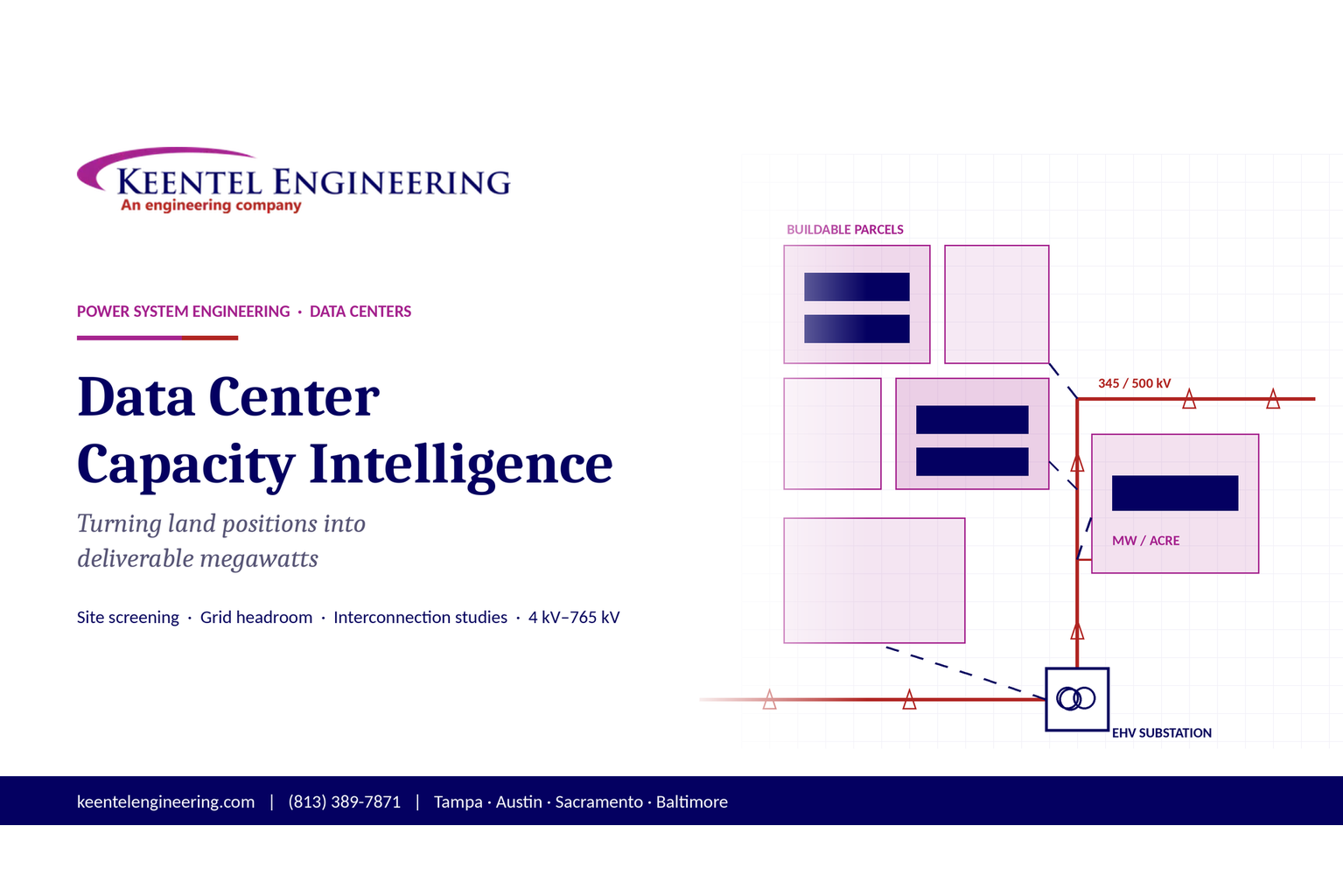
Plan data center capacity with land screening, MW-per-acre estimates, grid power availability and interconnection feasibility studies from Keentel Engineering.
By SANDIP R PATEL
•
October 11, 2026
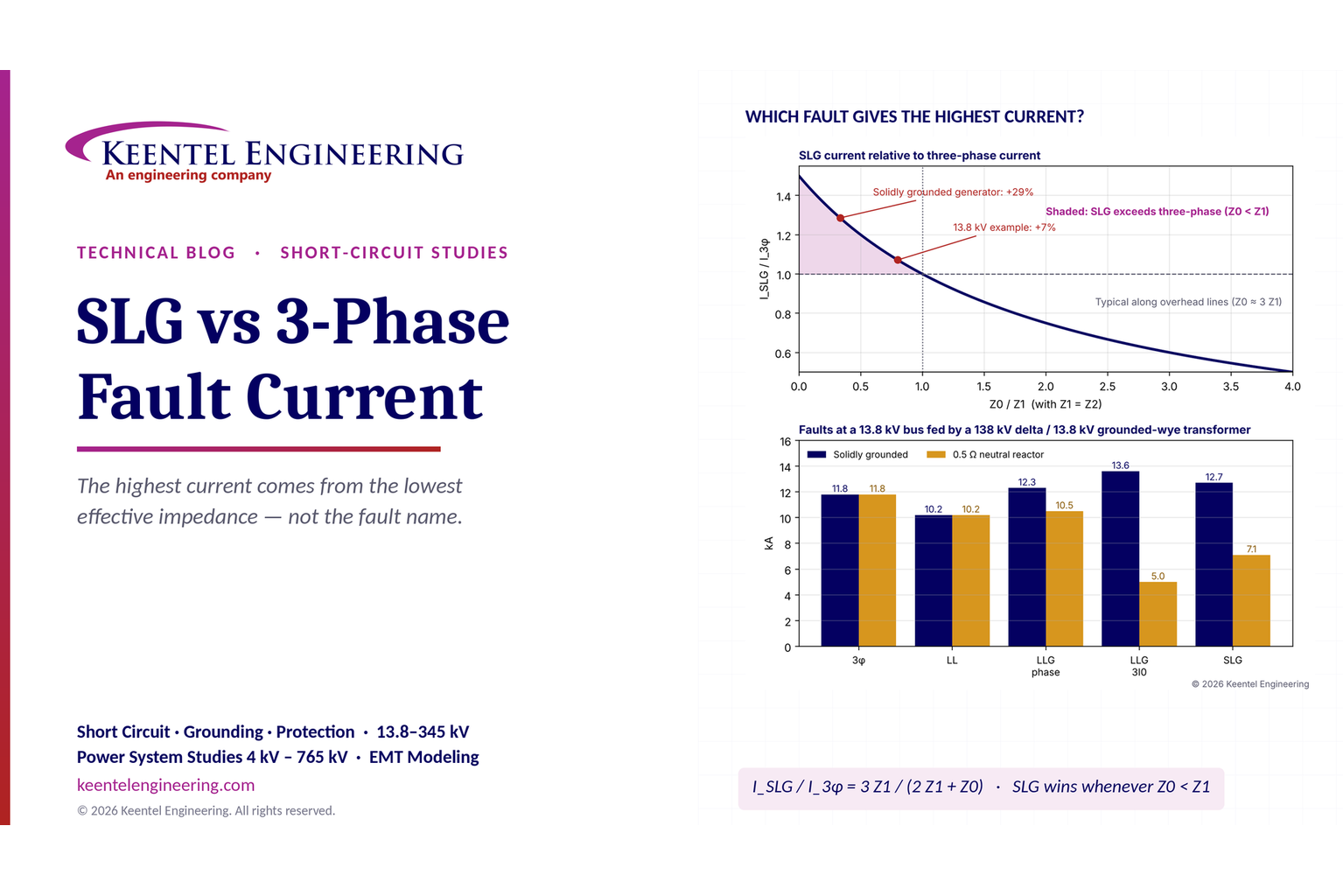
Learn which fault produces the highest current at a bus, why SLG faults can exceed three-phase faults, and how symmetrical components determine fault duty.
By SANDIP R PATEL
•
October 11, 2026
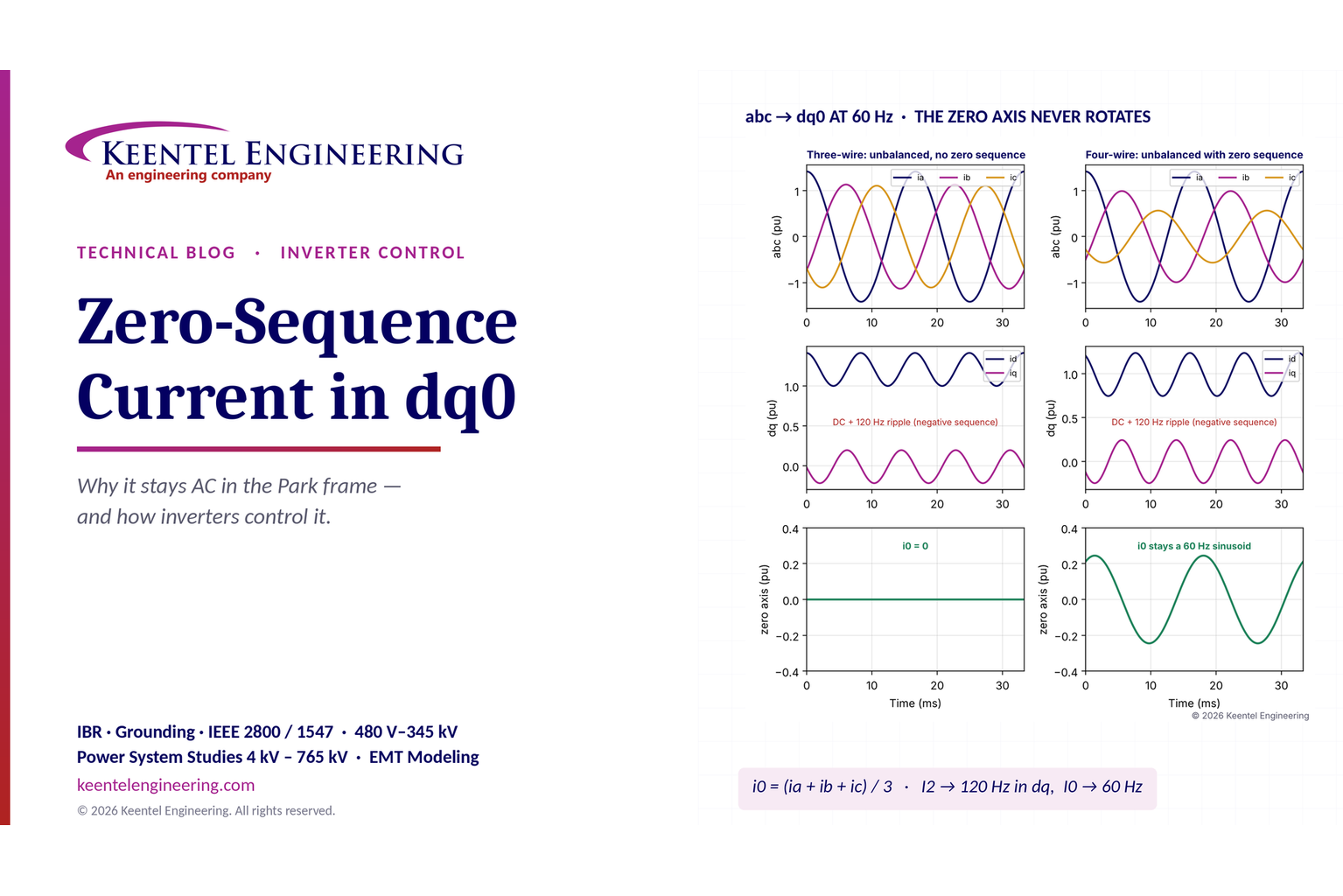
Learn why zero-sequence current pulsates in the dq0 frame, how Park's transformation works, and how inverter controls handle unbalance and ground faults.
By SANDIP R PATEL
•
October 11, 2026
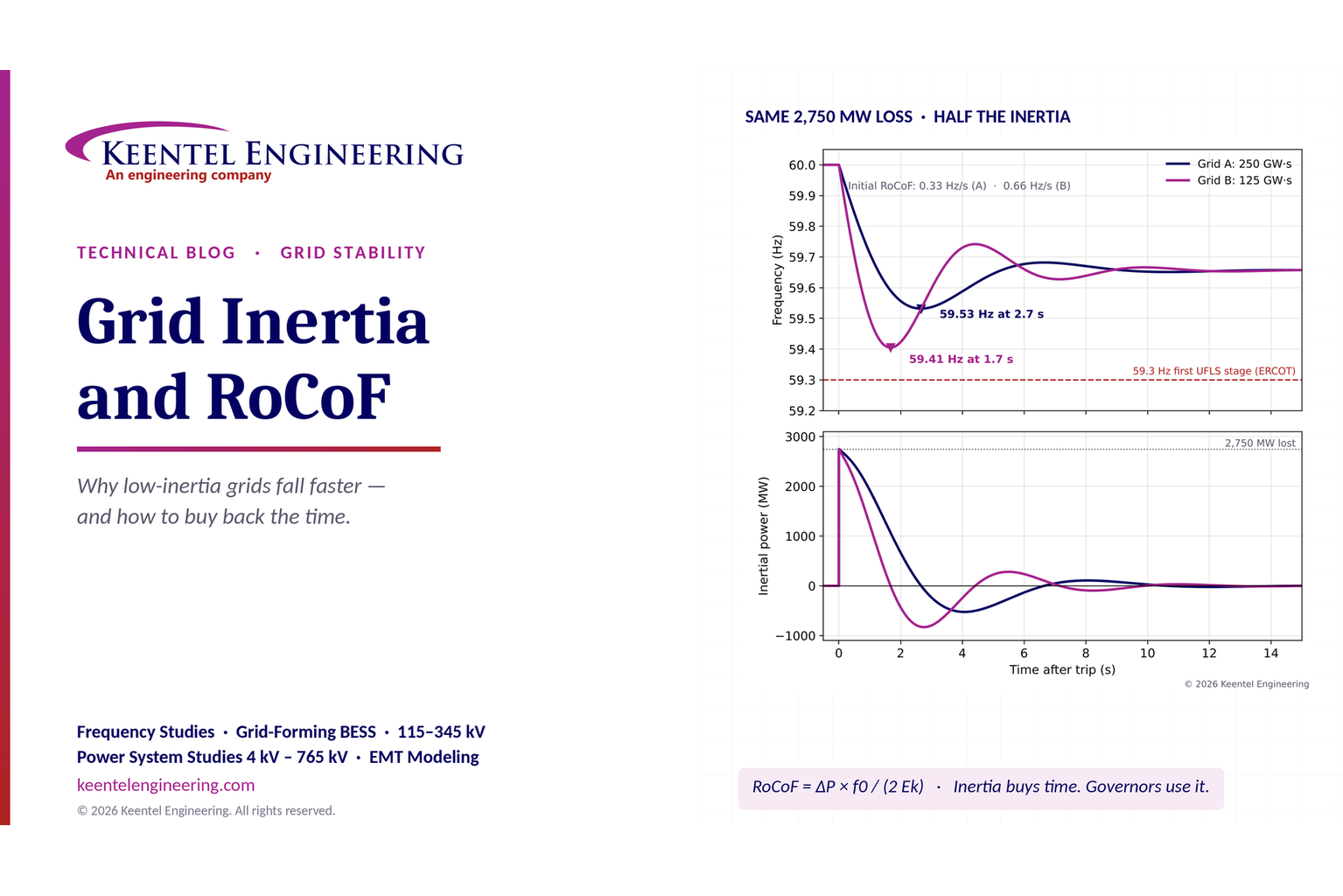
Explore grid inertia, RoCoF and frequency response, with swing equation calculations, frequency nadir analysis and US power system simulation examples.
By SANDIP R PATEL
•
October 11, 2026
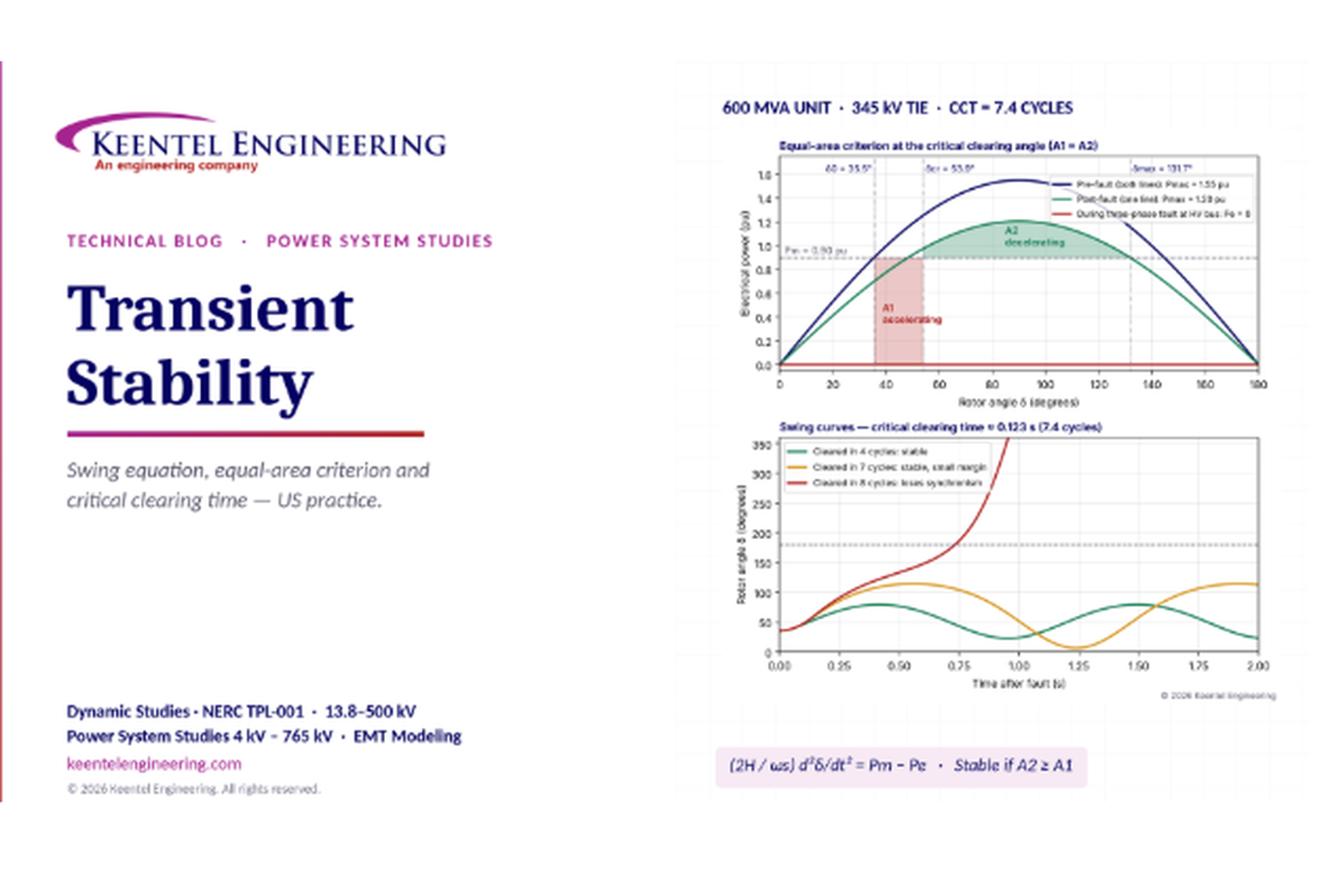
Learn transient stability analysis, swing equation, equal-area criterion and critical clearing time with a 345 kV worked example and NERC TPL-001 guidance.
By SANDIP R PATEL
•
October 11, 2026
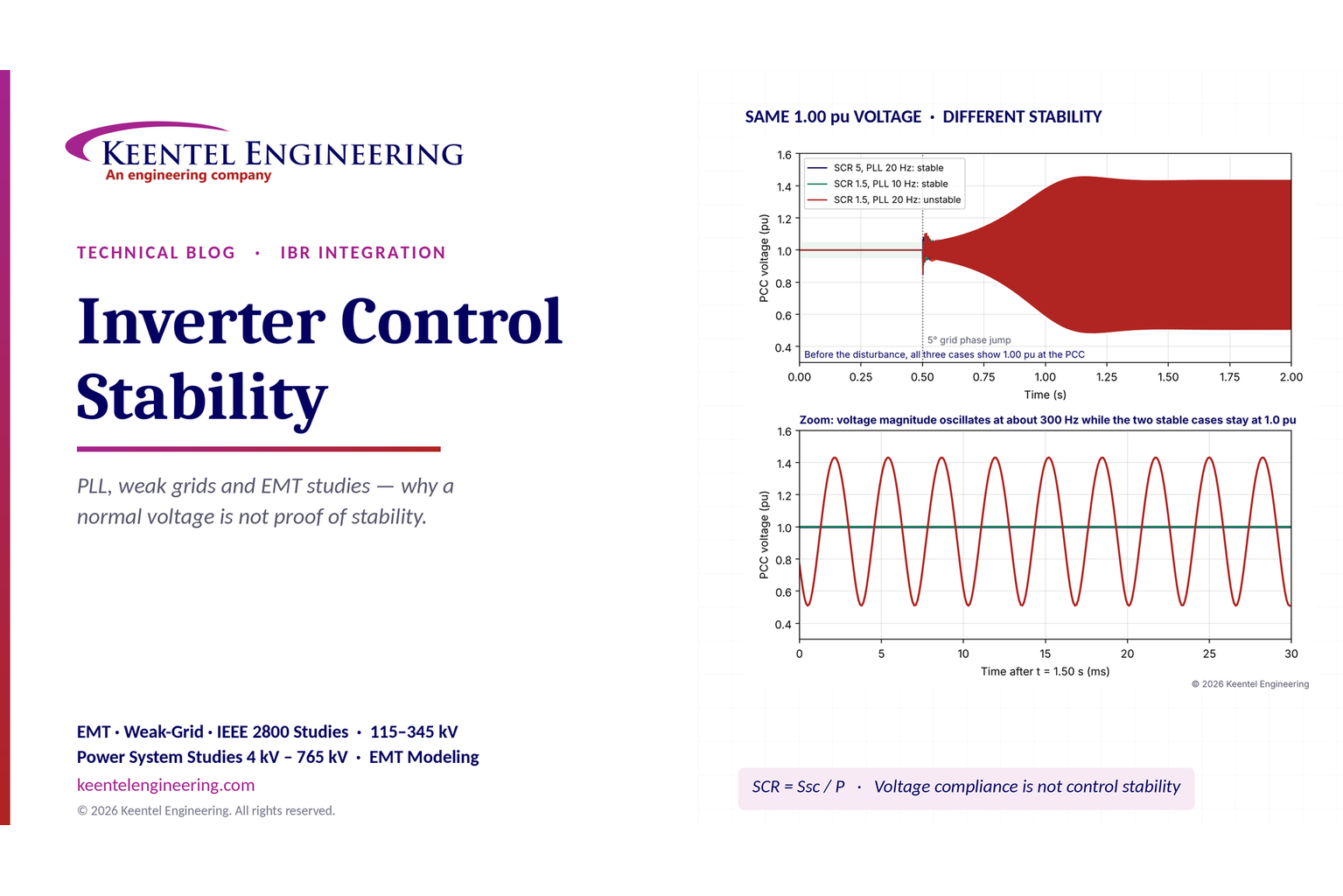
Learn why inverter controls become unstable in weak grids, how PLL bandwidth and SCR affect stability, and how PSCAD EMT studies identify and mitigate oscillations.
By SANDIP R PATEL
•
October 11, 2026
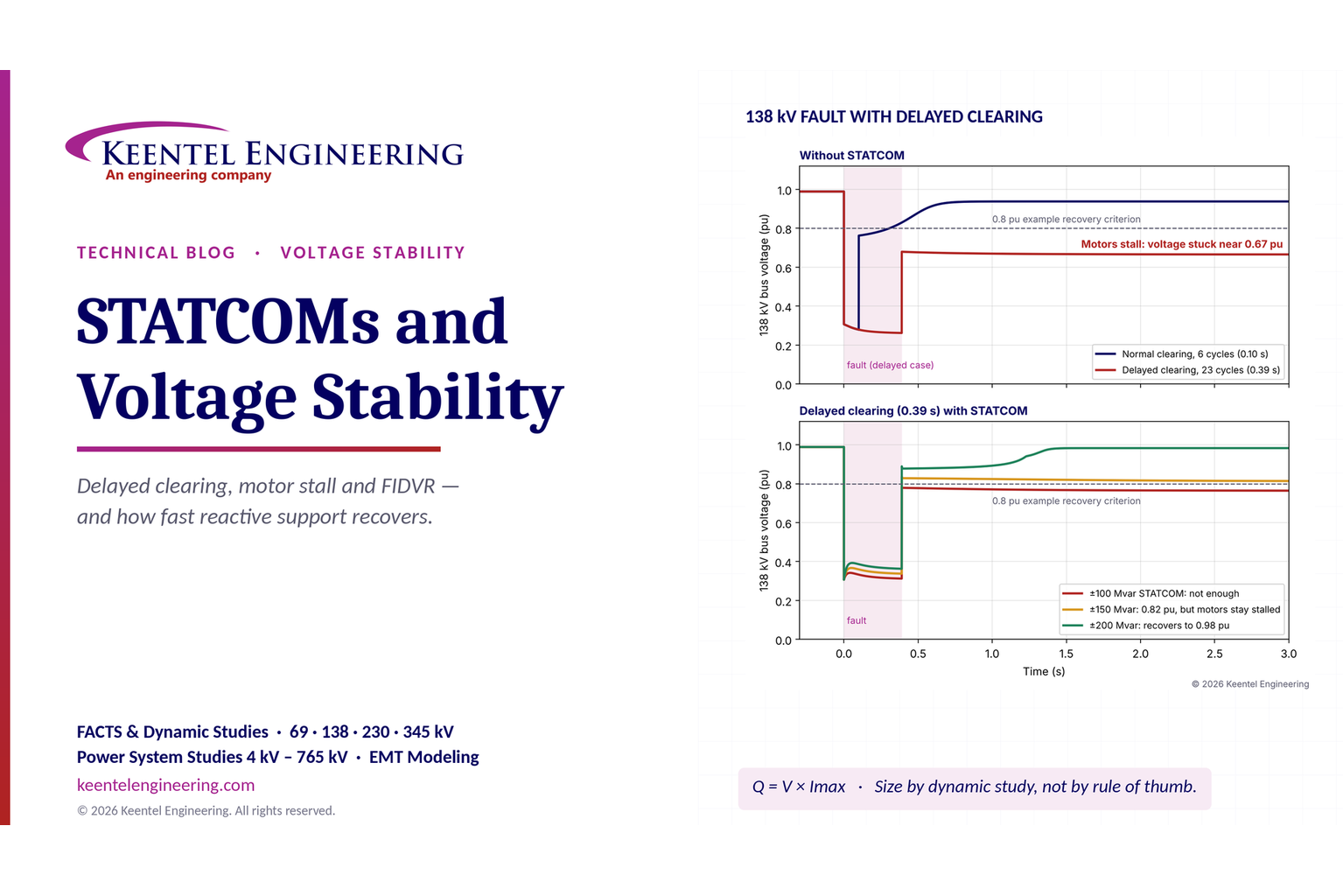
Learn how STATCOMs improve voltage stability and prevent FIDVR. Explore reactive power sizing, delayed fault clearing, NERC criteria and 138 kV simulation results.
By SANDIP R PATEL
•
October 10, 2026
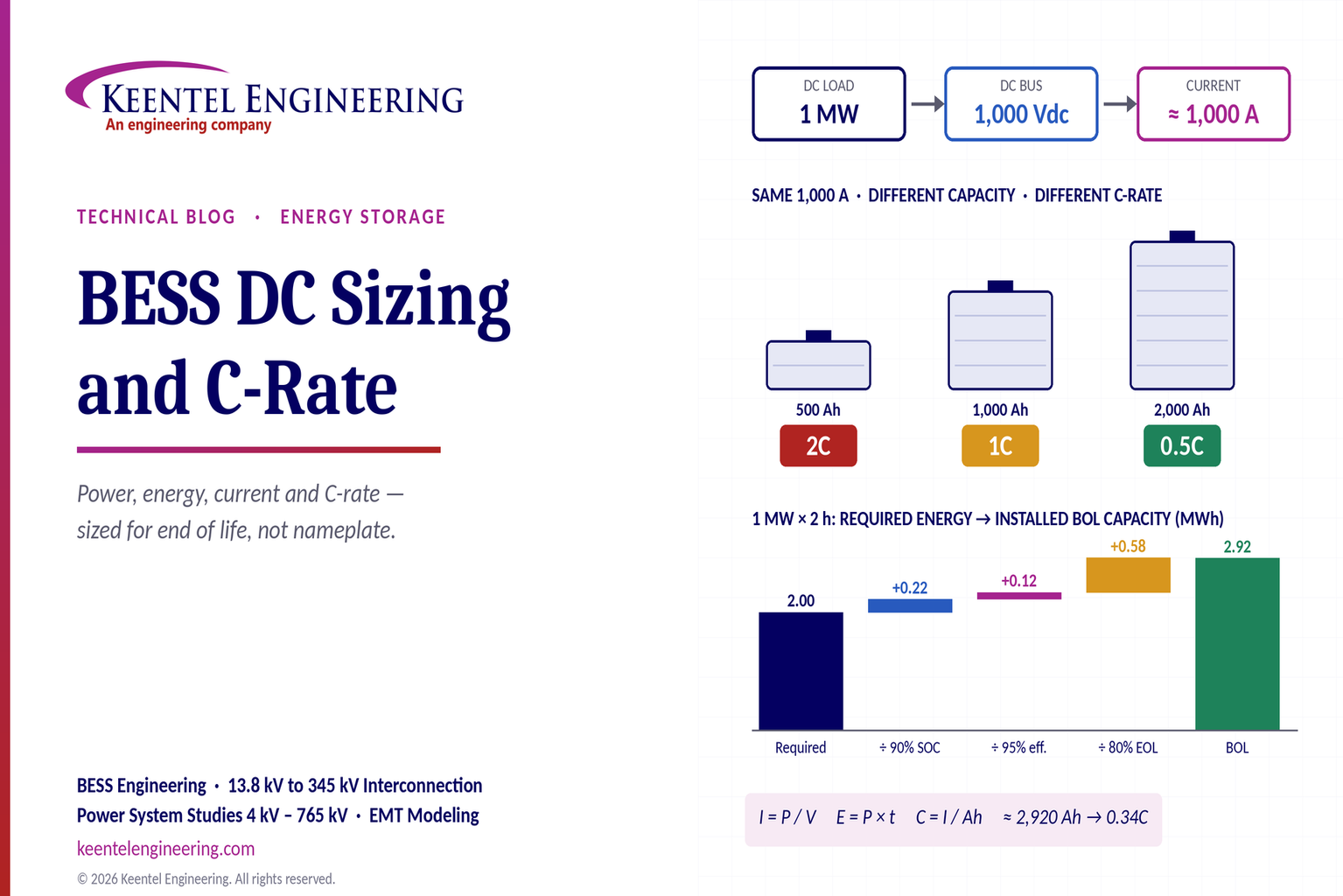
Learn BESS DC sizing with power, energy, current and C-rate calculations, battery losses, degradation and a 100 MW/400 MWh utility-scale example.
By SANDIP R PATEL
•
October 10, 2026
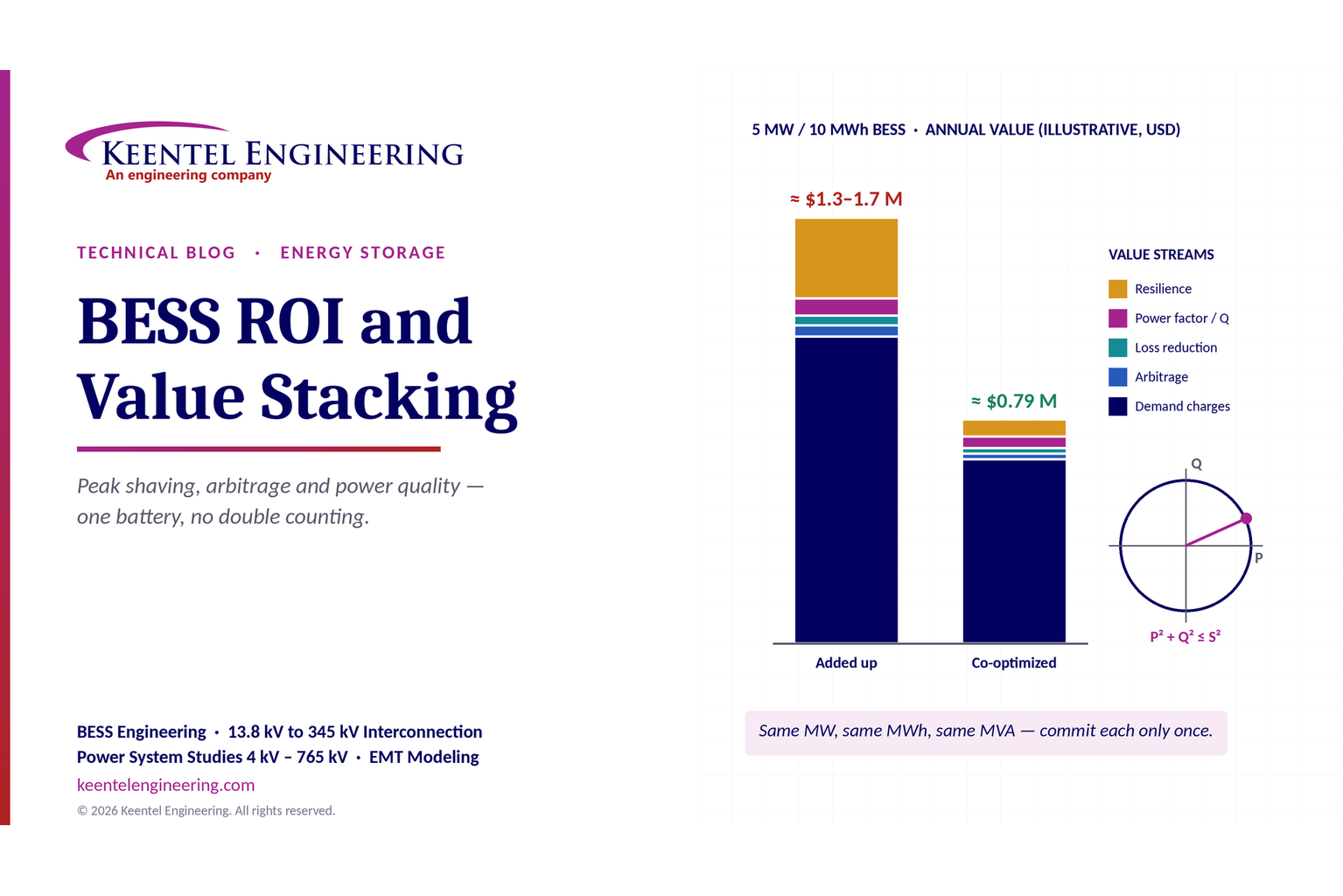
Learn how BESS ROI is calculated using peak shaving, energy arbitrage, power quality and battery storage economics, with a practical 5 MW/10 MWh example.