
A Coordinated Electric System Interconnection Review—the utility’s deep-dive on technical and cost impacts of your project.
Challenge: Frequent false tripping using conventional electromechanical relays
Solution: SEL-487E integration with multi-terminal differential protection and dynamic inrush restraint
Result: 90% reduction in false trips, saving over $250,000 in downtime
| Category | Metric |
|---|---|
| VPP capacity (Lunar Energy) | 650 MW |
| Lunar funding raised | US$232 million |
| Data center BESS example | 31 MW / 62 MWh |
| ERCOT grid-scale batteries | 15+ GW |
| LDES tenders (H1 2026) | Up to 9.3 GW |
| Lithium-ion share of LDES by 2030 | 77% |
| FEOC initial threshold | 55% |
| BESS tariff rate (2026) | ~55% |
| Capacity gain from analytics | 5–15% |
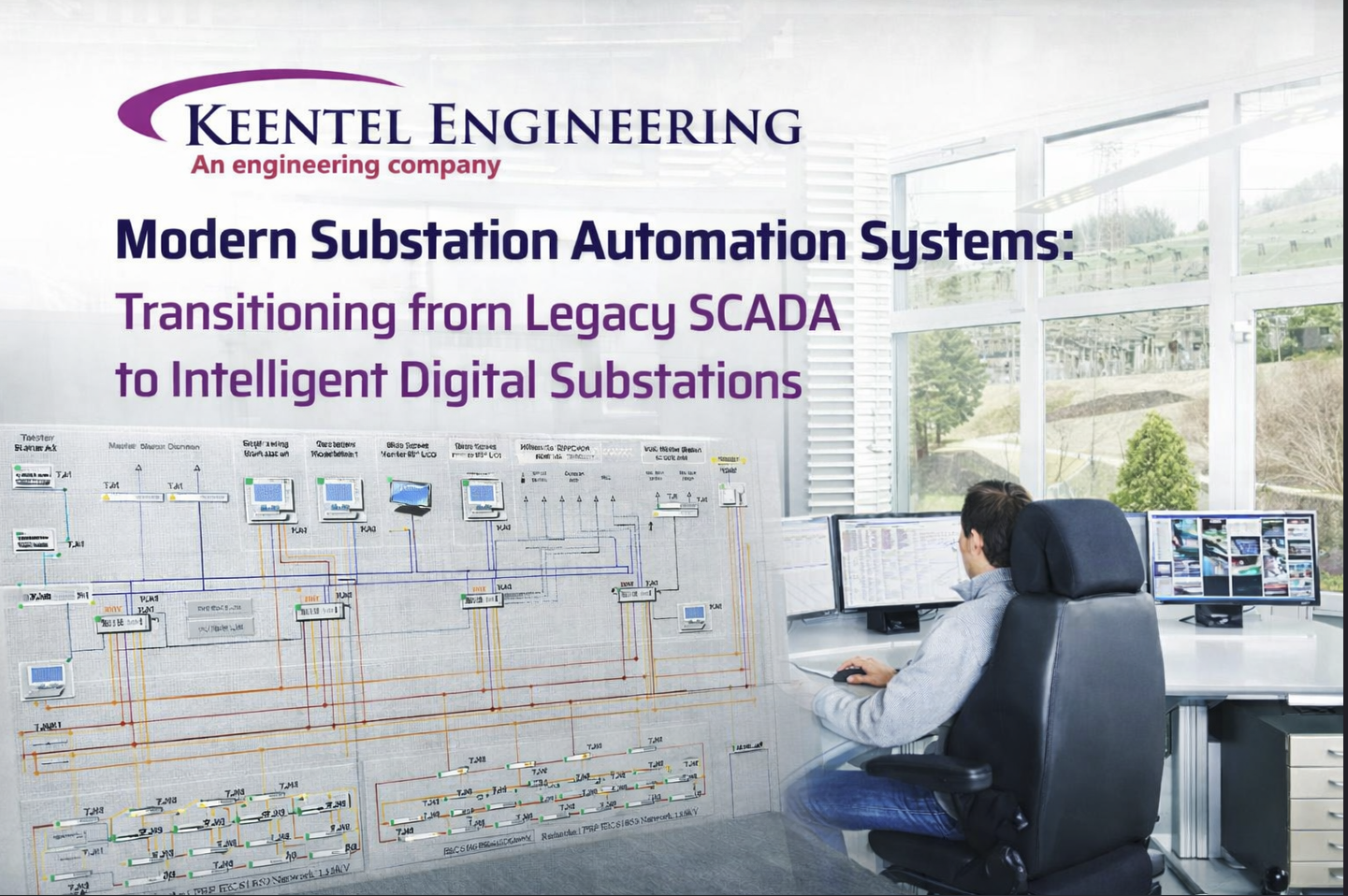
Modern Substation Automation Systems (SAS): Transitioning from Legacy SCADA to Intelligent Digital Substations
Mar 7, 2026 | blog
The power industry is undergoing a significant digital transformation. Modern power grids demand higher reliability, faster fault response, better monitoring, and efficient remote operation. As a result, many utilities and industrial power systems are moving away from conventional hardwired Supervisory Control and Data Acquisition (SCADA) architectures and adopting modern Substation Automation Systems (SAS).
A Substation Automation System integrates monitoring, control, protection, communication, and data acquisition into a unified digital platform. Instead of relying on extensive copper wiring and localized control panels, SAS relies on intelligent electronic devices (IEDs), high-speed communication networks, and centralized automation software to operate substations more efficiently and securely.
At Keentel Engineering, we support utilities, renewable developers, transmission owners, and industrial facilities with substation automation design, digital substation architecture, IEC 61850 implementation, and SCADA modernization projects.
This article explains how the industry is transitioning from legacy SCADA-based substations to modern SAS architectures and why this transformation is essential for future power system reliability.
What Is a Substation Automation System (SAS)?
A Substation Automation System (SAS) is an integrated framework that enables digital monitoring, control, protection coordination, and communication within a power substation.
Instead of traditional hardwired relay panels and manual operations, SAS integrates:
- Intelligent Electronic Devices (IEDs)
- Communication networks
- SCADA gateways
- Engineering workstations
- Human Machine Interface (HMI)
- Data analytics and event recording systems
These components work together to provide real-time visibility and remote control of substation equipment, enabling operators to monitor the grid from centralized control centers.
SAS is not a single device or product; rather, it is a complete system architecture combining hardware, software, communication protocols, and operational practices.
Why Utilities Are Moving Toward Substation Automation
Modern power networks face growing operational challenges:
- Increasing renewable energy integration
- Higher system complexity
- Distributed generation growth
- Higher reliability requirements
- Expanding grid infrastructure
- Rising operational costs
Most substations today are unmanned or remotely located, which requires continuous remote monitoring and automated fault detection.
Substation automation addresses these challenges by enabling:
- Remote monitoring and control
- Automated fault detection
- Real-time operational visibility
- Reduced maintenance costs
- Faster fault analysis and recovery
These capabilities allow utilities to operate large transmission and distribution networks efficiently without maintaining on-site staff at every substation.
Limitations of Traditional SCADA-Based Substations
Legacy SCADA systems were designed for earlier power system environments. These systems relied heavily on hardwired connections between devices, creating significant operational limitations.
In conventional substations:
- Every signal required dedicated copper wiring
- Protection relays connected to SCADA through interface panels
- Analog measurements required transducers
- System expansion required physical rewiring
For example, transmitting multiple relay signals to SCADA required the same number of physical wires, leading to large cable bundles and complex marshalling cabinets.
Common limitations of conventional SCADA substations include:
- Extensive copper cabling
- Large control panels
- High installation and maintenance costs
- Limited scalability
- Difficult system upgrades
- Increased risk of wiring errors
Because of these limitations, utilities increasingly modernize legacy substations through automation retrofits or digital substation deployments.
The Digital Transformation: From Copper Wiring to Communication Networks
Modern automated substations use digital communication networks instead of hardwired signal transmission.
This transition represents a fundamental shift in substation engineering.
Traditional Systems
- Hardwired signals
- Panel-centric design
- Limited data exchange
Modern SAS Systems
- Ethernet-based communication networks
- System-centric architecture
- High-speed digital communication
In modern substations:
- A single communication cable can replace hundreds of copper wires
- System modifications can be performed through software instead of rewiring
- Data from multiple devices can be integrated easily
This transformation significantly reduces physical infrastructure while increasing operational flexibility and reliability.
IEC 61850 – The Foundation of Modern Substation Automation
The most important technological breakthrough in SAS development is the IEC 61850 communication standard.
Before IEC 61850:
- Substation equipment from different vendors could not communicate easily
- Integration required proprietary communication protocols
- Multi-vendor substations were difficult to implement
IEC 61850 introduced standardized communication and data models, enabling interoperability between equipment from different manufacturers.
With IEC 61850:
- Protection relays can communicate with SCADA systems regardless of vendor
- Substations become easier to expand and integrate
- Communication becomes faster and more reliable
IEC 61850 also supports advanced features such as:
- GOOSE messaging
- Sampled values
- Process bus architecture
- High-speed peer-to-peer communication
These capabilities form the foundation of modern digital substations.
Substation Automation Architecture
Modern SAS implementations follow a hierarchical architecture consisting of three primary levels.
Process Level
The process level is where data originates from primary substation equipment.
Typical devices include:
- Circuit breakers
- Disconnect switches
- Current transformers (CTs)
- Voltage transformers (VTs)
- Transformer monitoring devices
This level gathers real-world measurements such as:
- Current and voltage
- Equipment status
- Temperature
- Alarms and switch positions
These signals are converted into digital data and transmitted to higher-level automation systems.
Bay Level
The bay level processes data for specific sections of the substation such as feeder bays, transformer bays, or bus sections.
Devices at this level include:
- Bay Control Units (BCUs)
- Protection relays
- Control IEDs
These devices:
- Execute protection algorithms
- Perform switching commands
- Implement interlocking logic
- Record disturbance events
- Communicate operational data to station-level systems
Modern substations transmit this data over fiber optic communication networks, enabling high-speed and reliable data exchange.
Station Level
The station level provides centralized monitoring and supervisory control of the entire substation.
Typical station-level components include:
- Human Machine Interface (HMI)
- SCADA gateway
- Data servers
- Alarm management systems
- Engineering workstations
At this level operators can:
- Monitor equipment status
- Issue control commands
- Review alarms and events
- Analyze disturbance records
Station-level systems also serve as the interface between the substation and remote
control centers .
Bay Control Units (BCU) and Local Control Cubicles (LCC)
One of the most critical elements of modern substation automation is the Bay Control Unit (BCU).
BCUs serve as the digital control center for each substation bay.
Key functions include:
- Data acquisition from field equipment
- Execution of control commands
- Implementation of interlocking logic
- Alarm management
- Event recording
- Communication with station-level systems
BCUs are typically installed inside Local Control Cubicles (LCCs) located near primary equipment.
Modern LCCs combine traditional hardware controls with digital automation capabilities, providing redundancy and operational flexibility.
Operational Advantages of Substation Automation
Utilities implementing modern SAS architectures experience several operational benefits.
Remote Engineering Access
Engineers can remotely:
- Download fault records
- Retrieve disturbance files
- Modify protection settings
- Reset protection relays
This reduces response time and eliminates unnecessary site visits.
Advanced Disturbance Monitoring
IEDs continuously record system disturbances such as:
- Voltage dips and swells
- Frequency deviations
- Harmonic distortion
- Transient events
This allows engineers to analyze system behavior and take corrective actions quickly.
Improved Maintenance Strategy
Modern SAS systems support condition-based maintenance.
Instead of performing maintenance at fixed intervals, utilities can analyze:
- breaker operation counts
- relay diagnostics
- equipment health data
This reduces unnecessary maintenance while improving system reliability.
Time Synchronization and Event Accuracy
Modern substations use centralized GPS clocks to synchronize all devices.
Accurate time stamping allows engineers to reconstruct fault events precisely and improve disturbance analysis.
How Keentel Engineering Supports Substation Automation Projects
Keentel Engineering provides comprehensive engineering services for digital substations and automation upgrades.
Our services include:
- Substation automation architecture design
- IEC 61850 engineering and configuration
- SCADA modernization
- Protection and control system integration
- Substation communication network design
- Digital substation consulting
- Automation system testing and commissioning
- SAS cybersecurity and network architecture
We support utilities,
renewable developers , transmission owners, and industrial facilities across North America and international markets.
Frequently Asked Questions (FAQ)
What is a Substation Automation System?
A Substation Automation System is a digital framework that integrates monitoring, control, protection, and communication within a power substation.
How does SAS differ from traditional SCADA systems?
Traditional SCADA relies on hardwired signals, while SAS uses digital communication networks and intelligent electronic devices.
What is IEC 61850?
IEC 61850 is an international communication standard that enables interoperability between substation automation devices from different manufacturers.
What are Intelligent Electronic Devices (IEDs)?
IEDs are digital protection and control devices used to monitor, protect, and control electrical equipment.
What are the three levels of SAS architecture?
Process level, bay level, and station level.
What is a Bay Control Unit?
A Bay Control Unit is a device responsible for bay-level control, monitoring, interlocking, and communication within an automated substation.
What is a Local Control Cubicle?
An LCC is an enclosure located near primary equipment that houses control devices such as BCUs.
Why is IEC 61850 important?
It enables standardized communication between devices, simplifying integration and system expansion.
What is disturbance monitoring?
Disturbance monitoring records system events such as faults, voltage dips, and frequency deviations.
What is remote engineering access?
Remote engineering allows engineers to retrieve data and modify protection settings from remote locations.
What is condition-based maintenance?
Maintenance based on equipment condition rather than fixed schedules.
Why are fiber optic networks used in SAS?
Fiber optic networks provide high-speed, reliable communication between substation devices.
What is time synchronization in substations?
It synchronizes device clocks to ensure accurate event recording and fault analysis.
What are GOOSE messages?
GOOSE messages are high-speed peer-to-peer communication messages used for protection signaling in IEC 61850 systems.
What is a digital substation?
A digital substation uses communication networks instead of copper wiring for protection, monitoring, and control signals
About the Author:
Sandip "Sonny" R. Patel, P.E.
IEEE Senior Member · Founder & CEO, Keentel Engineering
In 1995, Sonny Patel earned his Electrical Engineering degree from the University of Illinois. But degrees don't build legacies — action does.
For three decades, he has worked the power industry from every side of the table: 16 years as a utility engineer at Exelon/Commonwealth Edison; generation leadership across hydroelectric, industrial steam turbine, and a 9 GW renewable fleet; NERC Regional Entity Senior Compliance Engineer and Audit Team Lead, auditing some of the nation's largest utilities; and testing and commissioning lead on equipment up to 765 kV — the very top of the North American grid.Utility. Generator. Regulator. Consultant. Few engineers have seen all four seats. Fewer still have sat in them.
His experience spans nuclear, hydro, conventional generation, renewables, oil and gas, mining — and today's data centers, where he is authoring a three-book series on data center design. He is a Licensed Professional Engineer in six states and a Licensed Electrical Contractor in Florida (Unlimited EC) — he doesn't just design the work; he's qualified to stand behind its execution.Today, as Founder and CEO of Keentel Engineering, Sonny leads a nationwide team of engineers delivering substation design, power system studies, NERC compliance, and commissioning — done right, coast to coast.Three decades. Every side of the table. One standard: accountable engineering.
Services

Let's Discuss Your Project
Let's book a call to discuss your electrical engineering project that we can help you with.
About the Author:
Sandip "Sonny" R. Patel, P.E.
IEEE Senior Member · Founder & CEO, Keentel Engineering
In 1995, Sonny Patel earned his Electrical Engineering degree from the University of Illinois. But degrees don't build legacies — action does.
For three decades, he has worked the power industry from every side of the table: 16 years as a utility engineer at Exelon/Commonwealth Edison; generation leadership across hydroelectric, industrial steam turbine, and a 9 GW renewable fleet; NERC Regional Entity Senior Compliance Engineer and Audit Team Lead, auditing some of the nation's largest utilities; and testing and commissioning lead on equipment up to 765 kV — the very top of the North American grid.
Utility. Generator. Regulator. Consultant. Few engineers have seen all four seats. Fewer still have sat in them.
His experience spans nuclear, hydro, conventional generation, renewables, oil and gas, mining — and today's data centers, where he is authoring a three-book series on data center design. He is a Licensed Professional Engineer in six states and a Licensed Electrical Contractor in Florida (Unlimited EC) — he doesn't just design the work; he's qualified to stand behind its execution.
Today, as Founder and CEO of Keentel Engineering, Sonny leads a nationwide team of engineers delivering substation design, power system studies, NERC compliance, and commissioning — done right, coast to coast.Three decades. Every side of the table. One standard: accountable engineering.
Leave a Comment
Thank you for contacting us.
We will get back to you as soon as possible.
We will get back to you as soon as possible.
Oops, there was an error sending your message.
Please try again later.
Please try again later.
Related Posts
By SANDIP R PATEL
•
October 23, 2026
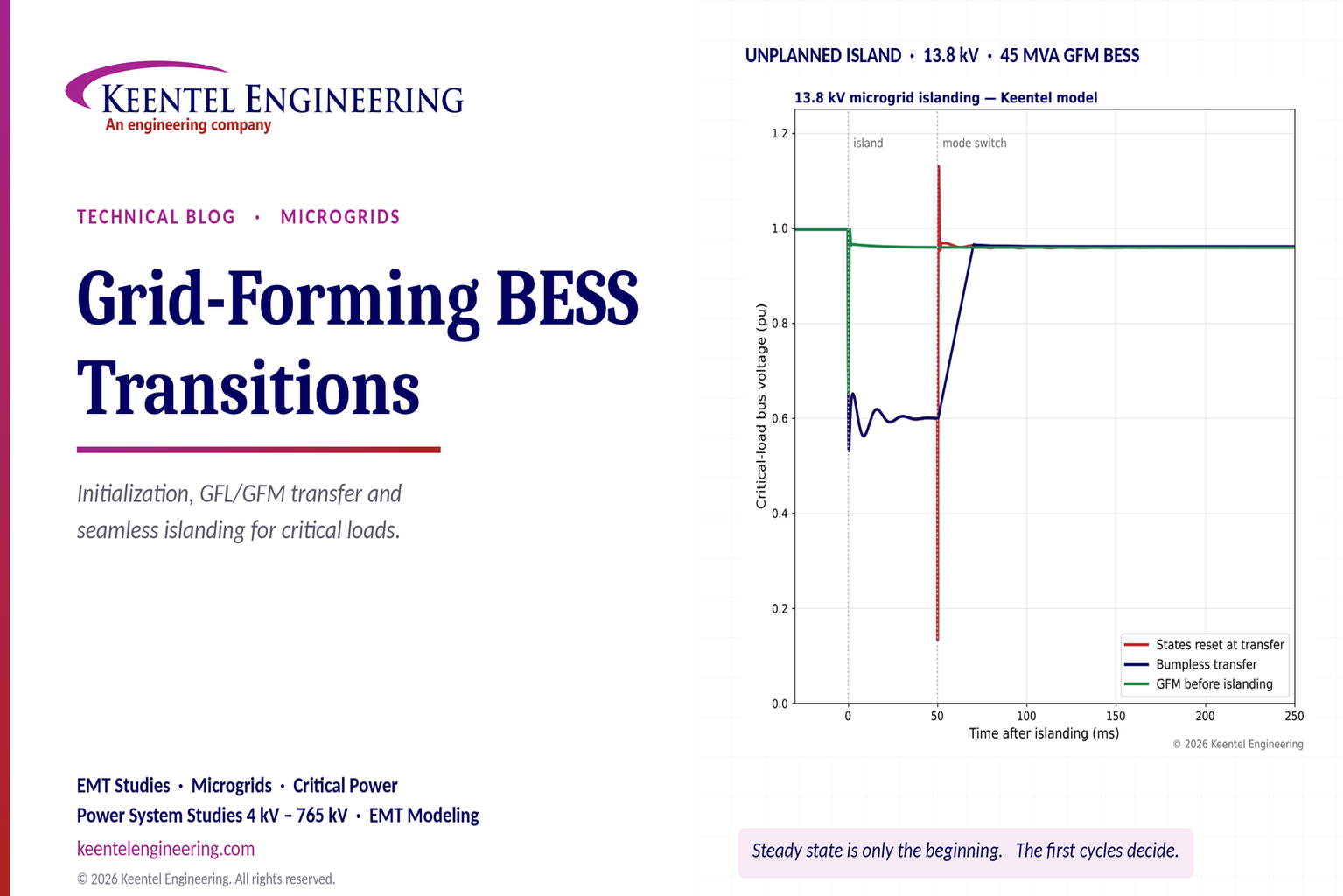
Explore grid-forming BESS initialization, GFL-to-GFM transitions, seamless islanding, EMT simulations, current limiting and microgrid protection.
By SANDIP R PATEL
•
October 23, 2026
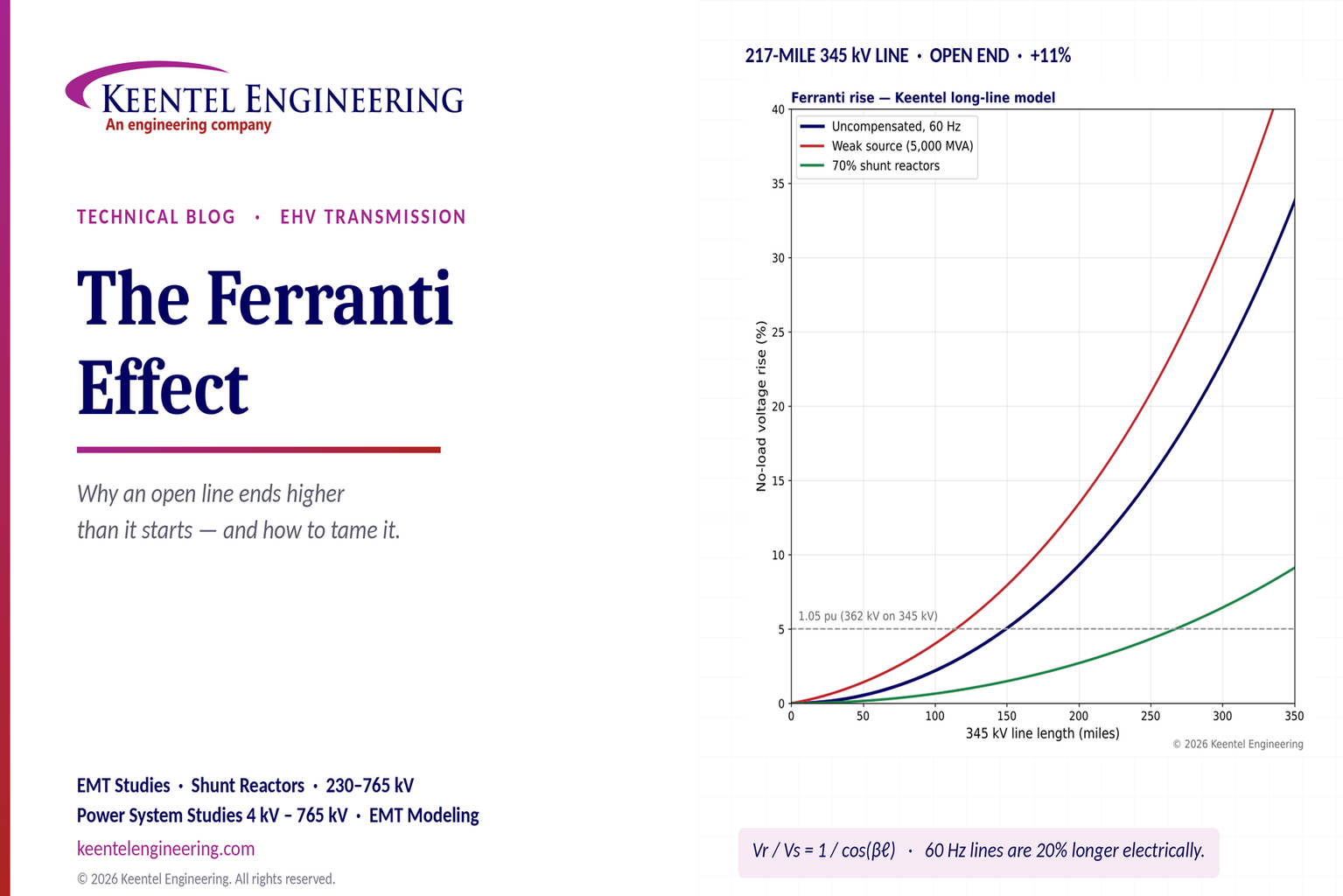
Explore the Ferranti effect in EHV transmission lines: voltage rise, 345 kV examples, switching overvoltages, shunt reactor sizing and mitigation.
By SANDIP R PATEL
•
October 23, 2026
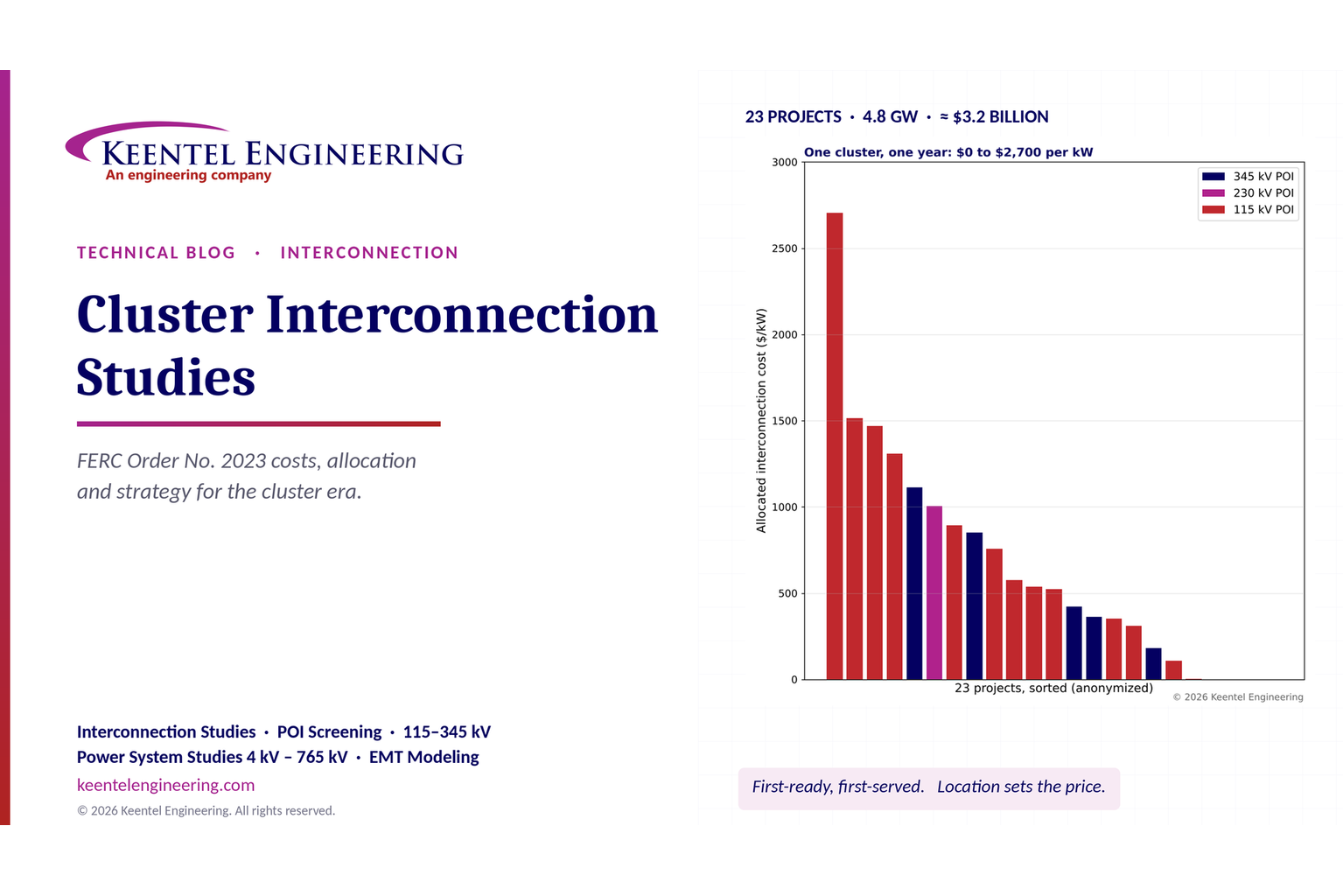
Explore cluster interconnection studies under FERC Order 2023, including network upgrades, cost allocation, withdrawal penalties and developer strategy.
By SANDIP R PATEL
•
October 21, 2026
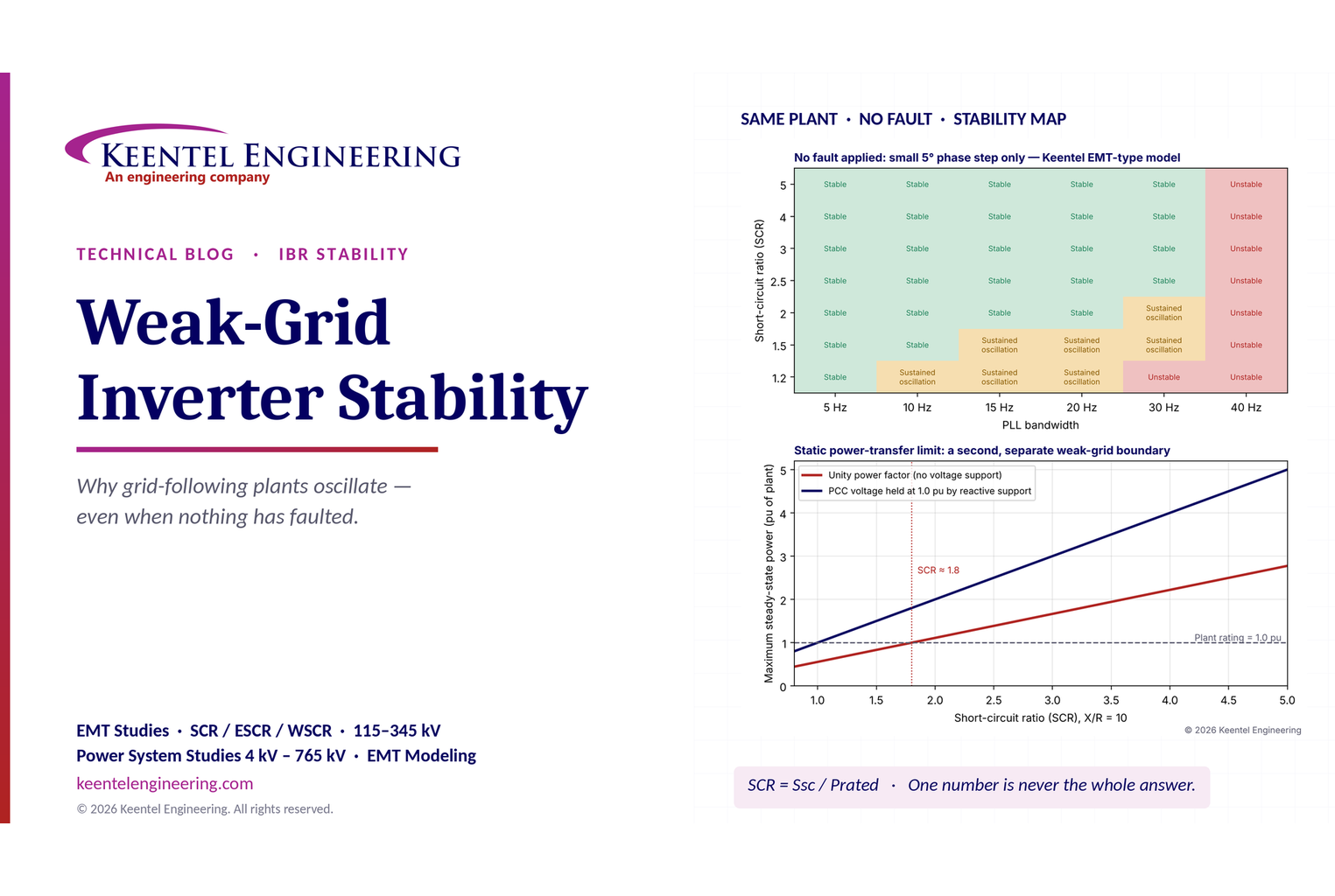
Learn why grid-following inverters become unstable without grid faults. Explore SCR, PLL interactions, EMT studies, grid strength, and mitigation.
By SANDIP R PATEL
•
October 21, 2026
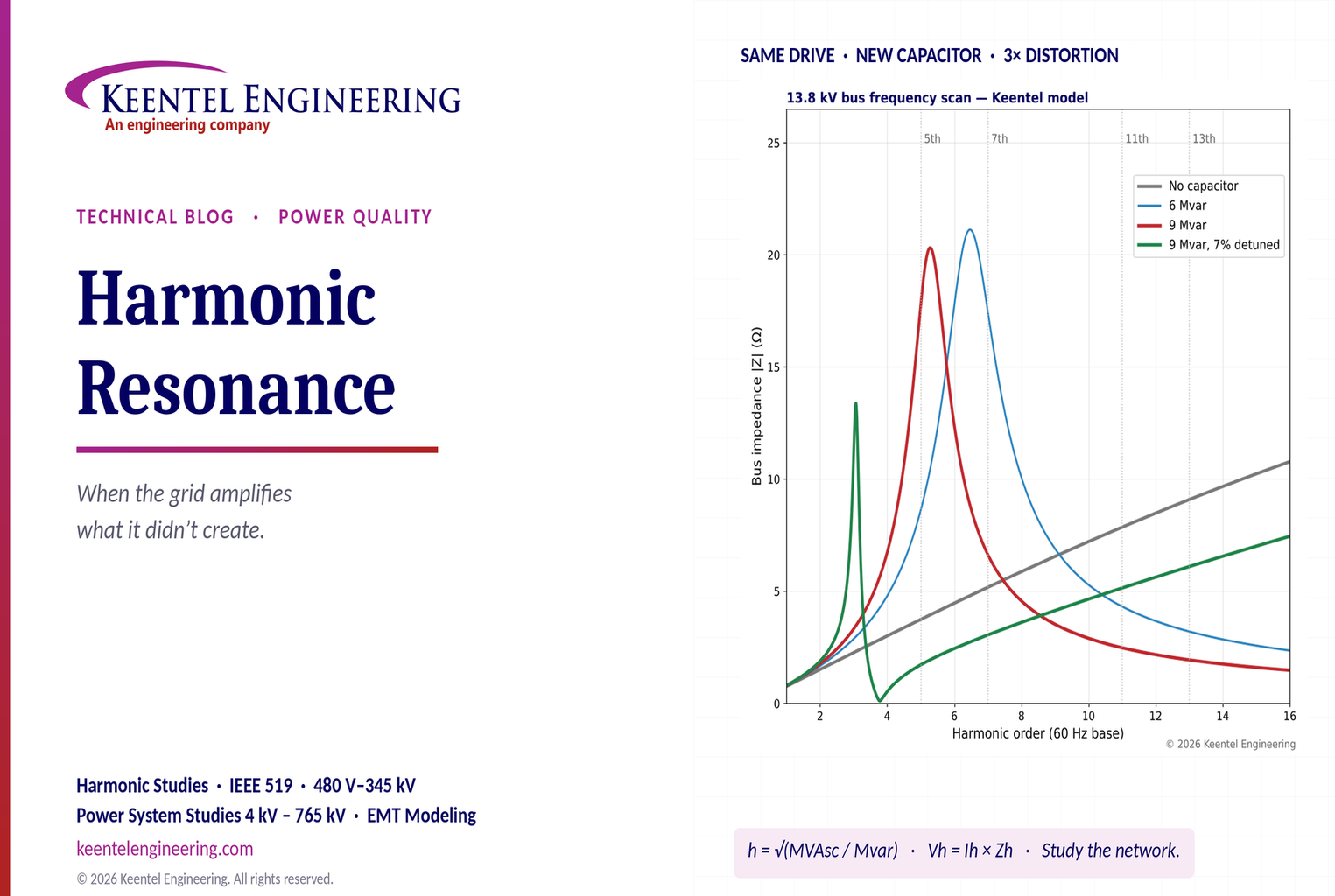
Learn how harmonic resonance amplifies distortion in power systems. Explore capacitor banks, detuned reactors, frequency scans, and IEEE 519 solutions.
By SANDIP R PATEL
•
October 20, 2026
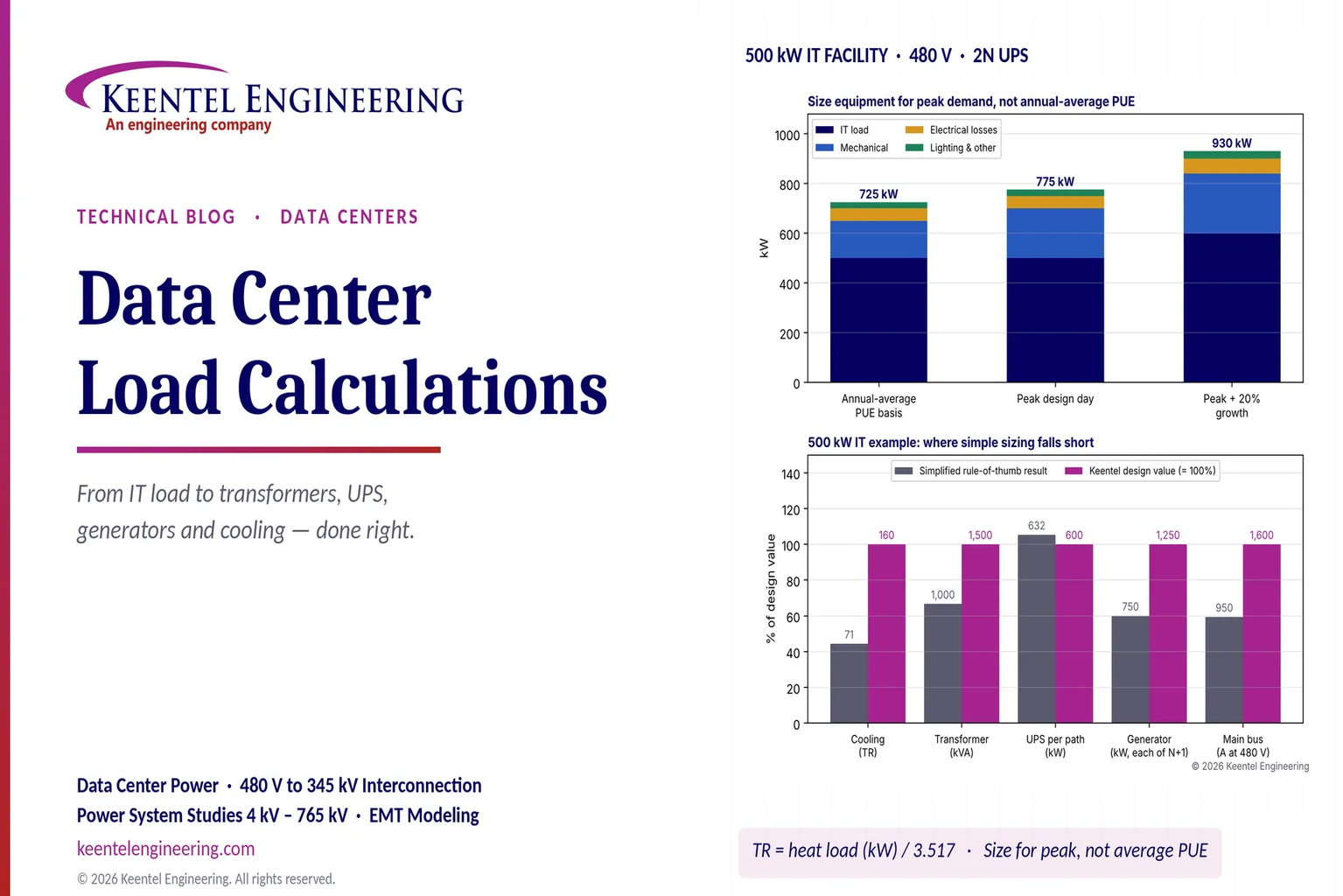
Learn data center electrical load calculations, including IT demand, PUE, UPS and generator sizing, cooling loads, redundancy, and worked US examples.
By SANDIP R PATEL
•
October 20, 2026
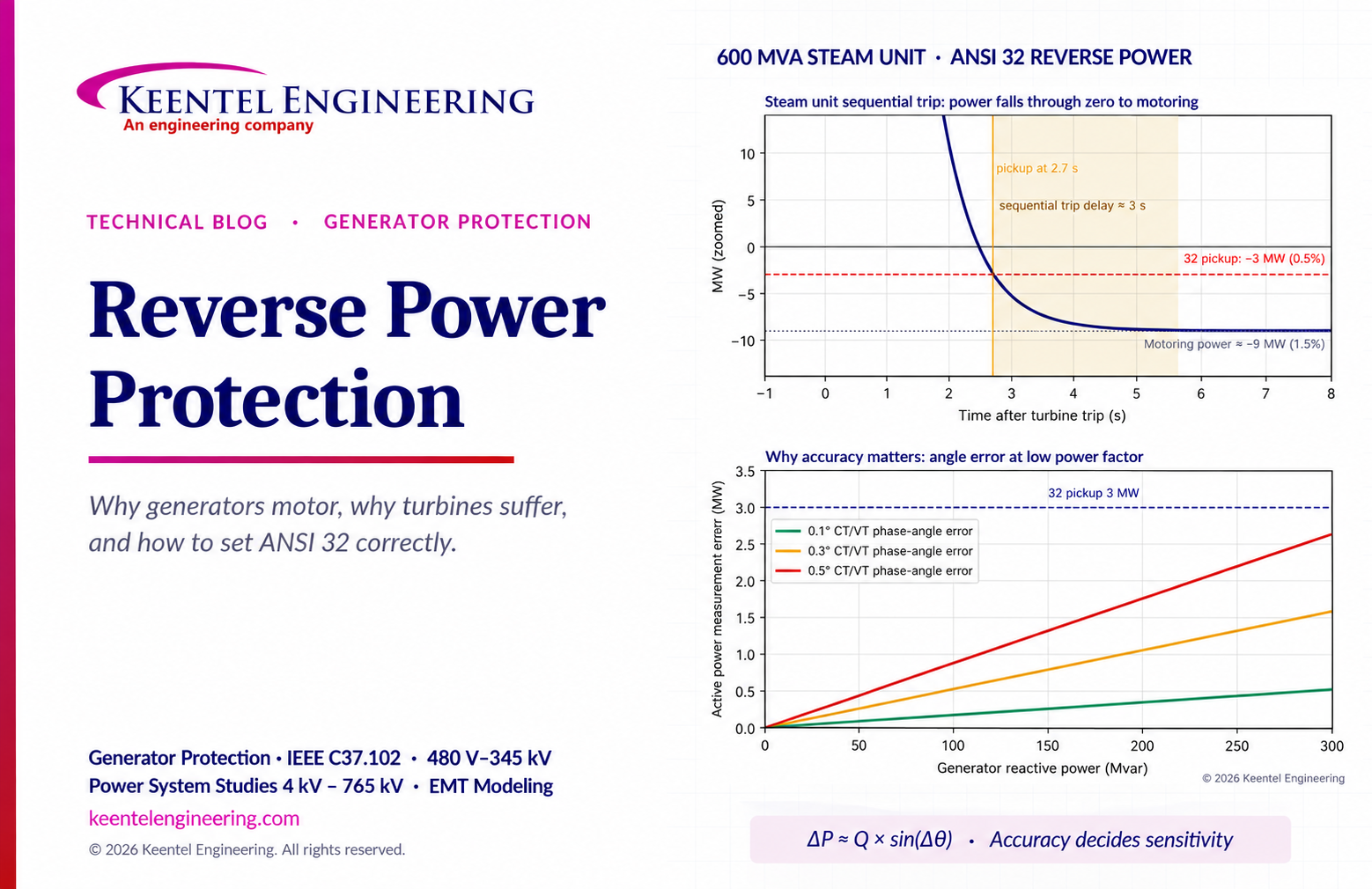
Learn reverse power protection (ANSI 32), generator motoring, relay pickup settings, time delays, sequential tripping and testing for US power plants.
By Team 2 Dexora
•
October 20, 2026
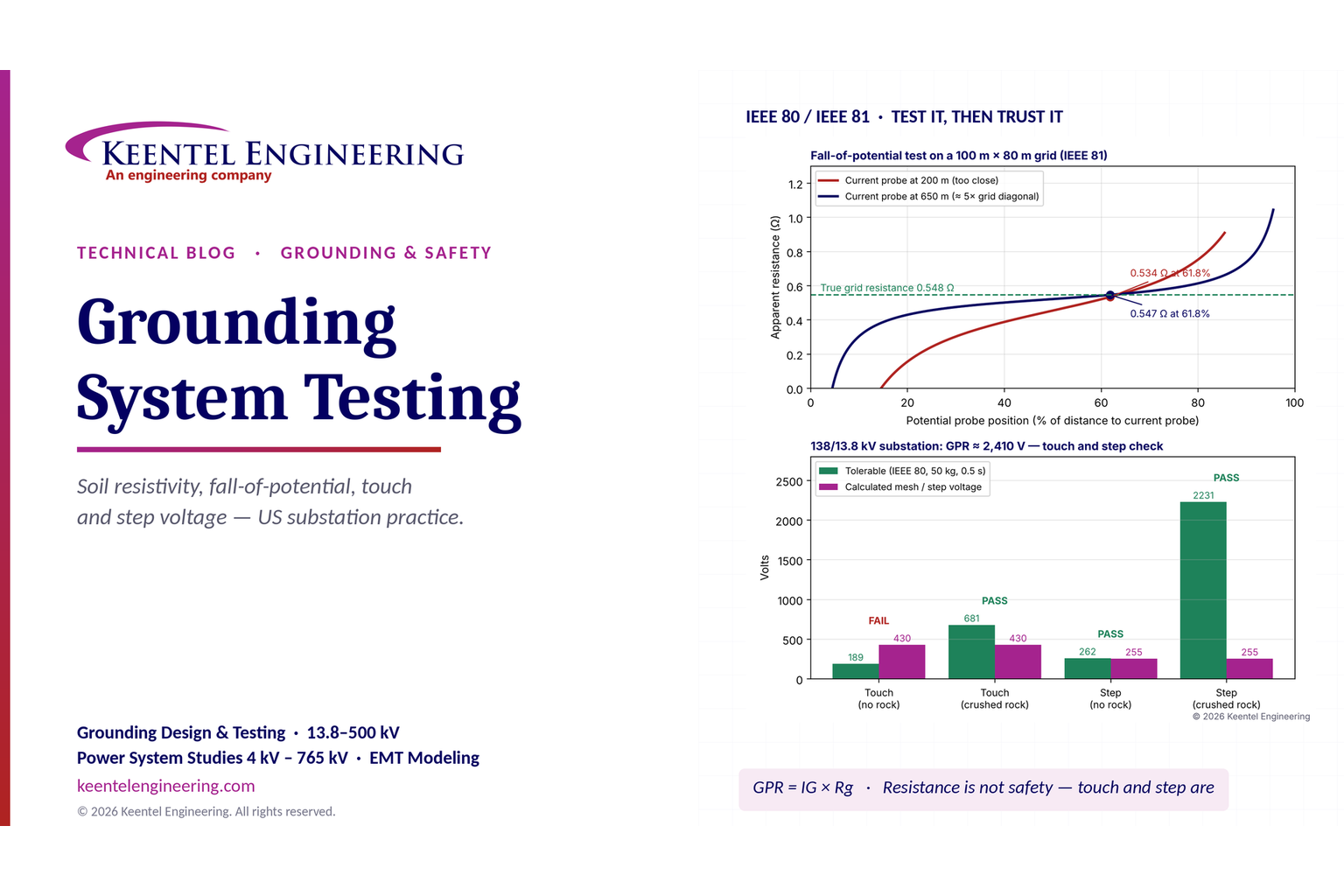
Explore grounding system testing with Keentel Engineering. Learn IEEE 80/81 methods, soil resistivity, ground resistance, and touch and step voltage safety.
By SANDIP R PATEL
•
October 13, 2026
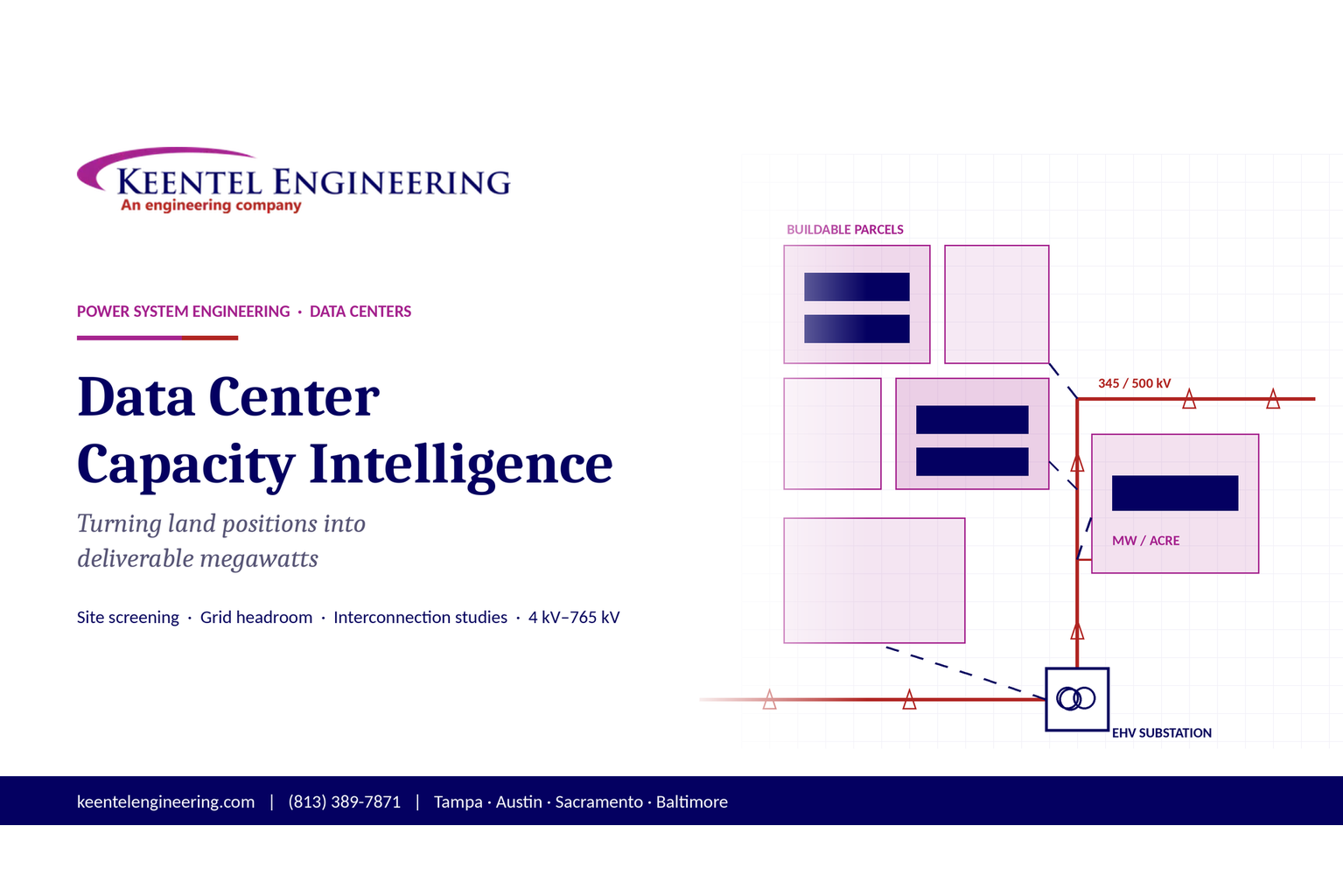
Plan data center capacity with land screening, MW-per-acre estimates, grid power availability and interconnection feasibility studies from Keentel Engineering.





