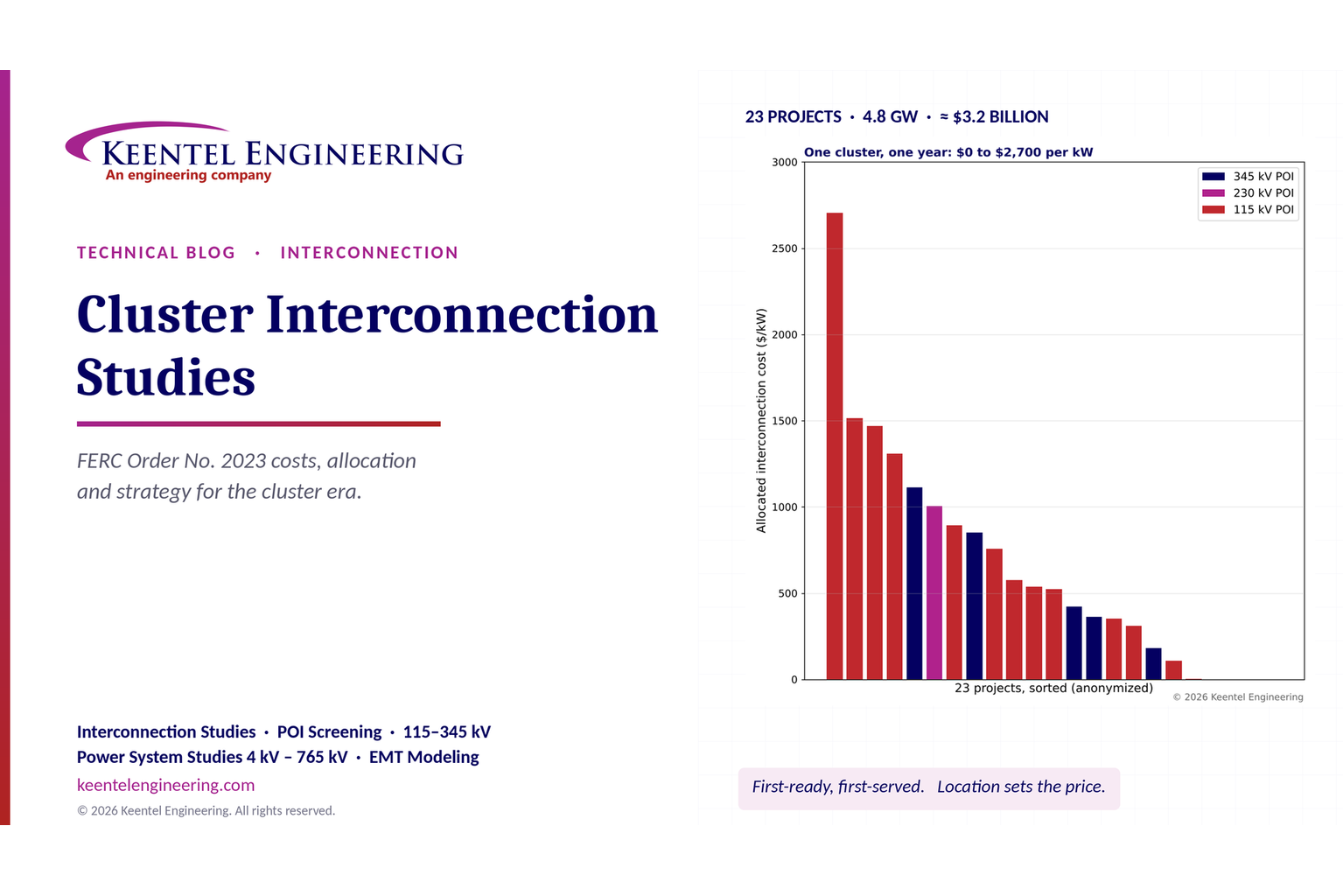

A Coordinated Electric System Interconnection Review—the utility’s deep-dive on technical and cost impacts of your project.
Challenge: Frequent false tripping using conventional electromechanical relays
Solution: SEL-487E integration with multi-terminal differential protection and dynamic inrush restraint
Result: 90% reduction in false trips, saving over $250,000 in downtime
| Category | Metric |
|---|---|
| VPP capacity (Lunar Energy) | 650 MW |
| Lunar funding raised | US$232 million |
| Data center BESS example | 31 MW / 62 MWh |
| ERCOT grid-scale batteries | 15+ GW |
| LDES tenders (H1 2026) | Up to 9.3 GW |
| Lithium-ion share of LDES by 2030 | 77% |
| FEOC initial threshold | 55% |
| BESS tariff rate (2026) | ~55% |
| Capacity gain from analytics | 5–15% |
Advanced Substation SCADA Design Using the SEL-3555-2 RTAC
February 24, 2026 | Blog
How Keentel Engineering Delivers Secure, High-Performance, Standards-Compliant Automation Architectures
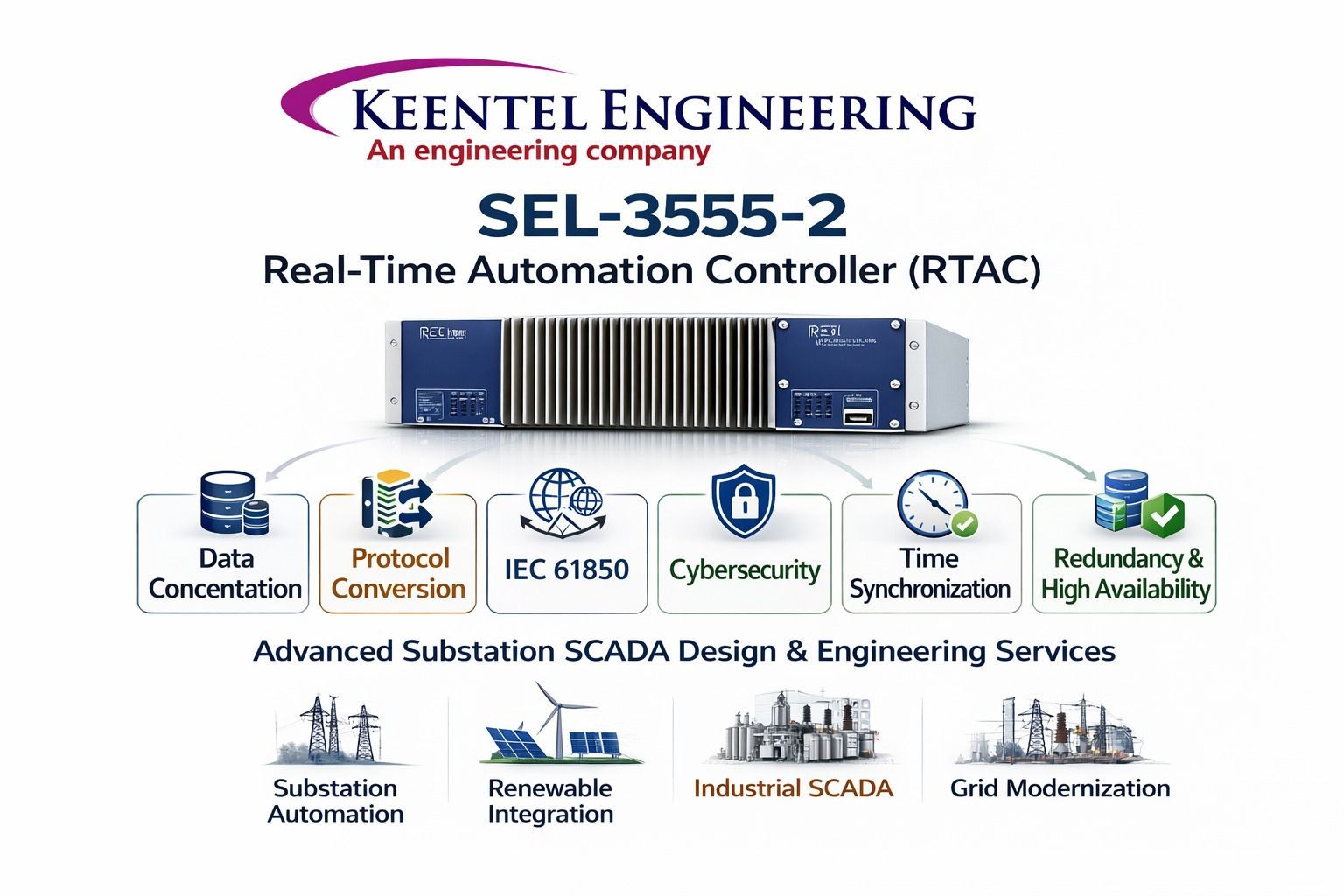
Modern substations are no longer passive power nodes. They are data-intensive, cyber sensitive, time synchronized, automation-driven control centers. At the core of next-generation substation SCADA architecture is the Real-Time Automation Controller (RTAC) platform.
The SEL-3555-2 RTAC, built on x86-64 architecture and SEL Linux® real-time operating system
provides a powerful foundation for:
- Substation SCADA data concentration
- Protocol conversion
- IEC 61131 automation logic
- Cybersecure remote engineering access
- Time synchronization (IRIG-B, NTP, PTP)
- Synchrophasor processing
- Redundant communications architectures
At Keentel Engineering, we design, configure, commission, and secure advanced SCADA systems around this platform ensuring utilities, renewables, and industrial facilities achieve performance, compliance, and long-term reliability.
1. The Modern Substation SCADA Challenge
Today’s substations must:
- Integrate legacy serial IEDs and modern IEC 61850 relays
- Concentrate data from DNP3, Modbus, IEC 61850 MMS, GOOSE, IEEE C37.118, and IEC 60870-5-101/104
- Provide high-speed local automation logic
- Support secure remote engineering access
- Enforce NERC CIP cybersecurity controls
- Maintain time synchronization accuracy across all IEDs
- Operate in harsh environmental conditions (–40°C to +75°C industrial rating)
This complexity demands more than a basic RTU. It requires an intelligent automation core.
2. Why Keentel Uses the SEL-3555-2 RTAC for SCADA Core Design
The SEL-3555-2 RTAC provides:
High-Performance Architecture
- Intel Xeon quad-core processors
- 8–64 GB ECC RAM
- RAID-capable industrial SSD storage
- Embedded SEL Linux real-time OS
Protocol Support for SCADA & Automation
The RTAC supports:
- DNP3 (Serial and LAN/WAN)
- Modbus RTU and TCP
- IEC 61850 MMS
- IEC 61850 GOOSE
- IEEE C37.118 Synchrophasors
- IEC 60870-5-101/104
- EtherCAT
- SEL MIRRORED BITS®
This multi-protocol capability allows Keentel to design flexible SCADA systems that bridge old and new technologies seamlessly.
3. Keentel’s Substation SCADA Architecture Philosophy
We design SCADA systems around five pillars:
3.1 Data Concentration and Protocol Translation
The RTAC performs:
- Client collection from downstream IEDs
- Server delivery to upstream SCADA master
- Real-time protocol conversion
Example:
- IEC 61850 MMS client → DNP3 server
- Modbus RTU → IEC 60870-5-104
- IEEE C37.118 → DNP3 for control center
Keentel configures data mapping tables, scaling, timestamp handling, and event buffering to ensure lossless translation.
3.3 Cybersecurity Architecture
Security features include:
- exe-GUARD® whitelisting anti-malware
- SSL/TLS and SSH encrypted communication
- LDAP authentication
- Role-based user accounts
- Audit logging
- Intrusion detection
Keentel designs SCADA networks to comply with:
- NERC CIP
- IEC 62351
- Utility cybersecurity frameworks
3.2 IEC 61131 Automation Logic
The RTAC supports IEC 61131 logic programming
.
Keentel engineers implement:
Breaker failure logic
Load shedding schemes
Interlocking automation
Alarm filtering
Analog scaling and validation
Synchrophasor-based calculations
High-speed tasks can run as fast as 1 millisecond
3.4 Time Synchronization & Event Accuracy
Time synchronization is critical for:
- SER accuracy
- Fault analysis
- Synchrophasor integrity
The RTAC supports:
- IRIG-B input/output
- NTP/SNTP
- PTP
- Internal clock regeneration
Keentel designs time hierarchy systems integrating:
- SEL-2401 GPS clock
- SEL-3390T Time & Ethernet card
- Serial IRIG distribution
3.5 Redundancy & High Availability
The RTAC supports:
- Dual hot-swappable power supplies
- RAID storage
- Bonded Ethernet interfaces
- Parallel Redundancy Protocol (PRP)
Keentel designs SCADA architectures with:
- Redundant control center connections
- Dual LAN topology
- Failover switching logic
- Redundant time sources
4. Keentel’s Substation SCADA Design Workflow
- System Requirements Definition
- IED Communication Matrix Development
- Protocol Mapping Strategy
- Network Architecture Design
- Cybersecurity Policy Integration
- RTAC Logic Programming
- HMI Page Development
- FAT Testing & Simulation
- Site Commissioning
- As-Built Documentation
5. Substation Applications Implemented by Keentel
Based on RTAC application capabilities
- SCADA Data Concentrator (RTU replacement)
- Security Gateway
- Protocol Gateway
- Synchrophasor Processor
- Intelligent Port Switch
- Time Synchronization Hub
6. Environmental & Utility-Grade Compliance
The SEL-3555-2 meets:
- IEC 61850-3
- IEEE 1613
- IEC 61010 safety standards
- –40°C to +75°C operating range
Keentel ensures installation meets:
- Grounding best practices
- Surge withstand capability
- Proper EMI shielding per type tests
Detailed FAQs – Keentel Substation SCADA Design
1. What is the role of the RTAC in a substation SCADA system?
The RTAC functions as a data concentrator, protocol gateway, automation controller, and cybersecurity enforcement point. It integrates multiple IEDs and presents unified data to control centers using standardized SCADA protocols
2. How does Keentel handle protocol conversion?
We configure RTAC client/server roles, map data objects, handle scaling, timestamp integrity, and ensure proper deadbands and event buffering across DNP3, Modbus, IEC 61850, and IEC 60870 protocols
3. Does the RTAC support IEC 61850 GOOSE?
Yes, it supports IEC 61850 GOOSE peer-to-peer communication
4. Can it handle synchrophasor data?
Yes. IEEE C37.118 client/server capability is supported and Keentel programs real-time phasor processing logic.
5. What cybersecurity protections are built in?
Whitelist-based anti-malware, SSL/TLS, SSH encryption, LDAP authentication, and audit logging
6. Can it replace legacy RTUs?
Yes. It can serve as an RTU/PLC and SCADA data concentrator
7. What is the environmental rating?
Operating range –40°C to +75°C (industrial grade)
8. Does it support redundant power supplies?
Yes, dual hot-swappable supplies
9. Can the RTAC serve as a security gateway?
Yes, including encryption and role-based access control
10. Does Keentel implement RAID storage?
Yes, RAID 0/1/5/10 supported via Intel RST
Conclusion
The SEL-3555-2 RTAC is not just a communication device it is the automation brain of a modern substation.
At Keentel Engineering, we transform this powerful platform into:
- Secure SCADA architectures
- Standards-compliant automation systems
- Redundant, high-availability control frameworks
- Future-ready digital substations
If you are planning a new substation or upgrading an existing SCADA system, Keentel delivers:
- Complete RTAC engineering
- Cybersecurity design
- IEC 61850 integration
- Protection & control coordination
- Commissioning and testing servicesThe SEL-3555-2 RTAC is not just a communication device—it is the automation brain of a modern substation.
- At Keentel Engineering, we transform this powerful platform into:
- Secure SCADA architectures
- Standards-compliant automation systems
- Redundant, high-availability control frameworks
- Future-ready digital substations
- If you are planning a new substation or upgrading an existing SCADA system, Keentel delivers:
- Complete RTAC engineering
- Cybersecurity design
- IEC 61850 integration
- Protection & control coordination
- Commissioning and testing services

About the Author:
Sonny Patel P.E. EC
IEEE Senior Member
In 1995, Sandip (Sonny) R. Patel earned his Electrical Engineering degree from the University of Illinois, specializing in Electrical Engineering . But degrees don’t build legacies—action does. For three decades, he’s been shaping the future of engineering, not just as a licensed Professional Engineer across multiple states (Florida, California, New York, West Virginia, and Minnesota), but as a doer. A builder. A leader. Not just an engineer. A Licensed Electrical Contractor in Florida with an Unlimited EC license. Not just an executive. The founder and CEO of KEENTEL LLC—where expertise meets execution. Three decades. Multiple states. Endless impact.
Services

Let's Discuss Your Project
Let's book a call to discuss your electrical engineering project that we can help you with.

About the Author:
Sonny Patel P.E. EC
IEEE Senior Member
In 1995, Sandip (Sonny) R. Patel earned his Electrical Engineering degree from the University of Illinois, specializing in Electrical Engineering . But degrees don’t build legacies—action does. For three decades, he’s been shaping the future of engineering, not just as a licensed Professional Engineer across multiple states (Florida, California, New York, West Virginia, and Minnesota), but as a doer. A builder. A leader. Not just an engineer. A Licensed Electrical Contractor in Florida with an Unlimited EC license. Not just an executive. The founder and CEO of KEENTEL LLC—where expertise meets execution. Three decades. Multiple states. Endless impact.
Leave a Comment
We will get back to you as soon as possible.
Please try again later.
Related Posts