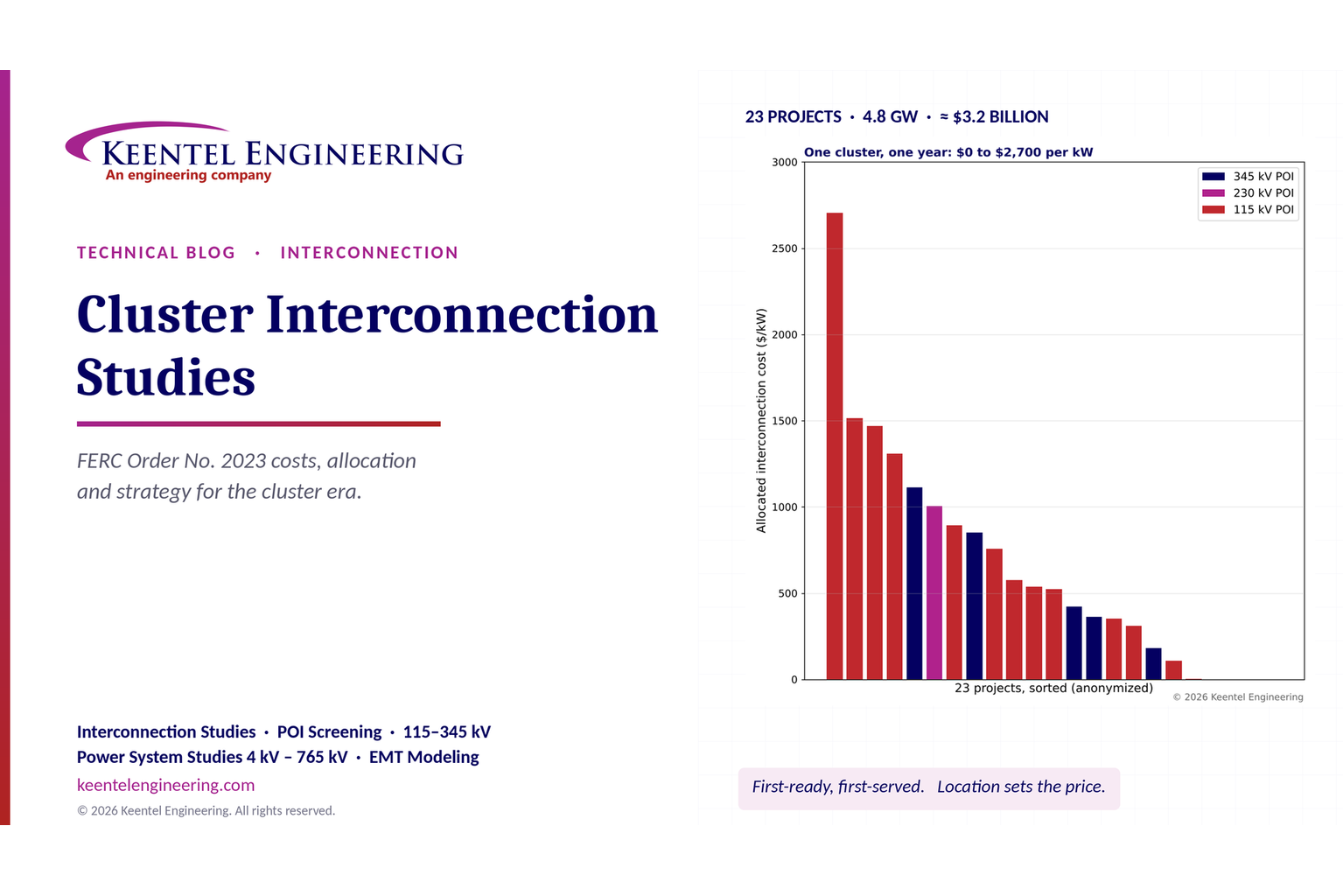


A Coordinated Electric System Interconnection Review—the utility’s deep-dive on technical and cost impacts of your project.
Challenge: Frequent false tripping using conventional electromechanical relays
Solution: SEL-487E integration with multi-terminal differential protection and dynamic inrush restraint
Result: 90% reduction in false trips, saving over $250,000 in downtime
| Category | Metric |
|---|---|
| VPP capacity (Lunar Energy) | 650 MW |
| Lunar funding raised | US$232 million |
| Data center BESS example | 31 MW / 62 MWh |
| ERCOT grid-scale batteries | 15+ GW |
| LDES tenders (H1 2026) | Up to 9.3 GW |
| Lithium-ion share of LDES by 2030 | 77% |
| FEOC initial threshold | 55% |
| BESS tariff rate (2026) | ~55% |
| Capacity gain from analytics | 5–15% |
Five Phenomena That Could Collapse the Entire Power System
A Statistical and Engineering Deep Dive into Extreme Contingencies and Grid Defense Strategies
February 23, 2026 | Blog
Executive Summary
Over the last three decades, the number of large-scale blackouts worldwide has increased significantly. As transmission systems expand, renewable penetration rises, and interconnections become more complex, modern power grids face elevated systemic risk. While grids are more technologically advanced than ever, they are also more tightly coupled and dynamically sensitive.
There are five dominant instability mechanisms capable of triggering partial or total system collapse:
- Transient Angle Instability
- Frequency Instability
- Voltage Instability
- Small Signal Angle Instability
- Cascade Tripping
Each phenomenon operates on different time scales, involves different physical drivers, and requires specific
Emergency Protection System (EPS) countermeasures. This article provides a statistical, mathematical, and operational analysis of these instability types and evaluates defense strategies used to prevent widespread blackouts.
1. Why Large-Scale Blackouts Are Increasing
1.1 Structural Changes in Modern Grids
| Parameter | 1990s Grid 2025 Grid | System Impact |
|---|---|---|
| Renewable Penetration | <5% | 30–60% Reduced inertia |
| Interconnection Size | Regional | Continental Higher cascading risk |
| Transfer Distances | Moderate | Very Long Voltage stress |
| Inertia Levels | High | Declining Faster frequency deviation |
Lower synchronous inertia combined with higher power transfers increases:
- Rate of Change of Frequency (RoCoF)
- Transient instability probability
- Voltage collapse sensitivity
- Cascading propagation speed
System risk increases nonlinearly with interdependency:
P cascade ≈ 1 − (1 − p) n
Where:
- p = probability of single component failure
- n = number of interdependent components
As n grows, systemic risk accelerates rapidly.
2. The Five Collapse Phenomena – Technical & Statistical Analysis
2.1 Transient Angle Instability
Definition
Loss of synchronism between generators following a major disturbance such as:
- Three-phase faults
- Loss of major generation
Sudden tie-line disconnection
Time Scale
Milliseconds to 5 seconds.
Governing Equation
dt 2 = P m − P e
Where:
- M = inertia constant
- δ = rotor angle
- Pm = mechanical power
- Pe = electrical power
If accelerating torque exceeds decelerating torque → instability.
Statistical Risk Factors
- High pre-fault transfer levels
- Weakly interconnected systems
- Heavy loading near stability limits
Effective Mitigation
- Generation rejection
- Turbine fast valving
- Dynamic braking
- Automatic load shedding
Fast actions (<500 ms) significantly reduce collapse probability.
2.2 Frequency Instability
Definition
Inability of system to maintain frequency within acceptable range following imbalance.
Safe Operating Range (60 Hz system)
| Frequency | Condition |
|---|---|
| 60 ± 0.5 Hz | Normal |
| <57.5 Hz | Generator damage risk |
| <55 Hz | Severe instability |
| >61.5 Hz | Hydro trip risk |
Frequency Decline Rate
dt = P mismatch
2Hf 0
Where:
- H = system inertia
- f₀ = nominal frequency
Lower inertia = faster decline.
Statistical Observations
Modern low-inertia grids experience 2–4 times higher RoCoF than traditional systems.
Mitigation Tools
- Underfrequency Load Shedding (UFLS)
- AGC setpoint correction
- Fast-start gas turbines
- Hydro overfrequency tripping
Well-designed UFLS can reduce full blackout probability by over 70% in generation-loss scenarios.
2.3 Voltage Instability
Definition
Inability to maintain acceptable bus voltage due to reactive power deficiency.
PV Curve Relationship
X
When operating beyond maximum transferable power → collapse.
Types
- Short-term (seconds): Motor stalling
- Long-term (minutes): LTC tap interactions
Risk Indicators
- Reactive reserves <10%
- High import corridors
- Multiple LTC operations
- Weak transmission paths
Mitigation Tools
- Undervoltage Load Shedding (UVLS)
- Shunt capacitor/reactor switching
- HVDC modulation
- Tap changer blocking
- Synchronous condenser voltage boost
Properly configured UVLS reduces collapse risk by 40–65%.
2.4 Small Signal Angle Instability
Definition
Poor damping of electromechanical oscillations between generators.
Oscillation Ranges
- Local modes: 0.7–2 Hz
- Inter-area modes: 0.1–0.7 Hz
Damping Ratio
√(σ 2 + ω 2 )
If ζ < 0 → unstable.
Most Vulnerable Systems
- Large interconnected grids
- Long-distance high-power transfers
- Weak tie-lines
Solutions
- Power System Stabilizers (PSS)
- Generator excitation control
- SVC and FACTS supplementary control
- HVDC damping modulation
2.5 Cascade Tripping – The Most Dangerous Mechanism
Definition
Uncontrolled sequence of transmission line and generator disconnections.
Propagation Mechanism
Loss of one line increases loading on remaining lines:
Remaining Lines
If overload > thermal limit → additional trips.
Triggering Mechanisms
- Zone 3 distance relay operations
- Overcurrent relay delayed trips
- Protection miscoordination
- Overload during high transfer conditions
Cascade probability increases dramatically when:
- Lines operate >85% capacity
- Inter-area transfers near limit
- Protection coordination margins are tight
Cascade events are responsible for most multi-day blackouts globally.
3. System Structure & Risk Correlation
Grid configuration strongly influences dominant instability risk.
Densely Meshed Systems
- Higher oscillation risk
- Better voltage resilience
- Lower frequency deviation severity
Lightly Meshed Systems
- Higher voltage instability risk
- Higher frequency collapse risk
- Faster cascade propagation
Isolated Systems
- Extremely vulnerable to frequency instability
- Less exposure to inter-area oscillations
4. Emergency Protection Systems (EPS)
EPS architecture consists of:
- Inputs (voltage, frequency, breaker status)
- Decision-making logic
- Action (load shedding, generator trip, switching)
EPS Action Categories
- Generation actions
- Load shedding (UFLS, UVLS, remote)
- Shunt equipment switching
- HVDC fast modulation
- Controlled islanding
- Closed-loop excitation and stabilizer controls
5. Multi-Layer Defense Strategy
Effective blackout prevention requires layered protection:
Layer 1 (Milliseconds)
- Fast valving
- Generation rejection
- Dynamic braking
Layer 2 (Seconds)
- UFLS
- UVLS
- HVDC modulation
Layer 3 (Minutes)
- Tap changer blocking
- Gas turbine startup
- AGC coordination
Layer 4 (Last Resort)
- Controlled islanding
- Interconnection separation
No single protection prevents collapse. Coordination is essential.
Final Engineering Insight
Modern grids are more interconnected but less inertially stable. System collapse occurs when:
P(Instability1)∩P(Instability2)∩P(Protection Failure)>Critical Threshold
Only coordinated, layered emergency protection systems can maintain system integrity under extreme contingencies.
15 Detailed FAQs
1. Which instability is most likely to cause total blackout?
Cascade tripping, due to nonlinear propagation.
2. What is the fastest collapse mechanism?
Transient angle instability (milliseconds to seconds).
3. What frequency causes turbine damage?
Below ~57.5 Hz in a 60 Hz system.
4. Why are modern grids more vulnerable?
Lower inertia and higher interdependence.
5. What is RoCoF?
Rate of Change of Frequency — indicator of imbalance severity.
6. How does UFLS prevent collapse?
It reduces load in steps before generators trip.
7. Why block tap changers?
To prevent voltage collapse acceleration.
8. What is small signal instability?
Poor damping of oscillations between generators.
9. Why is HVDC beneficial?
It allows rapid active and reactive power modulation.
10. What causes cascade tripping?
Overload, relay miscoordination, and power swings.
11. What is generation rejection?
Tripping selected generators to stabilize system angles.
12. What frequency trips hydro units?
Typically above 61.5 Hz.
13. What is UVLS?
Undervoltage load shedding to prevent voltage collapse.
14. When is controlled islanding used?
As a last-resort stabilization method.
15. What is the best overall prevention strategy?
A coordinated multi-layer defense plan combining fast and slow EPS actions.

About the Author:
Sonny Patel P.E. EC
IEEE Senior Member
In 1995, Sandip (Sonny) R. Patel earned his Electrical Engineering degree from the University of Illinois, specializing in Electrical Engineering . But degrees don’t build legacies—action does. For three decades, he’s been shaping the future of engineering, not just as a licensed Professional Engineer across multiple states (Florida, California, New York, West Virginia, and Minnesota), but as a doer. A builder. A leader. Not just an engineer. A Licensed Electrical Contractor in Florida with an Unlimited EC license. Not just an executive. The founder and CEO of KEENTEL LLC—where expertise meets execution. Three decades. Multiple states. Endless impact.
Services

Let's Discuss Your Project
Let's book a call to discuss your electrical engineering project that we can help you with.

About the Author:
Sonny Patel P.E. EC
IEEE Senior Member
In 1995, Sandip (Sonny) R. Patel earned his Electrical Engineering degree from the University of Illinois, specializing in Electrical Engineering . But degrees don’t build legacies—action does. For three decades, he’s been shaping the future of engineering, not just as a licensed Professional Engineer across multiple states (Florida, California, New York, West Virginia, and Minnesota), but as a doer. A builder. A leader. Not just an engineer. A Licensed Electrical Contractor in Florida with an Unlimited EC license. Not just an executive. The founder and CEO of KEENTEL LLC—where expertise meets execution. Three decades. Multiple states. Endless impact.
Leave a Comment
We will get back to you as soon as possible.
Please try again later.