A Coordinated Electric System Interconnection Review—the utility’s deep-dive on technical and cost impacts of your project.
Challenge: Frequent false tripping using conventional electromechanical relays
Solution: SEL-487E integration with multi-terminal differential protection and dynamic inrush restraint
Result: 90% reduction in false trips, saving over $250,000 in downtime
| Category | Metric |
|---|---|
| VPP capacity (Lunar Energy) | 650 MW |
| Lunar funding raised | US$232 million |
| Data center BESS example | 31 MW / 62 MWh |
| ERCOT grid-scale batteries | 15+ GW |
| LDES tenders (H1 2026) | Up to 9.3 GW |
| Lithium-ion share of LDES by 2030 | 77% |
| FEOC initial threshold | 55% |
| BESS tariff rate (2026) | ~55% |
| Capacity gain from analytics | 5–15% |
FAC-008-5 Facility Ratings: NERC Compliance Services Engineering Support for Reliable Bulk Power Systems | Keentel Engineering

March 5, 2026 | blog
Introduction
Power system reliability depends heavily on understanding the physical and operational limits of equipment connected to the Bulk Electric System (BES). Every transmission line, transformer, generator, and substation component has operational limits that must not be exceeded during planning or real-time operations.
To ensure that these limits are properly defined and consistently applied, the North American Electric Reliability Corporation (NERC) established the FAC-008-5 Reliability Standard, which governs the methodology used to determine Facility Ratings.
Facility Ratings define the maximum electrical capability of equipment under defined operating conditions. These ratings are essential for determining System Operating Limits (SOLs), conducting power system studies and ensuring that system operators maintain safe and reliable operation.
FAC-008-5 requires Transmission Owners and Generator Owners to establish documented methodologies for determining Facility Ratings and ensure that those ratings are consistent with engineering principles, industry standards, and operational realities.
What Is a Facility Rating?
A Facility Rating represents the maximum electrical capability of a facility or piece of equipment under specific conditions.
This rating may include limits based on:
- Thermal capability
- Mechanical constraints
- Insulation limits
- Environmental conditions
- System protection settings
A facility typically consists of multiple components, such as:
- Transmission conductors
- Transformers
- Circuit breakers
- Instrument transformers
- Disconnect switches
- Relay protection devices
- Reactive compensation equipment
The overall facility rating is determined by the most limiting equipment rating within the facility. If one component reaches its limit earlier than others, that component dictates the entire facility capability.
Purpose of FAC-008-5
The primary goal of FAC-008-5 is to ensure that Facility Ratings used for planning and operating the Bulk Electric System are determined using technically sound engineering principles.
The standard ensures:
- Consistency in equipment rating methodologies
- Transparency in rating assumptions
- Reliable planning and operational limits
- Data sharing between reliability entities
Without consistent rating methodologies, power system studies could underestimate equipment limits or allow unsafe loading conditions.
Entities Responsible for Compliance
FAC-008-5 applies to two primary types of entities:
1. Generator Owners (GO)
Generator Owners must determine Facility Ratings for equipment associated with generating facilities up to the interconnection point with the transmission system.
2. Transmission Owners (TO)
Transmission Owners must determine ratings for transmission facilities such as
:
- Transmission lines
- Substation equipment
- Transformers
- Protection devices
- Reactive power equipment
Both entities must maintain documented methodologies and ensure ratings remain consistent with those methodologies.
Key Principles of Facility Rating Methodology
FAC-008-5 requires that Facility Ratings be determined based on documented engineering methods.
Acceptable approaches include:
Manufacturer Equipment Ratings
Equipment ratings provided by manufacturers or listed on nameplates.
Industry Standards
Ratings derived using recognized engineering standards such as:
- IEEE standards
- ANSI standards
- CIGRE guidance
- Other accepted engineering standards
Engineering Analysis
Ratings validated through:
- engineering calculations
- performance testing
- operational history
These approaches ensure ratings are technically defensible and reproducible.
Major Components Considered in Facility Rating Methodology
A robust Facility Rating methodology evaluates all major system components.
1. Transmission Lines
Transmission line ratings depend primarily on conductor thermal capability.
Key factors affecting conductor rating include:
- Ambient temperature
- Wind speed
- Solar heating
- Conductor material properties
- Maximum allowable conductor temperature
Industry methods such as steady-state thermal calculations are used to determine allowable ampacity under defined conditions.
Emergency and transient ratings may also be established for short-duration overloads.
2. Underground Transmission Cables
Underground cable ratings depend on:
- Insulation temperature limits
- Soil thermal resistivity
- Burial depth
- Load factor
- Fault current capability
- Adjacent heat sources
Thermal modeling techniques are used to determine cable temperature rise and allowable current.
Cable ampacity calculations are often based on well-established thermal modeling methods used for cable systems.
3. Substation Terminal Equipment
Substation equipment ratings are determined using manufacturer specifications and relevant IEEE standards.
Typical equipment considered includes:
- Circuit breakers
- Disconnect switches
- Bus bars
- Instrument transformers
- Wave traps
- Capacitor banks
The lowest rated component determines the terminal facility rating.
4. Transformers
Transformer ratings depend on thermal and insulation limits.
Key parameters include:
- Top-oil temperature
- winding hot-spot temperature
- cooling system capability
- insulation aging limits
Transformer loading limits are typically determined based on recognized transformer loading guides and manufacturer data.
5. Generator Facilities
Generator facility ratings must consider the electrical capability of the entire generator system.
Important elements include:
- Generator capability curve
- generator step-up transformer
- current transformers
- voltage transformers
- bus connections
- generator breakers
The generator facility rating must reflect the most limiting component among these elements.
Performance testing may also be used to verify generator capability under real operating conditions.
Ambient Conditions and Environmental Assumptions
Environmental conditions significantly impact equipment ratings.
Typical assumptions may include:
- Summer design temperature
- Winter design temperature
- Solar radiation
- Wind speed
- atmospheric conditions
These conditions are used to ensure ratings represent worst-case operating scenarios.
Environmental assumptions must be clearly documented within the Facility Rating methodology.
Normal Ratings vs Emergency Ratings
FAC-008-5 requires entities to define at least two types of ratings:
Normal Rating
The continuous rating at which equipment can operate indefinitely without causing damage or unacceptable aging.
Emergency Rating
A temporary rating that allows equipment to operate above normal limits for a limited time under contingency conditions.
Emergency ratings are typically used during system disturbances or outages to maintain reliability.
Documentation Requirements
Entities must maintain comprehensive documentation describing how facility ratings are determined.
Documentation should include:
- rating methodology
- assumptions used
- applicable engineering standards
- equipment data sources
- calculation methods
This documentation must be retained and available for compliance audits.
Data Sharing Requirements
FAC-008-5 also requires that facility ratings and limiting equipment be provided to:
- Reliability Coordinators
- Planning Coordinators
- Transmission Planners
- Transmission Operators
- Transmission Owners
Entities must supply this information when requested, particularly when facility ratings impact:
- interconnection reliability limits
- transfer capability
- generator deliverability
- service to major load centers.
Compliance Monitoring
Compliance with FAC-008-5 may be evaluated through several mechanisms:
- compliance audits
- self-certifications
- spot checks
- violation investigations
- self-reporting
Entities must retain documentation and rating records to demonstrate compliance over time.
Failure to properly document rating methodologies or establish accurate facility ratings may result in reliability violations.
Importance of FAC-008-5 for Grid Reliability
FAC-008-5 plays a critical role in power system reliability.
Accurate facility ratings ensure that:
- power flows remain within safe limits
- equipment damage is prevented
- contingency analysis reflects realistic system capabilities
- transmission planning studies produce reliable results
Inaccurate or inconsistent facility ratings can lead to:
- equipment overloads
- thermal damage
- voltage instability
- cascading outages
Therefore, the standard is essential for maintaining the reliability of the Bulk Electric System across North America.
Conclusion
FAC-008-5 establishes a structured framework for determining Facility Ratings using sound engineering methodologies. By requiring documented rating methodologies, consistent assumptions, and adherence to industry standards, the reliability standard ensures that power system operators and planners use accurate equipment limits when evaluating system performance.
Facility Ratings form the foundation for reliable power system operation. Whether evaluating transmission capacity, generator deliverability, or contingency limits, accurate ratings ensure the grid operates safely within the capabilities of its equipment.
Organizations that implement rigorous Facility Rating methodologies strengthen both
operational reliability and regulatory compliance, helping maintain the stability of the interconnected power grid.
Frequently Asked Questions (FAQ)
1. What is the purpose of the FAC-008-5 reliability standard?
FAC-008-5 ensures that Facility Ratings used in planning and operating the Bulk Electric System are determined using technically sound and documented methodologies.
2. What is a Facility Rating?
A Facility Rating represents the maximum electrical capability of a facility under defined operating conditions without exceeding equipment limitations.
3. Why are Facility Ratings important for power system reliability?
Facility Ratings determine the maximum loading limits of equipment. Accurate ratings prevent equipment overheating, insulation damage, and system instability.
4. Who must comply with FAC-008-5?
The standard applies to Generator Owners and Transmission Owners responsible for BES facilities.
5. What determines the rating of a facility?
The rating of a facility is determined by the most limiting equipment rating within that facility.
6. What types of equipment must be included in facility rating methodology?
Typical equipment includes:
- conductors
- transformers
- protective relays
- circuit breakers
- disconnect switches
- compensation devices.
7. What is the difference between equipment rating and facility rating?
Equipment rating applies to an individual component, while facility rating represents the capability of the entire facility considering all components.
8. How are transmission line ratings determined?
Transmission line ratings are determined using thermal calculations that consider ambient temperature, wind speed, solar heating, and conductor properties.
9. What factors influence underground cable ratings?
Key factors include soil thermal resistivity, cable insulation limits, burial depth, load factor, and environmental conditions.
10. Why must rating methodologies be documented?
Documentation ensures consistency, transparency, and compliance during reliability audits.
11. What is an emergency rating?
An emergency rating allows equipment to operate above normal limits for a short period during contingency conditions.
12. How are transformer ratings determined?
Transformer ratings are determined using manufacturer data, thermal limits, and recognized transformer loading guides.
13. Can facility ratings change over time?
Yes. Ratings may change due to equipment upgrades, operational experience, system modifications, or improved engineering analysis.
14. What happens if equipment is damaged or degraded?
Temporary de-ratings may be applied to ensure safe operation until repairs or replacements are completed.
15. How often should facility ratings be reviewed?
Ratings should be reviewed whenever system modifications occur or when new engineering information becomes available.
16. What role do environmental conditions play in facility ratings?
Ambient temperature, wind conditions, and solar heating directly influence thermal limits and must be considered when determining ratings.
17. How do facility ratings affect transmission planning?
Facility ratings determine transfer limits and influence power flow studies used for transmission planning.
18. What information must be shared with reliability entities?
Entities must provide facility ratings and the identity of limiting equipment when requested by reliability authorities.
19. How is compliance with FAC-008-5 verified?
Compliance is verified through audits, self-certifications, spot checks, and investigations conducted by regulatory authorities.
20. What risks arise from inaccurate facility ratings?
Incorrect ratings may lead to overloaded equipment, reliability violations, and increased risk of power system disturbances.

About the Author:
Sandip "Sonny" R. Patel, P.E.
IEEE Senior Member · Founder & CEO, Keentel Engineering
In 1995, Sonny Patel earned his Electrical Engineering degree from the University of Illinois. But degrees don't build legacies — action does.
For three decades, he has worked the power industry from every side of the table: 16 years as a utility engineer at Exelon/Commonwealth Edison; generation leadership across hydroelectric, industrial steam turbine, and a 9 GW renewable fleet; NERC Regional Entity Senior Compliance Engineer and Audit Team Lead, auditing some of the nation's largest utilities; and testing and commissioning lead on equipment up to 765 kV — the very top of the North American grid.Utility. Generator. Regulator. Consultant. Few engineers have seen all four seats. Fewer still have sat in them.
His experience spans nuclear, hydro, conventional generation, renewables, oil and gas, mining — and today's data centers, where he is authoring a three-book series on data center design. He is a Licensed Professional Engineer in six states and a Licensed Electrical Contractor in Florida (Unlimited EC) — he doesn't just design the work; he's qualified to stand behind its execution.Today, as Founder and CEO of Keentel Engineering, Sonny leads a nationwide team of engineers delivering substation design, power system studies, NERC compliance, and commissioning — done right, coast to coast.Three decades. Every side of the table. One standard: accountable engineering.
Services

Let's Discuss Your Project
Let's book a call to discuss your electrical engineering project that we can help you with.
About the Author:
Sandip "Sonny" R. Patel, P.E.
IEEE Senior Member · Founder & CEO, Keentel Engineering
In 1995, Sonny Patel earned his Electrical Engineering degree from the University of Illinois. But degrees don't build legacies — action does.
For three decades, he has worked the power industry from every side of the table: 16 years as a utility engineer at Exelon/Commonwealth Edison; generation leadership across hydroelectric, industrial steam turbine, and a 9 GW renewable fleet; NERC Regional Entity Senior Compliance Engineer and Audit Team Lead, auditing some of the nation's largest utilities; and testing and commissioning lead on equipment up to 765 kV — the very top of the North American grid.
Utility. Generator. Regulator. Consultant. Few engineers have seen all four seats. Fewer still have sat in them.
His experience spans nuclear, hydro, conventional generation, renewables, oil and gas, mining — and today's data centers, where he is authoring a three-book series on data center design. He is a Licensed Professional Engineer in six states and a Licensed Electrical Contractor in Florida (Unlimited EC) — he doesn't just design the work; he's qualified to stand behind its execution.
Today, as Founder and CEO of Keentel Engineering, Sonny leads a nationwide team of engineers delivering substation design, power system studies, NERC compliance, and commissioning — done right, coast to coast.Three decades. Every side of the table. One standard: accountable engineering.
Leave a Comment
Thank you for contacting us.
We will get back to you as soon as possible.
We will get back to you as soon as possible.
Oops, there was an error sending your message.
Please try again later.
Please try again later.
Related Posts
By SANDIP R PATEL
•
October 20, 2026
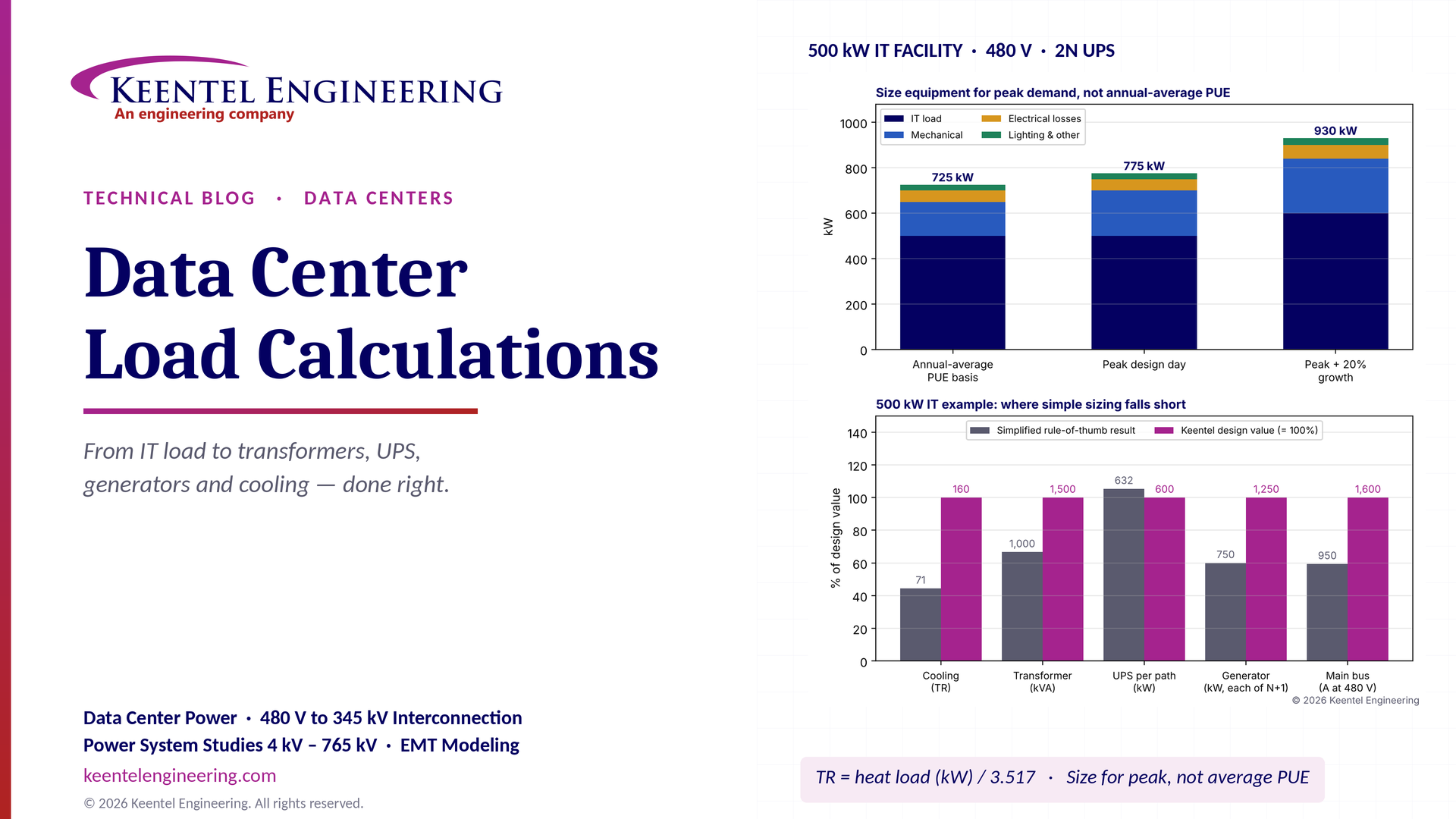
Learn data center electrical load calculations, including IT demand, PUE, UPS and generator sizing, cooling loads, redundancy, and worked US examples.
By SANDIP R PATEL
•
October 20, 2026
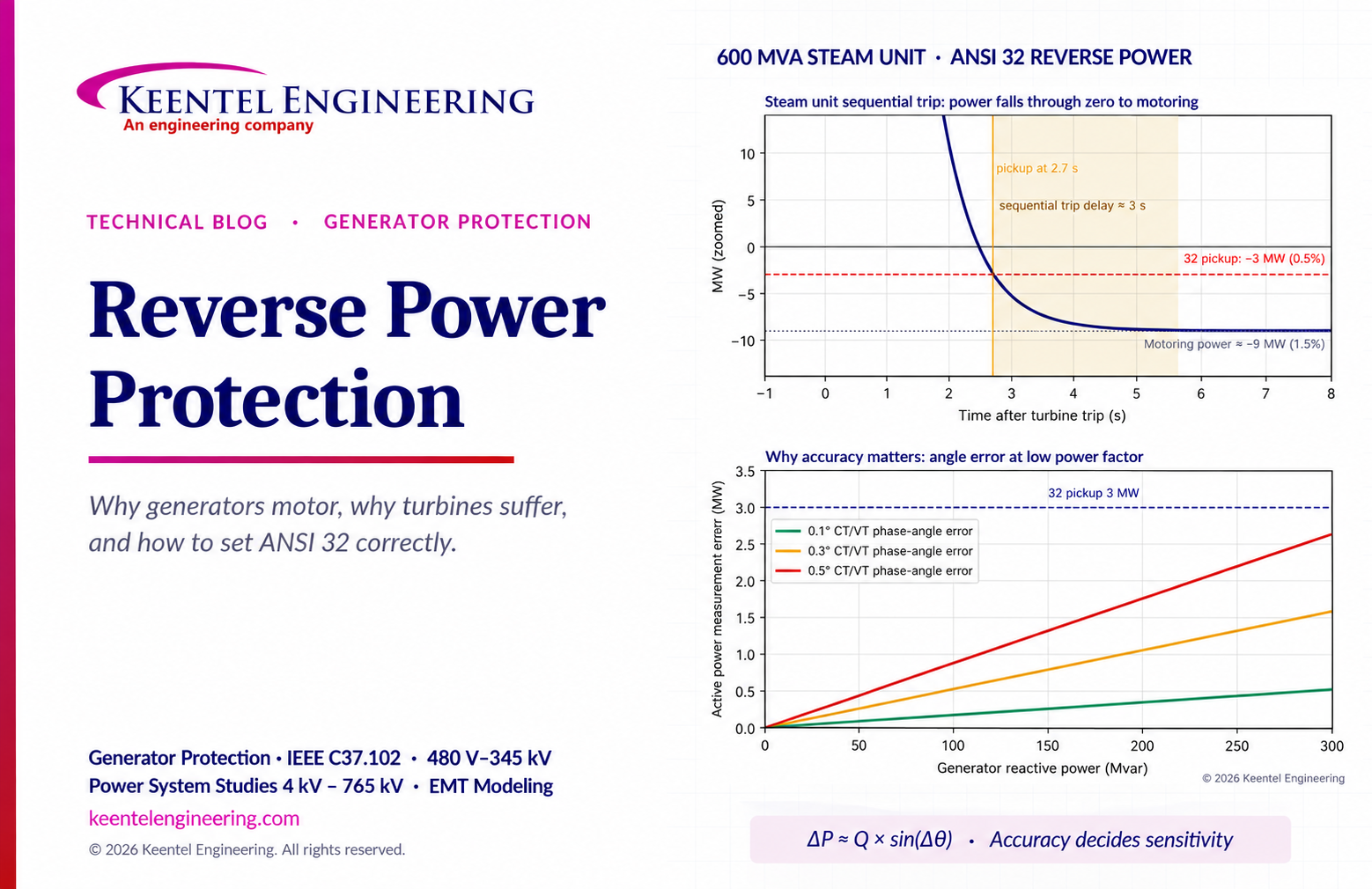
Learn reverse power protection (ANSI 32), generator motoring, relay pickup settings, time delays, sequential tripping and testing for US power plants.
Copy
By Team 2 Dexora
•
October 20, 2026
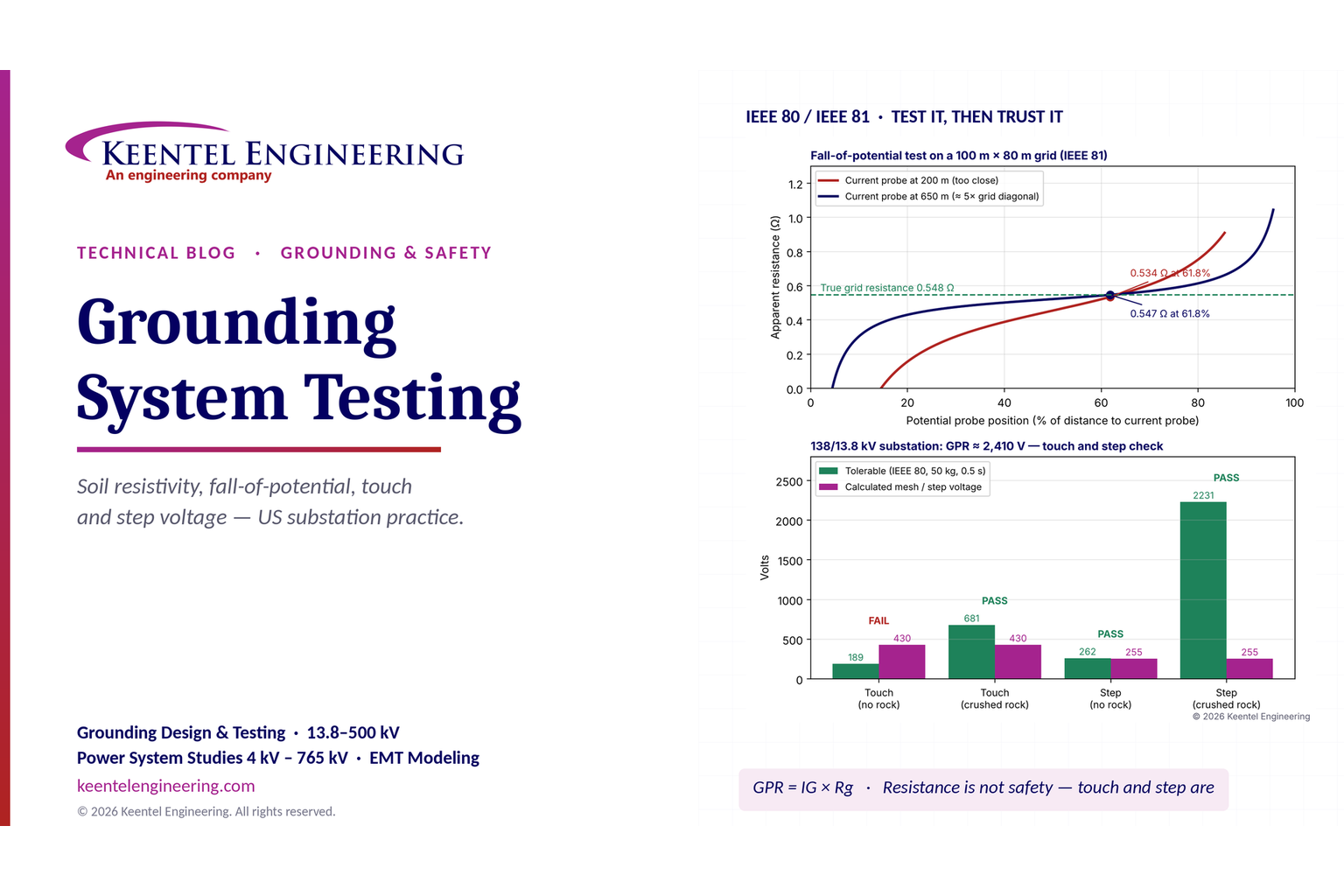
Explore grounding system testing with Keentel Engineering. Learn IEEE 80/81 methods, soil resistivity, ground resistance, and touch and step voltage safety.
By SANDIP R PATEL
•
October 13, 2026
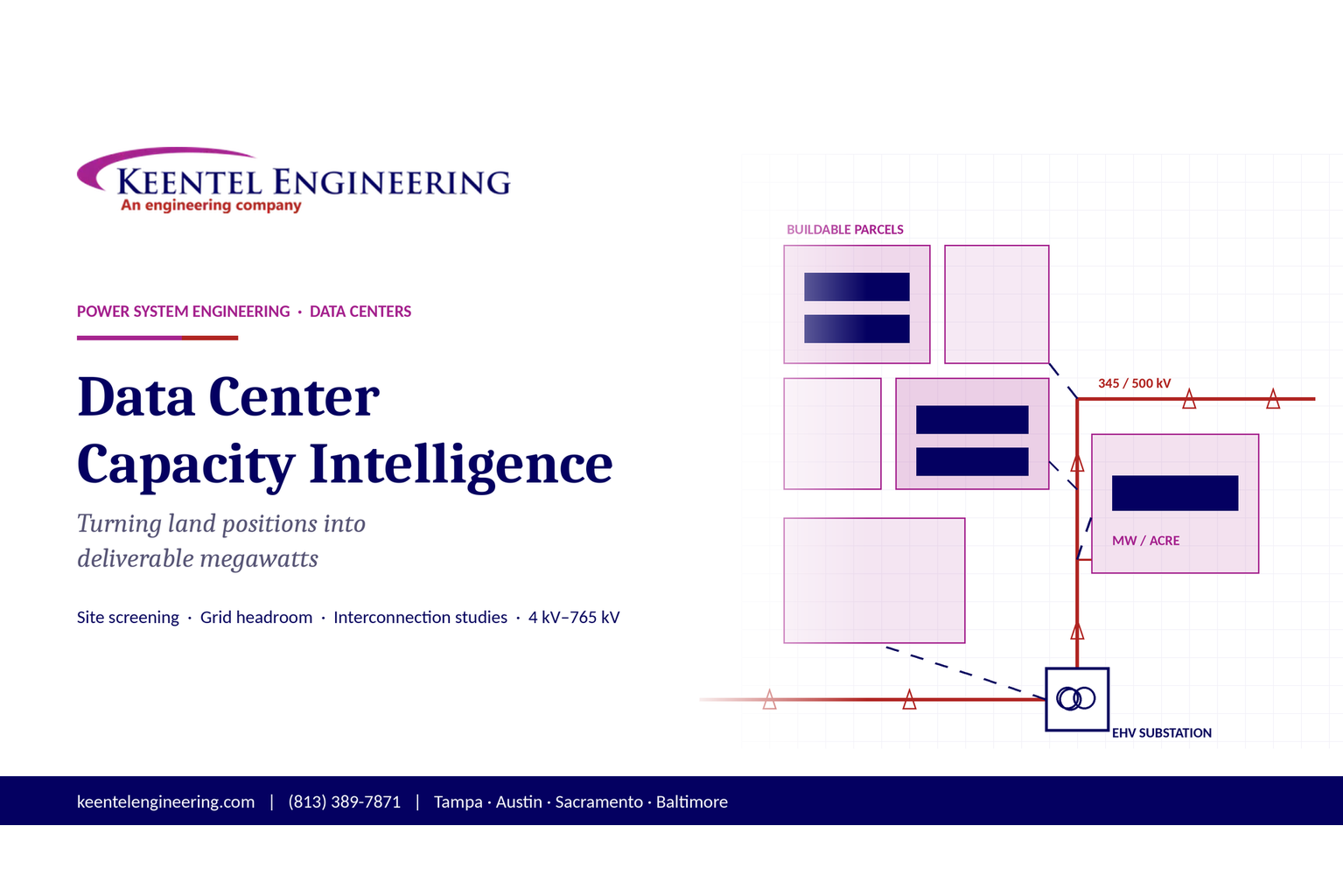
Plan data center capacity with land screening, MW-per-acre estimates, grid power availability and interconnection feasibility studies from Keentel Engineering.
By SANDIP R PATEL
•
October 11, 2026
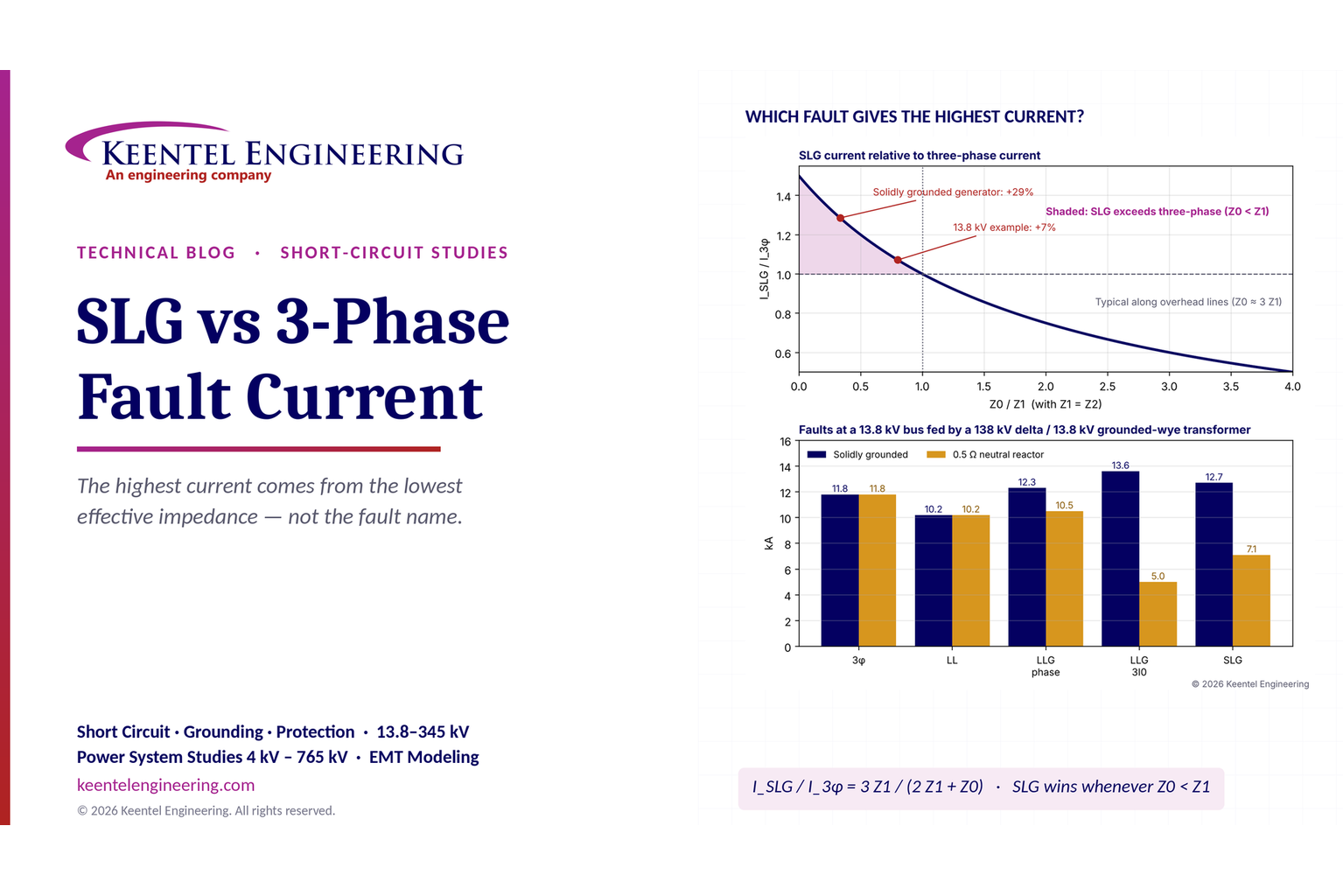
Learn which fault produces the highest current at a bus, why SLG faults can exceed three-phase faults, and how symmetrical components determine fault duty.
By SANDIP R PATEL
•
October 11, 2026
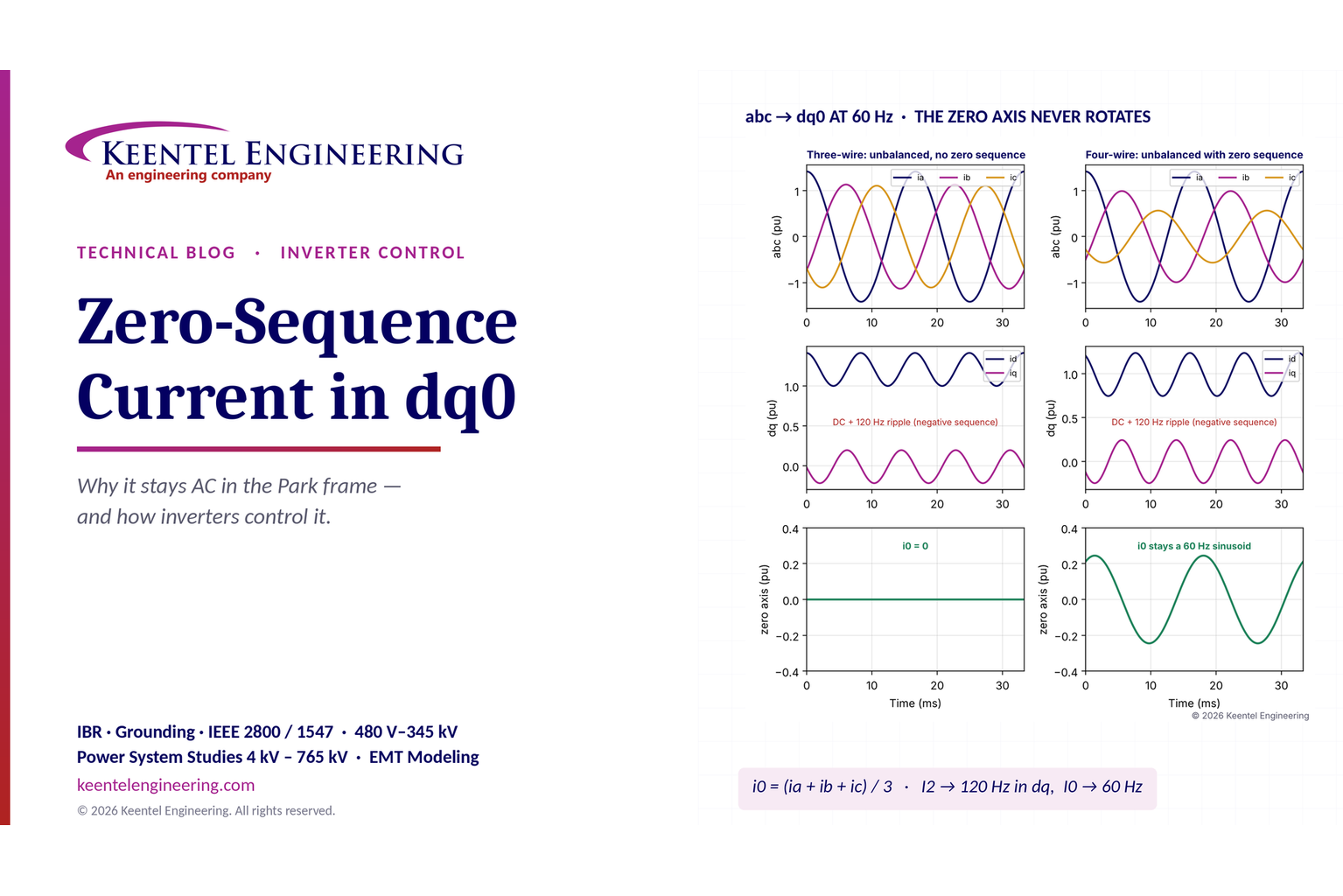
Learn why zero-sequence current pulsates in the dq0 frame, how Park's transformation works, and how inverter controls handle unbalance and ground faults.
By SANDIP R PATEL
•
October 11, 2026
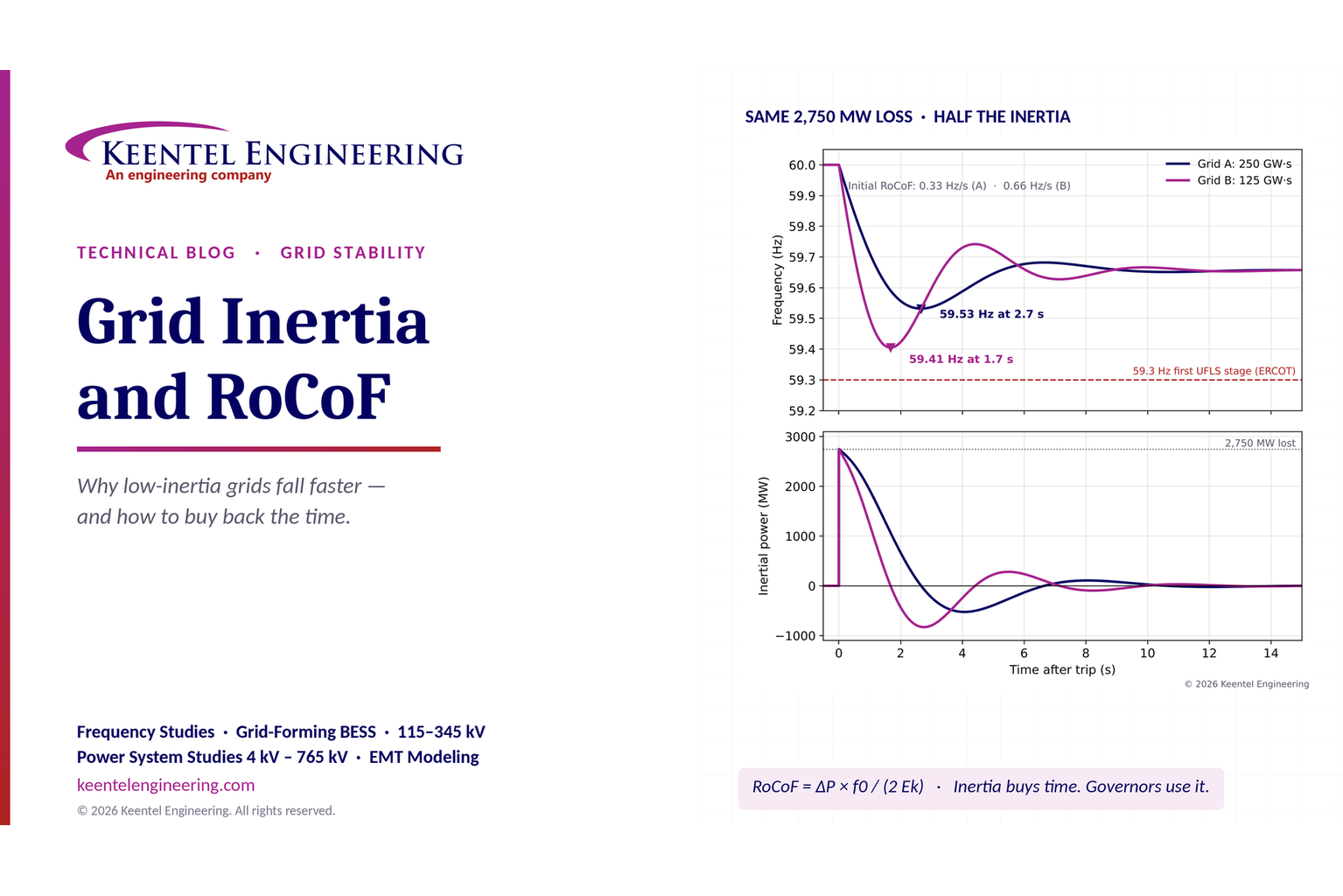
Explore grid inertia, RoCoF and frequency response, with swing equation calculations, frequency nadir analysis and US power system simulation examples.
By SANDIP R PATEL
•
October 11, 2026
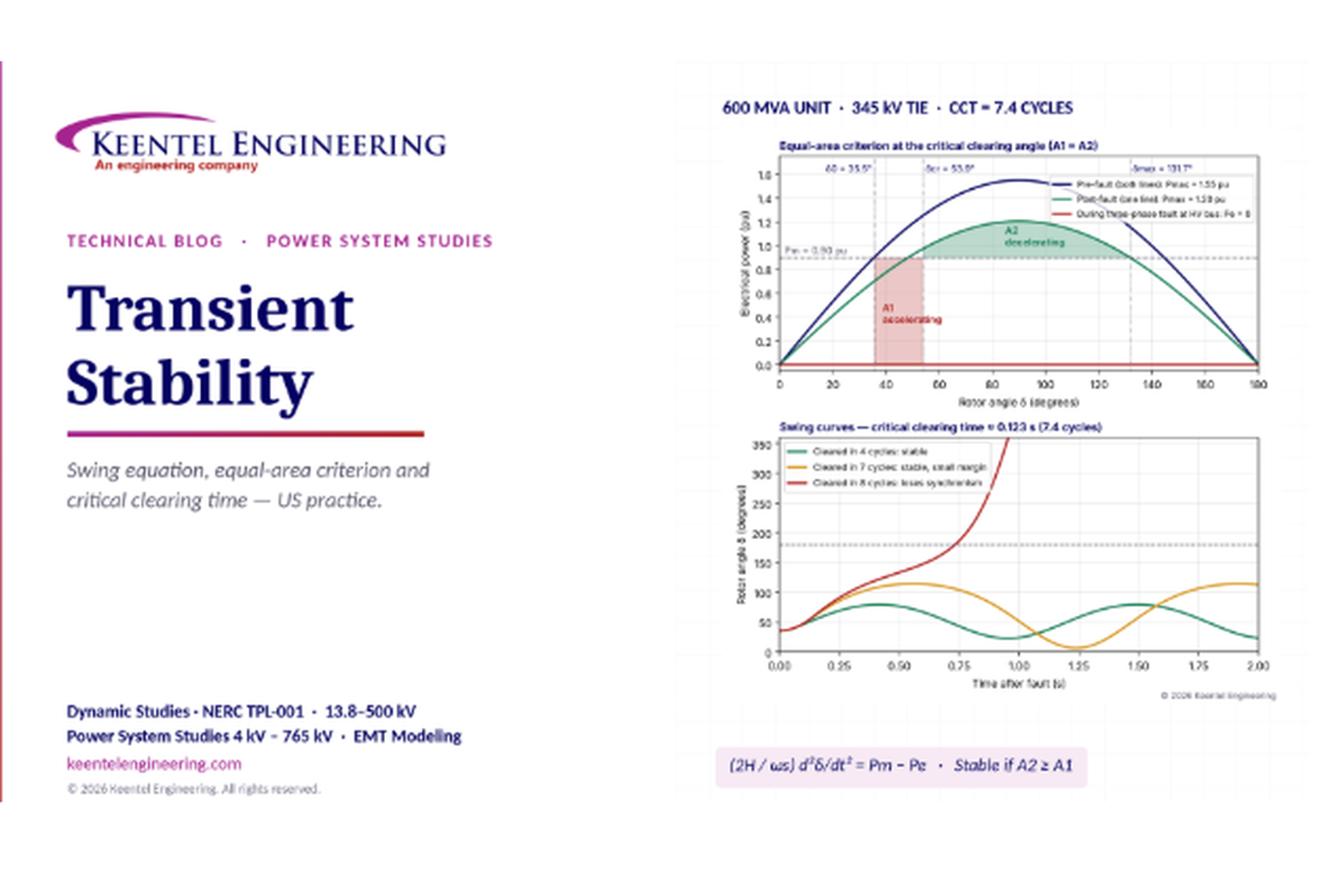
Learn transient stability analysis, swing equation, equal-area criterion and critical clearing time with a 345 kV worked example and NERC TPL-001 guidance.
By SANDIP R PATEL
•
October 11, 2026
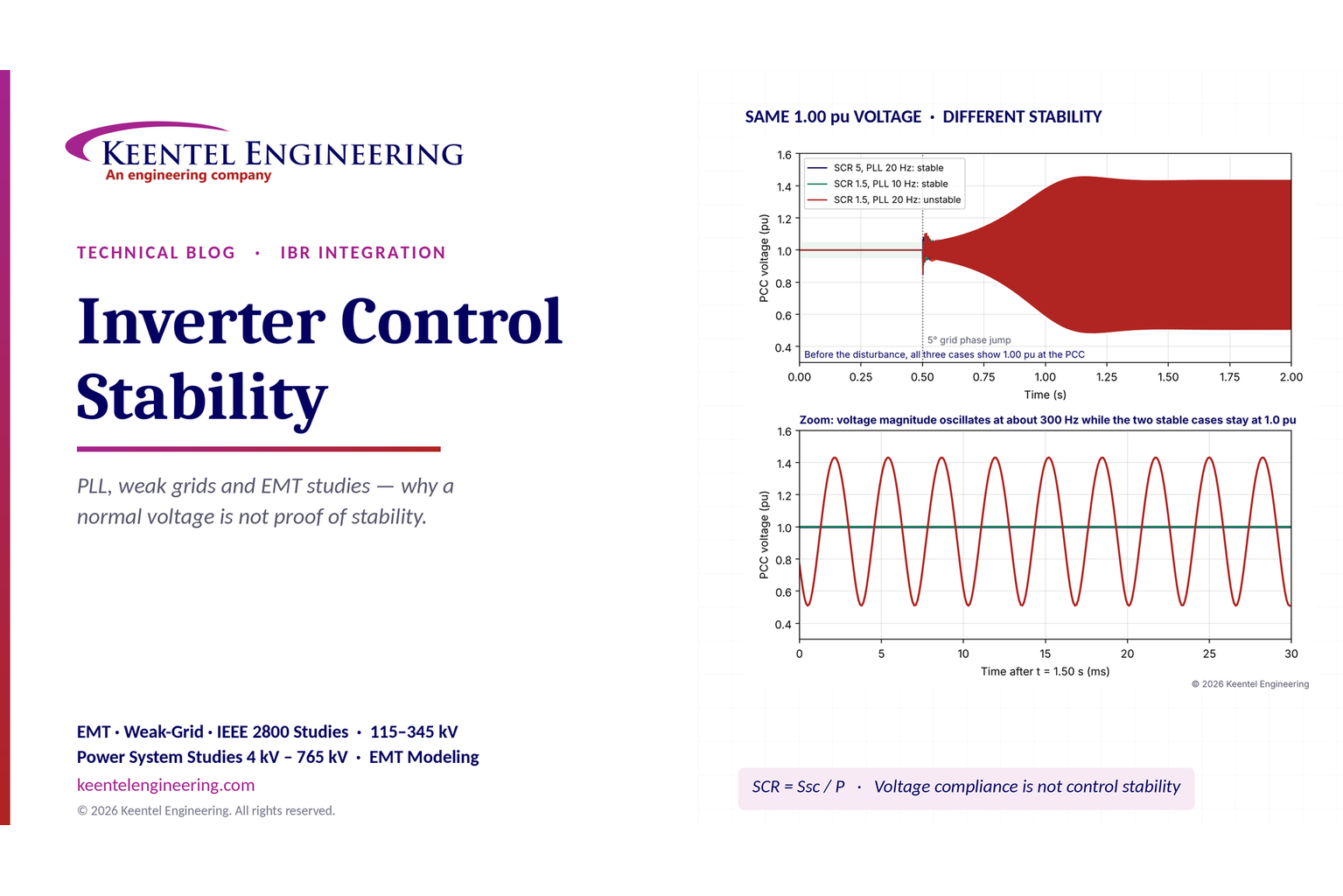
Learn why inverter controls become unstable in weak grids, how PLL bandwidth and SCR affect stability, and how PSCAD EMT studies identify and mitigate oscillations.