A Coordinated Electric System Interconnection Review—the utility’s deep-dive on technical and cost impacts of your project.
Challenge: Frequent false tripping using conventional electromechanical relays
Solution: SEL-487E integration with multi-terminal differential protection and dynamic inrush restraint
Result: 90% reduction in false trips, saving over $250,000 in downtime
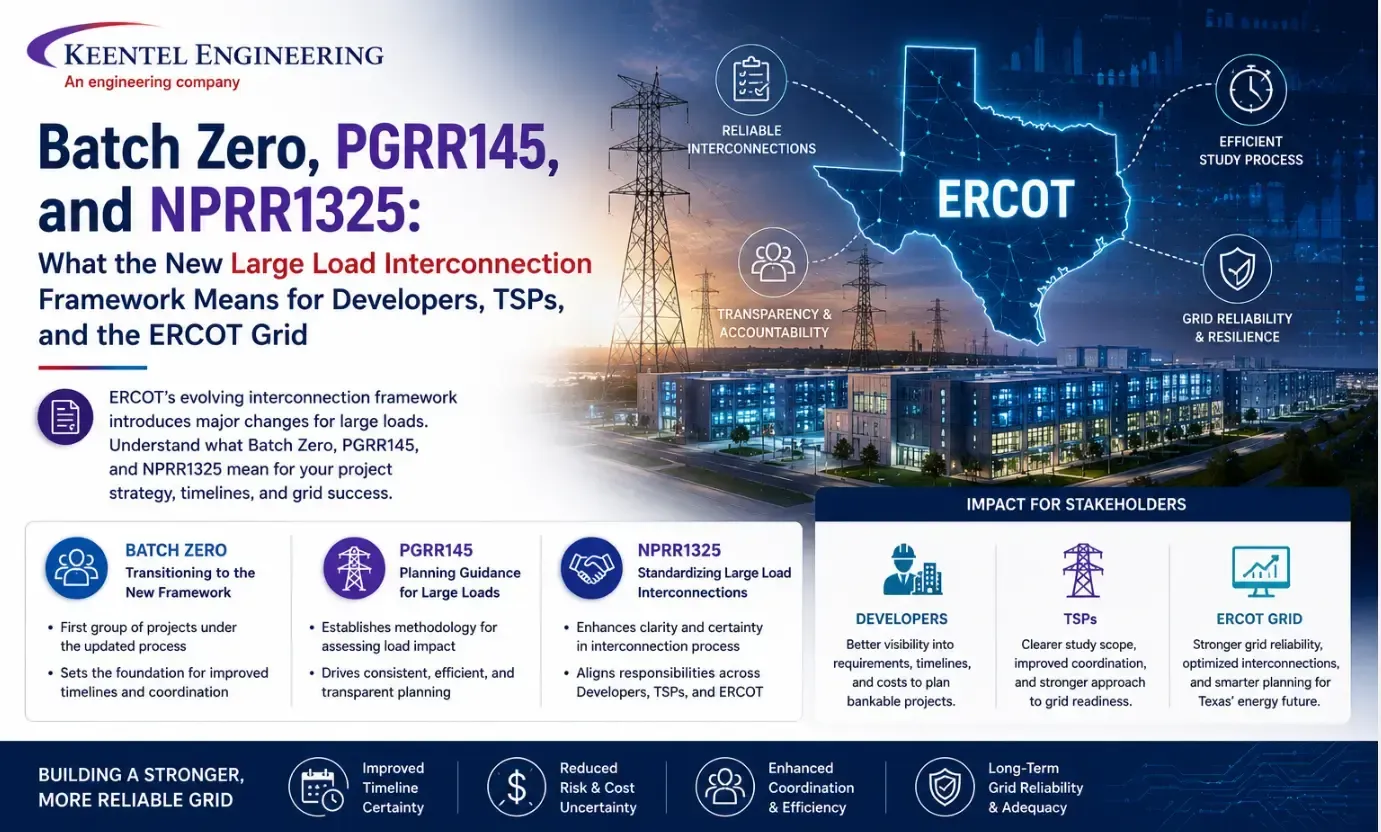
Batch Zero, PGRR145, and NPRR1325: What the New Large Load Interconnection Framework Means for Developers, TSPs, and the ERCOT Grid
May 20, 2026 | Blog
Why This Matters Now
The Texas grid is in the middle of the largest load-growth event in its history. Hyperscale data centers, AI training campuses, crypto mining facilities, and electrified industrial sites have pushed the active large-load interconnection queue well beyond what the historical ERCOT planning machinery was ever designed to absorb in a single cycle. Forecasts now place the 2032 load picture in the range of roughly 290 GW of cumulative load interest** against approximately **309 GW of available generation capacity and that generation total only reaches parity if planners are willing to count projects that have not yet completed full interconnection studies, and in some cases, projects that are technically classified as inactive.
That tight margin is the backdrop for two of the most consequential revision requests the ERCOT stakeholder process has produced in years: **PGRR145** (a Planning Guide Revision Request governing how large loads are studied and interconnected) and its companion protocol revision, NPRR1325. Together, they establish what the industry is now calling "**Batch Zero**" — the first coordinated, simultaneous study cycle for the wave of large loads currently sitting at the grid's front door.
For developers preparing site applications, for Transmission Service Providers (TSPs) sizing their next round of upgrades, and for load-serving entities planning around the new rules, the details inside Batch Zero will shape capital decisions for the next decade. This article walks through the framework, the engineering rationale behind the most-debated design choices, and three representative case studies that illustrate how the rules play out in practice.
The Core Problem: Why a "Batch" Approach At All
Historically, large loads in ERCOT followed one of two interconnection paths. If a load's in-service date was more than two years out, it could ride on an existing Regional Planning Group (RPG) transmission project review and use those studies for FAC-002 compliance. If the in-service date was inside two years, the load had to go through the **Large Load Interconnection Study (LLIS) process which examined that specific load against the existing system.
That model worked when large loads arrived one or two at a time. It breaks down when hundreds of gigawatts of requests arrive within a 36-month window, each load study assuming a different set of base conditions, each new request potentially invalidating an earlier one's reliability conclusions.
The Batch Zero concept fixes this by **studying all eligible loads simultaneously against a shared 2032 system case**. Rather than a serial first-come-first-served process where each new load is studied against an ever-shifting backdrop, Batch Zero freezes the modeling assumptions, applies a defined eligibility cutoff, and produces a single coherent allocation that can be defended on reliability grounds.
The trade-off is significant. Batching introduces a hard cutoff date that determines who is in and who waits for Batch 1. It also forces the question of how to rank loads whose studies overlap or conflict — a question the framework answers by ranking studies according to **completion date**, regardless of whether the study was conducted through the RPG pathway or through LLIS.
The Eligibility Picture: Load and Generation in 2032
Understanding the framework requires understanding the numbers it is built around.
On the load side, the modeled 2032 picture includes a base forecast of approximately 113 GW (covering organic growth, electric vehicles, rooftop PV, medium TSP loads, and crypto), plus the studied large-load categories that survive the validity check. After accounting for various overlapping categories — Permian Basin Plan loads, RPG-tracked large loads, validated LLIS loads, and additional load identified through stakeholder comments — the total potential modeled 2032 load reaches roughly 220 GW within Batch Zero scope, with another ~70 GW of additional requests visible in the broader queue.
On the generation side, ERCOT classifies projects against the Planning Guide Section 6.9 framework:
- 6.9(1) Operational — units actually energized today
- 6.9(5)(a) — Planned, signed SGIA
- 6.9(5)(b) — Planned, completed Full Interconnection Study (FIS)
- 6.9(5)(c)(i) — Planned, FIS started with steady-state and stability studies complete
- 6.9(5)(c)(ii) — Planned, FIS started with steady-state complete
- 6.9(5)(c)(iii) — Planned, FIS started
- 6.9(5)(d) — Inactive status with completed FIS stability study
The further down that list a project sits, the lower the probability it actually delivers MWs to the grid by 2032. Serving the current Batch Zero scope already requires reaching into the 6.9(5)(c)(iii) and later categories — projects that may or may not survive financing, siting, and construction. Expanding scope further would force modelers to count capacity from the 6.9(5)(d) inactive bucket, which is engineering speak for "we are pretending this will happen so the math works."
This is the central tension in the framework. The scope is already aggressive. Any expansion materially raises the risk of producing study outputs that look reliable on paper but cannot be physically delivered.
Study Validity: The Quiet Earthquake
One of the less-discussed but most operationally consequential elements of the framework is the study validity check. Before any large load can be classified as "base load" in the Batch Zero model — meaning it is assumed to be served reliably under all conditions and other loads must be planned around it — its underlying interconnection study has to be confirmed as still valid in the current system topology.
Here is where it gets interesting. Because LLIS studies and RPG-pathway studies have different assumptions about which other loads are present, changing the eligibility rules for RPG-tracked loads (which the framework does) ripples through the LLIS portfolio. A given LLIS study completed in February 2026 might have assumed certain RPG loads were not yet in the base case; if the rules now make those RPG loads automatically valid as of an earlier date, the LLIS study's reliability conclusions must be reassessed.
In practice, this means that a substantial number of LLIS loads that were considered to have valid studies under earlier draft language now require:
- A new validity check against the updated automatic-validity assumptions
- Potentially a full restudy if the validity check fails
- Reclassification from "base load" to "studied load" if the restudy reveals reliability issues
The framework handles this by ordering studies by completion date and then walking down the list, checking each one against the cumulative set of validated loads ahead of it. Loads whose studies pass the check enter Batch Zero as base load. Loads whose studies fail enter as studied load meaning their MW allocation will be determined inside Batch Zero rather than treated as a fixed input.
For developers, this distinction matters enormously. Base load status carries a presumption that the requested MWs will be served. Studied load status means the MWs are subject to the outcome of the steady-state and stability analysis, and could be reduced — sometimes significantly — based on what the system can actually carry.
Provisional Controllable Load Resources (PCLRs): The Headroom Mechanism
Once the base-and-studied-load distinction is settled, the framework still has to answer a question that has frustrated large-load developers for years: what happens when transmission capacity to serve full requested load won't exist for several years, but the load itself wants to ramp as early as possible?
The answer is the Provisional Controllable Load Resource (PCLR) — a new resource category that splits a large load's consumption into two components:
- Low Power Consumption (LPC) — the firm portion, defined as the maximum load that can be reliably served under steady-state conditions given today's transmission capability. This is hard-limit firm service.
- Flexible portion — the difference between requested peak load and LPC, served via dispatchable demand under ERCOT's Security-Constrained Economic Dispatch (SCED) following base points like any other dispatchable resource.
Crucially, the full requested load is studied in Batch Zero, not just the firm portion.
Transmission upgrades are identified that, over time, transition the flexible MWs to firm service. The PCLR mechanism is, in effect, a way to monetize transmission headroom as it appears rather than waiting for the entire upgrade plan to complete before allowing any consumption above LPC.
How PCLR Registration and Operation Work
A large load entity wanting to operate as a PCLR must:
- Declare intent before Batch Zero starts. This is not a back-end opt-in; it must be on the table at the front of the process.
- Submit a complete Declaration and supporting information by the defined deadline (currently late July of the cycle year).
- Be studied in Batch Zero at full requested load for steady-state purposes (to determine LPC) and at full consumption for stability analysis.
- Accept the Form W Part B election within the post-study window. This is the binding decision point.
- Register as a Resource Entity (RE) with ERCOT and designate a Qualified Scheduling Entity (QSE).
- Establish CLR parameters in RIOO and meter the facility for CLR participation.
- Set up ICCP telemetry to the Operations control room.
- Receive Approval to Energize from ERCOT.
Critically, steps 6–8 must occur before any non-firm load can energize. They can run in parallel with the Qualified Scheduling Entity Agreement (QSA), but they cannot be skipped or deferred.
Form W Part B: The Binding Election
After Batch Zero produces its results, each Interconnecting Large Load Entity (ILLE) receives an allocated LPC value (firm) and a Maximum Power Consumption (MPC) value (total ceiling including flexible). To proceed, the ILLE must file Form W Part B selecting one of four paths:
| Option | Description | Practical Implication |
|---|---|---|
| 1. Accept PCLR as awarded | Take the ERCOT-defined LPC and MPC values without modification | Retains full upside of consuming above LPC under PCLR rules, subject to dispatch and bid capping |
| 2. Accept PCLR with reduced values | Proceed as PCLR but reduce LPC, MPC, or both below awarded levels | Useful when on-site infrastructure or financing won't support full awarded values immediately |
| 3. Withdraw PCLR, retain firm load | Convert to firm-only at LPC (with optional reduction), waive ability to exceed LPC | Removes PCLR registration burden but locks load to firm allocation forever |
| 4. Withdraw from process | Decline participation entirely, exit Batch Zero | Project removed from Refinement Study, must re-enter through a future batch |
Failure to submit Form W Part B by the deadline is treated as Option 4 — automatic removal from the Refinement Study and loss of queue position. This is the single most expensive missed deadline in the framework.
Dynamic Bid Capping and Transmission Constraints
In real-time operations, PCLRs must follow SCED base points like any other dispatchable resource. But there is a wrinkle. Because the load is participating to consume *energy*, its energy bid curve must be capped under certain transmission-constrained conditions to ensure it actually backs down rather than continuing to consume through a binding constraint.
The dynamic bid capping logic works as follows:
Step 1: After each SCED run, the system generates a list of transmission constraints whose shadow price reached at least **90% of the maximum shadow price** observed in that run. This identifies the constraints that were materially binding.
Step 2: Before the next SCED execution, that list is compared against the active constraints in the current run. Constraints that appear in both lists are flagged as "triggering" constraints for bid capping.
Step 3: For each PCLR whose **shift factor is more negative than −0.02** on a triggering constraint, the PCLR's energy bid curve is capped at an **Adjusted Bid Cap (ABC)** value before the SCED step executes. The cap is calculated as:
> **ABC = Step 1 System Lambda − max(MaxShadowPrice × ShiftFactor) − $0.01/MWh**
The mechanism ensures that when a PCLR's continued consumption is contributing to a binding constraint, the price at which it is willing to buy energy is mechanically pulled below the marginal system price plus its contribution to the constraint, plus a $0.01 tiebreaker. The net effect is that SCED will dispatch the PCLR down rather than allow the constraint to violate.
It is worth noting that **no standard market mitigation applies to energy bid curves under this mechanism**. The bid cap is the mitigation. The logic remains grey-boxed in the protocol language pending implementation of NPRR1188 and the corresponding system changes for bid capping, but the design intent is clear.
Bring Your Own Generation (BYOG): Co-Located Load and Generation
Why BYOG Is Attractive
For the load developer, BYOG delivers timing certainty. The load can energize on the generator's schedule rather than waiting for backbone transmission upgrades that may take five to seven years from study to commissioning. Curtailment risk from grid constraints is also reduced because the facility is partly self-supplied.
For the generator, BYOG converts what would otherwise be a merchant exposure into a contracted demand from day one. That improves project bankability dramatically and gives generation developers a clear role in resolving the load interconnection bottleneck rather than competing for the same scarce transmission.
For the system, BYOG accelerates capacity build precisely in the locations where it is needed most, reduces congestion on the rest of the network, and improves overall resource adequacy by linking new demand to new supply.
The Three-Study Framework
The engineering challenge with BYOG is that a co-located load-and-generation facility looks different to different ERCOT study processes. A coordinated framework requires three study workstreams running in parallel but with distinct scopes:
1. Generation Interconnection Study (Planning Guide Section 5).
Evaluates the generator independently under standard GINR assumptions to determine export capability and interconnection requirements. Co-located load is included in this study when it materially affects system performance — particularly for stability, voltage, and operational impacts. Output: maximum injection limits, stability constraints, interconnection requirements.
2. Batch Study (Load Interconnection — Planning Guide Section 9 / PGRR145).
Evaluates the large load *as if it were grid-supplied only* — that is, with the co-located generation explicitly not counted. The purpose is to determine the maximum import (withdrawal) capability the load could draw from the ERCOT grid under steady-state conditions. Output: withdrawal limits and initial load allocation, subject to stability limits from the combined study.
3. Transmission Planning Study
Models load and generation together as a single integrated facility and assesses full system impact under standard reliability criteria including N-1 (single contingency) and G-1 (generator outage) conditions. Identifies required network upgrades and validates **Self-Limited Withdrawal exit (SLF-exit)** conditions — the configuration in which the BYOG facility no longer needs to self-limit because adequate transmission exists. Output: required transmission upgrades and validation of long-term post-BYOG operating conditions.
Final Allowable Load
Final allowable load = min(Requested Load, Stability Limit)
Example: 1,000 MW requested, 600 MW on-site → 500 MW final (100 MW grid + 400 MW on-site)
Operational Phases
Interim phase: self-limited withdrawal
Post-transmission: standard ERCOT operation
Sequential BYOG Timeline Table
| Phase | Timing | Activities |
|---|---|---|
| BYOG declaration | Pre-Batch Zero | Identify pairing |
| Case building | ~6 months | Integrated studies |
| Batch Study | Parallel | Withdrawal evaluation |
| LLIS eligibility | Window | Confirm inclusion |
| Generation FIS studies | Parallel | Stability & operability |
| Developer commitment | 60 days | Confirm MW allocation |
| Upgrade identification | 6–10 months | TSP-ERCOT upgrades |
| Refinement study | 10–14 months | Full system analysis |
Studying Forward to 2032
Approach 1: Rollover
- Years 2027–2031 studied, 2032 deferred
- Effort: 100%, Timeline: 6 months
Approach 2: Bookend
- Fully study 2028, 2030, 2032, interpolate 2029, 2031
- Effort: 140%, Timeline: 8.5 months
Approach 3: Study All
- Fully study 2028–2032
- Effort: 200%, Timeline: 12 months
Paragraph:
2032 dominates due to location effects, queue depth, cross-zonal interactions, and limited parallelization.
Adjusted Timelines
| Activity | Original | Bookend | Rollover |
|---|---|---|---|
| RPG Comment | Q3 | Q3 | Q3 |
| Developer Commitment | Standard | +30 days | +30 days |
| Case Build | 13 wks | 13 wks | 13 wks |
| Steady-State | 15 wks | 25 wks | 15 wks |
| Stability + Report | 16 wks | 16 wks | 16 wks |
| FAC-002 + Refinement | 14 wks | 14 wks | 14 wks |
| Batch Zero Report | Mid-cycle +1 | +10 wks | Earliest |
| Refinement study | Following | Following | Following |
Case Study
Case Study 1: Hyperscale Data Center Campus in the ERCOT North Zone
Facility profile
A hyperscale data center developer plans a multi-phase campus with a target peak demand of **800 MW by 2032**, ramping from initial energization at 200 MW in 2027, to 400 MW by 2029, 600 MW by 2031, and full 800 MW by 2032. The campus is located in the ERCOT North zone in an area with moderate existing transmission capacity but no committed backbone upgrades within the developer's required timeline.
Initial study outcomes
The LLIS was completed in February 2026 and passed initial validity review. However, after the study validity check against subsequent RPG-tracked loads that became automatically valid under the new framework, the original LLIS conclusions required reassessment. The reassessment determined that the full 800 MW could not be reliably served as firm load under 2032 conditions without significant transmission upgrades. The Batch Zero study determined a firm allocation (LPC) of **475 MW** and a stability-validated maximum (MPC) of **800 MW**, leaving 325 MW of flexible capacity dependent on PCLR participation.
Developer decision
The developer evaluated the three Form W Part B options seriously. Option 1 (accept PCLR as awarded) preserved the path to 800 MW but introduced exposure to SCED dispatch and dynamic bid capping for the flexible 325 MW. Option 3 (withdraw PCLR, retain firm) would have capped the campus at 475 MW permanently — sufficient for early phases but insufficient for the contracted AI training workload by 2031. The developer selected **Option 1** and registered as a PCLR.
Operational results
During 2027–2028, the campus operated comfortably within its 475 MW LPC for early-phase workloads. As the load ramped past 475 MW in 2029, the PCLR mechanism began actively dispatching the flexible portion. SCED dispatched the campus to its full requested level approximately **84% of operating hours**. During the remaining 16%, dynamic bid capping was active — primarily during summer peak hours and during planned transmission outages affecting the North zone. The campus held a sufficient operational reserve in its workload scheduling to redirect non-time-sensitive AI training jobs to other regions during capping events, limiting the operational impact.
Transmission catch-up
Backbone transmission upgrades identified in the Batch Zero Refinement Study completed in stages between 2030 and 2032. By the end of 2032, the campus had been fully transitioned to firm 800 MW service.
Key engineering takeaways
- The PCLR mechanism delivered the developer's strategic objective (path to full 800 MW) at the cost of accepting transmission-driven operational variability for the flexible portion.
- The shift factor screening (≤ −0.02 threshold) worked as designed: bid capping events were concentrated on the specific North-zone constraints where the campus materially contributed to the binding flow, not on every system-wide constraint.
- Form W Part B was the critical decision point. The 60-day window was tight given internal stakeholder approvals; developers in similar situations should pre-align their decision criteria before Batch Zero results are issued.
- The post-validity-check reclassification from full firm to partial firm + PCLR was a significant change from the original LLIS assumption. Engineering teams should not assume that an early LLIS pass guarantees firm allocation in Batch Zero.
Case Study 2: Industrial Decarbonization Site with Co-Located Solar + Storage (BYOG)
Facility profile
A specialty chemicals producer plans to electrify a large industrial site in the ERCOT South zone, replacing existing gas-fired process heat with electrified equivalents. Peak demand at full electrification is **600 MW by 2030**. The site is located in an area where transmission capacity to serve 600 MW of new firm load is at least 4–5 years from completion, with the available pathway being a planned 345 kV line extension that has not yet entered the active RTP queue.
The developer chose to pursue a **BYOG configuration**: 600 MW of process load co-located with **450 MW of utility-scale solar PV and 200 MW / 800 MWh of battery storage**, sized to cover daytime production with battery shifting to support evening operations.
Three-study results
The Generation Interconnection Study evaluated the 450 MW solar and 200 MW storage independently and determined a maximum injection limit of 380 MW at the POI, constrained by local 138 kV network capacity. Standard stability requirements were validated.
The Batch Study evaluated the 600 MW load as grid-supplied only and determined a withdrawal limit of 180 MW under 2030 conditions, reflecting limited transmission headroom from the existing network until the 345 kV extension completes.
The Transmission Planning Study modeled the integrated facility (600 MW load + 450 MW solar + 200 MW storage) and assessed N-1 and G-1 conditions. Stability analysis identified a maximum stable total load of 620 MW, which was non-binding (above the requested 600 MW). The study confirmed the BYOG configuration is reliable under all standard contingencies including the loss of the largest single generation unit on site.
Final allowable load determination
- Requested load: 600 MW
- Stability limit: 620 MW (non-binding)
- Withdrawal limit from grid: 180 MW
- Maximum from on-site generation: 450 MW (solar peak) + 200 MW (battery discharge) — but limited by load + storage charging needs
Final allowable load
Operational results
The facility operated under the BYOG agreement with self-limited withdrawal from 2028 through 2031. During daylight hours with high solar output, the facility met its full 600 MW load primarily from on-site generation, with grid imports averaging 80–140 MW. During evening hours, battery discharge covered the post-sunset shoulder, transitioning to higher grid reliance overnight when import demand sometimes approached the 180 MW cap. The chemical production schedule was adjusted to shift the most energy-intensive process steps to daylight hours when on-site generation was abundant.
During three separate events in 2029–2030, on-site generation was unavailable (planned solar maintenance combined with battery state-of-charge depletion). The facility's self-limiting controls reduced load to 180 MW within the required response time (subseconds for fast curtailment, with operational adjustment to safe-state production within minutes). No grid reliability events resulted from BYOG operation.
The 345 kV line extension completed in late 2031. After validation of SLF-exit conditions, the BYOG agreement dissolved in Q2 2032 and the facility transitioned to standard ERCOT operation. The solar and storage continued to operate but as independent market resources rather than as co-located self-supply.
Key engineering takeaways
- BYOG enabled the chemical producer to electrify on a timeline (2028 operational) that would have been impossible under firm-load-only assumptions (~2033 earliest given transmission completion).
- The three-study framework worked exactly as intended: the Batch Study correctly identified the limited grid contribution, the Generation study established export limits, and the integrated Transmission Planning Study identified the upgrades needed for the post-BYOG configuration.
- Load scheduling against solar availability required substantial process control investment. Facilities considering BYOG should account for the operational technology investment, not just the electrical interconnection cost.
- Battery sizing (200 MW / 800 MWh = 4-hour duration) was sufficient to cover evening shoulders but not full overnight operation. Facilities with 24/7 high-utilization workloads (such as data centers) would require larger storage or different supply configurations.
Case Study 3: Crypto Mining Operation Failing the Study Validity Check
Facility profile
A crypto mining operator planned a **350 MW expansion** of an existing site in the ERCOT West zone, co-located with existing wind generation capacity from a third-party owner. The original LLIS was completed in October 2025 — before PGRR115 implementation in December 2025 — under the assumption that an adjacent RPG-tracked transmission project would be available by the in-service date, and that several other large loads in the area would not yet be operational.
Validity check outcome
Under the Batch Zero study validity ranking by study completion date, the operator's LLIS was checked against subsequently validated loads and against the updated RPG eligibility framework. Two issues emerged.
First, the original LLIS had assumed that two large data center loads in the same West zone
substation district were *not* yet in the base case. Under the new automatic validity rules, those data centers became validated before the mining operation's study completion date, meaning they should have been in the base case for the original study but were not.
Second, the adjacent RPG transmission project that the LLIS had relied on for FAC-002 compliance had its expected in-service date pushed by approximately 18 months due to permitting issues, which the original LLIS had not contemplated.
The validity check **failed**, and a restudy was triggered.
Restudy results
The restudy determined that with the two data centers in the base case and without the delayed RPG transmission upgrade available within the relevant timeframe, the West zone substation district could not reliably serve the full 350 MW of mining expansion as firm load. The restudy concluded
- Firm allocation (LPC) feasible: **120 MW**
- Maximum studied under stability conditions: **350 MW**
- Difference (flexible / contingent): **230 MW** subject to either PCLR or BYOG treatment
Developer decision pathway
Option A
Accept 120 MW firm allocation, withdraw remaining 230 MW from Batch Zero, re-enter with future expansion in a subsequent batch. Selected against — would have limited near-term hash rate growth.
Option B
Accept PCLR designation for the full 350 MW, with 120 MW firm and 230 MW flexible. Strong consideration — preserved path to full capacity but introduced exposure to dynamic bid capping during West zone congestion events. Hash rate operations are extremely price-sensitive, and the operator's economic model showed that frequent bid capping would substantially reduce profitability.
Option C
Pursue BYOG configuration by contracting with the adjacent wind generator to formalize a co-located arrangement. The wind asset (nominal capacity 280 MW, average capacity factor ~38%) could supply a meaningful portion of the mining load on an availability basis. The Batch Study withdrawal limit remained at 120 MW, but the BYOG framework allowed the operator to draw the remainder from the wind asset when available and curtail mining hash rate during low-wind periods.
Detailed Frequently Asked Questions
Eligibility and Scope
Q1: Which large loads are eligible for inclusion in Batch Zero as "base load" versus "studied load"?
Eligibility flows from the type of interconnection study that was completed and when it was completed. Large loads that completed either an LLIS or were embedded in an RPG transmission project study before the defined cutoff are candidates. To be classified as **base load**, the underlying study must pass the validity check against the cumulative validated load list ranked by study completion date. Loads whose studies fail the validity check enter Batch Zero as **studied load**, meaning their MW allocation is determined by the steady-state and stability analysis rather than assumed as a fixed input. Loads that have not completed any qualifying study, or whose studies were not completed by the cutoff date, are not eligible for Batch Zero and must wait for Batch 1 or a subsequent cycle.
Q2: How does the study completion date ranking work when two large loads weren't included in each other's interconnection studies?
When two or more large loads are not mutually included in each other's studies, the framework ranks them by **study completion date**, with the earliest-completed study taking precedence. This applies regardless of whether the study was conducted through the RPG pathway or through LLIS. The earlier-completed study is treated as having established the base-case assumption set, and later studies are validated against it. If a later study did not account for an earlier-completed validated load, the later study must be checked for whether its reliability conclusions still hold; if they do not, the later load may be reclassified from base to studied, or potentially deferred to a subsequent batch.
Q3: What happens to a large load that fails the study validity check entirely — not just is reclassified, but cannot be served?
If a load fails the validity check and the subsequent restudy concludes that the load cannot be reliably served at the requested level under current transmission, several paths exist depending on the load's characteristics. The load may receive a partial allocation as **studied load** at a level the system can carry. The load may opt into **PCLR** treatment to retain optionality for consumption above the firm allocation as transmission improves. The load may pursue **BYOG** to co-develop on-site generation that reduces grid dependency. Or the load may withdraw from Batch Zero entirely and re-enter through a future batch when more transmission is available.
Q4: Is there a hard cap on total Batch Zero scope, or is the framework purely process-driven?
IEEE 2800 does not use the term “momentary cessation,” but it allows current blocking only in the permissive region. In the mandatory region, current must continue.
PCLR Operations
Q5: What is the difference between LPC and MPC, and how does each get used?
Low Power Consumption (LPC)** is the firm portion of a PCLR's allocation. It represents the maximum load that ERCOT determined can be reliably served under steady-state conditions given today's transmission capability. LPC is the hard floor: a PCLR can always consume up to its LPC value regardless of grid conditions (subject only to standard operational events).
**Maximum Power Consumption (MPC)** is the total ceiling, including both LPC and the flexible portion. MPC represents the requested peak load that was studied in Batch Zero for stability purposes. A PCLR can consume between LPC and MPC subject to SCED dispatch and dynamic bid capping. The flexible portion (MPC minus LPC) is the headroom that becomes more available as transmission upgrades complete.
Q6: How is a PCLR's flexible consumption actually dispatched in real time?
The PCLR participates as **dispatchable demand** and must follow SCED base points within its operating range, just like a controllable load resource (CLR) on the existing grid. SCED solves for the economic dispatch of all participating resources, including PCLRs, subject to transmission constraints. When transmission is unconstrained, the PCLR is dispatched up to its full MPC if its bid curve is competitive at the prevailing locational price. When transmission is constrained and the PCLR's contribution to the binding constraint is significant (shift factor more negative than −0.02), the dynamic bid capping logic activates and effectively pulls the PCLR's bid curve below the marginal price, causing SCED to dispatch it down.
Q7: What is the "shift factor ≤ −0.02" threshold and why does it exist?
The shift factor is a sensitivity coefficient describing how much a 1 MW change at one bus affects flow on a given transmission element. A shift factor of −0.02 means that 1 MW of additional load at the PCLR's bus produces roughly 0.02 MW of flow on the constraint, in the direction that *worsens* the constraint. The −0.02 threshold filters out PCLRs whose contribution to a given constraint is too small to materially affect outcomes. This avoids capping bids unnecessarily for PCLRs that aren't actually contributing to the binding flow, which would distort market outcomes without delivering reliability benefits. Only PCLRs that materially contribute to the binding constraint are subject to the bid cap.
Q8: Can a PCLR provide Ancillary Services?
Under the current framework, PCLRs are **not eligible to provide Ancillary Services**. The framework treats PCLRs as dispatchable demand following SCED base points, but the qualification, telemetry, and performance requirements for Ancillary Service provision are reserved for traditional controllable load resources and generation. This restriction may be revisited in future revision requests once PCLR operational experience is accumulated.
Q9: What happens if a PCLR fails to follow its SCED base point?
PCLRs are subject to the same performance monitoring as other dispatchable resources following SCED base points. Persistent failure to follow base points triggers ERCOT's standard performance review processes and can affect the resource's qualification. In addition, because the dynamic bid capping mechanism is specifically designed to prevent a PCLR from continuing to consume through a binding constraint, sustained failure to back down when the bid is capped would represent a serious operational issue and could lead to suspension of PCLR status pending corrective action.
Q10: Does PCLR status transfer if the underlying facility is sold or transferred to a new owner?
Yes. The framework establishes that the obligation to remain registered as a PCLR transfers with the facility to subsequent owners of the large load. This prevents a scenario in which a facility benefits from PCLR allocation in Batch Zero, then sells to a new owner who attempts to convert the load to fully firm service. The PCLR designation, including the LPC/MPC structure and dispatch obligations, runs with the asset until the formal exit date identified in the Batch Zero results.
BYOG and Co-Located Facilities
Q11: Can a BYOG facility export power to the grid?
Yes, subject to standard generation interconnection limits and SCED dispatch. During the interim phase, export is determined by SCED based on available surplus generation and is dispatched at the resource level via Current Operating Plan and telemetry. During the post-transmission phase, the facility transitions to standard ERCOT operation in which generation and load are treated as fully independent resources, both subject to normal market participation rules.
Q12: What is the difference in study treatment between a BYOG load and a non-BYOG large load?
A non-BYOG large load is studied in Batch Zero as grid-supplied, with the Batch Study determining its withdrawal limit and corresponding firm allocation. There is no consideration of on-site generation because no on-site generation has been declared.
A BYOG load is also studied in Batch Zero as grid-supplied for purposes of determining its withdrawal limit (the Batch Study deliberately does not count co-located generation when calculating maximum import capability). However, the co-located generation is studied separately through the Generation Interconnection process to determine export capability and stability impacts. Both the load and the generation are then studied together as a single integrated facility in the Transmission Planning Study to assess full N-1 system impacts and identify required upgrades to support the post-BYOG configuration. The final allowable load is the minimum of the requested load and the stability limit, with the withdrawal limit determining how much can come from the grid.
Q13: When does a BYOG agreement actually exit, and what determines the exit conditions?c
A BYOG agreement exits when transmission upgrades identified in the Transmission Planning Study are complete and the SLF-exit (Self-Limited Withdrawal exit) conditions are validated. The exit conditions are defined during the Transmission Planning Study and typically include: completion of the specific transmission projects identified as necessary to support the combined load and generation under standard reliability criteria; confirmation that the facility's combined operation no longer creates N-1 or G-1 violations; and validation that standard interconnection limits are sufficient to govern the facility's operation. Once these conditions are met, the SLF agreement dissolves and the facility transitions to standard ERCOT operation.
Q14: What telemetry and monitoring is required for a BYOG facility?
A BYOG facility requires monitoring of both **net** withdrawal/injection at the Point of Interconnection and **gross** generation and gross load behind the POI. Net telemetry is necessary to enforce the withdrawal limit and stability limits at the grid interface. Gross telemetry is necessary because stability limits apply to total gross load and total gross generation, not just net flows. Standard ICCP telemetry is available; additional load-specific telemetry may be requested by ERCOT depending on the facility configuration. Additional control room tools and displays are also required to support real-time operations of co-located facilities.
Q15: Can BYOG generation also serve as a Generation Resource for ERCOT market purposes during the interim phase?
The framework treats BYOG generation as a participating resource subject to SCED dispatch for any export. During the interim phase, the generation's primary purpose is to serve the co-located load, but surplus generation can be exported and dispatched through SCED. The generation participates as a standard Generation Resource for export purposes, including settlement, but with the operational constraint that load support takes priority over net export when self-limiting withdrawal applies. After the BYOG agreement exits, the generation participates in the market on equal footing with any other Generation Resource.
Timeline and Process
Q16: When is the developer commitment deadline, and what triggers it?
The developer commitment deadline falls approximately 60 days after Batch Zero results are issued in their initial form. The deadline is the point at which each ILLE must confirm — via Form W Part B and supporting documentation — that they intend to proceed with their allocated MWs and their selected PCLR or firm-load option. Adjusted timelines under the bookend or rollover scenarios add roughly 30 days to this window to accommodate the additional analysis. Failure to commit by the deadline results in removal from the Refinement Study and loss of queue position.
Q18: Can projects be added to Batch Zero after the eligibility cutoff?
No. The eligibility cutoff is a hard date that defines the scope of Batch Zero. Adding projects after the cutoff would invalidate the study assumptions and create the same study-validity problems the framework is specifically designed to solve. Projects that miss the cutoff enter Batch 1 or a subsequent batch through the standard process.
Q19: How does Batch Zero coordinate with the ongoing Regional Transmission Plan (RTP) cycles?
Batch Zero produces transmission upgrade requirements that flow into subsequent RTP cycles for prioritization, sequencing, and cost recovery. The framework anticipates an actionable transmission plan being delivered within the Batch Zero timeline, particularly under the bookend approach, with full TSP engagement during the study. This avoids the alternative of producing Batch Zero results and then waiting for the next RTP cycle to begin transmission planning, which would add years to the effective delivery timeline.
Q15: Can BYOG generation also serve as a Generation Resource for ERCOT market purposes during the interim phase?
The framework treats BYOG generation as a participating resource subject to SCED dispatch for any export. During the interim phase, the generation's primary purpose is to serve the co-located load, but surplus generation can be exported and dispatched through SCED. The generation participates as a standard Generation Resource for export purposes, including settlement, but with the operational constraint that load support takes priority over net export when self-limiting withdrawal applies. After the BYOG agreement exits, the generation participates in the market on equal footing with any other Generation Resource.
Q20: What is the role of TSPs during Batch Zero, and how does that role differ from a normal interconnection cycle?
TSPs play a substantially expanded role in Batch Zero compared to a normal interconnection cycle. Under the bookend or study-all approaches in particular, TSPs are engaged at study kickoff with a shared 2032 system case, develop transmission solutions and cost estimates in parallel with ERCOT's study work, and provide consolidated inputs that ERCOT integrates into a single coordinated plan. In a normal cycle, TSP involvement is more sequential — ERCOT identifies needed upgrades and the TSP responds with proposed projects. Batch Zero compresses that into a more collaborative, parallel workflow because the time pressure does not allow for sequential exchanges.

About the Author:
Sandip "Sonny" R. Patel, P.E.
IEEE Senior Member · Founder & CEO, Keentel Engineering
In 1995, Sonny Patel earned his Electrical Engineering degree from the University of Illinois. But degrees don't build legacies — action does.
For three decades, he has worked the power industry from every side of the table: 16 years as a utility engineer at Exelon/Commonwealth Edison; generation leadership across hydroelectric, industrial steam turbine, and a 9 GW renewable fleet; NERC Regional Entity Senior Compliance Engineer and Audit Team Lead, auditing some of the nation's largest utilities; and testing and commissioning lead on equipment up to 765 kV — the very top of the North American grid.Utility. Generator. Regulator. Consultant. Few engineers have seen all four seats. Fewer still have sat in them.
His experience spans nuclear, hydro, conventional generation, renewables, oil and gas, mining — and today's data centers, where he is authoring a three-book series on data center design. He is a Licensed Professional Engineer in six states and a Licensed Electrical Contractor in Florida (Unlimited EC) — he doesn't just design the work; he's qualified to stand behind its execution.Today, as Founder and CEO of Keentel Engineering, Sonny leads a nationwide team of engineers delivering substation design, power system studies, NERC compliance, and commissioning — done right, coast to coast.Three decades. Every side of the table. One standard: accountable engineering.
Services

Let's Discuss Your Project
Let's book a call to discuss your electrical engineering project that we can help you with.
About the Author:
Sandip "Sonny" R. Patel, P.E.
IEEE Senior Member · Founder & CEO, Keentel Engineering
In 1995, Sonny Patel earned his Electrical Engineering degree from the University of Illinois. But degrees don't build legacies — action does.
For three decades, he has worked the power industry from every side of the table: 16 years as a utility engineer at Exelon/Commonwealth Edison; generation leadership across hydroelectric, industrial steam turbine, and a 9 GW renewable fleet; NERC Regional Entity Senior Compliance Engineer and Audit Team Lead, auditing some of the nation's largest utilities; and testing and commissioning lead on equipment up to 765 kV — the very top of the North American grid.
Utility. Generator. Regulator. Consultant. Few engineers have seen all four seats. Fewer still have sat in them.
His experience spans nuclear, hydro, conventional generation, renewables, oil and gas, mining — and today's data centers, where he is authoring a three-book series on data center design. He is a Licensed Professional Engineer in six states and a Licensed Electrical Contractor in Florida (Unlimited EC) — he doesn't just design the work; he's qualified to stand behind its execution.
Today, as Founder and CEO of Keentel Engineering, Sonny leads a nationwide team of engineers delivering substation design, power system studies, NERC compliance, and commissioning — done right, coast to coast.Three decades. Every side of the table. One standard: accountable engineering.
Leave a Comment
Thank you for contacting us.
We will get back to you as soon as possible.
We will get back to you as soon as possible.
Oops, there was an error sending your message.
Please try again later.
Please try again later.
Related Posts
By SANDIP R PATEL
•
October 20, 2026
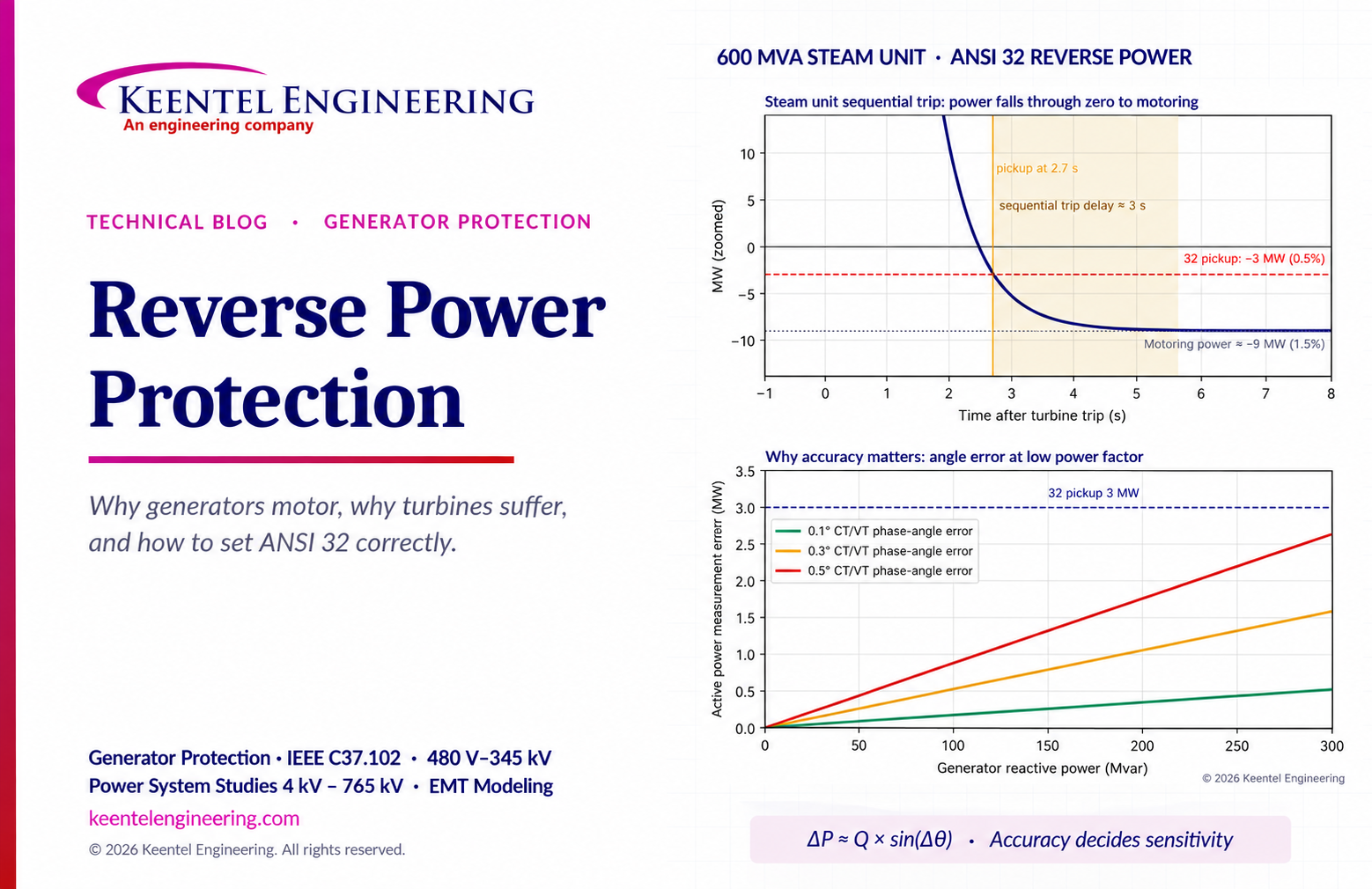
Learn reverse power protection (ANSI 32), generator motoring, relay pickup settings, time delays, sequential tripping and testing for US power plants.
Copy
By Team 2 Dexora
•
October 20, 2026
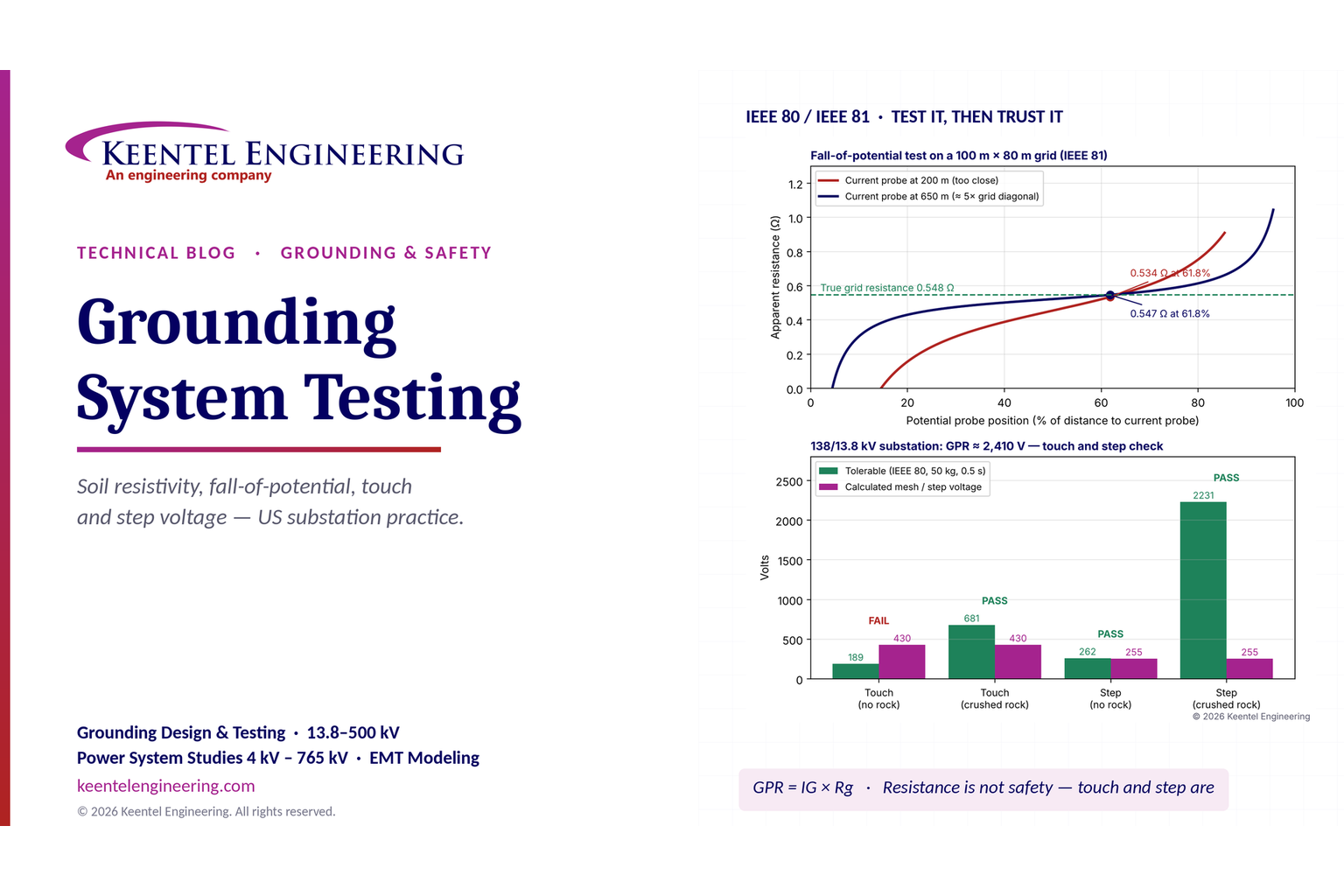
Explore grounding system testing with Keentel Engineering. Learn IEEE 80/81 methods, soil resistivity, ground resistance, and touch and step voltage safety.
By SANDIP R PATEL
•
October 13, 2026
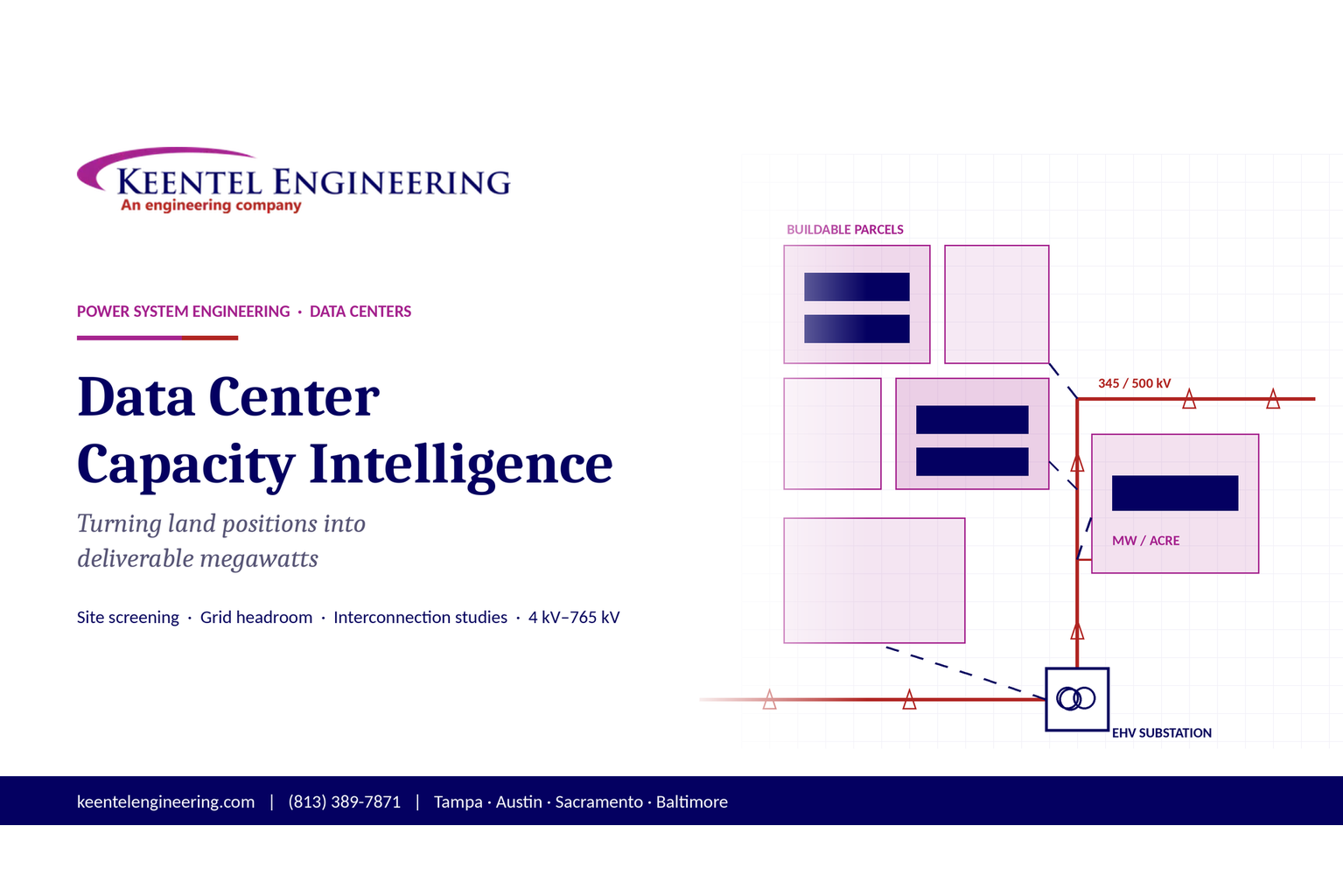
Plan data center capacity with land screening, MW-per-acre estimates, grid power availability and interconnection feasibility studies from Keentel Engineering.
By SANDIP R PATEL
•
October 11, 2026
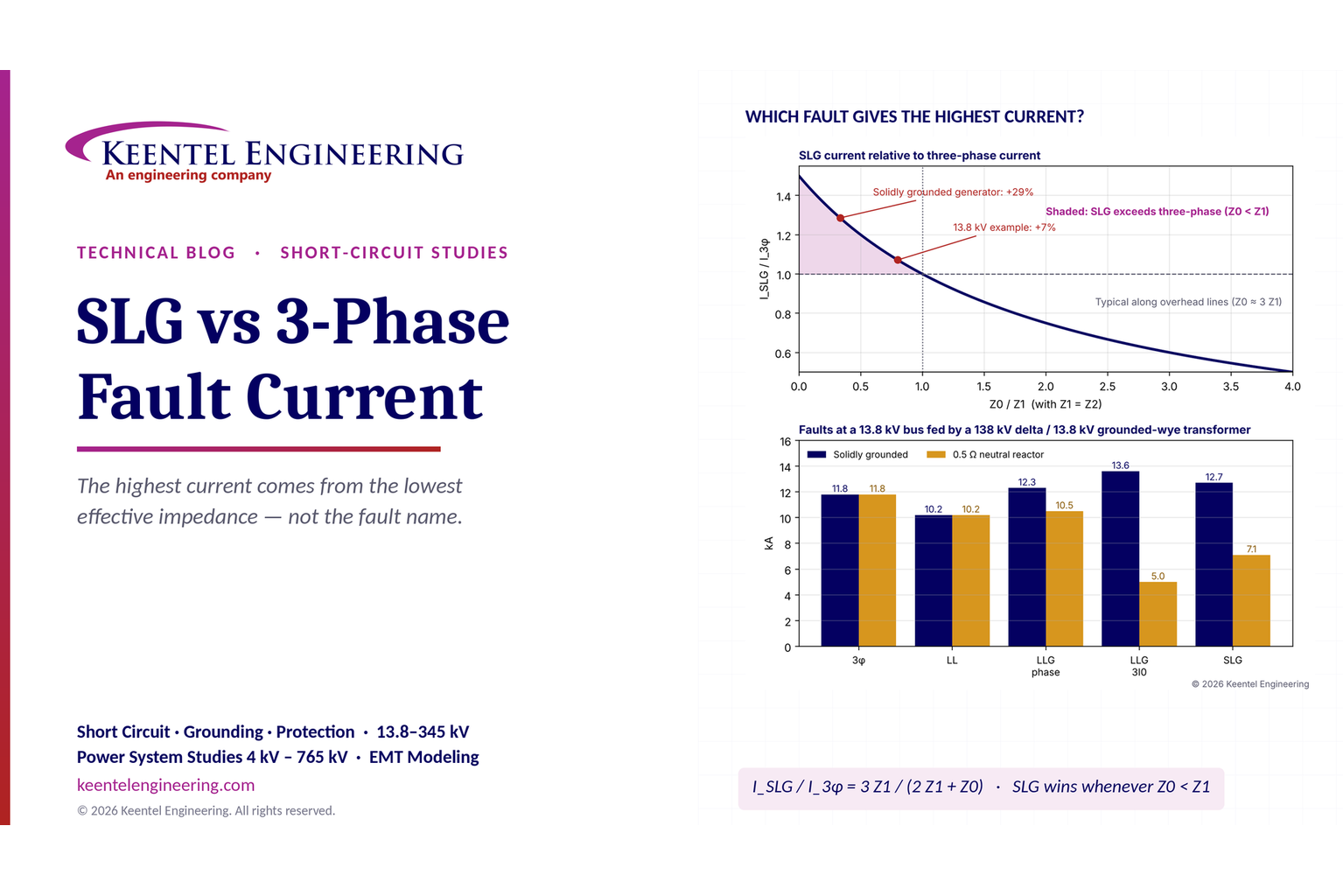
Learn which fault produces the highest current at a bus, why SLG faults can exceed three-phase faults, and how symmetrical components determine fault duty.
By SANDIP R PATEL
•
October 11, 2026
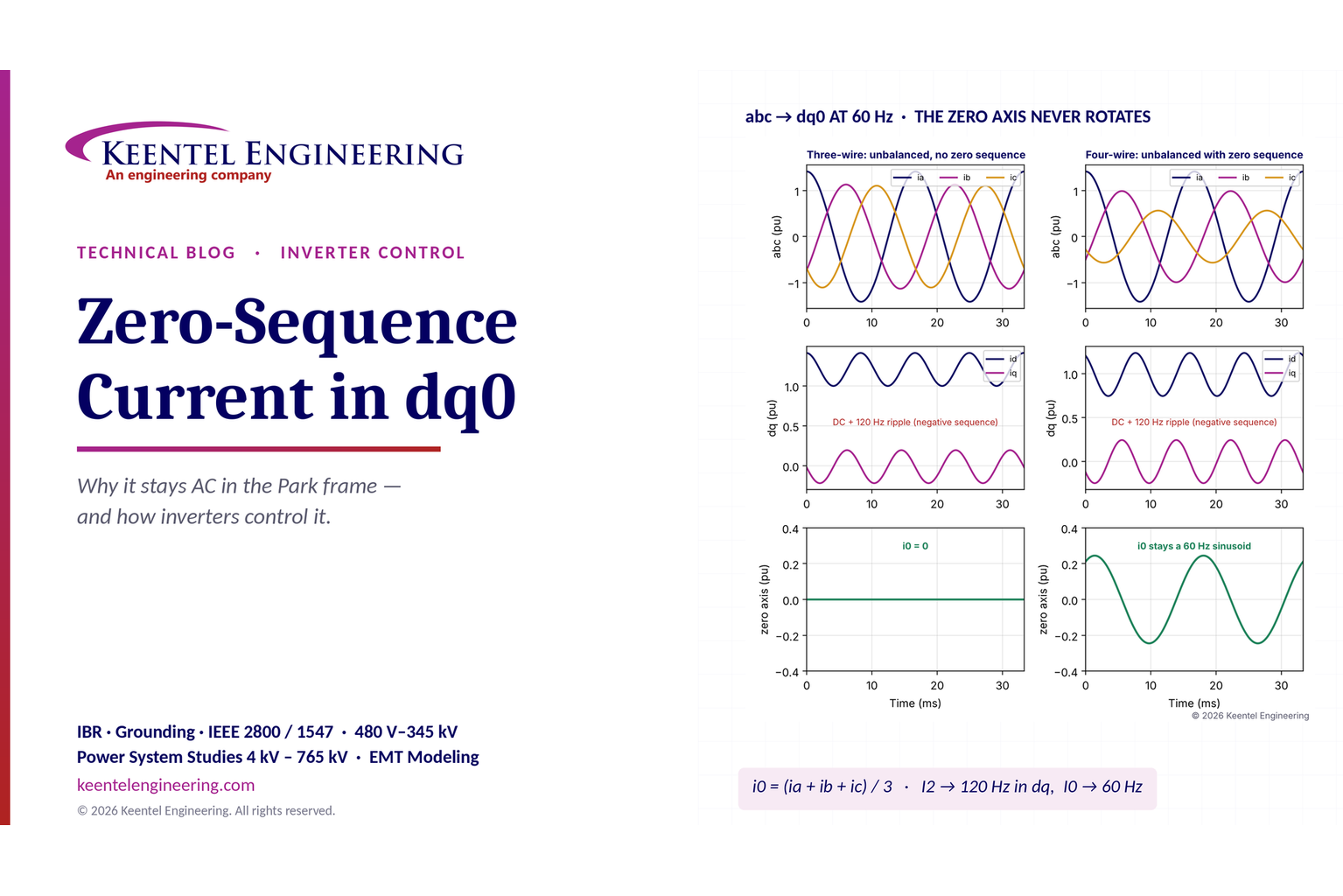
Learn why zero-sequence current pulsates in the dq0 frame, how Park's transformation works, and how inverter controls handle unbalance and ground faults.
By SANDIP R PATEL
•
October 11, 2026
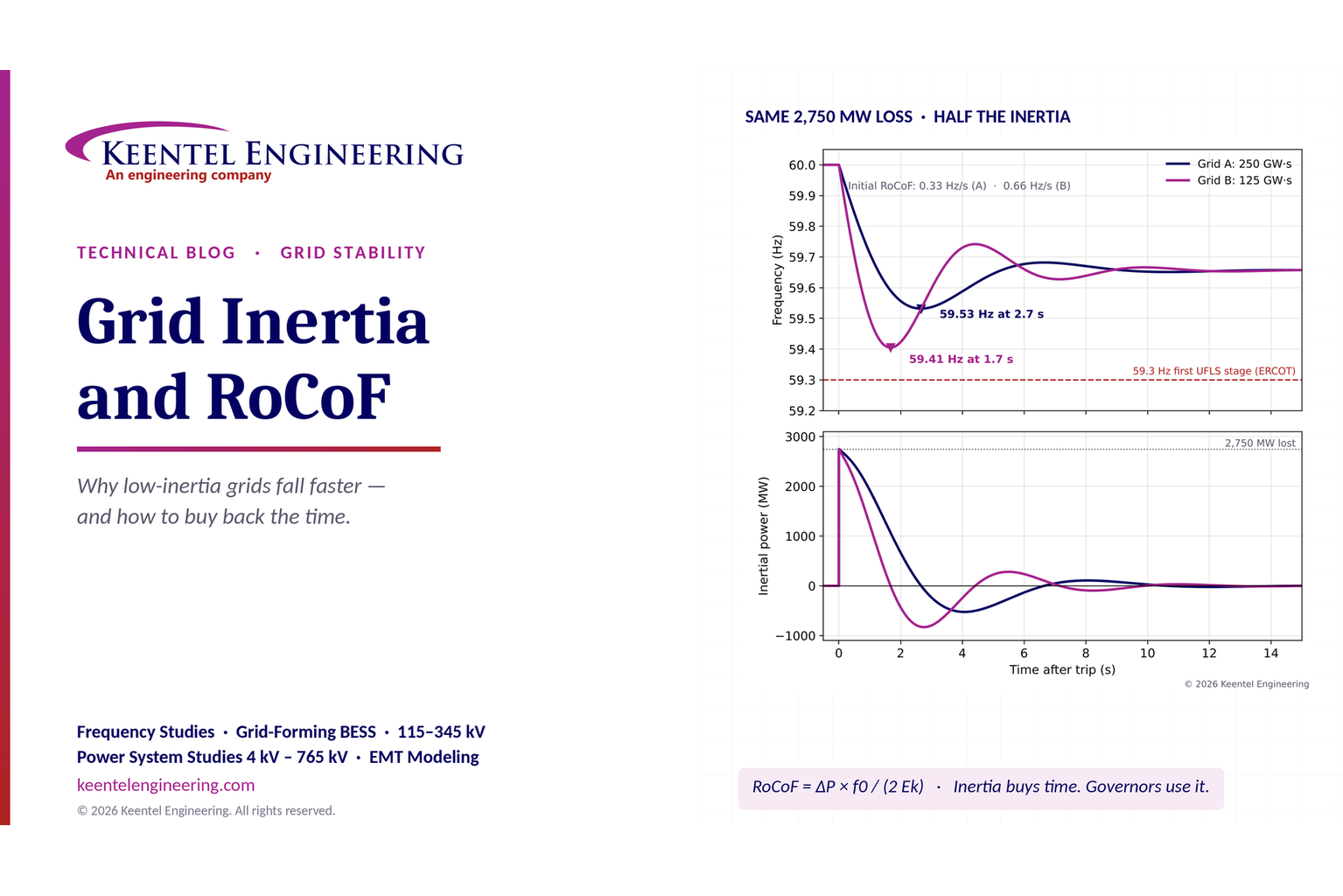
Explore grid inertia, RoCoF and frequency response, with swing equation calculations, frequency nadir analysis and US power system simulation examples.
By SANDIP R PATEL
•
October 11, 2026
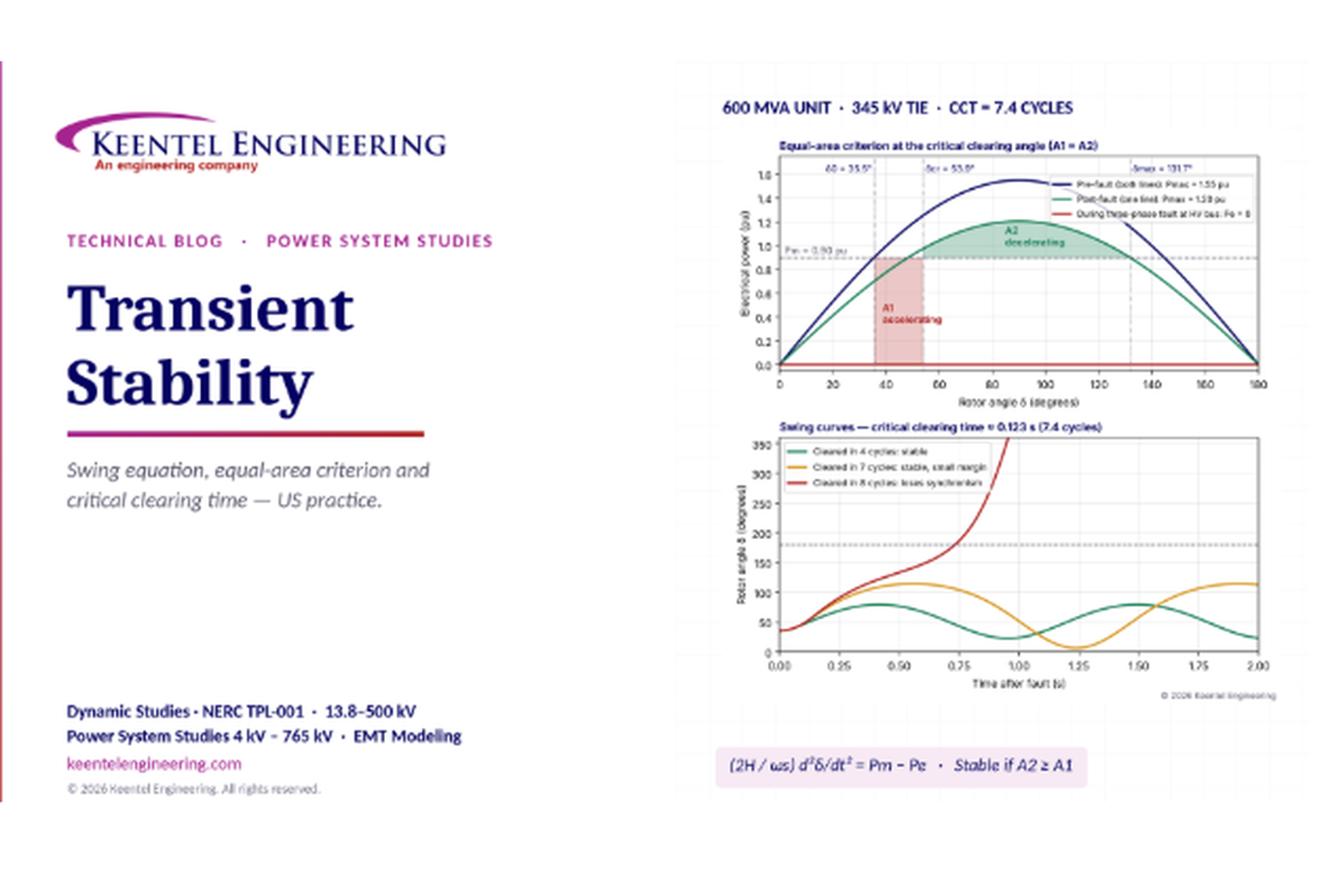
Learn transient stability analysis, swing equation, equal-area criterion and critical clearing time with a 345 kV worked example and NERC TPL-001 guidance.
By SANDIP R PATEL
•
October 11, 2026
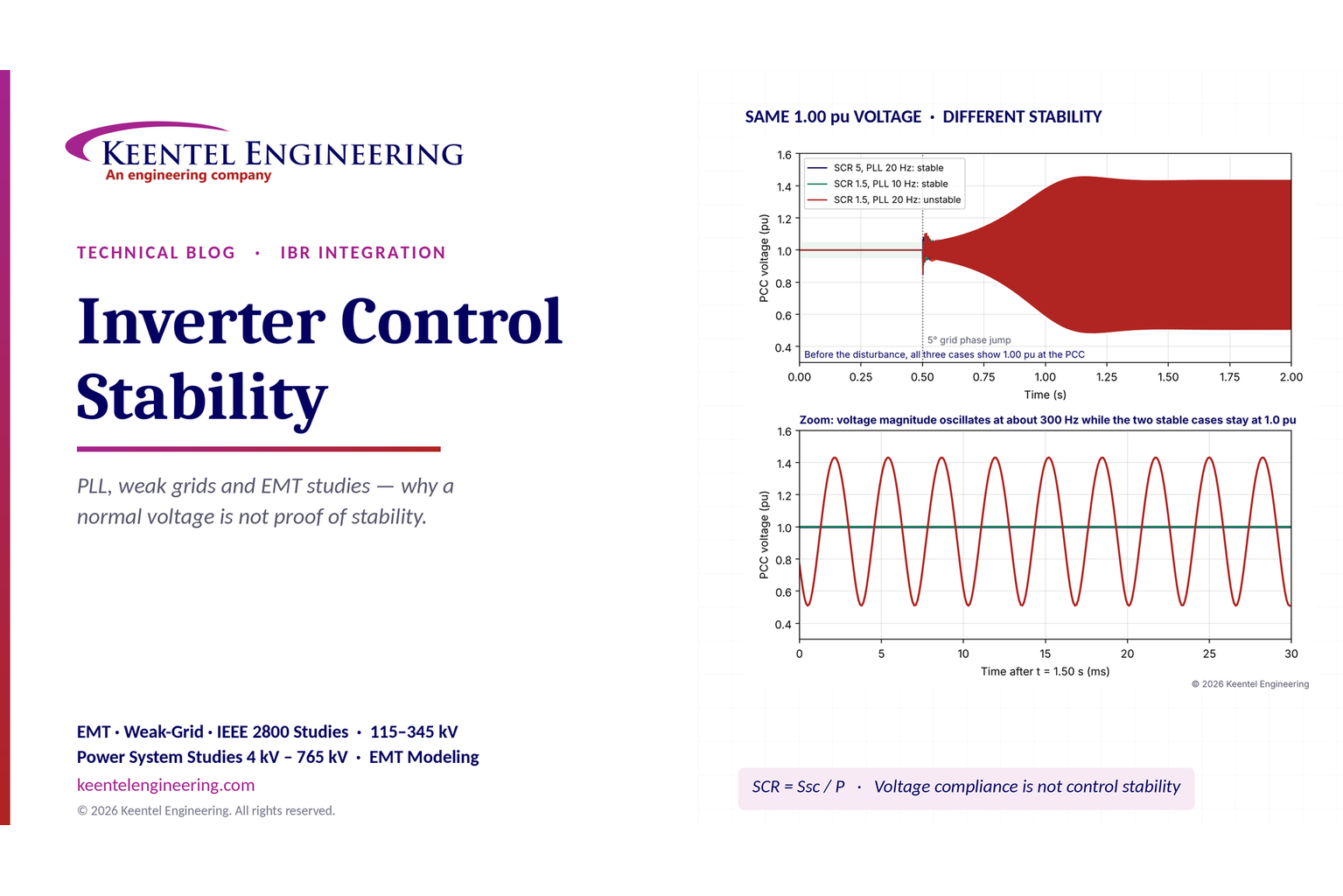
Learn why inverter controls become unstable in weak grids, how PLL bandwidth and SCR affect stability, and how PSCAD EMT studies identify and mitigate oscillations.
By SANDIP R PATEL
•
October 11, 2026
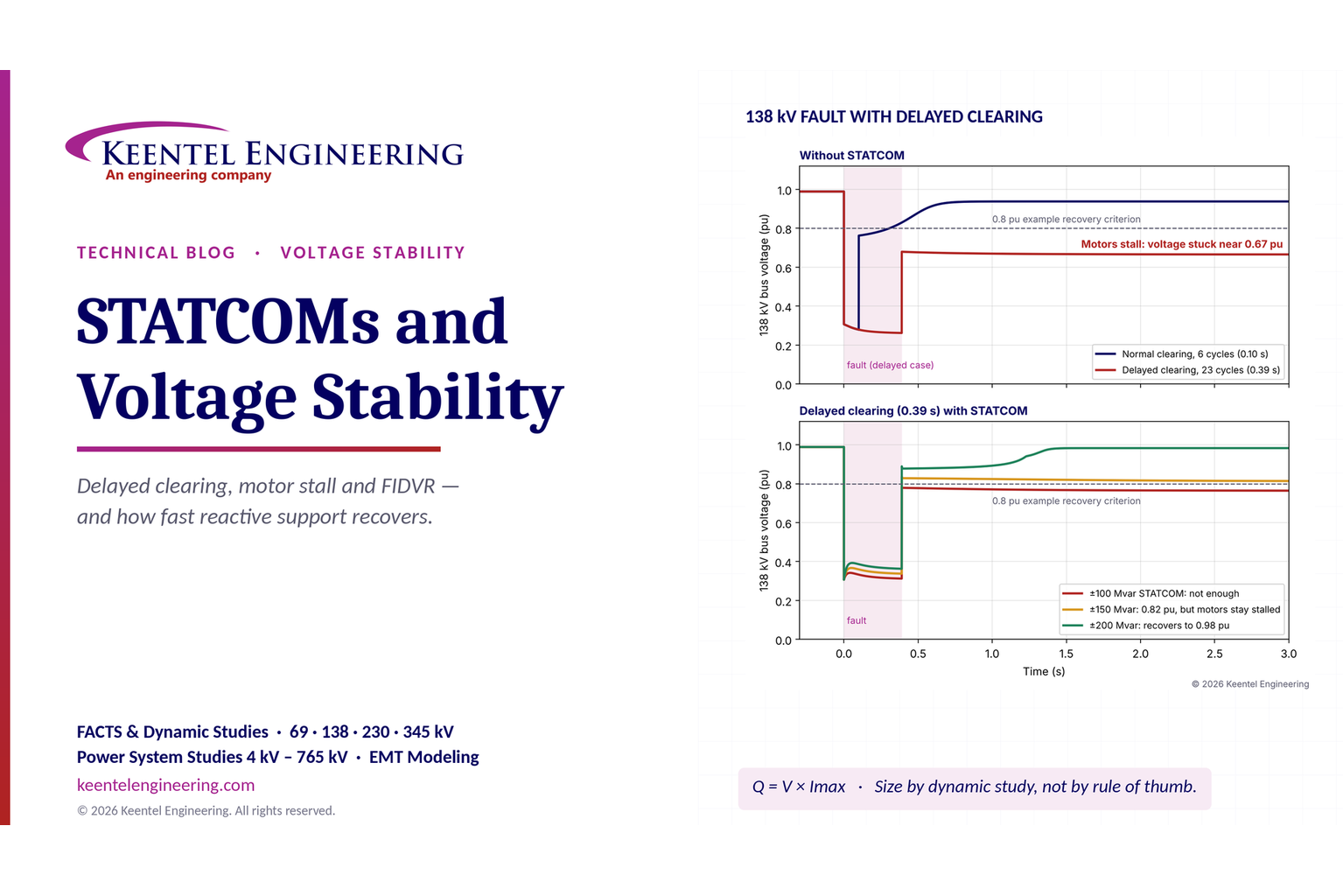
Learn how STATCOMs improve voltage stability and prevent FIDVR. Explore reactive power sizing, delayed fault clearing, NERC criteria and 138 kV simulation results.