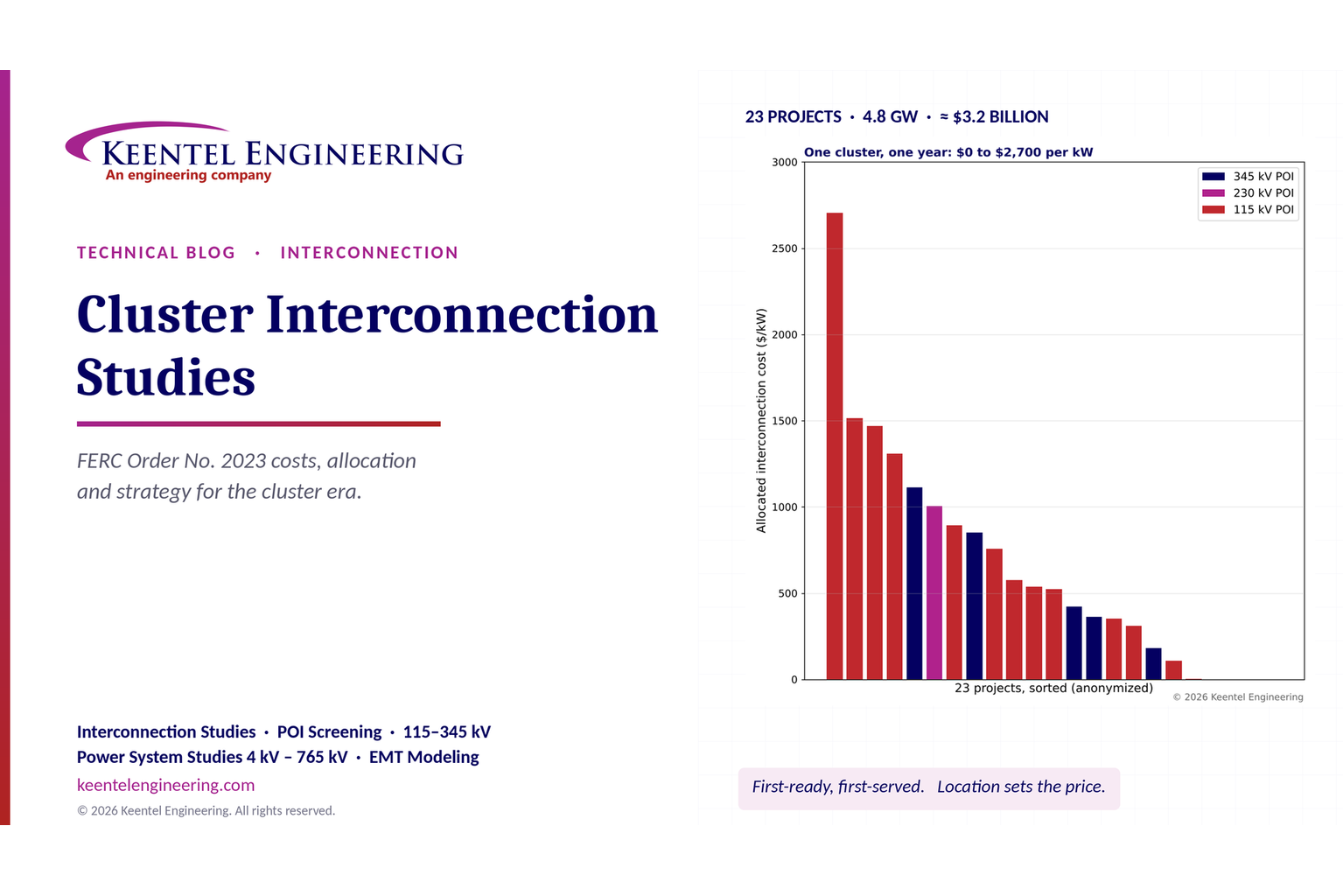


A Coordinated Electric System Interconnection Review—the utility’s deep-dive on technical and cost impacts of your project.

Challenge: Frequent false tripping using conventional electromechanical relays
Solution: SEL-487E integration with multi-terminal differential protection and dynamic inrush restraint
Result: 90% reduction in false trips, saving over $250,000 in downtime

Mastering IEEE 2800 Ride-Through Requirements for IBR Plants

CDEGS grounding analysis software used for substation grounding, electromagnetic studies, and power
Calendar icon. D

May 19, 2026 | Blog

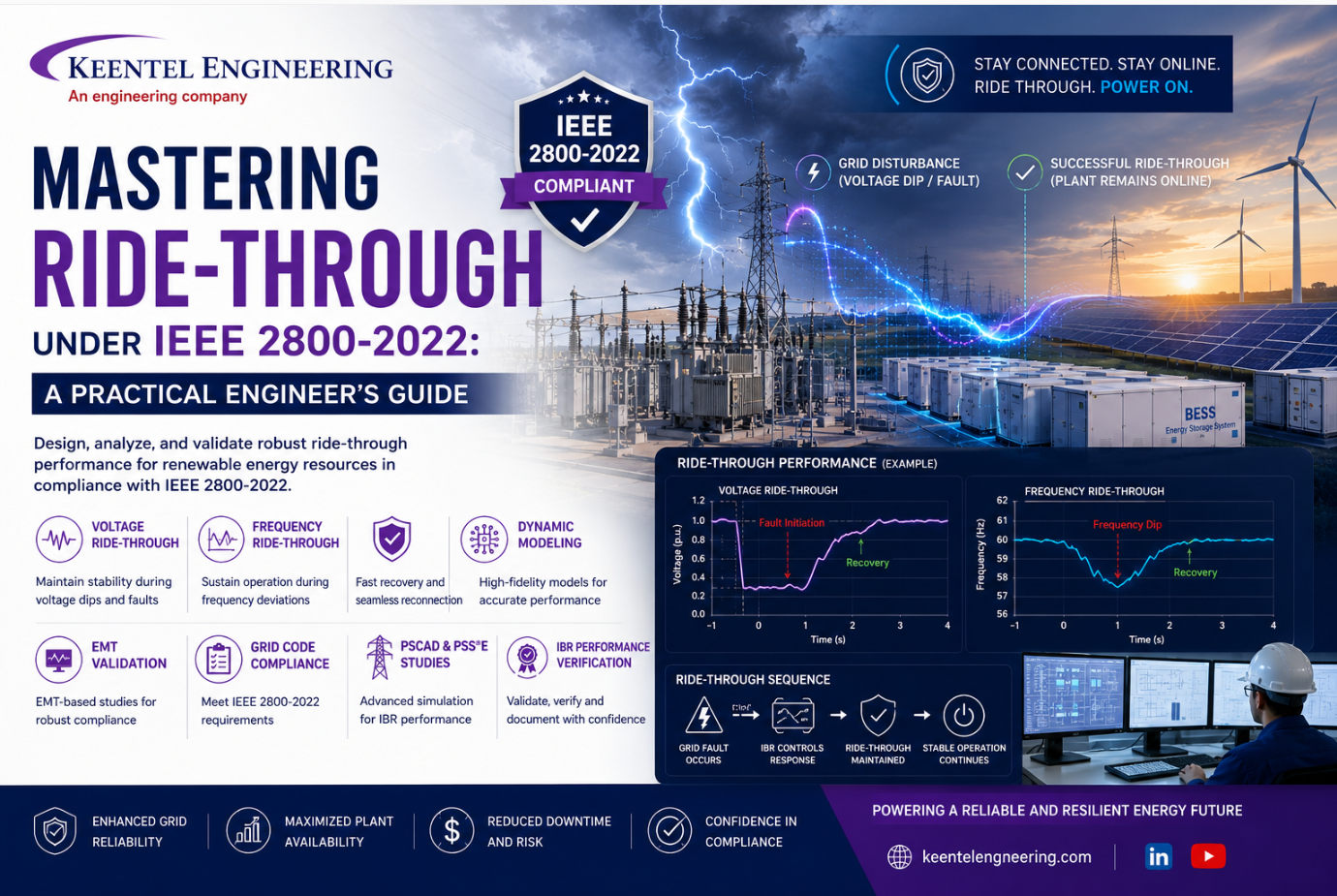
A practical engineer’s guide to voltage ride-through (LVRT/HVRT), frequency ride-through, dynamic voltage support, and compliance under IEEE Std 2800-2022 for solar, wind, and battery energy storage systems (BESS).


Why ride-through is the heart of IEEE 2800

Eleven technical clauses in IEEE Std 2800-2022, none gets more interconnection-process attention than Clause 7 — Response to Transmission System (TS) Abnormal Conditions.

The reason is operational: when a fault hits the grid, the inverter-based resource (IBR) fleet's behavior in the first 200 milliseconds determines whether the disturbance stays local or cascades.

Events like the 2016 Blue Cut Fire, the 2017 Canyon 2 Fire, and the 2021 Odessa Disturbance all share the same root cause family: inverter self-protection acting before the grid actually needed it to.


  • “Any tripping of the IBR plant, or other failure to provide the specified ride-through capability, due to IBR plant self-protection as a direct or indirect result of a voltage disturbance within a ride-through region, shall constitute non-compliance with this standard.”


That sentence reframes the design problem. Pre-2800, “the inverter tripped to protect itself” was usually an acceptable answer. Post-2800, it is a compliance failure.

The three operating regions you have to design to

Region What it means IBR obligation
Continuous operation Voltage/frequency is in the normal envelope. Stay connected, exchange pre-disturbance P and Q. No tripping permitted.
Mandatory Operation Voltage/frequency is outside the continuous envelope but inside the ride-through envelope. Stay connected for the minimum ride-through time and support the grid.
Permissive Operation Voltage is deep enough or frequency is past defined limits. Tripping may be acceptable, but should be avoided where possible.

Three notes that catch people out:

  1. The Reference Point of Applicability for voltage ride-through is the Point of Measurement.
  2. Voltage and frequency ride-through have a coupling rule.
  3. The 10% apparent-current allowance matters during deep voltage drops.

Voltage ride-through: the two capability tables

The standard publishes two capability tables. The one that applies depends on whether your plant contains auxiliary equipment that causes ride-through limitations.

Table 11 — Plants WITH ride-through-limiting auxiliary equipment

Applicable voltage at RPA Operating mode Minimum ride-through time
V > 1.20 May ride through or may trip NA
V > 1.10 Mandatory operation 1.0 s
V > 1.05 Continuous operation 1800 s
V < 0.90 Mandatory operation 3.00 s
V < 0.70 Mandatory operation 2.50 s
V < 0.50 Mandatory operation 1.20 s
V < 0.25 Mandatory operation 0.16 s
V < 0.10 Permissive operation 0.16 s

Table 12 — Plants WITHOUT ride-through-limiting auxiliary equipment

Applicable voltage at RPA Operating mode Minimum ride-through time
V > 1.20 May ride through or may trip NA
V > 1.10 Mandatory operation 1.0 s
V > 1.05 Continuous operation 1800 s
V < 0.90 Mandatory operation 3.00 s
V < 0.70 Mandatory operation 2.50 s
V < 0.50 Mandatory operation 1.20 s
V < 0.25 Mandatory operation 0.16 s
V < 0.10 Permissive operation 0.16 s

The PV/BESS envelope is materially deeper and longer. If you are commissioning a hybrid solar-plus-storage plant, you almost certainly fall under Table 12 and need to set protection elements accordingly.


Dynamic voltage support

Clause 7.2.2.3.4 explains what the IBR must actually do during ride-through, not just survive the fault.

Key obligations include:


  • Reactive current priority during low- and high-voltage ride-through.
  • Positive-sequence reactive current injection during balanced faults.
  • Negative-sequence reactive current injection during unbalanced faults.
  • Reactive current absorption during high-voltage events.
  • Negative-sequence injection capability when negative-sequence voltage is high enough.


The standard does not prescribe one fixed K-factor. It requires the capability and leaves the exact setpoint to project-specific design evaluation and agreement.


Performance specifications

Parameter Type III WTGs All other IBR units
Step response time NA ≤ 2.5 cycles
Settling time ≤ 6 cycles ≤ 4 cycles
Settling band -2.5% / +10% -2.5% / +10%

At 60 Hz, 2.5 cycles is roughly 42 ms and 4 cycles is roughly 67 ms. These are demanding response times, especially for legacy inverter platforms.


Consecutive voltage deviations

The IBR plant may trip if:


  • Cumulative duration exceeds allowed limits.
  • More than 4 deviations occur in any 10-second window.
  • More than 6 deviations occur in any 120-second window.
  • More than 10 deviations occur in any 30-minute window.
  • Any deviation follows the previous one by less than 20 cycles.
  • More than 2 deviations below 50% occur in any 10-second window.
  • More than 3 deviations below 50% occur in any 120-second window.


Single-pole reclosing schemes with very short dead times can conflict with these requirements.


Frequency ride-through

Frequency range Limits Minimum time Operation
f1, f4 +3% / -5% 299 s Mandatory operation
f2, f3 +2% / -2% Infinite Continuous operation

At 60 Hz nominal, the mandatory operation range is approximately 57.0 Hz to 61.8 Hz.

The plant must also ride through ROCOF up to 5.0 Hz/s averaged over at least 0.1 seconds.


Transient overvoltage ride-through

Voltage at RPA Minimum cumulative ride-through time
V > 1.80 Surge protection required
V > 1.70 0.2 ms
V > 1.60 1.0 ms
V > 1.40 3.0 ms
V > 1.20 15.0 ms

Coordination between surge arresters and inverter TOV capability is important during as-built evaluation.


Three case studies

Case Study 1: A 300 MW PV plant


A 300 MW PV plant had a dispute over whether Table 11 or Table 12 applied. The issue focused on whether tracker motors and inverter cooling fans counted as ride-through-limiting auxiliary equipment.

The design team proved the auxiliary systems could tolerate the disturbance envelope. The TS operator accepted Table 12 with post-commissioning monitoring.


Lesson: Auxiliary-equipment classification must be supported with engineering evidence.


Case Study 2: A 200 MW Type III wind farm


A wind farm experienced turbine trips after a line fault. Event data showed negative-sequence reactive current angle outside the IEEE 2800 range.

The root cause was an OEM firmware update that changed converter response. The plant required updated firmware, renewed validation, and stricter firmware notification rules.


Lesson: Firmware changes that affect ride-through behavior are substantial compliance events.


Case Study 3: A 150 MW BESS


A BESS plant tripped during repeated storm-related voltage deviations. The plant was technically compliant because the reclose interval was shorter than the standard’s 20-cycle threshold.

The solution involved inverter controller tuning, revised transmission protection settings, and enhanced event monitoring.


Lesson: Compliance and operational preference are not always the same.


Frequently Asked Questions

  • Q1: Does 2800 apply to my existing wind/solar plant?

    Generally no, but substantial changes such as repowering, firmware updates, equipment replacement, or protection retuning can trigger full or partial IEEE 2800 compliance.

  • Q2: Is a UL 1741 SB-certified inverter automatically IEEE 2800-compliant?

    No. UL 1741 SA/SB is linked to distribution-level requirements, while IEEE 2800 is a transmission-level standard.

  • Q3: My inverter manual lists LVRT capability of “0.0 p.u. for 150 ms.” Is that compliant?

    Probably not for deeper IEEE 2800 requirements. Table 12 requires 320 ms at V < 0.10 p.u. and 1.2 seconds at V < 0.50 p.u.

  • Q4: What about momentary cessation?

    IEEE 2800 does not use the term “momentary cessation,” but it allows current blocking only in the permissive region. In the mandatory region, current must continue.

  • Q5: Does the plant controller get any say in ride-through?

    The plant controller must not prevent IBR units or supplemental devices from meeting ride-through performance requirements.

  • Q6: What is the difference between capability and performance?

    Capability means the plant must be able to do something. Performance means how fast and accurately it behaves when executing that function.

  • Q7: Can active-current priority be used during faults?

    Yes, if requested by the TS owner and mutually agreed. The default is reactive-current priority.

  • Q8: How do I verify ride-through compliance?

    Verification is done through type tests, design evaluation, EMT modeling, as-built evaluation, commissioning tests, and post-commissioning validation.

  • Q9: What does non-compliance mean in practice?

    It can mean interconnection delays, agreement breach, retrofit requirements, investigation exposure, and possible regulatory consequences.

  • Q10: Can I get an exemption?

    Specific deviations may be negotiated, but broad exemptions are uncommon.


Final Thoughts

IEEE 2800-2022 makes inverter-based resources responsible for supporting bulk power system reliability during disturbances.


A smiling man with glasses and a beard wearing a blue blazer stands in front of server racks in a data center.

About the Author:

Sonny Patel P.E. EC

IEEE Senior Member

In 1995, Sandip (Sonny) R. Patel earned his Electrical Engineering degree from the University of Illinois, specializing in Electrical Engineering . But degrees don’t build legacies—action does. For three decades, he’s been shaping the future of engineering, not just as a licensed Professional Engineer across multiple states (Florida, California, New York, West Virginia, and Minnesota), but as a doer. A builder. A leader. Not just an engineer. A Licensed Electrical Contractor in Florida with an Unlimited EC license. Not just an executive. The founder and CEO of KEENTEL LLC—where expertise meets execution. Three decades. Multiple states. Endless impact.

Four workers in safety vests and helmets stand with arms crossed near wind turbines.

Let's Discuss Your Project

Let's book a call to discuss your electrical engineering project that we can help you with.

Man in a blazer and open shirt, looking at the camera, against a blurred background.

About the Author:

Sonny Patel P.E. EC

IEEE Senior Member

In 1995, Sandip (Sonny) R. Patel earned his Electrical Engineering degree from the University of Illinois, specializing in Electrical Engineering . But degrees don’t build legacies—action does. For three decades, he’s been shaping the future of engineering, not just as a licensed Professional Engineer across multiple states (Florida, California, New York, West Virginia, and Minnesota), but as a doer. A builder. A leader. Not just an engineer. A Licensed Electrical Contractor in Florida with an Unlimited EC license. Not just an executive. The founder and CEO of KEENTEL LLC—where expertise meets execution. Three decades. Multiple states. Endless impact.

Leave a Comment

Related Posts

Keentel Engineering white paper cover for transmission interconnection study services
By SANDIP R PATEL June 11, 2026
Learn how generation injection, large load interconnection studies, and transmission interconnection services help secure the best POI and streamline approvals.
CAISO Appendix H ride-through compliance for inverter-based resources graph image
By SANDIP R PATEL June 11, 2026
Learn CAISO Appendix H compliance, ride-through rules, and PRC-029-1 alignment for IBR projects. Discover expert engineering support.
Medium-voltage interconnection engineering white paper cover
By SANDIP R PATEL June 11, 2026
Medium-voltage interconnection engineering guide covering system studies, protection, collector routing, and SCADA integration. Learn more.
Owner's Engineer services for utility-scale BESS and HV substation projects
By SANDIP R PATEL June 11, 2026
Owner’s Engineer services for BESS and HV substations. Reduce project risk with design review, commissioning support, and bankability insight. Learn more.
NERC compliance white paper cover for generator owners and operators
By SANDIP R PATEL June 11, 2026
NERC compliance guide for Generator Owners and Operators covering audits, CIP cybersecurity, IBR standards, and managed compliance. Learn more.
Power system switching technical insight banner for transmission and distribution systems
By SANDIP R PATEL June 11, 2026
Learn power system switching duties, switching transients, fault current interruption, and substation safety practices. Discover key engineering insights.
NYISO large load interconnection study guide image
By SANDIP R PATEL June 10, 2026
Learn how NYISO interconnection study, Load SIS, POI strategy, and modeling data requirements affect large load and generation projects in New York.
ERCOT ride-through rules for data centers and large electronic loads
By SANDIP R PATEL June 9, 2026
Learn ERCOT ride through requirements for Large Electronic Loads, data centers, and interconnection compliance. Discover NOGRR282 engineering steps.
Cable ampacity and sizing guide with power cable and thermal performance illustration.
By SANDIP R PATEL June 8, 2026
Learn cable ampacity and sizing methods, conductor thermal limits, derating factors, and cable sizing calculations for reliable power systems.