A Coordinated Electric System Interconnection Review—the utility’s deep-dive on technical and cost impacts of your project.
Challenge: Frequent false tripping using conventional electromechanical relays
Solution: SEL-487E integration with multi-terminal differential protection and dynamic inrush restraint
Result: 90% reduction in false trips, saving over $250,000 in downtime
PRC-029-1 Explained: Applicability, Key Dates, and What Generator Owners Must Do Now
january 30, 2026 | Blog
Introduction
The adoption of NERC Reliability Standard PRC-029-1 marks a fundamental shift in how generator ride-through performance—particularly for Inverter-Based Resources (IBRs)—is regulated in North America. Unlike legacy standards that focused primarily on protection settings, PRC-029-1 introduces a performance-based framework that relies on actual disturbance behavior, supported by monitoring data and post-event validation.
This blog provides a comprehensive, date-driven explanation of PRC-029-1, including its regulatory origins, phased implementation schedule, applicability thresholds, and how it interacts with PRC-024-4, PRC-028-1, IEEE 2800-2022, and ERCOT NOGRR 245.
Regulatory Background: Why PRC-029-1 Exists
NERC Project 2020-02 was initiated in response to widespread and recurring IBR ride-through failures observed across multiple Interconnections over the past decade. Numerous NERC event analyses, disturbance reports, and industry alerts demonstrated that generators—particularly IBRs—were disconnecting during grid disturbances even when protection settings complied with PRC-024-3.
Recognizing this gap, the NERC Standards Committee approved a Standard Authorization Request (SAR) to either modify PRC-024-3 or replace it with a performance-based ride-through standard. The revised SAR was accepted on April 19, 2023, following initial acceptance on April 20, 2022 .
The regulatory urgency increased with FERC Order No. 901, issued in October 2023, which directed NERC to develop new or modified Reliability Standards addressing:
- Ride-through performance,
- Disturbance monitoring,
- Data sharing,
- Post-event performance validation, and
- Corrective action plans for IBR performance failures.
To comply with Order 901, NERC was required to file IBR ride-through standards with FERC by November 4, 2024, which directly drove the development and approval of PRC-029-1 .
Key Milestone Dates
| Milestone | Date |
|---|---|
| SAR initially accepted | April 20, 2022 |
| Revised SAR accepted | April 19, 2023 |
| NERC Board adoption | October 8, 2024 |
| Filed with FERC | November 4, 2024 |
| PRC-024-3 retirement | Immediately prior to PRC-024-4 / PRC-029-1 effective date |
PRC-024-4 vs. PRC-029-1: Clear Separation of Applicability
One of the most important outcomes of Project 2020-02 is the clear separation of responsibilities between synchronous resources and IBRs:
- PRC-024-4 now applies to:
- Synchronous generators,
- Type 1 and Type 2 wind resources,
- Synchronous condensers.
- PRC-029-1 applies exclusively to:
Inverter-Based Generating Resources (IBRs).
This change formally removes IBRs from PRC-024 and places them under a new, performance-based compliance regime
Effective Date of PRC-029-1
The effective date of PRC-029-1 depends on jurisdictional approval:
Where governmental approval is required (e.g., FERC):
PRC-029-1 becomes effective on the first day of the first calendar quarter that is twelve months after the effective date of the approving authority’s order.
Where approval is not required:
The standard becomes effective twelve months after adoption by the NERC Board of Trustees.
This effectively places PRC-029-1’s initial enforceability in 2026 for most U.S. jurisdictions, depending on the final approval timeline .
Phased-In Compliance: Design vs. Operation
A defining feature of PRC-029-1 is its staggered compliance approach, recognizing that:
Design requirements can be verified relatively quickly, while
Operational performance requires disturbance monitoring data over time.
Requirements R1, R2, and R3
These requirements contain both capability-based (design) and performance-based (operation) elements.
Bulk Electric System (BES) IBRs
- Design compliance:
Required by the effective date of the standard. - Operational compliance:
Required after disturbance monitoring equipment is installed, in alignment with the PRC-028-1 implementation plan.
Applicable Non-BES IBRs
Defined as non-BES IBRs ≥20 MVA aggregated capacity connected at ≥60 kV.
- Design compliance:
Required by the later of January 1, 2027 or the standard’s effective date. - Operational compliance:
Deferred until disturbance monitoring capabilities are established.
Requirement R4: Equipment Limitations and Exemptions
Requirement R4 addresses situations where certain legacy IBRs cannot meet ride-through
requirements due to hardware limitations.
Key points:
- Only IBRs in operation as of the effective date of PRC-029-1 may be considered.
- Only limitations that cannot be resolved through software or settings changes qualify.
- Hardware-based exemptions must be documented, justified, and reported.
This provision aligns directly with FERC Order 901, which acknowledges that some older IBR technologies may require physical replacement to fully comply .
The Role of Disturbance Monitoring (PRC-028-1)
PRC-029-1 explicitly depends on disturbance monitoring data to demonstrate operational compliance. As such:
- Full operational compliance with R1–R3 is not required until disturbance monitoring equipment is installed.
- PRC-028-1 defines the monitoring, recording, and reporting requirements that support PRC-029-1 evidence.
This linkage formally moves the industry from settings-based compliance to measured performance-based compliance.
Why PRC-029-1 Is a Major Paradigm Shift
PRC-029-1 represents:
- A shift from protection settings to actual ride-through behavior,
- Increased reliance on event data and model validation,
- Greater scrutiny of inverter controls, plant controllers, and hybrid interactions,
- A direct bridge to IEEE 2800-2022 performance expectations, and
- Alignment with ISO-specific requirements such as ERCOT NOGRR 245 and MQT.
For Generator Owners, this means compliance is no longer a one-time documentation exercise—it is an ongoing performance obligation.
What Generator Owners Should Be Doing Now
- Identify which assets are IBRs under PRC-029-1.
- Classify assets as BES vs non-BES applicable IBRs.
- Verify design-level ride-through capability.
- Assess disturbance monitoring readiness.
- Review inverter and plant controller settings against IEEE 2800-2022.
- Develop a strategy for R4 documentation, if applicable.
- Coordinate PRC-029-1 efforts with ERCOT MQT and NOGRR 245 where relevant.
Conclusion
PRC-029-1 is not simply a replacement for PRC-024—it is a fundamental restructuring of generator ride-through compliance. With phased timelines, performance-based evidence, and strong linkage to disturbance monitoring, Generator Owners who act early will be far better positioned to manage compliance risk and avoid last-minute corrective actions.
At Keentel Engineering, we support Generator Owners through PRC-029-1 applicability assessments,
ride-through studies, ERCOT MQT alignment, PSCAD EMT analysis, and audit-ready documentation.
Frequently Asked Questions (FAQ)
1. What is PRC-029-1?
PRC-029-1 is a performance-based NERC Reliability Standard that establishes voltage and frequency ride-through requirements specifically for Inverter-Based Resources (IBRs). Unlike PRC-024, it relies on measured performance during real grid disturbances, supported by disturbance monitoring data.
2. Why was PRC-029 created?
PRC-029 was developed in response to widespread IBR ride-through failures documented in NERC event reports and mandated by FERC Order 901, which required performance-based IBR ride-through standards.
3. How is PRC-029 different from PRC-024?
PRC-024 focuses on protection settings, while PRC-029 evaluates actual ride-through behavior using event data and validated models.
4. Does PRC-029 apply to synchronous generators?
No. PRC-029 applies only to IBRs. Synchronous generators are now covered under PRC-024-4.
5. Which IBRs are subject to PRC-029?
BES IBRs
Certain non-BES IBRs ≥20 MVA aggregated capacity connected at ≥60 kV
6. When does PRC-029 become enforceable?
Generally in 2026, depending on jurisdictional approval timelines (12 months after FERC approval, effective at the next calendar quarter).
7. What are the core requirements of PRC-029?
R1: Voltage ride-through capability
R2: Reactive current and control behavior
R3: Frequency ride-through capability
R4: Hardware limitation documentation
8. What is “performance-based” compliance?
Compliance is demonstrated using actual disturbance data, not just relay or inverter settings.
9. Is modeling alone sufficient for compliance?
No. Modeling supports compliance, but measured event performance is the primary evidence once disturbance monitoring is available.
10. How does PRC-028 relate to PRC-029?
PRC-028 provides the disturbance monitoring equipment and data required to demonstrate PRC-029 operational compliance.
11. Is disturbance monitoring mandatory for PRC-029?
Yes — operational compliance cannot be demonstrated without disturbance monitoring equipment installed per PRC-028.
12. What happens if an IBR trips during a disturbance?
The event must be analyzed, documented, and if non-compliant, addressed with corrective actions.
13. What qualifies as a hardware limitation under R4?
Only physical equipment limitations that cannot be resolved via settings or firmware changes.
14. Are legacy IBRs eligible for R4?
Only IBRs in service as of the PRC-029 effective date.
15. Does PRC-029 require PSCAD modeling?
Not universally. PSCAD is used only when EMT-level validation is required (e.g., phase-angle jump, performance failure analysis).
16. How does IEEE 2800-2022 relate to PRC-029?
IEEE 2800 defines performance expectations; PRC-029 enforces those expectations using real disturbance data.
17. How does PRC-029 affect hybrid plants?
Hybrid plants are evaluated as a single IBR resource, with scrutiny on control interactions between components.
18. What is the role of ERCOT MQT?
MQT validates models used to support PRC-029 compliance but does not replace event-based evidence.
19. Does PRC-029 replace PRC-024 entirely?
For IBRs, yes. For synchronous machines, PRC-024 remains applicable.
20. How often must compliance be demonstrated?
Continuously, as events occur — not just once at commissioning.
21. Can PRC-029 trigger enforcement actions?
Yes, if repeated or systemic ride-through failures occur without corrective action.
22. How should Generator Owners prepare now?
Inventory IBRs, verify ride-through capability, install DME, review controls, and align with IEEE 2800.
23. What is the biggest compliance risk?
Assuming protection settings alone equal compliance.
24. Does PRC-029 apply outside ERCOT?
Yes — PRC-029 is a NERC-wide standard, not ERCOT-specific.
25. How can Keentel Engineering help?
Through applicability assessments, ride-through studies, MQT alignment, PSCAD EMT analysis, and audit-ready compliance documentation.

About the Author:
Sandip "Sonny" R. Patel, P.E.
IEEE Senior Member · Founder & CEO, Keentel Engineering
In 1995, Sonny Patel earned his Electrical Engineering degree from the University of Illinois. But degrees don't build legacies — action does.
For three decades, he has worked the power industry from every side of the table: 16 years as a utility engineer at Exelon/Commonwealth Edison; generation leadership across hydroelectric, industrial steam turbine, and a 9 GW renewable fleet; NERC Regional Entity Senior Compliance Engineer and Audit Team Lead, auditing some of the nation's largest utilities; and testing and commissioning lead on equipment up to 765 kV — the very top of the North American grid.Utility. Generator. Regulator. Consultant. Few engineers have seen all four seats. Fewer still have sat in them.
His experience spans nuclear, hydro, conventional generation, renewables, oil and gas, mining — and today's data centers, where he is authoring a three-book series on data center design. He is a Licensed Professional Engineer in six states and a Licensed Electrical Contractor in Florida (Unlimited EC) — he doesn't just design the work; he's qualified to stand behind its execution.Today, as Founder and CEO of Keentel Engineering, Sonny leads a nationwide team of engineers delivering substation design, power system studies, NERC compliance, and commissioning — done right, coast to coast.Three decades. Every side of the table. One standard: accountable engineering.
Services

Let's Discuss Your Project
Let's book a call to discuss your electrical engineering project that we can help you with.
About the Author:
Sandip "Sonny" R. Patel, P.E.
IEEE Senior Member · Founder & CEO, Keentel Engineering
In 1995, Sonny Patel earned his Electrical Engineering degree from the University of Illinois. But degrees don't build legacies — action does.
For three decades, he has worked the power industry from every side of the table: 16 years as a utility engineer at Exelon/Commonwealth Edison; generation leadership across hydroelectric, industrial steam turbine, and a 9 GW renewable fleet; NERC Regional Entity Senior Compliance Engineer and Audit Team Lead, auditing some of the nation's largest utilities; and testing and commissioning lead on equipment up to 765 kV — the very top of the North American grid.
Utility. Generator. Regulator. Consultant. Few engineers have seen all four seats. Fewer still have sat in them.
His experience spans nuclear, hydro, conventional generation, renewables, oil and gas, mining — and today's data centers, where he is authoring a three-book series on data center design. He is a Licensed Professional Engineer in six states and a Licensed Electrical Contractor in Florida (Unlimited EC) — he doesn't just design the work; he's qualified to stand behind its execution.
Today, as Founder and CEO of Keentel Engineering, Sonny leads a nationwide team of engineers delivering substation design, power system studies, NERC compliance, and commissioning — done right, coast to coast.Three decades. Every side of the table. One standard: accountable engineering.
Leave a Comment
Thank you for contacting us.
We will get back to you as soon as possible.
We will get back to you as soon as possible.
Oops, there was an error sending your message.
Please try again later.
Please try again later.
Related Posts
By SANDIP R PATEL
•
October 23, 2026
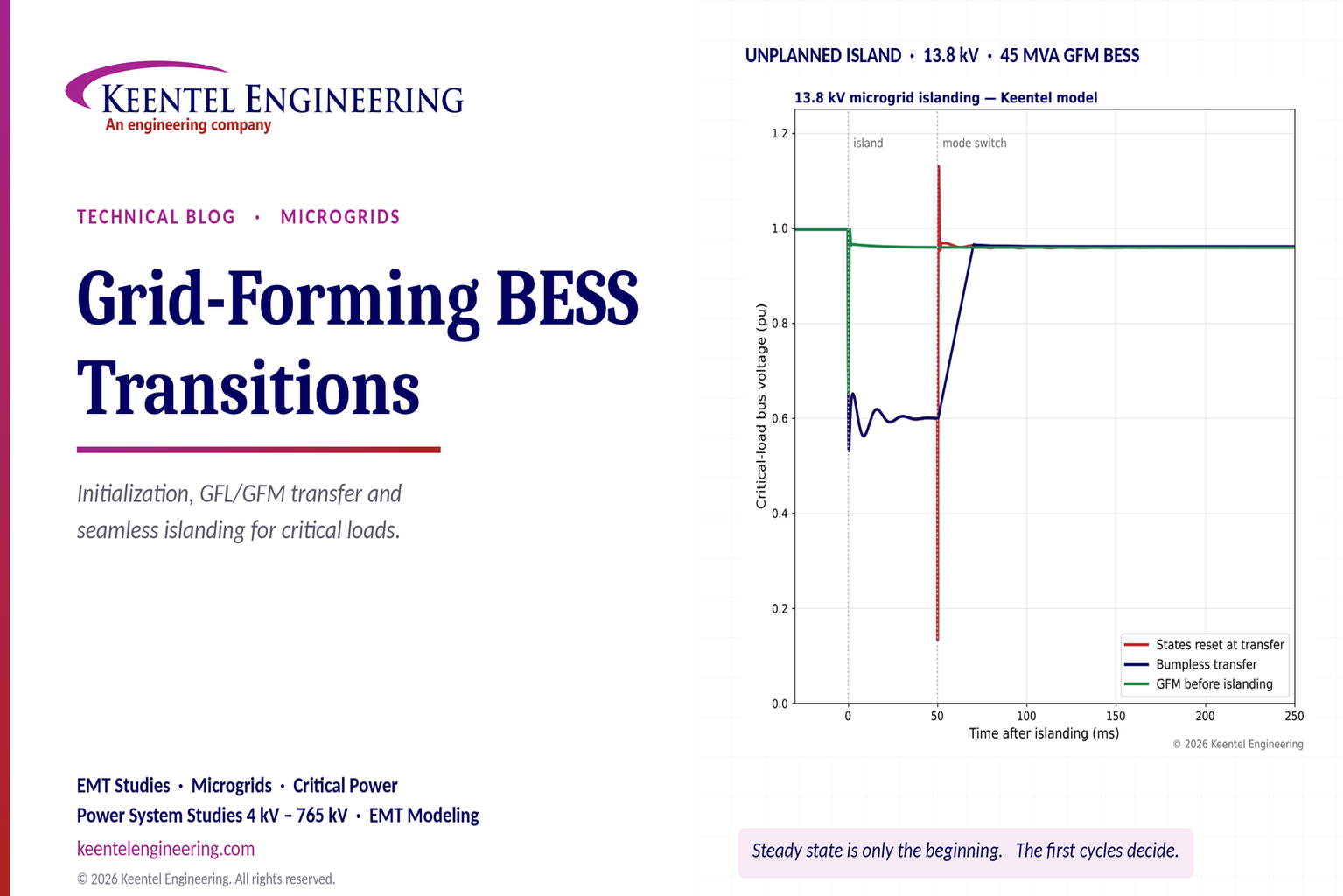
Explore grid-forming BESS initialization, GFL-to-GFM transitions, seamless islanding, EMT simulations, current limiting and microgrid protection.
By SANDIP R PATEL
•
October 23, 2026
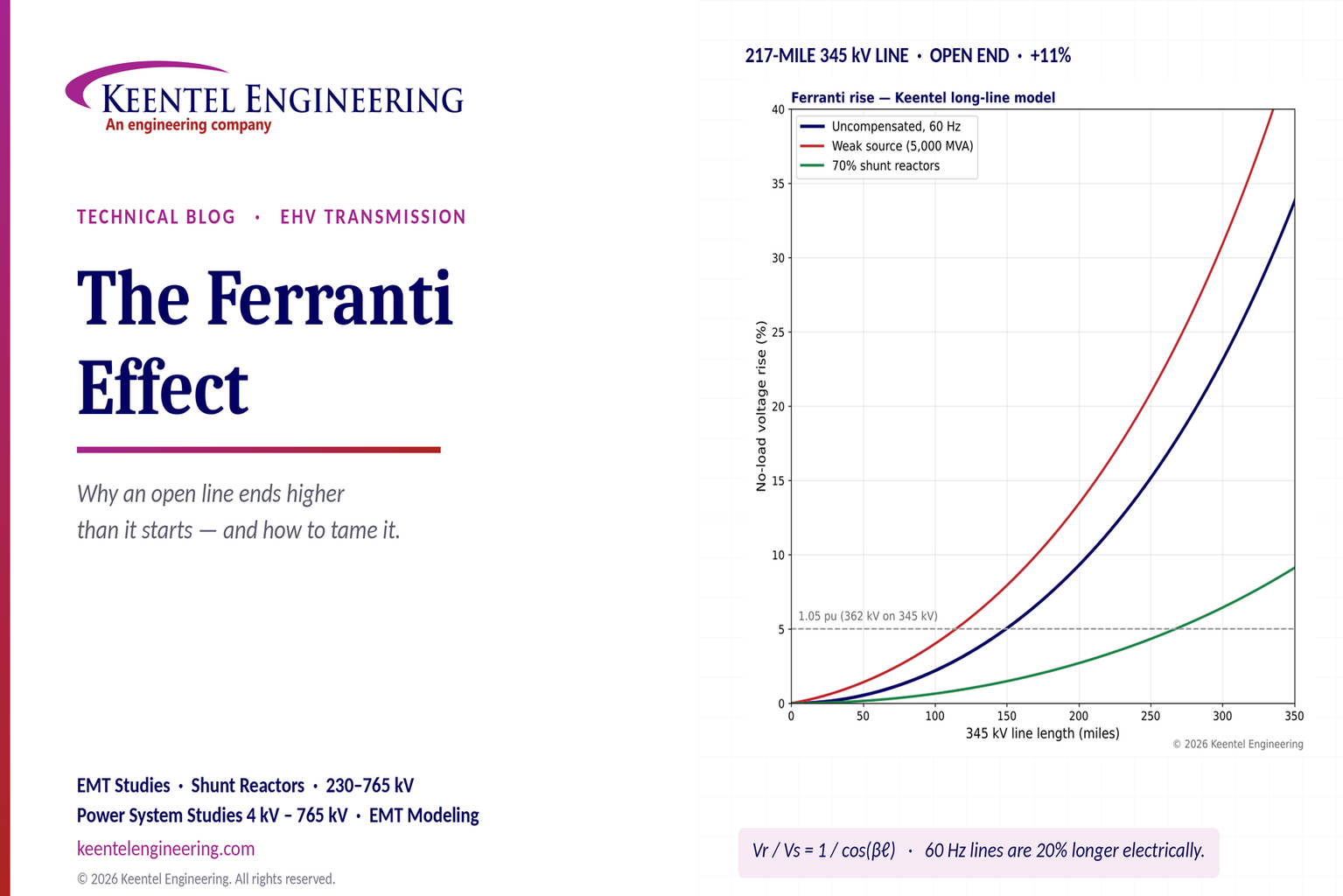
Explore the Ferranti effect in EHV transmission lines: voltage rise, 345 kV examples, switching overvoltages, shunt reactor sizing and mitigation.
By SANDIP R PATEL
•
October 23, 2026
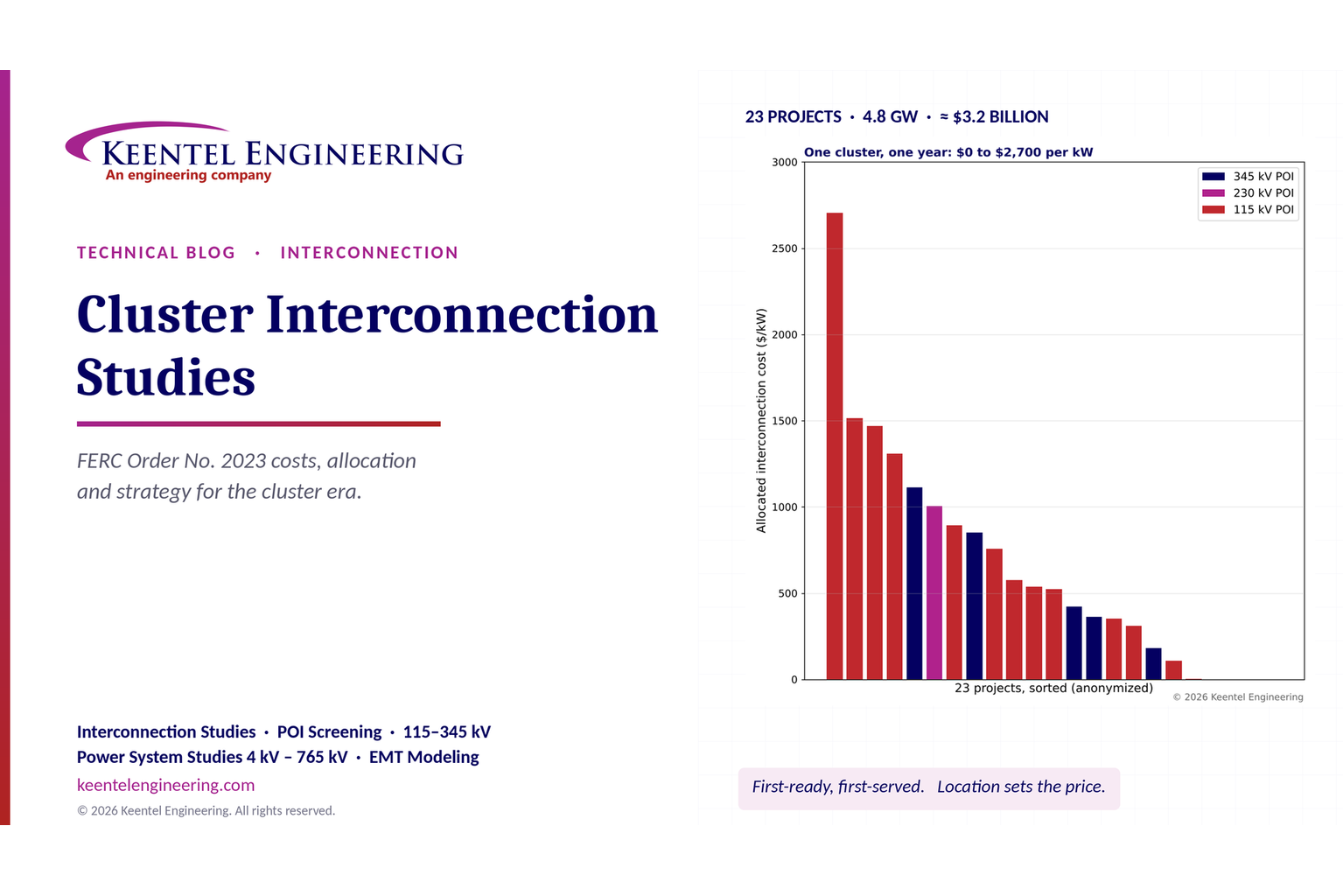
Explore cluster interconnection studies under FERC Order 2023, including network upgrades, cost allocation, withdrawal penalties and developer strategy.
By SANDIP R PATEL
•
October 21, 2026
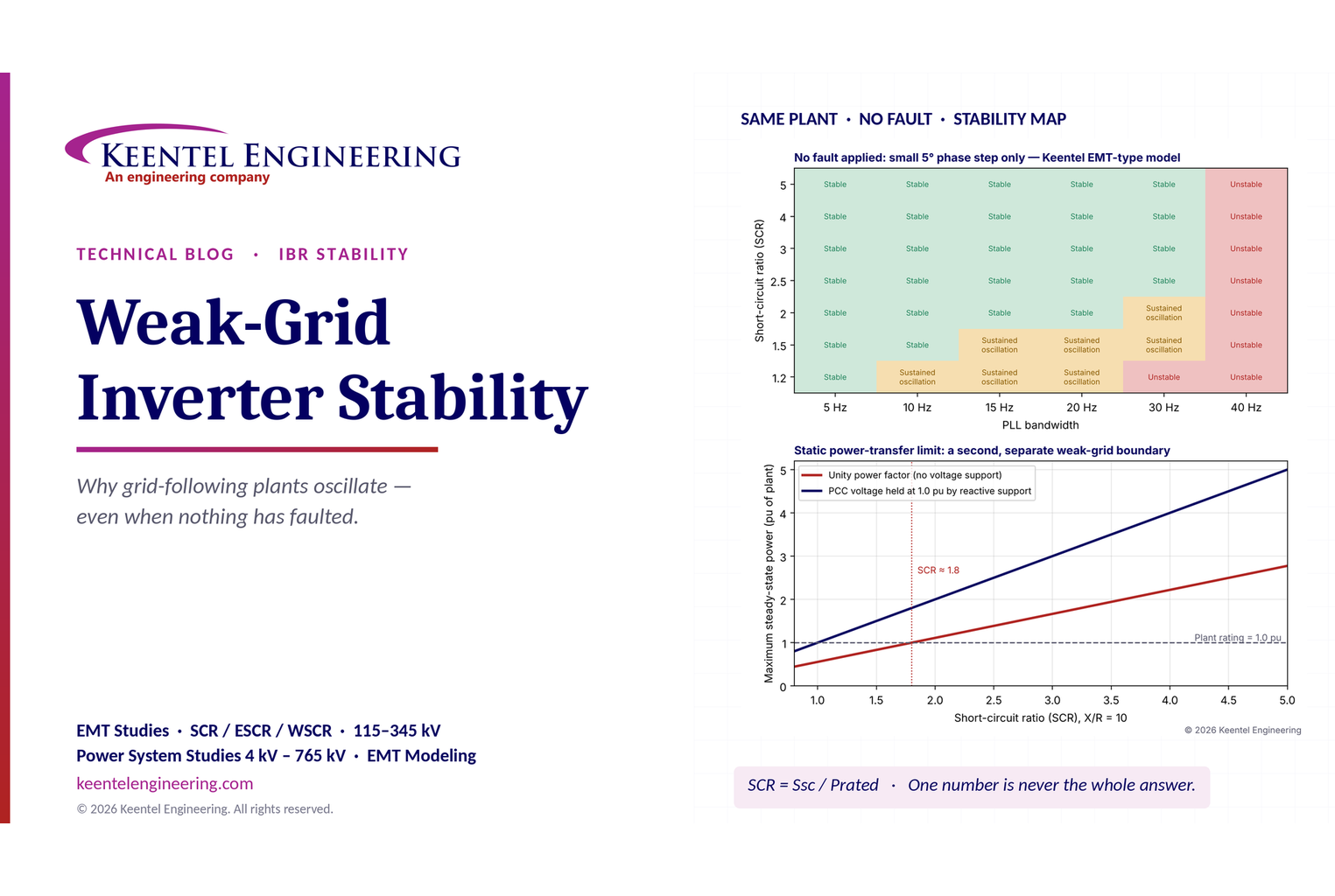
Learn why grid-following inverters become unstable without grid faults. Explore SCR, PLL interactions, EMT studies, grid strength, and mitigation.
By SANDIP R PATEL
•
October 21, 2026
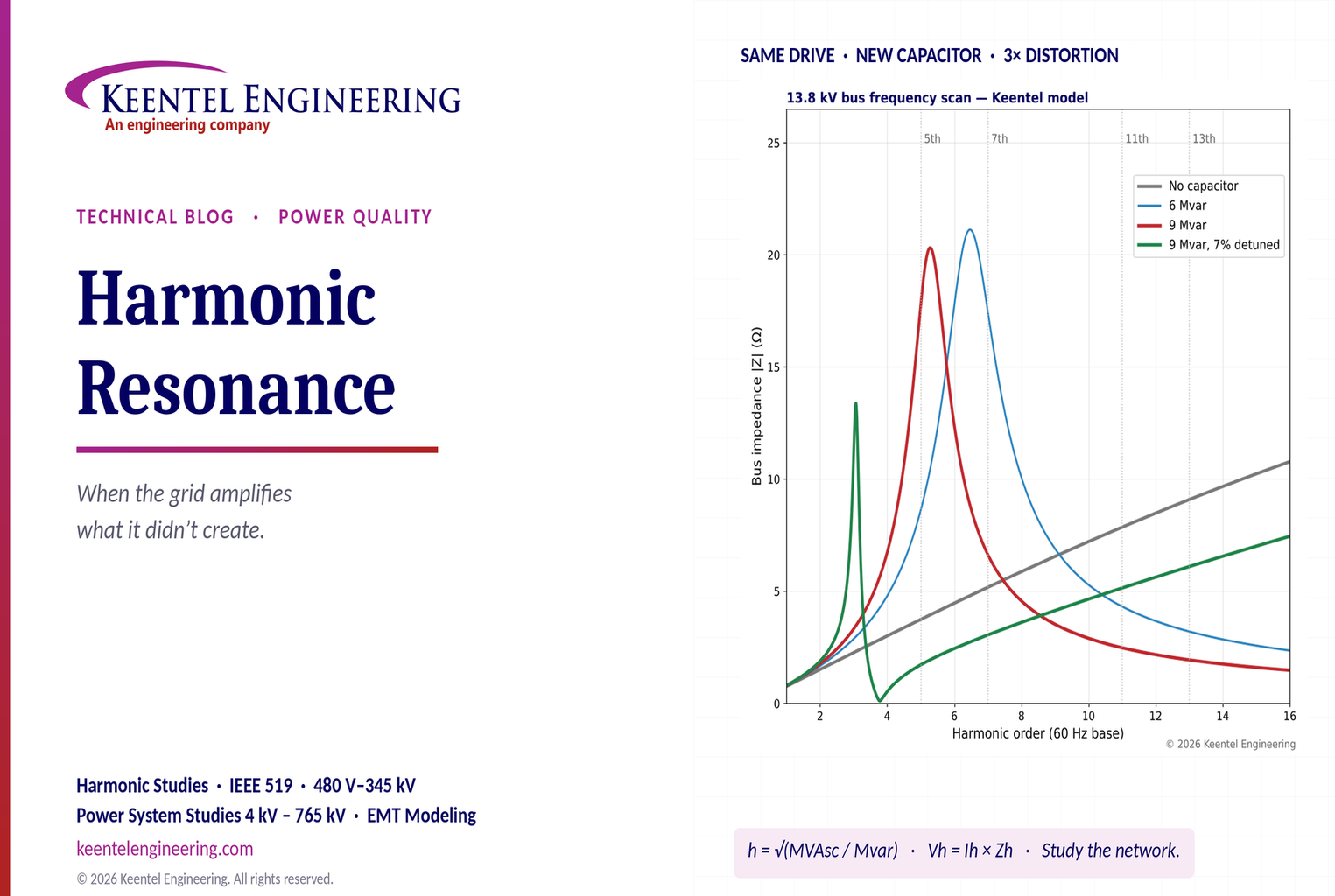
Learn how harmonic resonance amplifies distortion in power systems. Explore capacitor banks, detuned reactors, frequency scans, and IEEE 519 solutions.
By SANDIP R PATEL
•
October 20, 2026
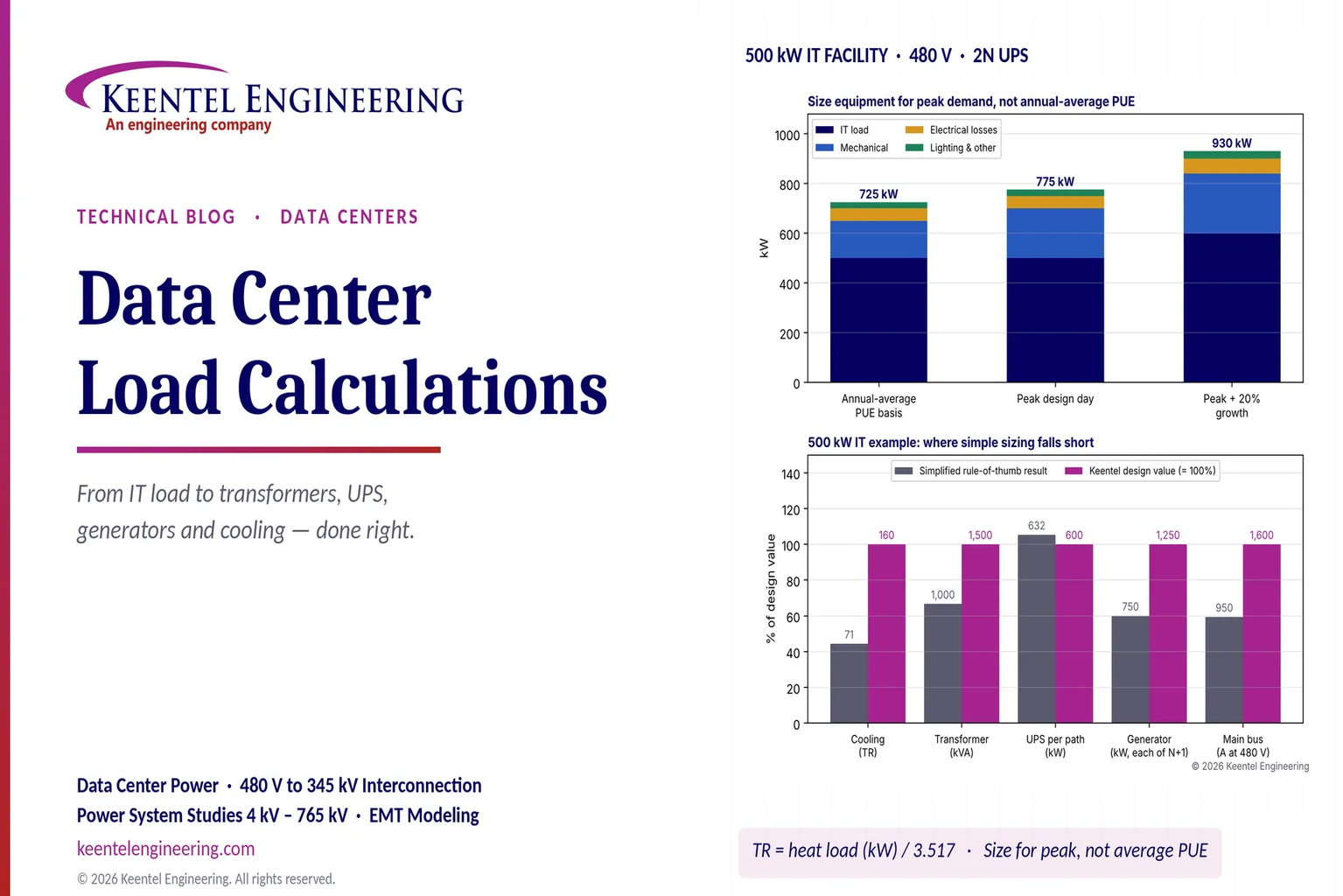
Learn data center electrical load calculations, including IT demand, PUE, UPS and generator sizing, cooling loads, redundancy, and worked US examples.
By SANDIP R PATEL
•
October 20, 2026
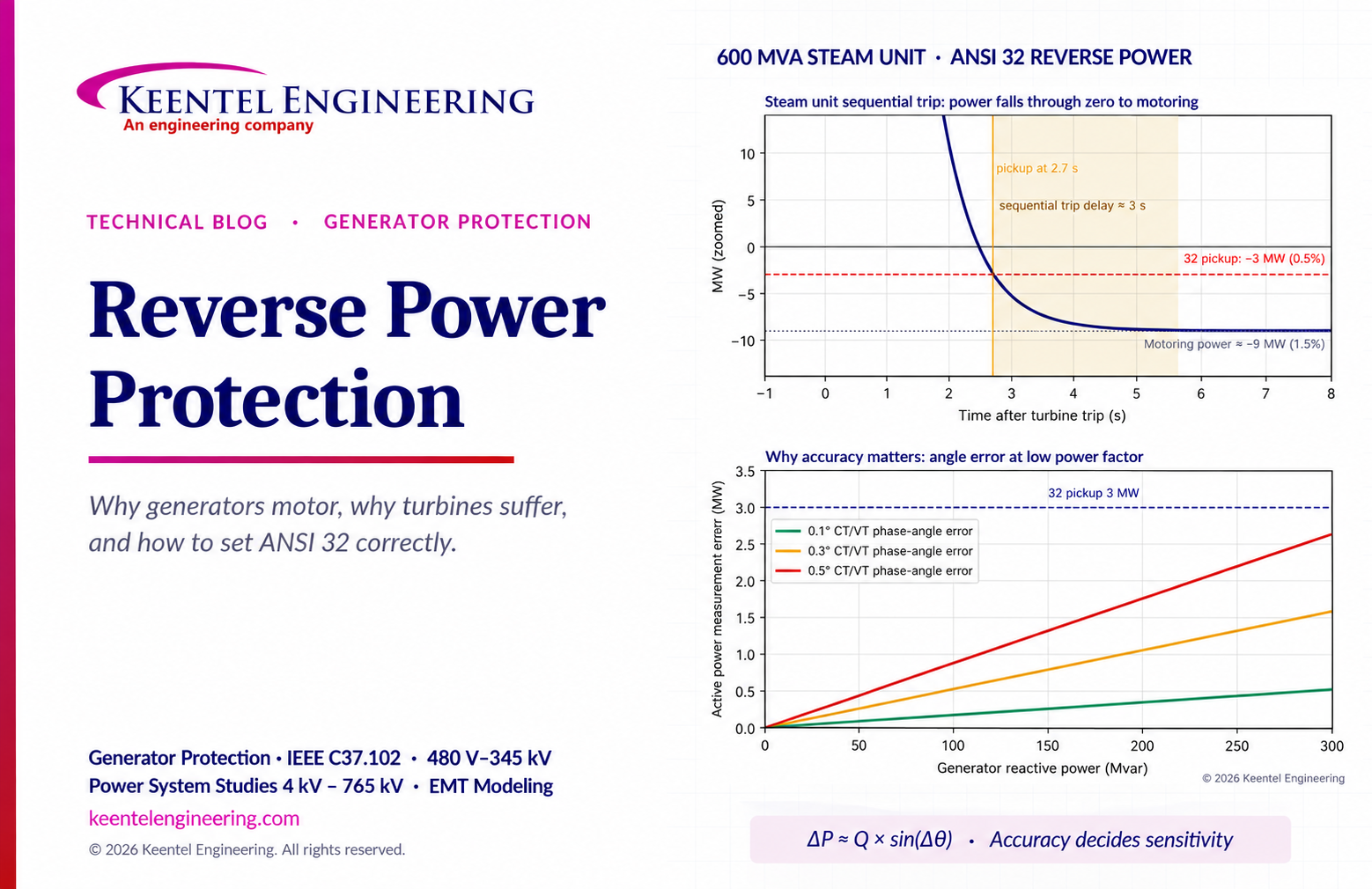
Learn reverse power protection (ANSI 32), generator motoring, relay pickup settings, time delays, sequential tripping and testing for US power plants.
By Team 2 Dexora
•
October 20, 2026
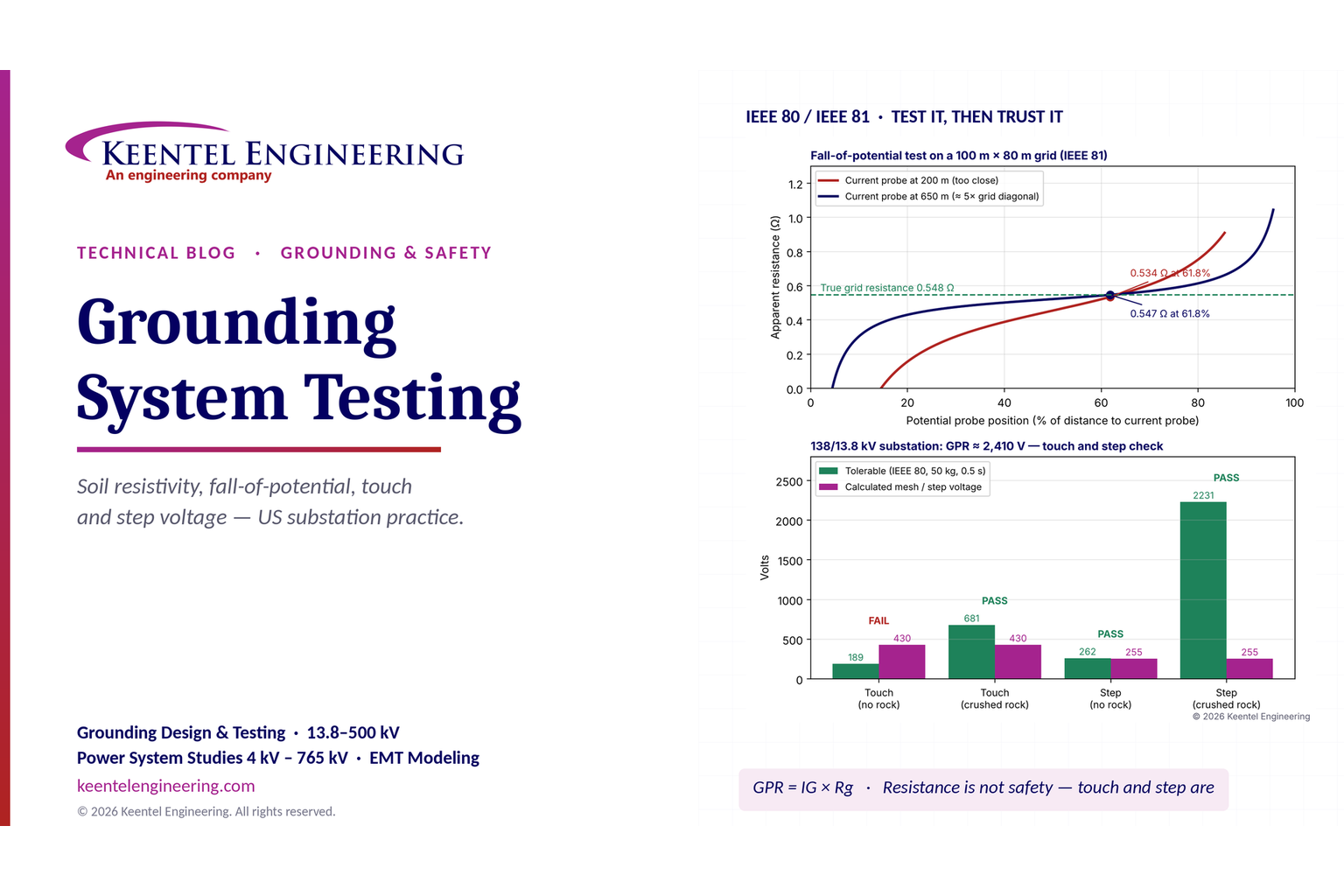
Explore grounding system testing with Keentel Engineering. Learn IEEE 80/81 methods, soil resistivity, ground resistance, and touch and step voltage safety.
By SANDIP R PATEL
•
October 13, 2026
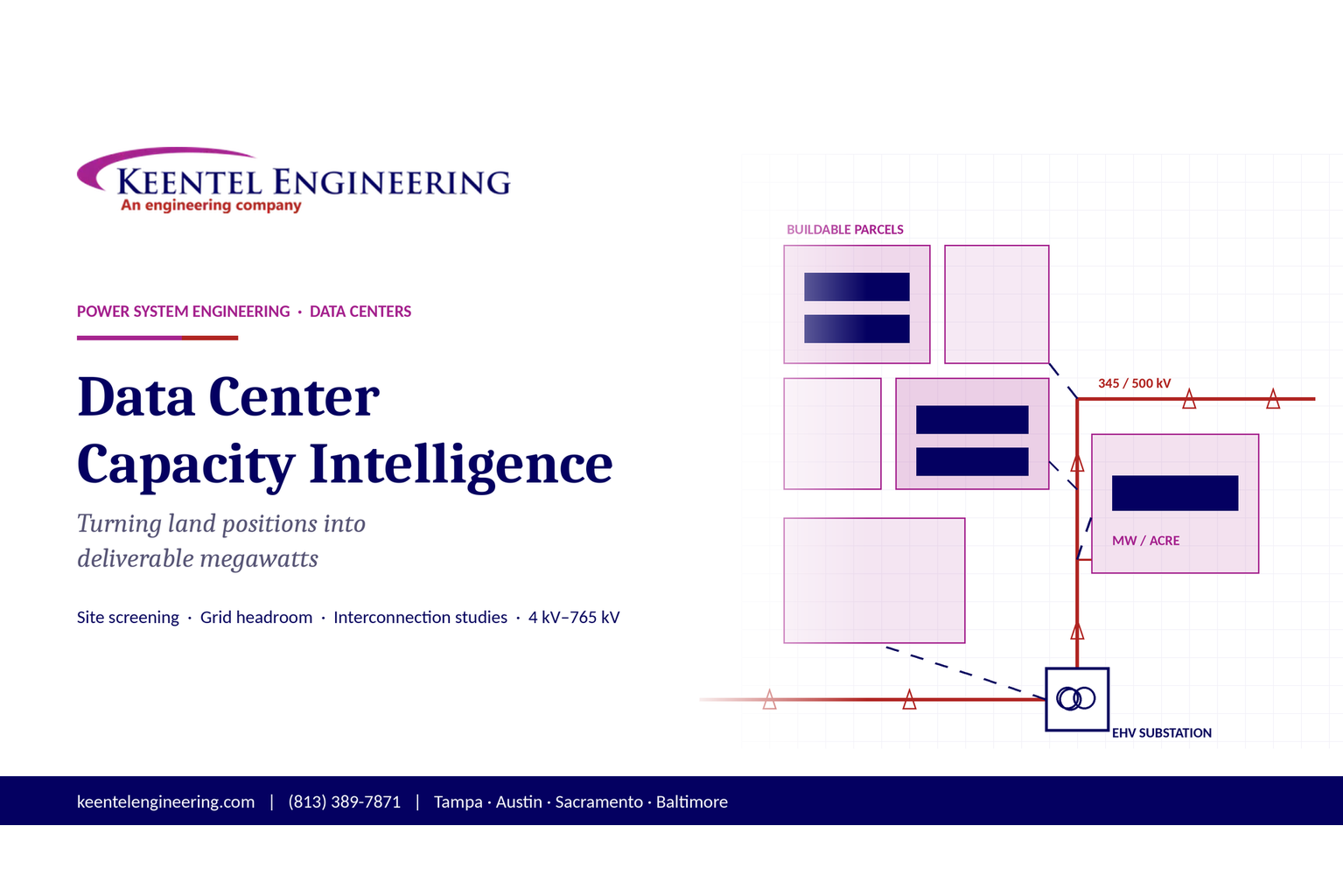
Plan data center capacity with land screening, MW-per-acre estimates, grid power availability and interconnection feasibility studies from Keentel Engineering.