A Coordinated Electric System Interconnection Review—the utility’s deep-dive on technical and cost impacts of your project.
Challenge: Frequent false tripping using conventional electromechanical relays
Solution: SEL-487E integration with multi-terminal differential protection and dynamic inrush restraint
Result: 90% reduction in false trips, saving over $250,000 in downtime
The three operating regions you have to design to
| Device | Output vs voltage | Response | Best suited to | Main limitations |
|---|---|---|---|---|
| Mechanically switched capacitor or reactor | Proportional to voltage squared | Seconds; discrete steps; limited switching operations per day | Steady-state reactive supply, voltage profile, loss reduction | No dynamic capability; step voltage change on switching; capability collapses when most needed |
| Static var compensator | Capacitive branches proportional to voltage squared | A few cycles; continuously controllable | Continuous control where cost matters and deep voltage support is not the driver | Square-law capability loss; harmonic filters are part of the plant and interact with the network |
| STATCOM | Approximately proportional to voltage — constant current capability | One to two cycles closed loop; converter response faster still | Voltage stability margin, weak interconnections, fast disturbance recovery, flicker and unbalance compensation | Higher capital cost; converter losses; adds a converter and its control dynamics to the network |
| Synchronous condenser | Governed by machine capability and excitation | Excitation response in the hundreds of milliseconds; inherent inertial response instantaneous | System strength and inertia, short-circuit contribution, black start support | Rotating plant with maintenance and losses; slower controlled response than a converter |
| STATCOM with energy storage | Reactive as a STATCOM, plus real power within the storage rating | As STATCOM for reactive; real power limited by storage | Where a real power deficiency is part of the problem | Cost and complexity of the storage; different failure and maintenance profile |
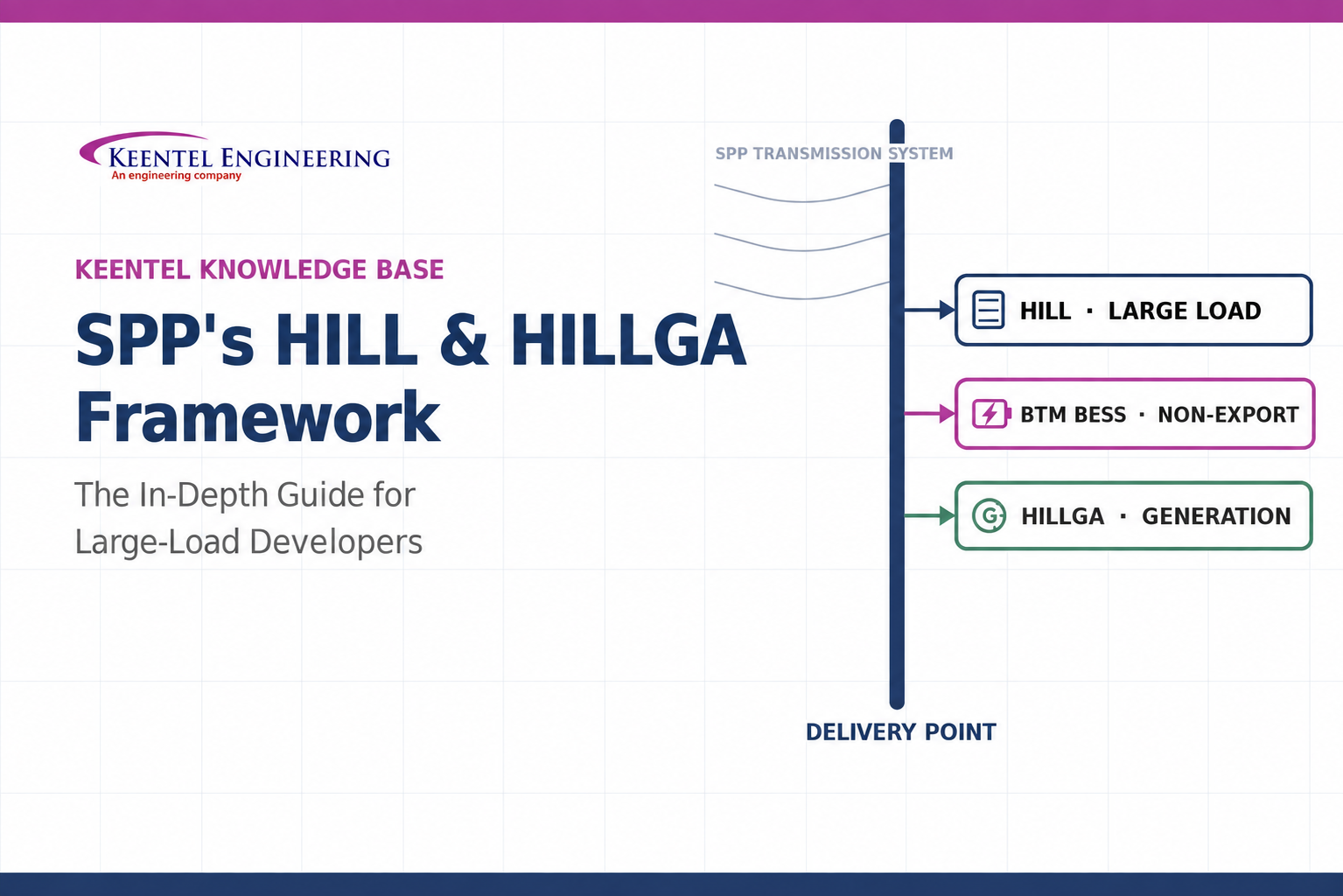
SPP's HILL and HILLGA Framework: The In-Depth Guide for Large-Load Developers
September 26, 2026 | Blog
What the tariff says, how the process works, and the questions that decide your project — from Keentel Engineering's working knowledge of the framework
Data centers, hydrogen facilities, and industrial electrification are arriving on the transmission system faster than any load class in modern history and in the Southwest Power Pool (SPP) footprint, they arrive into a framework that did not exist before 2026. SPP's High Impact Large Load (HILL) process, and its generation companion the HILL Generation Assessment (HILLGA), received FERC approval in January 2026. That makes this one of the youngest major interconnection frameworks in the country: the tariff text is new, the study practice is forming in real time, and the market's understanding is uneven.
Keentel Engineering works inside this framework daily advising large-load developers, building the load and generation models the process requires, and engaging the process's open questions as they resolve. This guide consolidates what we know: the tariff structure, the study mechanics, the economics, and most valuably the practical clarifications that are emerging as the framework meets real projects. It is written for developers, and it is deliberately thorough.
One note before we begin: this framework is young and evolving. What follows reflects the tariff, the published business practices, and Keentel's working experience as of publication. Positions on unsettled points are identified as such. Nothing here substitutes for project-specific engineering or for written confirmation from SPP on load-bearing questions obtaining that confirmation is, in fact, one of the disciplines this guide recommends.
Part 1: What HILL Is — and Why It Exists
Transmission planning was built around load that grows slowly and predictably. A single campus that adds hundreds of megawatts in eighteen months breaks that model: it can consume delivery capability that other customers were counting on, stress voltage and stability margins, and arrive faster than network upgrades can be built.
The HILL process is SPP's answer: a structured study-and-integration pathway for loads large enough to matter. In broad terms, a load qualifies for HILL treatment based on size and interconnection voltage with thresholds capturing large loads connecting at transmission voltages (loads of roughly 50 MW and above at higher transmission voltages, with a lower threshold at lower voltages). If your data center or industrial facility is in the size class this article cares about, you are in the process.
The HILL Delivery Point Study (HDPS)
The center of the load-side process is the HILL Delivery Point Study a comprehensive evaluation of whether, and how, the transmission system can serve your load at your chosen delivery point. Key features:
- A 90-day study clock that begins when your application is complete and validated — not when it is first submitted. Deficient applications do not start clocks. This single fact drives the most important discipline in the process: submittal quality is schedule.
- Study content: thermal loading, voltage performance, short-circuit duty, and dynamic performance at and around the delivery point, under system-intact and contingency conditions.
- A system-strength screening using composite short-circuit-ratio criteria and critical-clearing-time thresholds. Falling short of the screening criteria does not end the project — but it routes the request into supplemental electromagnetic-transient (EMT) analysis, which runs outside the 90-day window on its own timeline. Projects with significant power-electronic load (or co-located inverter-based generation) should treat this screening as a first-class risk item and consider proactive EMT model readiness.
The load models the process requires
SPP's HILL practice requires dynamic load models that actually represent the load's behavior — not generic placeholders. For data centers, this means composite load model (CMLD) and performance-based (PERC1-class) representations parameterized to the facility's real composition: the UPS/rectifier share, motor-driven mechanical load, power-factor characteristics, and ride-through behavior. Facilities with distinct load classes on distinct feeders can be represented with the appropriate model on each feeder within a single planning case an architecture that mirrors the physical design and reconciles cleanly to the requested megawatts.
The modeling requirement is a quiet filter: developers who arrive with well-parameterized models move; developers who arrive with defaults get comment cycles.
Part 2: HILLGA — When Generation Comes With the Load
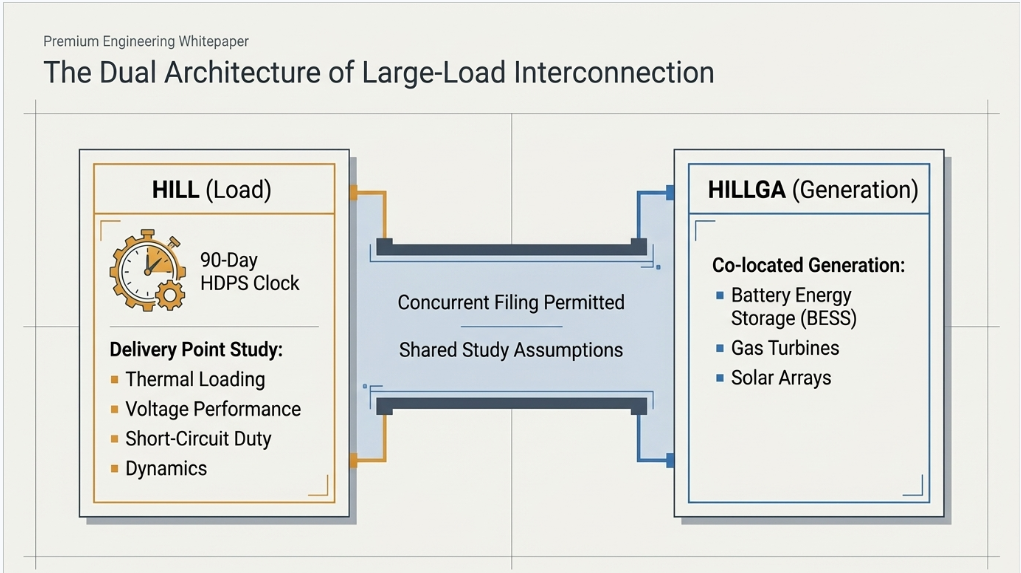
Many large-load strategies pair the load with co-located generation: batteries to shave constrained hours, gas turbines or solar to supply energy behind the fence. The HILLGA HILL Generation Assessment is the generation-side companion process for resources supporting a HILL.
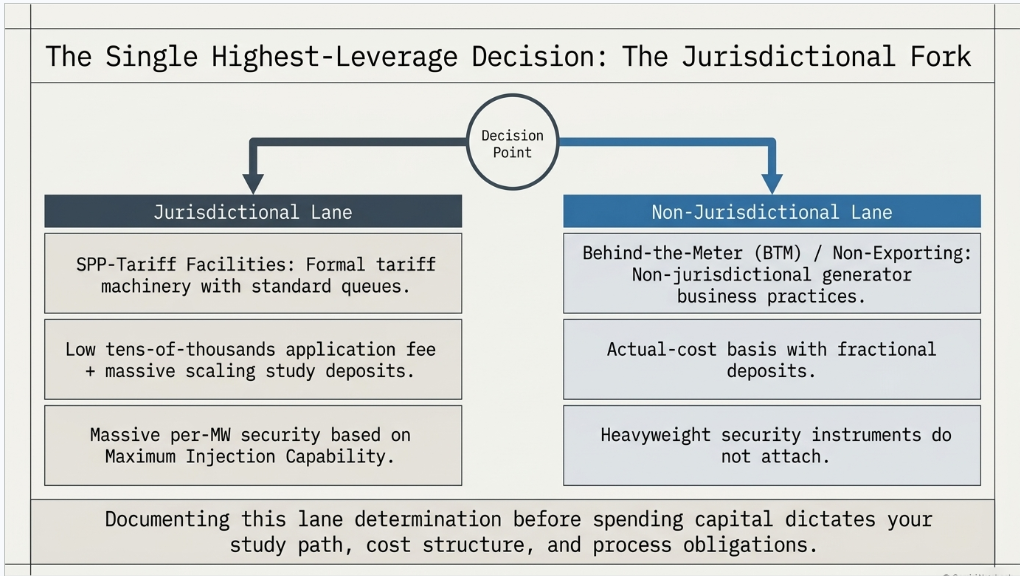
The jurisdictional fork: the first decision that matters
Before anything else, a co-located generation strategy must answer one question: does the generation interconnect to facilities under SPP's functional control, or entirely outside them? The answer selects the lane, and the lanes are profoundly different.
The jurisdictional lane (generation connected to SPP-tariff facilities) runs through the HILLGA's formal machinery, with its published economics: an application fee in the low tens of thousands of dollars, study deposits in the several-hundred-thousand-dollar class scaled by project size, and most notably a security requirement computed per megawatt of Maximum Injection Capability. That last phrase deserves attention, and we return to it below.
The non-jurisdictional lane applies to generation that interconnects entirely behind the customer's meter, outside SPP functional control the classic behind-the-meter (BTM), non-exporting configuration. This lane runs under the non-jurisdictional generator provisions of SPP's business practices, and its economics are materially lighter: study costs run on an actual-cost basis with deposit-and-true-up mechanics at a small fraction of the jurisdictional lane's published deposit schedule, and the heavyweight security instruments of the jurisdictional lane do not attach.
The fork is not a formality. It determines your study path, your cost structure, your security exposure, and your process obligations. Getting the lane determination right and documented before spending anything else is the single highest-leverage act in a co-located strategy.
The zero-injection insight
For a non-exporting configuration, notice what the security formula implies: security scales with Maximum Injection Capability the maximum real power the facility can inject at the point of interconnection. A facility that is protection-limited to zero injection where relay schemes with defined trip logic make export physically impossible, not merely contractually promised has a maximum injection capability of zero. A declared zero is an argument; a protection-backed, demonstrable zero is a fact. Configurations built on the latter, with the protection scheme documented in the application (one-line, relay elements, trip logic, failure modes), put themselves in the strongest possible posture on both the jurisdictional determination and everything downstream.
One threshold worth engraving: under the non-jurisdictional provisions, small incidental injection (at or below roughly one megawatt under normal system-intact configuration) is tolerated within the lane but injection capability above that level changes the treatment of affected-system studies and pulls the configuration toward the standard interconnection machinery. The design implication: engineer the export limit below the threshold, enforce it in protection, and document it relentlessly.
Part 3: The Pathway Menu — Seven Ways to Connect, One Underlying Study
The framework's revision requests (RR696 and its companions) built out a menu of connection pathways, and understanding what each one permits and what it does not is where strategy begins. Every pathway runs the same underlying delivery-point study; they differ in what they allow
before firm capacity exists and in how they eventually firm up:
| Pathway | What it does | How it firms up |
|---|---|---|
| Attachment AQ | Delivery-point firm service once necessary network upgrades are in place — the classic firm end-state | Firm end-state |
| Attachment AX (Provisional Load Process) | Interconnect once supporting generation and upgrades are in place; uniquely, lets SPP count planned, not-yet-designated generation in the study | Firm end-state via the designation machinery |
| Attachment BC | The flexibility path for customers without sufficient Designated Resources — the fastest route to conditional service | Requires a follow-on AQ or AX request; never firm on its own |
| HILLGA | Connects the generation supporting the load (common-bus or local-area configurations); output tied to the supporting load forecast | Consolidated Planning Process |
| Interim process | Connects the load and supporting generation after required upgrades while the final interconnection agreement completes | CPP (final GIA) |
| CHILL / CHILLS | Conditional (curtailable) HILL service as soon as interconnection upgrades and supporting generation are in place — multi-year non-firm terms | Attachment AQ, AX, or BC |
| PAL (developing) | Price Adaptive Load — connects as soon as upgrades are in place, curtailable on a permanent basis | Remains curtailable |
Three strategic observations:
Pathways can run in parallel. A load may pursue more than one route simultaneously a conditional-service track for early energization alongside a firm track for the end-state. The combinations, their study interactions, and their decision forks are where a well-advised strategy separates from a default one.
Attachment AX is the co-location pathway. Its distinguishing power counting planned, not-yet-designated generation in the study is precisely what a load-plus-generation strategy needs. Most of Part 5's modeling questions, and all of Part 6's endgame, live inside AX.
The conditional pathways trade certainty for speed. BC and CHILL/CHILLS energize sooner and firm up later which makes the firm-versus-conditional megawatt split a genuine commercial decision, and one that pre-application analysis (testing alternate sizes at the same point of interconnection before filing) can inform rather than leave to the study results.
Part 4: How the Studies Actually Sequence — What Practice Is Revealing
The tariff describes the studies; practice is revealing how they run together. Several clarifications have emerged that materially improve what developers can plan for:
Concurrent filing is available
A HILLGA request must have a corresponding HILL request the generation assessment points at a load but the two may be filed at the same time. Early market readings assumed strict sequence; the framework as practiced allows the requests to move together, and the assessments share study assumptions in ways that can shorten combined timelines.
The battery charging study can run alongside the rest
Energy storage in these configurations is evaluated for its charging behavior (as negative generation, on customer-specified charging windows, under the system conditions that matter for charging), and parallel execution across the framework's evaluations is broadly available. The practical coupling worth knowing: these studies share modeling foundations, so as a matter of workflow, the model build is the shared critical path. The lesson generalizes: in this framework, data readiness and model quality not tariff clocks are the true schedule drivers. Every formal clock starts on complete, validated inputs; the developer who shows up with an airtight data package controls the schedule.
End-to-end duration is what you make it
SPP has, sensibly, declined to promise end-to-end timelines data-gathering and verification phases vary too much by project. The tariff anchors are the defined study windows (the 90-day delivery-point study; a 90-day stability-analysis window on the non-jurisdictional side). Around those anchors, a well-prepared project pursuing everything promptly on complete data can credibly plan in months, not years which, compared to the standard generation interconnection queue experience, is the entire point of the framework.
Part 5: The Modeling Question — How a Behind-the-Meter Battery Is Actually Studied
For co-located battery configurations, the deepest technical question in the framework is deceptively simple: when your load application includes a BTM battery as its supporting planned resource, how does the battery actually appear in the study cases? The answer determines whether your 100 or 200 MW of behind-the-fence capacity actually counts.
The modeling categories
SPP's model development practice distinguishes several treatments for distributed and storage resources: bulk-system-scale storage modeled as generating units (with discharge capability as maximum output and charging as negative minimum); registered network-resource-class units that are always modeled as generating units; unregistered resources submitted as generation, which may be modeled in-service or out-of-service with model-governance concurrence; storage serving as transmission-only assets, modeled offline in all cases (a category inapplicable to behind-the-meter facilities); and, where explicit generator modeling criteria are not met, representation within the load record through distributed-generation fields never as a silent reduction of forecast load. Netting generation against load is not how this framework works: resources are represented explicitly.
The questions that decide it and how to resolve them
Which category applies to a behind-the-meter battery submitted as the planned resource supporting a large load — and therefore which study states apply (producing in the cases where it supports the load; out-of-service in stress-test conditions; charging treated in the dedicated charging evaluation) is exactly the class of question a developer should resolve with SPP at the scoping stage rather than assume. The framework rewards those who ask it concretely: which case types apply which dispatch state, and what the load is assumed to be served by in each. In Keentel's working experience, the treatments the framework applies to well-documented, protection-limited configurations align with what a well-designed project wants but the discipline is to establish that treatment on the record for your configuration before study assumptions lock.
The practical corollary for application design: carry the battery's charging demand inside the requested load megawatts and the ten-year forecast from the first draft, so the charging evaluation and the load study rest on one consistent data set and pre-agree the dispatch and study-state assumptions at the scoping call rather than discovering them in study results.
Part 6: The Endgame From Provisional Service to Firm
Here is the part of the framework most often misunderstood, and where recent clarification has been most decisive.
The load-process pathway grants what is, in essence, provisional service a structured way to energize and operate while the supply picture completes. The framework's intent is a path toward firm service. And the transition to firm has a specific requirement: the planned generation supporting the load must itself receive firm service through the aggregate transmission service study process, or through the expedited designation process the tariff provides.
Two implications deserve emphasis:
First, market-registration alone does not carry the transition
The tariff provides registration constructs for resources that do not inject and do not seek network-resource status useful for what they are but the provisional-to-firm transition runs through the designation machinery, not around it. Strategies built on the assumption that registration alone completes the picture should be revisited.
Second, the tariff provides more than one designation route and route selection is a genuine strategy decision
Alongside the aggregate study process, an expedited designation provision exists, and for purpose-built co-located resources the choice between routes their timing, their study constructs for a resource with no network point of receipt, and their fit against the load-process milestones deserves early, deliberate evaluation rather than default assumption. The load-bearing questions a developer should resolve early, in writing: when the designation process must commence relative to the load-process milestones, how a zero-interface resource is studied within the designation machinery, and how long provisional service may run before the transition must complete. Those answers convert the endgame from a surprise into a schedule line.
Part 7: The Technical Bar — Ride-Through, System Strength, and the EMT Question
Two published requirement sets deserve their own section, because they are where large power-electronic loads most often meet the framework's hard engineering edges.
The fault ride-through requirements
SPP's HILL fault ride-through requirements (now in their second published version) set performance obligations that a data-center-class load must demonstrate, not merely assert:
- A voltage ride-through envelope at the point of interconnection — the load must remain connected through defined voltage-sag regions rather than tripping on the first disturbance.
- Transient overvoltage withstand referenced to the IEEE 2800-2022 cumulative-duration logic the load must tolerate defined overvoltage magnitudes for defined cumulative durations.
- Frequency ride-through on profiles aligned with the NERC PRC-029 lineage.
- Constant-current behavior during disturbances — the load's power electronics must behave predictably through the event, not chaotically.
- Recovery discipline — return to at least ninety percent of pre-disturbance consumption within one second of voltage recovery.
- Reclosing endurance — ride through multiple fault-clearing (reclosing) attempts in rapid succession up to six events inside ninety seconds.
Two practical notes. First, these requirements flow down into the load models: the CMLD/PERC1 parameterizations must encode the trip, transfer, and recovery behavior the requirements demand, so that simulated performance matches the obligation which is why a fault ride-through gap review (stated equipment capability versus required behavior) belongs at the front of any modeling engagement. Second, the requirements contemplate targeted exemptions variable-speed-drive equipment, for example, may qualify for relief from selected requirements where the delivery-point study demonstrates no adverse reliability impact. An exemption strategy, properly supported, is real compliance-cost money.
The system-strength screen and the EMT decision
The delivery-point study screens every request for system strength: composite short-circuit-ratio measures and a critical-clearing-time test. Published screening thresholds are demanding composite ratios in the mid-single digits and clearing times measured in fractions of a second and a large power-electronic load at a weak point of interconnection can fail them.
Failing the screen does not kill the project. It routes the request into a supplemental EMT study stage electromagnetic-transient dynamic performance, sub-synchronous oscillation screening (per the applicable CIGRE guidance), converter-driven stability, emergency power control, power quality, fault ride-through demonstration, and model verification performed outside the 90-day window, on a timeline SPP does not fix. Industry experience with supplemental EMT stages elsewhere suggests months, not weeks.
This is why the framework's own guidance points toward providing a PSCAD EMT model at the time of application: a request that arrives EMT-ready cannot be schedule-hostaged by the screen. The decision build the EMT model proactively or risk the supplemental stage is a genuine cost-versus-schedule tradeoff, and it should be made deliberately, on a screening-informed basis, before filing. An EMT model built “supplemental-stage-ready” from day one stable initialization, operation against network equivalents, suitability for oscillation screening, documented quality checks converts the framework's biggest schedule risk into a contingency you have already covered.
The verification expectation
Where both RMS (positive-sequence) and EMT models are submitted, expect them to be compared: the framework's model-verification expectations run the model sets through common disturbances and look for consistency. The models are a matched pair, not independent artifacts building them as one internally consistent package, benchmarked against each other before submission, pre-empts the least productive comment cycle in the process.
Part 8: The Disciplines That Separate Winning Applications
Across everything above, five disciplines recur:
1. Determine the lane first, in writing. The jurisdictional fork drives everything; document the determination before committing spend.
2. Make zero injection a fact, not a claim. Protection-enforced, documented, demonstrable with the small-injection threshold engineered against.
3. Treat data readiness as the schedule. Every clock starts on validated inputs. Model quality is submittal quality is schedule.
4. State your premises explicitly in every filing. New frameworks default to their oldest interpretations; applications that name their lane and their configuration foreclose the generic treatment.
5.
Convert interpretations into written confirmations before filings harden. On a framework this young, the difference between an interpretation and a confirmed position is the difference between a plan and a hope. Build the confirmation step into your schedule.
Frequently Asked Questions: The In-Depth Set
1. What makes a load a "HILL" in SPP?
Size and interconnection voltage — the framework captures large loads connecting at transmission voltages, with thresholds set so that loads big enough to affect the system (roughly 50 MW and above at higher transmission voltages; a lower bar at lower voltages) receive structured study. If you are developing at data-center scale in the SPP footprint, plan on being in the process.
2. How long does the delivery-point study take?
Ninety days — from a complete, validated application. The distinction matters more than the number: deficient submittals do not start clocks. In our experience the controllable schedule lives almost entirely in application quality.
3. What load models are required, and why do they matter so much?
Composite (CMLD) and performance-class (PERC1) dynamic load models parameterized to your actual facility — UPS/rectifier composition, motor load, power factor, ride-through behavior. They matter because they are both a filing requirement and a study input: poor models generate comment cycles and conservative results; good models move.
4. What is the system-strength screening, and what happens if we miss it?
A composite short-circuit-ratio and critical-clearing-time screen of the delivery point. Missing it routes the request into supplemental EMT analysis outside the 90-day window. High power-electronics facilities should assess this risk before filing and consider EMT model readiness proactively — the supplemental window is open-ended, and arriving prepared is the difference between weeks and quarters.
5. What exactly is HILLGA, and when do we need it?
The generation-side assessment for resources supporting a HILL. If your strategy pairs the load with co-located generation, the generation runs through HILLGA treatment — with the jurisdictional fork (Part 2) deciding which lane and which economics.
6. Can the HILLGA be filed at the same time as the HILL?
Yes. The HILLGA must correspond to a HILL, but concurrent filing is available, and the assessments share assumptions in ways that can compress combined timelines. Design the submittal package so both requests share one data set and one forecast.
7. What does the non-jurisdictional lane actually save?
Compared to the jurisdictional lane's published schedule — application fee, study deposits scaled in the hundreds of thousands, and per-megawatt security on maximum injection capability — the non-jurisdictional lane runs on materially lighter, actual-cost study economics with the heavyweight security not attaching. For a protection-limited zero-injection configuration, the delta is decisive.
8. Does seniority protect against obsolescence?
For the strongest posture: no. The framework's economics and treatment key off injection capability. A protection-enforced scheme — relay elements, trip logic, failure modes addressed, demonstrable on request — converts "we won't export" into "we can't export," and that conversion is worth real money and real certainty.
9. How much injection is too much for the non-jurisdictional lane?
The working threshold is small — on the order of one megawatt under normal system-intact conditions. Above that capability, affected-system treatment changes and the configuration is pulled toward the standard interconnection machinery. Engineer below the threshold with margin, and document it.
10. How is our behind-the-meter battery actually modeled in the load studies?
Explicitly — never netted against load; that principle is firmly established. The applied category, the in-service status, and the dispatch state per case type are configuration-specific determinations worth establishing with SPP on the record at the scoping stage — and a well-documented, protection-limited configuration is positioned to receive the treatment it wants: capacity counting where it supports the load, prudent stress-testing, and charging handled in the evaluation built for it.
11. Do the studies test conditions where our resource is unavailable?
Prudent planning practice evaluates exactly that — whether the system can carry the load when the supporting resource is out of service, the planning-world equivalent of an N-1 on your own supply. Understanding which cases apply that posture, and what serves the load in them, is one of the sharpest project-specific questions in the framework — and worth resolving explicitly for your configuration before results surprise you.
12. Should battery charging be inside our requested load MW?
Yes — from the first draft. Carrying charging inside the requested megawatts and the ten-year forecast keeps the charging evaluation and the load study on one consistent data set and forecloses deficiency findings. It is the single most common application-design mistake we see avoided too late.
13. Can the charging study run in parallel with everything else?
Parallel execution is broadly available across the framework's studies — and the practical constraint is rarely the tariff: it is model and data readiness. The studies share modeling foundations, so the model build is the true shared critical path. Invest there.
14. What is "provisional" about the load pathway, and how do we get to firm?
The pathway energizes the load while the supply picture completes — a path toward firm service, not a destination. The transition to firm runs through the tariff's resource-designation machinery, and the route selection and timing are strategy decisions worth resolving early and in writing — assumptions here have filing consequences.
15. What designation options exist for a resource built to serve its own load?
More than one — the tariff provides both an aggregate study process and an expedited designation provision, and their fit differs by configuration and schedule. The questions to resolve early: commencement timing relative to your load-process milestones, the study construct for a resource with no network point of receipt, and the allowable duration of provisional service. Resolve those in writing and the endgame becomes a schedule line.
16. How should we handle questions the framework doesn't clearly answer?
Deliberately. Frame questions concretely (specific configurations get specific answers; generic questions get generic-lane boilerplate), state your premises so the answer cannot miss them, decompose compound questions into separately answerable parts, and convert every load-bearing interpretation into a written confirmation before your filings harden. On a framework this young, question craft is a genuine competitive skill.
17. What can change after we file — and what re-opens studies?
The organizing principle: changes are measured against what was studied and represented. Reductions within the studied envelope tend to be administrable; increases, technology changes (a battery is not a gas turbine is not a solar array — their dynamics, fault behavior, and study treatment differ fundamentally), charging-basis changes, and protection-scheme changes touch the studied basis and invite re-evaluation. The practical hedge: define your intended flexibility — ranges, technologies, windows — in the application itself, so foreseeable changes land inside the studied envelope.
18. Does resource type really matter if the megawatts are the same?
In a steady-state snapshot, less than you'd think. Everywhere else — dynamics, short-circuit contribution, system-strength interaction, and (for storage) energy duration and the charging side — fundamentally. A 200 MW battery, a 200 MW turbine, and 200 MW of solar are three different studies wearing the same nameplate.
19. Who has actually completed one of these projects end-to-end?
As of this writing: nobody — the framework is months old, and any firm claiming a multi-year HILL track record deserves your skepticism. The real currency is active work in the framework as it stands, current command of its business practices and model requirements, and the discipline to distinguish what is established from what still needs written confirmation.
20. What should we do first?
Three things, in order: determine your jurisdictional lane and document it; commission the load characterization and modeling work early (it gates everything); and build your question-and-confirmation list before you file, so the framework's open points are resolved on your schedule instead of discovered on SPP's.
21. What connection pathways exist besides the basic HILL study — and can we pursue several at once?
The menu spans firm end-states (Attachment AQ; Attachment AX for loads with planned co-located generation), a flexibility path that is fastest to conditional service but never firm on its own (Attachment BC), conditional curtailable service (CHILL/CHILLS), an interim bridge while final agreements complete, and a developing permanently-curtailable option (PAL). Yes — pathways may be pursued simultaneously, and a parallel-path strategy (early conditional service alongside a firm track) is often the strongest structure. See Part 3.
22. What is the difference between CHILL service and firm service — commercially?
CHILL-class service is curtailable: it energizes sooner, on multi-year non-firm terms, and the system operator can curtail it when conditions require. Firm delivery-point service is the end-state. The commercial question is what fraction of your megawatts can tolerate curtailment (and for how long) — which is why testing alternate project sizes at the same point of interconnection before filing, to map the firm-versus-conditional split, is worth doing privately rather than discovering in study results.
23. What are the fault ride-through obligations for a large load, in plain terms?
Stay connected through defined voltage sags at the point of interconnection; withstand transient overvoltages per cumulative-duration logic (IEEE 2800-2022 lineage); ride through frequency excursions (PRC-029 lineage); behave as a constant-current device during disturbances; recover to at least 90% of pre-disturbance consumption within one second of voltage recovery; and endure up to six reclosing attempts inside ninety seconds. These are demonstration obligations — your models must show the behavior. See Part 7.
24. What does not training cost?
At a $185 billing rate, an eighty-hour avoidable rework is $14,800 of unbillable time, which is approximately what it costs to train four engineers for a year at the statutory minimum. A forty-hour rework is two engineer-years. The comparison omits the harder costs: the client relationship, the schedule impact when engineering is on the critical path, work not won because a capability could not be credibly claimed, and engineers lost to firms that invest in them.
25. What is the single most useful thing a firm can do?
Maintain a register of which standards govern which deliverable, at which edition, with the date each was last reviewed — and assign one engineer each month to read one of them properly and present what changed. It costs one person a day a month, it builds the capability level that no public resource supplies, and it produces the artefact that makes every other deliverable defensible.
26. What is actually in the supplemental EMT stage if the screen is failed?
EMT dynamic performance, sub-synchronous oscillation screening per the applicable CIGRE guidance, converter-driven stability, emergency power control, power quality, fault ride-through demonstration, and model verification — all outside the 90-day window. It is the single largest schedule risk in the process, and the reason EMT readiness is a first-class strategic question.
27. How do the RMS and EMT models relate to each other?
As a matched pair. Verification practice compares them across common disturbances and expects consistency — so build them as one internally consistent package and benchmark them against each other before submission. A mismatch found by the reviewer is a comment cycle; a mismatch found by your own benchmarking is a Tuesday.
28. What belongs in the application data package for the load side?
The request forms and study agreement; a ten-year load forecast (with any storage charging carried inside the requested megawatts); the delivery-point one-line; steady-state model change files; the dynamic load models parameterized to your facility; and the framework's load-characteristics form. Completeness is not bureaucratic virtue — it is what starts the 90-day clock.
29. Who does what — between the developer, the serving utility, the host Transmission Owner, and SPP?
The developer (or its customer of record) owns the application, the data, the models, and the commercial elections; the serving utility/transmission customer executes the service agreements; the host Transmission Owner runs its own connection study alongside SPP's delivery-point study and owns the local facilities; SPP administers the framework and performs the regional studies. Mapping these dependencies — who must produce what, by when, for whose study — is half of program management in this process.
30. What does a well-run engagement look like, start to finish?
Lane determination and pathway strategy first; the load characterization, model build, and gap review next (they gate everything); a private injection analysis and screening assessment before fees and deposits are committed; a complete, validation-ready application; pre-agreed assumptions at the scoping call; disciplined turnaround through the study window; and an independent review of the results against your own prior analysis before the commercial election. Every step exists to protect the same two things: the schedule and the megawatts.
Closing Thought
SPP's HILL/HILLGA framework is the most consequential development in large-load interconnection in years — a genuine fast lane, for developers disciplined enough to use it well. The winners in this framework will not be the ones with the oldest brochures. They will be the ones who arrive with protection-backed configurations, real models, airtight data packages, and every load-bearing interpretation confirmed in writing before it matters.
That is the practice we have built.
Keentel Engineering is a power systems engineering firm headquartered in Tampa, Florida, with offices in Austin, Sacramento, and Baltimore, providing Professional Engineering services in all 50 states. Our practice spans SPP and ERCOT large-load interconnection, HILL/HILLGA advisory, dynamic load and facility modeling (CMLD/PERC1, PSS\u00aeE, PSCAD), delivery-point and injection studies, and interconnection application support.
Contact: 813-389-7871 \u00b7 contact@keentelengineering.com \u00b7 keentelengineering.com
This article is provided for general informational purposes only. It reflects the SPP tariff, business practices, and Keentel's professional experience as of publication; the framework is new and evolving, and specific provisions, thresholds, and figures should be verified against current tariff documents. Nothing herein constitutes engineering, legal, or investment advice for any specific project, and no engineering studies underlie this publication. Project decisions should rest on project-specific engineering and written confirmations from SPP and the applicable Transmission Owner.

About the Author:
Sandip "Sonny" R. Patel, P.E.
IEEE Senior Member · Founder & CEO, Keentel Engineering
In 1995, Sonny Patel earned his Electrical Engineering degree from the University of Illinois. But degrees don't build legacies — action does.
For three decades, he has worked the power industry from every side of the table: 16 years as a utility engineer at Exelon/Commonwealth Edison; generation leadership across hydroelectric, industrial steam turbine, and a 9 GW renewable fleet; NERC Regional Entity Senior Compliance Engineer and Audit Team Lead, auditing some of the nation's largest utilities; and testing and commissioning lead on equipment up to 765 kV — the very top of the North American grid.Utility. Generator. Regulator. Consultant. Few engineers have seen all four seats. Fewer still have sat in them.
His experience spans nuclear, hydro, conventional generation, renewables, oil and gas, mining — and today's data centers, where he is authoring a three-book series on data center design. He is a Licensed Professional Engineer in six states and a Licensed Electrical Contractor in Florida (Unlimited EC) — he doesn't just design the work; he's qualified to stand behind its execution.Today, as Founder and CEO of Keentel Engineering, Sonny leads a nationwide team of engineers delivering substation design, power system studies, NERC compliance, and commissioning — done right, coast to coast.Three decades. Every side of the table. One standard: accountable engineering.
Services

Let's Discuss Your Project
Let's book a call to discuss your electrical engineering project that we can help you with.
About the Author:
Sandip "Sonny" R. Patel, P.E.
IEEE Senior Member · Founder & CEO, Keentel Engineering
In 1995, Sonny Patel earned his Electrical Engineering degree from the University of Illinois. But degrees don't build legacies — action does.
For three decades, he has worked the power industry from every side of the table: 16 years as a utility engineer at Exelon/Commonwealth Edison; generation leadership across hydroelectric, industrial steam turbine, and a 9 GW renewable fleet; NERC Regional Entity Senior Compliance Engineer and Audit Team Lead, auditing some of the nation's largest utilities; and testing and commissioning lead on equipment up to 765 kV — the very top of the North American grid.
Utility. Generator. Regulator. Consultant. Few engineers have seen all four seats. Fewer still have sat in them.
His experience spans nuclear, hydro, conventional generation, renewables, oil and gas, mining — and today's data centers, where he is authoring a three-book series on data center design. He is a Licensed Professional Engineer in six states and a Licensed Electrical Contractor in Florida (Unlimited EC) — he doesn't just design the work; he's qualified to stand behind its execution.
Today, as Founder and CEO of Keentel Engineering, Sonny leads a nationwide team of engineers delivering substation design, power system studies, NERC compliance, and commissioning — done right, coast to coast.Three decades. Every side of the table. One standard: accountable engineering.
Leave a Comment
Thank you for contacting us.
We will get back to you as soon as possible.
We will get back to you as soon as possible.
Oops, there was an error sending your message.
Please try again later.
Please try again later.
Related Posts
By SANDIP R PATEL
•
October 13, 2026
Plan data center capacity with land screening, MW-per-acre estimates, grid power availability and interconnection feasibility studies from Keentel Engineering.
By SANDIP R PATEL
•
October 11, 2026
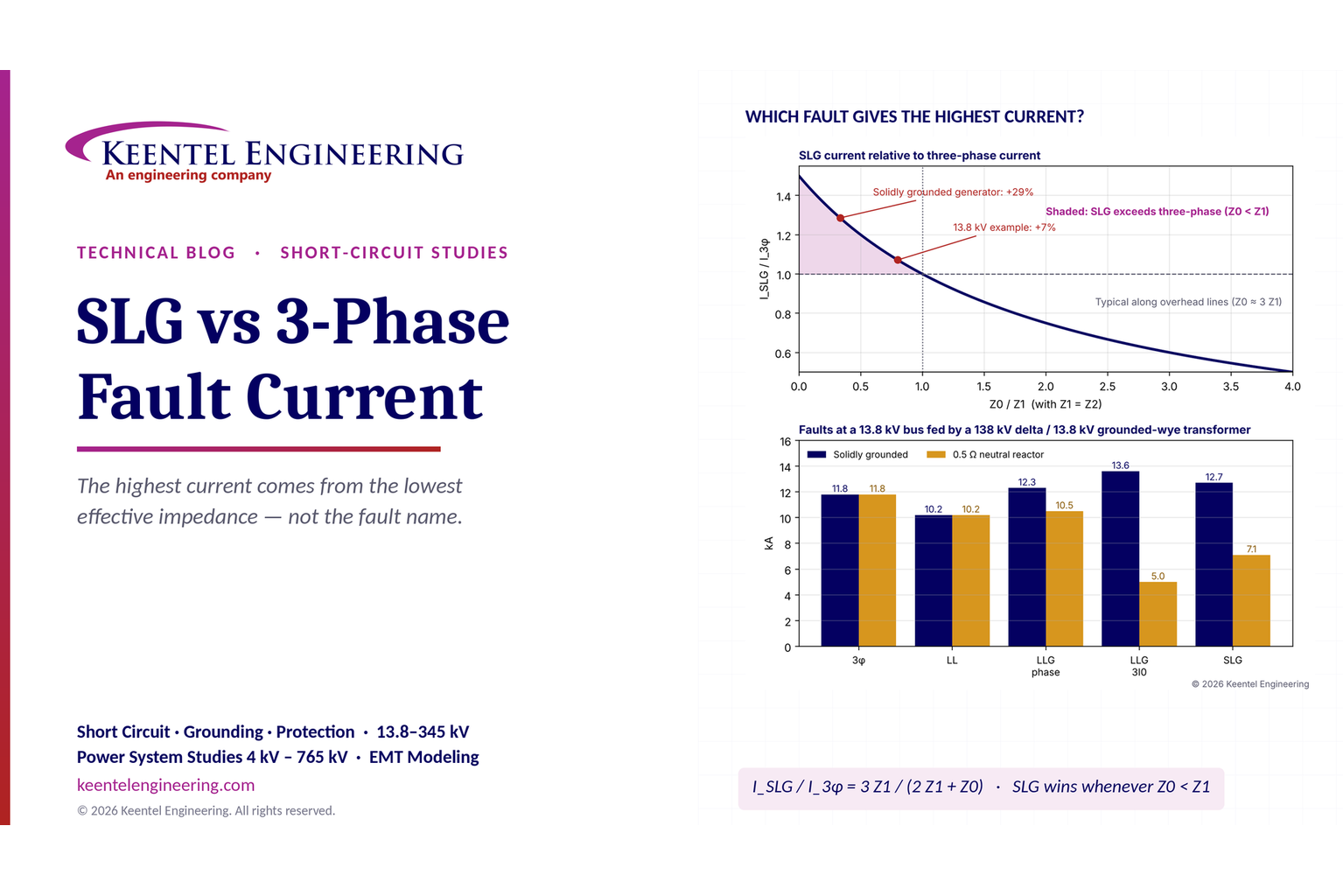
Learn which fault produces the highest current at a bus, why SLG faults can exceed three-phase faults, and how symmetrical components determine fault duty.
By SANDIP R PATEL
•
October 11, 2026
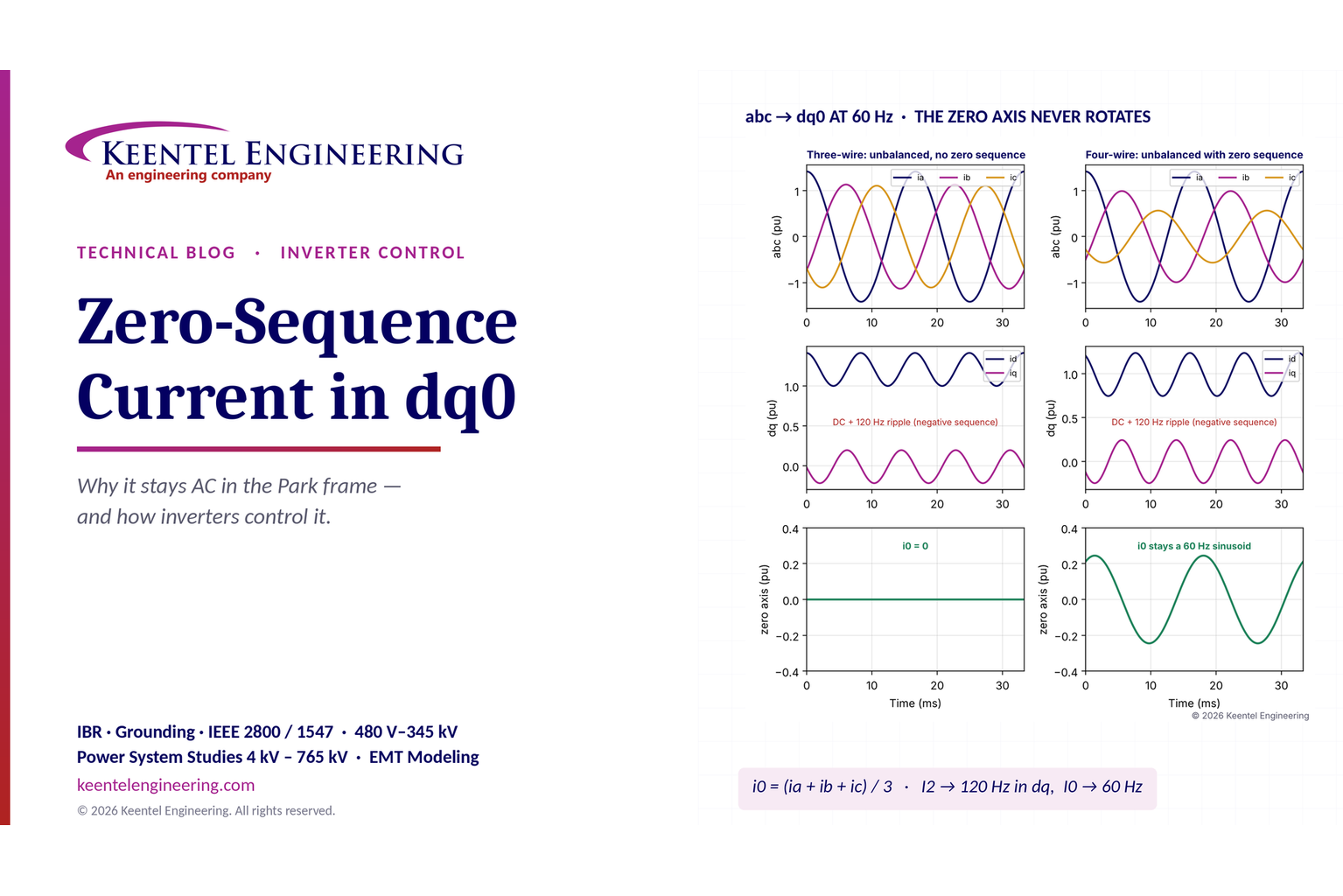
Learn why zero-sequence current pulsates in the dq0 frame, how Park's transformation works, and how inverter controls handle unbalance and ground faults.
By SANDIP R PATEL
•
October 11, 2026
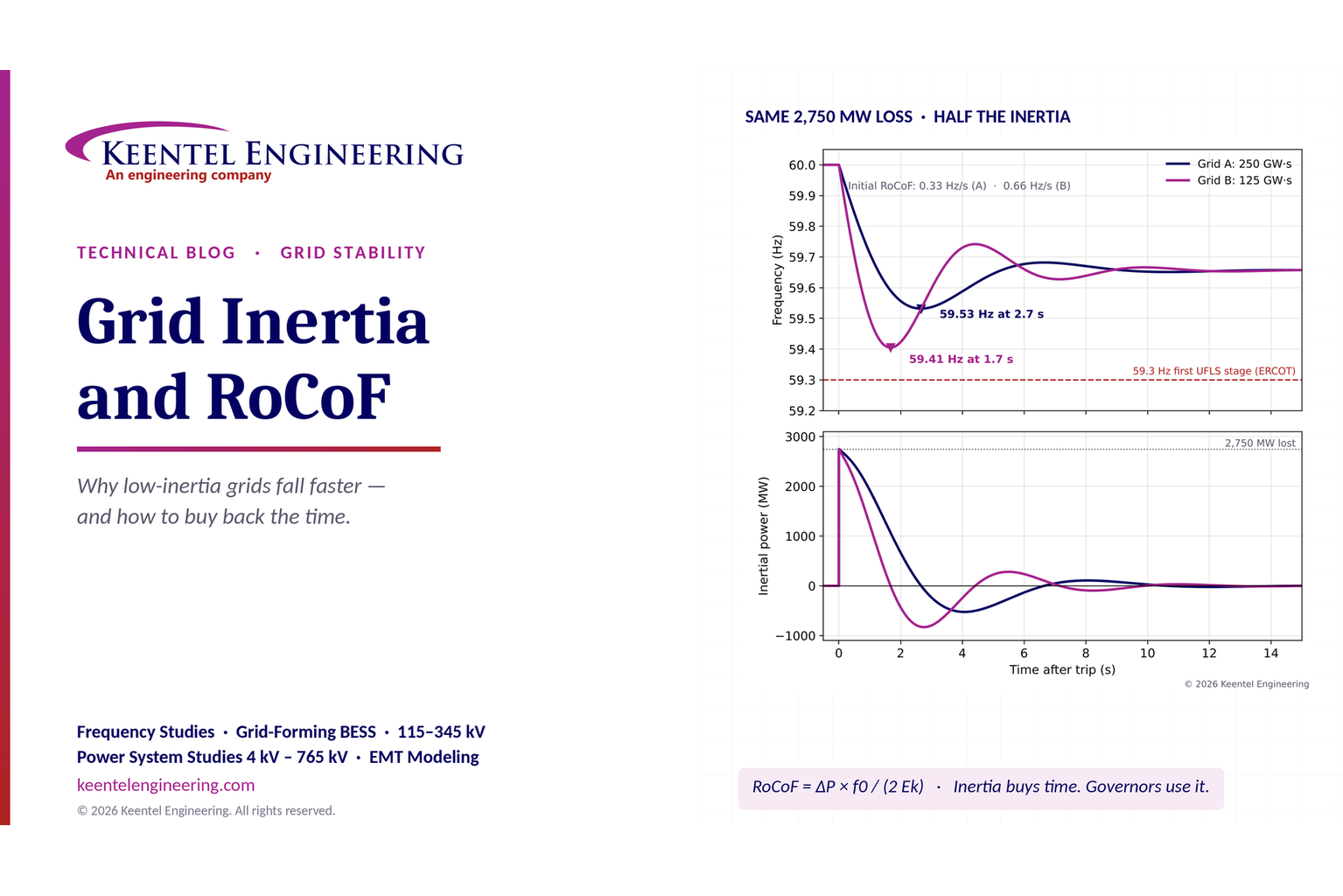
Explore grid inertia, RoCoF and frequency response, with swing equation calculations, frequency nadir analysis and US power system simulation examples.
By SANDIP R PATEL
•
October 11, 2026
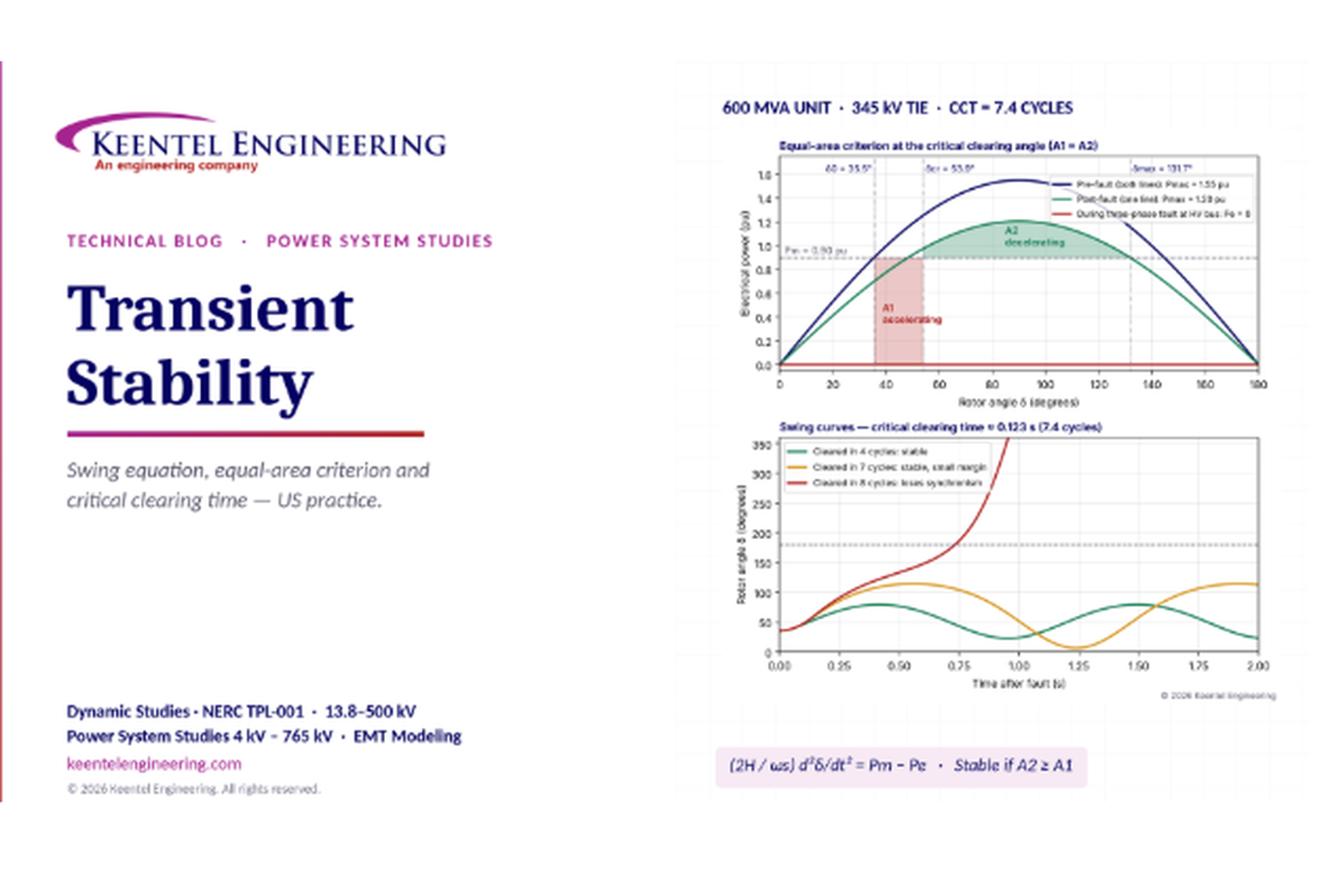
Learn transient stability analysis, swing equation, equal-area criterion and critical clearing time with a 345 kV worked example and NERC TPL-001 guidance.
By SANDIP R PATEL
•
October 11, 2026
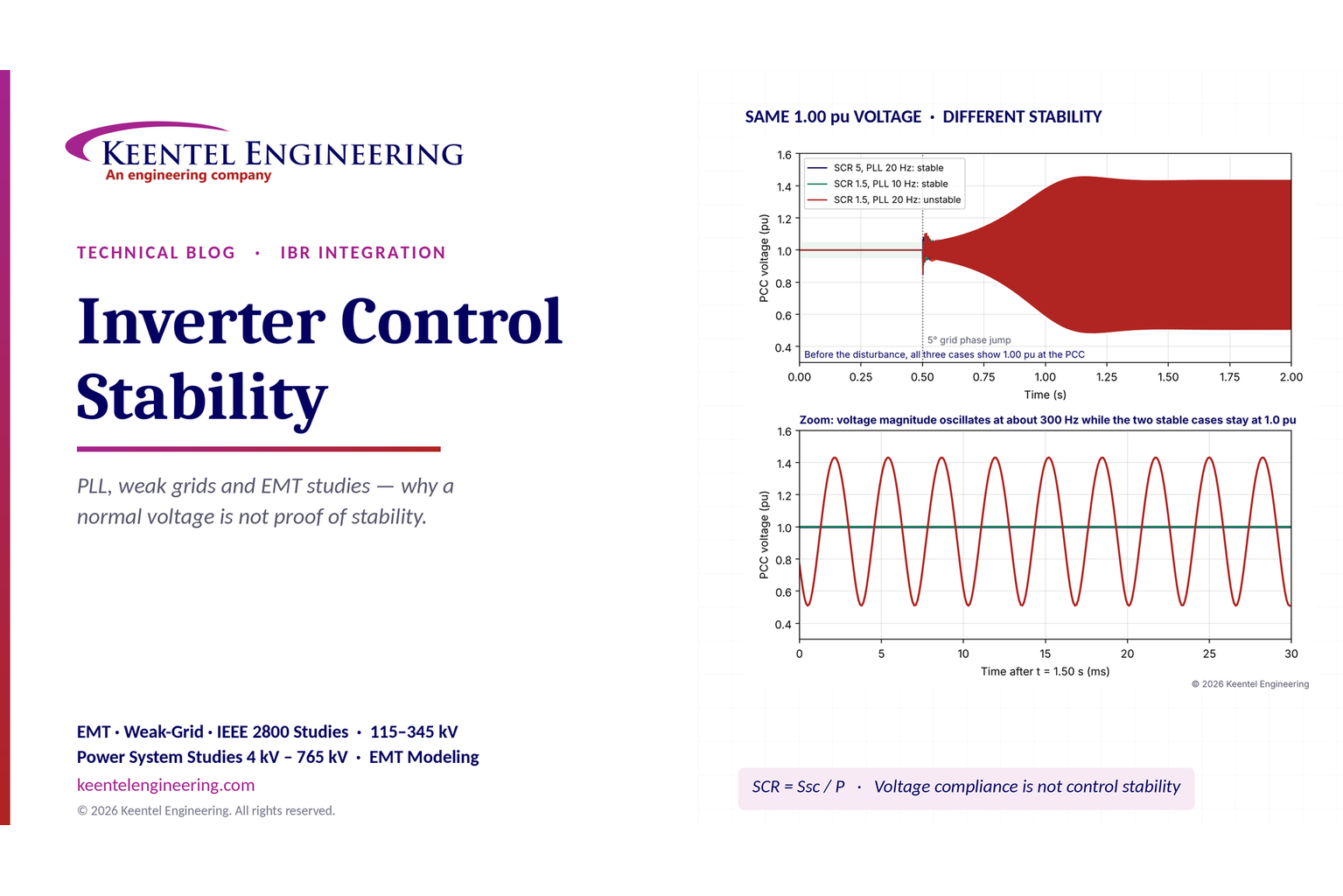
Learn why inverter controls become unstable in weak grids, how PLL bandwidth and SCR affect stability, and how PSCAD EMT studies identify and mitigate oscillations.
By SANDIP R PATEL
•
October 11, 2026
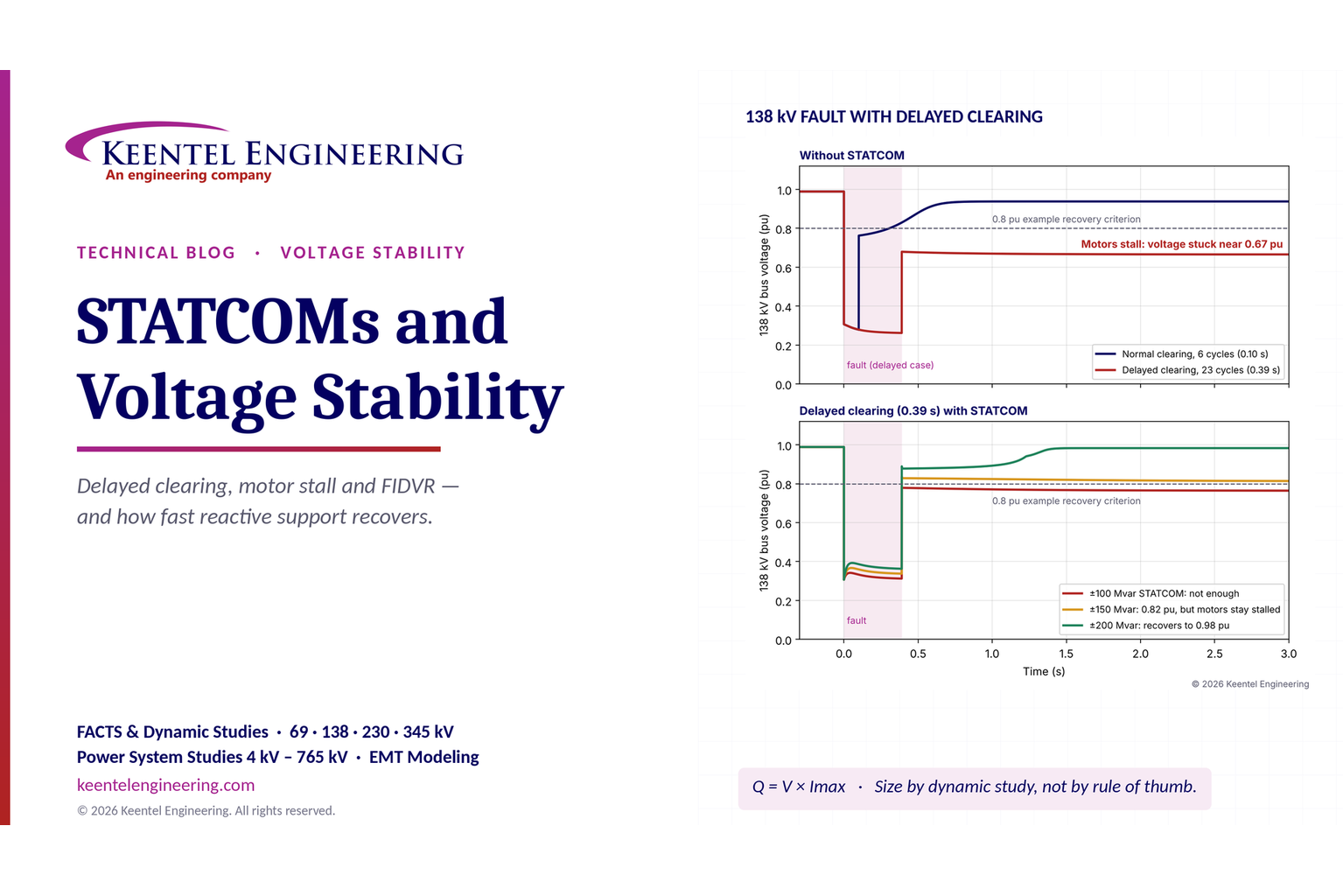
Learn how STATCOMs improve voltage stability and prevent FIDVR. Explore reactive power sizing, delayed fault clearing, NERC criteria and 138 kV simulation results.
By SANDIP R PATEL
•
October 10, 2026
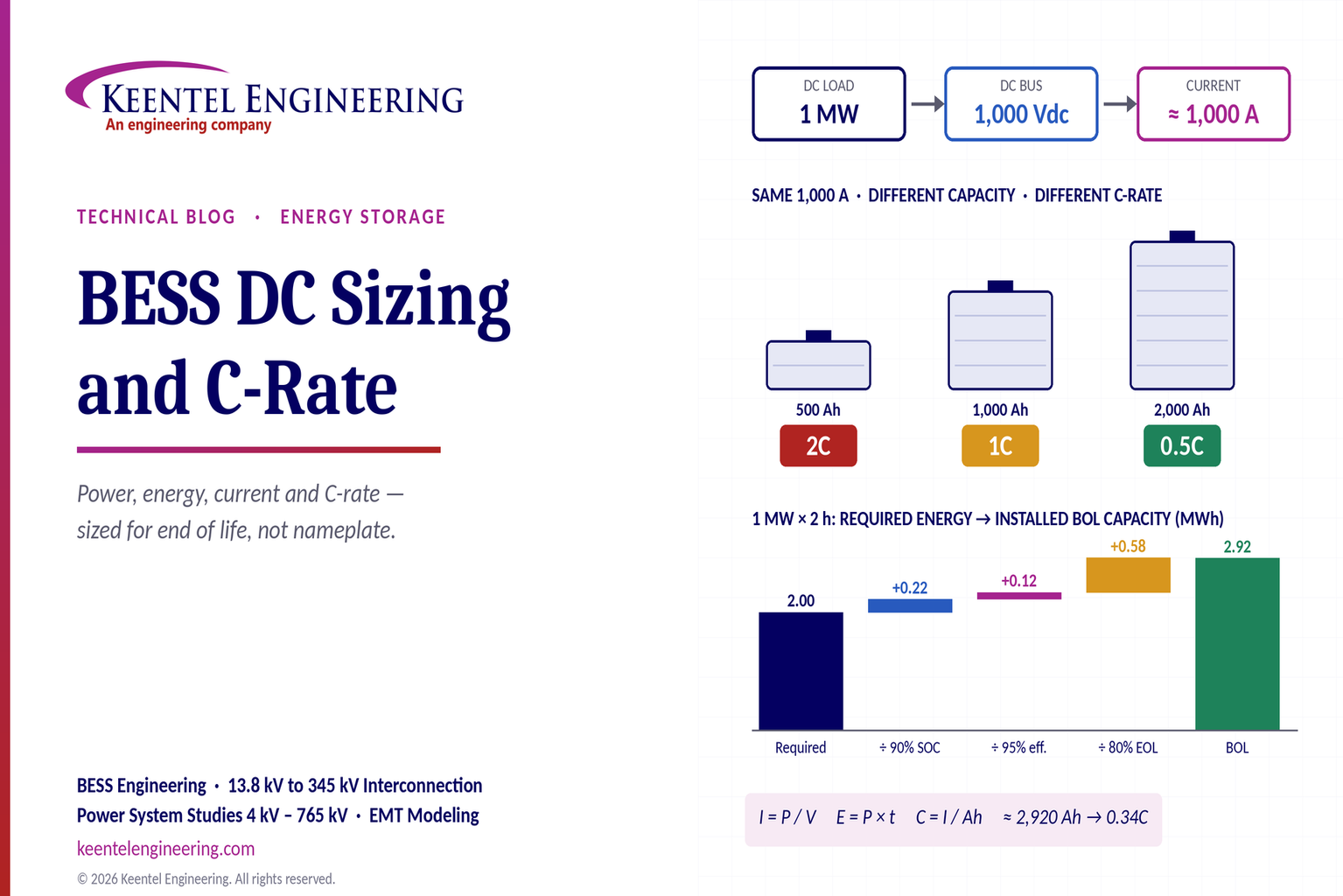
Learn BESS DC sizing with power, energy, current and C-rate calculations, battery losses, degradation and a 100 MW/400 MWh utility-scale example.
By SANDIP R PATEL
•
October 10, 2026
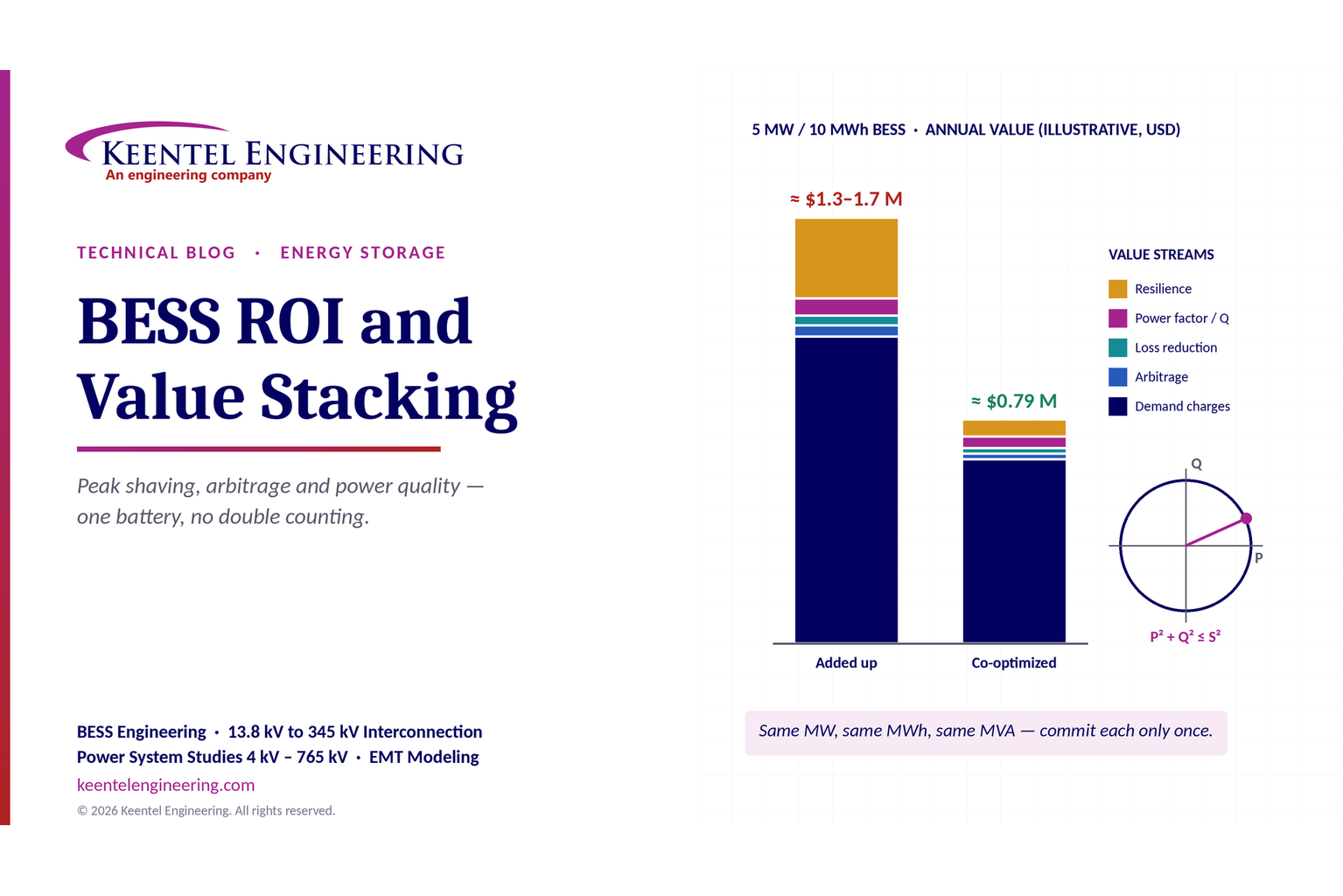
Learn how BESS ROI is calculated using peak shaving, energy arbitrage, power quality and battery storage economics, with a practical 5 MW/10 MWh example.