A Coordinated Electric System Interconnection Review—the utility’s deep-dive on technical and cost impacts of your project.
Challenge: Frequent false tripping using conventional electromechanical relays
Solution: SEL-487E integration with multi-terminal differential protection and dynamic inrush restraint
Result: 90% reduction in false trips, saving over $250,000 in downtime
The three operating regions you have to design to
| Device | Output vs voltage | Response | Best suited to | Main limitations |
|---|---|---|---|---|
| Mechanically switched capacitor or reactor | Proportional to voltage squared | Seconds; discrete steps; limited switching operations per day | Steady-state reactive supply, voltage profile, loss reduction | No dynamic capability; step voltage change on switching; capability collapses when most needed |
| Static var compensator | Capacitive branches proportional to voltage squared | A few cycles; continuously controllable | Continuous control where cost matters and deep voltage support is not the driver | Square-law capability loss; harmonic filters are part of the plant and interact with the network |
| STATCOM | Approximately proportional to voltage — constant current capability | One to two cycles closed loop; converter response faster still | Voltage stability margin, weak interconnections, fast disturbance recovery, flicker and unbalance compensation | Higher capital cost; converter losses; adds a converter and its control dynamics to the network |
| Synchronous condenser | Governed by machine capability and excitation | Excitation response in the hundreds of milliseconds; inherent inertial response instantaneous | System strength and inertia, short-circuit contribution, black start support | Rotating plant with maintenance and losses; slower controlled response than a converter |
| STATCOM with energy storage | Reactive as a STATCOM, plus real power within the storage rating | As STATCOM for reactive; real power limited by storage | Where a real power deficiency is part of the problem | Cost and complexity of the storage; different failure and maintenance profile |
Continuing Technical Training in Power Engineering: From Intern to Principal
September 24, 2026 | Blog
Why the Standards Change Faster Than the Physics, What a Free Learning Hub Covers and What It Cannot, and Why the Senior Engineer Is the One Most at Risk of Falling Behind
1. Executive Summary
Power system engineering has a peculiar property. The physics does not change Maxwell's equations are where they were a century ago, a synchronous machine still behaves like a synchronous machine, and a travelling wave still travels at close to the speed of light. What changes, constantly and substantially, is everything built on top of the physics: the standards, the reliability requirements, the interconnection rules, the market protocols, the modelling expectations and the equipment itself.
That is why an engineer in this field cannot coast on a degree. The fundamentals earned at university remain true for a whole career. The framework in which those fundamentals are applied turns over roughly every five years, and in the last eight years it has turned over faster than that.
This paper sets out why continuing technical training is a structural requirement in power engineering rather than a benefit, how the requirement differs at each stage of a career, and how Keentel Engineering organises it. Five findings frame the argument.
First, the pace of change is measurable. Between 2018 and 2026 there were at least thirteen material changes to the standards, orders and market rules a United States power engineer works under — roughly one and a half a year. An engineer whose knowledge was last refreshed in 2018 has missed the first transmission-level standard for inverter-based resources, a complete rewrite of interconnection queue processing, the arrival of ride-through and disturbance-monitoring reliability standards, two editions of the National Electrical Code, and the emergence of large load interconnection as a discipline that did not previously exist.
Second, the decay is faster than it feels. Treating technical currency as decaying with a half-life of about five years — an approximation, but a useful one — an engineer who stops learning retains about half their currency after five years, a quarter after ten and six per cent after twenty. Nothing about that process is perceptible day to day, which is precisely what makes it dangerous.
Third, the return on training is front-loaded. The difference between zero formal training and fifteen hours a year is large. The difference between forty hours and eighty is small. Most of the benefit is bought by the first modest commitment, which is convenient, because fifteen hours is 0.7 per cent of a working year — about four days per decade.
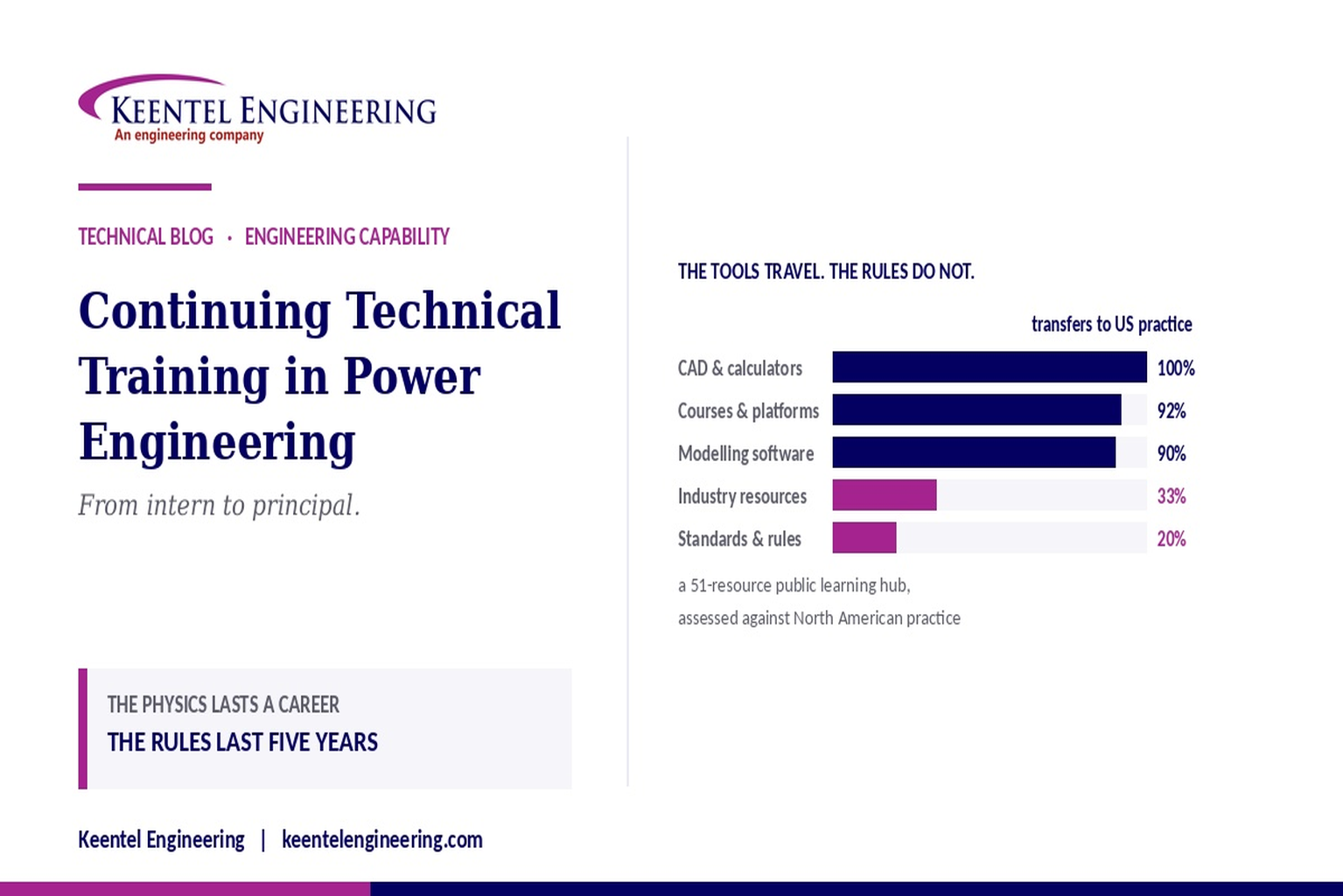
Fourth, free learning resources are excellent and incomplete, and they are incomplete in a specific and predictable way. Reviewing a well-constructed public learning hub of fifty-one resources against United States practice, about ninety per cent of the modelling software entries and all of the computer-aided design entries transfer unchanged, while only twenty per cent of the standards and regulatory entries do. The tools travel. The rules do not. Any firm relying on public resources has to supply the regulatory half itself.
Fifth, the senior engineer is the one most at risk. Training budgets and mentoring attention flow naturally toward juniors, who visibly need them. The engineer with twenty years of experience is assumed to be current, is too busy to attend anything, and is the person whose seal goes on the drawing. That combination — highest authority, lowest refresh rate, least supervision is where the expensive failures concentrate.
The sentence worth taking from this
In power engineering the fundamentals last a career and the framework lasts about five years. A degree buys the first. Only deliberate, scheduled, continuing training buys the second.
And the cost of buying it is roughly one avoidable rework every four engineer-years.
2. Why Power Engineering Cannot Coast
Every technical profession claims to change quickly. Power engineering has a specific structural reason why the claim is true here, and it is worth stating precisely rather than generally.
Three layers, three different lifetimes
| Layer | Examples | How long it stays true | Where it is learned |
|---|---|---|---|
| Physics and fundamentals | Symmetrical components, travelling waves, machine theory, electromagnetics, thermodynamics of losses | Indefinitely | University, textbooks, first principles |
| Engineering method | Short circuit calculation, protection coordination, insulation coordination, load flow, grounding design | Decades, with refinement | University, early career, mentored work |
| Framework | Reliability standards, interconnection rules, market protocols, codes, modelling requirements, equipment ratings | Three to seven years | Continuing training and active practice only |
The first two layers are why a good engineer from 1995 can still reason correctly about a fault. The third layer is why that same engineer cannot, without updating, file a compliant interconnection application, produce an acceptable electromagnetic transient model, or answer a reliability standard audit.
The framework layer is also the layer that clients pay for. A client rarely asks whether the engineer understands symmetrical components; they assume it. What they are buying is a deliverable that satisfies a specific, current, external requirement and the value of that deliverable is zero if the requirement has moved.
The asymmetry of being out of date
There is a further asymmetry that makes this field unusual. In many disciplines, being slightly out of date produces a slightly worse result. In power engineering it frequently produces a result that is rejected outright.
An interconnection study prepared to the previous queue process is not a slightly weaker study; it is a study the transmission provider will not accept. A model that does not meet the current submission checklist is not a slightly inferior model; it is returned. A protection setting derived against a superseded standard is not marginally non-compliant; it is a finding. The failure mode is binary, and that is why the field rewards currency so heavily.
What this means for a firm
Technical training in power engineering is not a staff benefit and it is not a morale exercise. It is the maintenance programme for the firm's primary asset.
A firm that does not schedule it is running that asset to failure and will discover the condition the same way anyone discovers a maintenance failure — during an event, at the worst moment, in front of a client.
3. What Actually Changed Between 2018 and 2026
The argument above is easy to assert. The following table makes it concrete. Each entry is a change that materially altered how a United States power engineer does the work, in the sense that a deliverable prepared without knowledge of it would be deficient.
| Year | Change | Who it affects |
|---|---|---|
| 2018 | IEEE 1547 revised — distributed energy resource interconnection rewritten around ride-through, voltage and frequency support and abnormal operating performance categories | Anyone doing DER interconnection or inverter settings |
| 2018 | IEEE 1584 revised — the arc flash incident energy calculation method substantially changed | Anyone producing arc flash studies or labels |
| 2020 | FERC Order 2222 — distributed energy resource aggregation into wholesale markets | DER developers, aggregators, market interface design |
| 2022 | IEEE 2800 published — the first transmission-level interconnection standard for inverter-based resources | Every utility-scale solar, wind and storage interconnection |
| 2022 | IEEE 519 revised — harmonic limits, measurement and the point of evaluation | Harmonic studies, large loads, inverter plant |
| 2023 | FERC Order 2023 — interconnection queue reform, cluster studies, first-ready first-served, penalties and deposits | Every generation interconnection in FERC jurisdiction |
| 2023 | FERC Order 901 — directed the development of reliability standards for inverter-based resources on a fixed schedule | All IBR owners and operators |
| 2023 | NFPA 70B became a standard rather than a recommended practice | Maintenance programmes, condition-based decisions, arc flash inputs |
| 2023 | NEC 2023 edition | All installation design and permitting |
| 2024 | NERC inverter-based resource registration initiative — Category 2 generator owner and operator registration | Plants previously below the registration threshold |
| 2024–25 | Ride-through and disturbance monitoring reliability standards developed for IBR | Plant protection, controls, DME and compliance |
| 2025 | Large load interconnection emerges as a distinct discipline across the ISOs and RTOs | Data centre and industrial load interconnection |
| 2026 | NEC 2026 edition; ERCOT real-time co-optimisation; ERCOT large load protocol development | Installation design, ERCOT market participants, large loads |
Thirteen material changes in eight years is about one and a half per year. That is the rate at which the framework layer turns over, and it is why a five-year half-life is a reasonable working assumption rather than a pessimistic one.
It is worth reading the table a second way. An engineer who was fully current in 2018 and did nothing deliberate since has missed every row of it. Nothing in their daily work would have told them so, because the older knowledge continues to feel correct — it simply stops being sufficient.
4. The Half-Life of Technical Currency
A useful way to think about technical decay is to borrow the form of radioactive decay: the currency of what an engineer knows halves over some characteristic period. The half-life is not a measured physical constant and different disciplines are quoted at anywhere from three to ten years. For the framework layer of power engineering, five years is a defensible working figure and the table below shows why the choice does not much matter.
| Years without deliberate updating | Half-life 4 years | Half-life 5 years | Half-life 7 years |
|---|---|---|---|
| 0 | 100% | 100% | 100% |
| 2 | 71% | 76% | 82% |
| 5 | 42% | 50% | 61% |
| 10 | 18% | 25% | 37% |
| 15 | 7% | 12% | 23% |
| 20 | 3% | 6% | 14% |
Whichever column is chosen, the shape is the same and the conclusion is the same. Ten years of coasting costs most of the framework knowledge. Twenty years costs nearly all of it.
What continuous training does to the curve
The same arithmetic can be run in the other direction. If currency decays at a rate set by the half-life and is refreshed at a rate set by deliberate training, the level settles where the two balance. The precise numbers depend on assumptions that are not worth defending in detail; the shape is what matters.
| Formal training per year | As a share of a 2,080-hour year | Relative contribution to currency |
|---|---|---|
| 0 hours | 0% | None — decay only |
| 8 hours | 0.4% | Meaningful |
| 15 hours | 0.7% | Most of the available benefit |
| 24 hours | 1.2% | Comfortable |
| 40 hours | 1.9% | Strong |
| 80 hours | 3.8% | Diminishing returns |
Two things follow. The curve is steep at the bottom and flat at the top, so the important threshold is not the difference between forty hours and eighty — it is the difference between zero and fifteen. And fifteen hours is 0.7 per cent of a working year, which is about four days per decade. The obstacle to continuing training has never been the time. It is that nobody scheduled it.
One caveat is worth stating, because the table understates reality. Formal training is not the only refresh mechanism, and for most practising engineers it is not the largest one. Project work on current requirements, design review, and the discipline of answering a client's question correctly all refresh currency continuously. The table isolates the formal component because that is the component a firm can schedule; the informal component is real but it only covers what the firm happens to be working on, and it therefore narrows over time rather than broadening.
5. Five Levels of Capability, and What Each Requires
Discussions about training usually founder because "training" covers five different things that are acquired in different ways and cannot substitute for one another. Separating them makes the rest of this paper tractable.
| Level | What it is | How it is acquired | Can a course provide it? |
|---|---|---|---|
| 1. Fundamentals | Circuit theory, symmetrical components, machine theory, electromagnetics, control | University, textbooks, structured self-study | Yes — and free platforms do this very well |
| 2. Tool proficiency | Driving PSCAD, PSS®E, ETAP, PowerFactory, CDEGS, ASPEN, MATLAB competently | Vendor training, student licences, guided practice on real cases | Partly — a course teaches the buttons, not the modelling judgement |
| 3. Standards and regulatory literacy | Knowing what applies, what it requires, which edition governs and how to read it | Deliberate reading, committee participation, audit and submission experience | Rarely — very little of this is taught anywhere |
| 4. Domain depth | Protection philosophy, insulation coordination, grounding, harmonics, EMT, machine behaviour | Years of focused work in one area, under review | Partly — courses give structure, depth comes from cases |
| 5. Judgement | Knowing what matters, what to check, when a result is wrong, what to escalate, what to refuse | Mentored project work, being reviewed, reviewing others, seeing failures | No |
The hierarchy is not a ladder that people climb once. A senior protection engineer moving into inverter-based resource compliance re-enters at level three and level four for that subject, regardless of twenty years of level five judgement in protection. This is why seniority does not protect against obsolescence in a new subject area, and why the arrival of a new discipline large load interconnection is the current example resets a great many experienced engineers to a beginner position in that specific domain.
The substitution error
The most common mistake in training planning is treating levels as interchangeable — sending an engineer on a software course when the gap is standards literacy, or assuming that reading a standard produces modelling judgement.
Diagnose the level first. A tool course will not fix a level three gap, and no amount of level one and two material produces level five.
6. What a Free Learning Hub Covers, and What It Cannot
Excellent free and low-cost learning resources exist, and any engineer who has not used them is leaving value on the table. Curated collections of them circulate regularly and they are genuinely useful. They are also systematically incomplete, and the incompleteness follows a pattern worth understanding before relying on one.
A quantified look
Taking a well-constructed public learning hub of fifty-one resources, organised into standards, training platforms, modelling software, computer-aided design tools, industry resources and online calculators, and asking of each entry whether it transfers directly to United States practice:
| Category | Entries | Transfer directly | Need a North American substitute |
|---|---|---|---|
| Computer-aided design tools | 5 | 100% | 0 |
| Online tools, calculators and data | 5 | 100% | 0 |
| Training platforms and courses | 12 | 92% | 1 |
| Power system modelling software | 10 | 90% | 1 |
| Industry and professional resources | 9 | 33% | 8 |
| Standards and technical references | 10 | 20% | 8 |
| Total | 51 | 69% | 16 |
The pattern is clean and it generalises. Mathematics, software and technique are international; a load flow solves the same way everywhere and a partial discharge measurement means the same thing on either side of an ocean. Standards, regulation, market rules and grid codes are national, and frequently regional within a nation.
So a public hub, wherever it originates, will reliably cover levels one and two of the capability hierarchy, will partly cover level four, and will barely touch level three. Level five it cannot touch at all.
What the gap means in practice
For an engineer this means free resources are the right way to build fundamentals and tool skills and the wrong place to look for what actually governs a deliverable. For a firm it means the regulatory half of the training programme has to be supplied internally, because nobody else is going to supply it — and it is the half on which the acceptability of the work depends.
Section 15 sets out the North American substitutions explicitly.
7. The Intern: Twelve Weeks That Decide a Direction
An internship is too short to produce a competent engineer and long enough to produce a decided one. The realistic objective is not output; it is orientation, plus one piece of work the intern genuinely owns.
What an internship should actually deliver
- Exposure to what the work is. Most engineering students have no accurate picture of what a power systems consultant does all day. Two weeks of sitting in on real reviews corrects this faster than any description.
- One tool, properly. Not five superficially. An intern who leaves able to build, run and interrogate a load flow case competently has something real; one who has watched demonstrations of six packages has nothing.
- One deliverable they own end to end, however small — a calculation, a drawing markup, a data extraction, a literature review — checked and returned with comments, and then corrected. The correction cycle is the learning; the first draft is not.
- An introduction to the idea that standards govern. Most students have never opened one. Being asked to find the answer to a specific question inside a specific standard, and to cite the clause, is a formative exercise.
- A named mentor who is accountable for their experience, not a rotating series of whoever is free.
What an internship should not be
It should not be unsupervised. It should not be a drawer of leftover tasks nobody wanted. And it should not be a twelve-week software tutorial, because tool proficiency without any exposure to why the model is being built produces an operator rather than an engineer.
One further point deserves emphasis. An intern is the cheapest and most honest source of feedback a firm will ever get on its own documentation. A newcomer trying to follow an internal procedure finds every gap in it within a week. That feedback is worth collecting formally rather than losing when they leave.
8. The Entry-Level Engineer: Years One to Three
The first three years are where the capability hierarchy is climbed fastest and where the habits that determine a career are set. The technical content matters less than the habits, which is not an argument for neglecting the content.
The technical programme
| Year | Focus | Target outcome |
|---|---|---|
| Year 1 | Two tools to genuine competence; the fundamentals of one domain; how the firm's deliverables are structured; how to document work so somebody else can check it | Produces checkable work in a familiar case without supervision at every step |
| Year 2 | Standards literacy in one domain; participation in real submissions; first exposure to client interaction; first review of somebody else's work | Can find and apply the governing requirement without being handed it |
| Year 3 | Depth in the chosen domain; an unfamiliar case handled end to end; FE examination completed and EI or EIT status obtained where not already | Can take an unfamiliar problem in a familiar domain and produce a defensible answer |
The habits
- Writing down assumptions as they are made, not reconstructing them afterwards. This single habit distinguishes engineers whose work can be checked from those whose cannot.
- Sanity-checking every computed result by an independent route before believing it — an order of magnitude, a hand calculation, a limiting case.
- Reading the standard rather than the summary of the standard, at least once per subject, so that the shape of the document is known even if the detail is looked up later.
- Asking early rather than late. The cost of a question rises sharply with the amount of work built on top of the wrong assumption.
- Treating a review comment as information rather than as criticism, and treating the absence of review comments as a warning sign rather than as praise.
The FE and the path to licensure
The Fundamentals of Engineering examination is best taken as close to graduation as possible, while the material is fresh — and that is an argument every firm should make to every new graduate in their first week, because the difficulty of passing it rises measurably with every year of delay. Engineer-in-training or engineer-intern status, obtained early, starts the clock on the experience requirement that licensure depends on.
9. The Mid-Career Engineer: Years Four to Ten
This is the period in which an engineer becomes genuinely useful and, paradoxically, in which the training risk first appears. The work becomes productive, the schedule fills, and the incentive to spend a day learning something that is not on this week's project weakens.
The three transitions
Three distinct changes happen in this period and each has a training implication.
From doing to owning. The engineer stops executing defined tasks and starts owning a scope. That requires understanding the requirement rather than the instruction — a level three capability, and the first point at which standards literacy becomes load-bearing rather than optional.
From one domain to two. Almost every useful senior engineer has depth in a second domain, and the second is acquired in this period or usually not at all. Choosing it deliberately is better than acquiring one by accident from whatever projects arrived.
From being reviewed to reviewing. Reviewing another engineer's work is the most underrated training activity available, because it forces the reviewer to articulate what "correct" means. An engineer who has never reviewed has never had to make their own standards explicit.
What to protect against
The specific failure mode in this period is narrowing. The engineer becomes very strong in the work the firm happens to sell and loses breadth everywhere else. It is invisible while the market holds and expensive when it shifts which, in this industry, it does about every five years.
The counter is deliberately allocating part of the training year to something the current project list does not require. It feels like the least urgent thing on the calendar and it is the reason an engineer is still employable when the project list changes.
10. The Senior Engineer: Why the Top Decays Fastest
This is the section that matters most and the one most often left out of a discussion about training, because training is culturally associated with being junior.
The structural problem
Three things are true simultaneously about a senior engineer, and their combination is the problem.
| Fact | Consequence |
|---|---|
| They have the most authority — their judgement settles questions and their seal goes on the deliverable | Their errors propagate furthest and are least likely to be caught downstream |
| They are the busiest — the most billable, the most in demand, the most likely to cancel a training day for a client call | Their refresh rate is the lowest in the firm |
| They are assumed to be current — nobody checks a principal's knowledge of a new standard | Their gaps are the least visible, including to themselves |
Highest authority, lowest refresh rate, least supervision. Any maintenance engineer reading that description recognises it immediately: it is the definition of a critical asset with no inspection programme.
The particular trap: strong fundamentals as a substitute
A senior engineer's fundamentals are genuinely excellent, and that is what makes the trap work. Deep level one and level two knowledge allows an engineer to reason fluently and confidently about a problem whose governing framework has changed underneath them. The reasoning is correct. The conclusion is inadmissible. And because the reasoning is correct, the engineer has no internal signal that anything is wrong.
This is a different failure from ignorance and it needs a different remedy. An engineer who knows they do not know something will look it up. An engineer whose excellent knowledge is quietly out of date will not, because nothing prompts them to.
What actually works
- Structural exposure rather than voluntary attendance. Assigning a senior engineer to present a new standard internally guarantees they read it, and turns their update into everyone else's update.
- Reverse mentoring on tools. The junior engineer is usually better with the current software version, and an explicit arrangement to that effect removes the awkwardness of a principal asking.
- Committee and working group participation. It is the highest-value training available to a senior engineer because it exposes them to changes before publication rather than after, and it is one of the few activities that scales both capability and reputation at once.
- Being reviewed. A principal whose work nobody reviews has left the system. Peer review across firms, or formal internal review by another licensed engineer, restores the check.
- Treating a new discipline honestly. Twenty years of protection experience does not confer competence in inverter-based resource compliance, and saying so plainly is a mark of seniority rather than a concession.
The uncomfortable question
When did the most experienced engineer in the organisation last sit through training they did not deliver?
If the answer is measured in years, the firm has an unmonitored critical asset — and it is the one with signature authority.
11. The Seal: Competence as a Legal Obligation
Everything above is an argument about capability and commercial risk. There is also a narrower argument, which is that for a licensed engineer, maintaining competence is not discretionary.
The rules of professional conduct adopted by state licensing boards, and the model language they derive from, require in substance that a licensee practise only in areas of competence, that competence be maintained, and that the licensee take professional responsibility for work they seal. The specific wording varies by jurisdiction; the substance is consistent across all of them.
| Obligation | What it means in practice |
|---|---|
| Practise only within your area of competence | A licensed engineer may not seal work in a discipline they are not competent in, regardless of how many years they hold in another discipline |
| Maintain competence | Competence is not a permanent state established at licensure; it is a condition to be maintained against a moving standard of practice |
| Take responsibility for sealed work | The seal is a personal attestation, and the defensibility of it rests on the engineer having been current with the requirements that governed the work |
| Be truthful about qualifications | Including being explicit when a subject falls outside the engineer's competence |
The practical reading of this is direct. The standard against which an engineer's work will be judged, whether by a board, a client or a court, is the standard of practice at the time the work was performed not the standard of practice when the engineer learned the subject. Continuing training is how the second is kept aligned with the first, and a documented training record is part of how an engineer demonstrates that it was.
This paper is not legal advice and the governing rules are those of the boards an engineer is licensed by. The point is only that the obligation exists and is not a matter of preference.
12. PDH and Licensure: What the Law Requires
Most, though not all, state boards attach an explicit continuing education requirement to licence renewal, expressed in professional development hours. The requirements vary considerably in quantity, cycle and subject content, and a firm operating in several states has to plan against the union of them rather than any single one.
The table below uses the four states in which Keentel Engineering maintains offices. The values are representative and are shown to illustrate the structure of the problem. Board rules change, and every engineer must verify the current requirement with each board they are licensed by.
How the multi-state arithmetic actually works
The structure is not additive, and this is the part that is routinely misunderstood.
Most boards accept the same qualifying activity toward multiple licences, so the total number of hours required is set by the strictest state rather than by the sum. Across the four states above, that is fifteen hours per year.
The subject requirements do not work the same way. Those are the union of every state's specific demands, because a Florida laws and rules course does not satisfy a Texas ethics requirement and neither is satisfied by general technical content. So a single fifteen-hour annual plan satisfies all four licences only if it happens to contain a Florida laws and rules component, an ethics component and enough qualifying technical content to make up the balance.
A firm that plans hours without planning subjects discovers this at renewal, which is the worst possible moment.
13. Software Proficiency Is Not Software Literacy
Power engineering runs on a small number of specialised software packages, and a firm's training conversation tends to start and finish with them. That is a reasonable starting point and a poor stopping point.
Three distinct competencies
| Competency | What it looks like | How long it takes | How it is acquired |
|---|---|---|---|
| Operating the tool | Can build a case, run it and extract results without needing help with the interface | Days to weeks | Vendor training, tutorials, student licences |
| Modelling correctly | Chooses the right model class, knows what each representation assumes and where it stops being valid | Months to years | Mentored work on real cases, with review |
| Knowing when the answer is wrong | Recognises an implausible result before anybody else does, and can say which assumption produced it | Years | Experience of being wrong, under supervision, and seeing why |
Vendor training reliably delivers the first. It sometimes gestures at the second. It cannot deliver the third, and no course anywhere can, because the third is built from a personal library of mistakes.
The specific risk of a capable tool
Modern power system software is very good, and that is the problem. It will converge, produce plots and generate a professional-looking report from a model containing a serious error. Nothing in the workflow objects. The tool has no opinion about whether the line model class suits the study, whether the arrester model was verified at the right duty, or whether the machine data corresponds to the machine.
The only defence is an engineer who holds an independent expectation of the answer before running the case. That expectation comes from fundamentals and from hand calculation — which is the real reason level one training continues to matter long after an engineer has stopped doing arithmetic by hand.
A training rule worth adopting
Every engineer learning a new analysis tool should first solve a small case by hand, then reproduce it in the software, and reconcile any difference before moving on.
The habit of holding an expectation before running a case is the single most transferable thing a modelling engineer can learn, and it does not survive being taught the buttons first.
14. Standards Literacy: The Skill Nobody Teaches
Level three of the capability hierarchy — knowing what applies, what it requires, which edition governs, and how to read it is the least taught and the most commercially decisive capability in the field. Universities do not teach it, public learning hubs barely touch it, and most firms transmit it by osmosis if at all.
What standards literacy actually consists of
- Knowing which documents exist in a domain and what each is for — a standard, a guide and a recommended practice are different things with different force.
- Knowing which edition governs a particular project, which is a contractual and jurisdictional question rather than a technical one, and knowing that the newest edition is frequently not the answer.
- Being able to read a standard structurally — finding the scope, the definitions, the normative requirements and the informative annexes, and understanding that only some of it is binding.
- Distinguishing a requirement from a recommendation from an example, which turns on specific verbs that are defined in the front matter of the document and almost never read.
- Tracking amendments, errata and corrigenda, which change requirements without changing the document number.
- Knowing where the standard stops and engineering judgement begins, because every standard has a boundary and a great deal of practice happens outside it.
How to build it deliberately
Standards literacy responds well to a simple, repeatable internal practice: one engineer takes one document, reads it properly, and presents to the group what it requires, what changed from the previous edition, and which of the firm's deliverables it touches. Half an hour of presentation costs the presenter a day of reading and gives everyone else the structure of a document they can now navigate when they need it.
Done monthly, that is twelve documents a year across a firm, and it converts an individual's reading into an organisational capability. It also produces the single most useful artefact a technical firm can own: a maintained internal register of which standards govern which deliverable, at which edition, with the date each was last reviewed.
15. North American Resource Map
Section 6 established that the standards and regulatory portion of any public learning resource is the part that does not transfer across jurisdictions. This section supplies the substitutions for United States practice. It is organised to mirror the structure such collections usually take, so that a reader holding one can translate it directly.
Regulatory and system framework
| Function | Typical international reference | North American equivalent |
|---|---|---|
| Economic regulator | National energy regulator | Federal Energy Regulatory Commission for interstate transmission and wholesale markets; state public utility commissions for retail and distribution |
| System operator and planning standards | National system operator codes | NERC reliability standards, enforced through the regional entities; ISO and RTO tariffs, planning criteria and business practice manuals |
| Connection and use of system rules | National connection code | FERC pro forma large and small generator interconnection procedures and agreements, as reformed by Order 2023; regional variations by ISO and RTO |
| Generator connection requirements | National grid code and engineering recommendations | IEEE 2800 for transmission-connected inverter-based resources; IEEE 1547 for distributed energy resources; utility-specific interconnection requirements |
| National standards body | National standards institute | ANSI, with technical content largely from IEEE, NFPA, ASTM, UL and NEMA |
| Professional institution | National engineering institution | IEEE and the IEEE Power & Energy Society; NSPE for professional practice and licensure matters |
Technical standards by subject
| Subject | Common international reference | North American equivalent |
|---|---|---|
| Harmonics and power quality | IEC 61000 series; national harmonic recommendations | IEEE 519 for limits; IEEE 1159 for monitoring; IEEE 1453 for flicker |
| Short circuit calculation | IEC 60909 | IEEE C37.010 and the ANSI C37 series; IEC 60909 also used where specified |
| Protection relays and schemes | IEC 60255 | IEEE C37 series, including C37.2 device numbers, C37.91, C37.102, C37.230 |
| High-voltage switchgear | IEC 62271 | IEEE C37.04, C37.06 and C37.09; ANSI C37.20 for metal-enclosed equipment |
| Grounding and earthing | BS EN 50522; IEC 61936 | IEEE 80 for substation grounding safety; IEEE 81 for measurement; IEEE 142 for industrial and commercial systems; NEC Article 250 |
| Cable rating | IEC 60287 | IEEE 835 ampacity tables; the Neher-McGrath method; NEC Article 310 for installations |
| Power transformers | IEC 60076 series | IEEE C57 series, including C57.12.00, C57.12.90, C57.91 and C57.152 |
| Rotating machines | IEC 60034 series | IEEE C50.12 and C50.13; NEMA MG-1; IEEE 43 and IEEE 115 |
| Insulation coordination | IEC 60071 | IEEE 1313.1 and 1313.2; IEEE C62.22 for arrester application |
| Surge arresters | IEC 60099-4 | IEEE C62.11 |
| Electrical safety at work | National construction and safety regulations | OSHA 29 CFR 1910 and 1926; NFPA 70E for workplace electrical safety; NFPA 70B for maintenance |
| Installation code | National wiring regulations | NFPA 70, the National Electrical Code; IEEE C2, the National Electrical Safety Code, for utility installations |
What transfers unchanged
For completeness, the categories that need no translation at all: the modelling software, the computer-aided design tools, the mathematics and the online calculators. A transient program is a transient program, a load flow is a load flow, and the free student and academic licences offered by the major vendors are available internationally. Open-source packages, university course material from any country, and the research literature are equally portable.
The practical conclusion for an engineer holding any curated learning collection is therefore simple: keep the software column, keep the courses column, keep the calculators, and replace the standards and regulatory columns entirely.
16. Mentorship, Review and the Transfer of Judgement
Level five of the capability hierarchy judgement is the one no external provider sells, and it is the one that determines whether a firm's work is reliable. It transfers by only two mechanisms, and both of them are activities a firm has to deliberately create time for.
Mentorship
Effective technical mentorship is more specific than the word suggests. It is not career advice and it is not availability. It is an experienced engineer explaining, on a live problem, why they are doing what they are doing which assumption they are worried about, what they expect the answer to be before they compute it, and what would make them abandon the approach.
That narration is the transfer. An engineer who watches a senior colleague produce a correct answer learns almost nothing; an engineer who hears the reasoning, including the discarded branches, learns the method.
Review as the principal training mechanism
Technical review is usually justified as quality control, and it is. It is also the most efficient training mechanism a firm has, and it trains in both directions.
| Direction | What is learned | Why it works |
|---|---|---|
| Being reviewed | Where one's own reasoning is weak, which assumptions were unstated, what a defensible deliverable looks like | Specific, immediate, about work the engineer cares about |
| Doing the reviewing | What "correct" means, articulated explicitly; exposure to approaches other than one's own | Forces the reviewer to make their own internal standards explicit, which is the step that converts habit into knowledge |
| Reviewing upward | The senior engineer receives a check they otherwise would not; the junior sees senior-level work closely | Restores the missing inspection on the firm's highest-authority output |
The third row is the one most firms omit and the one section 10 argues is most needed. It requires a culture in which a junior engineer can raise a question about a principal's work without social cost, and that culture is created by principals visibly asking for it rather than by policy.
Learning from what went wrong
The most valuable training material any firm owns is its own record of errors the study that had to be reworked, the comment that came back from a reviewer, the assumption that turned out to be wrong. Most of it is never written down, because writing it down is uncomfortable.
A firm that keeps a plain internal record of technical findings and what caused them, discussed without blame, converts single incidents into organisational knowledge. It is the cheapest training available and the hardest to start.
17. Building a Training Year That Survives a Busy One
Every firm intends to train. The training is the first thing cancelled when a deadline moves, and the deadlines always move. A programme that only works in a quiet year is not a programme. The following structure is designed to survive a busy one.
Principles
- Schedule it as work, in the calendar, with the same status as a client commitment. Training that occupies whatever time is left over occupies no time.
- Prefer many short commitments to a few long ones. A recurring monthly hour survives a busy quarter; a week-long course does not.
- Tie part of the programme to live work, so that it pays for itself immediately and is therefore hard to cancel.
- Make one person accountable for the plan existing and being tracked, or it will not be.
- Record hours as they are earned, not at renewal. Reconstructing a year of professional development hours from memory is unpleasant and occasionally impossible.
A workable annual shape
| Component | Cadence | Hours per year | What it covers |
|---|---|---|---|
| Internal standards session — one engineer presents one document | Monthly, one hour | 12 | Standards literacy; the level three gap public resources leave |
| Ethics and state laws and rules | Annually | 2–5 | Board subject requirements across all states of licensure |
| Tool or vendor training | As needed, one or two per year | 8–16 | New software versions, new modules, new analysis types |
| Conference, committee or working group | One per year minimum for senior staff | 8–24 | Changes before publication; professional network; reputation |
| Structured self-study on a chosen subject | Continuous, with a defined objective | 10–20 | Deliberate breadth outside the current project list |
| Review and mentoring time | Built into every project | Not counted separately | Judgement — the level nothing else reaches |
The formal components above total roughly forty to seventy hours a year, comfortably above every state requirement in section 12 and within the range where section 4 shows returns are still strong. Review and mentoring time is deliberately not counted, because it is part of doing the work rather than an addition to it.
The tiering
The same shape is applied differently at each career stage, which is the practical answer to the question of how an intern, an entry-level engineer and a principal can all be on one programme.
| Stage | Weighting of effort | The specific risk being managed |
|---|---|---|
| Intern | Orientation and one tool; heavy supervision | Leaving with nothing they own |
| Entry level, years 1–3 | Tools and fundamentals; standards literacy beginning; FE and licensure track | Habits forming badly; unchecked work |
| Mid-career, years 4–10 | Standards literacy load-bearing; second domain; begins reviewing | Narrowing to what the firm currently sells |
| Senior | Committee participation; presenting internally; deliberate new-discipline work | Invisible obsolescence behind excellent fundamentals |
| Principal | All of the above, plus being reviewed | Unmonitored authority |
18. The Economics of Training
The case for training is usually made qualitatively, which is why it loses to a quantitative argument about utilisation. It is worth making quantitatively.
What it costs
Taking a loaded cost of engineer time of $150 per hour and an allowance of $1,500 per engineer per year for courses, materials and registrations:
| Programme | Hours | Time cost | Fees | Total per engineer | Five engineers |
|---|---|---|---|---|---|
| Statutory minimum | 15 | $2,250 | $1,500 | $3,750 | $18,750 |
| Recommended | 40 | $6,000 | $1,500 | $7,500 | $37,500 |
What not training costs
Against a billing rate of $185 per hour, a single avoidable rework — a study returned because it was prepared against a superseded requirement, a model rejected at submission, an analysis redone after a review finding:
| Rework | Unbillable cost | Equivalent in engineer-years of statutory training |
|---|---|---|
| 40 hours | $7,400 | 2.0 |
| 80 hours | $14,800 | 3.9 |
| 160 hours | $29,600 | 7.9 |
One eighty-hour rework costs approximately what it costs to train four engineers for a year. That is the whole economic argument, and it does not depend on any optimistic assumption about the value of learning only on the observation that rework is expensive and that being out of date causes it.
The calculation also omits the costs that are real and harder to quantify: the client relationship, the schedule impact on a project where the engineering was on the critical path, the opportunity cost of work not won because the firm could not credibly claim a capability, and the recruitment cost of losing an engineer to a firm that invests in them.
The framing that works with a sceptical reader
Training is not an expense set against utilisation. It is the maintenance budget for the only asset the firm has.
No power engineer would accept a client running a transformer fleet with no maintenance programme on the grounds that the units are currently working. The same argument applies to the engineers.
19. How Keentel Engineering Trains Its People
Keentel Engineering LLC is a United States power system engineering firm working across generation, transmission, substation, industrial and large-load projects, with studies from 4 kV to 765 kV. The work spans interconnection engineering, power system studies, substation and transmission design, EMT modelling, NERC compliance and owner's engineer services a range that only stays credible if the people doing it stay current across a wide and moving front.
The programme described below is how Keentel Engineering approaches that, and it follows the structure set out in this paper.
Every engineer has a written annual plan
Each engineer, from intern to principal, has a training plan for the year with defined subjects, a target hour commitment and a named person accountable for it. Hours are recorded as they are earned rather than reconstructed at renewal, and the plan is reviewed rather than filed.
Licensure and professional development hours are planned across all states
With offices in Florida, Texas, California and Maryland, Keentel Engineering plans professional development against the union of the applicable board requirements hours set by the strictest state, subjects set by all of them rather than against any single jurisdiction. Engineers on the licensure track are supported through the Fundamentals of Engineering examination, engineer-in-training registration and the Principles and Practice examination.
Standards literacy is built internally, because nobody else supplies it
The regulatory half of the capability hierarchy is the half no public resource covers, so Keentel Engineering builds it in-house: engineers take documents, read them properly, and present to the group what the document requires, what changed and which deliverables it touches. The firm maintains an internal register of which standards govern which deliverable, at which edition.
Tool training is practical and tied to live work
Engineers are trained on the analysis platforms the work actually uses electromagnetic transient and dynamic simulation, short circuit and coordination, grounding, cable and harmonic analysis with new engineers required to reconcile a hand calculation against the software before being trusted with a case. Vendor training is used for the interface; modelling judgement is built on real projects under review.
Interns leave with something they own
Interns are assigned a named mentor, one tool to genuine competence, and at least one deliverable they own end to end through a full check-and-correct cycle. They are also asked, before they leave, what was unclear about the firm's own documentation which is the most useful feedback a newcomer can give.
Senior engineers are trained deliberately and are reviewed
The risk identified in section 10 is managed explicitly rather than assumed away. Senior engineers present new standards internally, participate in industry committees and working groups, take on new-discipline work deliberately, and have their work reviewed by another licensed engineer. A principal whose work nobody checks has left the system, and Keentel Engineering does not operate that way.
Review is treated as training, not only as quality control
Every deliverable is reviewed, and the review is treated as a teaching activity in both directions. Findings are recorded and discussed without blame, so that a single incident becomes organisational knowledge rather than one engineer's private lesson.
20. Frequently Asked Questions
1. Why does power engineering need continuing training more than other disciplines?
Because of a structural split between three layers. The physics is permanent, the engineering method changes slowly, but the framework layer — reliability standards, interconnection rules, market protocols, codes and modelling requirements — turns over every three to seven years. The framework layer is also the layer clients pay for, because a deliverable's acceptability depends on satisfying a current external requirement rather than on the engineer understanding the physics.
2. How fast does technical knowledge actually go out of date?
Treating currency as decaying with a half-life of about five years, an engineer who stops updating retains roughly half their framework currency after five years, a quarter after ten and six per cent after twenty. The half-life is a useful approximation rather than a measured constant, but the conclusion holds across any plausible value: ten years of coasting costs most of it.
3. What specifically has changed recently?
Between 2018 and 2026 there were at least thirteen material changes, roughly one and a half per year: IEEE 1547 and IEEE 1584 revised in 2018, FERC Order 2222 in 2020, IEEE 2800 and a revised IEEE 519 in 2022, FERC Orders 2023 and 901 plus NFPA 70B becoming a standard and the NEC 2023 edition in 2023, the NERC inverter-based resource registration initiative and the IBR ride-through and disturbance monitoring standards in 2024 and 2025, the emergence of large load interconnection as a discipline, and the NEC 2026 edition.
4. How many hours of training per year are actually needed?
The return is front-loaded. The difference between zero and fifteen hours is large; the difference between forty and eighty is small. Fifteen hours a year is 0.7 per cent of a 2,080-hour working year — about four days per decade — and it also satisfies the strictest of the state board requirements among Keentel Engineering's four office states. Forty hours a year is a comfortable target that leaves room for depth as well as compliance.
5. Are free learning resources enough?
They are excellent for fundamentals and tool skills and systematically incomplete on standards and regulation. Assessing a public hub of fifty-one resources against United States practice, all the computer-aided design entries and online calculators transfer, 92 per cent of the course platforms and 90 per cent of the modelling software transfer, but only 20 per cent of the standards and technical reference entries do. The tools travel; the rules do not.
6. Why do standards and regulatory resources not transfer between countries?
Because mathematics, software and technique are international while standards, regulation, market rules and grid codes are national and often regional within a nation. A load flow solves identically everywhere; a connection requirement does not. Any curated learning collection therefore reflects the jurisdiction it was assembled in, and the standards column is the part that needs replacing rather than adapting.
7. What are the five levels of engineering capability?
Fundamentals; tool proficiency; standards and regulatory literacy; domain depth; and judgement. They are acquired differently and cannot substitute for one another. Free resources cover levels one and two well and level three barely. Level five — knowing what matters, what to check and when a result is wrong — comes only from mentored work, being reviewed and reviewing others.
8. Does seniority protect against obsolescence?
Not in a new subject area. A senior protection engineer moving into inverter-based resource compliance re-enters at levels three and four for that subject regardless of twenty years of judgement in protection. The arrival of a genuinely new discipline — large load interconnection is the current example — resets a great many experienced engineers to a beginner position in that specific domain, and recognising that plainly is a mark of seniority rather than a concession.
9. Why is the senior engineer most at risk?
Because three things are true at once. They have the most authority, so their errors propagate furthest. They are the busiest, so their refresh rate is the lowest in the firm. And they are assumed to be current, so nobody checks. Highest authority, lowest refresh rate, least supervision is the definition of a critical asset with no inspection programme.
10. What is the particular trap for an experienced engineer?
That excellent fundamentals allow fluent, confident reasoning about a problem whose governing framework has moved underneath them. The reasoning is correct and the conclusion is inadmissible, and because the reasoning is correct there is no internal signal that anything is wrong. An engineer who knows they do not know something looks it up; an engineer whose excellent knowledge is quietly out of date does not, because nothing prompts them to.
11. What training actually works for senior engineers?
Structural exposure rather than voluntary attendance. Assigning a senior engineer to present a new standard internally guarantees they read it and turns their update into everyone else's. Committee and working group participation is the highest-value option because it exposes them to changes before publication. Reverse mentoring on software removes the awkwardness of a principal asking a junior. And being reviewed by another licensed engineer restores the missing check.
12. Is maintaining competence a legal obligation or just good practice?
It is an obligation. The rules of professional conduct adopted by state boards require in substance that a licensee practise only within their area of competence, maintain that competence, and take personal responsibility for sealed work. The standard against which work is judged is the standard of practice at the time the work was performed, not the standard when the engineer learned the subject. Specific wording varies by jurisdiction and the governing rules are those of the boards an engineer is licensed by.
13. How do professional development hour requirements work across multiple states?
Not additively. Most boards accept the same qualifying activity toward multiple licences, so the hour count is set by the strictest state. The subject requirements, however, are the union of every state's specific demands — a state laws and rules course does not satisfy an ethics requirement and neither is satisfied by general technical content. A single annual plan satisfies several licences only if it contains every required subject as well as enough hours.
14. If a state has no continuing education requirement, is training optional there?
No. The obligation to maintain competence sits in the rules of professional conduct rather than in the renewal requirement, so the absence of an hours requirement removes the paperwork and not the duty. An engineer licensed in that state and in any other is bound by the stricter regime in any case, and a firm operating across states plans against the union rather than the minimum.
15. What should an internship actually deliver?
Orientation plus one thing the intern owns. Specifically: exposure to what the work really is, one tool to genuine competence rather than five superficially, one deliverable owned end to end through a full check-and-correct cycle, a first encounter with the idea that standards govern, and a named mentor accountable for the experience. The correction cycle is where the learning happens; the first draft is not.
16. What matters most in the first three years?
The habits, more than the content. Writing down assumptions as they are made rather than reconstructing them; sanity-checking every computed result by an independent route before believing it; reading the standard rather than the summary at least once per subject; asking early rather than late; and treating a review comment as information rather than criticism. The technical programme should reach two tools, standards literacy in one domain, and the Fundamentals of Engineering examination taken as close to graduation as possible.
17. What is the specific risk in mid-career?
Narrowing. The engineer becomes very strong in whatever the firm currently sells and loses breadth everywhere else. It is invisible while the market holds and expensive when it shifts, which in this industry happens about every five years. The counter is deliberately allocating part of the training year to something the current project list does not require — which always feels like the least urgent item on the calendar.
18. Is vendor software training sufficient?
It reliably teaches operating the tool, sometimes gestures at modelling correctly, and cannot teach recognising a wrong answer. Modern software is very good, which is the problem: it will converge and produce a professional-looking report from a model containing a serious error, and nothing in the workflow objects. The only defence is an engineer holding an independent expectation of the answer before running the case, which comes from fundamentals and hand calculation.
19. What is standards literacy and how is it built?
Knowing which documents exist and what each is for, which edition governs a given project, how to read a standard structurally, how to distinguish a requirement from a recommendation from an example, how to track amendments and errata, and where the standard stops and judgement begins. It is built by a simple repeatable practice: one engineer reads one document properly and presents what it requires, what changed and which deliverables it touches. Monthly, that is twelve documents a year across a firm.
20. Why is technical review described as training?
Because it trains in both directions. Being reviewed shows an engineer where their reasoning is weak and which assumptions were unstated. Doing the reviewing forces the reviewer to articulate what "correct" means, which is the step that converts habit into knowledge. And reviewing upward gives the senior engineer a check they would otherwise not receive — the row most firms omit and the one most needed.
21. How should a firm record its own mistakes?
Plainly, internally, and without blame. The most valuable training material any firm owns is its record of what had to be reworked, what a reviewer found and which assumption turned out to be wrong. Most of it is never written down because writing it down is uncomfortable. A firm that keeps that record converts single incidents into organisational knowledge, and it is simultaneously the cheapest training available and the hardest to start.
22. How do you keep a training programme alive in a busy year?
Schedule it as work with the same calendar status as a client commitment; prefer many short commitments to a few long ones, because a recurring monthly hour survives a busy quarter and a week-long course does not; tie part of it to live work so it pays for itself immediately; make one person accountable for the plan existing; and record hours as they are earned rather than reconstructing them at renewal.
23. What does a training programme cost?
At a loaded cost of $150 per hour and $1,500 per engineer per year for courses and materials, fifteen hours costs about $3,750 per engineer, or $18,750 for a five-engineer firm. Forty hours costs about $7,500 per engineer. Those are illustrative figures with stated assumptions rather than quoted rates, but the order of magnitude is what the argument turns on.
24. What does not training cost?
At a $185 billing rate, an eighty-hour avoidable rework is $14,800 of unbillable time, which is approximately what it costs to train four engineers for a year at the statutory minimum. A forty-hour rework is two engineer-years. The comparison omits the harder costs: the client relationship, the schedule impact when engineering is on the critical path, work not won because a capability could not be credibly claimed, and engineers lost to firms that invest in them.
25. What is the single most useful thing a firm can do?
Maintain a register of which standards govern which deliverable, at which edition, with the date each was last reviewed — and assign one engineer each month to read one of them properly and present what changed. It costs one person a day a month, it builds the capability level that no public resource supplies, and it produces the artefact that makes every other deliverable defensible.
References and Further Reading
The following are the principal public references relevant to the material in this paper. Keentel Engineering technical content is prepared independently; the sources below are listed for the reader's further study. Standards and board rules are revised, and the governing version is the one in force for the relevant jurisdiction at the relevant time.
Professional practice and licensure
- NCEES — Model Rules and Model Law, including continuing professional competency provisions, and examination information — National Council of Examiners for Engineering and Surveying
- NSPE Code of Ethics for Engineers — National Society of Professional Engineers
- State board rules on licensure and continuing education — the governing source for any individual licensee — Florida Board of Professional Engineers; Texas Board of Professional Engineers and Land Surveyors; California Board for Professional Engineers, Land Surveyors, and Geologists; Maryland State Board for Professional Engineers
Interconnection, reliability and market framework
- Order No. 2023 — Improvements to Generator Interconnection Procedures and Agreements; Order No. 901 — Reliability Standards for Inverter-Based Resources; Order No. 2222 — Distributed Energy Resource Aggregation; Order No. 827 — Reactive Power Requirements for Non-Synchronous Generation — Federal Energy Regulatory Commission
- Reliability Standards, the Standards Development Process, and the Inverter-Based Resource Registration Initiative — North American Electric Reliability Corporation
- ISO and RTO tariffs, planning criteria and business practice manuals — ERCOT Nodal Protocols and Planning Guides, PJM Manuals, CAISO Business Practice Manuals, MISO Business Practice Manuals, SPP Planning Criteria, ISO-NE Planning Procedures, NYISO Manuals — Independent System Operators and Regional Transmission Organizations
Technical standards referenced in the resource map
- IEEE Std 2800 — Standard for Interconnection and Interoperability of Inverter-Based Resources Interconnecting with Associated Transmission Electric Power Systems — Institute of Electrical and Electronics Engineers
- IEEE Std 1547 — Standard for Interconnection and Interoperability of Distributed Energy Resources with Associated Electric Power Systems Interfaces — Institute of Electrical and Electronics Engineers
- IEEE Std 519 — Standard for Harmonic Control in Electric Power Systems; IEEE Std 1159; IEEE Std 1453 — Institute of Electrical and Electronics Engineers
- IEEE Std 80 and IEEE Std 81 — Substation grounding safety and the measurement of ground system performance; IEEE Std 142 — Institute of Electrical and Electronics Engineers
- IEEE Std 1584 — Guide for Performing Arc-Flash Hazard Calculations — Institute of Electrical and Electronics Engineers
- IEEE C37 series — protection, circuit breakers and switchgear; IEEE C57 series — transformers; IEEE C50 series — synchronous machines; IEEE C62 series — surge protection — Institute of Electrical and Electronics Engineers
- NFPA 70 — National Electrical Code; NFPA 70E — Electrical Safety in the Workplace; NFPA 70B — Electrical Equipment Maintenance — National Fire Protection Association
- IEEE C2 — National Electrical Safety Code — Institute of Electrical and Electronics Engineers
- 29 CFR 1910 and 29 CFR 1926 — Occupational safety and health standards, general industry and construction — Occupational Safety and Health Administration
Learning resources
- IEEE Power & Energy Society — technical committees, conferences, tutorials and standards development participation — Institute of Electrical and Electronics Engineers
- CIGRE and the US National Committee — working groups and technical brochures — International Council on Large Electric Systems
- EPRI — research reports and technical updates — Electric Power Research Institute
- NETA — acceptance and maintenance testing specifications, technical training and certification — InterNational Electrical Testing Association
- Open course material and open-access platforms — MIT OpenCourseWare, edX, Coursera, FutureLearn, OpenLearn, and university short-course programmes — Various institutions
- Open-source and free-for-students power system software — pandapower, OpenDSS, and the student and academic licence programmes offered by the major commercial vendors — Various developers and vendors
- A curated public learning hub of free and student resources for power systems engineering, circulated on professional social media in September 2026, which prompted the preparation of this paper and supplied the resource count analysed in section 6 — Professional social media
Notice and Disclaimer
This document is original technical content prepared by Keentel Engineering LLC for general professional education and discussion. It is published as commentary and does not constitute engineering advice, legal advice, career advice, or a recommendation for any particular individual, firm, course, programme or qualification.
Statements in this document about professional licensure, continuing professional competency, professional development hours and the rules of professional conduct are general and illustrative.
Requirements differ by state, are revised, and are subject to interpretation by the boards that administer them. The professional development hour figures shown for Florida, Texas, Maryland and California are representative values used to illustrate how multi-state requirements interact, and they must not be relied upon for compliance. Every licensee is responsible for verifying the current requirements of each board they are licensed by, directly with that board. Nothing in this document is a statement of any individual's or firm's compliance status.
The half-life model, the training-return figures, the cost and rework comparisons and the resource-transfer percentages are illustrative analyses based on stated assumptions. They are presented to show the direction and approximate magnitude of an effect and are not measurements, benchmarks or quoted rates. The rates used for engineer time and billing are assumptions chosen to make the arithmetic transparent and do not represent Keentel Engineering's rates or any other firm's.
The list of standards, orders and market rule changes in section 3 is an illustrative selection intended to show the pace of change. It is not complete, dates refer to publication or issuance rather than to compliance or enforcement dates, and the applicability of any item to a particular project must be established for that project. References to standards, codes, regulations and regulatory orders are provided for the reader's further study; the governing edition for any application is the one in force for the relevant jurisdiction and contract at the relevant time, and readers must verify it.
No organisation, institution, training provider, publisher, software product or vendor named or described in this document is endorsed, criticised, affiliated with or represented by Keentel Engineering LLC, and no performance or quality claim by any such party is adopted. Where categories of resources or software are described generically, no recommendation of any particular product is intended.
Section 19 describes Keentel Engineering's approach to professional development. It is a description of the firm's practices and intentions and is not a contractual commitment, a warranty of any individual engineer's qualifications, or a representation about the staffing of any particular project.
Keentel Engineering LLC accepts no liability for any action taken or not taken on the basis of this document.

About the Author:
Sandip "Sonny" R. Patel, P.E.
IEEE Senior Member · Founder & CEO, Keentel Engineering
In 1995, Sonny Patel earned his Electrical Engineering degree from the University of Illinois. But degrees don't build legacies — action does.
For three decades, he has worked the power industry from every side of the table: 16 years as a utility engineer at Exelon/Commonwealth Edison; generation leadership across hydroelectric, industrial steam turbine, and a 9 GW renewable fleet; NERC Regional Entity Senior Compliance Engineer and Audit Team Lead, auditing some of the nation's largest utilities; and testing and commissioning lead on equipment up to 765 kV — the very top of the North American grid.Utility. Generator. Regulator. Consultant. Few engineers have seen all four seats. Fewer still have sat in them.
His experience spans nuclear, hydro, conventional generation, renewables, oil and gas, mining — and today's data centers, where he is authoring a three-book series on data center design. He is a Licensed Professional Engineer in six states and a Licensed Electrical Contractor in Florida (Unlimited EC) — he doesn't just design the work; he's qualified to stand behind its execution.Today, as Founder and CEO of Keentel Engineering, Sonny leads a nationwide team of engineers delivering substation design, power system studies, NERC compliance, and commissioning — done right, coast to coast.Three decades. Every side of the table. One standard: accountable engineering.
Services

Let's Discuss Your Project
Let's book a call to discuss your electrical engineering project that we can help you with.
About the Author:
Sandip "Sonny" R. Patel, P.E.
IEEE Senior Member · Founder & CEO, Keentel Engineering
In 1995, Sonny Patel earned his Electrical Engineering degree from the University of Illinois. But degrees don't build legacies — action does.
For three decades, he has worked the power industry from every side of the table: 16 years as a utility engineer at Exelon/Commonwealth Edison; generation leadership across hydroelectric, industrial steam turbine, and a 9 GW renewable fleet; NERC Regional Entity Senior Compliance Engineer and Audit Team Lead, auditing some of the nation's largest utilities; and testing and commissioning lead on equipment up to 765 kV — the very top of the North American grid.
Utility. Generator. Regulator. Consultant. Few engineers have seen all four seats. Fewer still have sat in them.
His experience spans nuclear, hydro, conventional generation, renewables, oil and gas, mining — and today's data centers, where he is authoring a three-book series on data center design. He is a Licensed Professional Engineer in six states and a Licensed Electrical Contractor in Florida (Unlimited EC) — he doesn't just design the work; he's qualified to stand behind its execution.
Today, as Founder and CEO of Keentel Engineering, Sonny leads a nationwide team of engineers delivering substation design, power system studies, NERC compliance, and commissioning — done right, coast to coast.Three decades. Every side of the table. One standard: accountable engineering.
Leave a Comment
Thank you for contacting us.
We will get back to you as soon as possible.
We will get back to you as soon as possible.
Oops, there was an error sending your message.
Please try again later.
Please try again later.
Related Posts
By SANDIP R PATEL
•
September 22, 2026
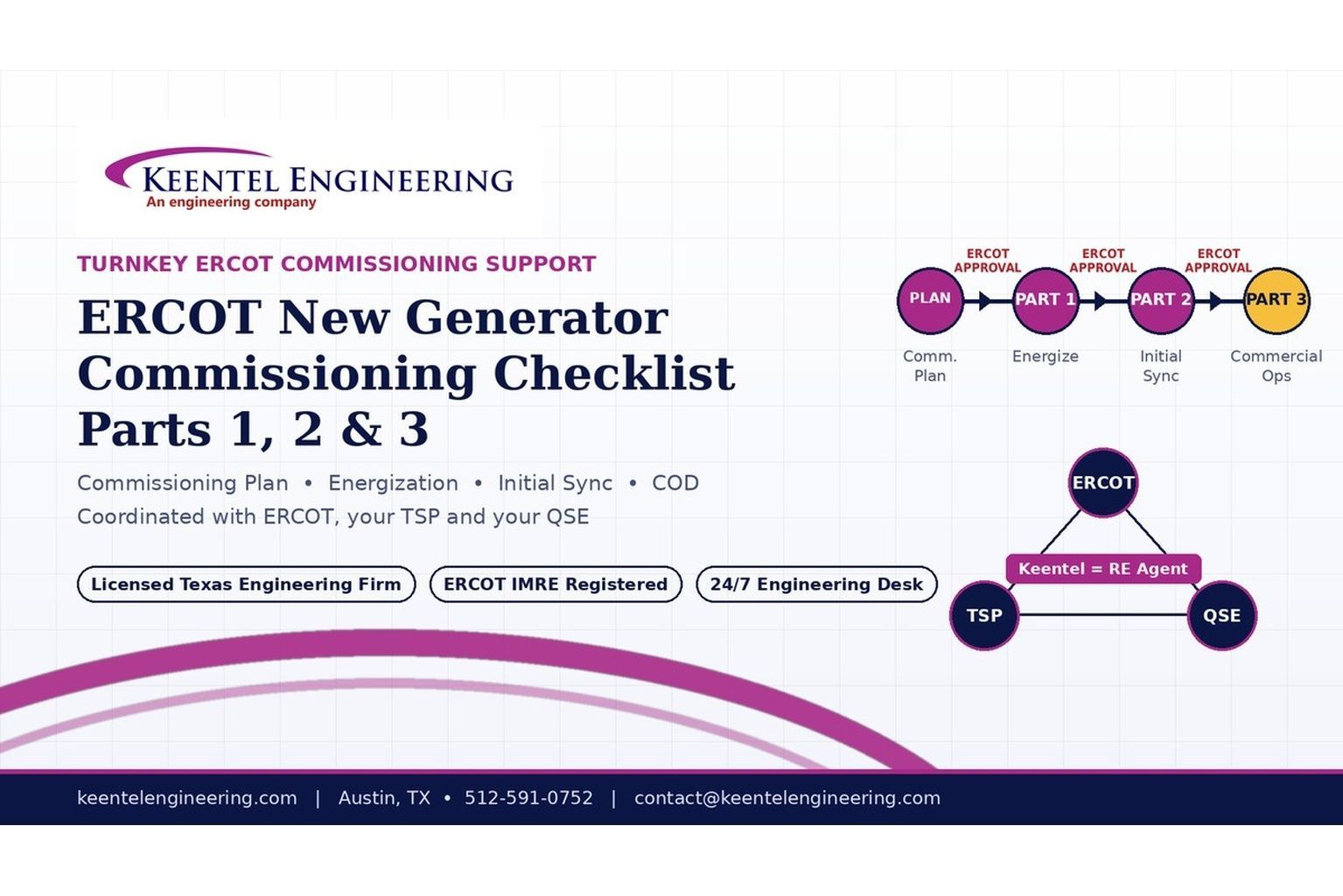
2026 ERCOT commissioning guide covering the Commissioning Plan, Checklist Parts 1–3, BESS requirements, TSP/QSE coordination, field testing and COD.
By SANDIP R PATEL
•
September 22, 2026
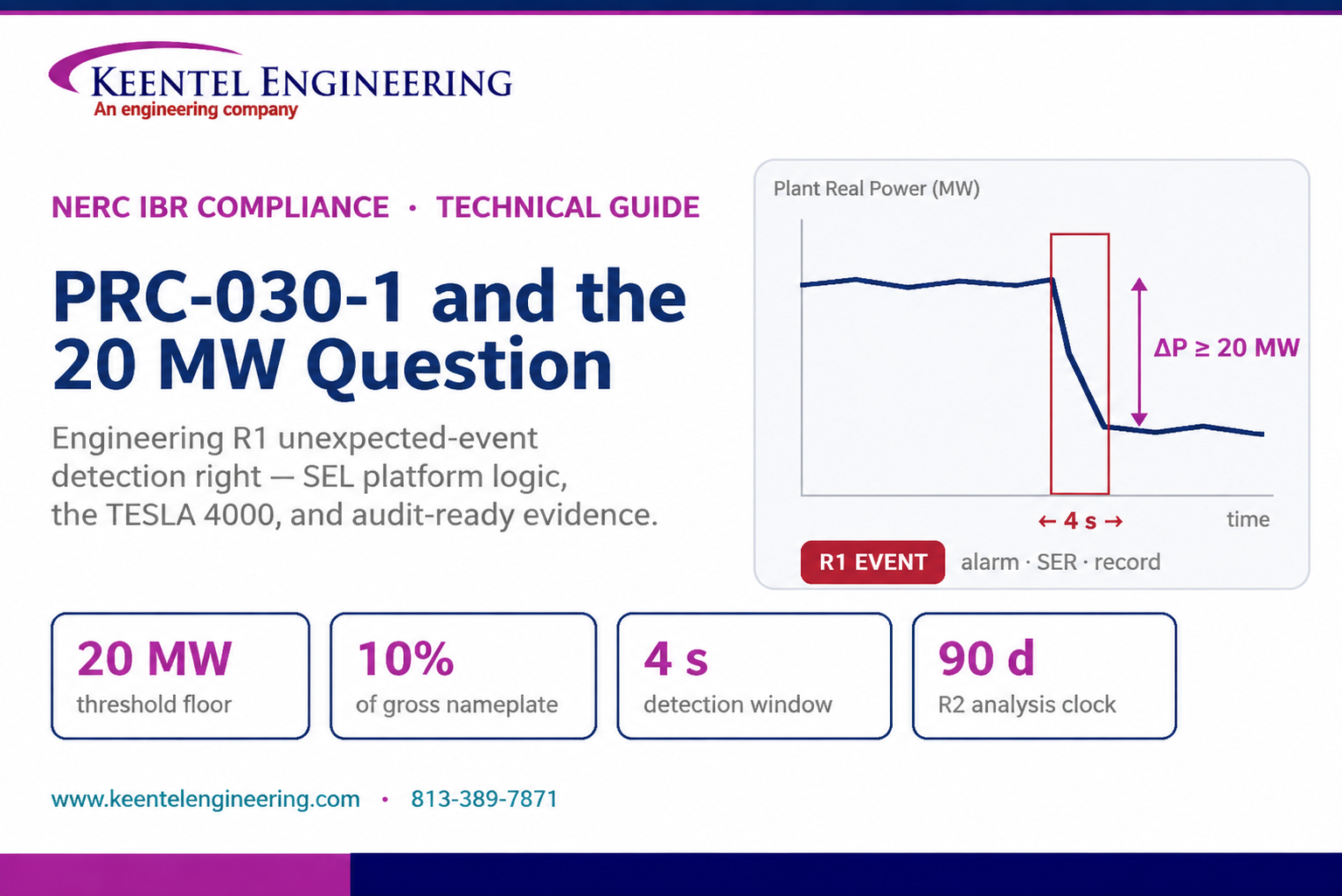
Learn PRC-030-1 R1 event detection requirements for inverter-based resources, SEL platforms, disturbance monitoring, and audit-ready compliance.
By SANDIP R PATEL
•
September 22, 2026
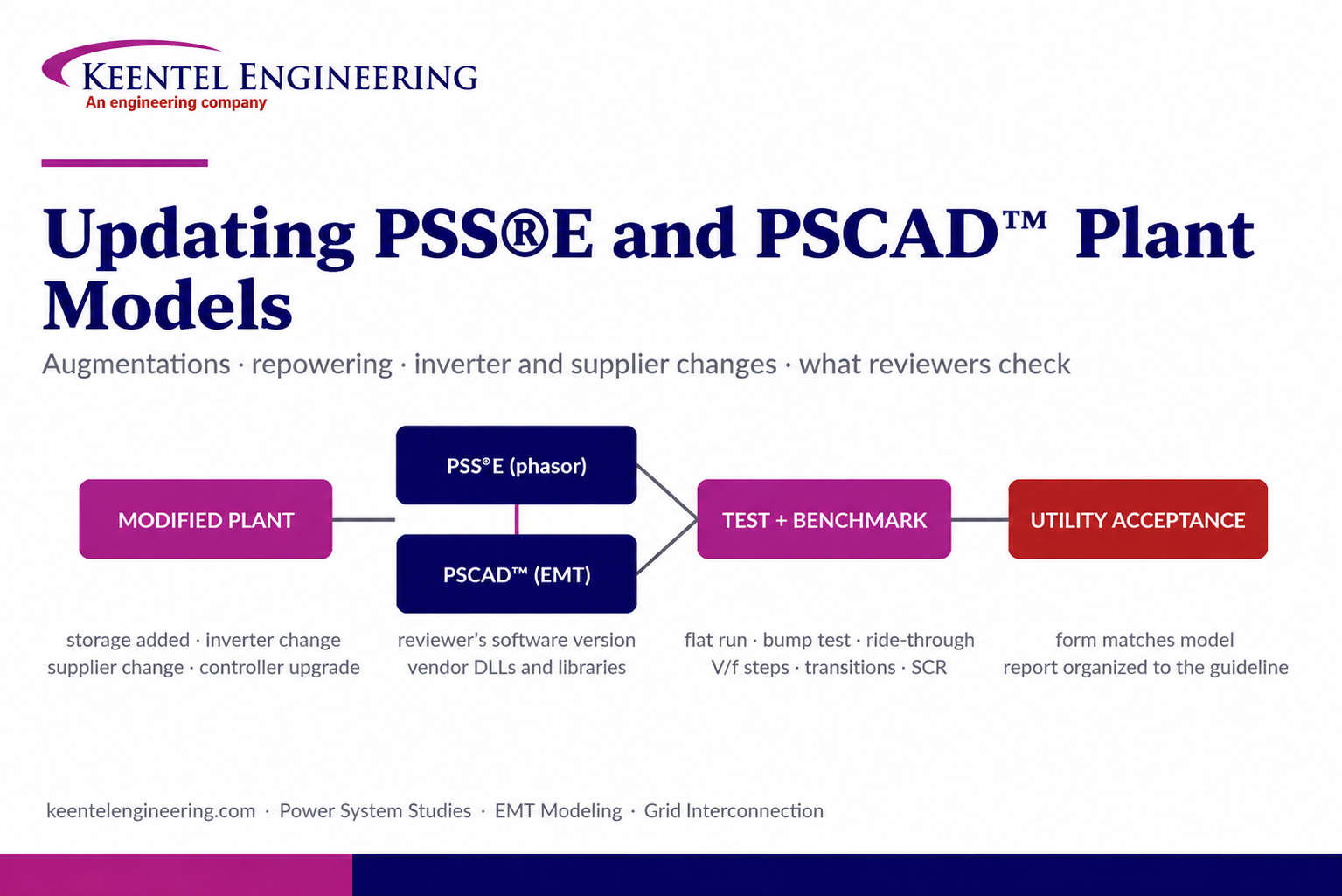
Learn how PSS®E and PSCAD™ model updates support plant augmentations, repowering, equipment changes, testing, benchmarking, and grid compliance.
By SANDIP R PATEL
•
September 20, 2026
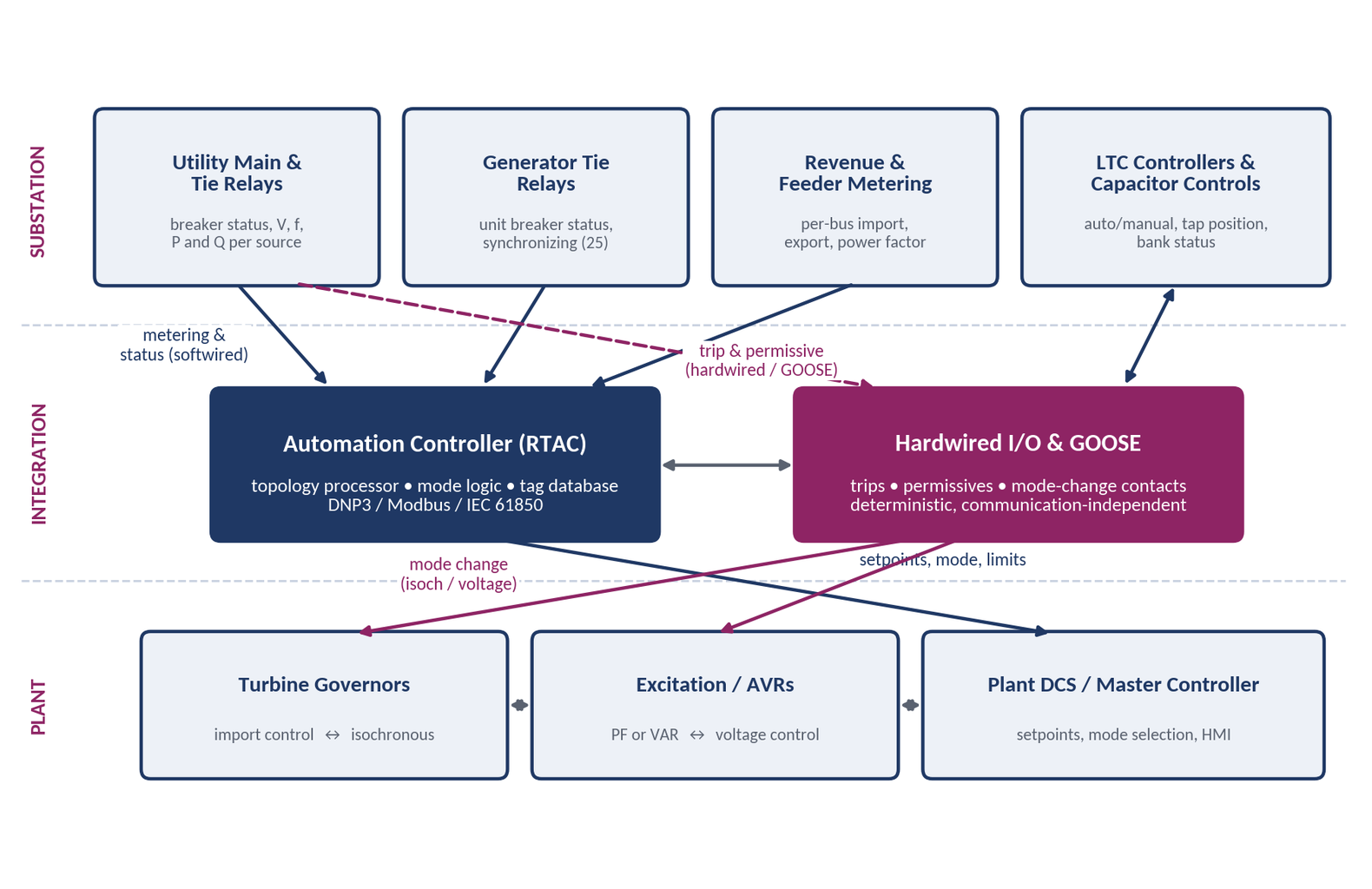
Learn CHP load following and island detection engineering for campus plants, including protection, controls, power studies, and grid transition design.
By SANDIP R PATEL
•
September 20, 2026
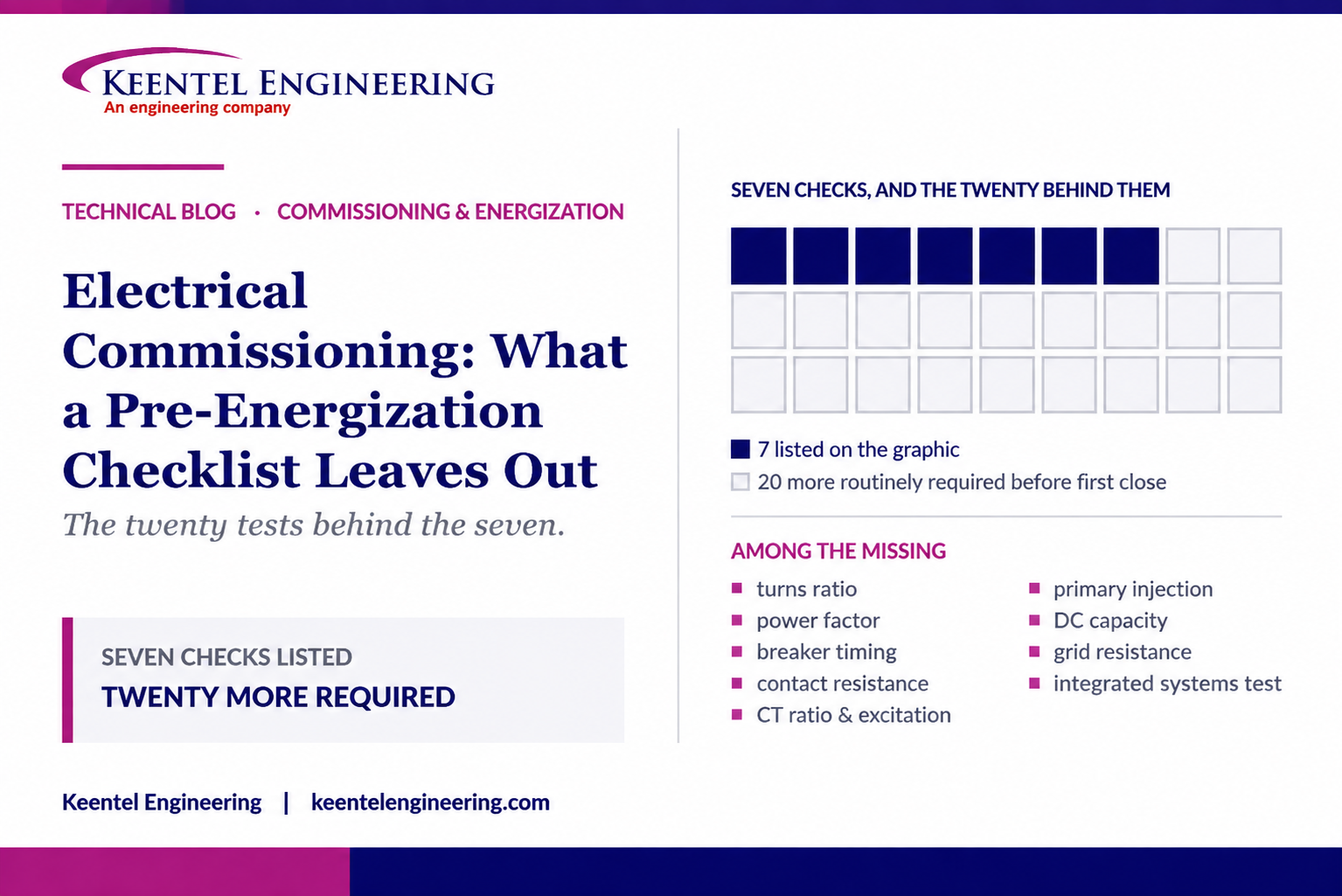
Learn what a pre-energization checklist misses, including electrical testing, protection checks, commissioning steps, and safe energization practices.
By SANDIP R PATEL
•
September 20, 2026
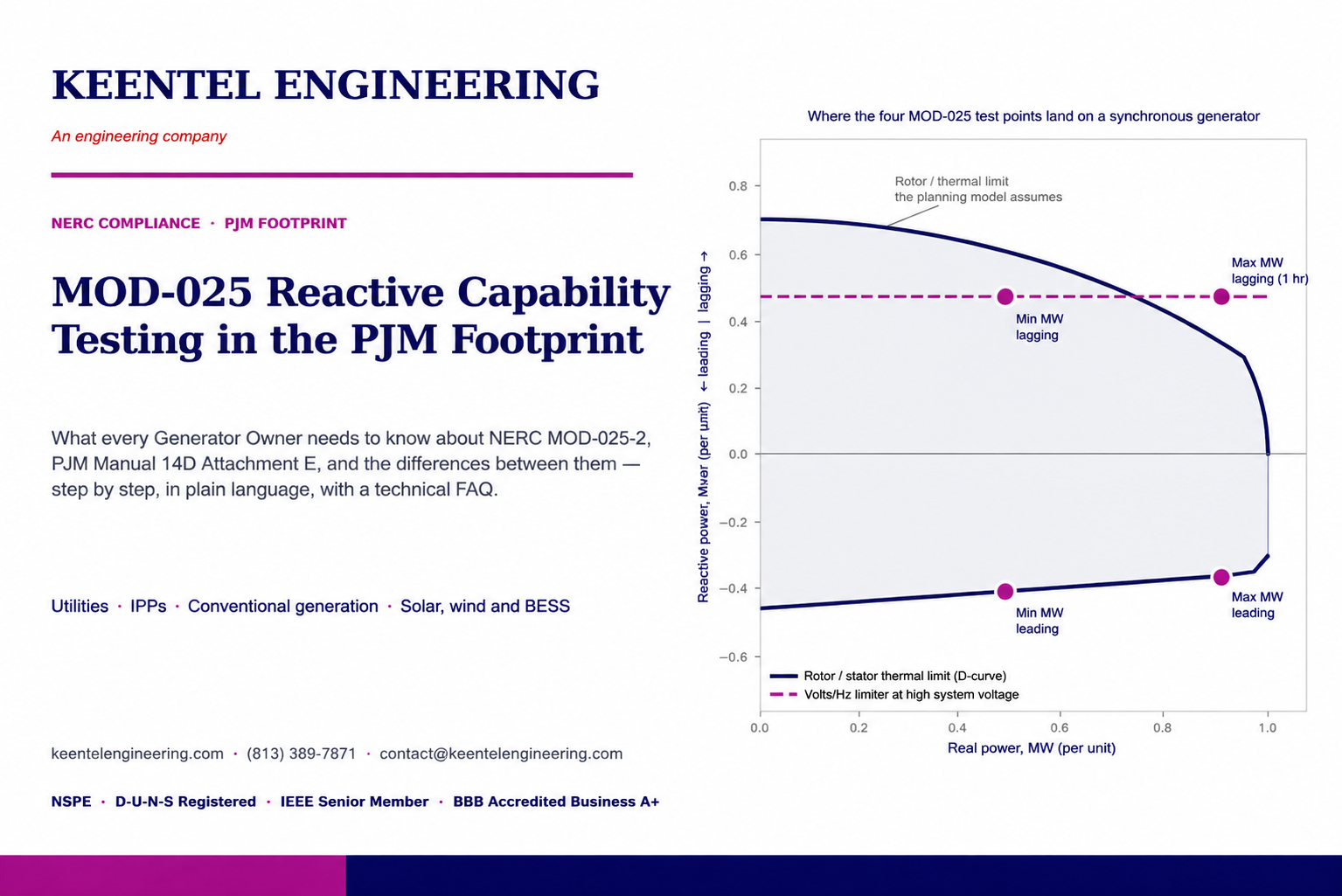
NERC MOD-025-2 Generator Owners, MOD-025-2 reactive power testing, generator capability verification, NERC Attachment 1, MOD-025 compliance testing
By SANDIP R PATEL
•
September 20, 2026
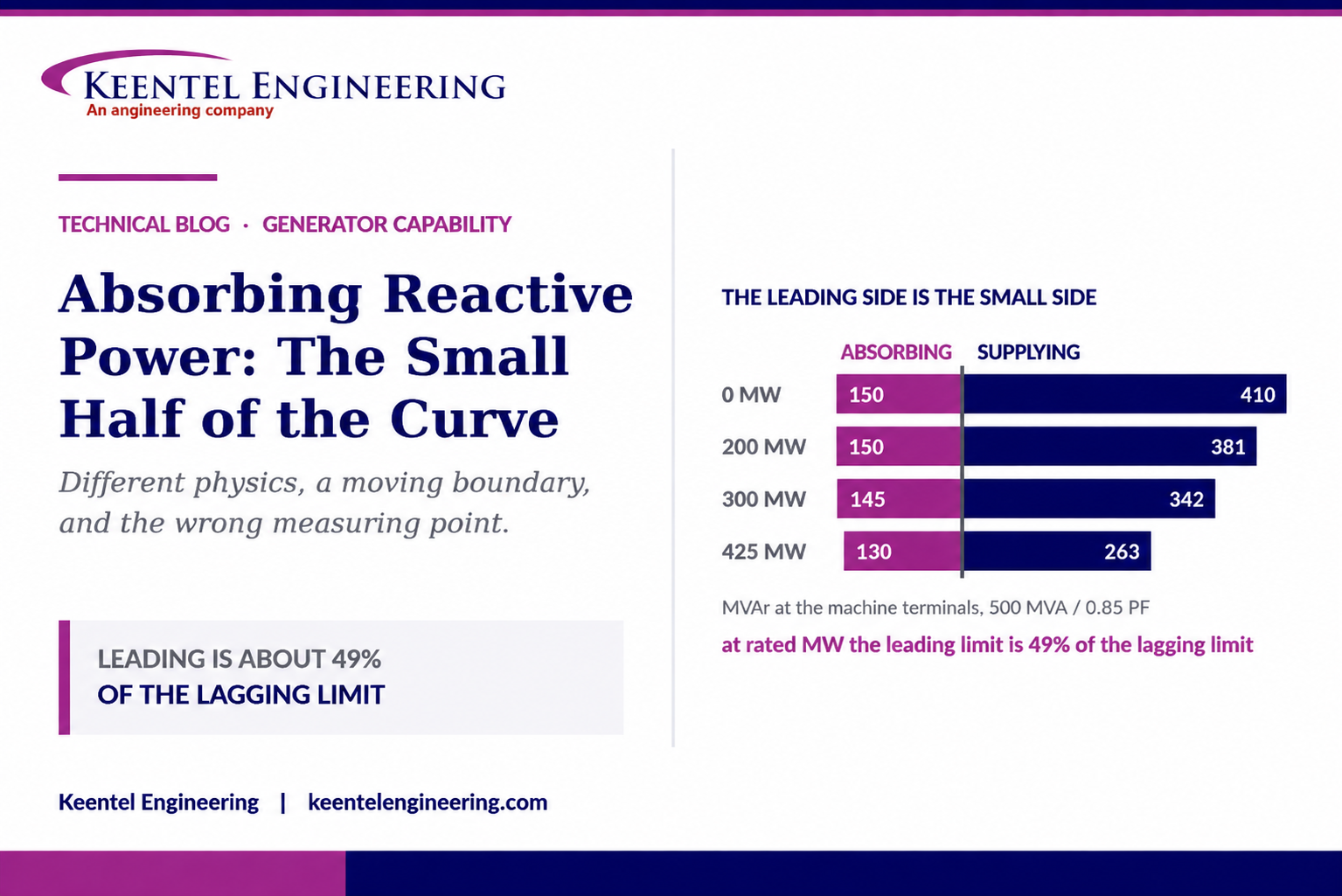
Understand generator capability curves, reactive power absorption, MVAr limits, MOD-025 verification, protection coordination, and grid requirements.
By SANDIP R PATEL
•
September 20, 2026
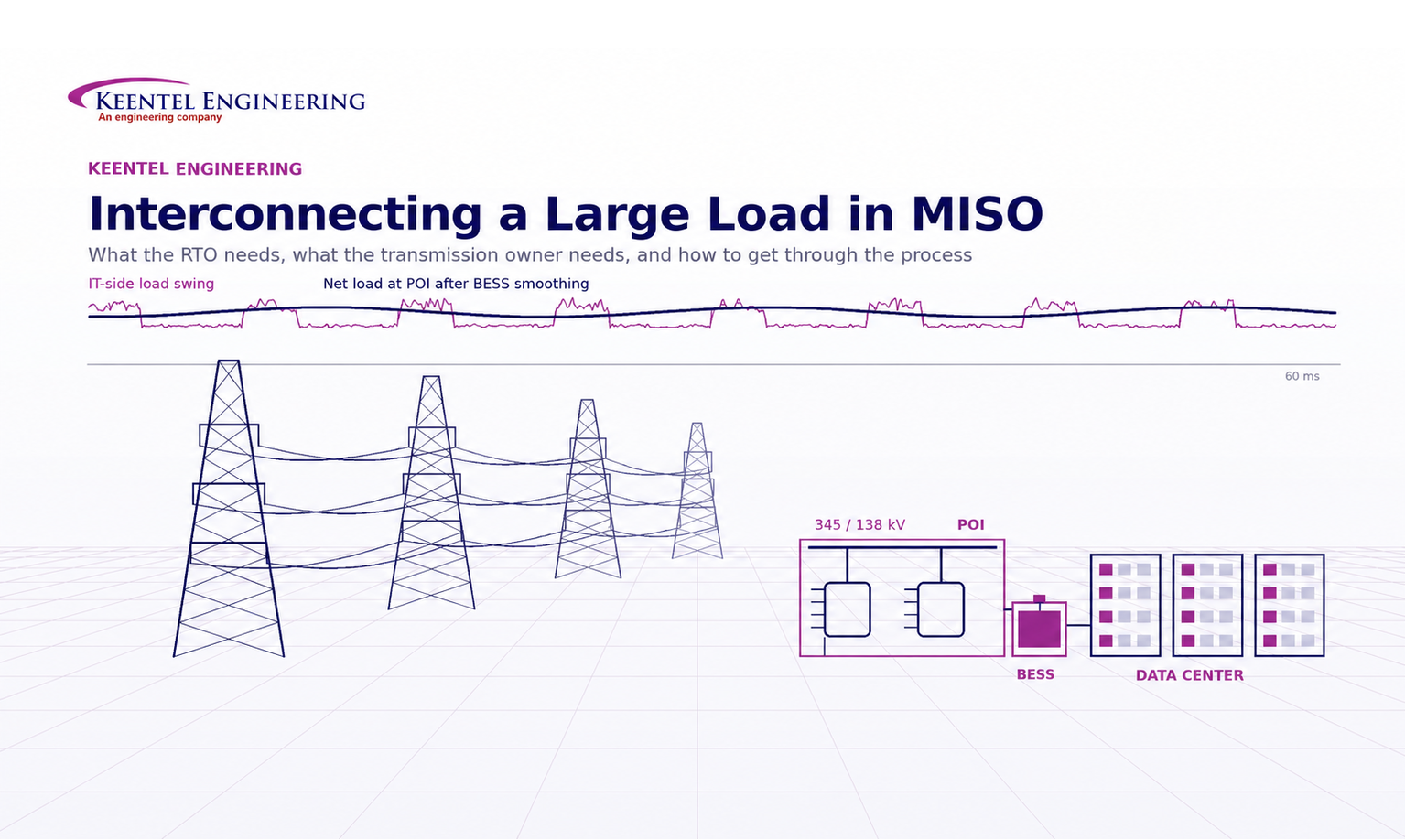
Understand MISO large load interconnection requirements for data centers, including TO data, PSS®E models, ride-through, harmonics, BESS and EPR.
By SANDIP R PATEL
•
September 19, 2026
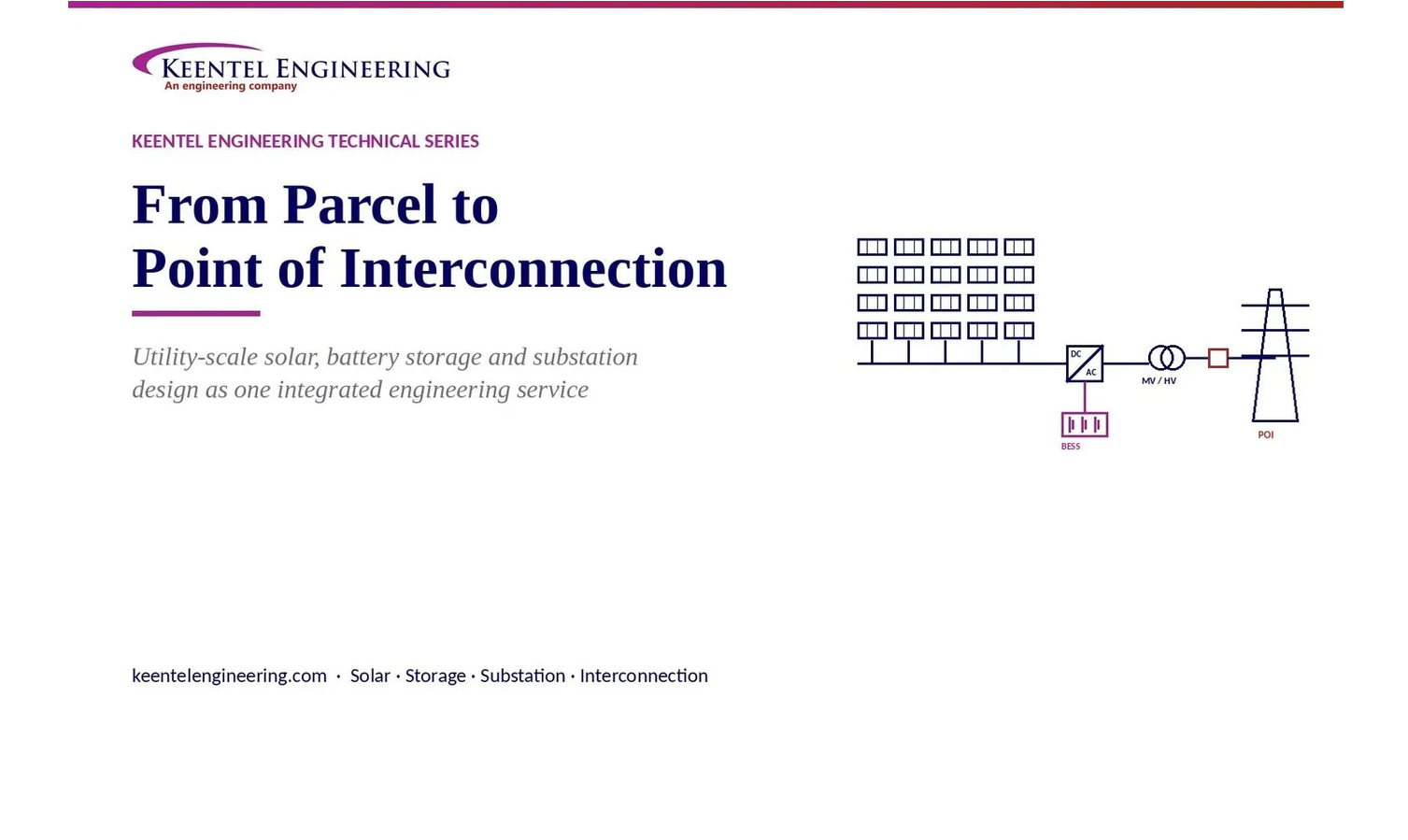
Explore utility scale solar engineering from site assessment to POI interconnection, including PV design, BESS, substation and grid studies.