A Coordinated Electric System Interconnection Review—the utility’s deep-dive on technical and cost impacts of your project.
Challenge: Frequent false tripping using conventional electromechanical relays
Solution: SEL-487E integration with multi-terminal differential protection and dynamic inrush restraint
Result: 90% reduction in false trips, saving over $250,000 in downtime
| Category | Metric |
|---|---|
| VPP capacity (Lunar Energy) | 650 MW |
| Lunar funding raised | US$232 million |
| Data center BESS example | 31 MW / 62 MWh |
| ERCOT grid-scale batteries | 15+ GW |
| LDES tenders (H1 2026) | Up to 9.3 GW |
| Lithium-ion share of LDES by 2030 | 77% |
| FEOC initial threshold | 55% |
| BESS tariff rate (2026) | ~55% |
| Capacity gain from analytics | 5–15% |
What is T&D Co-Simulation?
Confusing Physical Connections with Logical Nodes in IEC 61850
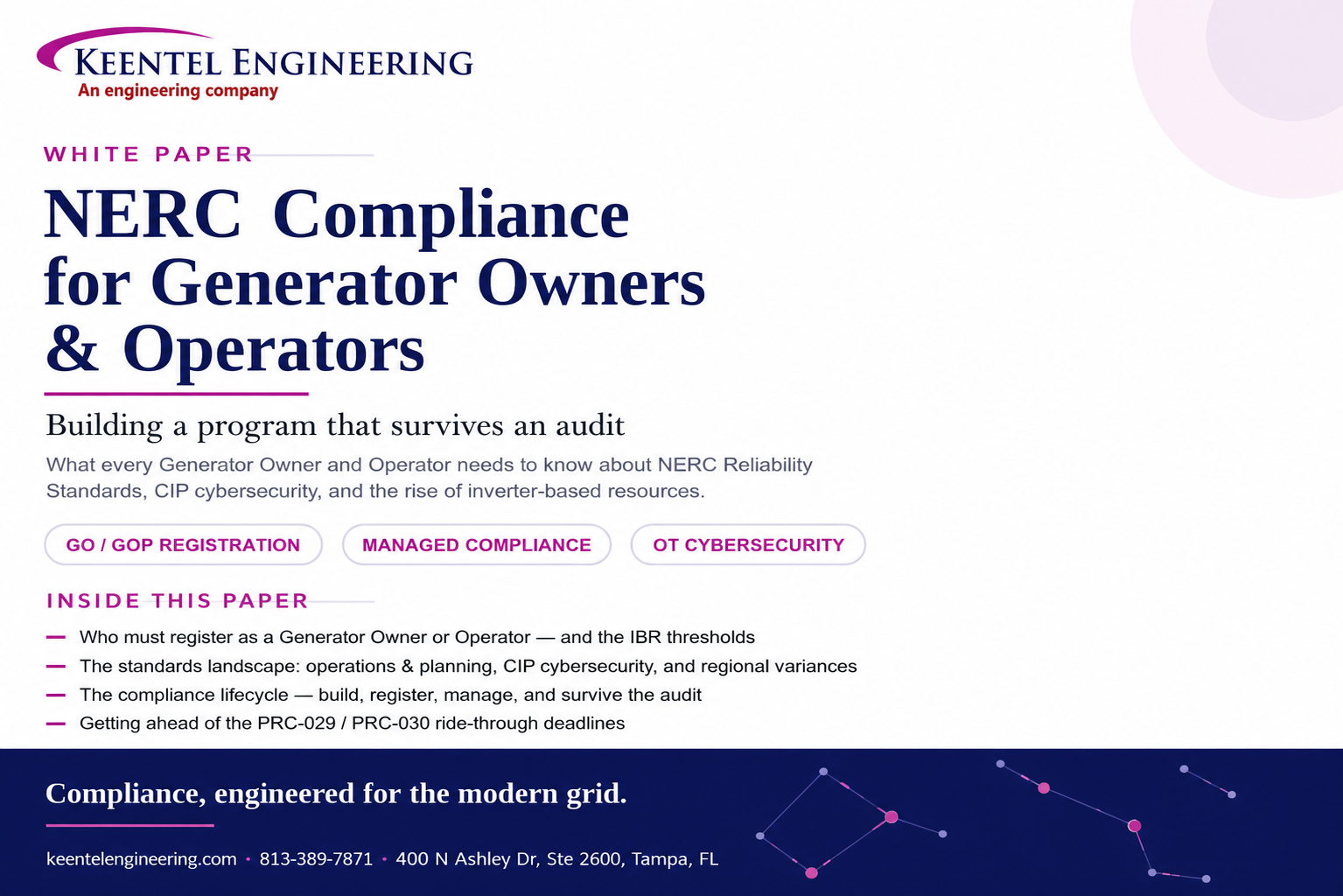
NERC Compliance for Generator Owners and Operators
Jun 11, 2026 | blog
Every megawatt connected to the bulk power system comes with a set of obligations that have nothing to do with producing energy and everything to do with proving you can be trusted to operate on a shared grid. For Generator Owners (GOs) and Generator Operators (GOPs), those obligations live in the NERC Reliability Standards — a body of mandatory, federally enforceable requirements that govern how generation is designed, protected, modeled, maintained, secured, and reported.
These standards are not aspirational. They are enforceable. Violations can carry civil penalties exceeding a million dollars per violation, per day, and that is before the operational disruption, regulatory scrutiny, and reputational damage that follow a finding. Yet many asset owners — especially newer entrants in solar, wind, and battery storage — discover their compliance obligations late, treat them as a one-time paperwork exercise, or assume the EPC or O&M provider has it handled. None of those assumptions survive contact with a Regional Entity audit.
This article lays out what GO and GOP compliance actually requires, why the landscape has shifted dramatically for inverter-based resources, where compliance programs most often fail, and what a defensible program looks like from development through ongoing management.
Who carries the obligation: Generator Owner vs. Generator Operator
NERC registers entities by function. The two that matter most for a generating facility are the Generator Owner, which owns the generating equipment, and the Generator Operator, which operates it. A single organization may hold both registrations, or the functions may be split — for example, when an asset owner contracts operations to a third party. Either way, the registered entity is legally responsible for the compliance obligations attached to its functional registration, and that responsibility cannot be outsourced away. You can delegate the work; you cannot delegate the accountability.
That distinction matters because it shapes who must produce evidence for which standards, who interfaces with the Regional Entity, and who is on the hook when something is missing. A well-structured program is explicit about these boundaries from the outset, including how the GO and GOP coordinate on shared obligations and how evidence flows between the owner, the operator, and any O&M or engineering contractors.
The standards that apply — and the ones you still have to account for
The Reliability Standards are organized into families, and a typical Generator Owner will have obligations spanning most of them:
EOP (Emergency Preparedness and Operations)
event reporting, emergency operations, and cold-weather preparedness obligations that have grown sharply in recent years.
FAC (Facilities Design, Connections, and Maintenance)
facility interconnection requirements and, critically, facility ratings methodology and the identification of most-limiting elements.
MOD (Modeling, Data, and Analysis)
generator data, capability, and verification requirements that feed system planning models.
PRC (Protection and Control)
protection system maintenance programs, misoperation analysis, and the coordination and verification of relay settings.
VAR (Voltage and Reactive)
voltage and reactive control obligations.
BAL, IRO, TOP
, and others — balancing, interconnection reliability, and transmission operations data-sharing requirements that apply depending on facility type and region.
CIP (Critical Infrastructure Protection)
the cybersecurity standards, which for most renewable facilities apply at the low-impact level under CIP-002 and CIP-003.
What surprises many new registrants is that compliance is not only about the standards you must actively perform. A registered Generator Owner must also demonstrate that it has reviewed and considered every standard applicable to its function — including those for which it has no operational obligation because it lacks the relevant equipment or system. Auditors expect audit-ready attestations of non-applicability for those standards, not silence. A program that simply ignores the standards that "don't apply" has a hole in it, and that hole is exactly what a Regional Entity will probe.
Layered on top of the continent-wide standards are regional variances and criteria. A facility in the Western Interconnection inherits WECC-specific requirements; a facility in Texas inherits ERCOT and Texas Reliability Entity obligations, including standards such as BAL-001-TRE. These regional layers materially change a facility's scope, and they are a frequent source of gaps when a national checklist is applied to a facility without accounting for where it actually sits.
The inverter-based resource wave: why this is urgent now
For years, the GO and GOP compliance burden fell most heavily on conventional generation. That has changed. NERC's inverter-based resource (IBR) registration initiative has pulled a large population of solar, wind, and storage facilities into Generator Owner and Generator Operator registration — many for the first time. Under the new framework, resources that meet defined size and interconnection thresholds are required to register and to comply with the standards that come with that registration.
The registration milestone for many of these resources has now passed, but registration is the beginning of the obligation, not the end of it. The harder work — building the program, generating the evidence, and demonstrating actual compliance — follows. And the clock is still running. A new set of ride-through standards, PRC-029 and PRC-030, establishes how inverter-based resources must perform through voltage and frequency disturbances, with compliance dates phasing in during late 2026 and into 2027. For a facility that registered recently and has not yet stood up a functioning program, that is a short runway to build something an auditor will accept.
There is also a hard sequencing lesson buried in this transition: a facility should not declare its Commercial Operation Date before its NERC compliance program is developed and actively in place. Energizing and declaring commercial operation ahead of the program does not pause the obligations — it simply means the entity is non-compliant from day one, with violations accruing against standards it has not yet operationalized. The right order is program first, COD second.
Compliance is a lifecycle, not a document
The single most expensive misconception in this space is that NERC compliance is a deliverable you produce once and file away. It is a continuous lifecycle with four distinct phases, each requiring different work.
Program development
This is the build: developing the operations-and-planning procedures, the low-impact CIP policies and plans, the Internal Compliance Program, and the technical-standards evidence that demonstrates the facility actually meets requirements like facility ratings (FAC-008) and protection system maintenance (PRC-005). It includes creating attestations for the standards that don't apply and conducting exercises such as a Cyber Security Incident Response Plan tabletop. Done well, this phase produces a complete, audit-ready evidence package and the documented program that governs it.
Registration
Submitting the registration request to the appropriate Regional Entity and coordinating with the Regional Entity, Transmission Owner, Transmission Operator, and Planning Coordinator as needed. This is a process-heavy phase where missteps create delays and downstream compliance exposure.
Ongoing managed compliance
This is where most programs quietly decay. Standards change. Data submittals come due on recurring cycles. NERC issues Alerts that demand a response. Self-certifications must be completed. Evidence must be generated, organized, and retained so it can be produced on demand. Someone has to act as the compliance program administrator, monitor regulatory developments, maintain the evidence repository, and keep the documentation current as the facility and the standards evolve. Without a dedicated owner of this function, a program that passed its first audit can fail its second.
Audits and enforcement
Periodic audits, spot checks, and — when something goes wrong — event-driven investigations and inquiries. Pre-audit preparation, including the development of Reliability Standard Audit Worksheets and responses to data requests, is its own discipline. So is responding to a self-reported or discovered violation with a credible mitigation plan.
The OT cybersecurity layer
For most renewable facilities, the CIP standards apply at the low-impact level, but "low impact" does not mean "low effort." CIP-002 requires categorizing the facility's BES Cyber Systems, and CIP-003 requires a suite of security management controls: a cyber security policy, electronic and physical access controls, a Cyber Security Incident Response Plan, transient cyber asset and removable media controls, and more — each backed by evidence.
Underneath the policy layer sits the real operational technology environment: the SCADA servers and workstations, firewalls, managed switches, remote terminal units, and cellular modems that actually run the site. Keeping that environment compliant is a managed-service discipline in its own right — ingesting and monitoring security event logs, managing firewall rulesets and access, patching and remediating vulnerabilities, maintaining known-good backups, controlling transient devices, running change management, and producing the periodic evidence (firewall ruleset audits, network diagram reviews, access reviews) that CIP-003 demands. The deliverable is not a one-time hardening exercise; it is a continuous evidence engine that demonstrates the OT environment is being actively managed and secured.
Treating NERC compliance and OT cybersecurity as two unrelated workstreams — handled by two different providers who don't talk to each other — is how seams form. And seams are where evidence falls through.
Where compliance programs go wrong
Across the industry, the failure modes are remarkably consistent:
- Declaring commercial operation before the program exists, accruing violations from the start.
- Treating compliance as one-time, with no owner for the ongoing managed function, so the program decays between audits.
- Ignoring non-applicable standards instead of documenting reviewed-and-considered attestations.
- Missing regional variances — applying a generic national scope to a facility with WECC, ERCOT, or other regional obligations.
- Thin technical evidence — having a policy that says protection systems are maintained, but no maintenance list, no settings coordination records, no facility ratings analysis to back it up.
- Disconnected cyber and compliance programs, where CIP evidence and the actual OT environment drift apart.
- No plan for change — being caught flat-footed when a standard is revised or a new one (like the IBR ride-through requirements) comes into force.
None of these are exotic. They are the predictable result of underestimating what a living compliance program requires.
What a defensible program looks like
A program that holds up has a few hallmarks. It is built before commercial operation, not after. It pairs documented procedures with real technical evidence for every in-scope standard, and audit-ready attestations for every out-of-scope one. It includes an Internal Compliance Program — not required by the standards, but the clearest demonstration to a regulator that the entity is managing compliance deliberately rather than reactively. It maintains a single, organized evidence repository. It assigns clear ownership of the ongoing administrative function: submittals, self-certifications, Alert responses, document control, and regulatory monitoring. And it draws an honest line between the predictable, fixed-scope work and the genuinely unpredictable work — audits, investigations, major standard changes, non-routine engineering — so the unpredictable work is resourced when it arises rather than assumed away.
The strongest commercial structure mirrors that reality: a fixed-price program build, a recurring managed-compliance service for the steady-state administration, and a time-and-materials lane for the episodic, high-effort work. That structure is transparent, comparable, and aligned with how the obligations actually behave over a facility's life.
How Keentel Engineering helps Generator Owners and Operators
Keentel Engineering works with Generator Owners and Operators across solar, wind, and storage to build and run NERC compliance programs that stand up to scrutiny — and to keep the operational technology underneath them secure and audit-ready. Our work spans the full lifecycle:
NERC GO/GOP program development
We develop the operations-and-planning procedures, low-impact CIP documentation, Internal Compliance Program, and the audit-ready attestations that together form a complete program — and we prepare and submit the registration request to the appropriate Regional Entity, coordinating with the Transmission Owner, Transmission Operator, and Planning Coordinator along the way.
Technical standards evidence
We build the engineering evidence that proves compliance, not just claims it — facility ratings analysis for FAC-008, protection system maintenance lists and settings coordination for the PRC standards, and the supporting documentation regulators expect to see.
CIP and incident response
We develop the low-impact CIP policies and plans, assemble the CIP evidence package, and conduct Cyber Security Incident Response Plan tabletop exercises so the plan is tested before it's ever needed.
Ongoing Managed Compliance Services
We act as the compliance program administrator on an ongoing basis — coordinating periodic data submittals, responding to NERC Alerts, leading self-certifications, maintaining the evidence repository, monitoring regulatory developments, and keeping documentation current as standards and facilities change.
OT/SCADA cybersecurity managed service
We run the operational technology environment as a continuous evidence engine: log monitoring and alerting, firewall and access management, patch and vulnerability management, backups, change management, and the recurring CIP-003 audits and reporting that demonstrate the environment is actively secured.
Regional and inverter-based resource expertise
We support the regional layers that trip up generic programs — including Texas and ERCOT requirements such as PUCT Emergency Operations Plans and BAL-001-TRE, and IEEE 2800-2022 conformance reviews — and we help inverter-based resources get ahead of the new ride-through standards now phasing into enforcement.
Because we deliver NERC compliance and OT cybersecurity under one roof, there are no seams between the program and the environment it governs — one accountable partner for the obligations that span the Generator Owner, the Generator Operator, and the operational technology that connects them.
FAQs
Registration & applicability
Do we have to register with NERC as a Generator Owner or Operator?
If your facility connects to the bulk power system and meets the applicable size and interconnection thresholds, then yes. Under NERC's inverter-based resource initiative, solar, wind, and storage facilities that generally reach an aggregate capacity of about 20 MVA or more and interconnect at 60 kV or higher fall into the registration population — many for the first time. The precise applicability depends on your facility's configuration and region, which is exactly the kind of determination worth confirming early rather than assuming.
What's the difference between a Generator Owner and a Generator Operator?
NERC registers entities by function. The Generator Owner (GO) owns the generating equipment; the Generator Operator (GOP) operates it. One organization can hold both registrations, or the roles can be split — for example, when an owner contracts operations to a third party. Each function carries its own set of compliance obligations.
We use a third-party O&M or operations provider. Doesn't that make compliance their problem?
You can delegate the work, but not the accountability. The registered entity remains legally responsible for the obligations attached to its functional registration. A sound program defines explicitly how the GO, the GOP, and any contractors coordinate, and how evidence flows between them — so nothing falls through the gap between organizations.
Our project is small. Are we automatically exempt?
applicability rules are specific, and "small" facilities can still pick up obligations depending on aggregate capacity, interconnection voltage, and regional criteria. The safe move is a documented applicability determination, not a gut-feel exemption.
Standards & scope
Which NERC standards actually apply to a generator?
A typical Generator Owner has obligations across most standard families: EOP (emergency preparedness, including cold-weather), FAC (facility ratings and interconnection), MOD (generator modeling and data), PRC (protection system maintenance, coordination, and misoperation analysis), VAR (voltage and reactive control), CIP (cybersecurity), and depending on facility type and region, BAL, IRO, and TOP data-sharing requirements. The exact in-scope list depends on your equipment and location.
Do we really have to deal with standards that don't apply to us?
Yes — and this surprises a lot of new registrants. A registered entity must demonstrate that it has reviewed and considered every standard applicable to its function, including the ones it has no obligation to perform because it lacks the relevant equipment. Auditors expect audit-ready attestations of non-applicability for those, not silence. Ignoring them leaves a hole that a Regional Entity will find.
What are regional variances, and why do they matter?
On top of the continent-wide standards, each region adds its own requirements. A Western Interconnection facility inherits WECC criteria; a Texas facility inherits ERCOT and Texas Reliability Entity obligations such as BAL-001-TRE, plus state-level requirements. Applying a generic national checklist to a facility without accounting for where it sits is a common — and expensive — source of gaps.
Is CIP cybersecurity compliance the same as having good OT security?
They're related but not identical. CIP compliance (for most renewables, the low-impact level under CIP-002 and CIP-003) is about having the required policies, plans, and documented evidence. OT security is the actual practice of protecting the SCADA environment day to day. A strong program keeps the two aligned so the evidence reflects what's really happening on the network — when they drift apart, audits get uncomfortable.
Timing & process
When should we start, and can we declare commercial operation first and sort out compliance later?
Start before commercial operation. Declaring your Commercial Operation Date before the NERC program is developed and in place does not pause the obligations — it means you're non-compliant from day one, with violations accruing against standards you haven't operationalized yet. The correct sequence is program first, COD second.
How long does it take to build a compliance program?
It varies with facility complexity, the number of standards in scope, regional requirements, and how readily the engineering documentation can be gathered from the EPC and project team. The build includes developing procedures, CIP documentation, the Internal Compliance Program, technical evidence, attestations, and the registration submittal — so it's a structured project, not a quick form-fill. Starting well ahead of your target COD is the single best way to avoid a compliance gap at energization.
What does registration actually involve?
Submitting the registration request to the appropriate Regional Entity and coordinating with the Regional Entity, Transmission Owner, Transmission Operator, and Planning Coordinator as needed. It's process-heavy, and missteps create delays that ripple into your compliance timeline.
Inverter-based resources
What changed for solar, wind, and storage facilities?
NERC's IBR registration initiative brought a large population of inverter-based resources into Generator Owner and Operator registration. The registration milestone for many resources has already passed — but registration is the start of the obligation, not the finish. The substantive work of building the program and producing compliant evidence follows.
What are PRC-029 and PRC-030?
They're new ride-through standards defining how inverter-based resources must perform through voltage and frequency disturbances, with compliance dates phasing in during late 2026 and into 2027. For a facility that registered recently and hasn't stood up a working program, that's a short runway — worth getting ahead of now.
What is IEEE 2800-2022, and do we need to care?
IEEE 2800-2022 sets interconnection performance requirements for inverter-based resources (active power-frequency response, voltage and frequency ride-through, protective functions). It's increasingly referenced in interconnection and state processes, particularly in Texas. A conformance review of your design documents can surface non-compliant settings before they become an interconnection or reliability problem.
Ongoing management, audits & penalties
Is NERC compliance a one-time project or an ongoing obligation?
Ongoing — and this is where most programs quietly decay. Standards change, data submittals come due on recurring cycles, NERC issues Alerts that require responses, and self-certifications must be completed. Without a dedicated owner of that administrative function, a program that passed its first audit can fail its second.
What is an Internal Compliance Program (ICP)?
An ICP is the management framework that keeps your compliance program current and demonstrates to regulators that you're managing compliance deliberately rather than reactively. It isn't strictly required by the standards, but it's one of the clearest signals to a Regional Entity that an entity takes its obligations seriously.
What happens during an audit?
A Regional Entity reviews your evidence against the applicable standards, often via Reliability Standard Audit Worksheets (RSAWs) and data requests. Pre-audit preparation — assembling RSAWs, organizing the evidence repository, and preparing responses — is its own discipline. Spot checks and event-driven investigations can also occur outside the regular audit cycle.
What are the penalties for non-compliance?
Financial penalties can exceed a million dollars per violation, per day, alongside mitigation requirements, heightened regulatory scrutiny, and reputational impact. The cost of a well-run program is modest by comparison.
What's a self-certification or self-report?
Self-certifications are periodic attestations of your compliance status that registered entities are required to complete. A self-report is when you proactively disclose a potential violation — which, handled with a credible mitigation plan, is generally viewed far more favorably than a violation discovered by an auditor.
OT cybersecurity
Which devices fall under the OT cybersecurity scope?
Typically the operational technology that runs the site: SCADA servers and workstations, firewalls, managed switches, remote terminal units, and cellular modems. Items like inverters, trackers, relays, meters, and weather stations, along with corporate and utility networks, generally sit outside that managed scope — though the exact boundary should be defined per facility.
What does an OT cybersecurity managed service actually do?
It runs the environment as a continuous evidence engine: ingesting and monitoring security event logs, managing firewall rulesets and access, patching and remediating vulnerabilities, maintaining known-good backups, controlling transient devices and removable media, running change management, and producing the recurring CIP-003 evidence (firewall ruleset audits, network-diagram reviews, access reviews) and reporting. It's ongoing operations, not a one-time hardening exercise.
Working with Keentel Engineering
What does Keentel actually provide?
The full lifecycle: GO/GOP program development, technical-standards evidence (facility ratings, protection system maintenance and coordination, and more), low-impact CIP documentation and Cyber Security Incident Response Plan tabletops, registration support, ongoing Managed Compliance Services, and an OT/SCADA cybersecurity managed service — plus regional support for Texas/ERCOT requirements and IEEE 2800 reviews.
Can you handle both NERC compliance and OT cybersecurity?
Yes — and delivering both under one roof removes the seams that form when two separate providers own the program and the environment it governs. One accountable partner covers the obligations spanning the Generator Owner, the Generator Operator, and the OT that connects them.
How is your work typically structured?
Three lanes that mirror how the obligations behave: a fixed-price program build, a recurring managed-compliance (and optional OT cyber) service for steady-state administration, and a time-and-materials lane for episodic, high-effort work like audit support, investigations, and major standard changes. That structure keeps costs transparent and comparable.
Can you take over a program we already started, or that another provider built?
Yes. We can assess an existing program, close gaps, and assume the ongoing compliance and OT functions — including organizing the evidence repository and managing the transition so nothing lapses during the handoff
Final Thoughts
NERC compliance for Generator Owners and Operators is not a binder you produce and forget. It is a program you build correctly, register on the right timeline, and manage continuously — through standard changes, audits, and a rapidly evolving set of expectations for inverter-based resources. The cost of doing it well is modest next to the cost of doing it poorly: penalties measured in millions, audits that expose years of accumulated gaps, and the operational risk of running on a grid you can't prove you belong on.
The facilities that come through the IBR transition cleanly will be the ones that treated compliance as an engineering discipline from the start and that had a
partner accountable for keeping it true over time.

About the Author:
Sandip "Sonny" R. Patel, P.E.
IEEE Senior Member · Founder & CEO, Keentel Engineering
In 1995, Sonny Patel earned his Electrical Engineering degree from the University of Illinois. But degrees don't build legacies — action does.
For three decades, he has worked the power industry from every side of the table: 16 years as a utility engineer at Exelon/Commonwealth Edison; generation leadership across hydroelectric, industrial steam turbine, and a 9 GW renewable fleet; NERC Regional Entity Senior Compliance Engineer and Audit Team Lead, auditing some of the nation's largest utilities; and testing and commissioning lead on equipment up to 765 kV — the very top of the North American grid.Utility. Generator. Regulator. Consultant. Few engineers have seen all four seats. Fewer still have sat in them.
His experience spans nuclear, hydro, conventional generation, renewables, oil and gas, mining — and today's data centers, where he is authoring a three-book series on data center design. He is a Licensed Professional Engineer in six states and a Licensed Electrical Contractor in Florida (Unlimited EC) — he doesn't just design the work; he's qualified to stand behind its execution.Today, as Founder and CEO of Keentel Engineering, Sonny leads a nationwide team of engineers delivering substation design, power system studies, NERC compliance, and commissioning — done right, coast to coast.Three decades. Every side of the table. One standard: accountable engineering.
Services

Let's Discuss Your Project
Let's book a call to discuss your electrical engineering project that we can help you with.
About the Author:
Sandip "Sonny" R. Patel, P.E.
IEEE Senior Member · Founder & CEO, Keentel Engineering
In 1995, Sonny Patel earned his Electrical Engineering degree from the University of Illinois. But degrees don't build legacies — action does.
For three decades, he has worked the power industry from every side of the table: 16 years as a utility engineer at Exelon/Commonwealth Edison; generation leadership across hydroelectric, industrial steam turbine, and a 9 GW renewable fleet; NERC Regional Entity Senior Compliance Engineer and Audit Team Lead, auditing some of the nation's largest utilities; and testing and commissioning lead on equipment up to 765 kV — the very top of the North American grid.
Utility. Generator. Regulator. Consultant. Few engineers have seen all four seats. Fewer still have sat in them.
His experience spans nuclear, hydro, conventional generation, renewables, oil and gas, mining — and today's data centers, where he is authoring a three-book series on data center design. He is a Licensed Professional Engineer in six states and a Licensed Electrical Contractor in Florida (Unlimited EC) — he doesn't just design the work; he's qualified to stand behind its execution.
Today, as Founder and CEO of Keentel Engineering, Sonny leads a nationwide team of engineers delivering substation design, power system studies, NERC compliance, and commissioning — done right, coast to coast.Three decades. Every side of the table. One standard: accountable engineering.
Leave a Comment
Thank you for contacting us.
We will get back to you as soon as possible.
We will get back to you as soon as possible.
Oops, there was an error sending your message.
Please try again later.
Please try again later.
Related Posts
By SANDIP R PATEL
•
October 23, 2026
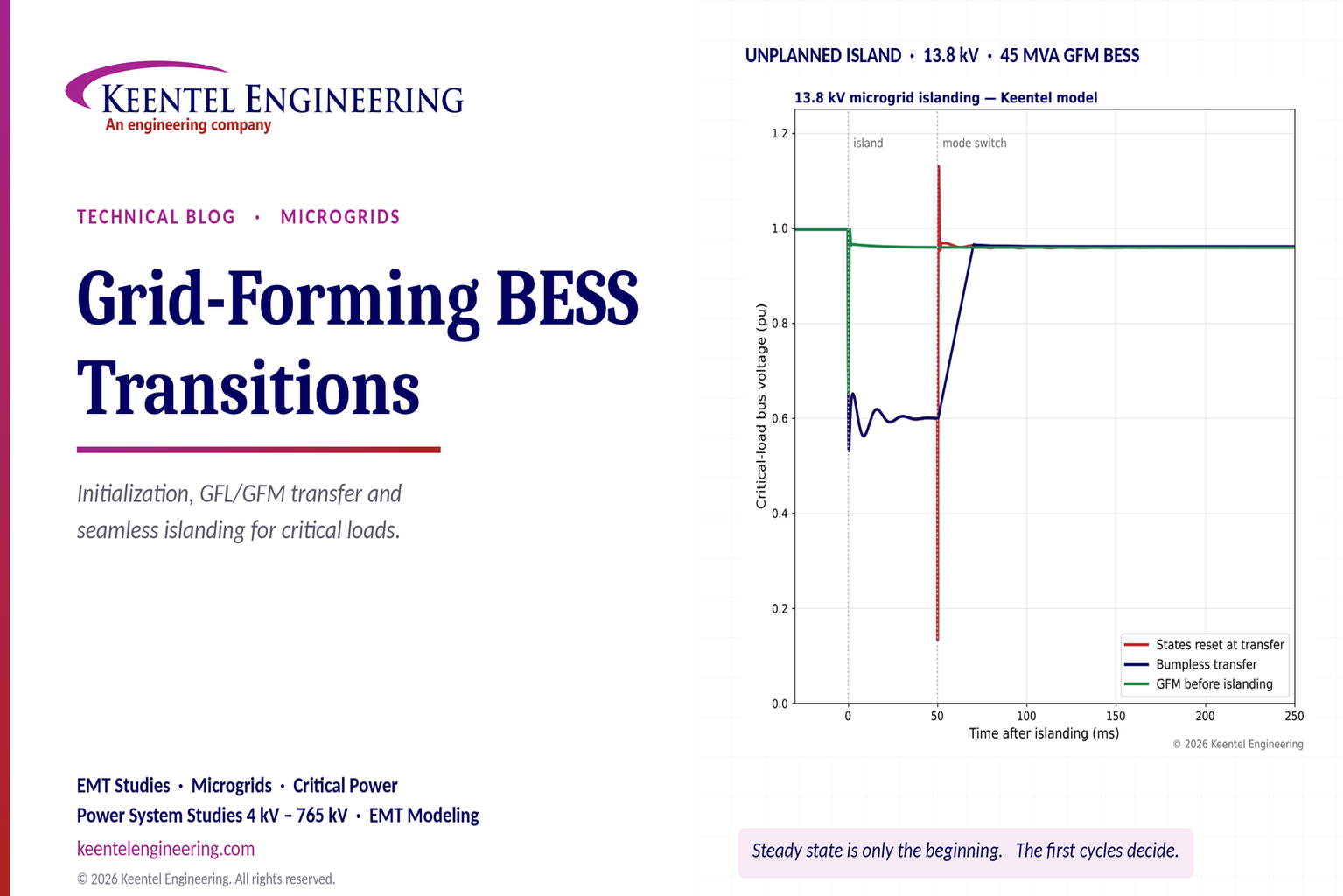
Explore grid-forming BESS initialization, GFL-to-GFM transitions, seamless islanding, EMT simulations, current limiting and microgrid protection.
By SANDIP R PATEL
•
October 23, 2026
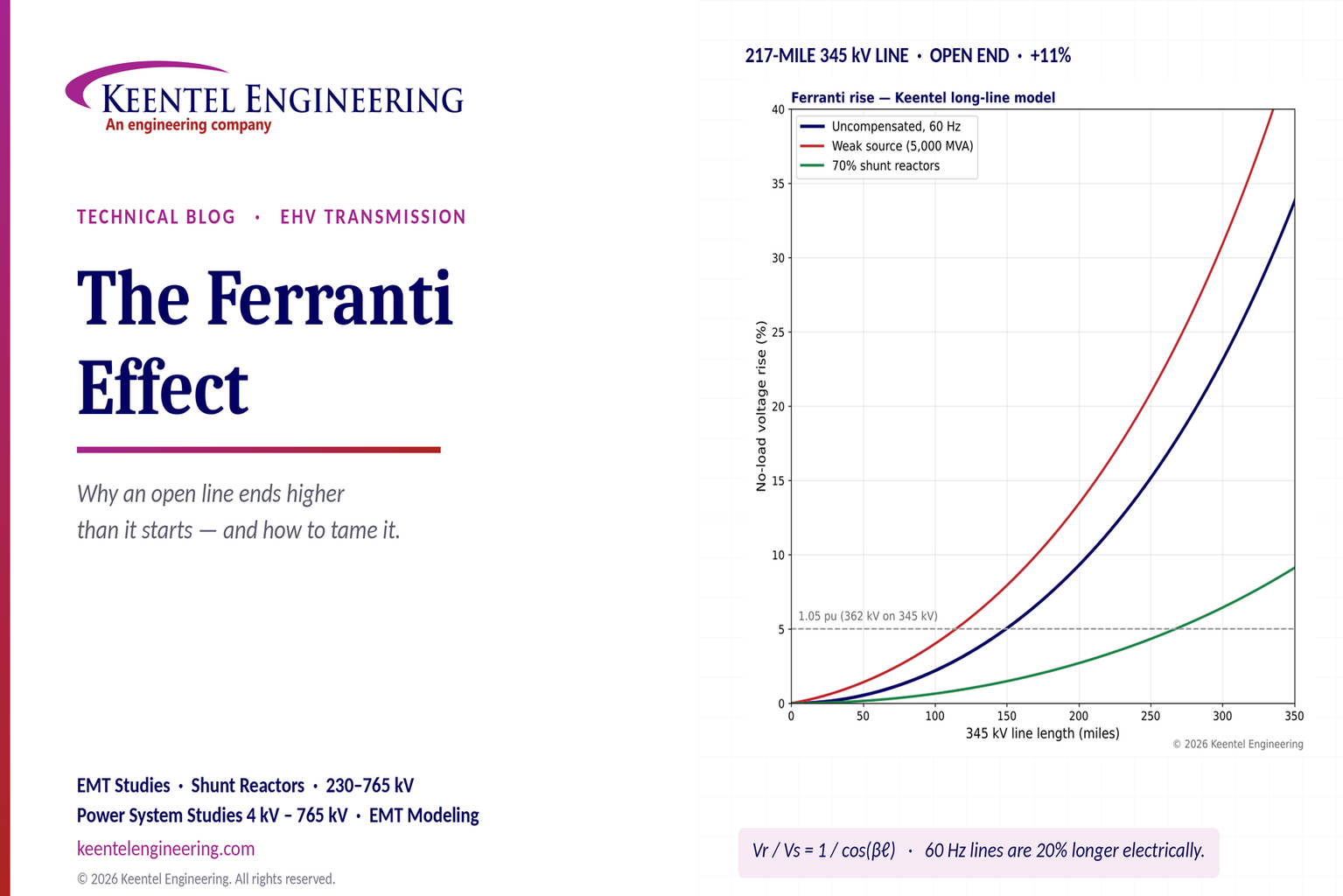
Explore the Ferranti effect in EHV transmission lines: voltage rise, 345 kV examples, switching overvoltages, shunt reactor sizing and mitigation.
By SANDIP R PATEL
•
October 23, 2026
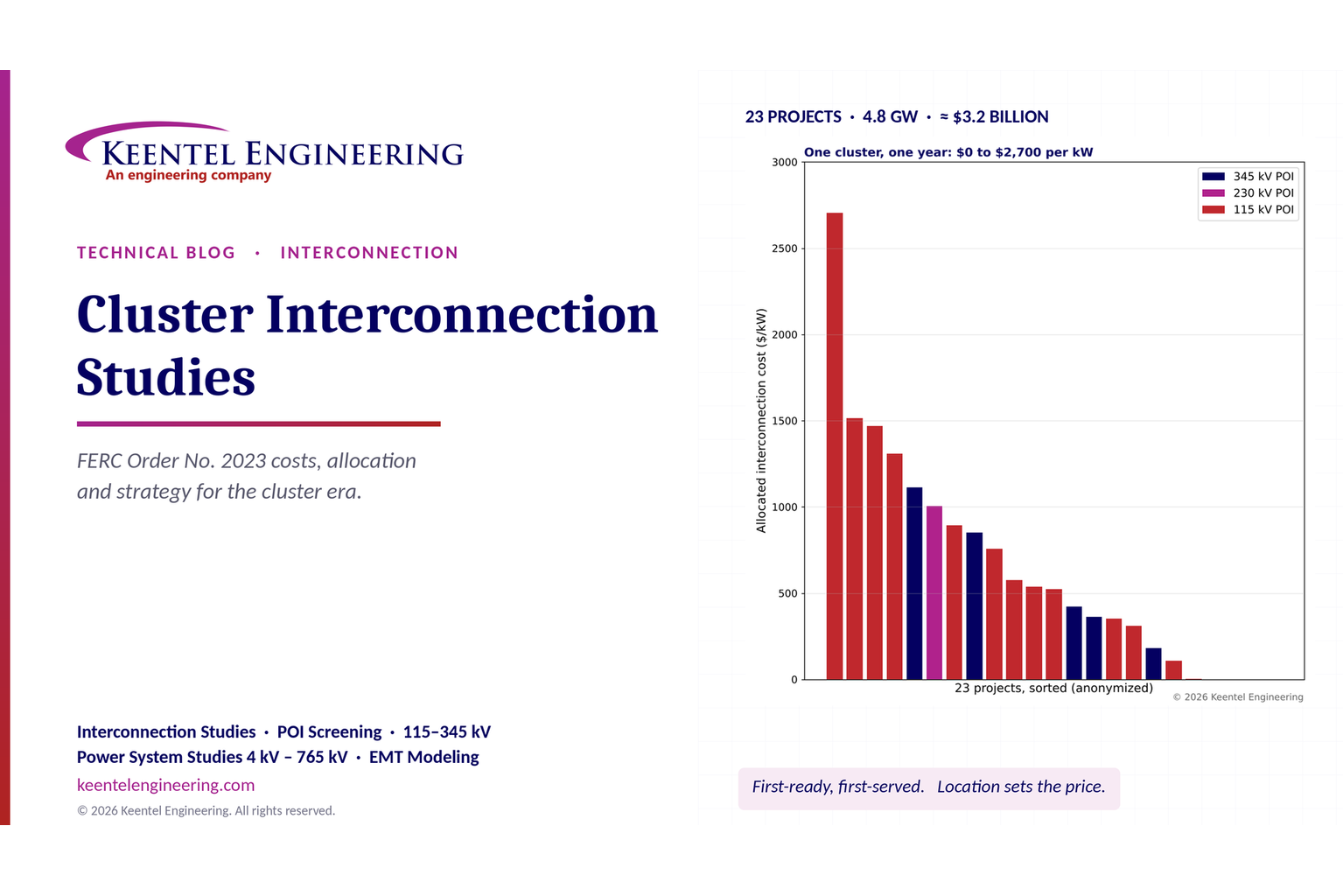
Explore cluster interconnection studies under FERC Order 2023, including network upgrades, cost allocation, withdrawal penalties and developer strategy.
By SANDIP R PATEL
•
October 21, 2026
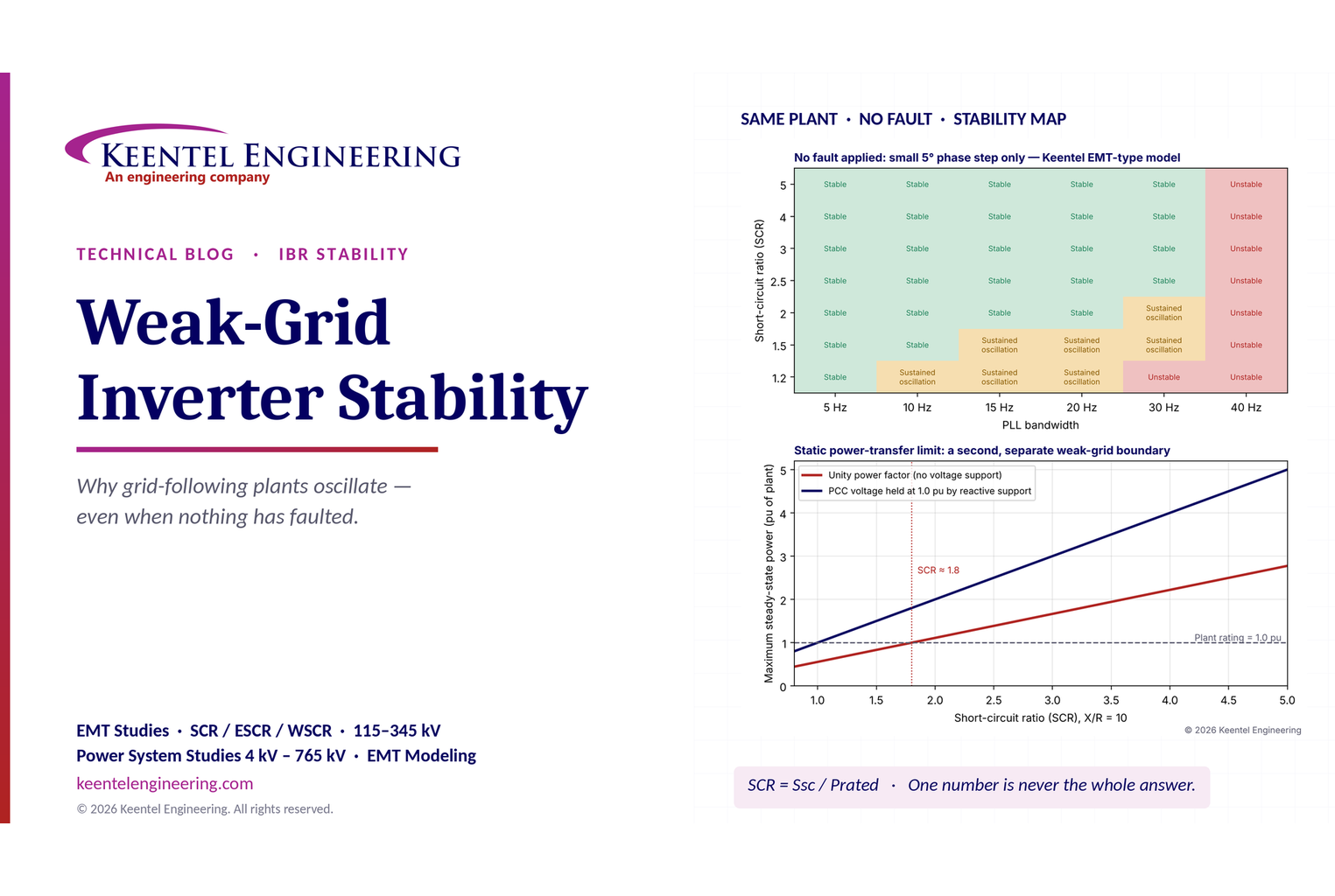
Learn why grid-following inverters become unstable without grid faults. Explore SCR, PLL interactions, EMT studies, grid strength, and mitigation.
By SANDIP R PATEL
•
October 21, 2026
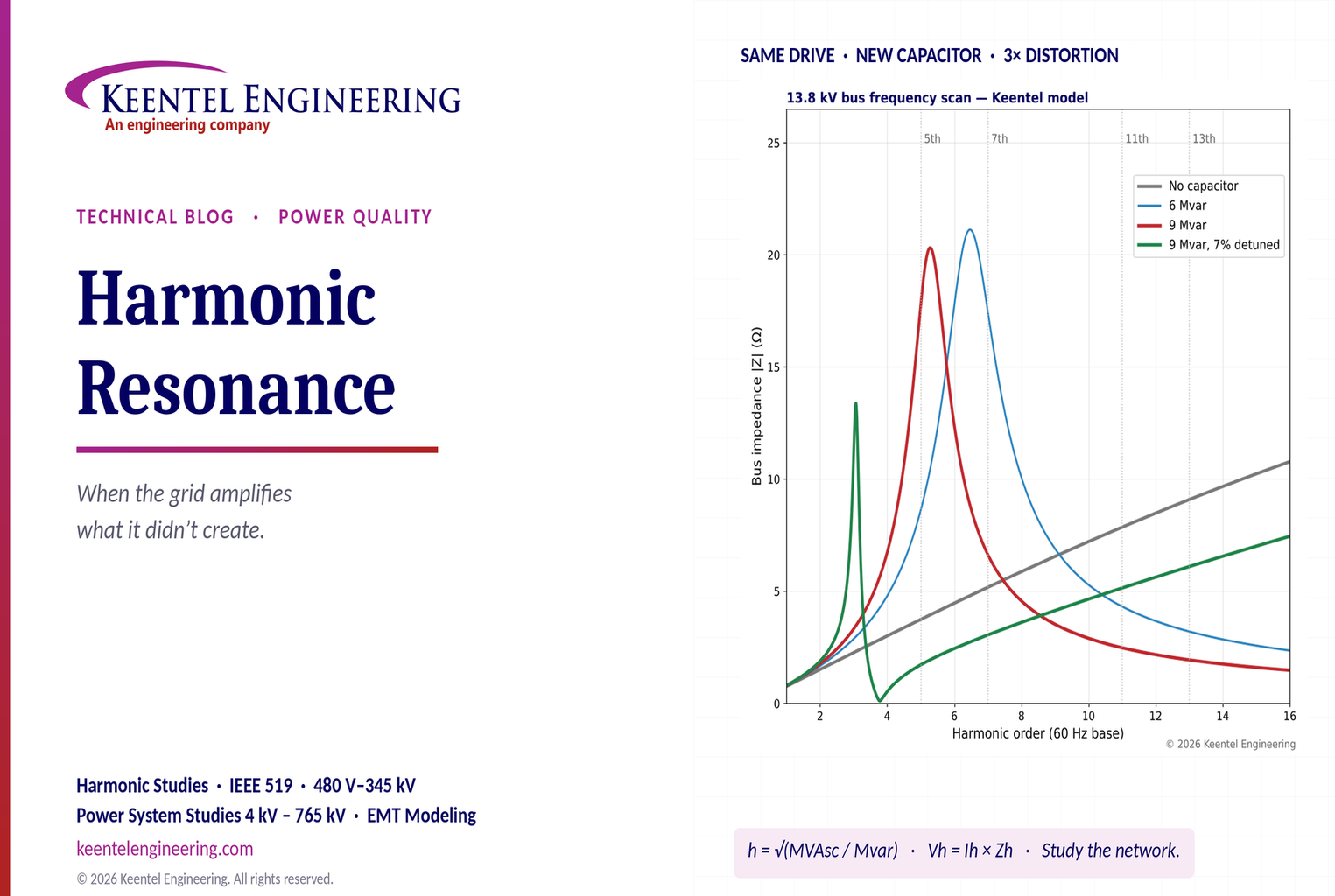
Learn how harmonic resonance amplifies distortion in power systems. Explore capacitor banks, detuned reactors, frequency scans, and IEEE 519 solutions.
By SANDIP R PATEL
•
October 20, 2026
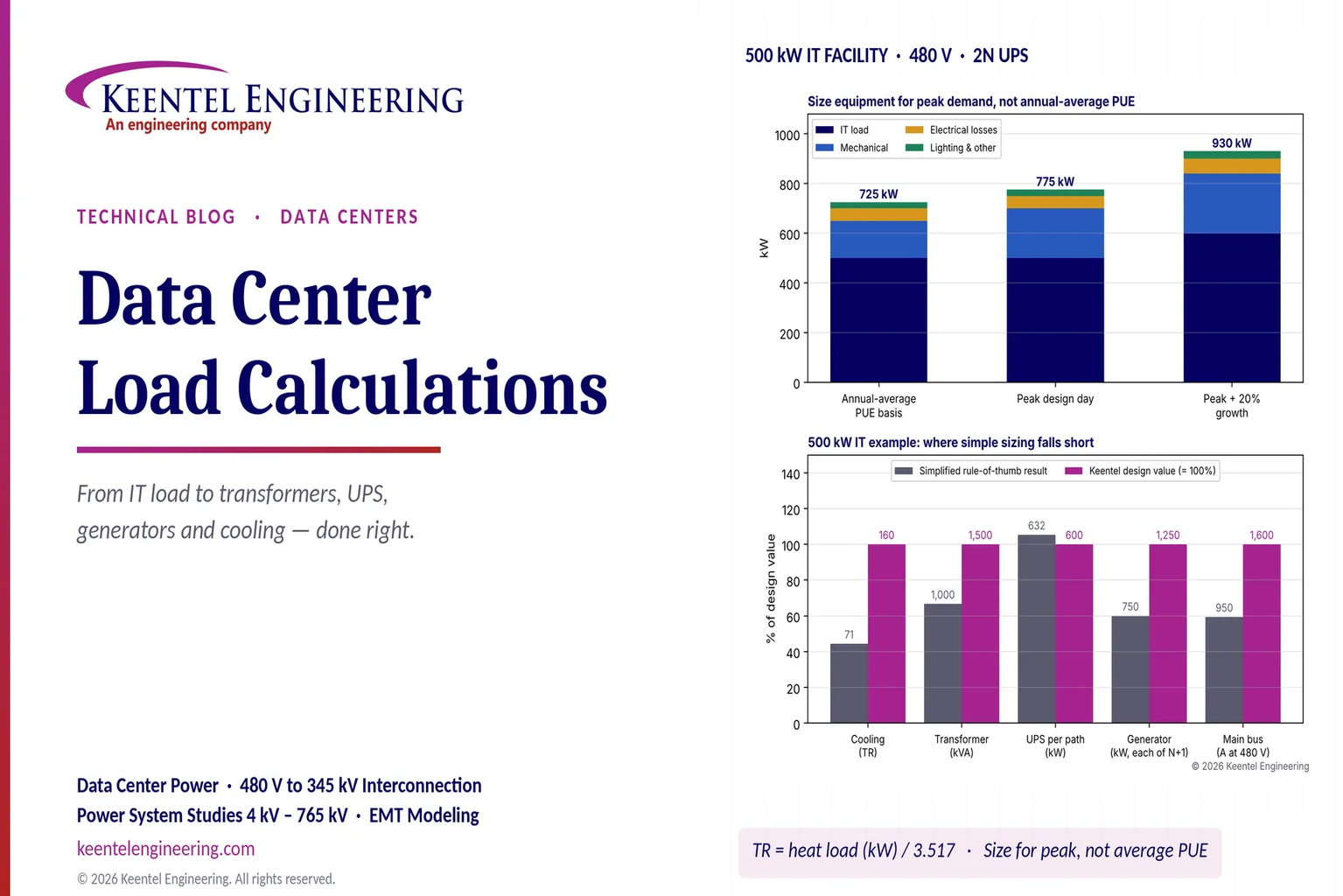
Learn data center electrical load calculations, including IT demand, PUE, UPS and generator sizing, cooling loads, redundancy, and worked US examples.
By SANDIP R PATEL
•
October 20, 2026
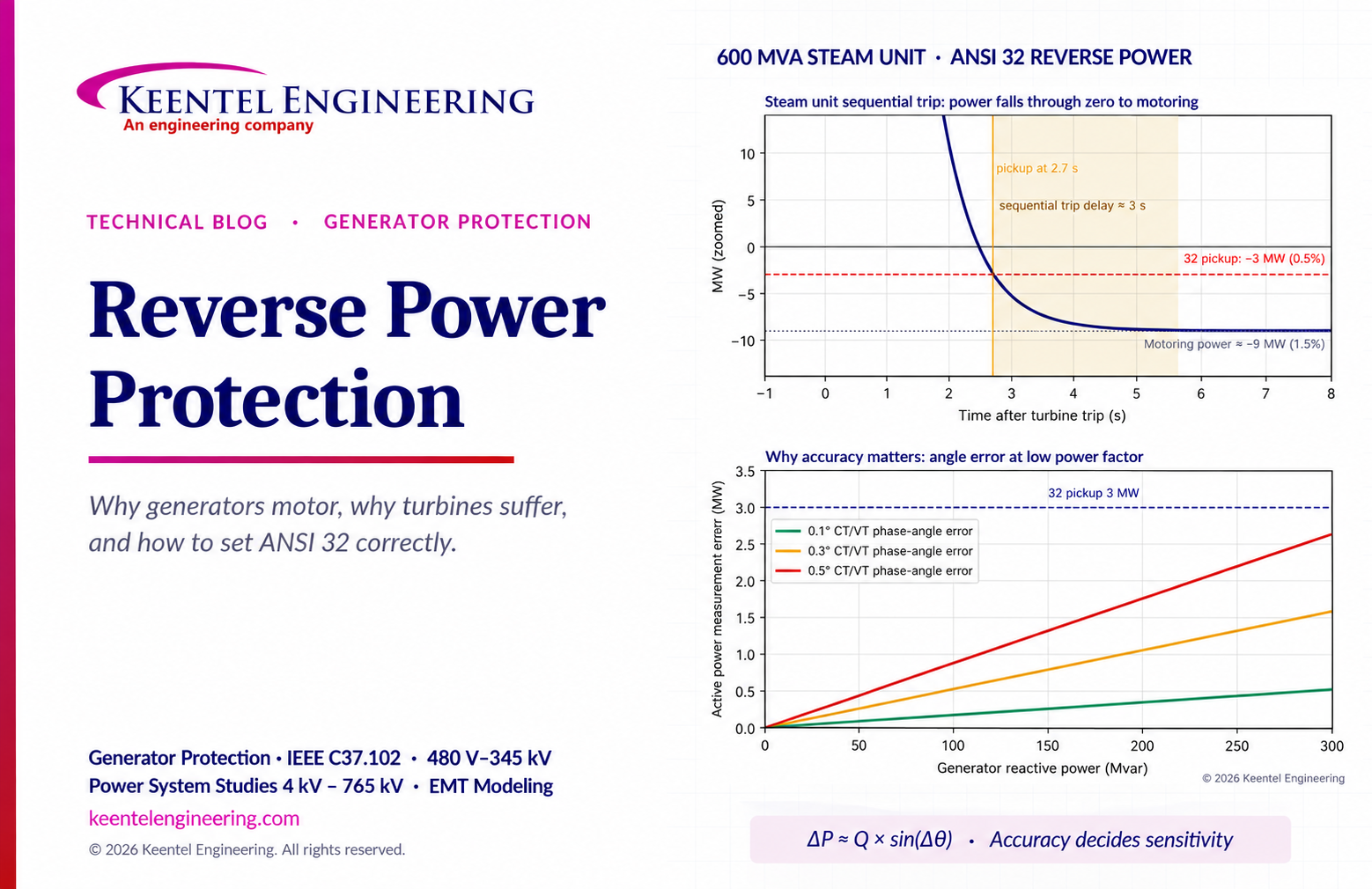
Learn reverse power protection (ANSI 32), generator motoring, relay pickup settings, time delays, sequential tripping and testing for US power plants.
By Team 2 Dexora
•
October 20, 2026
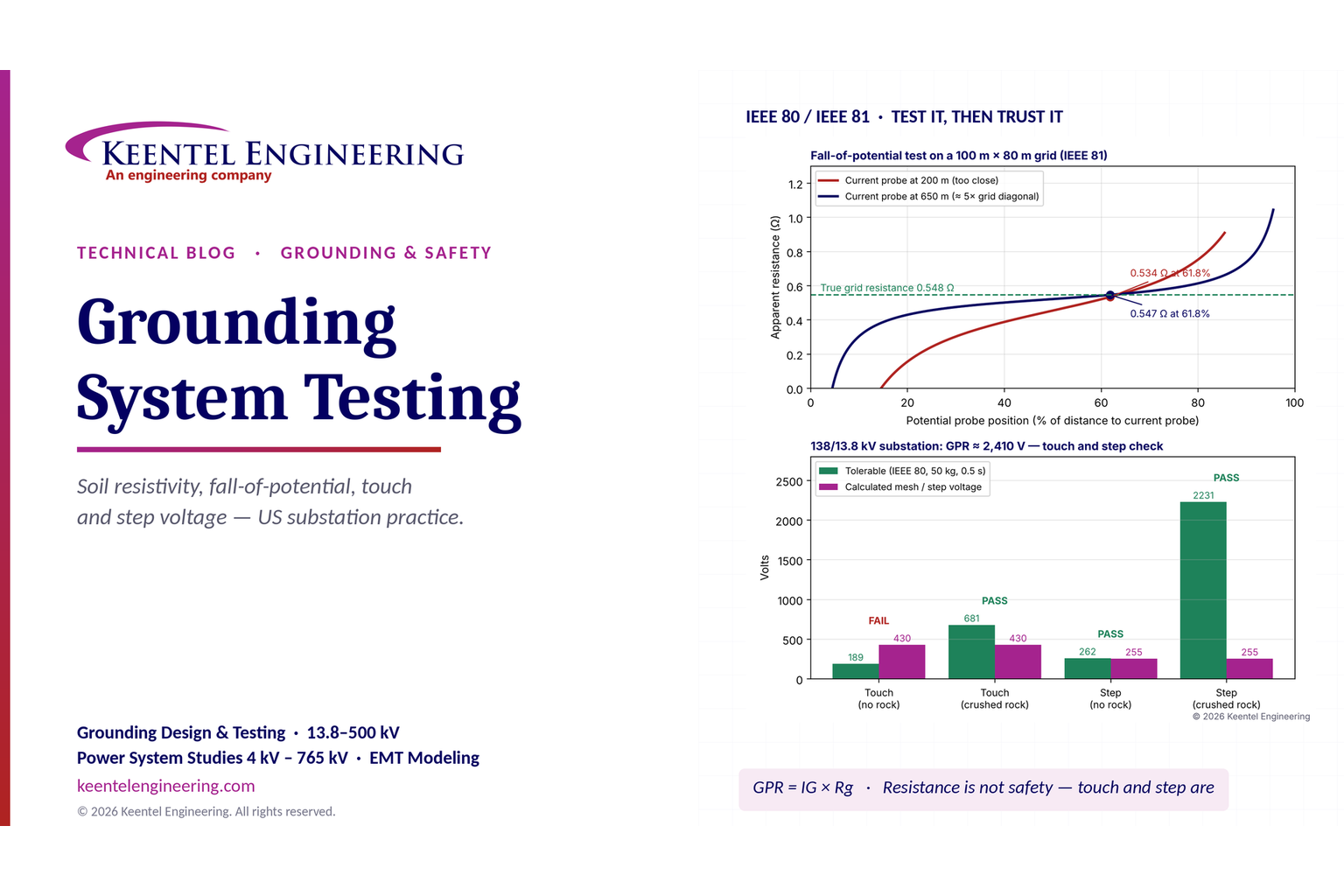
Explore grounding system testing with Keentel Engineering. Learn IEEE 80/81 methods, soil resistivity, ground resistance, and touch and step voltage safety.
By SANDIP R PATEL
•
October 13, 2026
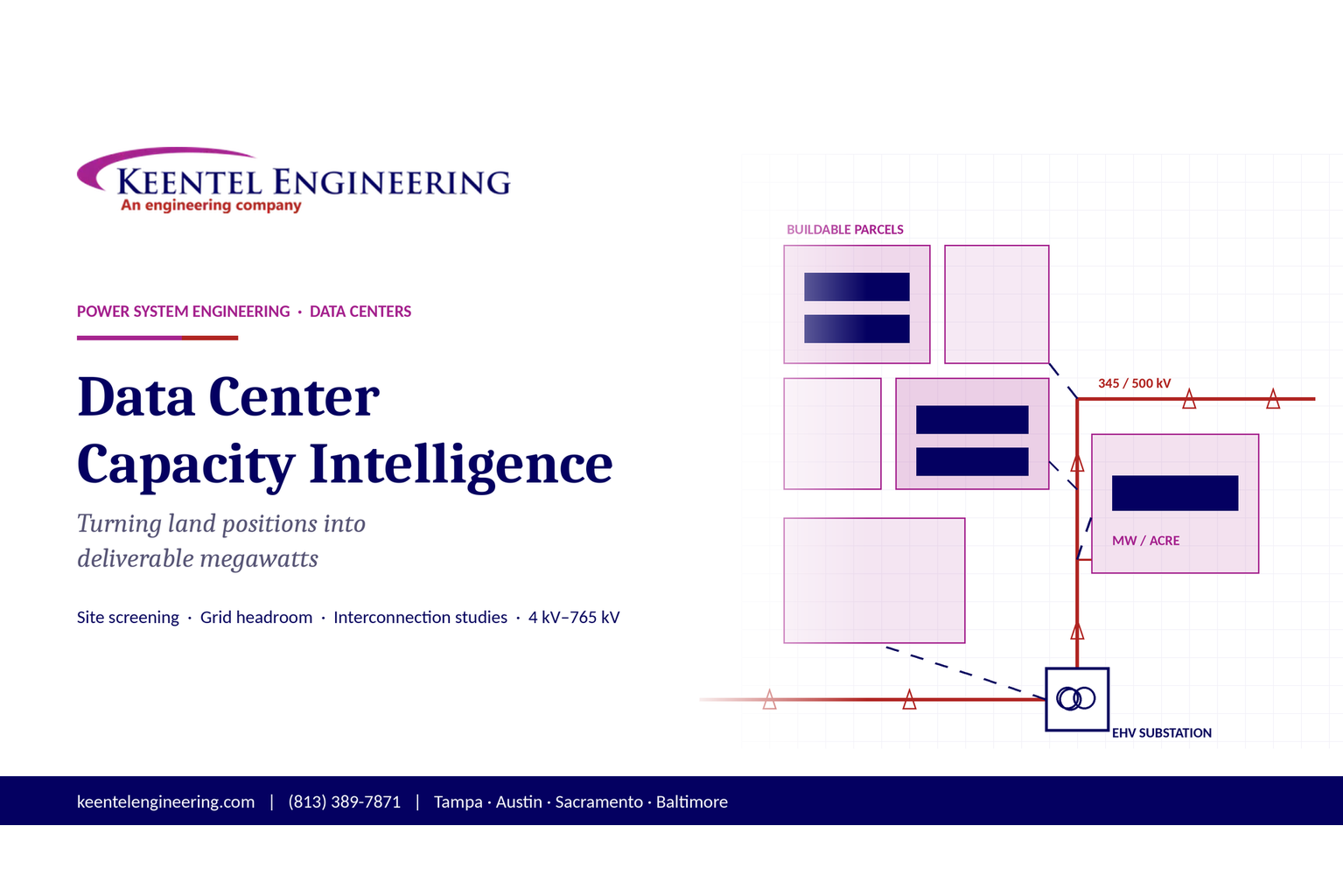
Plan data center capacity with land screening, MW-per-acre estimates, grid power availability and interconnection feasibility studies from Keentel Engineering.