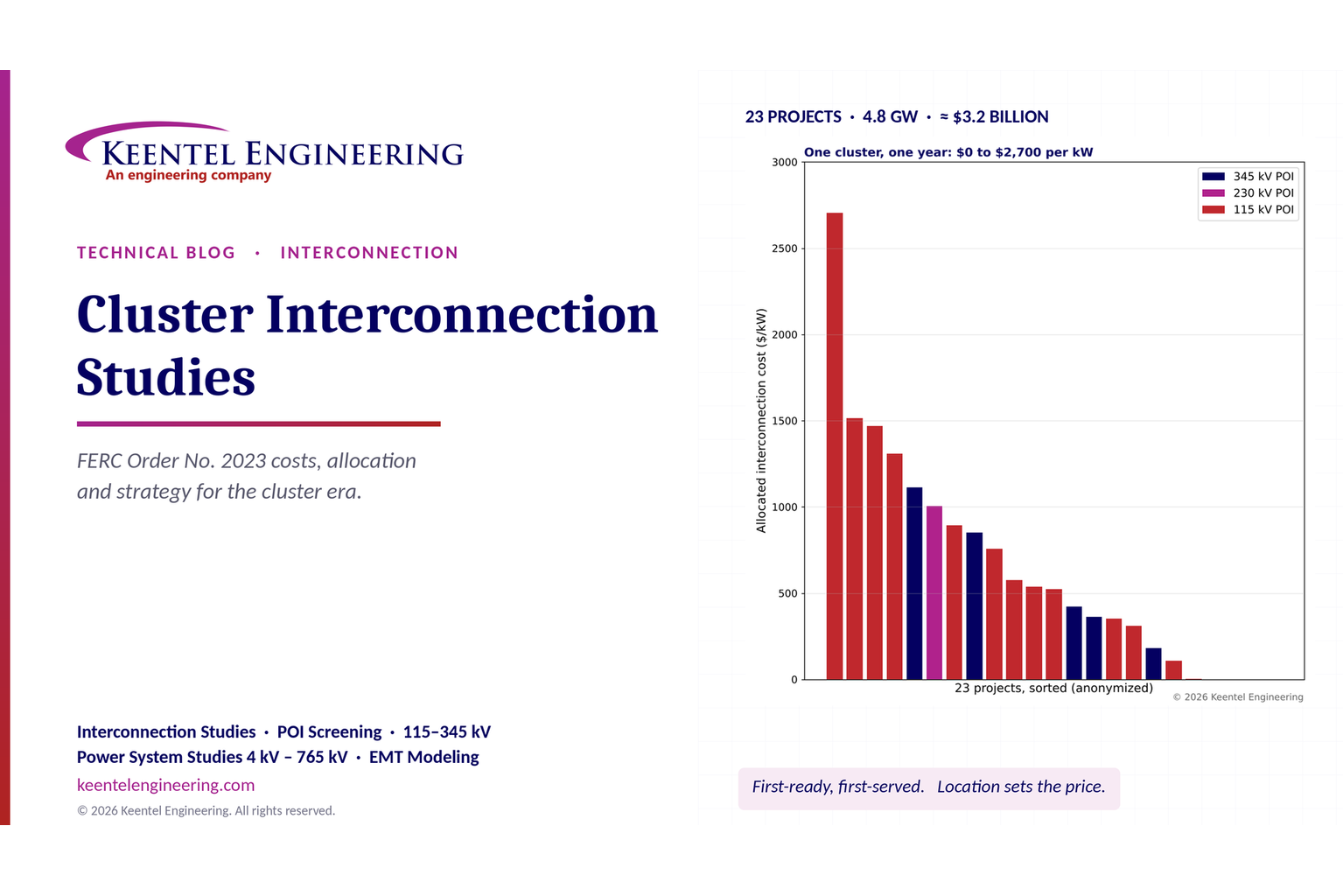

A Coordinated Electric System Interconnection Review—the utility’s deep-dive on technical and cost impacts of your project.

Challenge: Frequent false tripping using conventional electromechanical relays
Solution: SEL-487E integration with multi-terminal differential protection and dynamic inrush restraint
Result: 90% reduction in false trips, saving over $250,000 in downtime

Category Metric
VPP capacity (Lunar Energy) 650 MW
Lunar funding raised US$232 million
Data center BESS example 31 MW / 62 MWh
ERCOT grid-scale batteries 15+ GW
LDES tenders (H1 2026) Up to 9.3 GW
Lithium-ion share of LDES by 2030 77%
FEOC initial threshold 55%
BESS tariff rate (2026) ~55%
Capacity gain from analytics 5–15%

The Hidden Challenges of Digital Substations: Why Advanced Systems Demand Smarter Engineering

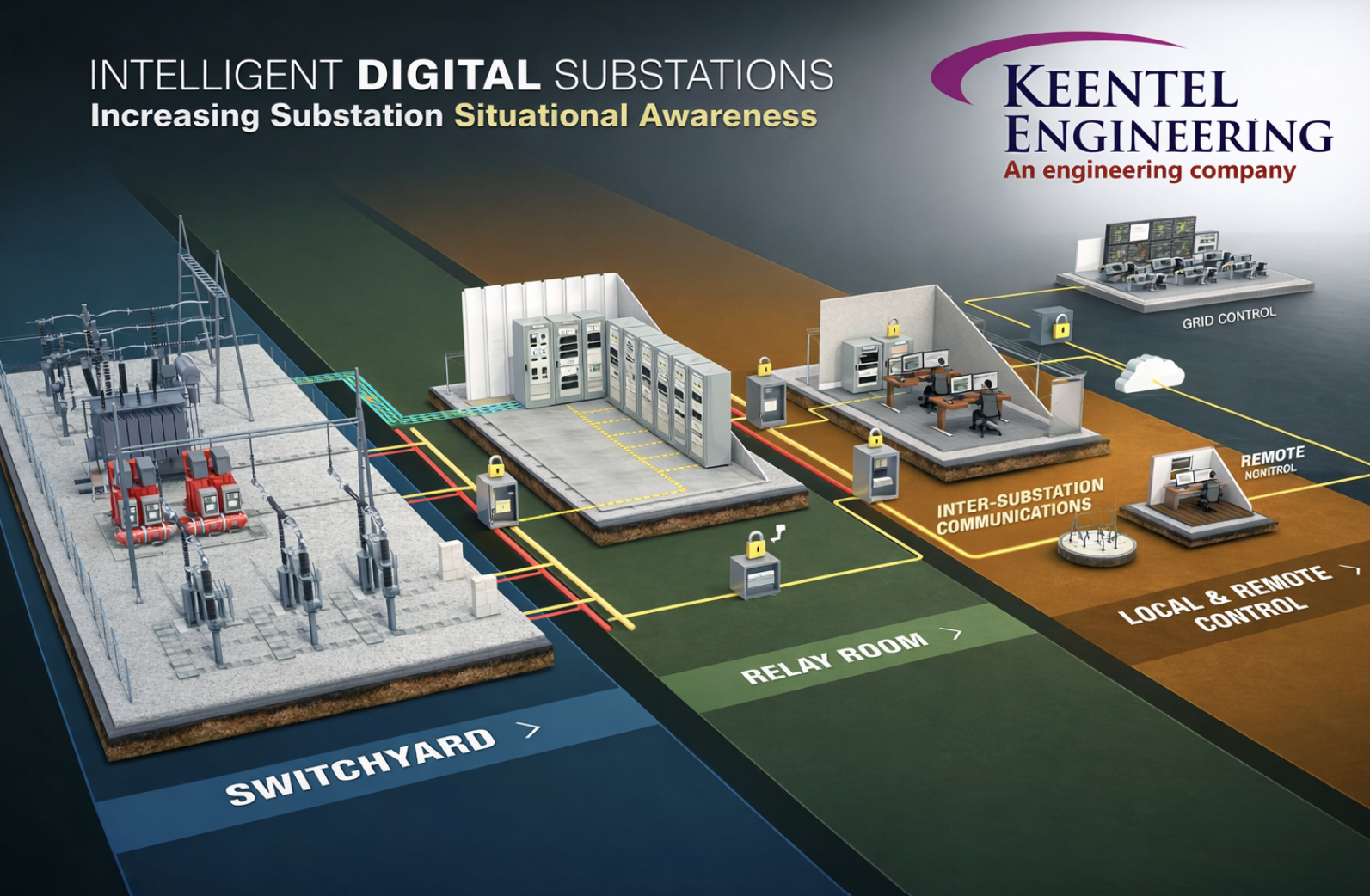
Digital substation with switchyard, relay room, and grid control for smart grid infrastructure.
Calendar icon. D

Apr 6, 2026  | blog

By Keentel Engineering

The power industry is undergoing a fundamental transformation. Digital substations driven by IEC 61850, fiber optics, and software-defined protection are rapidly replacing conventional hardwired systems.


While the benefits are undeniable reduced copper wiring, enhanced safety, and advanced diagnostics this transformation introduces a new class of engineering risks that many utilities underestimate.


This article explores the real-world challenges of digital substations, based on industry insights, and explains how expert engineering firms like Keentel Engineering mitigate these risks to deliver reliable, future-ready infrastructure.


1. From Copper to Code: A Paradigm Shift in Substation Design

Traditional substations rely on analog signals transmitted through copper wiring. Digital substations replace this with:


  • Fiber-optic communication 
  • IEC 61850 protocols 
  • Sampled Values (SV) and GOOSE messaging 


This transition dramatically reduces footprint and improves safety by eliminating high-energy analog signals in control rooms .


However, it also introduces network dependency, meaning system reliability is no longer purely electrical it is now digital.


2. Cybersecurity: The New Grid Vulnerability

In conventional substations, protection systems are physically isolated. Digital substations, however, integrate IT and OT networks.


This creates vulnerabilities such as:


  • GOOSE message spoofing 
  • Sampled Value injection attacks 
  • Lateral movement from IT networks into protection systems 


The PDF highlights how attackers can manipulate relay behavior by injecting false data into the network .

Keentel Engineering Approach

  • IEC 62351 cybersecurity implementation 
  • Network segmentation (Station Bus vs Process Bus) 
  • Deep packet inspection & intrusion detection

3. Precision Time Synchronization Risks

Digital substations depend on IEEE 1588 PTP (Precision Time Protocol) for sub-microsecond synchronization.


If synchronization fails:


  • Differential protection may misoperate 
  • False tripping can occur


Loss of GPS signals (due to weather or spoofing) can push systems beyond acceptable timing limits .

Engineering Solution

  • Redundant time sources (GPS + IRIG-B + internal oscillators) 
  • Holdover performance validation 
  • Time sync monitoring systems

4. Network Traffic Overload and Data Storms

Digital substations generate massive data volumes :


  • One merging unit can generate ~4800 frames/sec 
  • Multiple units create continuous high-bandwidth traffic 


A misconfigured network can cause:


  • Broadcast storms 
  • Dropped protection signals 
  • System-wide failures 

Best Practices

  • VLAN segmentation 
  • QoS prioritization (GOOSE over SV) 
  • Multicast filtering (IGMP/GMRP) 

5. IEC 61850 Interoperability Challenges

While IEC 61850 promises vendor interoperability reality is different.

Issues include:


  • Vendor-specific implementations 
  • Differences between Edition 1 and Edition 2 
  • Complex XML (SCL) configurations 

Keentel Engineering Advantage

  • Multi-vendor integration expertise 
  • SCL engineering and validation 
  • Factory Acceptance Testing (FAT) support 

6. Software-Defined Engineering Complexity

Digital substations rely on:


  • SCL (Substation Configuration Language) 
  • ICD, SSD, and SCD files


A single configuration error can:


  • Break communication 
  • Disable protection schemes

Solution

  • Configuration management systems 
  • Version control for SCL files 
  • Automated validation tools

7. Lifecycle Mismatch: IT vs Power Equipment

Primary equipment (transformers, breakers):


  • 40–50 year lifespan 


Digital components (IEDs, switches):


  • 10–15 year lifecycle 


This creates:


  • Increased operational costs 
  • Frequent upgrades 
  • Long-term planning challenges

8. Harsh Environmental Conditions

Digital substations push electronics into the switchyard.


Equipment must withstand:


  • Extreme temperatures (-40°C to +85°C) 
  • EMI/RFI interference 
  • Dust, humidity, vibration 

Engineering Focus

  • Ruggedized hardware design 
  • EMI shielding and grounding 
  • Environmental testing

9. The IT/OT Skills Gap

Modern engineers must understand:


  • Power system protection 
  • Networking (VLANs, protocols) 
  • Cybersecurity 
  • Data analysis tools like Wireshark 


This hybrid skillset is scarce .

Keentel Engineering Solution

  • Cross-disciplinary engineering teams 
  • Training programs for utilities 
  • Integrated IT + power system expertise 

10. Firmware and Configuration Risks

Firmware updates can:


  • Break GOOSE messaging 
  • Disrupt system coordination 
  • Require extensive testing 

Best Practice

  • Controlled update procedures 
  • Regression testing 
  • Compliance with NERC CIP

11. Redundancy Complexity (PRP & HSR)

Digital substations require zero downtime.


Protocols used:


  • PRP (Parallel Redundancy Protocol) 
  • HSR (High-availability Seamless Redundancy) 


While effective, they:


  • Double infrastructure cost 
  • Increase troubleshooting complexity 

Conclusion: Digital Substations Are Powerful—but Fragile Without Expertise

Digital substations represent the future of power systems. However, their reliability depends on:\


  • Advanced network design 
  • Cybersecurity integration 
  • Precise configuration management 
  • Skilled hybrid engineers 


As highlighted in the source material, the industry must evolve beyond traditional engineering silos to fully realize the benefits of digital substations .


Why Keentel Engineering?

Keentel Engineering delivers:


  • End-to-end IEC 61850 solutions 
  • Digital substation design & integration 
  • NERC compliance and cybersecurity 
  • Advanced modeling and system validation

Frequently Asked Questions (FAQs)

  • 1. What is a digital substation?

    A digital substation replaces analog wiring with fiber-optic communication and uses IEC 61850 protocols for protection, control, and monitoring.


  • 2. What are Sampled Values (SV)?

    SV are digitized voltage and current measurements transmitted over the process bus to protection relays.


  • 3. What is GOOSE messaging?

    GOOSE (Generic Object-Oriented Substation Event) is a high-speed communication protocol used for protection signals like breaker tripping.


  • 4. Why are digital substations more vulnerable to cyberattacks?

    They integrate IT and OT systems, exposing protection networks to cybersecurity risks.


  • 5. What happens if time synchronization fails?

    Protection systems may misinterpret data, leading to false trips or failure to trip.


  • 6. What is IEC 61850?

    An international standard defining communication protocols for substation automation systems.


  • 7. Why is interoperability difficult despite IEC 61850?

    Different vendors implement the standard differently, requiring complex configuration.


  • 8. What causes network congestion in digital substations?

    High volumes of Sampled Values data and improper network configuration.


  • 9. What is PRP vs HSR?

    • PRP uses duplicate networks 
    • HSR uses ring topology
    • Both ensure zero downtime. 

  • 10. How long do digital substation components last?

    Typically 10–15 years, compared to 40–50 years for primary equipment.


  • 11. What is the biggest challenge in digital substations?

    Managing the complexity of software-defined systems and ensuring reliable communication.


  • 12. Why is cybersecurity critical?

    Because malicious data injection can cause physical damage to equipment.


  • 13. What skills are required for digital substations?

    A combination of power systems, networking, cybersecurity, and software engineering.


  • 14. What is SCL in IEC 61850?

    Substation Configuration Language—an XML-based system configuration format.


  • 15. How does Keentel Engineering help utilities?

    By providing design, integration, cybersecurity, compliance, and testing services for digital substations.


Man in a blazer and open shirt, looking at the camera, against a blurred background.

About the Author:

Sonny Patel P.E. EC

IEEE Senior Member

In 1995, Sandip (Sonny) R. Patel earned his Electrical Engineering degree from the University of Illinois, specializing in Electrical Engineering . But degrees don’t build legacies—action does. For three decades, he’s been shaping the future of engineering, not just as a licensed Professional Engineer across multiple states (Florida, California, New York, West Virginia, and Minnesota), but as a doer. A builder. A leader. Not just an engineer. A Licensed Electrical Contractor in Florida with an Unlimited EC license. Not just an executive. The founder and CEO of KEENTEL LLC—where expertise meets execution. Three decades. Multiple states. Endless impact.

Four workers in safety vests and helmets stand with arms crossed near wind turbines.

Let's Discuss Your Project

Let's book a call to discuss your electrical engineering project that we can help you with.

Man in a blazer and open shirt, looking at the camera, against a blurred background.

About the Author:

Sonny Patel P.E. EC

IEEE Senior Member

In 1995, Sandip (Sonny) R. Patel earned his Electrical Engineering degree from the University of Illinois, specializing in Electrical Engineering . But degrees don’t build legacies—action does. For three decades, he’s been shaping the future of engineering, not just as a licensed Professional Engineer across multiple states (Florida, California, New York, West Virginia, and Minnesota), but as a doer. A builder. A leader. Not just an engineer. A Licensed Electrical Contractor in Florida with an Unlimited EC license. Not just an executive. The founder and CEO of KEENTEL LLC—where expertise meets execution. Three decades. Multiple states. Endless impact.

Leave a Comment

Related Posts

NERC BAL-007-1 Explained banner with power lines and April 1, 2027 effective date.
By SANDIP R PATEL April 3, 2026
Learn how NERC BAL-007-1 ensures energy adequacy, ERA methods, and proactive grid reliability strategies for utilities, developers & BAs.
Future NERC reliability standards for power grid and cybersecurity by Keentel Engineering
By SANDIP R PATEL April 1, 2026
Explore upcoming NERC Reliability Standards (2026–2029), including BAL-007 energy assessments, IBR ride-through rules, cybersecurity (CIP-003-9), and extreme weather planning. Learn compliance strategies, risks, and real-world case studies.
Substation equipment testing and validation process with electrical panels and FAT inspection
By SANDIP R PATEL March 31, 2026
Learn the complete substation testing lifecycle including Type Testing, FAT, and SAT. Discover how to reduce risks, improve reliability, and ensure NERC compliance.
Internal inspection engineers identifying root causes in industrial equipment at Keentel Engineering
By SANDIP R PATEL March 31, 2026
Explore advanced transformer failure analysis methods, diagnostics, and prevention strategies used by power system engineers.
Power system engineering services for data centers and industrial large load integration
By SANDIP R PATEL March 28, 2026
Explore SEL PMU devices, IEEE-compliant synchrophasor tech, and grid monitoring solutions for real-time visibility, stability, and renewable integration.
Phasor Measurement Unit (PMU) and WAMS system architecture for real-time power grid
By SANDIP R PATEL March 28, 2026
Explore how PMU and synchrophasor technology with WAMS improves grid visibility, detects oscillations, and ensures stability in modern power systems.
Power system engineering services for data centers and industrial large load integration
By SANDIP R PATEL March 19, 2026
Large load integration solutions for grid reliability, data centers, and industrial power systems with advanced engineering and compliance support.
Large load grid reliability solutions for AI data centers and industrial power systems
By SANDIP R PATEL March 19, 2026
Large loads are reshaping grid behavior. Discover risks, interconnection challenges, and engineering solutions for reliable power system integration.
Keentel Engineering transmission infrastructure project with utility truck, construction loader.
By SANDIP R PATEL March 13, 2026
FERC Order 1920-B introduces long-term regional transmission planning reforms in the U.S. Learn how the rule affects utilities, renewable integration, and grid infrastructure development.