A Coordinated Electric System Interconnection Review—the utility’s deep-dive on technical and cost impacts of your project.
Challenge: Frequent false tripping using conventional electromechanical relays
Solution: SEL-487E integration with multi-terminal differential protection and dynamic inrush restraint
Result: 90% reduction in false trips, saving over $250,000 in downtime
Integrating Data Centers into the PJM Grid


June 1, 2026 | Blog
In-Depth Explainer: PJM and the Large Load Surge
If you are trying to bring a large data center online anywhere in the PJM footprint, you have probably already felt the tension at the heart of this article: you want to connect quickly, and the grid operator wants to make sure the lights stay on for everyone else while you do it. Over the course of 2025, PJM Interconnection moved from talking about that tension to filing concrete rules to manage it. This explainer walks through what PJM is proposing, why, and what it means for anyone planning a large load addition.
The story unfolds in three altitudes: PJM's May 2025 stakeholder workshop laid out the concepts; the November 2025 Critical Issue Fast Path (CIFP) Stage 4 package hardened them into filed proposals with dates and dollar figures; and a real-world forecasting dispute shows exactly where the friction lands for a developer's pipeline.
Why this is happening: a demand curve that bent upward
For most of the last fifteen years, electricity demand in the PJM region was essentially flat. That era is over. PJM's 2025 summer-peak forecast now climbs from roughly 155,000 MW today toward more than 230,000 MW by the mid-2040s. More striking than the absolute number is the shape of the curve: laid against every prior year's forecast, the older lines crawl along gently while the 2025 line bends sharply upward beginning around 2026. The growth is both large and recent — it appeared in the forecasts faster than the system was built to absorb it.
The cause is no secret. The new demand is dominated by data centers, increasingly by very large hyperscale facilities tied to artificial intelligence and cloud computing. PJM frames this growth as a genuine opportunity — economic development, jobs, investment, technological leadership, even national security — and has been explicit that it does not see its role as turning these loads away. PJM cannot refuse load integrations; utilities and load-serving entities tell PJM what is coming, and PJM has to plan to serve it.
The difficulty is that wanting to serve large loads and being able to serve them reliably are different things. PJM has identified four problems that must be solved together:
- Supply may not keep up. Forecasted generation may be insufficient to meet forecasted load as the curve steepens.
- The timing is misaligned. Load is growing fast at the same moment older generators retire, and new generation and transmission take years to build. Transitional mechanisms may be needed to bridge the gap.
- Large loads do not want to be flexible. Existing demand-side products give them too little reason to participate; data centers prefer to run continuously, and on-site back-up units face environmental limits on run time.
- Speed-to-market pushes developers off the grid. Because data centers want to energize quickly, some pursue co-location arrangements outside PJM's markets and planning — which PJM views as less reliable.
PJM's guiding principle: come in as Network Load
PJM's strong preference is for large loads to interconnect as Network Load — fully integrated into the grid, accounted for in planning, and served like any other firm load. PJM argues this delivers less operating complexity, more reliable service for critical facilities, better curtailment-priority management in emergencies, and more holistic planning.
The arrangement that worries PJM is the islanded co-located configuration, where a large load sits behind a generator with protection equipment designed to prevent it from drawing grid energy. In PJM's eight-option framing these are Options 4 and 5 — and PJM explicitly does not prefer them. Under those arrangements neither the generator nor the load pays for transmission or energy and ancillary services, the load is invisible to forward planning, and the complex relay schemes create operational risks such as power swings and transient impacts to voltage and frequency. PJM's pitch to developers is therefore: come inside the tent as Network Load, and we will give you flexible, faster ways to do it.
The three paths (and the eight options behind them)
In its response to the FERC Section 206 proceeding on co-located load (Docket No. EL25-49), PJM described eight integration options. Three already exist under its Tariff — variations on network load with separate or shared points of interconnection, and existing behind-the-meter generation rules. Five are newer. PJM has cautioned that the options are not all equally workable, are not mutually exclusive, and that state laws may limit when load can be served by anyone other than the franchised utility. Setting aside the not-preferred islanding options, the constructive menu collapses into three paths.
Path 1 — Bring Your Own Generation (Option 6)
A new large load brings incremental generation that commits to PJM's capacity market (the Reliability Pricing Model, or RPM) alongside the new demand — through ownership or a demonstrated Power Purchase Agreement. The generation need not be physically co-located; it must meet or exceed the load on an unforced-capacity (UCAP) basis. The payoff is favorable treatment: such a load would only be curtailed in a true emergency manual load-dump, much like residential load. PJM also points to Provisional Interconnection Service (enabled under FERC Order 845) as a way to interconnect generation faster — signing a provisional agreement before all studies and network upgrades are complete, saving roughly 6 to 12 months in exchange for accepting the risk that additional upgrades surface later.
Path 2 — Demand Response (Option 8)
Rather than building generation, a large load earns better terms by reducing consumption when the grid is stressed. The problem is that hyperscalers barely participate today — traditional enterprise data centers make up only about 3% of demand-response capacity, and the largest facilities have essentially no track record. PJM's diagnosis is that the barriers are fixable: emissions rules limit back-up generation run time; the ELCC accreditation method undervalues some demand response; and cost-recovery rules make participation unattractive. Proposed fixes include partnering with state and federal authorities to relax emissions limits during pre-emergency conditions, creating a dedicated data-center accreditation class, expanding cost recovery toward revenue-neutrality, and exploring seasonal or transitional products with limits on curtailment frequency.
Path 3 — Non-Capacity Backed Load (Option 7)
This is the explicitly transitional option and the most novel. It becomes available only when a resource-adequacy test fails — when projected supply falls short of the reliability requirement. In that situation, a large load above a threshold can integrate at reduced cost in exchange for agreeing to curtail before emergency procedures begin. The trade is clear: the load does not pay for capacity and has minimal or no impact on capacity prices, but accepts pre-emergency curtailment, with residential customers given priority in extreme conditions. Importantly it is still treated as Network Load for planning and remains fully part of transmission planning, so the grid is still built to serve it. If an electric distribution company declines the option on a load's behalf, that load falls back to status-quo curtailment rules.
From concept to commitment: the CIFP Stage 4 package
The May workshop was PJM thinking out loud. By November 2025 the concepts had hardened into a package filed under the Critical Issue Fast Path process — PJM's expedited route for urgent issues. The trigger was concrete: the capacity auction for the 2025/2026 delivery year returned tight system conditions, confirming the supply-shortfall concern was not hypothetical. The package has five components; three matter most to developers.
Enhanced load forecasting
Beginning with PJM's 2027 Load Forecast, new elements include a step for state commissions to review large-load adjustments before the forecast is finalized; a duplicative-request disclosure rule (with the penalty that unflagged-but-duplicative requests can be removed entirely); added third-party and national cross-check review; and a transparency requirement that customer non-disclosure agreements must permit utilities to share large-load information with PJM. Several rules are already in place and directly shape how much of a project's nameplate lands in the forecast: loads tied to a Construction Commitment or Electric Service Obligation contract are considered for inclusion; projects further out without firm commitments get de-rated; PJM applies a default 3-year ramp rate absent the utility's own; it uses a default utilization factor of around 70% unless given supporting data; and it expects documented financial commitments.
Demand-side products
PJM is reforming Price Responsive Demand (PRD) for the 2028/2029 Base Residual Auction — removing the old dynamic-retail-rate requirement, replacing it with an energy-market bid price, and aligning PRD dispatch order and penalties with demand response. Notably, PJM is not proposing broader new demand-response products in this package; a limited-duration product some stakeholders wanted cannot be implemented until the 2029/2030 auction.
The Expedited Interconnection Track (EIT) — the one to watch
For developers, this is the headline: a new track, targeted for mid-2026, running in parallel to and outside the normal interconnection Cycle Process, built for shovel-ready generation tied to new large load. Its key parameters
| Parameter | EIT requirement |
|---|---|
| Speed | ~10 months from application; commercial operation within 3 years |
| Size | Generation greater than 250 MW (UCAP) |
| Fuel type | All fuel types eligible, including storage |
| State backing | Evidence of state commitment to expedite permitting and siting (e.g., governor's office or siting authority letter) |
| Deposits | Nonrefundable study deposit over $500,000; readiness deposit of $10k/MW (paired with load) or $20k/MW (not paired) |
| Cost responsibility | 100% of identified network upgrades; no cost-sharing |
| Flexibility | Essentially no post-agreement changes to site control, fuel type, MW size, or equipment |
| Volume | Capped at 10 projects per year; prioritized serially as applications arrive |
The trade is explicit: speed and certainty in exchange for real financial commitment and inflexibility. This is Path 1 turned into an actual filing.
CIFP Phase II and beyond
PJM also recommended its Board invoke a narrower second phase to incentivize load flexibility when PJM is capacity-deficient and to reform the manual load-shedding allocation methodology and the RPM reliability-backstop mechanism. A separate post-CIFP track commits to longer-term resource-adequacy work that will not be ready before the 2028/2029 auction.
Where the friction actually lands: forecast discounting
The most relatable illustration of all this comes from how PJM treats a utility's large-load forecast. A utility working directly with its customers may compile a pipeline of data-center projects backed by signed agreements and binding financial penalties, then submit it for inclusion in the PJM load forecast. PJM applies its own methodology — and can discount that pipeline heavily. In one documented case PJM discounted all signed-agreement projects to zero for in-service dates before 2031 (citing infeasible construction and material timelines) and applied a 33% discount to projects beyond 2031. The utility pushed back, warning that aggressive discounting risks delayed transmission upgrades in-zone reliability violations, and far costlier emergency fixes later.
For a developer the lesson is direct and uncomfortable: a signed contract with your utility does not guarantee that PJM counts your megawatts in its plan. The strength of your milestones, the credibility of your in-service date, your ramp schedule, and your financial commitments all feed into whether — and how much of — your project survives PJM's discounting. The forecasting rules are not bureaucratic footnotes; they are the filter your project passes through.
Timeline and what to do now
Pulling the dates together: forecasting changes begin with the 2027 Load Forecast; the Expedited Interconnection Track and transparency measures target mid-2026; PRD reforms and many large-load rules aim for the 2028/2029 Base Residual Auction in June 2026; a limited-duration demand-response product waits until the 2029/2030 auction; longer-term resource-adequacy work comes afterward. Practical takeaways for developers:
- Plan to be Network Load, not an island. PJM's incentives, faster pathways, and favorable curtailment treatment flow to loads that integrate fully and pair with committed supply.
- Decide early which path fits. Bring-your-own-generation (possibly via the EIT) buys speed and reliability but demands capital and rigidity; demand response and non-capacity backed load trade flexibility for lower cost. They are not mutually exclusive.
- Treat your forecast submission as a deliverable. Firm contracts, demonstrable milestones, realistic ramp rates, and documented financials convert requested megawatts into counted megawatts.
- Watch the dockets and the deposits. The FERC 206 proceeding and CIFP filings will set the final rules, and the EIT deposit structure means early commitment carries real cost.
Part 2 — Case Studies (Confidential)
The following are anonymized, composite case studies. They contain no project names, no client names, and no locations, and they combine details from representative engagements to illustrate how PJM's large-load rules play out in practice. Figures are illustrative and rounded.
Case Study A — A hyperscale load takes the bring-your-own-generation route
Profile: A hyperscale operator planning a multi-hundred-megawatt computing campus within the PJM footprint, targeting energization roughly three years out.
Situation. The operator's first instinct was an islanded co-located design — sit behind a dedicated generator and avoid the queue. Early diligence flagged the problems PJM had signaled: the configuration is not preferred, it leaves the load invisible to planning, and the relay schemes needed to prevent grid lean introduce operational risk. It also exposed the campus to weaker curtailment treatment and an uncertain regulatory posture as the FERC 206 proceeding evolved.
Approach. We modeled the campus instead as fully integrated Network Load paired with matching incremental generation under Path 1. Because the generation did not need to be physically co-located, the operator secured supply through a PPA sized to exceed the campus peak on a UCAP basis rather than nameplate — which required deliberately over-procuring nameplate to clear the accreditation de-rate. To compress schedule, the generation interconnected via an expedited path: a large nonrefundable study deposit and readiness deposit at the paired-with-load rate, full responsibility for identified network upgrades, and three years of locked site control at application.
Outcome. The campus achieved a credible path to energization on the operator's timeline while qualifying for residential-like curtailment treatment, meaning interruption only in a genuine emergency manual load-dump. The cost was front-loaded capital and a deliberately inflexible design — no post-agreement changes to fuel type, size, or site.
Lessons for developers. First, the UCAP match, not nameplate, governs how much generation you must commit. Second, the expedited path's lower deposit is a direct reward for pairing generation with load. Third, inflexibility is the price of speed — lock your engineering before you commit.
Case Study B — A development pipeline collides with forecast discounting
Profile: A developer with a multi-gigawatt pipeline of data-center projects across several years, each backed by signed agreements and financial penalties for cancellation, relying on its utility to submit the pipeline as a Large Load Adjustment.
Situation. The developer assumed that signed agreements plus binding penalties would secure inclusion in the PJM load forecast at close to face value. When the forecast was finalized, PJM had applied aggressive haircuts: the earliest in-service years were discounted heavily on the grounds that construction and material lead times made those dates infeasible, and later years carried a substantial percentage discount. The gap between requested and counted megawatts was large enough to threaten the timing of the transmission upgrades the pipeline depended on.
Illustrative requested-vs-counted pattern (rounded, anonymized):
| NumberIn-service window | Requested (MW) | Reflected after PJM treatment |
|---|---|---|
| Earliest years | Several thousand | Discounted toward zero (timelines judged infeasible) |
| Middle years | Growing cumulative | Slower ramp applied |
| Later years | Pipeline peak | Material percentage discount applied |
Approach. We treated the forecast submission as an engineering deliverable rather than a paperwork step. That meant supplying project-specific ramp schedules in place of the conservative default; documenting utilization with the contractual minimum-demand basis instead of accepting the default factor; assembling the milestone evidence PJM weighs — site control, procurement status, permitting progress, and quantified financial commitment; and proactively disclosing any potentially duplicative siting to avoid wholesale removal under the duplicative-request rule.
Outcome. The discounting did not vanish — PJM applies its own methodology regardless — but a better-substantiated submission narrowed the gap on the projects with the strongest evidence, and gave the developer a clear-eyed view of which megawatts to rely on for its own infrastructure planning. The exercise also reframed internal expectations: the team stopped treating a signed contract as equivalent to a counted megawatt.
Lessons for developers. A signed contract is necessary but not sufficient. Near-term, fast-energization claims draw the most skepticism, so be ready to defend lead times. The defaults are conservative by design; project-specific, well-documented inputs are the lever you control.
Case Study C — A transitional bridge using flexibility before supply arrives
Profile: A large-load developer needing to energize well before any matching generation could realistically be interconnected and accredited, in a zone where projected supply was tight.
Situation. A pure bring-your-own-generation approach was the right end state but could not meet the energization date — the supply would not be online and accredited in time. The developer needed a way to begin operating sooner without either taking on the not-preferred islanded design or absorbing full capacity costs during a period when capacity was scarce and expensive.
Approach. We structured a sequenced strategy. As a bridge, the load was set up to use a flexibility-based posture: in the resource-adequacy-constrained zone, the non-capacity backed load option allowed integration at reduced cost in exchange for accepting pre-emergency curtailment, while still being planned as Network Load. In parallel, the load enrolled its reliable on-site back-up generation in demand response, positioned to benefit from the proposed data-center accreditation class and expanded cost recovery so that participation trended toward revenue-neutral. The durable plan remained a transition to fully capacity-backed Network Load once committed generation came online.
Outcome. The load energized on the developer's timeline at a materially lower carrying cost during the bridge period, accepting a defined and pre-coordinated curtailment exposure rather than an uncontrolled one. Advance coordination of the back-up facilities minimized expected downtime, and the developer retained a clean migration path to the capacity-backed end state.
Lessons for developers. The paths are sequencing tools, not a one-time choice. Transitional options like non-capacity backed load are gated by a resource-adequacy test, so they are situational — available precisely when supply is short. Reliable, well-documented back-up generation is what makes the flexibility paths viable, and the value of that flexibility improves as the proposed accreditation and cost-recovery reforms take effect.
Part 3 — Technical FAQ
The questions below go a level deeper than a general overview, aimed at engineering and
development teams evaluating a PJM large-load project. Answers reflect PJM's 2025 workshop
materials, the CIFP Stage 4 package, and a representative utility load-adjustment submission.
This is general technical information, not legal or regulatory advice; confirm against current PJM
filings and FERC docket activity.
Q1. What exactly qualifies a load as a "large load" for these rules?
There is no single bright line across every rule, but the mechanisms are aimed at multi-
megawatt facilities — overwhelmingly data centers — large enough to materially affect resource
adequacy in a zone. The Expedited Interconnection Track, by contrast, sets an explicit floor on
the paired generation side: requests must be for large-scale generation greater than 250 MW on
a UCAP basis. Non-capacity backed load is similarly framed as applying to loads above a
certain threshold. For planning purposes, the practical trigger is whether your load is large
enough to be submitted as a Large Load Adjustment by your EDC/LSE.
Q2. What is the difference between Network Load and a co-located islanded load, in operational terms?
Network Load is electrically integrated and fully served by the grid: it pays transmission and
energy/ancillary charges and is incorporated into the load forecast, RPM planning parameters,
and RTEP transmission planning. An islanded co-located load (Options 4 and 5) sits behind a
generator with protection equipment that prevents it from drawing system energy when the
generator is offline; neither party is assessed transmission or energy/ancillary charges, and the
load is excluded from forward planning. The operational cost of islanding is real: PJM cites
power swings and transient voltage/frequency impacts from the complex relay schemes
required to keep the load from leaning on the grid.
Q3. On a bring-your-own-generation arrangement, does the generation have to be physically co-located with my load?
No. PJM is explicit that new generation does not need to be co-located. What matters is that the
quantity of committed generation meets or exceeds the load on a UCAP (unforced capacity)
basis and commits to RPM alongside the new load, whether by ownership or a demonstrated
PPA. Electrical proximity can provide efficiencies, but it is not a requirement of the path.
Q4. What does UCAP mean and why does PJM frame the match on a UCAP rather than nameplate basis?
UCAP (Unforced Capacity) is a resource's capacity value de-rated for its forced-outage history
and, increasingly, its accredited reliability contribution. Matching load to generation on a UCAP
basis ensures the commitment reflects the capacity the resource can actually be relied upon to
deliver during tight conditions, not its optimistic nameplate. For a developer pairing generation
with load, this means you generally need more nameplate than your peak load to clear the
UCAP match — the multiplier depends on the resource's accreditation.
Q5. How does Provisional Interconnection Service actually compress the timeline, and what is the risk?
Under FERC Order 845, a developer can sign a provisional interconnection agreement based
on a preliminary reliability study and proceed to engineering, procurement, and construction in
parallel with — rather than after — the full interconnection studies. That can save roughly 6 to
12 months. The risk is borne by the developer: if the completed studies identify additional
network upgrades or modifications, those fall on the project, and Capacity Interconnection
Rights are not assigned until all necessary upgrades are complete. It is a deliberate speed-for-
risk trade.
Q6. What are the precise eligibility and cost terms of the Expedited Interconnection Track (EIT)?
Key terms: generation greater than 250 MW UCAP; all fuel types including storage; capacity-
resource status and Capacity Interconnection Rights requested at application; commercial
operation within three years; a nonrefundable study deposit over $500,000; readiness deposits
of $10,000/MW when paired with load and $20,000/MW when not paired; 100% responsibility
for identified network upgrades with no cost-sharing; three years of site control for 100% of the
generating site and interconnection facilities at application; and effectively no post-application
changes to site control, fuel type, MW size, or equipment. Applications can be submitted any
time, are prioritized serially, and the track is capped at ten projects per year. State support for
permitting/siting (e.g., a governor's-office letter) is required.
Q7. Why is the EIT readiness deposit higher for generation not paired with load?
The pairing is the policy point. PJM's overarching goal is to add load and matching supply
together so resource adequacy is not degraded. Generation that arrives already contracted to a
specific new large load advances that goal directly, so it carries the lower $10k/MW readiness
deposit. Standalone generation without a load contract is still useful but less directly tied to the
load it is meant to offset, so PJM requires a higher $20k/MW readiness commitment to
demonstrate seriousness.
Q8. What is the resource-adequacy test that gates the Non-Capacity Backed Load option?
The option is available only when PJM's forecasted RPM supply is less than the Reliability
Requirement (which includes reserves). Conceptually: PJM runs its planning process, compares
projected supply to the reliability requirement, and if supply exceeds the requirement the load is
simply included in RPM as normal. If supply is short, PJM may offer the non-capacity backed
option to the EDC, and if the EDC elects it, the RPM Reliability Requirement is effectively
reduced by the non-capacity backed megawatts. Because the option only exists in a shortage,
PJM expects minimal or no impact on RPM prices from it.
Q9. If I take Non-Capacity Backed Load, when and how would I actually be curtailed?
Non-capacity backed megawatts are subject to pre-emergency curtailment — meaning you can
be asked to reduce before the system reaches the emergency procedures that govern firm load.
Residential customers retain priority in extreme conditions. The benefit is that the arrangement
allows for advance coordination to run back-up facilities, which can minimize or eliminate
downtime. If your EDC opts not to take the non-capacity backed option, your load instead
defaults to status-quo curtailment rules (i.e., manual load dump treatment alongside other firm
load).
Q10. What is ELCC, and why does PJM say it undervalues some demand response?
ELCC (Effective Load Carrying Capability) is the accreditation method that translates a
resource's raw capability into the reliable capacity it contributes during the hours the system is
most at risk. PJM has flagged that ELCC, as currently applied, inadequately captures the value
of some demand response — for example, leaving excess winter capability stranded and
undervaluing data-center DR backed by reliable on-site generation. One proposed fix is a
dedicated data-center ELCC class that accredits these resources based on the demonstrated
reliability of their operating back-up generation.
Q11. What are the default ramp rate and utilization factor, and how do they affect my counted megawatts?
Absent project-specific data from the EDC/LSE, PJM applies a default 3-year ramp rate (how
quickly the load reaches full size) and a default utilization factor of roughly 70% (how much of
nameplate is assumed at peak). Both reduce the megawatts PJM plans around relative to
nameplate. Because these defaults are conservative, supplying well-supported, project-specific
ramp and utilization data is one of the most direct levers a developer has to increase the share
of a project that is reflected in the forecast.
Q12. What is the duplicative-request rule and how could it remove my project from the forecast?
Because a single project sometimes shops the same load across multiple sites or regions, PJM
now requires submitters, as part of the annual Large Load Adjustment process, to inquire with
their customers and disclose whether any interconnection requests lacking an Electric Service
Obligation or Construction Commitment are duplicative with requests made elsewhere (inside or
outside PJM), such that only a subset will reach commercial operation. If duplicative sites and
megawatts are not disclosed with sufficient justification, all such requests can be removed from
the forecast. Transparency here protects your counted load.
Q13. What contractual milestones make a load most likely to be counted by PJM?
In order of strengthening certainty: a Letter of Authorization with financial penalties for
cancellation; an executed Electric Service Agreement / Electric Service Obligation and
Construction Service Agreement; documented site control; demonstrable engineering progress
and local/state approvals; and quantified financial commitment. Loads tied to a Construction
Commitment or ESO within the service provider's territory are considered for inclusion; loads
beyond that but under eight years out may be included if they have cleared demonstrable
milestones, often de-rated for uncertainty.
Q14. What is the relationship between the RPM Base Residual Auction timeline and these rules?
RPM procures capacity years forward through the Base Residual Auction (BRA). PJM is
targeting the 2028/2029 BRA — scheduled for June 2026 — as the implementation point for
many large-load rules, including the PRD reforms. Timing is why some changes are deferred: a
limited-duration demand-response product cannot be ready until the 2029/2030 BRA, and
broader resource-adequacy enhancements are not feasible before the 28/29 auction.
Q15. How is Price Responsive Demand (PRD) changing, technically?
For the 28/29 BRA, PJM proposes to remove the requirement for a dynamic retail rate and
replace it with an energy-market bid price. PRD would then be required to respond when
dispatched (the same as demand response) ahead of its bid price, while remaining eligible to
set LMP at its bid price to the extent it is needed to balance supply and demand. If there is a
Performance Assessment Interval, PRD becomes subject to penalty when dispatched, aligning
it with DR, and its energy bid price cap matches DR (a 30-minute basis).
Q16. Does the Expedited Interconnection Track allow cost-sharing of network upgrades with other projects?
No. EIT resources are responsible for 100% of all identified required network upgrades, with no
cost-sharing with other EIT projects or with Cycle Process projects. Cost estimates for
mitigations are at a planning-estimate level of accuracy. This single-project cost responsibility is
part of the speed trade — it removes the dependencies and cost-allocation negotiations that
slow the standard Cycle Process.
Q17. What happens to my project if the studies reveal more network upgrades after I have committed under an expedited path?
On the EIT, output to the grid may still be limited until any required network upgrades are
complete, even though commercial operation is targeted within three years. On Provisional
Interconnection Service, additional upgrades or modifications identified by the completed
studies are the developer's responsibility, and full Capacity Interconnection Rights are withheld
until those upgrades finish. In both cases, the expedited path moves construction earlier but
does not waive the underlying reliability upgrades — it shifts their timing and their risk onto the
Developer.
Q18. How should I think about combining paths rather than choosing just one?
The options are explicitly not mutually exclusive. A common pattern is to pursue bring-your-own-
generation as the durable end state (matching committed supply for favorable Network Load
treatment) while using non-capacity backed load or demand response as a transitional bridge
during the years before that generation is interconnected and accredited. Sequencing the paths
lets a developer energize sooner under a lower-cost transitional arrangement and migrate to the
fully capacity-backed posture as supply comes online.

About the Author:
Sandip "Sonny" R. Patel, P.E.
IEEE Senior Member · Founder & CEO, Keentel Engineering
In 1995, Sonny Patel earned his Electrical Engineering degree from the University of Illinois. But degrees don't build legacies — action does.
For three decades, he has worked the power industry from every side of the table: 16 years as a utility engineer at Exelon/Commonwealth Edison; generation leadership across hydroelectric, industrial steam turbine, and a 9 GW renewable fleet; NERC Regional Entity Senior Compliance Engineer and Audit Team Lead, auditing some of the nation's largest utilities; and testing and commissioning lead on equipment up to 765 kV — the very top of the North American grid.Utility. Generator. Regulator. Consultant. Few engineers have seen all four seats. Fewer still have sat in them.
His experience spans nuclear, hydro, conventional generation, renewables, oil and gas, mining — and today's data centers, where he is authoring a three-book series on data center design. He is a Licensed Professional Engineer in six states and a Licensed Electrical Contractor in Florida (Unlimited EC) — he doesn't just design the work; he's qualified to stand behind its execution.Today, as Founder and CEO of Keentel Engineering, Sonny leads a nationwide team of engineers delivering substation design, power system studies, NERC compliance, and commissioning — done right, coast to coast.Three decades. Every side of the table. One standard: accountable engineering.
Services

Let's Discuss Your Project
Let's book a call to discuss your electrical engineering project that we can help you with.
About the Author:
Sandip "Sonny" R. Patel, P.E.
IEEE Senior Member · Founder & CEO, Keentel Engineering
In 1995, Sonny Patel earned his Electrical Engineering degree from the University of Illinois. But degrees don't build legacies — action does.
For three decades, he has worked the power industry from every side of the table: 16 years as a utility engineer at Exelon/Commonwealth Edison; generation leadership across hydroelectric, industrial steam turbine, and a 9 GW renewable fleet; NERC Regional Entity Senior Compliance Engineer and Audit Team Lead, auditing some of the nation's largest utilities; and testing and commissioning lead on equipment up to 765 kV — the very top of the North American grid.
Utility. Generator. Regulator. Consultant. Few engineers have seen all four seats. Fewer still have sat in them.
His experience spans nuclear, hydro, conventional generation, renewables, oil and gas, mining — and today's data centers, where he is authoring a three-book series on data center design. He is a Licensed Professional Engineer in six states and a Licensed Electrical Contractor in Florida (Unlimited EC) — he doesn't just design the work; he's qualified to stand behind its execution.
Today, as Founder and CEO of Keentel Engineering, Sonny leads a nationwide team of engineers delivering substation design, power system studies, NERC compliance, and commissioning — done right, coast to coast.Three decades. Every side of the table. One standard: accountable engineering.
Leave a Comment
Thank you for contacting us.
We will get back to you as soon as possible.
We will get back to you as soon as possible.
Oops, there was an error sending your message.
Please try again later.
Please try again later.
Related Posts
By SANDIP R PATEL
•
October 11, 2026
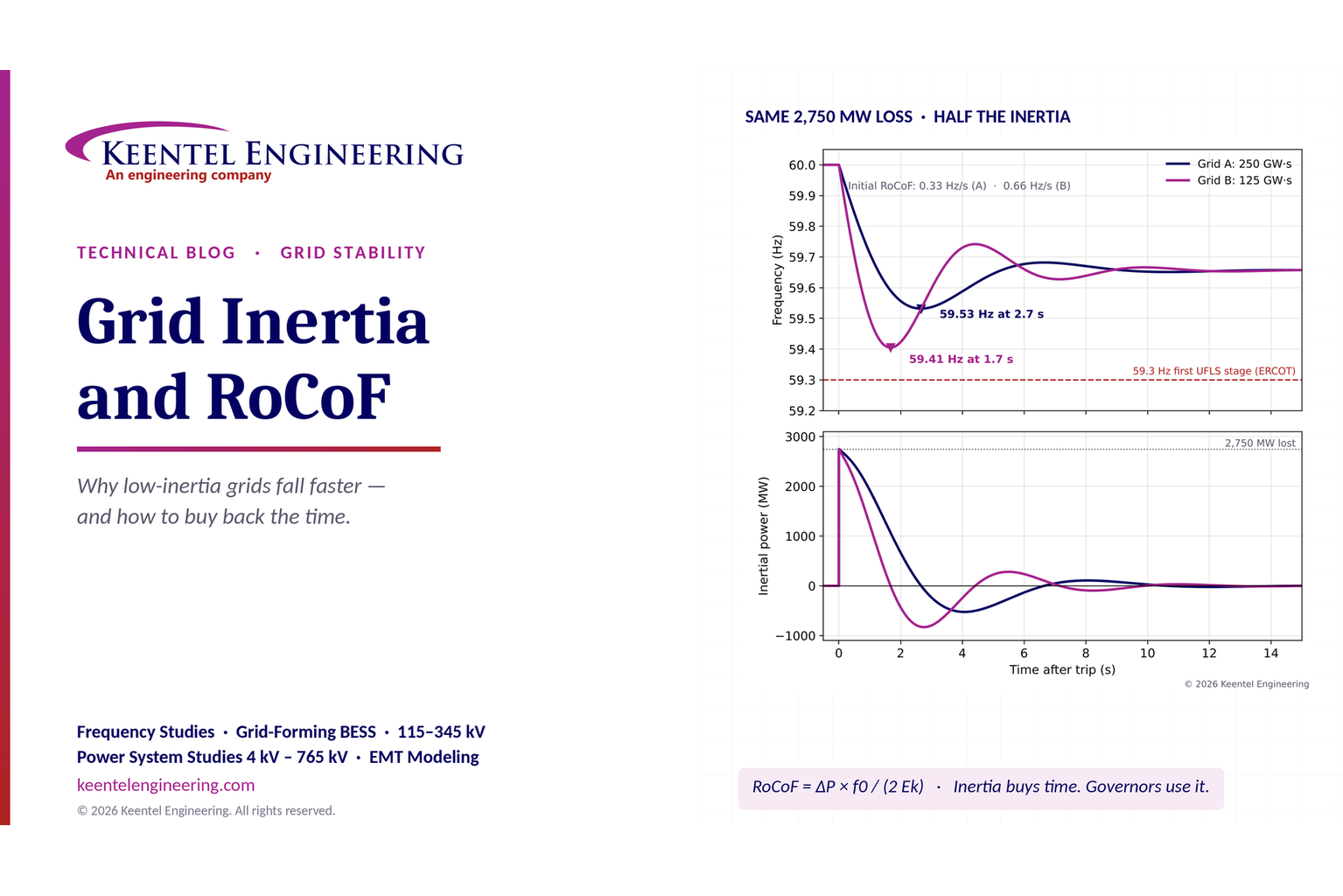
Explore grid inertia, RoCoF and frequency response, with swing equation calculations, frequency nadir analysis and US power system simulation examples.
By SANDIP R PATEL
•
October 10, 2026
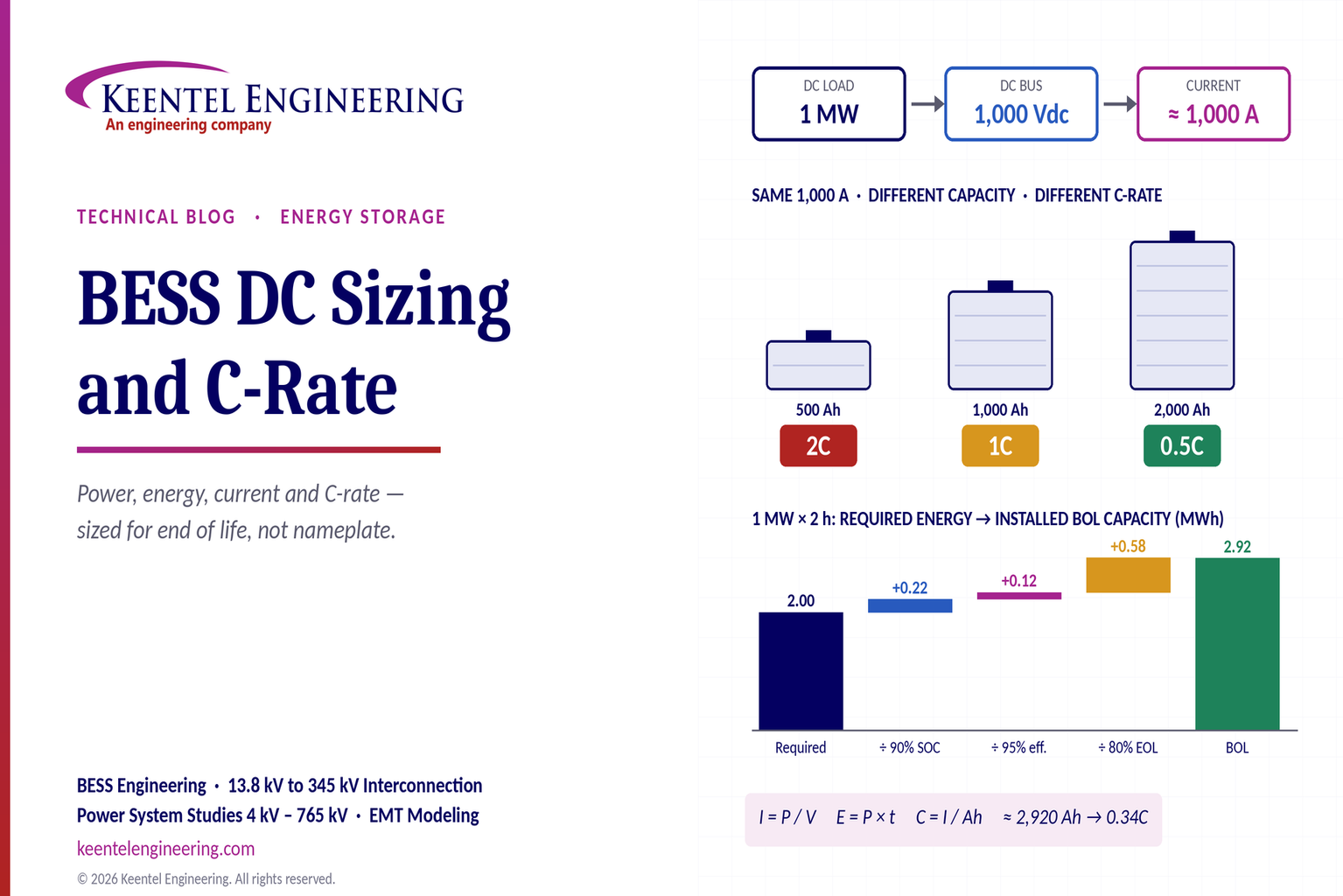
Learn BESS DC sizing with power, energy, current and C-rate calculations, battery losses, degradation and a 100 MW/400 MWh utility-scale example.
By SANDIP R PATEL
•
October 10, 2026
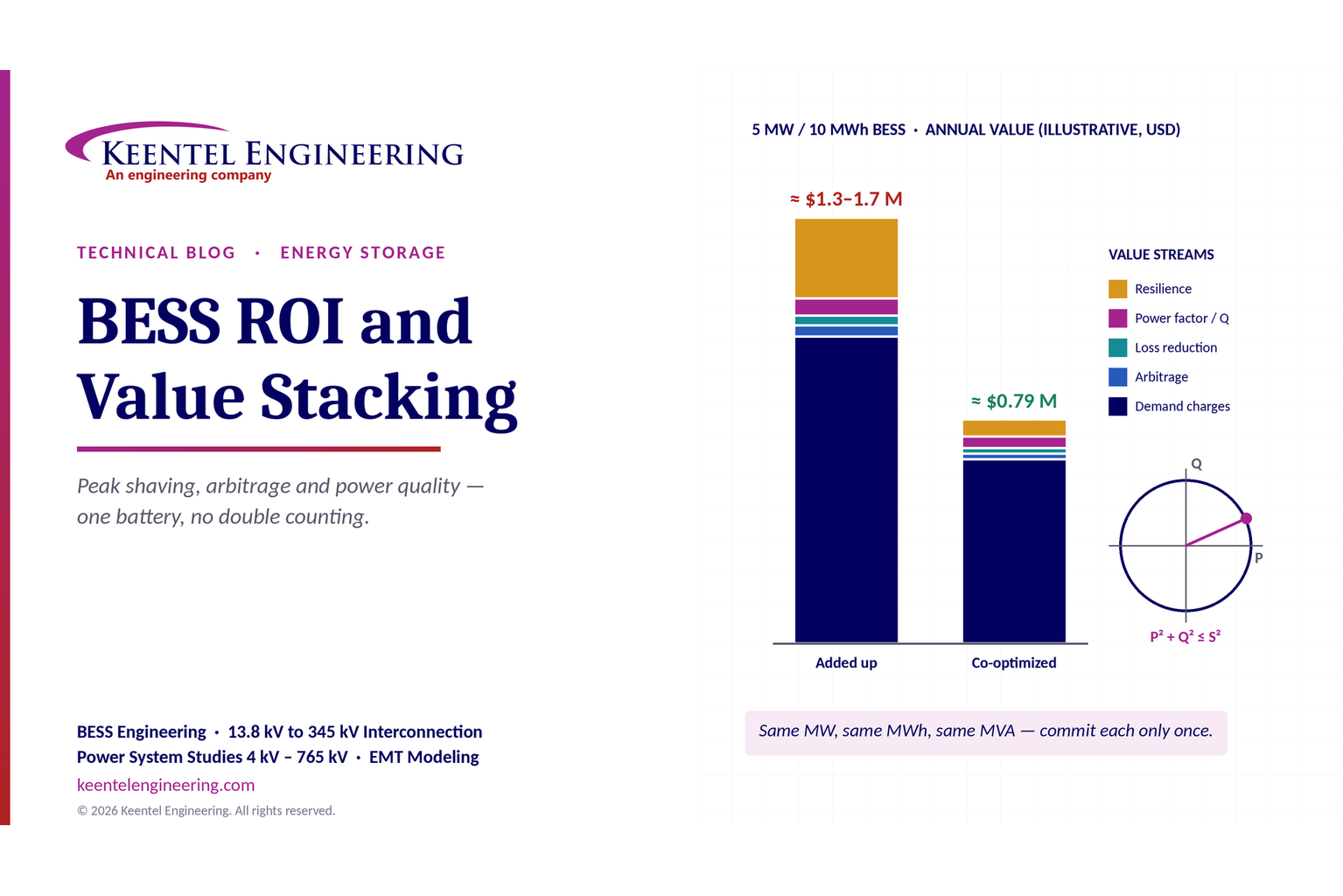
Learn how BESS ROI is calculated using peak shaving, energy arbitrage, power quality and battery storage economics, with a practical 5 MW/10 MWh example.

By SANDIP R PATEL
•
October 10, 2026
Learn why transformer differential relays detect current during external faults, how CT saturation causes spill current, and how secure 87T protection prevents trips.
By SANDIP R PATEL
•
October 10, 2026
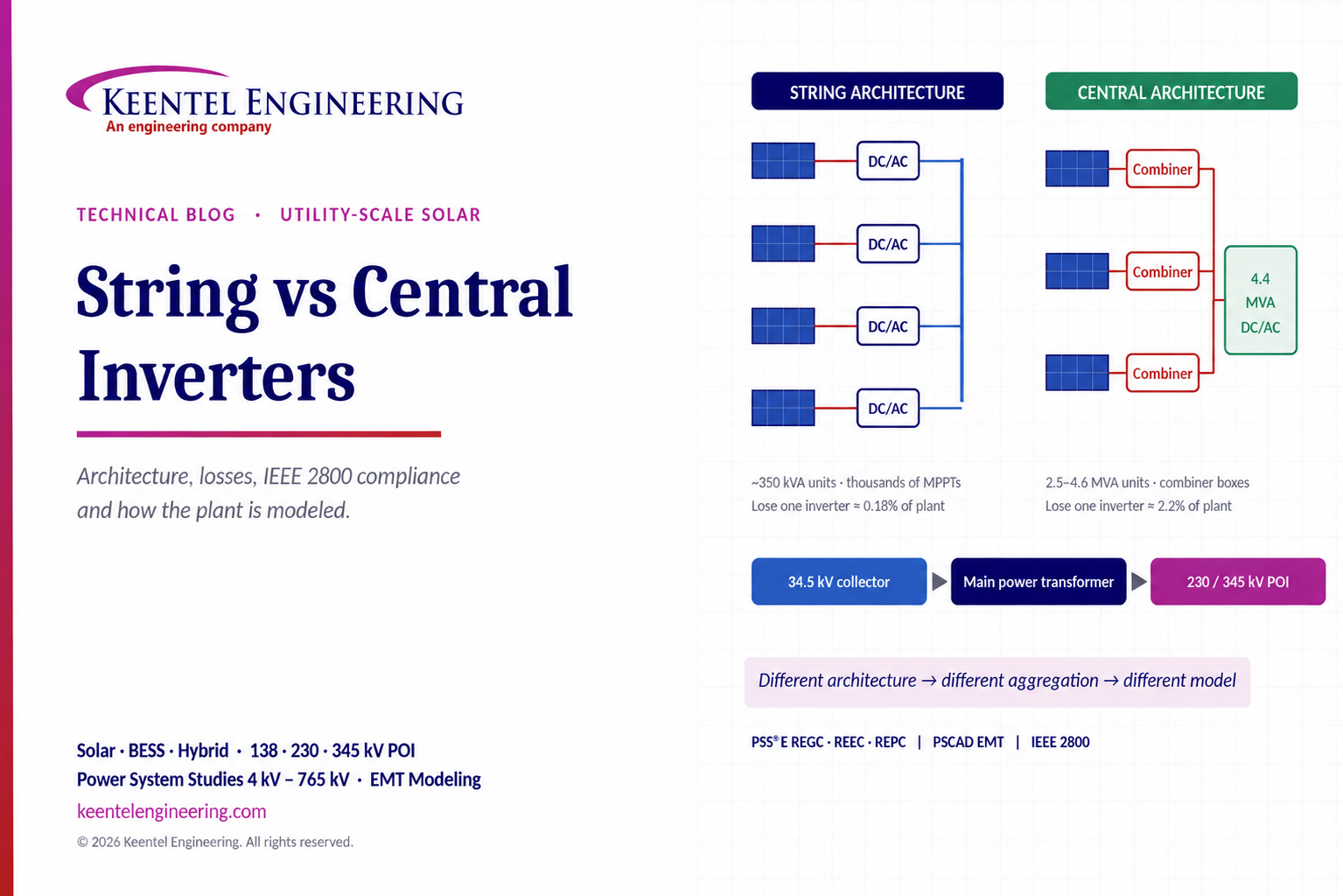
Compare string vs central inverters for utility-scale solar, including efficiency, maintenance, grid compliance, reactive power and interconnection studies.

By SANDIP R PATEL
•
October 9, 2026
Learn how insulator swing angle and conductor blowout affect transmission line ROW width, with NESC clearances, NERC FAC-003 guidance, and a 345 kV example.
Copy
By SANDIP R PATEL
•
October 3, 2026
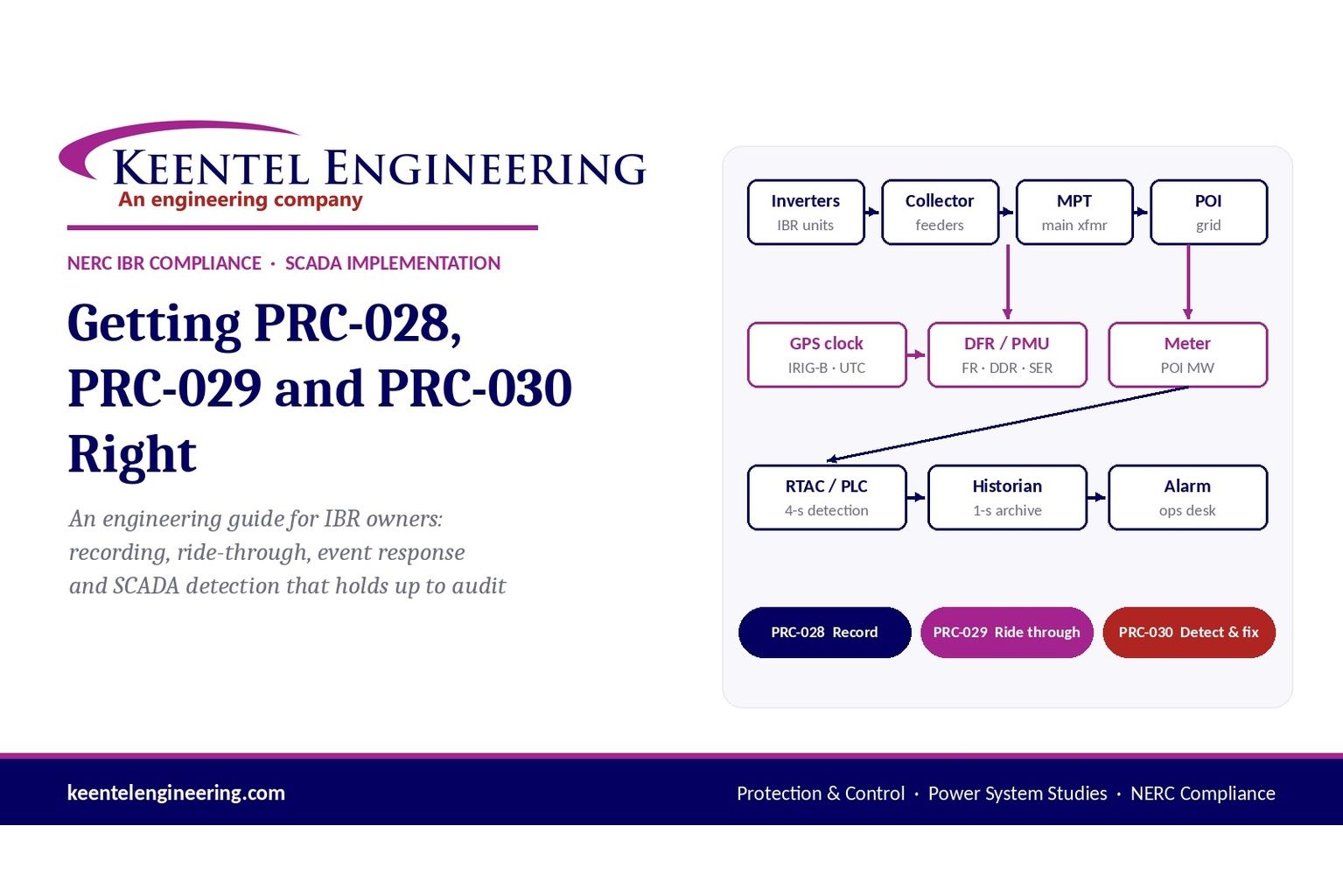
Engineering guide to PRC-028 disturbance recording, PRC-029 ride-through and PRC-030 event detection for inverter-based resources.

By SANDIP R PATEL
•
October 3, 2026
A practical guide to SSO classification, SSR, PEDI, Wind-SSCI, EMT analysis, mitigation and protection based on CIGRE TB 909.
By SANDIP R PATEL
•
October 3, 2026
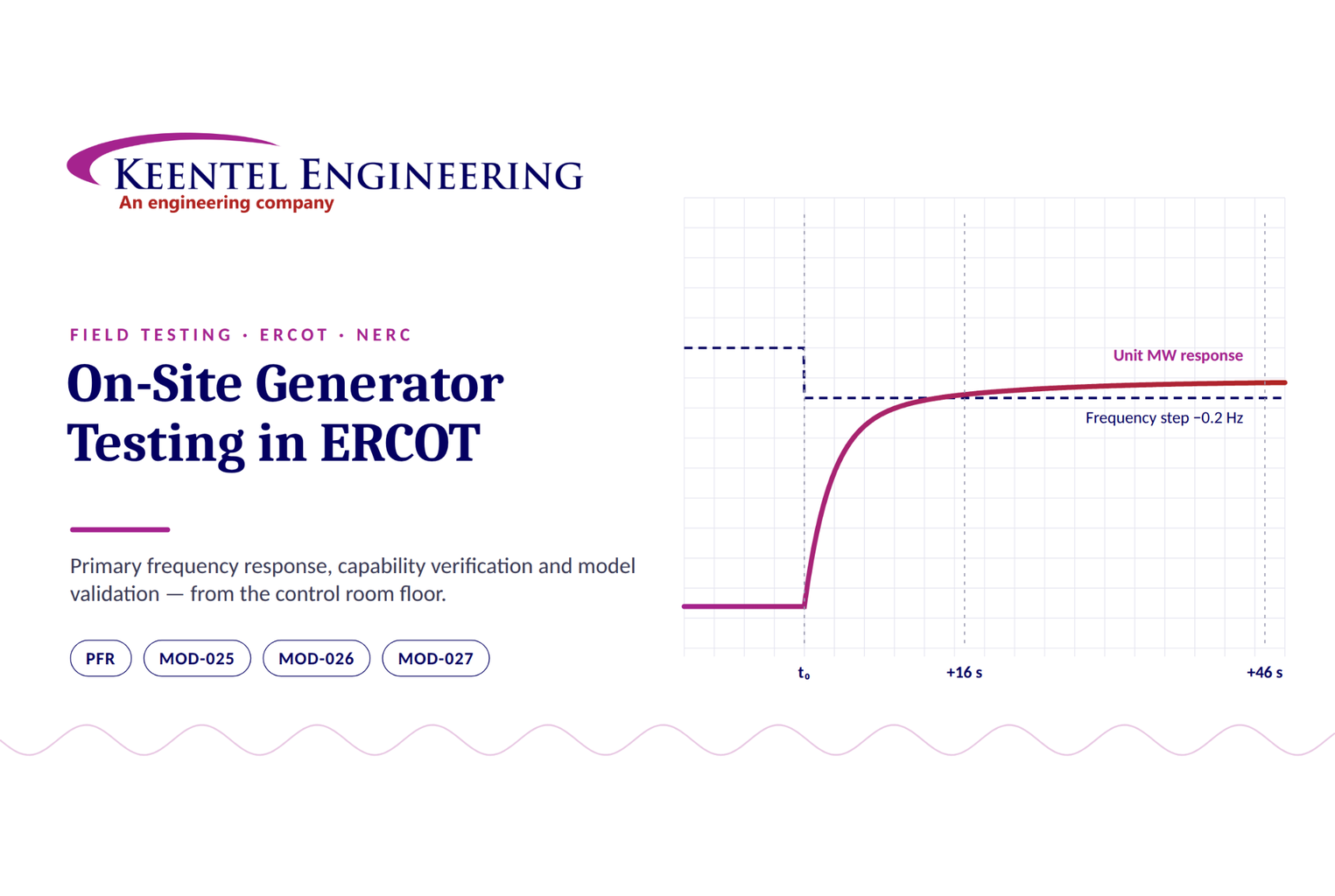
Learn ERCOT generator testing for PFR, MOD-025 and MOD-026/027, including staged tests, capability verification, dynamic models and field testing.