A Coordinated Electric System Interconnection Review—the utility’s deep-dive on technical and cost impacts of your project.
Challenge: Frequent false tripping using conventional electromechanical relays
Solution: SEL-487E integration with multi-terminal differential protection and dynamic inrush restraint
Result: 90% reduction in false trips, saving over $250,000 in downtime
Category 2 IBR Registration & Compliance: Technical Guide for Asset Owners and Operators
january 31, 2026 | Blog
Executive Summary
The North American bulk power system (BPS) is undergoing a fundamental transformation driven by the rapid growth of inverter-based resources (IBRs), including solar photovoltaic (PV), wind, battery energy storage systems (BESS), fuel cells, and hybrid plants. While these technologies deliver decarbonization, flexibility, and efficiency, they also introduce new reliability challenges that differ materially from those associated with traditional synchronous generation.
In response, the Federal Energy Regulatory Commission (FERC) and the North American Electric Reliability Corporation (NERC) have launched a coordinated, multi-year regulatory initiative to identify, register, and regulate a previously unregistered class of bulk power system–connected inverter-based resources, now commonly referred to as Category 2 IBRs. This effort fundamentally changes the compliance landscape for many owners and operators who historically operated outside mandatory NERC Reliability Standards.
This white paper provides a comprehensive, end-to-end explanation of the Category 2 IBR Registration Initiative, associated compliance timelines, applicable Reliability Standards, and the technical implications of FERC Order No. 901. It is written for executives, compliance managers, engineers, developers, and legal teams seeking a clear, actionable understanding of their obligations and risks.
1. Background: Why Category 2 IBRs Matter
1.1 The Reliability Gap
As inverter-based generation increased across North America, NERC identified a growing population of resources that:
- Are connected to the Bulk Power System (BPS),
- Have a material aggregate impact on system reliability,
- But do not meet the Bulk Electric System (BES) definition, and
- Were therefore not registered and not subject to NERC Reliability Standards.
This created a structural reliability gap. System planners and operators increasingly relied on IBRs for energy, capacity, and ancillary services, yet lacked enforceable mechanisms to ensure model accuracy, performance validation, data sharing, and disturbance response.
1.2 FERC Direction and NERC Response
In 2022, FERC formally directed NERC to address this gap by identifying and registering unregistered BPS-connected IBRs. NERC responded by developing and filing a multi-phase Work Plan, approved by FERC in May 2023, to bring these resources into the Electric Reliability Organization (ERO) Enterprise framework.
2. What Is a Category 2 IBR?
2.1 Definition2.1 Definition
A Category 2 Inverter-Based Resource is generally defined as a non-BES inverter-based generating resource that:
- Has or contributes to an aggregate nameplate capacity of 20 MVA or greater,
- Is connected through a system designed primarily to deliver power to a common point of connection, and
- Is interconnected at a voltage of 60 kV or higher.
These facilities are typically too large to be considered purely distribution-level resources, yet historically fell outside BES-based registration thresholds.
2.2 Functional Registration
Category 2 entities may be registered as:
- Generator Owners (GO),
- Generator Operators (GOP), or
- Both GO and GOP, depending on ownership and operational responsibilities.
Registration is functional, meaning compliance obligations attach to the specific reliability functions performed.
3. The IBR Registration Initiative: Structure and Timeline
3.1 Three-Phase Work Plan
NERC’s FERC-approved Work Plan follows three core phases:
- Registry Criteria Development – Updating NERC Rules of Procedure to define Category 2 GO/GOP registration.
- Identification & Outreach – Identifying candidate facilities and conducting extensive industry outreach.
Registration & Integration – Formal registration, onboarding, and compliance integration.
The registration of Category 2 GO/GOPs becomes effective May 15, 2026. From this date forward, registered entities are subject to mandatory compliance and enforcement.
4. Compliance Monitoring and Enforcement (CMEP)
4.1 What CMEP Means for New Registrants
Once registered, Category 2 entities enter the Compliance Monitoring and Enforcement Program (CMEP). CMEP governs:
- Audits and spot checks
- Self-certifications
- Self-reports and mitigation
- Enforcement actions and penalties
NERC and the Regional Entities have emphasized onboarding support, but CMEP expectations remain legally binding.
4.2 No Informal Grace Period
While NERC provides education and outreach, the compliance dates are explicit. Registration automatically triggers CMEP applicability for enforceable standards.
5. Reliability Standards Applicable to Category 2 IBRs
5.1 Initial Enforceable Standards (Effective May 15, 2026)
Eight Reliability Standards apply to Category 2 IBRs without requiring modification:
- BAL-001-TRE-2 – Real Power Balancing Control Performance
- IRO-010-5 – Reliability Coordinator Data Specification
- MOD-032-1 – Data for Power System Modeling and Analysis
- PRC-012-2 – Special Protection System Data and Documentation
- PRC-017-1 – Protection System Maintenance and Testing
- TOP-003-6.1 – Operational Reliability Data
- VAR-001-5 – Voltage and Reactive Control
- VAR-002-4.1 – Automatic Voltage Regulator Requirements
These standards form the minimum compliance baseline for Category 2 entities.
5.2 Standards Requiring Modification
Most other
NERC Reliability Standards
reference BES-based definitions and therefore require formal modification before they can apply to Category 2 IBRs. These revisions occur through the NERC Standards Development Process and are often driven by FERC directives.
6. FERC Order No. 901: The Technical Backbone
6.1 Purpose of Order No. 901
FERC Order No. 901 addresses systemic weaknesses in IBR modeling, validation, and study practices. The Order directs NERC to ensure that inverter-based resources are accurately represented in planning, operational, and event analysis models.
6.2 Milestone 3 Projects
Key standards projects under Milestone 3 include:
- Project 2020-06 – Verification of Models and Data for Generators
- Project 2021-01 – System Model Validation with IBRs
- Project 2022-02 – Uniform Modeling Framework for IBRs
- Project 2022-04 – Electromagnetic Transient (EMT) Modeling
These projects significantly expand expectations for data quality, model verification, and disturbance-based validation.
6.3 Milestone 4 (Looking Ahead)
Milestone 4 projects focus on operational and planning studies involving IBRs, further integrating these resources into real-time and long-term reliability assessments.
7. Technical Implications for Category 2 IBR Owners and Operators
Category 2 registration is not merely administrative. It carries substantial technical obligations, including:
- Submission of accurate steady-state and dynamic models
- Participation in model validation and correction
- Support for EMT studies where required
- Maintenance of protection, voltage control, and reactive capability
Engineering rigor and documentation become enforceable expectations.
8. Risk, Liability, and Strategic Preparation
8.1 Compliance Risk
Failure to prepare exposes entities to:
- Audit findings
- Penalties
- Required mitigation plans
- Reputational risk
8.2 Strategic Advantage of Early Preparation
Organizations that invest early in compliance readiness gain:
- Reduced enforcement risk
- Faster audit response
- Better interconnection and planning outcomes
- Improved credibility with regulators and system operators
9. How Keentel Engineering Supports Category 2 IBR Compliance
Keentel Engineering provides end-to-end technical and compliance support, including:
- Category 2 applicability assessments
- GO/GOP role mapping
- Reliability Standards gap analyses
- Dynamic and EMT modeling support
- Model validation and documentation
- CMEP readiness and audit support
Frequently Asked Questions (FAQs)
FAQ 1. What is a Category 2 Inverter-Based Resource (IBR)?
A Category 2 IBR is a non-Bulk Electric System (non-BES) inverter-based generating resource that is connected to the Bulk Power System and meets specific registration thresholds established by NERC. Generally, this includes inverter-based facilities with an aggregate nameplate capacity of 20 MVA or greater, connected at 60 kV or higher, that were historically unregistered. These resources are now subject to NERC registration and compliance due to their material impact on bulk power system reliability.
FAQ 2. Why did FERC and NERC create the Category 2 IBR Registration Initiative?
The initiative was created to address a documented reliability gap. As inverter-based resources rapidly increased, many BPS-connected IBRs were not registered and therefore not subject to mandatory Reliability Standards. FERC directed NERC to close this gap to ensure adequate modeling, data sharing, performance validation, and accountability for grid reliability.
FAQ 3. When does Category 2 IBR registration become effective?
Category 2 Generator Owner (GO) and Generator Operator (GOP) registration becomes effective on May 15, 2026. From this date forward, registered entities are subject to mandatory compliance and enforcement under the NERC Compliance Monitoring and Enforcement Program (CMEP).
FAQ 4. Does registration automatically mean enforcement?
Yes. Once registration becomes effective, compliance obligations attach immediately for applicable Reliability Standards. While NERC provides onboarding support and outreach, there is no informal grace period beyond the established compliance dates.
FAQ 5. Which Reliability Standards apply to Category 2 IBRs starting May 15, 2026?
Eight Reliability Standards apply without modification and become enforceable on May 15, 2026: BAL-001-TRE-2, IRO-010-5, MOD-032-1, PRC-012-2, PRC-017-1, TOP-003-6.1, VAR-001-5, and VAR-002-4.1. These standards form the initial compliance baseline for Category 2 entities.
FAQ 6. Why do most NERC Reliability Standards not yet apply to Category 2 IBRs?
Many existing standards rely on BES-based definitions or terminology that exclude Category 2 resources. NERC must formally modify these standards through the Standards Development Process before they can be applied and enforced for Category 2 IBRs.
FAQ 7. What is CMEP and how does it affect Category 2 entities?
The Compliance Monitoring and Enforcement Program (CMEP) is the framework used by NERC and Regional Entities to monitor, audit, and enforce compliance with Reliability Standards. Once registered, Category 2 entities are subject to CMEP activities, including audits, self-certifications, spot checks, and enforcement actions.
FAQ 8. What roles do Generator Owner (GO) and Generator Operator (GOP) play?
Registration is functional. Generator Owners are responsible for the physical assets, while Generator Operators are responsible for operating those assets. An entity may be registered as a GO, a GOP, or both, depending on contractual and operational arrangements.
FAQ 9. How does FERC Order No. 901 affect Category 2 IBRs?
FERC Order No. 901 establishes enhanced requirements for model validation, data accuracy, and study practices for inverter-based resources. While registration identifies who is regulated, Order No. 901 defines the technical expectations that registrants must meet, particularly related to dynamic and EMT modeling.
FAQ 10. What is model validation and why is it important?
Model validation ensures that simulation models accurately represent actual facility performance. For IBRs, inaccurate models can lead to incorrect planning and operational decisions. Order No. 901 requires improved verification using disturbance data and system events.
FAQ 11. Are Category 2 IBRs required to provide EMT models?
EMT models are not universally required for all Category 2 IBRs, but Order No. 901 significantly expands the circumstances under which EMT studies may be requested. Category 2 resources may be aggregated into EMT-relevant studies, especially where controls interactions or protection issues are identified.
FAQ 12. How does MOD-032-1 affect Category 2 IBR owners?
MOD-032-1 requires Generator Owners to provide accurate data for power system modeling and analysis. For Category 2 IBRs, this includes steady-state and dynamic data necessary for planners and operators to assess system reliability.
FAQ 13. What are the risks of non-compliance for Category 2 entities?
Risks include audit findings, financial penalties, mandatory mitigation plans, increased regulatory scrutiny, and reputational harm. Early preparation significantly reduces these risks.
FAQ 14. How do Regional Entities fit into the registration process?
NERC delegates day-to-day compliance monitoring and enforcement to six Regional Entities. These entities are responsible for initiating registration, conducting audits, and working directly with registered Category 2 entities.
FAQ 15. Does being newly registered reduce compliance expectations?
No. While NERC recognizes that many Category 2 entities are new to compliance, the standards and enforcement expectations remain mandatory and enforceable once compliance dates are reached.
FAQ 16. How does PRC-017-1 apply to inverter-based resources?
PRC-017-1 requires to ensure that all Remedial Action Schemes (RAS) are properly designed, meet performance requirements, and are coordinated with other protection systems. To ensure that maintenance and testing programs are developed and misoperations are analyzed and corrected.
FAQ 17. What is the relationship between registration and planning studies?
Registration ensures that planners know which entities are responsible for providing data and models. Planning studies increasingly rely on accurate IBR representation, particularly as penetration levels rise.
FAQ 18. Will additional standards apply to Category 2 IBRs in the future?
Yes. As standards are revised or newly developed—particularly under FERC Order No. 901—additional requirements will become applicable to Category 2 IBRs over time.
FAQ 19. How should Category 2 entities prepare today?
Preparation should include confirming registration status, identifying GO/GOP roles, reviewing applicable standards, organizing technical documentation, validating models, and developing internal compliance procedures.
FAQ 20. What documentation is most critical for audits?
Critical documentation includes modeling data, protection settings and maintenance records, operating procedures, voltage control capability, and evidence of compliance with applicable standards.
FAQ 21. How does VAR-001 and VAR-002 affect IBRs?
These standards govern voltage and reactive power control. Category 2 IBRs must demonstrate appropriate voltage regulation and reactive capability consistent with system requirements.
FAQ 22. Are hybrid plants treated differently under Category 2?
Hybrid plants are assessed based on their aggregate inverter-based capability and point of interconnection. Registration and compliance obligations apply based on functional roles and overall system impact.
FAQ 23. Can compliance obligations change after registration?
Yes. As standards are modified or new standards become effective, compliance obligations will expand. Category 2 entities should plan for ongoing regulatory evolution.
FAQ 24. How does early compliance preparation benefit asset owners?
Early preparation reduces enforcement risk, improves audit outcomes, accelerates interconnection and study processes, and demonstrates reliability commitment to regulators and system operators.
FAQ 25. How can Keentel Engineering help with Category 2 IBR compliance?
Keentel Engineering provides comprehensive support, including registration assessments, GO/GOP role analysis, Reliability Standards gap studies, power system modeling, EMT analysis, documentation development, and CMEP audit readiness.

About the Author:
Sandip "Sonny" R. Patel, P.E.
IEEE Senior Member · Founder & CEO, Keentel Engineering
In 1995, Sonny Patel earned his Electrical Engineering degree from the University of Illinois. But degrees don't build legacies — action does.
For three decades, he has worked the power industry from every side of the table: 16 years as a utility engineer at Exelon/Commonwealth Edison; generation leadership across hydroelectric, industrial steam turbine, and a 9 GW renewable fleet; NERC Regional Entity Senior Compliance Engineer and Audit Team Lead, auditing some of the nation's largest utilities; and testing and commissioning lead on equipment up to 765 kV — the very top of the North American grid.Utility. Generator. Regulator. Consultant. Few engineers have seen all four seats. Fewer still have sat in them.
His experience spans nuclear, hydro, conventional generation, renewables, oil and gas, mining — and today's data centers, where he is authoring a three-book series on data center design. He is a Licensed Professional Engineer in six states and a Licensed Electrical Contractor in Florida (Unlimited EC) — he doesn't just design the work; he's qualified to stand behind its execution.Today, as Founder and CEO of Keentel Engineering, Sonny leads a nationwide team of engineers delivering substation design, power system studies, NERC compliance, and commissioning — done right, coast to coast.Three decades. Every side of the table. One standard: accountable engineering.
Services

Let's Discuss Your Project
Let's book a call to discuss your electrical engineering project that we can help you with.
About the Author:
Sandip "Sonny" R. Patel, P.E.
IEEE Senior Member · Founder & CEO, Keentel Engineering
In 1995, Sonny Patel earned his Electrical Engineering degree from the University of Illinois. But degrees don't build legacies — action does.
For three decades, he has worked the power industry from every side of the table: 16 years as a utility engineer at Exelon/Commonwealth Edison; generation leadership across hydroelectric, industrial steam turbine, and a 9 GW renewable fleet; NERC Regional Entity Senior Compliance Engineer and Audit Team Lead, auditing some of the nation's largest utilities; and testing and commissioning lead on equipment up to 765 kV — the very top of the North American grid.
Utility. Generator. Regulator. Consultant. Few engineers have seen all four seats. Fewer still have sat in them.
His experience spans nuclear, hydro, conventional generation, renewables, oil and gas, mining — and today's data centers, where he is authoring a three-book series on data center design. He is a Licensed Professional Engineer in six states and a Licensed Electrical Contractor in Florida (Unlimited EC) — he doesn't just design the work; he's qualified to stand behind its execution.
Today, as Founder and CEO of Keentel Engineering, Sonny leads a nationwide team of engineers delivering substation design, power system studies, NERC compliance, and commissioning — done right, coast to coast.Three decades. Every side of the table. One standard: accountable engineering.
Leave a Comment
Thank you for contacting us.
We will get back to you as soon as possible.
We will get back to you as soon as possible.
Oops, there was an error sending your message.
Please try again later.
Please try again later.
Related Posts
By SANDIP R PATEL
•
October 11, 2026
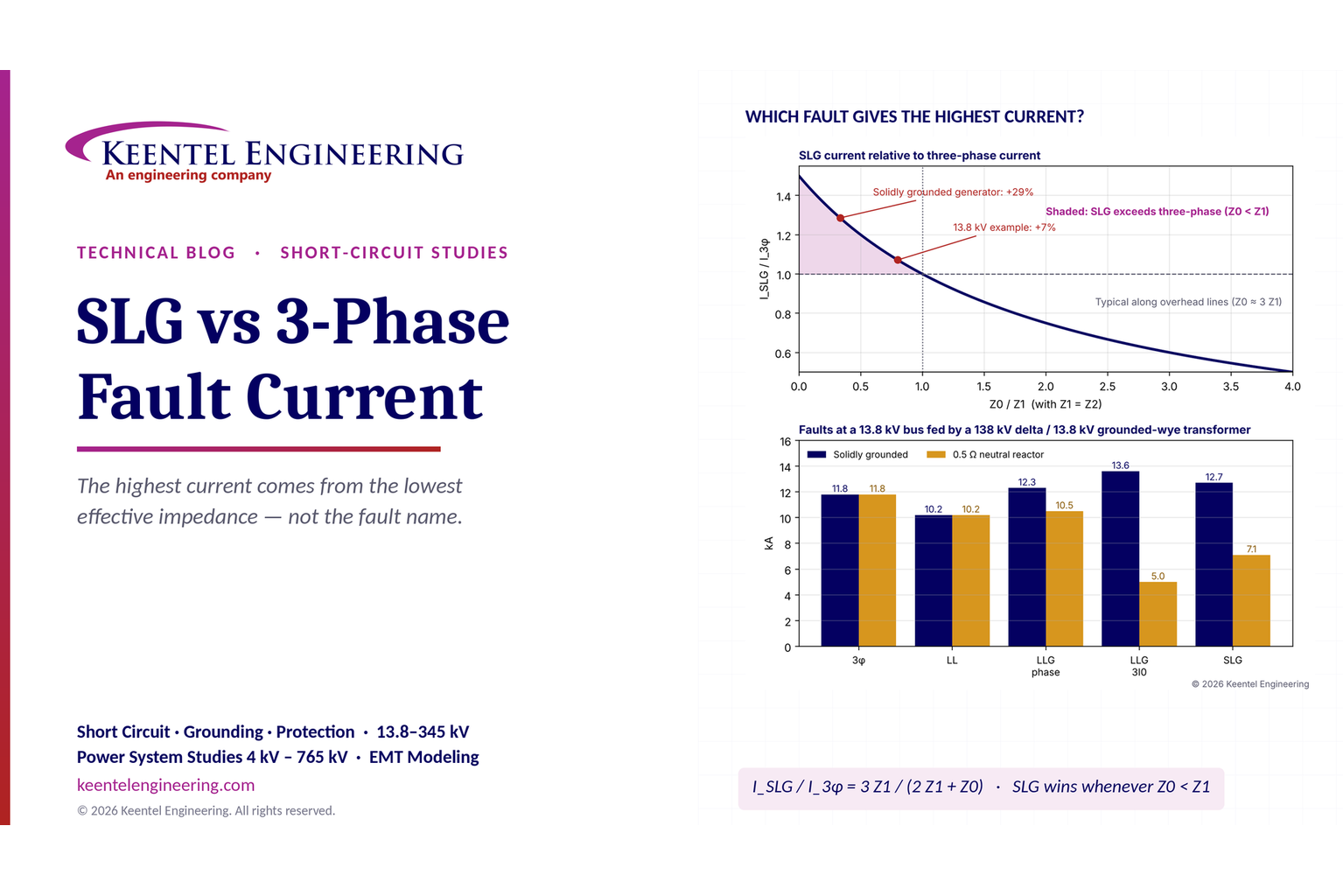
Learn which fault produces the highest current at a bus, why SLG faults can exceed three-phase faults, and how symmetrical components determine fault duty.
By SANDIP R PATEL
•
October 11, 2026
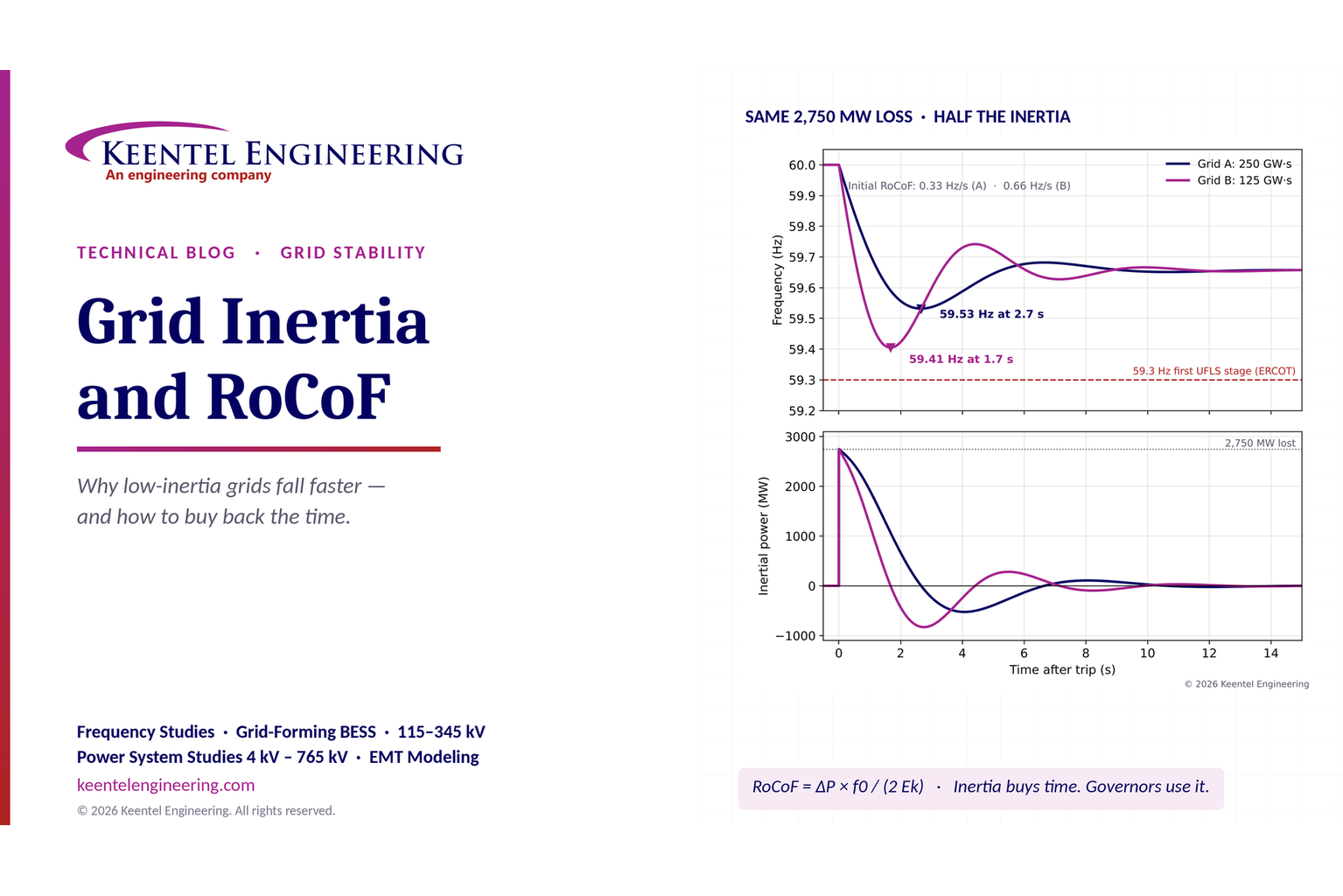
Explore grid inertia, RoCoF and frequency response, with swing equation calculations, frequency nadir analysis and US power system simulation examples.
By SANDIP R PATEL
•
October 11, 2026
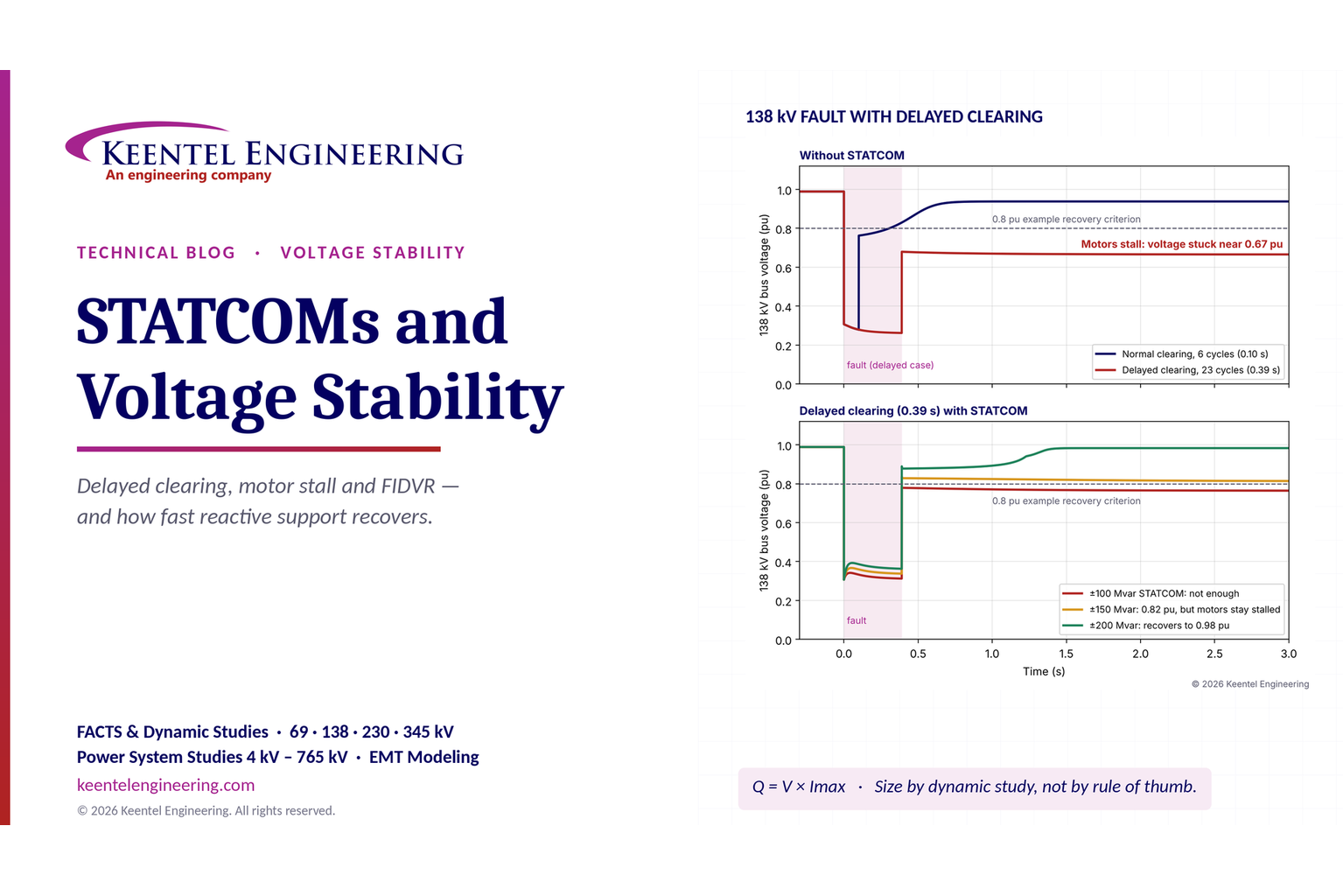
Learn how STATCOMs improve voltage stability and prevent FIDVR. Explore reactive power sizing, delayed fault clearing, NERC criteria and 138 kV simulation results.
By SANDIP R PATEL
•
October 10, 2026
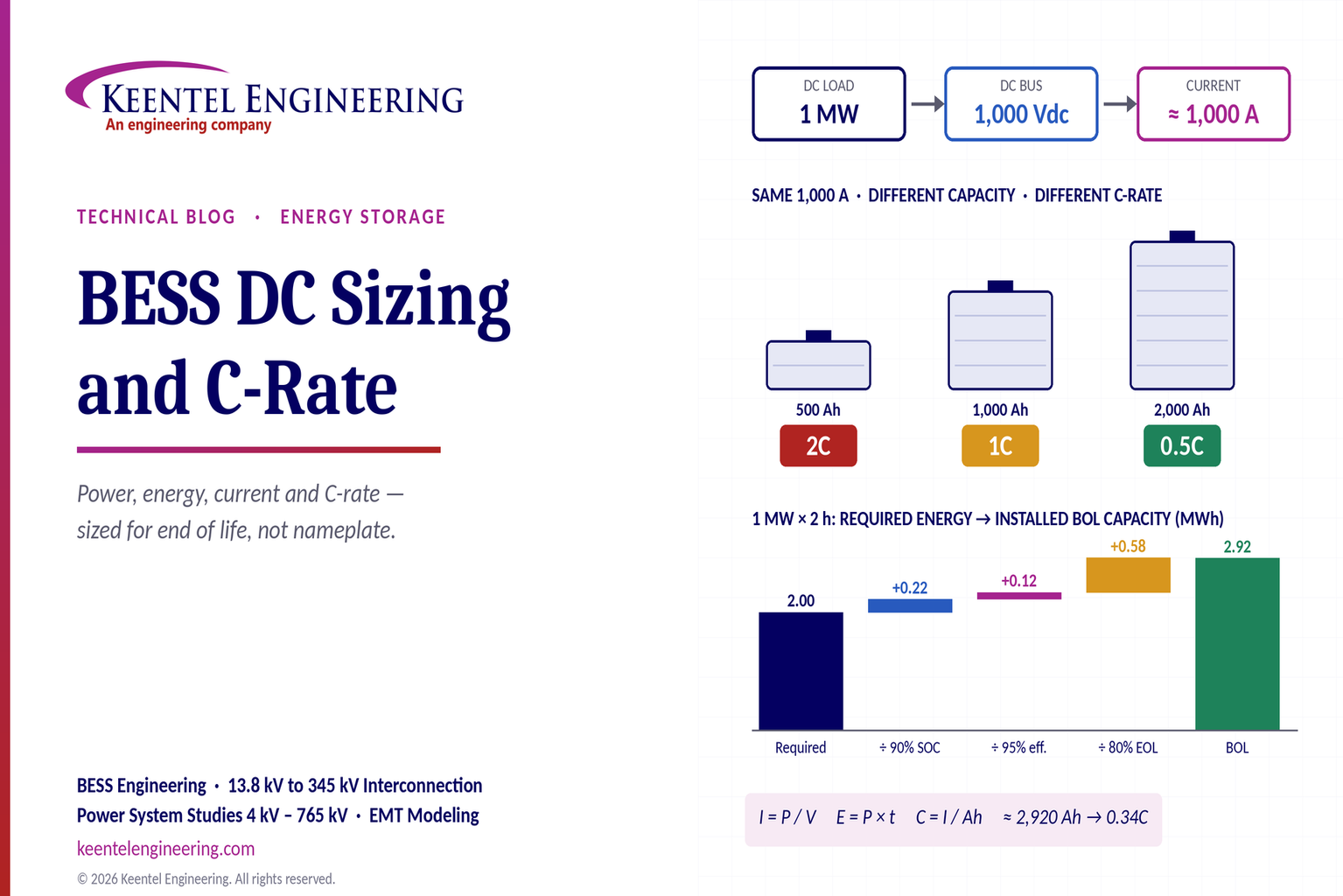
Learn BESS DC sizing with power, energy, current and C-rate calculations, battery losses, degradation and a 100 MW/400 MWh utility-scale example.
By SANDIP R PATEL
•
October 10, 2026
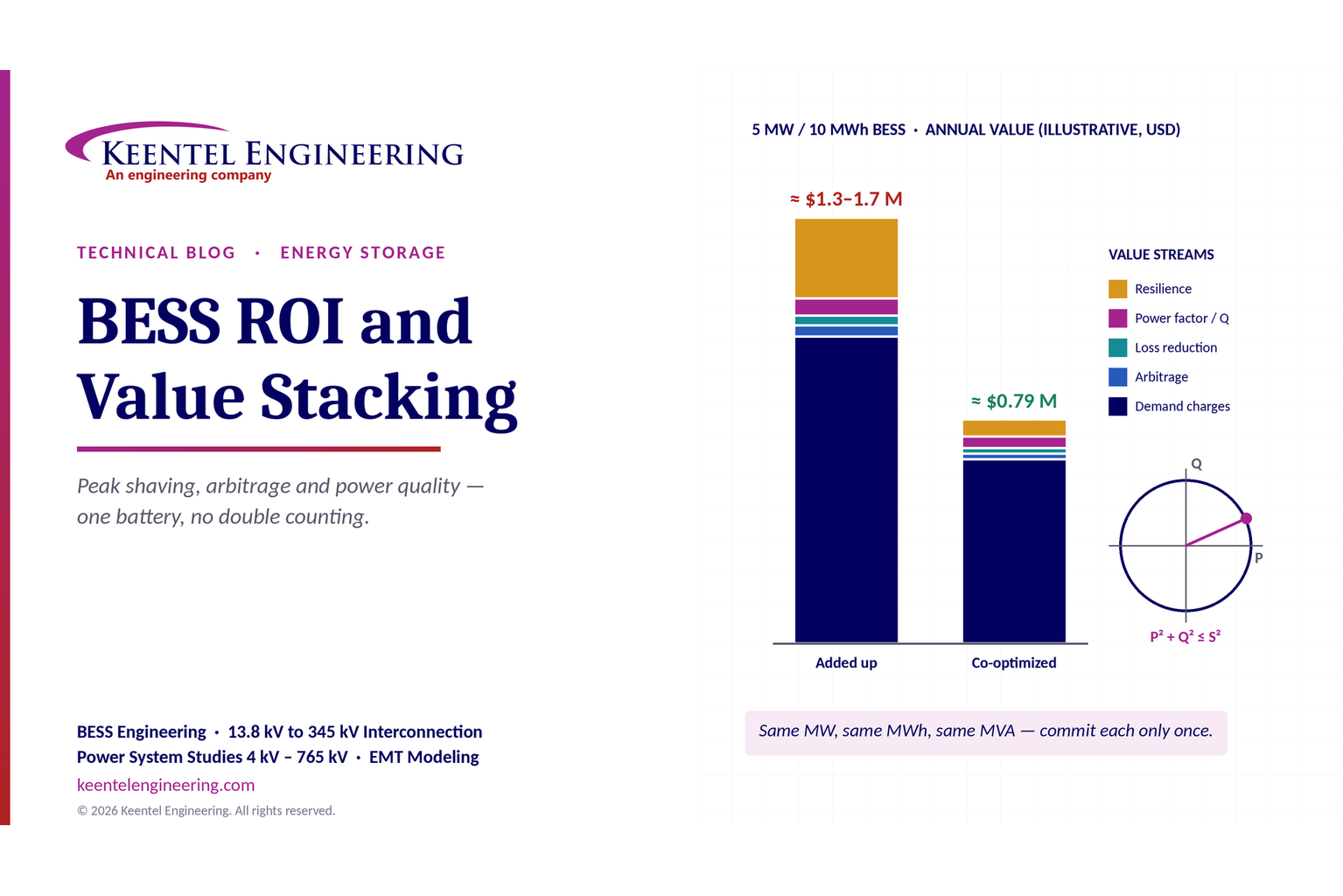
Learn how BESS ROI is calculated using peak shaving, energy arbitrage, power quality and battery storage economics, with a practical 5 MW/10 MWh example.
By SANDIP R PATEL
•
October 10, 2026
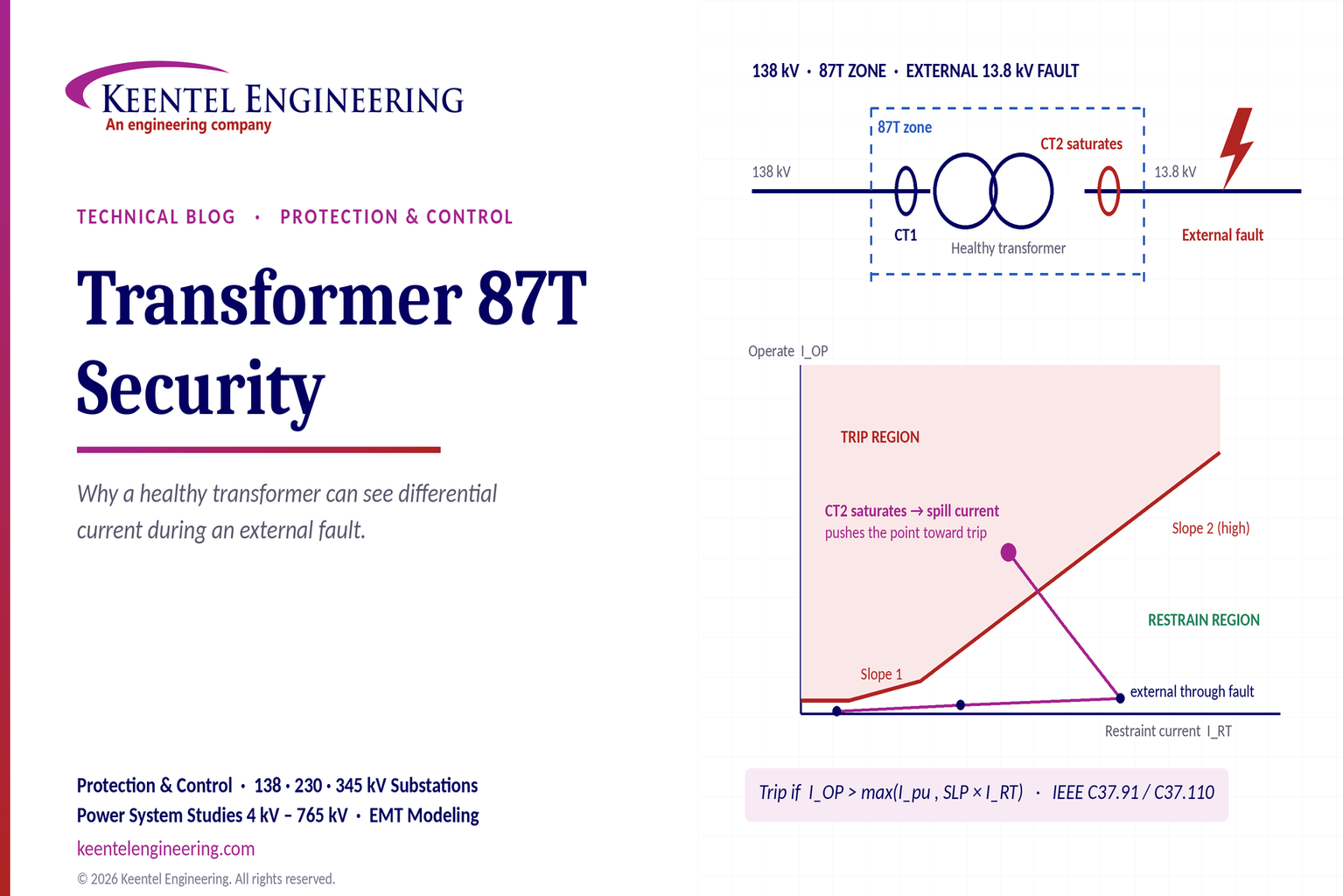
Learn why transformer differential relays detect current during external faults, how CT saturation causes spill current, and how secure 87T protection prevents trips.
By SANDIP R PATEL
•
October 10, 2026
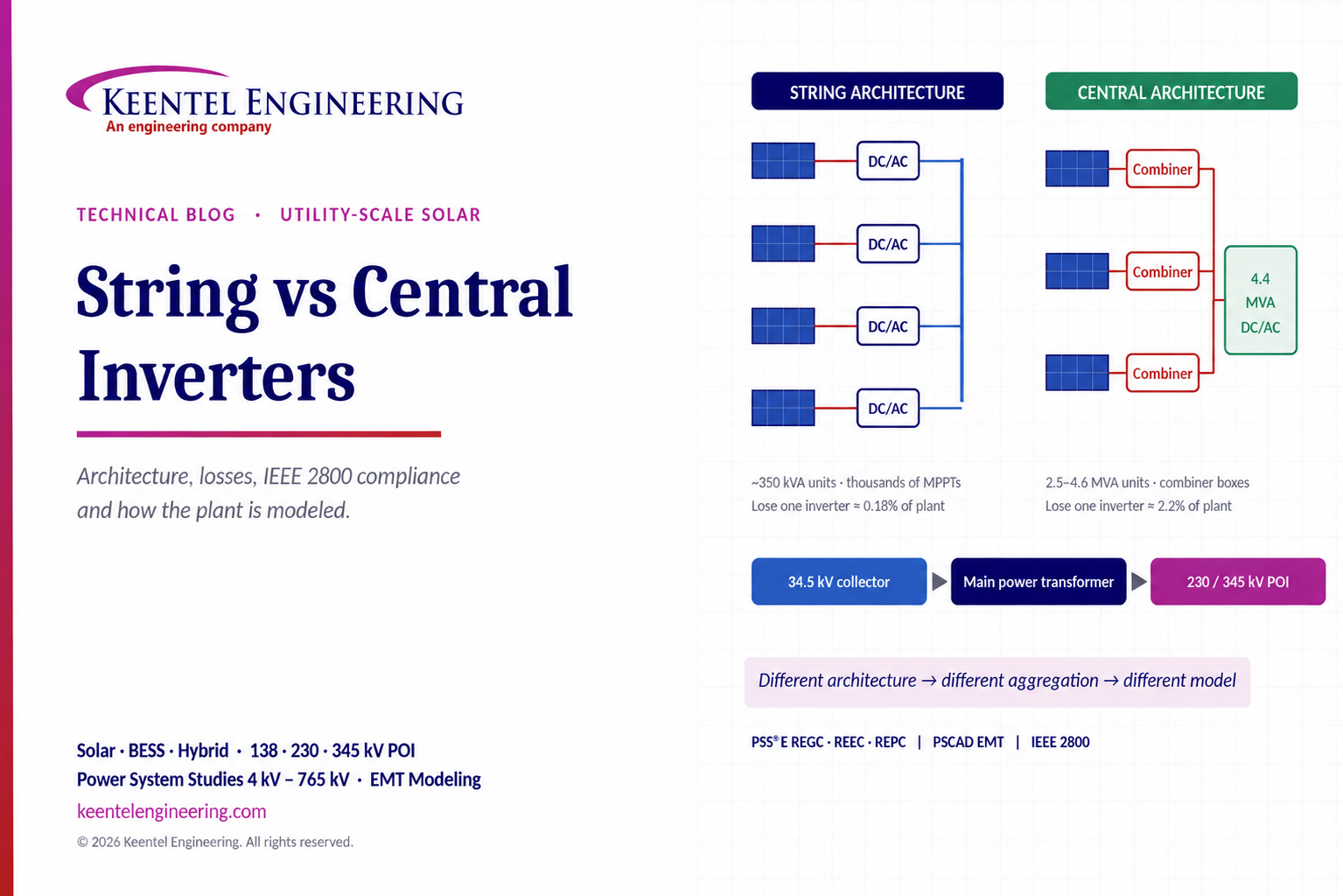
Compare string vs central inverters for utility-scale solar, including efficiency, maintenance, grid compliance, reactive power and interconnection studies.
By SANDIP R PATEL
•
October 9, 2026
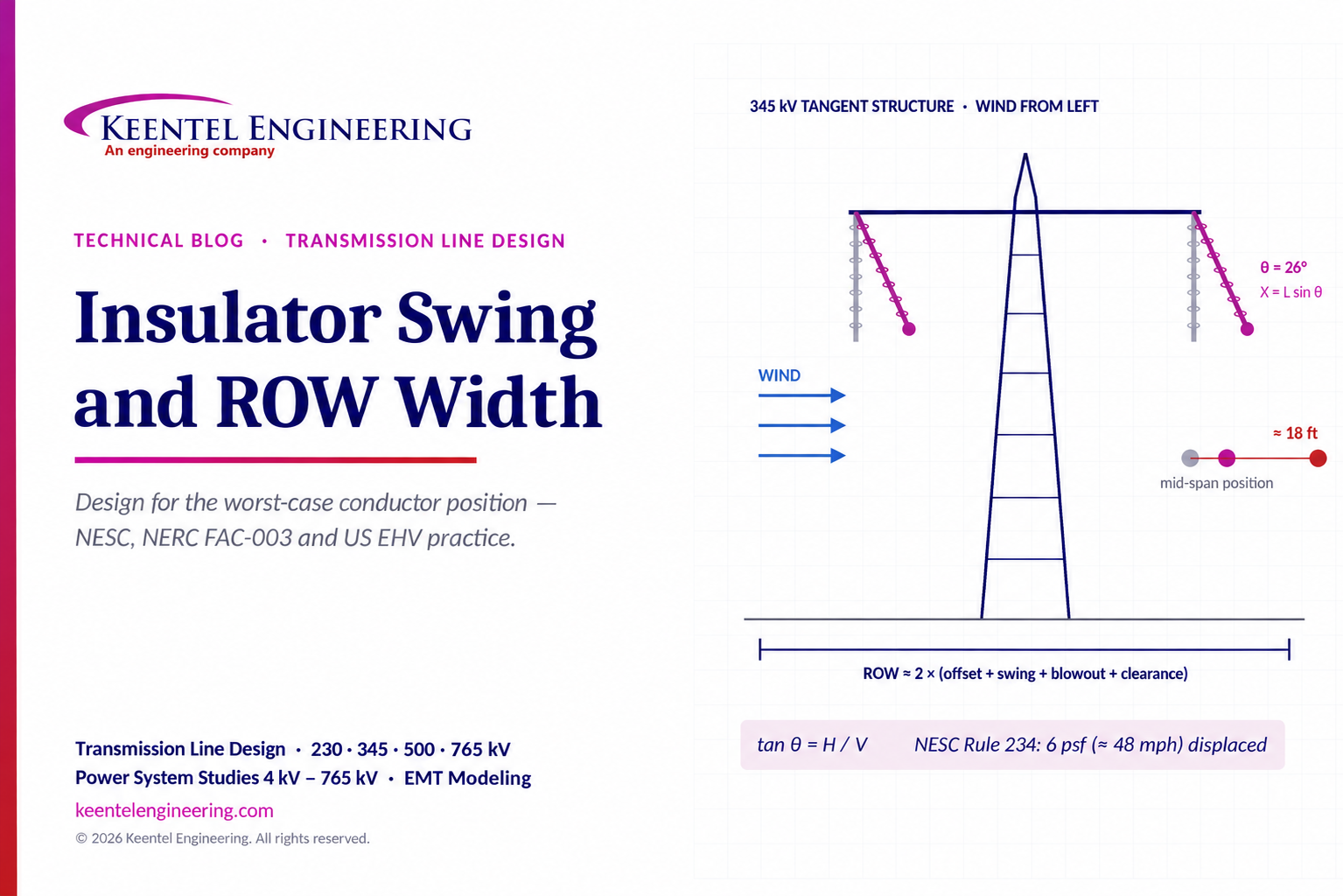
Learn how insulator swing angle and conductor blowout affect transmission line ROW width, with NESC clearances, NERC FAC-003 guidance, and a 345 kV example.
Copy
By SANDIP R PATEL
•
October 3, 2026
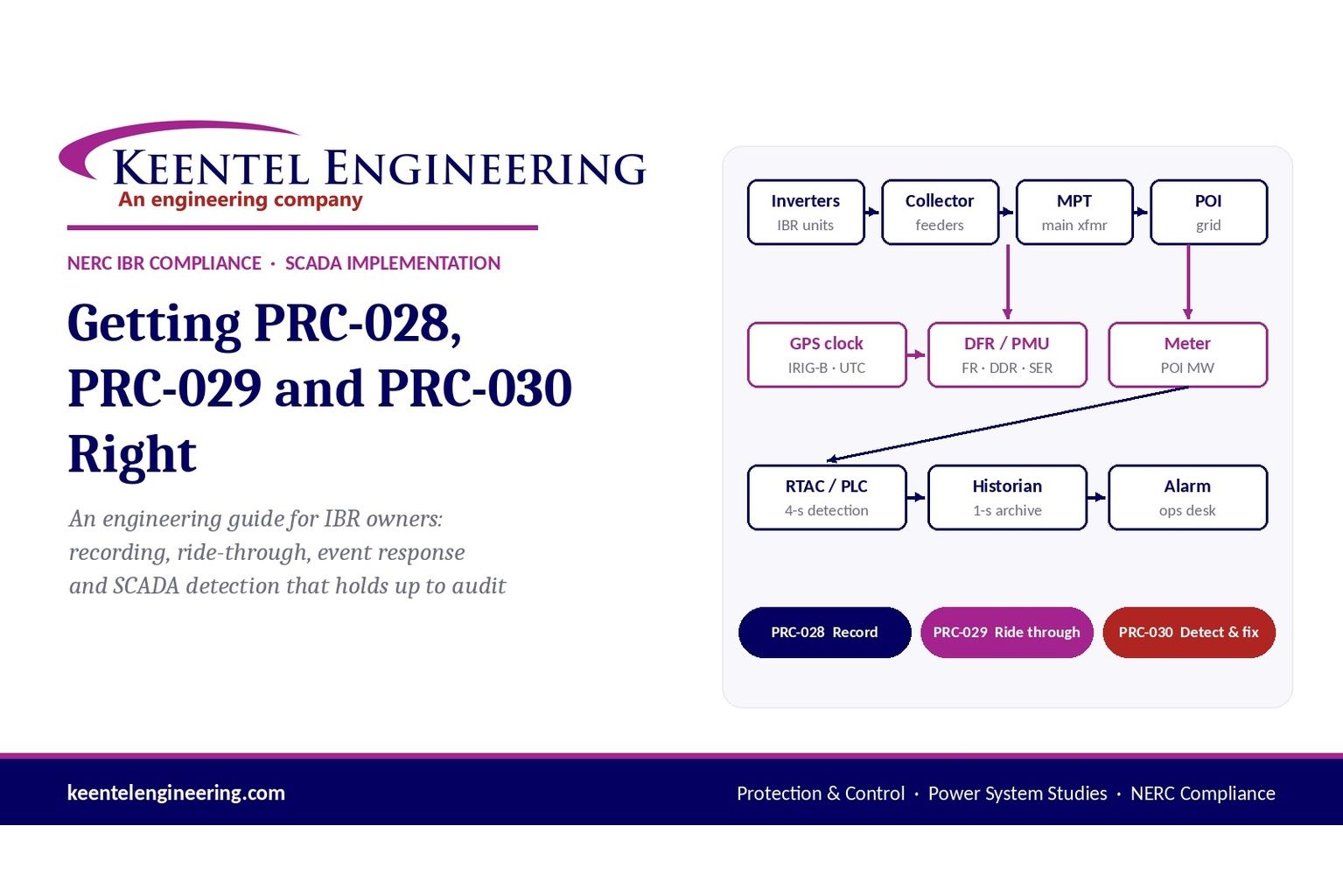
Engineering guide to PRC-028 disturbance recording, PRC-029 ride-through and PRC-030 event detection for inverter-based resources.