

A Coordinated Electric System Interconnection Review—the utility’s deep-dive on technical and cost impacts of your project.

Challenge: Frequent false tripping using conventional electromechanical relays
Solution: SEL-487E integration with multi-terminal differential protection and dynamic inrush restraint
Result: 90% reduction in false trips, saving over $250,000 in downtime

Category Metric
VPP capacity (Lunar Energy) 650 MW
Lunar funding raised US$232 million
Data center BESS example 31 MW / 62 MWh
ERCOT grid-scale batteries 15+ GW
LDES tenders (H1 2026) Up to 9.3 GW
Lithium-ion share of LDES by 2030 77%
FEOC initial threshold 55%
BESS tariff rate (2026) ~55%
Capacity gain from analytics 5–15%

What is T&D Co-Simulation?

Confusing Physical Connections with Logical Nodes in IEC 61850

NERC MOD-032-2, IBR & DER Modeling: What It Means for Grid Reliability—and How Keentel Engineering Leads Compliance

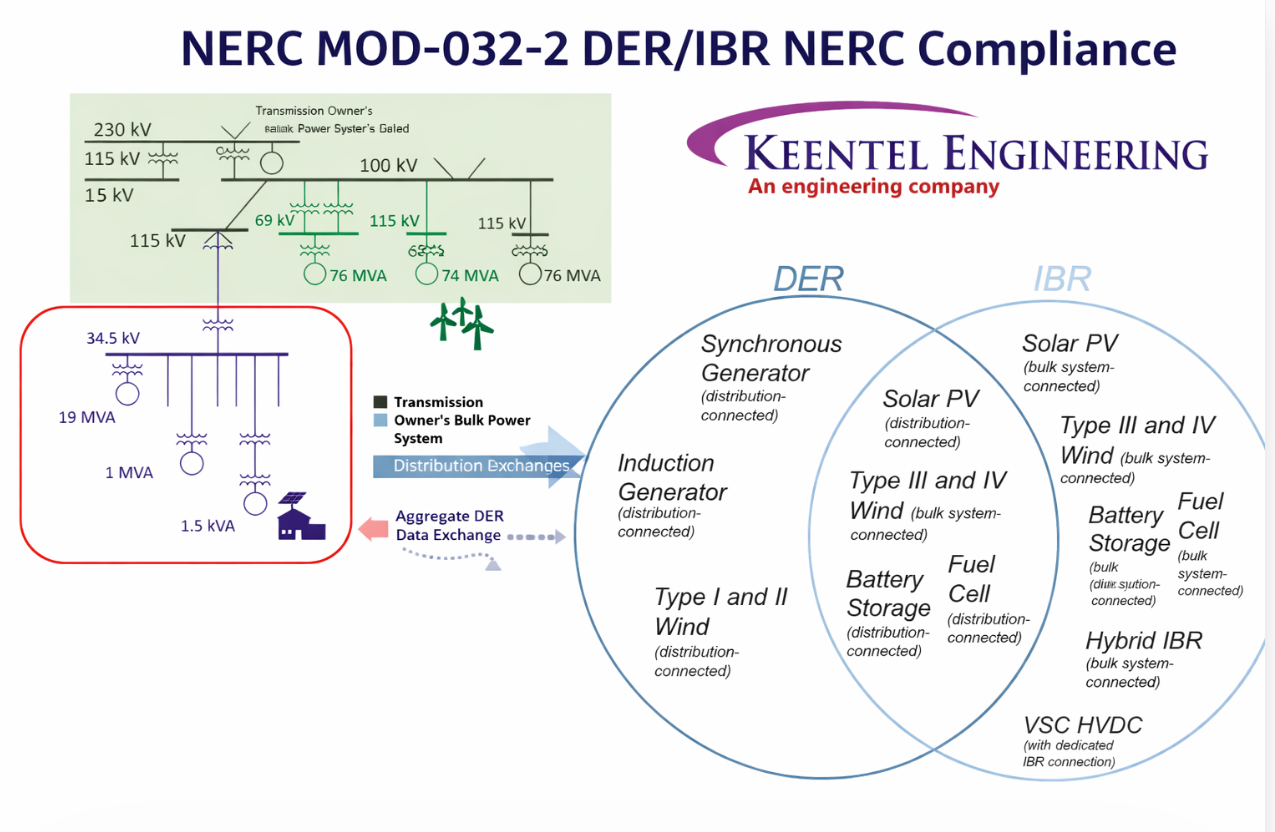
NERC MOD-032-2 Compliance Chart
Calendar icon. D

 Apr 18, 2022  | blog

Introduction: The Grid Is Changing And So Must Compliance

The North American power grid is undergoing one of the most significant transformations in its history. The rapid growth of Inverter-Based Resources (IBRs)—including solar, wind, and battery energy storage systems (BESS)—along with the expansion of Distributed Energy Resources (DERs) has fundamentally changed how power systems behave.


To address this shift, NERC Project 2022-02 introduces critical updates to:


  • MOD-032-2 – Data for Power System Modeling and Analysis 
  • TOP-003-8 – Transmission Operations Data Requirements 
  • IRO-010-6 – Reliability Coordinator Data Collection 


These updates are designed to ensure accurate system modeling, improved reliability, and compliance with FERC Order 901.


At Keentel Engineering, we specialize in helping utilities, developers, and asset owners navigate these evolving requirements through advanced modeling, compliance strategy, and engineering excellence.


Understanding MOD-032-2: The Backbone of Power System Modeling

MOD-032-2 establishes the data requirements necessary for accurate power system models used in:


  • Planning studies 
  • Stability and dynamic simulations 
  • Interconnection analysis 
  • Reliability assessments 


A key shift in the updated standard is the expansion of data requirements to include IBRs and DERs, ensuring that modern grid behavior is fully captured.


Key Change: Inclusion of DER Data


For the first time, MOD-032 explicitly requires aggregate DER modeling data, including:


  • Location 
  • Real power capability 
  • Resource type (solar, battery, diesel, etc.) 


This ensures that DERs are no longer treated as “invisible load offsets” but as active contributors to system behavior.


New Definition of DER: Why It Matters

The document introduces a standardized definition of DER:


A generator or energy storage resource connected to the distribution system capable of delivering real power in parallel with the Bulk Power System 


Why This Is Critical


  • Eliminates ambiguity across regions 
  • Aligns modeling assumptions 
  • Excludes demand response (treated differently in studies) 
  • Includes behind-the-meter resources 


This definition ensures consistent modeling across utilities, ISOs, and planners.


IBR Modeling Requirements: A Major Compliance Shift

FERC Order 901 mandates accurate modeling of IBR behavior. MOD-032-2 responds by requiring detailed representation of:


IBR Dynamic Performance Characteristics


  • Momentary cessation 
  • Tripping behavior 
  • Ride-through capability 
  • Frequency response 
  • Voltage control 


These parameters are essential for understanding grid stability during disturbances.

Why This Matters


Incorrect modeling has already caused real-world reliability issues, including:


  • Frequency instability 
  • Unexpected generation loss 
  • System oscillations 

DER Modeling: From Approximation to Engineering Precision

Historically, DERs were either ignored or approximated. That approach is no longer acceptable.


MOD-032-2 Introduces:


  • Aggregate DER modeling 
  • Dynamic behavior requirements 
  • Explicit inclusion in transmission planning models


Key Insight


DERs must now be modeled based on:

  • Ride-through behavior 
  • Voltage response 
  • Frequency-droop characteristics 
  • UFLS/UVLS interaction 


This represents a paradigm shift in planning studies.


Handling Data Gaps: Estimation Is Now Mandatory

One of the biggest challenges in DER compliance is data availability, especially for:


  • Behind-the-meter solar 
  • Small-scale storage 
  • Unregistered IBRs 


MOD-032-2 Solution


Entities must:


  1. Provide actual data where available 
  2. Estimate data where unavailable 
  3. Document: 


  • Methodology 
  • Assumptions 
  • Limitations 


Example Estimation Methods


  • Satellite-based solar estimation 
  • Regional penetration assumptions 
  • Average DER profiles by feeder 


This introduces engineering accountability and transparency.


Uniform Modeling Framework: Aligning Planning & Operations

A major requirement under FERC Order 901 is consistency between planning and operational models.


Standards Alignment


  • MOD-032 → Planning models 
  • TOP-003 / IRO-010 → Operational models


The updated standards require:


  • Consistent model structures 
  • Alignment of IBR parameters 
  • Coordinated data sharing across entities 

Compliance Responsibility: Who Owns the Data?

MOD-032-2 clarifies responsibilities across entities:


Typical Responsibilities


  • Distribution Providers (DP): DER data collection 
  • Transmission Owners (TO): Data when no DP exists 
  • Planning Coordinators (PC): Define requirements 


Even for unregistered DERs, registered entities must provide data.


Important Clarification


DERs themselves are not becoming BES assets, but their data must be included for system reliability studies


Keentel Engineering: Your Partner in NERC Compliance

At Keentel Engineering  we don’t just interpret standards—we implement them in real-world systems.


Our Core NERC Compliance Services


1. MOD-032 Compliance & Data Framework Development


  • Data request templates 
  • Entity responsibility mapping 
  • Reporting procedures 


2. IBR & DER Modeling


  • PSSE / TSAT / PSCAD modeling 
  • User-defined model validation 
  • Dynamic performance tuning 


3. DER Aggregation & Estimation Studies


  • Hosting capacity analysis 
  • DER penetration modeling 
  • Satellite & statistical estimation


4. Model Validation & Verification (MOD-026/027 Alignment)


  • Field vs. model comparison 
  • Parameter tuning 
  • Performance validation


5. Grid Code & FERC Order 901 Compliance


  • Gap analysis 
  • Implementation roadmap 
  • Audit support 

Why Keentel Engineering Stands Out

  • 30+ years of power system expertise 
  • Deep experience in NERC, ERCOT, CAISO, PJM, SPP 
  • Advanced simulation capabilities (PSSE, PSCAD, PowerFactory) 
  • Proven success in IBR and DER integration studies 


We help clients move from compliance risk → compliance confidence.


Conclusion: The Future of Compliance Is Data-Driven

MOD-032-2 and related standards mark a turning point in the industry:


  • DERs are now visible and measurable 
  • IBRs must be accurately modeled 
  • Data gaps must be engineered—not ignored 


Organizations that fail to adapt risk:


  • Non-compliance penalties 
  • Study inaccuracies 
  • Operational reliability issues 


With Keentel Engineering, you gain a partner that ensures your systems are:


  • Accurate
  • Compliant
  • Future-ready

25 Technical FAQs (With Answers)

  • 1. What is MOD-032-2?

    A NERC standard defining data requirements for power system modeling and analysis.


  • 2. Why was MOD-032 updated?

    To include IBRs and DERs and comply with FERC Order 901.


  • 3. What is a DER under NERC?

    A distribution-connected generator or storage resource capable of supplying real power.


  • 4. Are DERs considered BES assets?

    No, but their data must be included in modeling.


  • 5. What is aggregate DER modeling?

    Combining multiple DERs into a single equivalent representation for studies.


  • 6. Why is DER modeling important?

    It impacts system stability, voltage, and frequency response.


  • 7. What happens if DER data is unavailable?

    Entities must estimate it and document assumptions.


  • 8. What is IBR modeling?

    Modeling inverter-based resources like solar, wind, and BESS.


  • 9. What parameters are required for IBRs?

    Ride-through, tripping, voltage control, frequency response.


  • 10. What is momentary cessation?

    Temporary shutdown of IBR output during disturbances.


  • 11. Who is responsible for DER data?

    Typically Distribution Providers or Transmission Owners.


  • 12. What is FERC Order 901?

    A directive requiring improved IBR modeling and data transparency.


  • 13. What is a user-defined model?

    A custom model representing specific equipment behavior.


  • 14. Are generic models still allowed?

    Yes, but accuracy and usability must be ensured.


  • 15. What is the Unacceptable Models List (UML)?

    A NERC-maintained list of models that should not be used unless justified.


  • 16. What industries benefit from SAS?

    They ensure model validation and verification.

  • 17. How are DERs estimated?

    Using statistical, regional, or satellite-based methods.


  • 18. What is UFLS/UVLS interaction?

    DER response during load shedding events.


  • 19. What is planning vs operational model alignment?

    Ensuring consistency between long-term studies and real-time operations.


  • 20. Can DERs impact transmission studies?

    Yes, significantly, especially at high penetration levels.


  • 21. What is frequency droop control?

    DER response to frequency deviations.

  • 22. What is voltage control in DERs?

    Reactive power support affecting grid voltage.


  • 23. What is behind-the-meter DER?

    Generation or storage located on the customer side of the meter.


  • 24. Why exclude demand response from DER?

    Because it behaves as load, not generation.


  • 25. How can Keentel help with compliance?

    Through modeling, data frameworks, studies, and audit support.


A smiling man with glasses and a beard wearing a blue blazer stands in front of server racks in a data center.

About the Author:

Sonny Patel P.E. EC

IEEE Senior Member

In 1995, Sandip (Sonny) R. Patel earned his Electrical Engineering degree from the University of Illinois, specializing in Electrical Engineering . But degrees don’t build legacies—action does. For three decades, he’s been shaping the future of engineering, not just as a licensed Professional Engineer across multiple states (Florida, California, New York, West Virginia, and Minnesota), but as a doer. A builder. A leader. Not just an engineer. A Licensed Electrical Contractor in Florida with an Unlimited EC license. Not just an executive. The founder and CEO of KEENTEL LLC—where expertise meets execution. Three decades. Multiple states. Endless impact.

Four workers in safety vests and helmets stand with arms crossed near wind turbines.

Let's Discuss Your Project

Let's book a call to discuss your electrical engineering project that we can help you with.

Man in a blazer and open shirt, looking at the camera, against a blurred background.

About the Author:

Sonny Patel P.E. EC

IEEE Senior Member

In 1995, Sandip (Sonny) R. Patel earned his Electrical Engineering degree from the University of Illinois, specializing in Electrical Engineering . But degrees don’t build legacies—action does. For three decades, he’s been shaping the future of engineering, not just as a licensed Professional Engineer across multiple states (Florida, California, New York, West Virginia, and Minnesota), but as a doer. A builder. A leader. Not just an engineer. A Licensed Electrical Contractor in Florida with an Unlimited EC license. Not just an executive. The founder and CEO of KEENTEL LLC—where expertise meets execution. Three decades. Multiple states. Endless impact.

Leave a Comment

Related Posts

Keentel Engineering: Upgrading from Legacy SCADA to IEC 61850 Compliant Substation Automation System
By SANDIP R PATEL April 18, 2026
Explore the shift from legacy SCADA systems to Smart Substation Automation Systems (SAS). Learn how Keentel Engineering helps modernize power grids with IEC 61850 solutions. Get started today!
Primary injection testing setup with engineers inspecting current transformer commissioning in power
By SANDIP R PATEL April 17, 2026
Learn primary injection testing, CT commissioning, and current transformer validation. Ensure reliable substation protection systems discover best practices.
ASPEN power system analysis by Keentel Engineering for efficient electrical grid optimization.
By SANDIP R PATEL April 17, 2026
Optimize grids with ASPEN Power System Analysis, OneLiner & planning tools. Improve protection coordination and compliance. Discover solutions today.
MISO Planning Modeling Technical Guide banner with Keentel Engineering branding
By SANDIP R PATEL April 17, 2026
Master the MISO Planning Modeling Manual with expert insights on power system modeling, compliance, and generator requirements. Learn more today.
The image shows a map of Texas, highlighting regions associated with ERCOT
By SANDIP R PATEL April 16, 2026
Master ERCOT 2026 data and modeling requirements. Learn steady state, dynamic modeling, validation, and compliance strategies to avoid delays and rejections.
Power grid towers with digital network illustration and engineering article title.
By SANDIP R PATEL April 15, 2026
A detailed overview of PJM interconnection reforms, including the shift to a Cycle-based model, reduced queue delays, and the impact on grid reliability, project development, and engineering services.
Biggest Mistakes in Analyzing Modern Substation Schematics
By SANDIP R PATEL April 11, 2026
Discover 15 critical mistakes in modern substation schematic analysis, including IEC 61850, protection zones, GOOSE, CT/VT issues, and grid reliability risks.
Advanced large load modeling for grid reliability with data center power systems.
By SANDIP R PATEL April 10, 2026
Learn how large load modeling improves grid reliability for data centers and modern power systems using advanced EMT, dynamic studies, and compliance strategies.
ERCOT large load interconnection surge with data centers, renewable energy, and grid reliability
By SANDIP R PATEL April 10, 2026
ERCOT faces a surge in large load interconnections driven by AI data centers. Explore grid challenges, batch studies, and developer strategies