

A Coordinated Electric System Interconnection Review—the utility’s deep-dive on technical and cost impacts of your project.

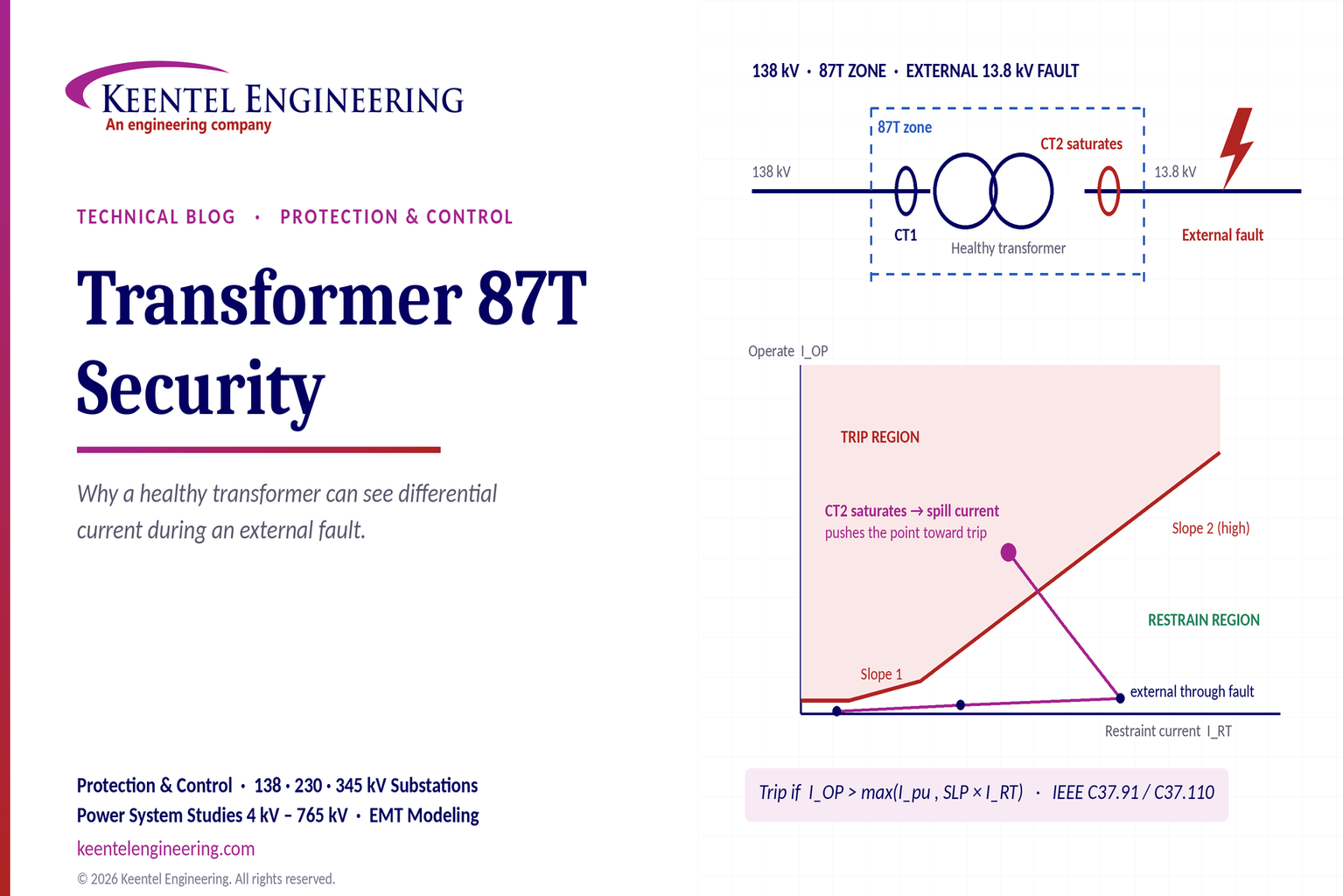
Challenge: Frequent false tripping using conventional electromechanical relays
Solution: SEL-487E integration with multi-terminal differential protection and dynamic inrush restraint
Result: 90% reduction in false trips, saving over $250,000 in downtime

Category Metric
VPP capacity (Lunar Energy) 650 MW
Lunar funding raised US$232 million
Data center BESS example 31 MW / 62 MWh
ERCOT grid-scale batteries 15+ GW
LDES tenders (H1 2026) Up to 9.3 GW
Lithium-ion share of LDES by 2030 77%
FEOC initial threshold 55%
BESS tariff rate (2026) ~55%
Capacity gain from analytics 5–15%

What is T&D Co-Simulation?

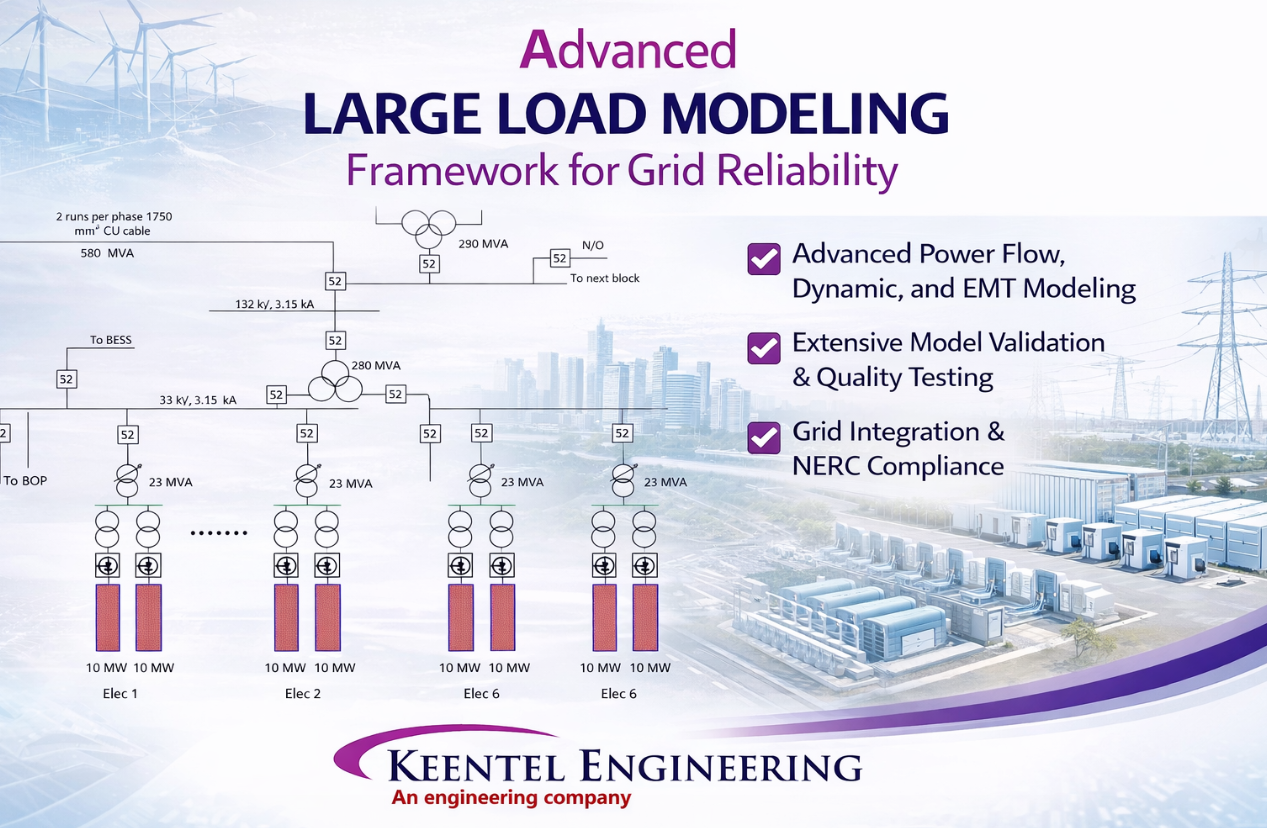
Advanced Large Load Modeling Framework for Grid Reliability

Keentel Engineering Industry Leading Power System Modeling & Compliance Solutions

Advanced large load modeling for grid reliability with data center power systems.
Calendar icon. D

Apr 10, 2026  | blog

Introduction

The rapid growth of large-scale electrical loads—including data centers, EV charging hubs, hydrogen electrolysis plants, and AI-driven infrastructure—is fundamentally transforming power system planning and reliability assessment.


Traditional load modeling approaches, designed primarily around induction motor-based industrial loads, are no longer sufficient. Emerging large loads are dominated by power electronic interfaces, creating new dynamic behaviors, instability risks, and modeling challenges.


At Keentel Engineering, we provide advanced large load modeling, validation, and compliance services aligned with evolving industry frameworks and NERC/ISO requirements—ensuring that your project is grid-compliant, reliable, and future-ready.


Why Large Load Modeling Matters Today

Modern grid operators face several critical challenges:

1. Unpredictable Behavior of Power Electronic Loads


  • Emerging loads rely on rectifiers and converters, unlike traditional motors
  • Their dynamic response during disturbances is not well understood
  • Existing composite load models are inadequate for high-fidelity simulations


2. Voltage Sensitivity & Ride-Through Risks


  • Many large loads (e.g., data centers) disconnect during minor faults. 
  • This causes: 


  • Sudden load drops 
  • Overvoltage / frequency excursions 
  • Potential grid instability 


3. Scale of Modern Loads


  • New facilities can exceed 1000 MW at a single interconnection point. 
  • Requires dedicated modeling, similar to generation plants. 


4. Complex Grid Interactions


  • Interaction between: 


  • Large loads 
  • Inverter-based resources (IBRs) 
  • Transmission systems 


  • Creates risks like: 


  • Oscillations 
  • Harmonics 
  • Control instability 

Keentel Engineering Approach to Large Load Modeling

1. Multi-Layer Modeling Strategy

We implement a tiered modeling framework:


A. Power Flow Modeling


  • Accurate load representation for: 


  • Steady-state conditions 
  • Interconnection studies 


B. Dynamic (Positive Sequence) Modeling


  • Used in tools like: 


  • PSSE 
  • PSLF 


  • Captures:


  • Transient stability 
  • Voltage recovery 
  • Frequency response 


C. EMT (Electromagnetic Transient) Modeling


  • High-fidelity simulations using: 


  • PSCAD 
  • EMTP 
  • MATLAB/Simulink 


  • Required for: 


  • Converter-level dynamics 
  • Harmonics 
  • Control interactions 

2. Load-Specific Modeling Expertise

We specialize in modeling:


  • Data Centers (AI) 
  • Hydrogen Electrolyzers 
  • EV Fleet Charging Infrastructure 
  • Crypto Mining Facilities 
  • Industrial Electrification Loads 


Each requires:


  • Custom modeling logic 
  • Control system representation 
  • Protection & ride-through behavior 

3. Model Development & Validation Framework

A model is only as good as its validation.


Keentel follows a rigorous process:


Data Collection


  • Equipment-level data 
  • Manufacturer inputs 
  • Site-specific parameters 


Parameterization


  • Component-based modeling 
  • Measurement-based tuning 


Validation


  • Matching simulation vs. real-world response 
  • Event-based calibration 


Model Quality Testing (MQT)


  • Similar to ERCOT IBR standards 
  • Ensures compliance with: 


  • Ride-through requirements 
  • Stability criteria


Poorly validated models can produce misleading results and reliability risks. 

4. Reliability Study Integration

We support all major study types:


Bulk System Studies


  • Transient stability 
  • Voltage recovery 
  • Frequency response 
  • Oscillation damping 


Local / Specialized Studies


  • Sub-synchronous oscillation (SSO) 
  • Harmonics analysis 
  • Ferroresonance 
  • Transient overvoltage 

Key Industry Gaps Keentel Solves

Challenge First Name
Lack of models for large loads Custom model development
Poor understanding of behavior Advanced simulation & studies
Inadequate validation Structured MQT framework
Compliance uncertainty NERC / ISO-aligned modeling
Data gaps Field + manufacturer data integration

Keentel Engineering Services

1. Large Load Interconnection Studies


  • Grid impact analysis 
  • POI design validation 
  • ISO/RTO compliance 


2. Dynamic Model Development


  • PSSE / PSLF / TSAT models 
  • EMT models (PSCAD, EMTP) 


3. Model Validation & MQT


  • Parameter tuning 
  • Event validation 
  • Compliance testing 


4. Grid Reliability & Stability Studies


  • Voltage stability 
  • Frequency response 
  • Oscillation analysis 


5. NERC Compliance Support


  • TPL-001 
  • MOD-032 / MOD-033 
  • PRC-related modeling validation 


6. Specialized Studies


  • Harmonics 
  • EMT simulations 
  • Controller interaction

Why Choose Keentel Engineering

  • 30+ years of power system expertise 
  • Deep experience in IBR + large load modeling 
  • Strong alignment with NERC, ERCOT, PJM, CAISO, WECC 
  • Advanced tools: PSSE, TSAT, PSCAD, PowerFactory 
  • Proven success in renewables + large load integration 

Frequently Asked Questions (FAQs)

  • 1. What is large load modeling?

    Large load modeling is the process of representing high-capacity electrical loads (e.g., data centers) in simulation tools to evaluate their impact on grid stability and reliability.


  • 2. Why are traditional load models insufficient?

    Traditional models focus on motor-based loads, whereas modern loads are power-electronic based, requiring more advanced dynamic modeling. 


  • 3. What is a composite load model?

    A composite load model combines:

    • Static load 
    • Motor load 
    • Electronic load 

    However, it is not adequate for emerging large loads. 


  • 4. What happens if load modeling is incorrect?

    Improper modeling can lead to:

    • Incorrect stability results 
    • Grid reliability risks 
    • Non-compliance with interconnection requirements 

  • 5. What is ride-through capability?

    It is the ability of a load to remain connected during grid disturbances. Lack of ride-through can destabilize the system.


  • 6. What is EMT modeling and when is it needed?

    EMT modeling captures fast electromagnetic transients and is required for:

    • Converter-based systems 
    • Harmonics 
    • Control interactions 

  • 7. What is Model Quality Testing (MQT)?

    MQT ensures that models:

    • Meet interconnection requirements 
    • Accurately represent system behavior 
    • Pass validation criteria 

  • 8. What standards apply to load modeling?

    Key standards include:

    • NERC TPL-001 
    • MOD-032 / MOD-033 
    • ISO/RTO-specific requirements 

  • 9. Do large loads behave like generators?

    In some cases, yes. Due to their size and controls, they require similar modeling rigor as generation resources.


  • 10. What industries require large load modeling?

    • Data centers (AI/cloud) 
    • Hydrogen production 
    • EV infrastructure 
    • Industrial electrification

  • 11. What tools are used for modeling?

    • PSSE / PSLF 
    • PSCAD / EMTP 
    • MATLAB / Simulink 

  • 12. Can generic models be used?

    Yes, for planning studies.

    But site-specific models are required for detailed analysis.


  • 13. Why is validation difficult for loads?

    Unlike generators:

    • Loads cannot be fully staged-tested 
    • They involve multiple components and vendors 

  • 14. How does Keentel ensure model accuracy?

    Through:

    • Data-driven parameterization 
    • Event validation 
    • MQT procedures 

  • 15. What risks do large loads pose to the grid?

    • Sudden disconnection 
    • Voltage instability 
    • Oscillations 
    • Harmonics 

  • 16. Are large loads required to submit models?

    Increasingly yes, as part of interconnection requirements.


  • 17. What is aggregation in load modeling?

    Combining multiple load components into a simplified model for system-level studies.


  • 18. What is the biggest challenge in large load modeling?

    Understanding power electronic behavior and control interactions.


  • 19. How does Keentel help developers?

    We provide:

    • End-to-end modeling 
    • Compliance support 
    • Study execution 
    • Interconnection strategy 

  • 20. Why is Keentel the right partner?

    Because we combine:

    • Engineering expertise 
    • Regulatory knowledge 
    • Advanced simulation capability 


Conclusion

The energy transition is driving a new class of large, complex electrical loads that require advanced modeling frameworks to ensure grid reliability.


Keentel Engineering stands at the forefront of this transformation, delivering:


  • Accurate models 
  • Reliable studies 
  • Full regulatory compliance


A smiling man with glasses and a beard wearing a blue blazer stands in front of server racks in a data center.

About the Author:

Sonny Patel P.E. EC

IEEE Senior Member

In 1995, Sandip (Sonny) R. Patel earned his Electrical Engineering degree from the University of Illinois, specializing in Electrical Engineering . But degrees don’t build legacies—action does. For three decades, he’s been shaping the future of engineering, not just as a licensed Professional Engineer across multiple states (Florida, California, New York, West Virginia, and Minnesota), but as a doer. A builder. A leader. Not just an engineer. A Licensed Electrical Contractor in Florida with an Unlimited EC license. Not just an executive. The founder and CEO of KEENTEL LLC—where expertise meets execution. Three decades. Multiple states. Endless impact.

Four workers in safety vests and helmets stand with arms crossed near wind turbines.

Let's Discuss Your Project

Let's book a call to discuss your electrical engineering project that we can help you with.

Man in a blazer and open shirt, looking at the camera, against a blurred background.

About the Author:

Sonny Patel P.E. EC

IEEE Senior Member

In 1995, Sandip (Sonny) R. Patel earned his Electrical Engineering degree from the University of Illinois, specializing in Electrical Engineering . But degrees don’t build legacies—action does. For three decades, he’s been shaping the future of engineering, not just as a licensed Professional Engineer across multiple states (Florida, California, New York, West Virginia, and Minnesota), but as a doer. A builder. A leader. Not just an engineer. A Licensed Electrical Contractor in Florida with an Unlimited EC license. Not just an executive. The founder and CEO of KEENTEL LLC—where expertise meets execution. Three decades. Multiple states. Endless impact.

Leave a Comment

Related Posts

Power system resource adequacy planning for renewable grids, energy storage, LOLE modeling
By SANDIP R PATEL May 17, 2026
Learn how power system resource adequacy supports grid reliability, LOLE planning, energy storage, and interconnection risk in renewable grids.
Category 2 IBR compliance flyer for renewable energy, BESS storage, grid code registration.
By SANDIP R PATEL May 16, 2026
Category 2 IBR compliance services for solar, wind, and BESS projects. Learn NERC registration, EMT modeling, and PRC readiness today.
ERCOT large load interconnection guide covering NPRR1234, PGRR115, and grid connection rules
By SANDIP R PATEL May 8, 2026
Learn ERCOT large load interconnection rules, LLIS requirements, and Texas grid compliance for data centers and industrial facilities.
NERC computational load risk infographic for AI data centers, grid reliability, and Level 3 complian
By SANDIP R PATEL May 8, 2026
Understand NERC large load compliance, EMT studies, and computational load modeling for AI data center reliability.
By SANDIP R PATEL May 4, 2026
Learn transmission injection and withdrawal studies, TIR & TWR, system impact studies, and grid analysis for solar, BESS, and HVDC. Discover more.
US Grid Code Requirements – Droop Control & Fast Frequency Response (FFR) | BESS IEEE 2800
By SANDIP R PATEL May 4, 2026
Learn how droop control and fast frequency response (FFR) enable IEEE 2800 compliance for BESS, solar, and wind in US grid interconnections.
ASPEN OneLiner V15 advanced protection system modeling white paper cover for relay coordination
By SANDIP R PATEL May 3, 2026
Master ASPEN OneLiner V15 for protection system modeling, relay coordination, and fault analysis. Learn advanced power system workflows today.
Texas Energy System Explained infographic showing ERCOT power market, Texas grid operations,
By SANDIP R PATEL May 3, 2026
Learn how ERCOT manages the Texas electricity grid, including LMP pricing, SCED dispatch, ancillary services, congestion, and wholesale power markets.
PJM Cycle 1 Interconnection Infographic: 220 GW Storage & Grid Update
By SANDIP R PATEL May 2, 2026
PJM's Cycle 1 reform brings a 220 GW storage-led pipeline. See how BESS and new modeling impact grid reliability.