

A Coordinated Electric System Interconnection Review—the utility’s deep-dive on technical and cost impacts of your project.
Challenge: Frequent false tripping using conventional electromechanical relays
Solution: SEL-487E integration with multi-terminal differential protection and dynamic inrush restraint
Result: 90% reduction in false trips, saving over $250,000 in downtime
| Category | Metric |
|---|---|
| VPP capacity (Lunar Energy) | 650 MW |
| Lunar funding raised | US$232 million |
| Data center BESS example | 31 MW / 62 MWh |
| ERCOT grid-scale batteries | 15+ GW |
| LDES tenders (H1 2026) | Up to 9.3 GW |
| Lithium-ion share of LDES by 2030 | 77% |
| FEOC initial threshold | 55% |
| BESS tariff rate (2026) | ~55% |
| Capacity gain from analytics | 5–15% |
What is T&D Co-Simulation?
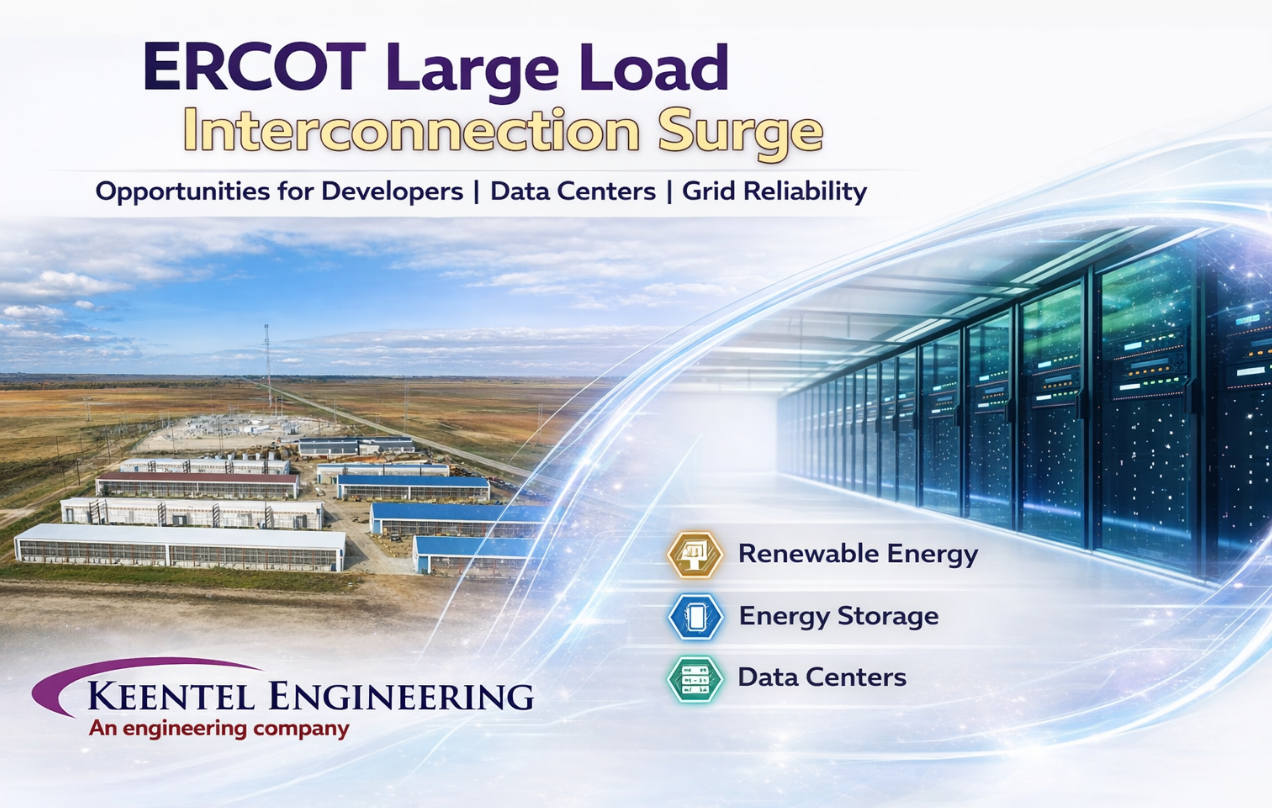
ERCOT Large Load Interconnection Surge: What It Means for Developers, Data Centers, and Grid Reliability
Apr 10, 2026 | blog
Introduction: A Grid Under Transformation
The ERCOT grid is undergoing one of the most dramatic transformations in U.S. power system history. The April 2026 ERCOT update highlights a convergence of massive load growth, renewable generation dominance, and regulatory evolution all happening simultaneously.
For developers, utilities, and large-load customers (especially data centers and AI infrastructure), this shift introduces both opportunity and risk.
At Keentel Engineering, we specialize in navigating exactly these kinds of transitions—providing interconnection studies, system impact analysis, compliance, and design solutions aligned with ERCOT and NERC requirements.
1. Explosive Growth in Generation Interconnection
ERCOT is currently managing:
- 2,008 active generation interconnection requests
- ~453 GW total capacity in the queue
Key Trend: Renewable Dominance
- Solar + Battery Storage = 76%+ of queued capacity
- Energy storage alone exceeds 177 GW
- Solar exceeds 162 GW
Gas is Back Strategically
- Gas capacity has grown 271% since the Texas Energy Fund (TEF) (2023)
Engineering Insight
This creates complex hybrid grid dynamics:
- High inverter-based resource (IBR) penetration
- Reduced system inertia
- Increased need for:
- EMT modeling
- Dynamic stability analysis
- Grid-forming inverter studies
Keentel Engineering Services:
- PSSE + TSAT + PSCAD modeling
- IBR compliance (IEEE 2800, NERC PRC standards)
- Interconnection feasibility & system impact studies
2. The Rise of Large Loads: Data Centers Are Driving the Grid
ERCOT is tracking:
- ~410 GW of large load interconnection requests
- ~87% are data centers
What This Means
The ERCOT grid is no longer just generation-driven—it is now load-driven, particularly by:
- AI data centers
- Hyperscale cloud infrastructure
- Crypto and industrial electrification
Load Growth Trajectory
From the chart on page 3:
- 2025 → ~6.7 GW
- 2030 → ~410 GW
This is a 60x increase in just five years.
Engineering Challenges
- Transmission congestion
- Voltage stability under large step loads
- Fault current contribution uncertainty (IBR + load mix)
- Substation capacity constraints
Keentel Engineering Services:
- Large load interconnection studies
- Load modeling (composite load + dynamic models)
- Substation and POI design
- Protection coordination for high-demand facilities
3. The AI Data Center Surge: A Game-Changer
The chart on page 4 shows a sharp spike in 2025–2026, described as:
“Rush of requests for AI Data Center loads seeking firm service”
Key Insight
This is not gradual growth—it is a demand shock.
Implications
- Grid planning models are becoming outdated quickly
- Interconnection queues are overwhelmed
- Firm transmission service demand is rising sharply
Risk for Developers
- Study delays
- Restudy loops
- Interconnection uncertainty
Keentel Advantage
We help clients:
- Strategically position projects in the queue
- Anticipate grid constraints early
- Reduce restudy risk through advanced modeling
4. The Shift to a Batch Study Process
ERCOT is transitioning from:
Old System: Sequential (Single Study)
- Each new project triggers restudies
- Prior results become invalid
- Projects face multi-year delays
New System: Batch Study Framework
- Projects grouped and studied every ~6 months
- Capacity is allocated and reserved
- Reduces restudy cycles
As described on page 7:
- Eliminates “restudy loops”
- Improves transparency
- Stabilizes timelines
Engineering Impact
- Study assumptions become more critical
- Competition within each batch increases
- Accurate modeling is essential for securing capacity
Keentel Engineering Services:
- Batch study readiness assessments
- Queue strategy consulting
- High-fidelity modeling to improve study outcomes
5. New Regulatory Requirements (PUCT Rules)
PUC Project 58480 (Effective March 2026)
- Only projects with executed agreements will be included in forecasts
PUC Project 58481 (Proposed Standards)
Key Requirements:
- Site control
- Financial security: $50,000/MW
- Interconnection fees (non-refundable)
- CIAC (Contribution in Aid of Construction)
Implications
- Higher barriers to entry
- Financial commitment required earlier
- Reduced speculative projects
Keentel Engineering Support:
- Regulatory compliance strategy
- Interconnection documentation
- Technical validation for financial commitments
6. Transmission & Geographic Constraints
The page 5 chart shows:
- Heavy concentration of load in specific TSP territories (e.g., Oncor dominance)
Implication
- Certain regions will experience:
- Severe congestion
- Longer timelines
- Higher upgrade costs
Keentel Approach
- Locational screening studies
- Optimal POI selection
- Cost-risk optimization
7. Digitalization: The Future of Interconnection
ERCOT is developing:
- Large Load Portal
- Real-time project tracking
- Enhanced communication with TSPs
Impact
- More transparency
- Faster decision-making
- Data-driven planning
Why This Matters for Your Project
Whether you're developing:
- A data center
- A BESS or solar project
- A gas peaker plant
- An industrial electrification facility
The ERCOT landscape now requires:
- Advanced modeling
- Strategic queue positioning
- Regulatory expertise
- Fast, accurate engineering execution
Why Choose Keentel Engineering
Keentel Engineering provides:
Core Services
- ERCOT Interconnection Studies (FIS, SIS, Stability)
- Large Load Modeling & Impact Studies
- PSCAD / EMT / RMS Simulations
- NERC Compliance (PRC, TPL, MOD)
- Substation & POI Design
- Protection & Control Engineering
Our Advantage
- Deep ERCOT expertise
- Experience with IBR and large load integration
- Fast turnaround with high accuracy
- End-to-end support (concept → energization)
Frequently Asked Questions (FAQs)
1. What is causing the surge in ERCOT interconnection requests?
The surge is driven primarily by solar, battery storage, and AI data centers, which together dominate both generation and load growth.
2. Why are data centers dominating large load requests?
AI and cloud computing require massive, continuous power, making ERCOT an attractive market due to its deregulated structure.
3. What is the ERCOT batch study process?
It is a new framework where projects are grouped and studied together every ~6 months, reducing restudy delays and improving efficiency.
4. What is a restudy loop and why is it a problem?
A restudy loop occurs when new projects invalidate prior studies, forcing repeated analysis and delaying approvals.
5. How much load is currently seeking interconnection in ERCOT?
Approximately 410 GW, with around 87% from data centers.
6. What are the biggest risks for new projects?
- Interconnection delays
- Transmission constraints
- Regulatory compliance requirements
- Study uncertainties
7. What financial requirements are imposed by PUCT?
Projects may need to provide $50,000/MW in financial security and meet strict interconnection agreement criteria.
8. How can developers improve their chances in the queue?
By using accurate models, early feasibility studies, and strategic siting.
9. What role does energy storage play?
Energy storage is critical for:
- Grid stability
- Peak shaving
- Renewable integration
10. What studies are required for large load interconnection?
- Steady-state load flow
- Short circuit analysis
- Dynamic stability studies
- EMT simulations (in many cases)
11. What is CIAC?
Contribution in Aid of Construction—costs paid by the developer for required grid upgrades.
12. Why is ERCOT moving to batch processing?
To eliminate inefficiencies and delays caused by sequential study processes.
13. How does location impact interconnection success?
Certain areas are congested, leading to higher costs and longer timelines.
14. What is the role of PSCAD in ERCOT studies?
PSCAD is used for EMT simulations, especially for inverter-based resources and large loads.
15. What is the Large Load Portal?
A planned ERCOT system to provide real-time project status and transparency.
16. How does gas generation fit into the future mix?
Gas is growing as a reliability resource, complementing intermittent renewables.
17. What challenges do inverter-based resources create?
- Reduced inertia
- Stability issues
- Complex protection coordination
18. How can Keentel Engineering help data center developers?
By providing:
- Grid impact analysis
- Interconnection strategy
- Substation and POI design
19. What is the timeline for ERCOT’s new process implementation?
Target protocol implementation is August 2026.
20. Why is early engineering critical in ERCOT today?
Because delays, costs, and risks increase exponentially without proper planning and modeling.
Final Thoughts
The ERCOT grid is entering a new era defined by electrification, AI, and renewable dominance.
Success in this environment requires more than just engineering it requires strategy, foresight, and deep system expertise.
Keentel Engineering is positioned to help you lead in this new energy landscape.

About the Author:
Sonny Patel P.E. EC
IEEE Senior Member
In 1995, Sandip (Sonny) R. Patel earned his Electrical Engineering degree from the University of Illinois, specializing in Electrical Engineering . But degrees don’t build legacies—action does. For three decades, he’s been shaping the future of engineering, not just as a licensed Professional Engineer across multiple states (Florida, California, New York, West Virginia, and Minnesota), but as a doer. A builder. A leader. Not just an engineer. A Licensed Electrical Contractor in Florida with an Unlimited EC license. Not just an executive. The founder and CEO of KEENTEL LLC—where expertise meets execution. Three decades. Multiple states. Endless impact.
Services

Let's Discuss Your Project
Let's book a call to discuss your electrical engineering project that we can help you with.

About the Author:
Sonny Patel P.E. EC
IEEE Senior Member
In 1995, Sandip (Sonny) R. Patel earned his Electrical Engineering degree from the University of Illinois, specializing in Electrical Engineering . But degrees don’t build legacies—action does. For three decades, he’s been shaping the future of engineering, not just as a licensed Professional Engineer across multiple states (Florida, California, New York, West Virginia, and Minnesota), but as a doer. A builder. A leader. Not just an engineer. A Licensed Electrical Contractor in Florida with an Unlimited EC license. Not just an executive. The founder and CEO of KEENTEL LLC—where expertise meets execution. Three decades. Multiple states. Endless impact.
Leave a Comment
We will get back to you as soon as possible.
Please try again later.