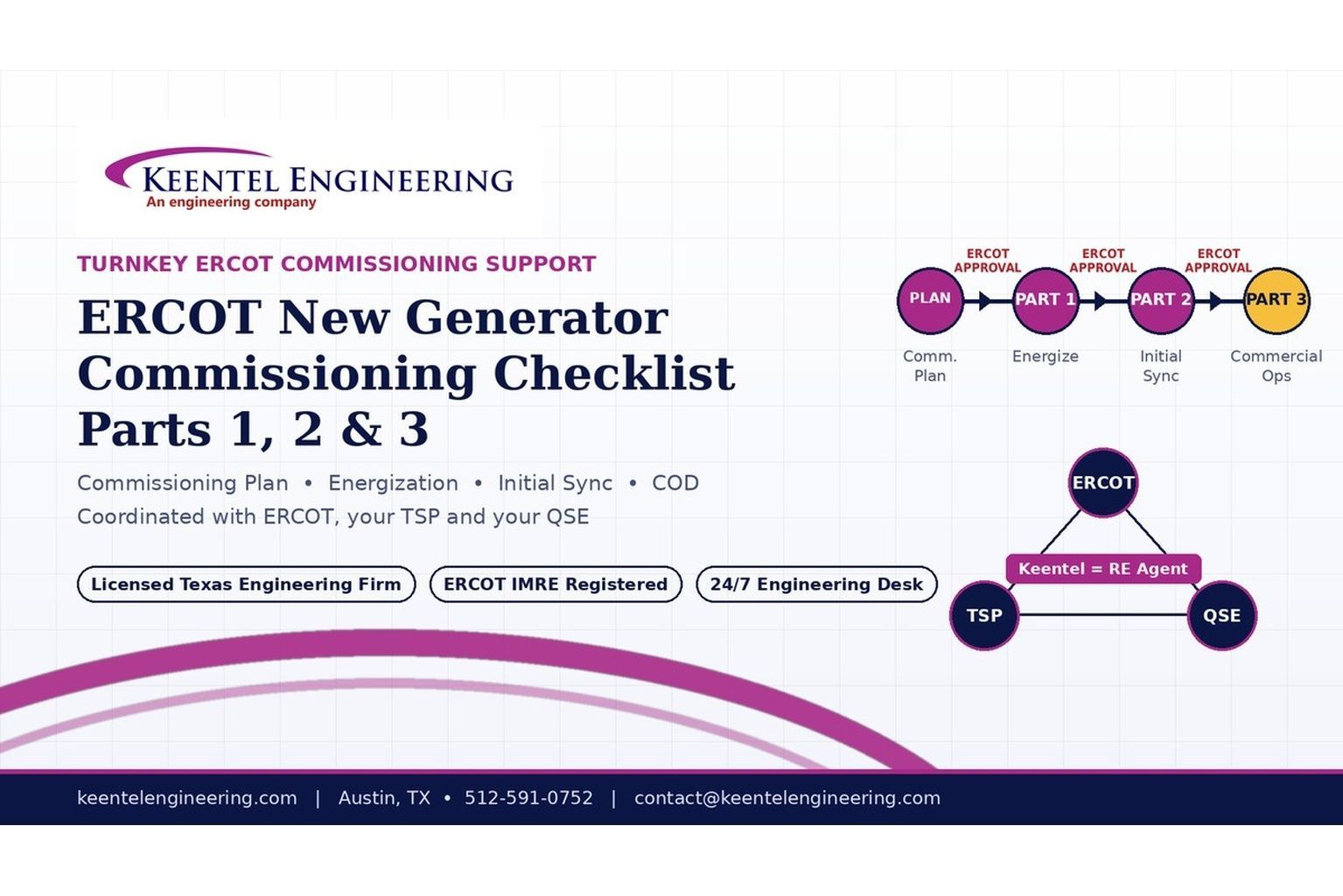

A Coordinated Electric System Interconnection Review—the utility’s deep-dive on technical and cost impacts of your project.
Challenge: Frequent false tripping using conventional electromechanical relays
Solution: SEL-487E integration with multi-terminal differential protection and dynamic inrush restraint
Result: 90% reduction in false trips, saving over $250,000 in downtime
| Category | Metric |
|---|---|
| VPP capacity (Lunar Energy) | 650 MW |
| Lunar funding raised | US$232 million |
| Data center BESS example | 31 MW / 62 MWh |
| ERCOT grid-scale batteries | 15+ GW |
| LDES tenders (H1 2026) | Up to 9.3 GW |
| Lithium-ion share of LDES by 2030 | 77% |
| FEOC initial threshold | 55% |
| BESS tariff rate (2026) | ~55% |
| Capacity gain from analytics | 5–15% |
Strengthening Grid Reliability: New Dynamic Modeling Requirements for Large Loads in Texas
January 2/1/2026
As large-scale data centers, cryptocurrency mining facilities, and other power-intensive operations continue to grow, maintaining grid stability has become a critical priority. In response, ERCOT has introduced Planning Guide Revision Request (PGRR) 144, establishing enhanced requirements for dynamic modeling and stability analysis of large loads.
This update is designed to ensure that large electrical facilities are accurately represented in system studies, helping prevent voltage collapse, frequency instability, and large-scale outages.
Understanding PGRR 144
PGRR 144 focuses on improving how large loads—especially Large Electronic Loads (LELs)are modeled in ERCOT’s planning and operational tools. These models must now:
- Accurately represent real-world equipment behavior
- Be compatible with PSS/E, PSCAD, and TSAT platforms
- Demonstrate voltage and frequency ride-through capability
- Include hardware validation for converter-based systems
With more than 200 GW of large loads seeking interconnection, ERCOT has identified dynamic modeling as essential for grid reliability.
Why Dynamic Modeling Matters
Dynamic models simulate how electrical systems respond to disturbances such as:
- Transmission faults
- Voltage sags
- Frequency excursions
- Sudden load changes
Poor quality models can underestimate risks, leading to cascading failures. Since 2022, ERCOT has observed repeated incidents where
large loads tripped during minor disturbances, highlighting the need for better modeling standards.
New Requirements for Large Load Developers
1. Comprehensive Dynamic Data
Facility owners must submit detailed models covering:
- Cooling systems
- Power electronics
- Control systems
- Protection relays
- Computer-based loads
These models must reflect actual field settings and operating conditions.
2. Mandatory Model Quality Testing
Each submitted model must pass standardized tests, including:
- Flat start (no-disturbance) test
- Large voltage disturbance test
- Frequency disturbance test
- System strength test (for inverter-based systems)
These tests verify that models initialize correctly and remain stable under stress.
3. Converter and Inverter Validation
For Large Electronic Loads, ERCOT now requires:
- PSCAD hardware benchmarking
- Voltage ride-through verification
- Subsynchronous oscillation testing
This ensures that power electronic devices behave in simulations the same way they do in the field.
4. Review Checkpoints Throughout Development
Model reviews are required at three major stages:
- Before dynamic stability studies
- Before Quarterly Stability Assessment (QSA)
- Before initial energization (LELs only)
These checkpoints help identify issues early and reduce costly redesigns.
Impact on Project Schedules and Costs
While ERCOT estimates no direct capital cost impact, it anticipates:
- $200K–$250K annual staffing costs
- Additional review time
- Increased documentation effor
One full-time engineering position will be added to support these activities.
Regulatory Oversight
PGRR 144 becomes effective after approval by the
Public Utility Commission of Texas (PUCT). Once approved, all new and modified large loads must comply.
How Keentel Engineering Supports Compliance
Keentel Engineering assists large load developers by providing:
Dynamic model development (PSS/E, PSCAD, TSAT)
Model quality and validation testing
LLIS documentation support
ERCOT submission management
Stability study coordination
As-built model certification
Our team ensures that projects meet regulatory requirements while minimizing delays.
Frequently Asked Questions (FAQs)
1. What is PGRR 144?
It is an ERCOT planning guide revision establishing new dynamic modeling and validation requirements for large loads.
2. Who must comply with PGRR 144?
Any new or modified facility meeting large load thresholds, including LELs, data centers, and high-density computing facilities.
3. What qualifies as a Large Load?
Generally, facilities exceeding 75 MW or materially affecting grid stability.
4. What is a Large Electronic Load (LEL)?
Facilities dominated by power electronics, such as crypto mines and hyperscale data centers.
5. Why are dynamic models required?
They predict how facilities respond to faults, voltage dips, and frequency events.
6. Which software platforms are accepted?
PSS/E, PSCAD, and TSAT, as specified in ERCOT’s procedure manual.
7. What is a flat start test?
A simulation verifying correct model initialization under steady-state conditions.
8. What is voltage ride-through testing?
Testing whether equipment remains connected during voltage disturbances.
9. Are hardware tests required?
Yes, for LELs, converter hardware must be benchmarked against PSCAD models.
10. What is LLIS?
The Large Load Interconnection Study process used to assess system impacts.
11. When must models be submitted?
Before dynamic stability studies and before quarterly assessments.
12. What is an “as-built” model?
A final model reflecting actual installed equipment and settings.
13. What happens if models are inaccurate?
ERCOT may require revisions, delay energization, or request new studies.
14. Are modifications subject to review?
Yes. Any material change affecting ride-through must go through LLIS.
15. What documentation is required?
Model manuals, validation reports, test results, and attestations.
16. How often must models be updated?
When equipment changes or when field data shows discrepancies.
17. What is system strength testing?
Testing performance under different short-circuit ratios.
18. What is QSA?
Quarterly Stability Assessment conducted by ERCOT.
19. Who reviews submissions?
Interconnecting Transmission Service Providers and ERCOT engineers.
20. How long does ERCOT review take?
Typically 10 business days, extendable by 20 days.
21. Are models confidential?
Yes. They are treated as protected information.
22. Does PGRR 144 affect project timelines?
Yes. Additional reviews may extend development schedules.
23. Are there financial penalties for non-compliance?
Indirectly, through delays, redesign costs, and re-studies.
24. Can one validation report be reused?
Yes, for the same inverter hardware type.
25. How can Keentel Engineering help?
By managing modeling, testing, documentation, and regulatory coordination from concept through energization.

About the Author:
Sonny Patel P.E. EC
IEEE Senior Member
In 1995, Sandip (Sonny) R. Patel earned his Electrical Engineering degree from the University of Illinois, specializing in Electrical Engineering . But degrees don’t build legacies—action does. For three decades, he’s been shaping the future of engineering, not just as a licensed Professional Engineer across multiple states (Florida, California, New York, West Virginia, and Minnesota), but as a doer. A builder. A leader. Not just an engineer. A Licensed Electrical Contractor in Florida with an Unlimited EC license. Not just an executive. The founder and CEO of KEENTEL LLC—where expertise meets execution. Three decades. Multiple states. Endless impact.
Services

Let's Discuss Your Project
Let's book a call to discuss your electrical engineering project that we can help you with.

About the Author:
Sonny Patel P.E. EC
IEEE Senior Member
In 1995, Sandip (Sonny) R. Patel earned his Electrical Engineering degree from the University of Illinois, specializing in Electrical Engineering . But degrees don’t build legacies—action does. For three decades, he’s been shaping the future of engineering, not just as a licensed Professional Engineer across multiple states (Florida, California, New York, West Virginia, and Minnesota), but as a doer. A builder. A leader. Not just an engineer. A Licensed Electrical Contractor in Florida with an Unlimited EC license. Not just an executive. The founder and CEO of KEENTEL LLC—where expertise meets execution. Three decades. Multiple states. Endless impact.
Leave a Comment
We will get back to you as soon as possible.
Please try again later.
Related Posts