

A Coordinated Electric System Interconnection Review—the utility’s deep-dive on technical and cost impacts of your project.

Challenge: Frequent false tripping using conventional electromechanical relays
Solution: SEL-487E integration with multi-terminal differential protection and dynamic inrush restraint
Result: 90% reduction in false trips, saving over $250,000 in downtime

Category Metric
VPP capacity (Lunar Energy) 650 MW
Lunar funding raised US$232 million
Data center BESS example 31 MW / 62 MWh
ERCOT grid-scale batteries 15+ GW
LDES tenders (H1 2026) Up to 9.3 GW
Lithium-ion share of LDES by 2030 77%
FEOC initial threshold 55%
BESS tariff rate (2026) ~55%
Capacity gain from analytics 5–15%

NERC BAL-007-1 Explained: Near-Term Energy Reliability Assessments (ERA) and What It Means for Grid Operators & Developers

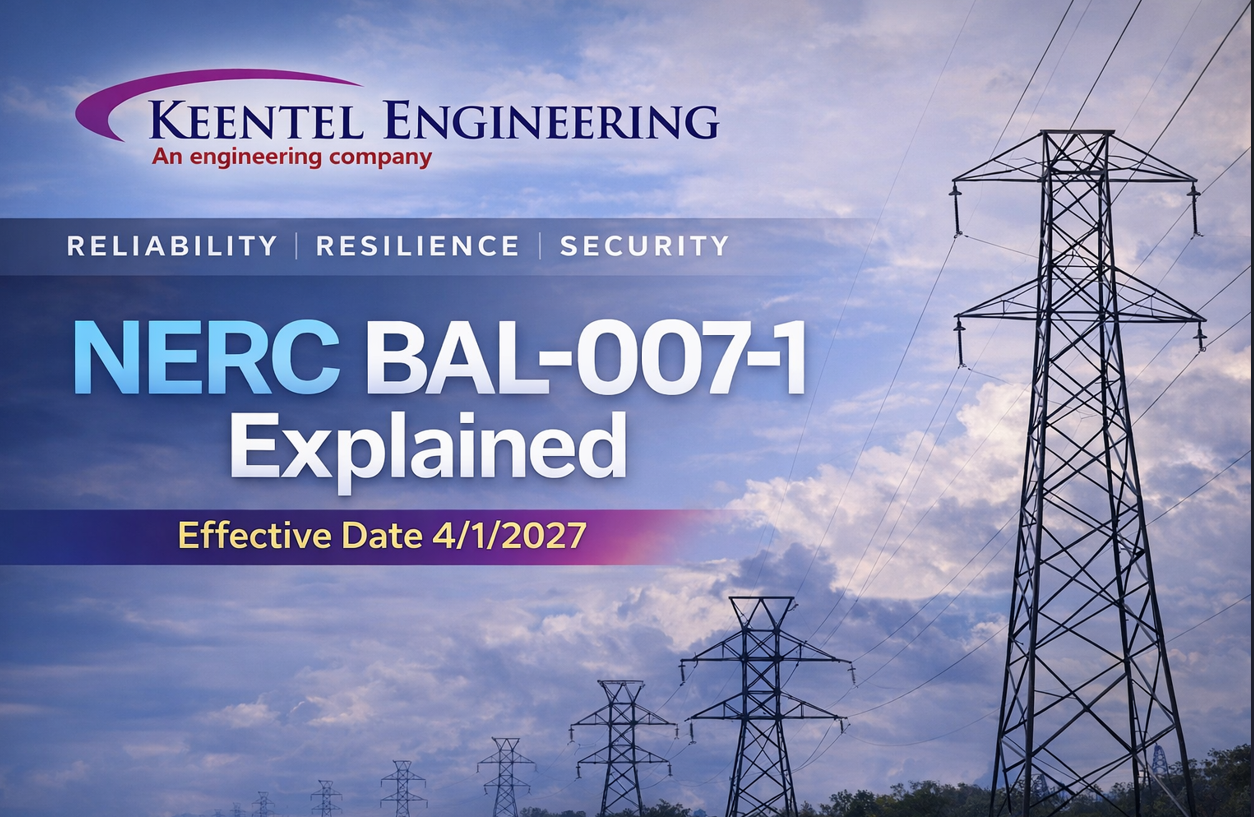
NERC BAL-007-1 Explained banner with power lines and April 1, 2027 effective date.
Calendar icon. D

Apr 3, 2026  | blog

Introduction: The Shift from Capacity to Energy Reliability

The North American power grid is undergoing a fundamental transformation. Traditional reliability planning focused on capacity adequacy ensuring enough MW is available. However, with the rapid growth of inverter-based resources (IBRs) like solar, wind, and battery storage, this approach is no longer sufficient.

The NERC BAL-007-1 Reliability Standard introduces a critical shift toward energy adequacy, ensuring that sufficient energy (MWh over time) is available—not just capacity. 

At Keentel Engineering, we help utilities, developers, and asset owners navigate this transition, ensuring full compliance while optimizing system performance.


Core Components of BAL-007-1

1. ERA Development (R1–R3)

Balancing Authorities (BAs) must:


  • Define modeling assumptions 
  • Develop scenarios 
  • Create operating plans 


Unlike prescriptive standards, BAL-007 allows flexibility:


  • Deterministic OR probabilistic methods 

2. ERA Execution (R4)

  • Perform assessments routinely 
  • Cover all relevant time horizons 
  • Ensure updated and current data 

3. Risk Identification & Mitigation (R5)

If a forecasted Energy Emergency is identified:


  • Trigger Operating Plans 
  • Align with EEA (Energy Emergency Alert) framework 

These modeling approaches often rely on advanced power system modeling and simulation techniques


What Makes ERA Different from Traditional Studies?

Traditional Capacity Study ERA (BAL-007-1)
Snapshot-based Time-series analysis
MW-focused MWh-focused
Ignores fuel depletion Models fuel constraints
Limited to next-day Up to 6 weeks horizon

Key Modeling Requirements in ERA

1. Fuel Modeling

  • Natural gas constraints 
  • Coal/oil inventory depletion 
  • Hydro limitations 
  • Renewable variability

2. Resource Types Considered

  • Dispatchable generation 
  • Energy storage (BESS, pumped hydro) 
  • Variable renewables (wind/solar) 

3. Transmission Constraints

  • Known deliverability limits must be included 
  • Full power flow not required, but constraints must be modeled 

Scenario-Based Risk Analysis (R2)

BAL-007 requires stress testing the system through scenarios:

1. Demand Stress

  • High load scenarios (e.g., 90/10 peak) 

2. Supply Loss

  • Loss of major energy resource

3. Fuel-Based Risk

  • Loss of common fuel supply (e.g., gas system) 

4. Historical/Extreme Events

  • Weather-driven scenarios 
  • Regional risks (snow, smoke, wind drought) 

These scenarios must be credible and documented 


Operating Plans: The Real Game Changer

Unlike reactive standards, BAL-007 emphasizes proactive mitigation.


Example Actions:


  • Reschedule outages 
  • Secure additional fuel 
  • Optimize storage dispatch 
  • Increase imports (with caution) 
  • Coordinate with Reliability Coordinators 


From page 9 examples:


  • Recall generation from maintenance 
  • Defer outages 
  • Increase ERA frequency 
  • Prepare thermal units ahead of cold weather 

Timeline Advantage: Why BAL-007 is Powerful

 Diagram on page 3 shows timeline interaction

BAL-007 operates:


  • Days to weeks ahead 


This enables:


  • Preventive action 
  • Reduced reliance on emergency procedures 
  • Better coordination across regions

Challenges for Industry Stakeholders

 Data Requirements

  • Requires coordination (TOP-003 updates) 
  • Multi-entity data integration

Modeling Complexity

  • Time-series simulations 
  • Fuel supply modeling 
  • Renewable uncertainty 

Operational Coordination

  • Interchange assumptions 
  • Cross-BA dependencies 

How Keentel Engineering Supports BAL-007 Compliance

At Keentel Engineering we provide end-to-end NERC BAL-007 solutions:

1. ERA Model Development

2. Scenario Design

  • Region-specific stress scenarios 
  • Weather + fuel + contingency modeling 

3. Operating Plan Development

  • Custom mitigation strategies 
  • Coordination procedures 
  • EEA-aligned frameworks 

4. Compliance Documentation

  • R1–R6 compliance packages 
  • Audit-ready documentation

5. Advanced Studies

  • Fuel risk analysis 
  • Renewable variability assessment 
  • Storage optimization

Conclusion: The Future is Energy-Based Reliability

BAL-007-1 is not just a compliance requirementit is a paradigm shift.

The grid is evolving from:


  • Capacity adequacy
  • To energy assurance


Organizations that adapt early will:


  • Reduce risk 
  • Improve reliability 
  • Gain operational flexibility 


Keentel Engineering is at the forefront of this transformation.


 25 TECHNICAL FAQs (FOR SEO + CLIENT EDUCATION)

  • 1. What is BAL-007-1?

    A NERC Reliability Standard focused on near-term energy adequacy assessments.


  • 2. What is an ERA?

    An Energy Reliability Assessment evaluating energy sufficiency over time.


  • 3. What is the time horizon of a Near-Term ERA?

    5 days to 6 weeks. 


  • 4. Why is BAL-007 needed?

    Capacity-based planning does not capture energy risks. 


  • 5. Who must comply?

    Balancing Authorities (BAs).


  • 6. What is the difference between capacity and energy?

    Capacity = MW

    Energy = MWh over time


  • 7. Does ERA require probabilistic modeling?

    No deterministic or probabilistic methods are allowed.


  • 8. What are key ERA inputs?

    • Load forecast 
    • Resource availability 
    • Fuel supply 
    • Transmission constraints 

  • 9. Are renewables modeled differently?

    Yes must include variability and uncertainty.


  • 10. What is a forecasted Energy Emergency?

    A predicted shortfall aligned with EEA criteria.


  • 11. How does BAL-007 relate to EOP-011?

    BAL-007 is proactive; EOP-011 is reactive.


  • 12. Does ERA replace TOP-002?

    No it complements it. 


  • 13. How often must ERAs be performed?

    Regularly, covering all time periods.


  • 14. What are the required scenarios?

    • Demand stress 
    • Supply loss 
    • Fuel supply risk 
    • Historical events 

  • 15. Are transmission constraints required?

    Yes, known constraints must be modeled.


  • 16. Is power flow required?

    No, but constraints must be represented.


  • 17. What fuels must be modeled?

    Gas, coal, oil, hydro, renewables.


  • 18. How is demand response treated?

    Optional depends on BA assumptions.


  • 19. Can ERAs be done jointly?

    Yes, multiple BAs can collaborate.


  • 20. What triggers Operating Plans?

    Forecasted energy deficiency.


  • 21. What are typical mitigation actions?

    • Rescheduling outages 
    • Fuel management 
    • Storage optimization 

  • 22. Are imports considered firm?

    No must be verified. 


  • 23. How often must processes be reviewed?

    At least every 24 months.


  • 24. What software is used for ERA?

    • PSSE + TSAT 
    • PSCAD 
    • PowerFactory 
    • MATLAB 

  • 25. How can Keentel Engineering help?

    Through modeling, compliance support and operational strategy development.


A smiling man with glasses and a beard wearing a blue blazer stands in front of server racks in a data center.

About the Author:

Sonny Patel P.E. EC

IEEE Senior Member

In 1995, Sandip (Sonny) R. Patel earned his Electrical Engineering degree from the University of Illinois, specializing in Electrical Engineering . But degrees don’t build legacies—action does. For three decades, he’s been shaping the future of engineering, not just as a licensed Professional Engineer across multiple states (Florida, California, New York, West Virginia, and Minnesota), but as a doer. A builder. A leader. Not just an engineer. A Licensed Electrical Contractor in Florida with an Unlimited EC license. Not just an executive. The founder and CEO of KEENTEL LLC—where expertise meets execution. Three decades. Multiple states. Endless impact.

Four workers in safety vests and helmets stand with arms crossed near wind turbines.

Let's Discuss Your Project

Let's book a call to discuss your electrical engineering project that we can help you with.

Man in a blazer and open shirt, looking at the camera, against a blurred background.

About the Author:

Sonny Patel P.E. EC

IEEE Senior Member

In 1995, Sandip (Sonny) R. Patel earned his Electrical Engineering degree from the University of Illinois, specializing in Electrical Engineering . But degrees don’t build legacies—action does. For three decades, he’s been shaping the future of engineering, not just as a licensed Professional Engineer across multiple states (Florida, California, New York, West Virginia, and Minnesota), but as a doer. A builder. A leader. Not just an engineer. A Licensed Electrical Contractor in Florida with an Unlimited EC license. Not just an executive. The founder and CEO of KEENTEL LLC—where expertise meets execution. Three decades. Multiple states. Endless impact.

Leave a Comment

Related Posts

PJM EMT modeling guidelines for inverter-based resources
By SANDIP R PATEL July 3, 2026
Learn PJM EMT model development requirements for inverter-based resources, including PSCAD modeling, benchmark testing, EMT studies, and Decision Point II compliance.
Power transformer testing and commissioning
By SANDIP R PATEL July 2, 2026
Master power transformer testing and commissioning with expert guidance on TTR, winding resistance, insulation testing, impedance tests, CT verification, and safe energization.
Fast real-time EMT simulation for low-inertia power systems
By SANDIP R PATEL July 2, 2026
Discover fast real-time EMT simulation for low-inertia power systems, HIL testing, PSCAD modeling, cloud-based EMT, OEM controller integration, and transient stability assessment.
Fundamentals of substation protection and power system relays
By SANDIP R PATEL June 30, 2026
Learn substation protection, protective relaying, relay coordination, fault analysis, and power system protection fundamentals.
Utility-scale solar and battery storage engineering infrastructure
By SANDIP R PATEL June 30, 2026
Learn utility-scale solar engineering, battery storage integration, grid interconnection, power system studies, and commissioning best practices.
Data center design engineering with grid-to-rack power and cooling
By SANDIP R PATEL June 29, 2026
WHITE PAPER |Learn data center design, power infrastructure, cooling systems, redundancy, and grid interconnection to build reliable, efficient facilities.
Transmission line engineering from 30% design to IFC
By SANDIP R PATEL June 29, 2026
Learn how transmission line design progresses from 30% to IFC, covering clearance, sag-tension, structures, foundations, and engineering best practices.
AP1000 nuclear power supply chain and grid interconnection infrastructure
By SANDIP R PATEL June 29, 2026
Learn how the AP1000 supply chain, combined operating licenses, nuclear grid interconnection, transmission planning, and power system studies. for success.
CenterPoint Energy Interconnection
By SANDIP R PATEL June 27, 2026
Learn CenterPoint Energy's interconnection requirements for large data center loads, including primary service, harmonic analysis, emergency generation, protection, and engineering compliance.