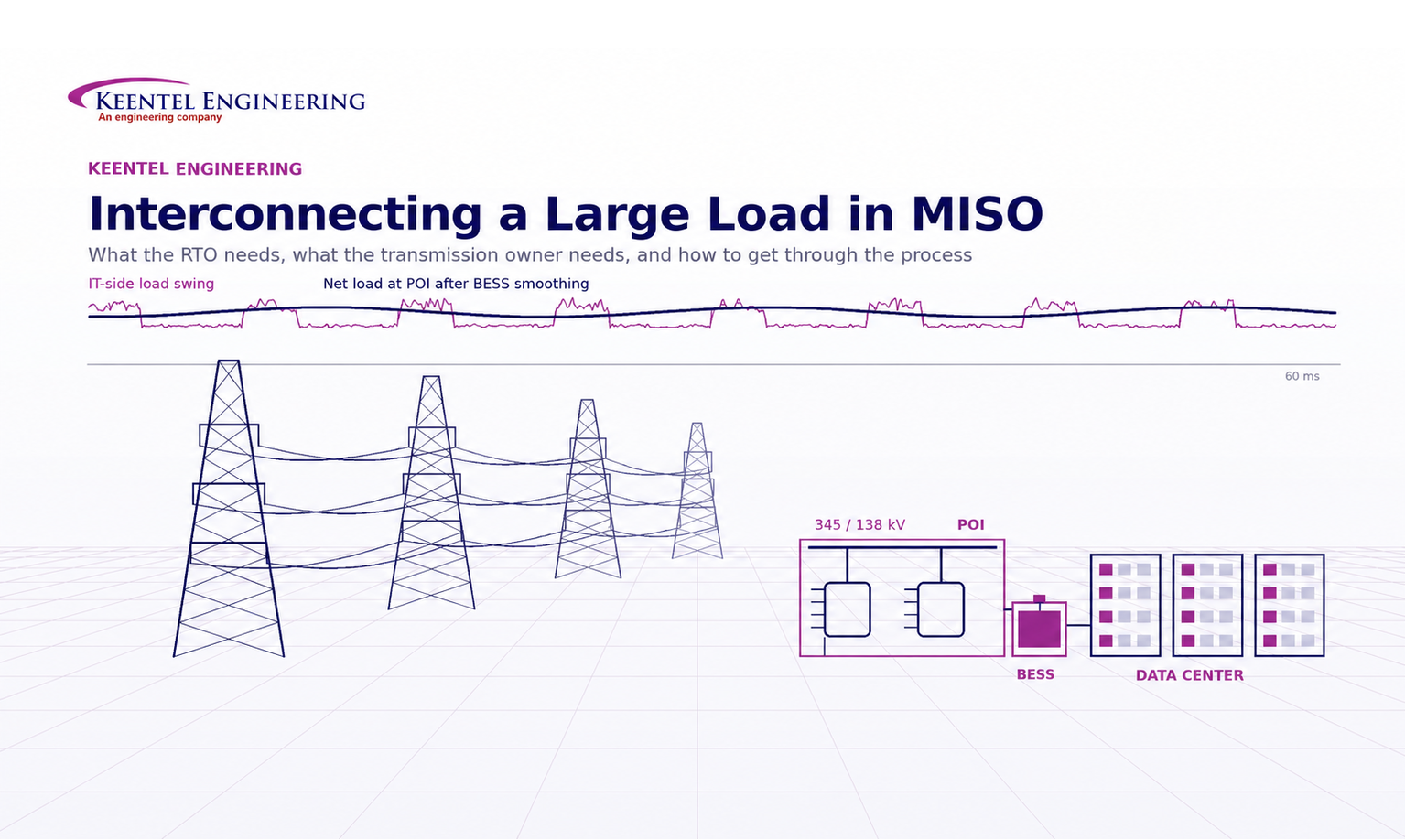


A Coordinated Electric System Interconnection Review—the utility’s deep-dive on technical and cost impacts of your project.

Challenge: Frequent false tripping using conventional electromechanical relays
Solution: SEL-487E integration with multi-terminal differential protection and dynamic inrush restraint
Result: 90% reduction in false trips, saving over $250,000 in downtime

Understanding the PJM Regional Transmission Planning Process (RTEP): A Guide by Keentel Engineering

Calendar icon. D

April 19, 2025 | Blog

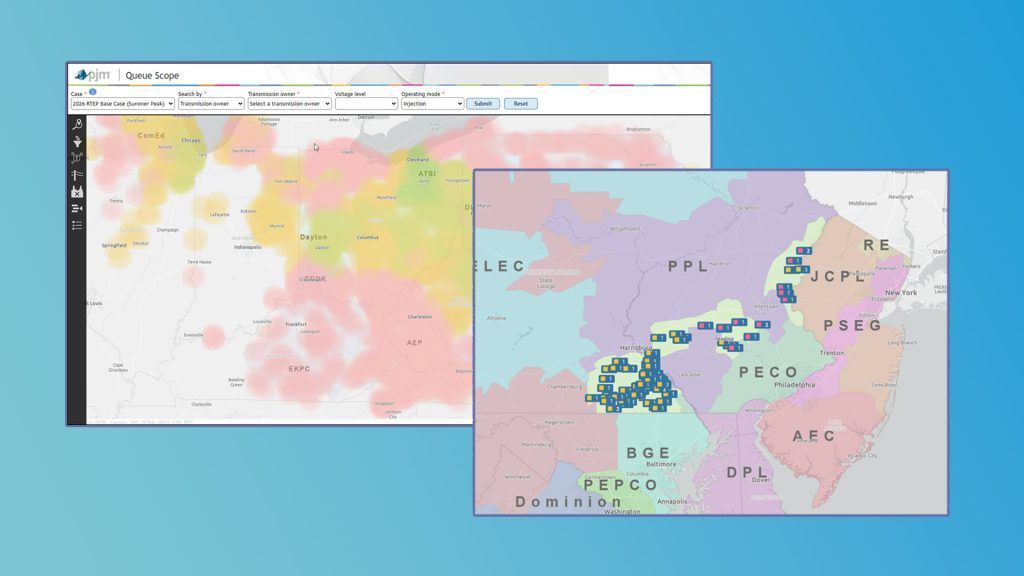
Two maps: one with shaded areas, the other with outlined regions and labels like PPL and BEC.

At Keentel Engineering, we stay ahead of evolving regulatory frameworks to deliver exceptional power system engineering services. One of the cornerstones of our grid planning expertise lies in our thorough understanding of PJM Manual 14B, which governs the PJM Regional Transmission Expansion Plan (RTEP) — a critical process ensuring grid reliability, economic efficiency, and alignment with public policy objectives across the PJM Interconnection.


With 30+ years of utility-scale experience, our engineers support utilities, IPPs, and developers through each step of PJM regional transmission planning with modeling, compliance, and technical proposal development.


What Is PJM Manual 14B and Why It Matters

PJM Manual 14B outlines the core process for planning transmission system upgrades across the PJM footprint. It includes five key project types:

➤ Baseline Reliability Projects – Required upgrades based on NERC TPL standards.
➤ Supplemental Projects – Driven by Transmission Owners for asset management and local needs.
➤ Market Efficiency Projects – Designed to resolve congestion using a benefit-to-cost ratio.
➤ Public Policy Projects – Support state energy policies via the State Agreement Approach.
➤ Customer-Funded Upgrades – Initiated by interconnection customers or merchant developers.

This planning framework ensures that every project meets FERC, NERC, and state-level energy regulations, while balancing stakeholder input and economic value.

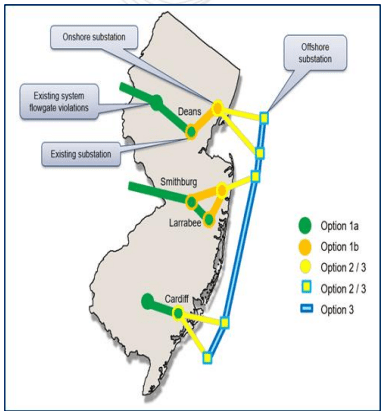
Map of New Jersey showing potential offshore wind power transmission routes. Colored lines and substation locations are highlighted.

Key Components of the PJM RTEP Process

1. Baseline Reliability Planning

  • Identifies and mitigates thermal overloads, voltage violations, and stability issues.
  • Relies on load flow, short-circuit, and dynamic modeling over a 15-year planning horizon.

2. Supplemental Projects in PJM

  • Initiated by Transmission Owners (TOs) to address asset replacements and lifecycle planning.
  • Must pass “do-no-harm” reliability screening before inclusion in the RTEP.

3. Market Efficiency Projects

  • Improve cost-efficiency by relieving congestion and lowering production costs.
  • Require a 25% minimum benefit-to-cost ratio across 15 years.

4. Public Policy-Driven Planning

  • Facilitated through the State Agreement Approach, aligning infrastructure with clean energy mandates.

5. Customer-Funded Transmission Upgrades

  • Support interconnections, merchant lines, and special customer-driven capacity additions.

How Keentel Engineering Supports the PJM Transmission Planning Cycle

Keentel Engineering provides full-scope technical, modeling, and regulatory services across all PJM planning categories:

  • Power System Studies: Load flow, N-1-1 contingency, stability, and deliverability analysis
  • Modeling Support: PSCAD, PSS®E, ASPEN, and ETAP dynamic model development
  • PJM Proposal Window Submissions: Economic impact assessments and CEII-ready documentation
  • NERC & FERC Compliance: Expertise in TPL, FAC, PRC standards and Form No. 715 requirements
  • Asset Retirement & EOL Planning: Evaluating transmission asset end-of-life (EOL) status for reliability impact

Related Services: Learn how our Power System Studies and Substation Design Services support PJM project compliance and system integration.


PJM RTEP FAQs

  • Q1: What is the PJM RTEP process and why is it important?

    The Regional Transmission Expansion Plan (RTEP) identifies necessary transmission upgrades to meet reliability, market, and policy needs across the PJM Interconnection.

  • Q2: What are Baseline Reliability Projects in PJM?

    These are projects required to meet NERC reliability standards, based on PJM’s planning simulations.

  • Q3: What is a Supplemental Project in PJM Manual 14B?

    Projects initiated by Transmission Owners for system maintenance, asset management, or compliance—not necessarily driven by PJM.

  • Q4: What is “do no harm” evaluation?

    A test to ensure proposed upgrades don’t negatively affect the broader grid’s performance or reliability.

  • Q5: What is the role of FERC Form No. 715?

    It outlines local planning criteria, including asset aging and condition-based replacement strategy used in PJM evaluations.

  • Q6: What software is used in PJM transmission modeling?

    PJM primarily uses PSS®E, PowerWorld, and TARA; Keentel adds depth using PSCAD, ASPEN, and ETAP.

  • Q7: Who can submit proposals during PJM’s planning cycle?

    Both incumbent TOs and qualified developers (including merchant providers) may submit projects during PJM’s annual proposal window.

  • Q8: What is the State Agreement Approach?

    A formal method allowing states to sponsor and fund projects that meet local clean energy or climate policy goals.

  • Q9: How are project costs allocated?

    Via PJM’s cost allocation methods, based on whether a project is baseline, supplemental, or market-driven.

  • Q10: How does Keentel help with PJM submissions?

    We support modeling, documentation, proposal justification, CEII data management, and stakeholder presentation preparation.


Why Choose Keentel Engineering for PJM Planning Support?

With decades of experience and deep software proficiency, Keentel delivers:

  • Industry-leading PJM RTEP modeling and submittal support
  • FERC/NERC compliance alignment for all proposal types
  • Technical expertise with modeling tools like PSS®E, PSCAD, ASPEN, ETAP
  • Reliable stakeholder representation across TEAC, Subregional RTEP, and FERC dockets


Man in a blazer and open shirt, looking at the camera, against a blurred background.

About the Author:

Sonny Patel P.E. EC

IEEE Senior Member

In 1995, Sandip (Sonny) R. Patel earned his Electrical Engineering degree from the University of Illinois, specializing in Electrical Engineering . But degrees don’t build legacies—action does. For three decades, he’s been shaping the future of engineering, not just as a licensed Professional Engineer across multiple states (Florida, California, New York, West Virginia, and Minnesota), but as a doer. A builder. A leader. Not just an engineer. A Licensed Electrical Contractor in Florida with an Unlimited EC license. Not just an executive. The founder and CEO of KEENTEL LLC—where expertise meets execution. Three decades. Multiple states. Endless impact.

Four workers in safety vests and helmets stand with arms crossed near wind turbines.

Let's Discuss Your Project

Let's book a call to discuss your electrical engineering project that we can help you with.

Man in a blazer and open shirt, looking at the camera, against a blurred background.

About the Author:

Sonny Patel P.E. EC

IEEE Senior Member

In 1995, Sandip (Sonny) R. Patel earned his Electrical Engineering degree from the University of Illinois, specializing in Electrical Engineering . But degrees don’t build legacies—action does. For three decades, he’s been shaping the future of engineering, not just as a licensed Professional Engineer across multiple states (Florida, California, New York, West Virginia, and Minnesota), but as a doer. A builder. A leader. Not just an engineer. A Licensed Electrical Contractor in Florida with an Unlimited EC license. Not just an executive. The founder and CEO of KEENTEL LLC—where expertise meets execution. Three decades. Multiple states. Endless impact.

Leave a Comment

Related Posts

Electrical substation with high-voltage equipment, wires, and insulators against a blue sky.
By SANDIP R PATEL November 26, 2025
Learn how to stay compliant with NERC PRC-004-6 and MIDAS reporting. Keentel Engineering provides misoperation analysis, CAP support, and audit-ready documentation.
ISO-NE DDMS Guide
By SANDIP R PATEL November 26, 2025
Technical guide to ISO-NE’s DDMS for power system engineers — model submissions, file formats (RAW/DYR), certification workflow, and annual recertification for MOD-032, MOD-026, MOD-027.
Learn how PRC-004-6 misoperations and MIDAS reporting work.
By SANDIP R PATEL November 15, 2025
Learn how PRC-004-6 misoperations and MIDAS reporting work. A complete NERC compliance guide from Keentel Engineering for utilities and power entities.
Solar panels field and power plant with smokestacks on a cloudy day.
By SANDIP R PATEL October 30, 2025
Learn how Generator and Transmission Owners meet PJM MOD-032 data submission requirements using Gen Model, Model on Demand, and ASPEN tools for NERC compliance.
An aerial view of a large battery storage facility with numerous white shipping container-like units. Wind turbines in background.
By SANDIP R PATEL October 27, 2025
Learn how utility-scale BESS meet IEEE 2800 voltage and frequency ride-through requirements with simulation, validation, and compliance reporting.
Diagram of a redundant power distribution system with utility, UPS, and critical/non-critical loads.
By SANDIP R PATEL October 19, 2025
Explore NERC’s 2025 review on simultaneous voltage-sensitive load reductions amid industrial electrification, data center growth, and crypto mining.
Diagram showing frequency monitoring and point of interconnection with a Tesla 400E box.
By SANDIP R PATEL October 16, 2025
Discover how the TESLA 4000 IED enables precise frequency monitoring at the Point of Interconnection for reliable, compliant grid operations.
Electrical diagram showing power distribution with utilities, switchgear, generators, and UPS systems.
By SANDIP R PATEL October 10, 2025
Discover how data centers, crypto, and EV hubs impact grid stability—and how Keentel Engineering mitigates emerging load risks.
An industrial power plant with multiple smokestacks at sunset.
By SANDIP R PATEL October 10, 2025
Learn how Keentel Engineering enhances industrial reliability and safety through power system analysis — including short-circuit, coordination, load-flow, stability, and grounding studies. Discover why these analyses are essential for optimized power performance.