

A Coordinated Electric System Interconnection Review—the utility’s deep-dive on technical and cost impacts of your project.

Challenge: Frequent false tripping using conventional electromechanical relays
Solution: SEL-487E integration with multi-terminal differential protection and dynamic inrush restraint
Result: 90% reduction in false trips, saving over $250,000 in downtime

Category Metric
VPP capacity (Lunar Energy) 650 MW
Lunar funding raised US$232 million
Data center BESS example 31 MW / 62 MWh
ERCOT grid-scale batteries 15+ GW
LDES tenders (H1 2026) Up to 9.3 GW
Lithium-ion share of LDES by 2030 77%
FEOC initial threshold 55%
BESS tariff rate (2026) ~55%
Capacity gain from analytics 5–15%

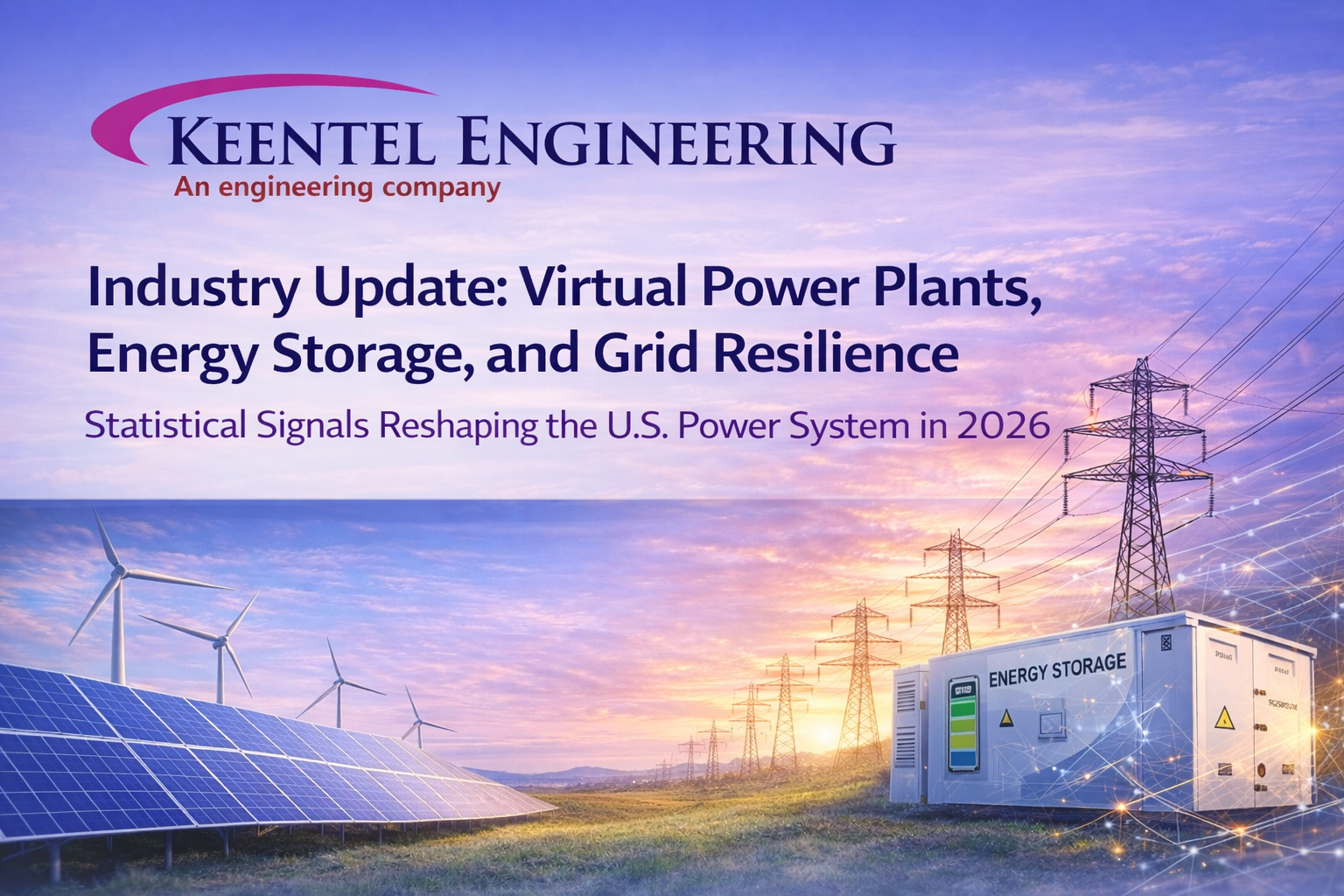
Industry Update: Virtual Power Plants, Energy Storage, and Grid Resilience: Statistical Signals Reshaping the U.S. Power System in 2026

Keentel Engineering blog banner showing renewable energy grid infrastructure with solar panels, wind turbines, power transmission lines, and an energy storage system, titled ‘Industry Update: Virtual Power Plants, Energy Storage, and Grid Resilience – Statistical Signals Reshaping the U.S. Power System in 2026.
Calendar icon. D

February 08, 2026 | Blog

Executive Summary

In early 2026, the U.S. energy storage and distributed energy resource (DER) sector crossed several statistical thresholds that signal a structural shift in how grid reliability, affordability, and flexibility are delivered. Large-scale batteries are now central to winter storm resilience, virtual power plants (VPPs) are operating at utility scale, long-duration storage technologies are entering competitive procurement cycles, and domestic battery supply chains are being reshaped by tariffs, FEOC restrictions, and slowing EV demand.

Taken together, recent funding announcements, regulatory guidance, market rankings, and real-world grid performance data show that energy storage has moved from an optional grid enhancement to core infrastructure.


1. Virtual Power Plants Are Scaling to Hundreds of Megawatts

Lunar Energy: Capital Inflows and Operational Scale

In February 2026, Lunar Energy raised US$232 million across Series C and D funding rounds, underscoring growing investor confidence in VPP platforms as grid assets rather than experimental software.


Key metrics include:

  • US$102 million Series D (oversubscribed)
  • US$130 million prior Series C
  • 650 MW of DER devices under management globally
  • Operations spanning:
  • California
  • New England
  • Hawaii
  • Puerto Rico
  • Europe and Asia


Lunar’s AI-powered Gridshare platform is used by:

  • Residential solar-plus-storage installers
  • Community Choice Aggregators (CCAs)
  • Utilities and energy retailers


From a grid-planning perspective, 650 MW of dispatchable residential and small commercial assets is equivalent to a mid-sized peaking plant but with geographically distributed resilience benefits.

Statistical signal: VPPs are no longer pilot-scale; they are entering the same capacity conversation as conventional generation.


2. Data Centers and Storage: Peak Shaving as an Interconnection Strategy

NEMA Guidance on ESS and Microgrids

The National Electrical Manufacturers Association (NEMA) published two guidance papers in early 2026 focused on:


NEMA explicitly frames energy storage as a solution to:

  • Interconnection queue delays
  • Peak demand constraints
  • Reliability and uptime requirements


A concrete example illustrates this shift:

  • 31 MW / 62 MWh BESS at Aligned Data Centres in Hillsboro, Oregon
  • Designed specifically to accelerate interconnection approval
  • Enabled partial load service years ahead of full utility upgrades


According to NEMA, data centers often hit their highest loads during AI model training. Storage allows:

  • Partial self-supply during peaks
  • Reduced grid impact
  • Faster regulatory approval


Statistical signal: Storage is increasingly being treated as an interconnection mitigation tool, not just backup power.


3. Long-Duration Energy Storage: Market Leaders and a Pivotal Year

LDES Supplier Rankings and Procurement Outlook

Sightline Climate’s new Long-Duration Energy Storage (LDES) Leaderboard ranks suppliers based on deployment, finance, economics, and technology readiness.


Key findings:

  • Lithium-ion dominates, representing 77% of global LDES capacity scheduled by 2030
  • Tesla and Chint Power lead overall rankings
  • Energy Dome is the highest-ranked non-lithium provider
  • Other top non-lithium technologies include:
  • Liquid air energy storage
  • Advanced compressed air
  • Iron hybrid flow batteries
  • Geothermal storage

Critically:

  • Up to 9.3 GW of LDES tenders are expected to be awarded in H1 2026 across:
  • UK
  • New South Wales (Australia)
  • Ontario (Canada)

Analysts note that 2026 awards will likely determine which non-lithium technologies reach financial maturity.

Statistical signal: LDES is transitioning from demonstration to competitive procurement at multi-gigawatt scale.


4. ERCOT Batteries: Grid Resilience in Real Time

Texas Winter Storm Performance

ERCOT now has more than 15 GW of grid-scale battery energy storage systems connected and operating in its energy-only market.


During winter storms:

  • Batteries respond in milliseconds
  • Gas plants may take minutes or hours — or fail due to frozen supply
  • Short-duration batteries (1–2 hours) still provide critical system buffers


Industry data shows:

  • Even 1–1.5 hours of additional flexibility can prevent cascading outages
  • 5–15% improvement in usable capacity during extreme events materially impacts grid outcomes and market revenues


Battery analytics providers emphasize that:

  • Cold weather reduces lithium-ion diffusion
  • Thermal management and auxiliary power are essential
  • Predictive analytics prevent state-of-charge errors that can erase value during price spikes


Statistical signal: Batteries have become the first line of defense during extreme grid events, not a secondary resource.


5. Supply Chains, Tariffs, and the EV Slowdown

FEOC Restrictions and Section 301 Tariffs

As of January 1, 2026:

  • Section 301 tariffs on Chinese-origin BESS increased to 25%
  • Total effective tariffs rose to ~55%
  • FEOC restrictions disqualify projects from tax credits if:
  • Foreign content exceeds 55% initially
  • Rising to 75% after 2029


This is significant because:

  • ~75% of U.S. lithium-ion battery imports historically came from China


However, a slowdown in EV adoption is reshaping supply:

  • Removal of EV consumer tax credits reduced demand
  • Battery gigafactories are retooling EV lines for stationary storage
  • Analysts project cell oversupply by late 2026


Major manufacturers expanding U.S. supply:

  • LG Energy Solution
  • Samsung SDI
  • SK On
  • Domestic integrators (e.g., Fluence)
  • Non-lithium firms (e.g., Eos)


Developers report that:

  • Domestic BESS costs are now only ~10% higher than Chinese systems
  • Customers are willing to pay a premium for:
  • Supply certainty
  • Shorter logistics chains
  • Reduced tariff risk


Statistical signal: Energy storage supply chains are localizing faster than expected, driven by policy and market forces rather than subsidies alone.


Key Statistics at a Glance

Category Metric
VPP capacity (Lunar Energy) 650 MW
Lunar funding raised US$232 million
Data center BESS example 31 MW / 62 MWh
ERCOT grid-scale batteries 15+ GW
LDES tenders (H1 2026) Up to 9.3 GW
Lithium-ion share of LDES by 2030 77%
FEOC initial threshold 55%
BESS tariff rate (2026) ~55%
Capacity gain from analytics 5–15%

Technical FAQs

  • 1. Why are VPPs now considered grid-scale resources?

    When aggregated, hundreds of thousands of DERs can deliver hundreds of megawatts of dispatchable capacity, rivaling conventional peaking plants while improving local resilience.


  • 2. How does energy storage speed up data center interconnection?

    By shaving peak demand and providing on-site flexibility, storage reduces required utility upgrades, allowing partial or full service earlier.


  • 3. What makes 2026 critical for long-duration storage?

    Multi-gigawatt government tenders will determine which technologies achieve financial close and scale beyond pilot projects.


  • 4. Why are batteries so important during winter storms?

    They respond instantly, are not fuel-dependent, and can stabilize the grid while operators re-dispatch generation or shed load.


  • 5. How do FEOC rules affect storage projects?

    Projects exceeding foreign-content thresholds lose access to tax credits, making domestic sourcing a financial necessity.


  • 6. Is lithium-ion still dominant?

    Yes, especially at 8-hour durations, but non-lithium technologies are gaining traction where longer duration and domestic sourcing matter.


  • 7. Why does analytics matter for BESS performance?

    During extreme events, even small errors in state-of-charge or thermal control can reduce available energy by double-digit percentages.


  • 8. Will domestic battery supply be sufficient?

    Current forecasts show potential oversupply by late 2026 due to EV manufacturing capacity shifting to stationary storage.


Closing Insight

The data is clear: energy storage and VPPs are no longer emerging technologies — they are foundational grid infrastructure. As markets, regulations, and supply chains evolve simultaneously, engineering design, system modeling, and performance analytics will determine which projects deliver value and which fall behind.

For utilities, regulators, and large-load customers alike, the future grid will be flexible, data-driven, and storage-enabled — or it will not be reliable at all


Man in a blazer and open shirt, looking at the camera, against a blurred background.

About the Author:

Sonny Patel P.E. EC

IEEE Senior Member

In 1995, Sandip (Sonny) R. Patel earned his Electrical Engineering degree from the University of Illinois, specializing in Electrical Engineering . But degrees don’t build legacies—action does. For three decades, he’s been shaping the future of engineering, not just as a licensed Professional Engineer across multiple states (Florida, California, New York, West Virginia, and Minnesota), but as a doer. A builder. A leader. Not just an engineer. A Licensed Electrical Contractor in Florida with an Unlimited EC license. Not just an executive. The founder and CEO of KEENTEL LLC—where expertise meets execution. Three decades. Multiple states. Endless impact.

Four workers in safety vests and helmets stand with arms crossed near wind turbines.

Let's Discuss Your Project

Let's book a call to discuss your electrical engineering project that we can help you with.

Man in a blazer and open shirt, looking at the camera, against a blurred background.

About the Author:

Sonny Patel P.E. EC

IEEE Senior Member

In 1995, Sandip (Sonny) R. Patel earned his Electrical Engineering degree from the University of Illinois, specializing in Electrical Engineering . But degrees don’t build legacies—action does. For three decades, he’s been shaping the future of engineering, not just as a licensed Professional Engineer across multiple states (Florida, California, New York, West Virginia, and Minnesota), but as a doer. A builder. A leader. Not just an engineer. A Licensed Electrical Contractor in Florida with an Unlimited EC license. Not just an executive. The founder and CEO of KEENTEL LLC—where expertise meets execution. Three decades. Multiple states. Endless impact.

Leave a Comment

Related Posts

Keentel Engineering branded image showing electrical control panels with wiring and network equipmen
By SANDIP R PATEL February 8, 2026
Learn best practices for substation secondary systems design—covering protection and control, DC systems, relay panels, CT/VT circuits, redundancy, and compliant substation engineering.
Keentel Engineering blog banner featuring a modern data center facility, electrical substation
By SANDIP R PATEL February 8, 2026
Explore how hyperscale data centers and gigawatt-scale loads are transforming U.S. power systems covering utility tariffs, transmission planning, grid modernization, and engineering challenges.
Keentel Engineering featured image for NYISO Interconnection Modeling Guidelines Explained showing p
By SANDIP R PATEL February 7, 2026
A comprehensive engineering guide to NYISO interconnection modeling requirements, including steady-state, short-circuit, and dynamic studies.
Keentel Engineering featured image illustrating AI data centers, grid stress, and large-load regulat
By SANDIP R PATEL February 7, 2026
Data-driven analysis of AI data center load growth, large-load tariffs, transmission planning, and ratepayer protection shaping U.S. power systems.
Keentel Engineering banner featuring a panoramic view of a nuclear power plant overlaid with a detai
By SANDIP R PATEL February 3, 2026
Explore the critical design of Class 1E electrical systems in nuclear plants. Learn about safety compliance, redundancy, emergency power, and grid interfaces.
Keentel Engineering overview graphic explaining FERC RM22-12-000 Order No. 901 and its engineering,
By SANDIP R PATEL February 1, 2026
Understand FERC RM22-12-000 Order 901 and its impact on power system modeling, NERC compliance, generator data, and protection standards.
IBR Registration Initiative for Category 2 Generator Owners and Operators
By SANDIP R PATEL January 31, 2026
Learn what the IBR Registration Initiative means for Category 2 Generator Owners and Operators, key deadlines through May 2026, required documentation, and how Keentel Engineering supports NERC compliance readiness.
IBR Registration Initiative for Category 2 Generator Owners and Operators
By SANDIP R PATEL January 31, 2026
Understand NERC PRC-029-1 ride-through requirements for IBRs, key compliance dates through 2026, applicability to BES and non-BES assets, and what Generator Owners must do now.
Understanding Category 2 IBR Registration and Compliance white paper cover by Keentel Engineering fe
By SANDIP R PATEL January 31, 2026
Complete guide to Category 2 IBR registration and compliance, including NERC requirements, FERC Order 901, CMEP enforcement, applicable standards, and preparation steps.