A Coordinated Electric System Interconnection Review—the utility’s deep-dive on technical and cost impacts of your project.
Challenge: Frequent false tripping using conventional electromechanical relays
Solution: SEL-487E integration with multi-terminal differential protection and dynamic inrush restraint
Result: 90% reduction in false trips, saving over $250,000 in downtime
| Category | Metric |
|---|---|
| VPP capacity (Lunar Energy) | 650 MW |
| Lunar funding raised | US$232 million |
| Data center BESS example | 31 MW / 62 MWh |
| ERCOT grid-scale batteries | 15+ GW |
| LDES tenders (H1 2026) | Up to 9.3 GW |
| Lithium-ion share of LDES by 2030 | 77% |
| FEOC initial threshold | 55% |
| BESS tariff rate (2026) | ~55% |
| Capacity gain from analytics | 5–15% |
IEEE Standards and the Future of Substation Design
March 3, 2026 | blog
How Keentel Engineering Delivers Compliance, Reliability, and Cybersecure Power Infrastructure
Substations are no longer just switching yards filled with steel and copper. They are intelligent, automated, cyber-secured energy nodes operating at the center of an increasingly complex grid.
In 2025, the bar has been raised.
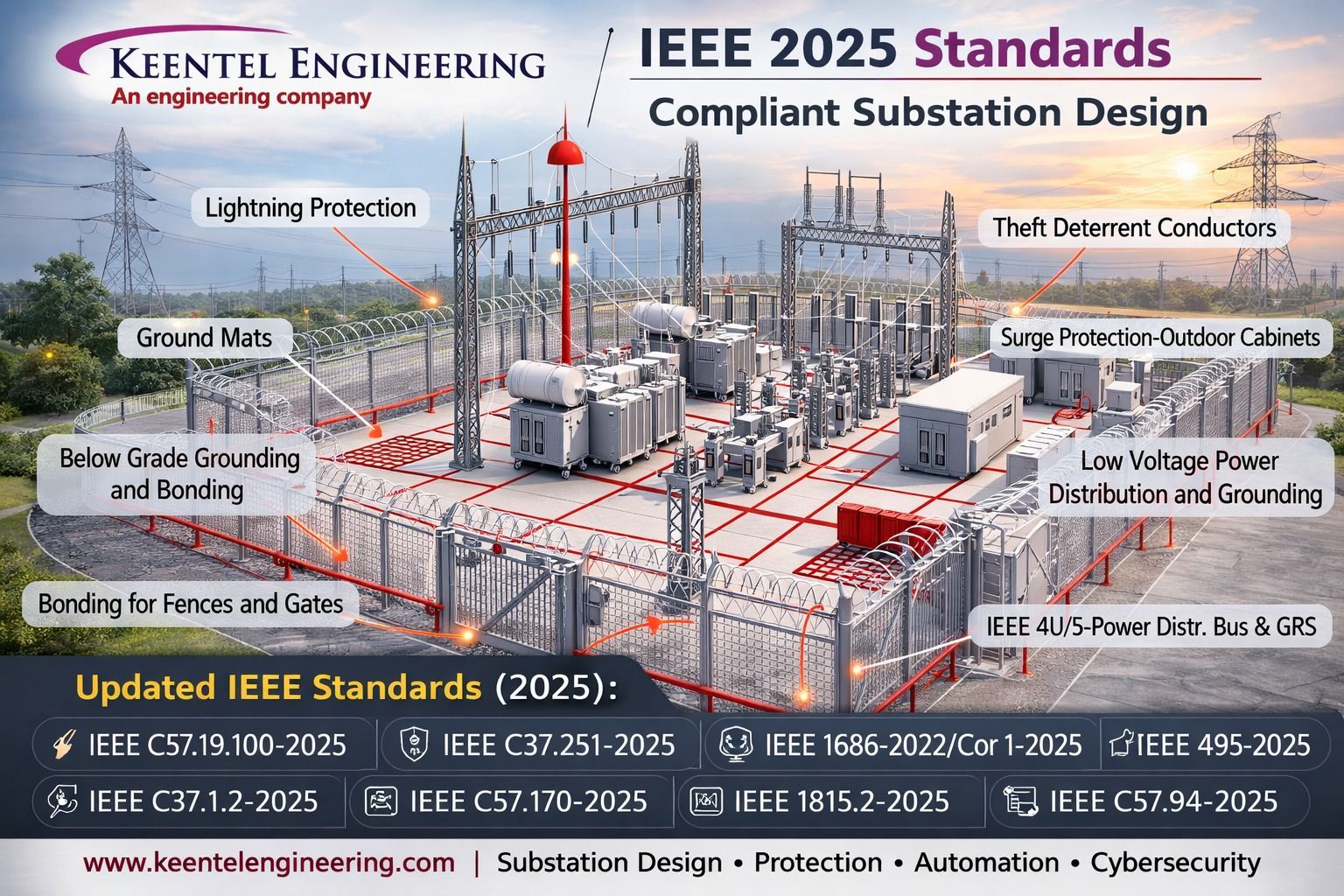
With the release and updates of major IEEE standards including IEEE C57.19.100-2025 (Power Apparatus Bushings), IEEE C37.251-2025 (COMSET Data Format), IEEE 1686-2022/Cor 1-2025 (IED Cybersecurity), IEEE 495-2025 (Faulted Circuit Indicators), IEEE C37.1.2-2025 (Automation Databases), IEEE C57.170-2025 (Transformer Condition Assessment), and others substation design is entering a new era.
At Keentel Engineering, we design substations that are not only code-compliant but future-proof, resilient, digitally integrated, and cybersecurity-hardened.
This article explores how these 2025 IEEE standards impact substation engineering and how Keentel Engineering integrates them into every project.
1. IEEE C57.19.100-2025: Power Apparatus Bushings The Interface Between Voltage and Reliability
Bushings are often underestimated components in substation design. They are the controlled insulation pathways that allow conductors to pass safely through grounded barriers such as transformer tanks and switchgear enclosures.
The 2025 edition of IEEE C57.19.100 provides guidance on:
- Application of outdoor power apparatus bushings
- Proper selection per IEEE C57.19.00 construction standards
- Voltage class considerations
- References to legacy/obsolete voltage classes
- Breaker bushing compatibility
Why This Matters in Substation Design
Improper bushing selection leads to:
- Partial discharge
- Dielectric breakdown
- Thermal runaway
- Oil contamination
- Catastrophic transformer failure
At Keentel Engineering, we evaluate:
- BIL coordination
- Pollution class and creepage distances
- Seismic loading (IEEE 693 alignment)
- Short-circuit mechanical forces
- Transient overvoltage exposure
- Temperature rise margins
Our substation design process ensures that bushings are not selected based on nameplate voltage alone but based on insulation coordination studies, system grounding philosophy, switching surge exposure, and long-term asset management strategy.
2. IEEE C37.251-2025 (COMSET): A New Era of Protection Configuration Data
Modern substations operate on digital settings. Protection relays, automation devices, and control logic are increasingly complex.
IEEE C37.251-2025 (COMSET) defines:
- A standardized protection and control configuration format
- Based on IEC 61850 System Configuration Language (SCL)
- Organizational structure for settings files
- Methods for extensibility
Why It Changes Substation Engineering
Historically:
- Each relay vendor had proprietary settings formats
- Utility integration was time-consuming
- Settings verification was manual and error-prone
COMSET introduces:
- Interoperable configuration data
- Structured validation
- Version-controlled settings management
- Improved commissioning workflows
At Keentel Engineering, we:
- Develop protection settings in IEC 61850-compliant architecture
- Ensure compatibility with COMSET formatting
- Implement digital substation workflows
- Support model-based relay configuration
- Integrate station-level SCADA databases
The result? Reduced commissioning errors. Faster deployment. Higher system integrity.
3. IEEE 1686-2022/Cor 1-2025: Cybersecurity for Intelligent Electronic Devices (IEDs)
A substation without cybersecurity is a liability.
IEEE 1686 (with 2025 corrigendum) defines mandatory cybersecurity capabilities for IEDs, including:
- Access control
- Role-based authentication
- Secure firmware updates
- Logging and auditing
- Data confidentiality
- Integrity of external interfaces
- Secure remote access
Cybersecurity is Now a Design Requirement
Cybersecurity is no longer an IT afterthought. It is a core engineering discipline.
Keentel Engineering integrates:
- Zero-trust architecture concepts
- Encrypted communications (IEC 62351 alignment)
- Secure DNP3 and IEC 61850 communications
- VLAN segmentation
- Secure engineering access ports
- Compliance with NERC CIP standards
We design substations assuming adversarial conditions — because resilience is not optional.
4. IEEE 495-2025: Faulted Circuit Indicators (FCIs)
FCIs are critical for distribution reliability and outage restoration speed.
The updated IEEE 495-2025 establishes:
- Definitions and terminology
- Service conditions
- Performance testing requirements
- Environmental test protocols
- Accuracy validation procedures
Substation & Distribution Integration
At Keentel Engineering, we incorporate:
- SCADA-integrated FCIs
- Communication-enabled smart FCIs
- Underground feeder monitoring
- Automated sectionalizing strategies
- FLISR (Fault Location, Isolation, and Service Restoration) support
FCIs reduce outage duration and improve SAIDI/SAIFI metrics.
5. IEEE C37.1.2-2025: Databases in Utility Automation Systems
Digital substations require structured data.
This guide outlines database characteristics for:
- Protection engineers
- Automation engineers
- IT coordination
- SCADA historians
- Operational analytics
Why This Is Critical
Database architecture affects:
- Event retrieval time
- Disturbance recording analysis
- Protection coordination validation
- Asset health monitoring
- Predictive maintenance analytics
Keentel Engineering designs:
- Structured event databases
- Redundant historian architecture
- IEC 61850 logical node mapping
- Protection event tagging consistency
- Cyber-hardened database interfaces
6. IEEE C57.170-2025: Condition Assessment of Liquid-Immersed Transformers
Transformers represent the highest capital investment in most substations.
The 2025 guide provides methodologies for:
- DGA interpretation
- Thermal aging evaluation
- Bushing condition assessment
- Insulation life modeling
- Risk scoring frameworks
- Remaining life estimation
At Keentel Engineering, we combine:
- IEEE C57.91 loading calculations
- DGA trending models
- Thermal imaging integration
- Online monitoring system design
- Asset health scoring
Our substation designs incorporate:
- Sensor-ready infrastructure
- Fiber optic temperature monitoring
- Smart monitoring ports
- Maintenance accessibility
- Future analytics integration
7. IEEE C57.13.10-2025: Calibration of Energized CTs (34.5 kV and Below)
Current transformer accuracy is foundational to:
- Relay protection
- Metering accuracy
- Revenue billing
- Fault detection sensitivity
The new guide provides:
- Energized calibration methods
- Test conditions
- Equipment requirements
- Result documentation procedures
Keentel Engineering designs substations with:
- Testing accessibility
- Secondary injection interfaces
- Safe calibration points
- Protection redundancy verification
- Arc-flash safe layouts
8. IEEE C37.13.1-2025: Low-Voltage Switching Devices in Metal-Enclosed Switchgear
Low-voltage systems inside substations often power:
- Station service
- Protection panels
- Battery chargers
- HVAC systems
- SCADA servers
The updated standard covers:
- Fused drawout devices
- 600V systems
- Construction requirements
- Thermal performance
- Switching endurance
Keentel Engineering ensures:
- NEC compliance
- Short-circuit withstand ratings
- Arc-flash labeling and mitigation
- Selective coordination studies
- Reliable station service continuity
9. IEEE 1815.2-2025: DER Communications Using DNP3
Distributed Energy Resources (DERs) are reshaping substation architecture.
IEEE 1815.2-2025 defines:
- DER communication profile using DNP3
- Mapping IEC 61850-7-420 data models
- Fixed DNP3 data point structures
Keentel Engineering designs:
- DER interconnection substations
- Solar + BESS collector substations
- Inverter-based resource protection
- Secure DNP3 over IP networks
- IEEE 1547-compliant integration
We bridge the gap between traditional substations and renewable generation.
10. IEEE C57.94-2025: Dry-Type Transformer Installation & Maintenance
Dry-type transformers are critical in:
- Industrial substations
- Indoor substations
- Urban installations
- Data centers
- Renewable plants
This guide provides recommendations for:
- Installation
- Operation
- Maintenance
- Ventilation considerations
- Environmental limitations
Keentel Engineering designs dry-type transformer systems with:
- Ventilation load analysis
- Harmonic mitigation studies
- Temperature rise coordination
- Fire risk mitigation
- Compliance with NEC and IEEE
Why Keentel Engineering is the Right Substation Design Partner
At Keentel Engineering, substation design is not drafting.
It is:
- Power system modeling
- Protection coordination
- Transient studies
- Grounding design
- Lightning protection
- Structural analysis
- Cybersecurity engineering
- Standards compliance integration
We provide:
- HV & EHV Substation Design (AIS & GIS)
- Collector Substations (Solar, Wind, BESS)
- Protection & Control Design
- NERC Compliance Support
- IEC 61850 Engineering
- SCADA & Automation Design
- Asset Health & Monitoring Integration
- Peer Reviews & Owner’s Engineering
Every design aligns with the latest IEEE standards including the 2025 releases.
Frequently Asked Questions (FAQ)
1. Why are the 2025 IEEE standards important for substation design?
They introduce updated guidance on cybersecurity, digital configuration formats, transformer assessment, DER communication, and protection data management critical for modern substations.
2. How does IEEE C57.19.100 affect transformer reliability?
It improves bushing application guidance, reducing insulation failure risk and enhancing long term transformer performance.
3. What is COMSET (IEEE C37.251)?
A standardized format for protection and control configuration data based on IEC 61850 SCL.
4. Does Keentel Engineering implement COMSET formatting?
Yes, we integrate COMSET-aligned data structuring for relay settings and protection files.
5. Why is IEEE 1686 cybersecurity compliance critical?
IEDs are vulnerable to cyber threats. IEEE 1686 defines secure access and data integrity requirements.
6. Does Keentel design NERC CIP-compliant substations?
Yes, including secure architecture, logging, access control, and encrypted communication.
7. What role do FCIs play in reliability?
They reduce outage duration by enabling faster fault location and isolation.
8. How does IEEE C57.170 improve transformer maintenance?
It provides structured condition assessment methodologies to quantify asset health.
9. Can Keentel perform transformer condition assessments?
Yes, including DGA analysis, loading evaluation, and asset life modeling.
10. Why is CT calibration critical?
Inaccurate CTs compromise protection sensitivity and revenue metering accuracy.
11. Does Keentel support energized CT calibration design considerations?
Yes, we design systems allowing safe and accurate testing.
12. How does IEEE 1815.2 support DER integration?
It standardizes communication between DER systems and utility SCADA.
13. Does Keentel design solar and BESS substations?
Yes, including collector systems, POI substations, and interconnection compliance.
14. What is the importance of database architecture in substations?
It impacts event recording, analytics, cybersecurity, and operational response.
15. Does Keentel design IEC 61850 substations?
Yes, including GOOSE messaging, MMS, and digital substation architecture.
16. How do dry-type transformer standards affect indoor substations?
They guide ventilation, installation, and thermal management requirements.
17. Does Keentel provide arc-flash studies?
Yes, including mitigation design and labeling per IEEE 1584.
18. Can Keentel perform insulation coordination studies?
Yes, including BIL verification and surge analysis.
19. Does Keentel provide grounding system design?
Yes, including IEEE 80-compliant grounding grids.
20. Why choose Keentel Engineering?
Because we design substations that meet today's standards and tomorrow's grid challenges.
Build Your Next Substation with Confidence
The grid is evolving.
Cyber threats are real. Renewable integration is accelerating. Protection systems are digital. Transformers are aging. Compliance requirements are tightening.
Your substation must be:
- Electrically sound
- Digitally integrated
- Cybersecure
- IEEE compliant
- Future-ready
Keentel Engineering delivers exactly that.
Whether you are developing:
- A 345 kV transmission substation
- A 138 kV collector substation
- A BESS interconnection yard
- An industrial power substation
- A GIS installation in urban territory
We bring 30+ years of power system engineering expertise to every project.
Contact Keentel Engineering Today
Upgrade your substation design to meet 2025 IEEE standards.
Visit: Keentel Engineering
Substation Design Services
Request a proposal:
Schedule a consultation.
Future-proof your grid infrastructure.
Because substations are not just facilities.
They are the backbone of reliability.
And reliability is engineered.

About the Author:
Sandip "Sonny" R. Patel, P.E.
IEEE Senior Member · Founder & CEO, Keentel Engineering
In 1995, Sonny Patel earned his Electrical Engineering degree from the University of Illinois. But degrees don't build legacies — action does.
For three decades, he has worked the power industry from every side of the table: 16 years as a utility engineer at Exelon/Commonwealth Edison; generation leadership across hydroelectric, industrial steam turbine, and a 9 GW renewable fleet; NERC Regional Entity Senior Compliance Engineer and Audit Team Lead, auditing some of the nation's largest utilities; and testing and commissioning lead on equipment up to 765 kV — the very top of the North American grid.Utility. Generator. Regulator. Consultant. Few engineers have seen all four seats. Fewer still have sat in them.
His experience spans nuclear, hydro, conventional generation, renewables, oil and gas, mining — and today's data centers, where he is authoring a three-book series on data center design. He is a Licensed Professional Engineer in six states and a Licensed Electrical Contractor in Florida (Unlimited EC) — he doesn't just design the work; he's qualified to stand behind its execution.Today, as Founder and CEO of Keentel Engineering, Sonny leads a nationwide team of engineers delivering substation design, power system studies, NERC compliance, and commissioning — done right, coast to coast.Three decades. Every side of the table. One standard: accountable engineering.
Services

Let's Discuss Your Project
Let's book a call to discuss your electrical engineering project that we can help you with.
About the Author:
Sandip "Sonny" R. Patel, P.E.
IEEE Senior Member · Founder & CEO, Keentel Engineering
In 1995, Sonny Patel earned his Electrical Engineering degree from the University of Illinois. But degrees don't build legacies — action does.
For three decades, he has worked the power industry from every side of the table: 16 years as a utility engineer at Exelon/Commonwealth Edison; generation leadership across hydroelectric, industrial steam turbine, and a 9 GW renewable fleet; NERC Regional Entity Senior Compliance Engineer and Audit Team Lead, auditing some of the nation's largest utilities; and testing and commissioning lead on equipment up to 765 kV — the very top of the North American grid.
Utility. Generator. Regulator. Consultant. Few engineers have seen all four seats. Fewer still have sat in them.
His experience spans nuclear, hydro, conventional generation, renewables, oil and gas, mining — and today's data centers, where he is authoring a three-book series on data center design. He is a Licensed Professional Engineer in six states and a Licensed Electrical Contractor in Florida (Unlimited EC) — he doesn't just design the work; he's qualified to stand behind its execution.
Today, as Founder and CEO of Keentel Engineering, Sonny leads a nationwide team of engineers delivering substation design, power system studies, NERC compliance, and commissioning — done right, coast to coast.Three decades. Every side of the table. One standard: accountable engineering.
Leave a Comment
Thank you for contacting us.
We will get back to you as soon as possible.
We will get back to you as soon as possible.
Oops, there was an error sending your message.
Please try again later.
Please try again later.
Related Posts
By SANDIP R PATEL
•
October 13, 2026
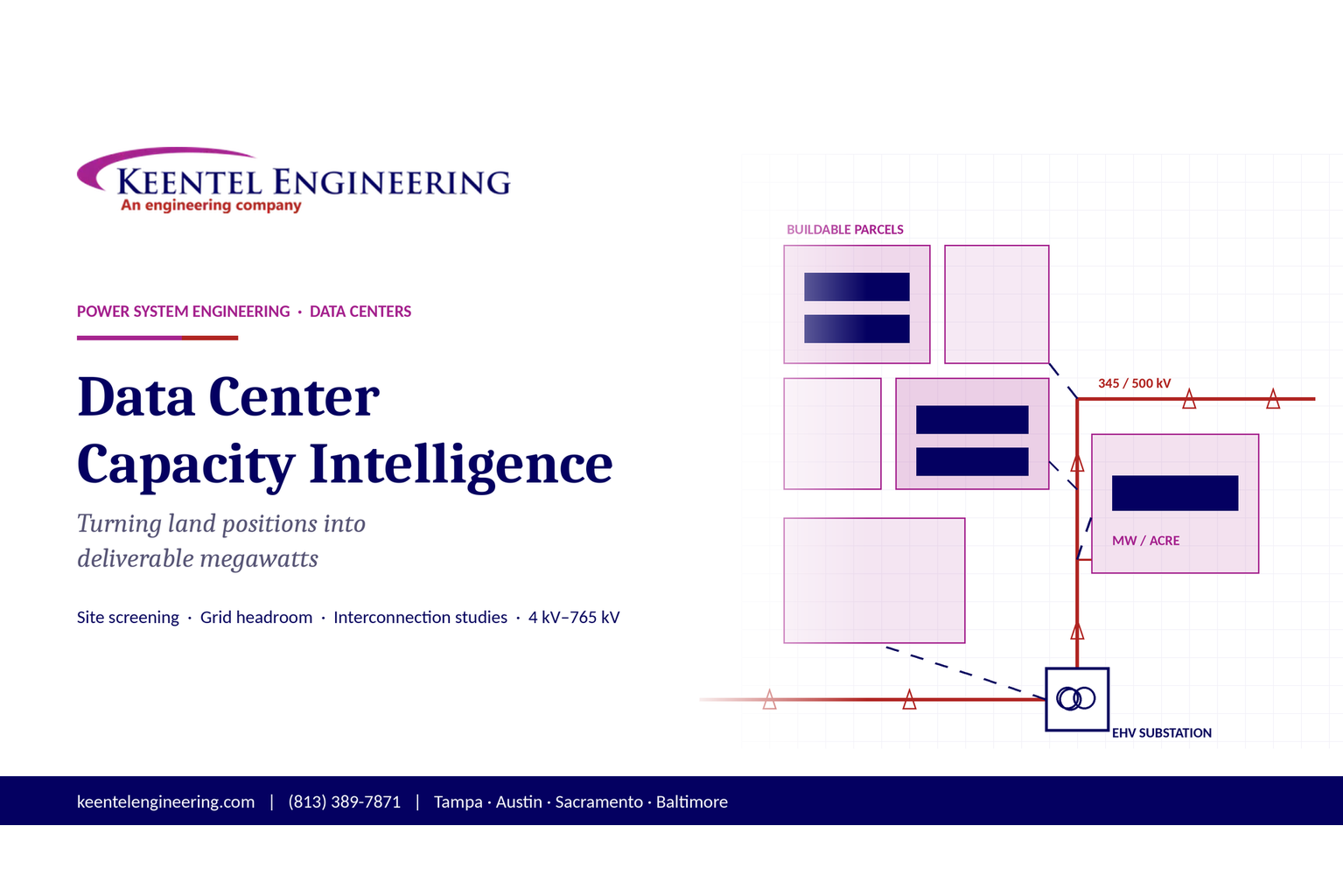
Plan data center capacity with land screening, MW-per-acre estimates, grid power availability and interconnection feasibility studies from Keentel Engineering.
By SANDIP R PATEL
•
October 11, 2026
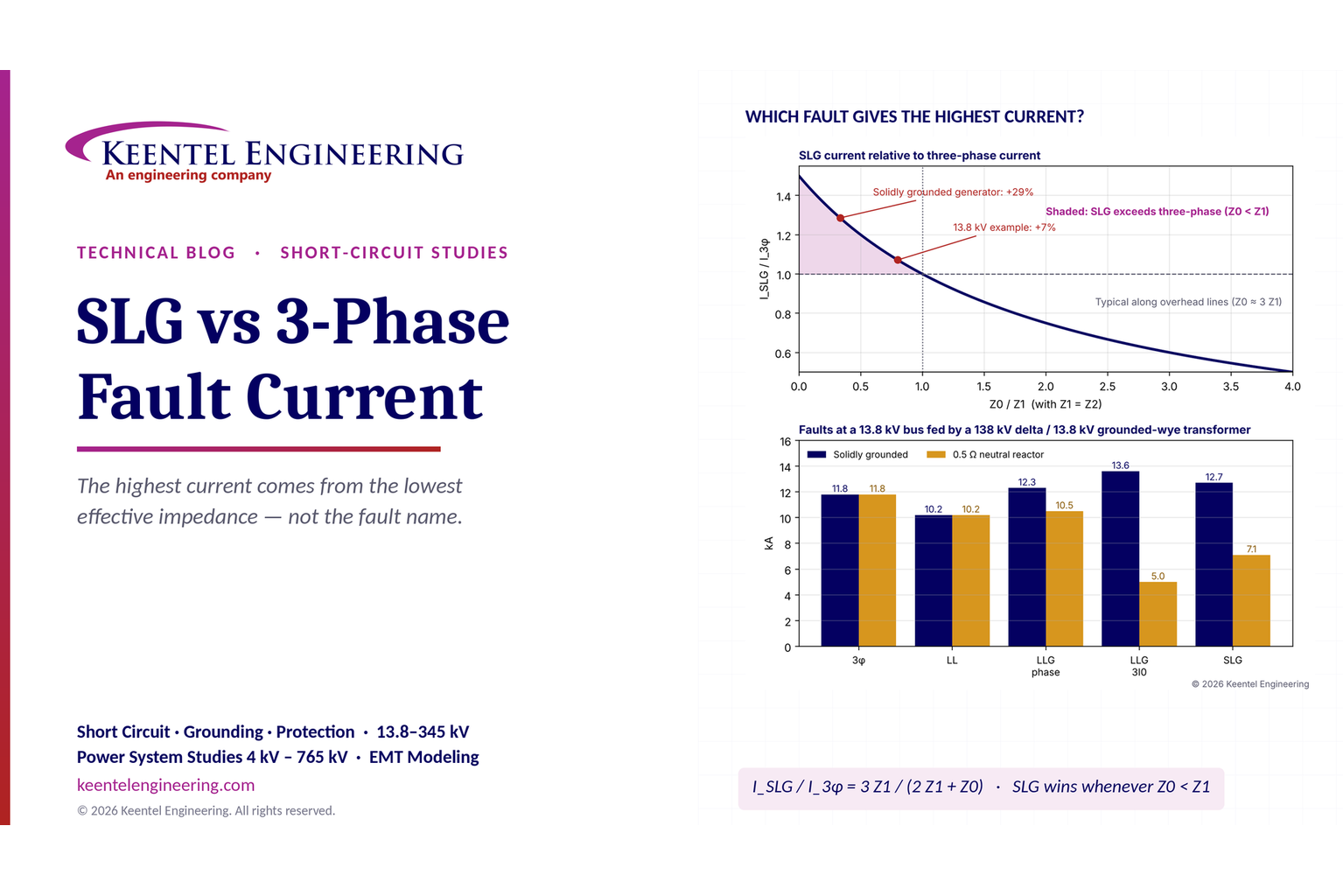
Learn which fault produces the highest current at a bus, why SLG faults can exceed three-phase faults, and how symmetrical components determine fault duty.
By SANDIP R PATEL
•
October 11, 2026
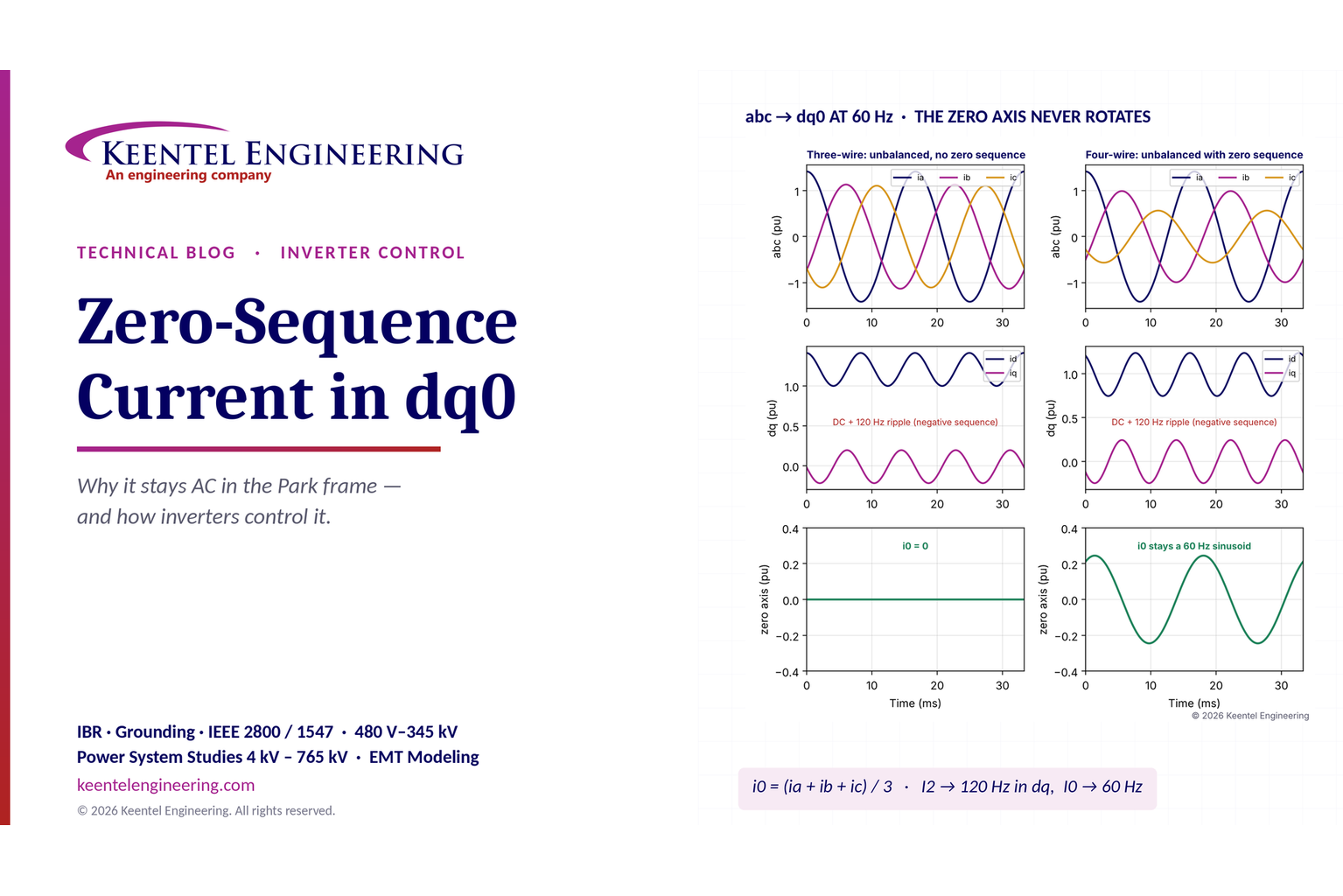
Learn why zero-sequence current pulsates in the dq0 frame, how Park's transformation works, and how inverter controls handle unbalance and ground faults.
By SANDIP R PATEL
•
October 11, 2026
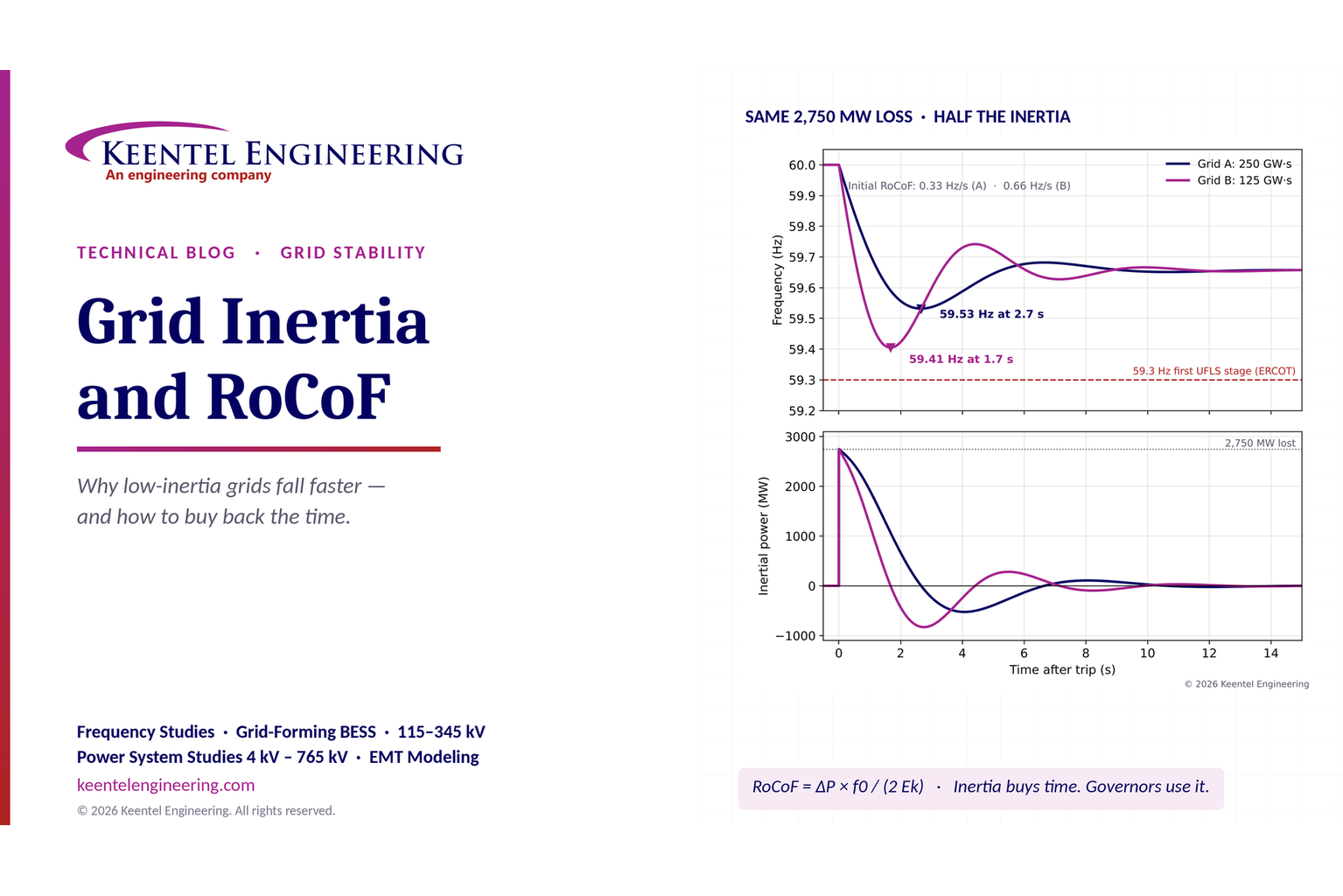
Explore grid inertia, RoCoF and frequency response, with swing equation calculations, frequency nadir analysis and US power system simulation examples.
By SANDIP R PATEL
•
October 11, 2026
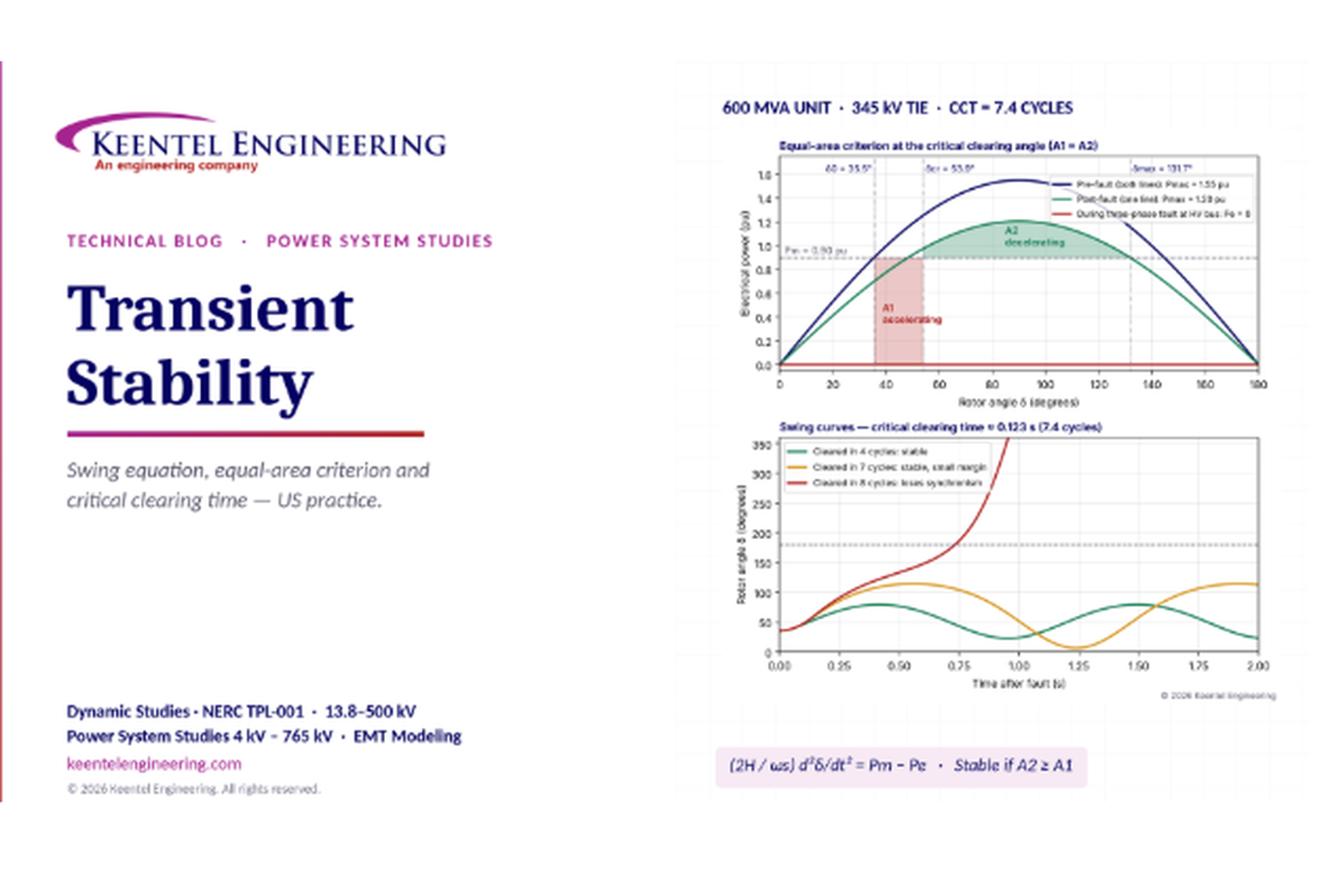
Learn transient stability analysis, swing equation, equal-area criterion and critical clearing time with a 345 kV worked example and NERC TPL-001 guidance.
By SANDIP R PATEL
•
October 11, 2026
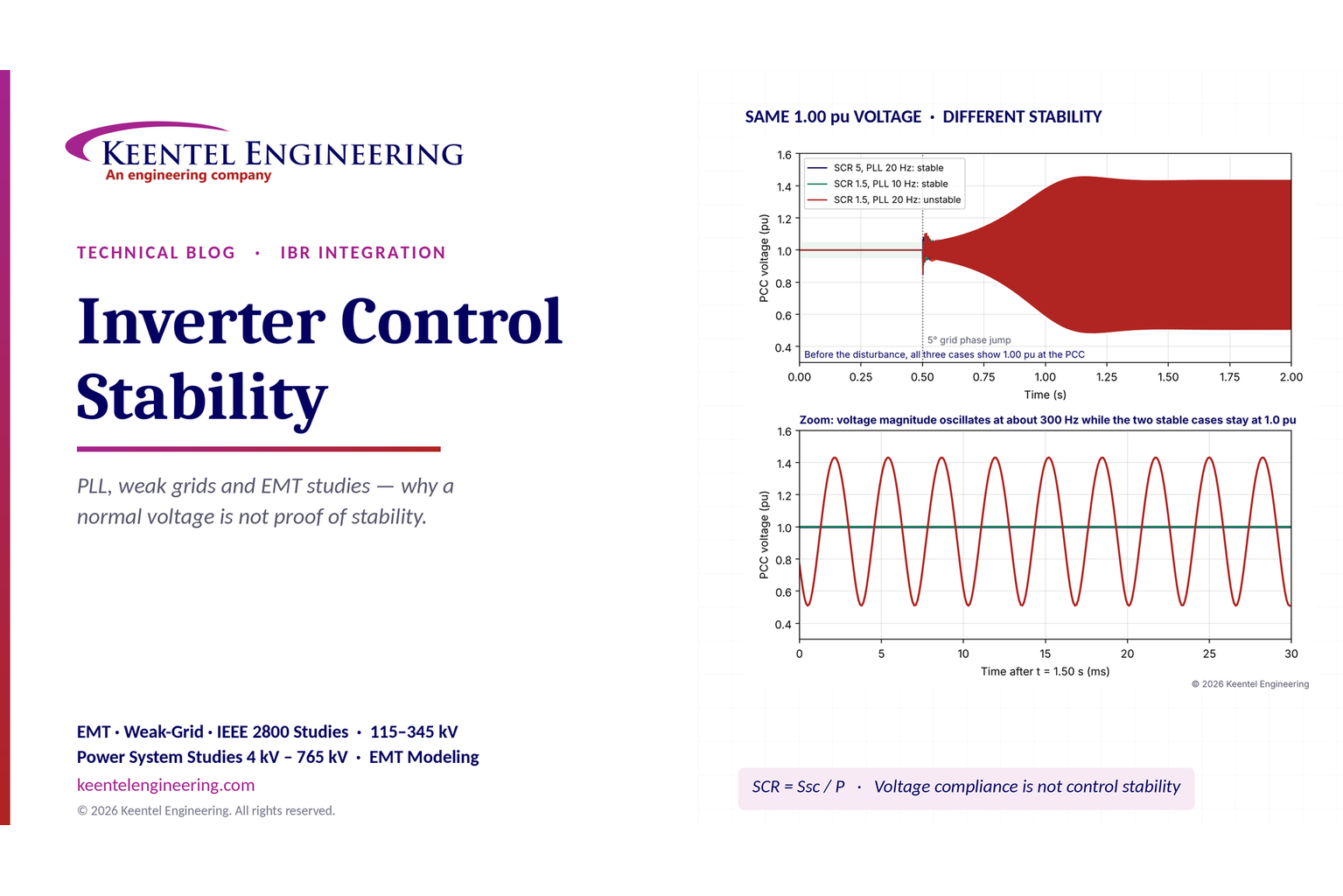
Learn why inverter controls become unstable in weak grids, how PLL bandwidth and SCR affect stability, and how PSCAD EMT studies identify and mitigate oscillations.
By SANDIP R PATEL
•
October 11, 2026
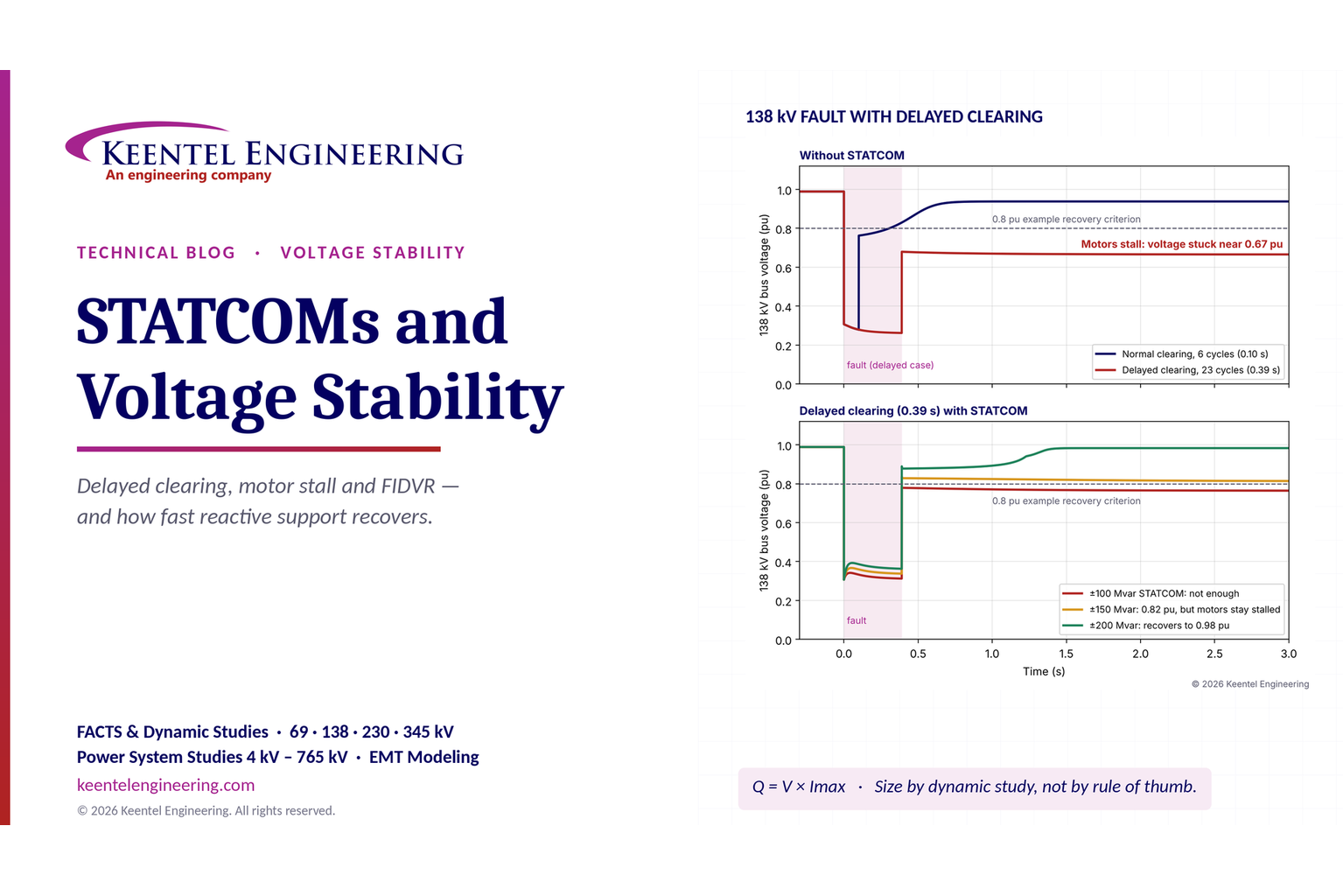
Learn how STATCOMs improve voltage stability and prevent FIDVR. Explore reactive power sizing, delayed fault clearing, NERC criteria and 138 kV simulation results.
By SANDIP R PATEL
•
October 10, 2026
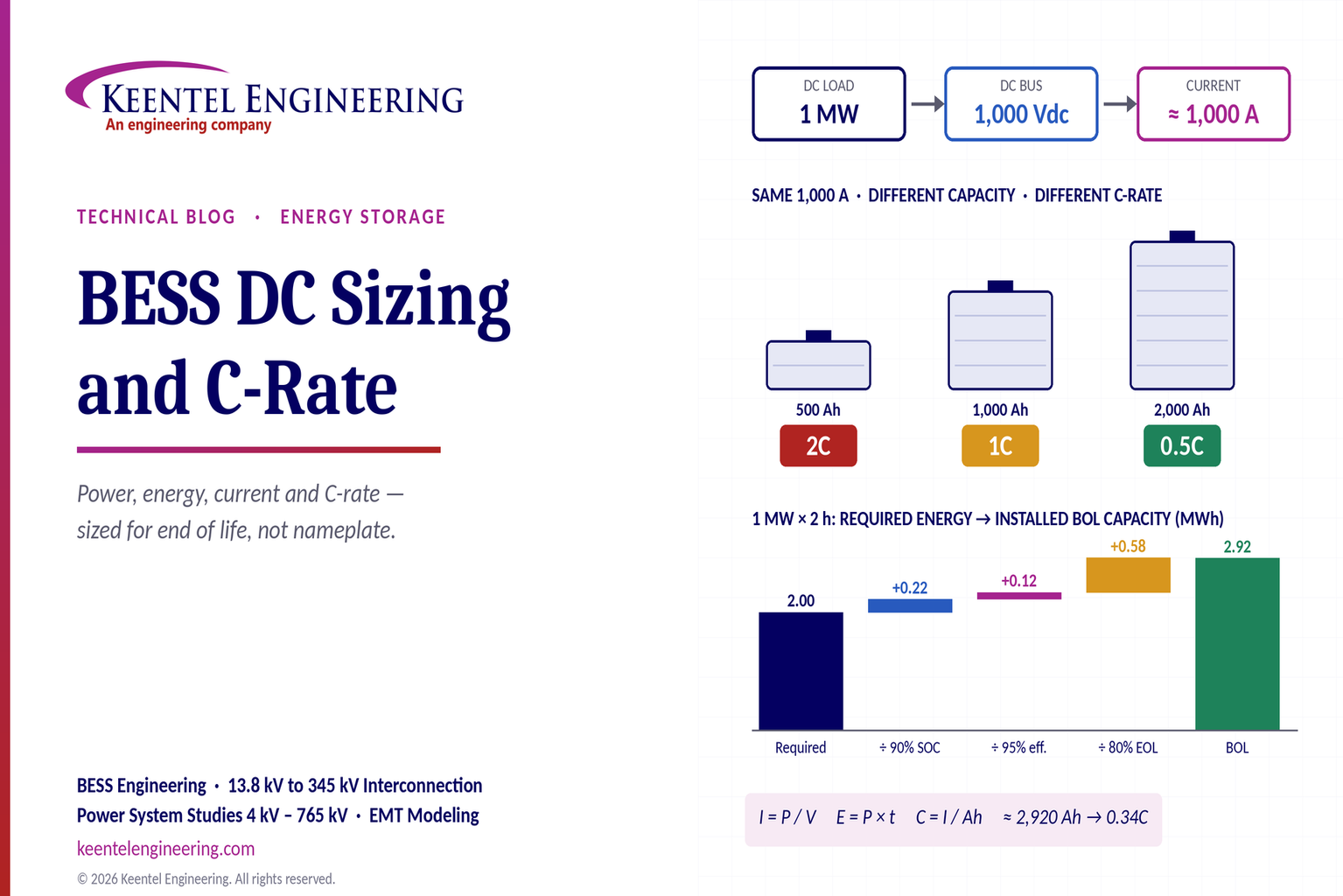
Learn BESS DC sizing with power, energy, current and C-rate calculations, battery losses, degradation and a 100 MW/400 MWh utility-scale example.
By SANDIP R PATEL
•
October 10, 2026
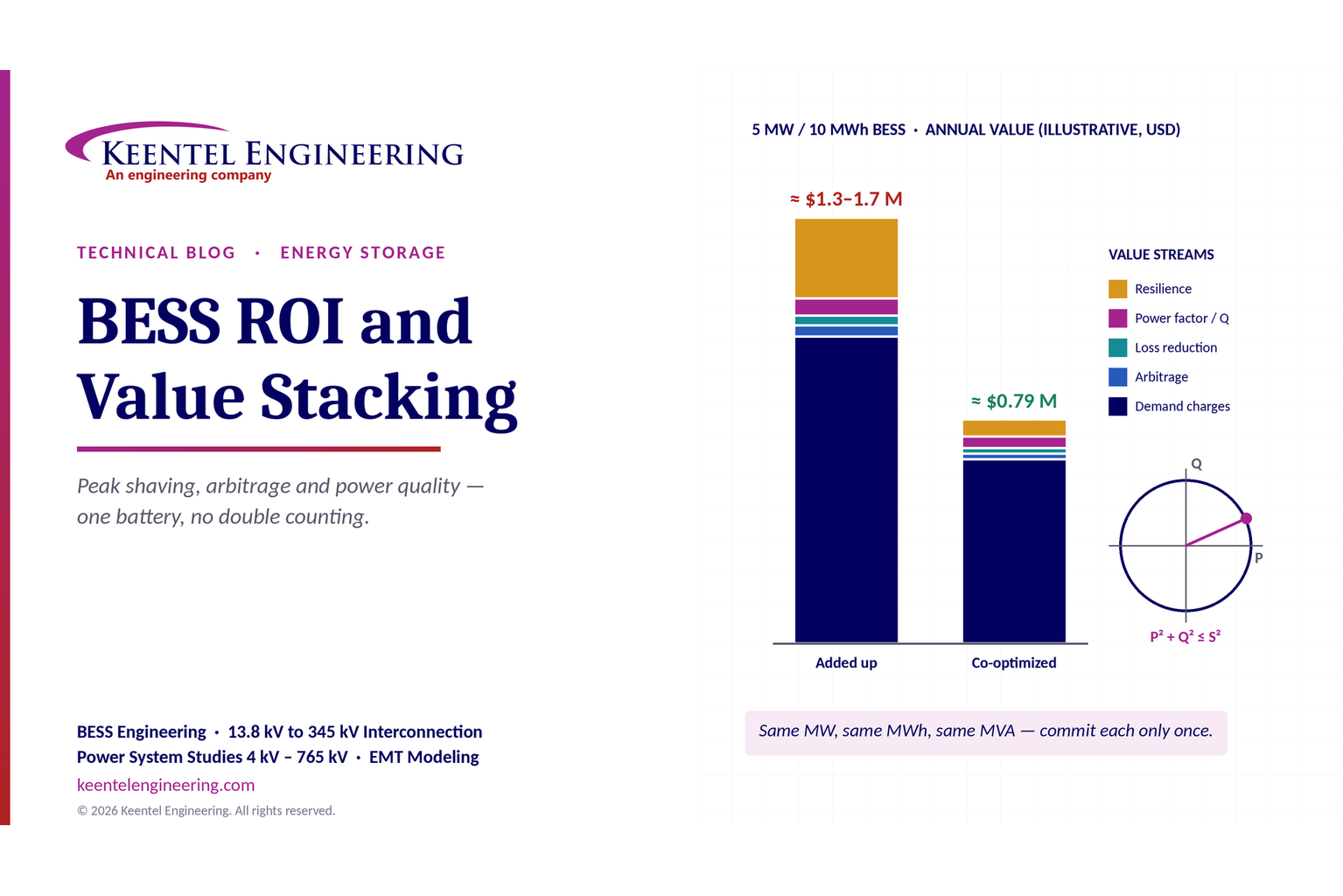
Learn how BESS ROI is calculated using peak shaving, energy arbitrage, power quality and battery storage economics, with a practical 5 MW/10 MWh example.