

A Coordinated Electric System Interconnection Review—the utility’s deep-dive on technical and cost impacts of your project.
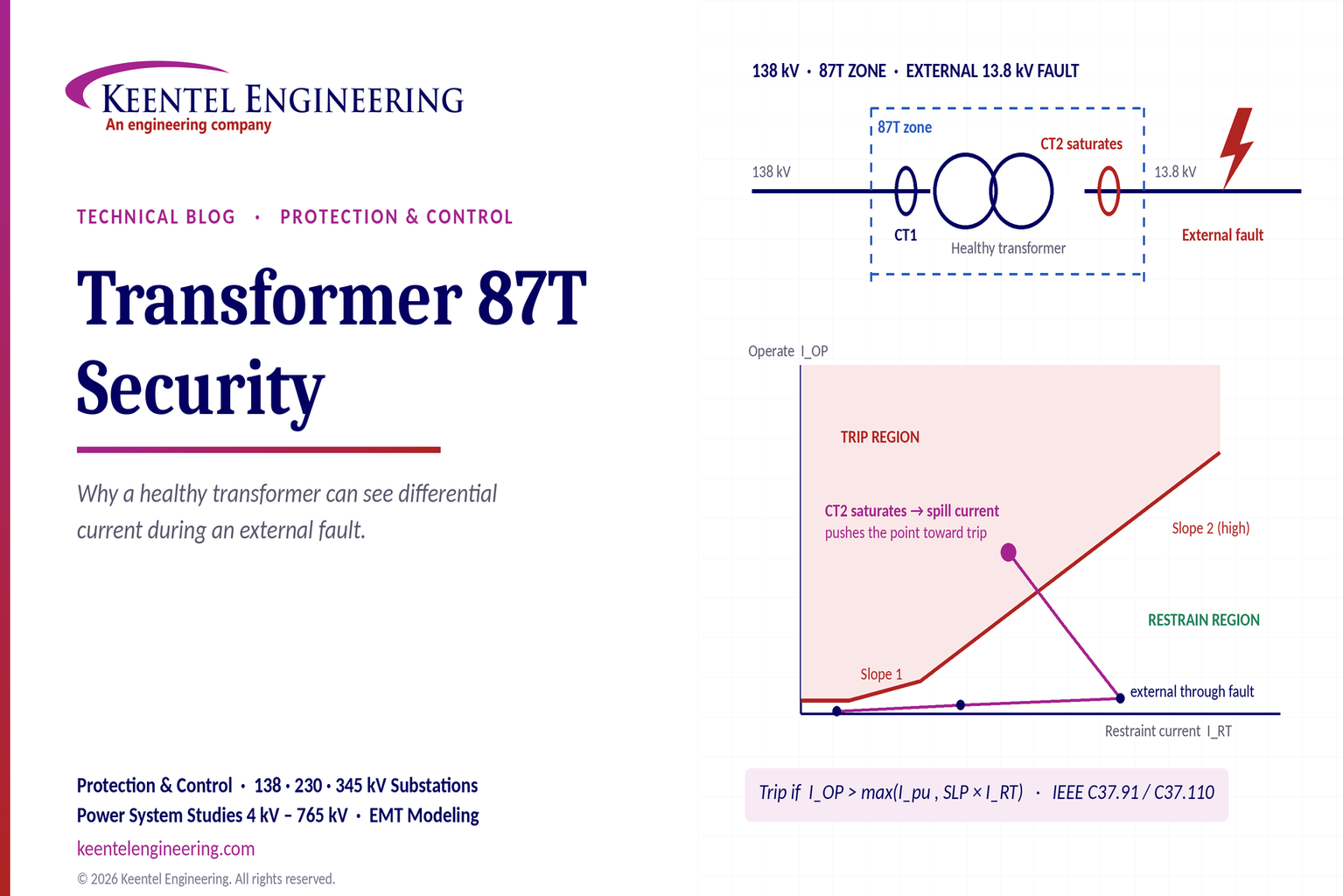
Challenge: Frequent false tripping using conventional electromechanical relays
Solution: SEL-487E integration with multi-terminal differential protection and dynamic inrush restraint
Result: 90% reduction in false trips, saving over $250,000 in downtime
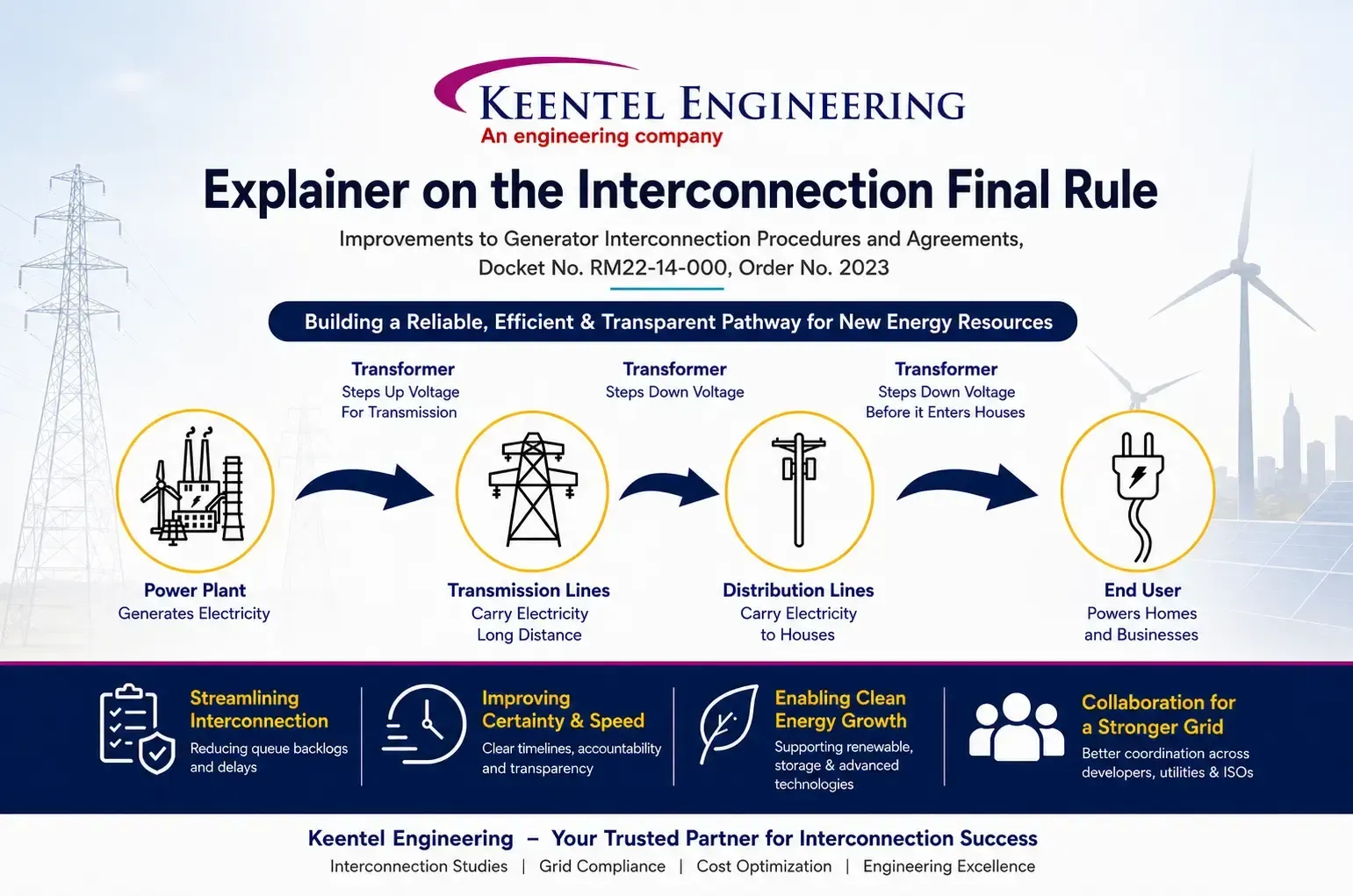
FERC Order 2023 Explained: Transforming Generator Interconnection for the Future Grid A Technical Deep Dive by Keentel Engineering
May 1, 2026 | Blog
Introduction
The U.S. electric grid is undergoing one of the most significant transformations in its history. The rapid integration of renewable energy, battery storage, and inverter-based resources (IBRs) has exposed fundamental limitations in legacy generator interconnection processes.
To address these challenges, the Federal Energy Regulatory Commission (FERC) issued Order No. 2023, a landmark reform aimed at improving generator interconnection procedures, reducing queue backlogs, and enabling faster deployment of new generation resources.
At Keentel Engineering, we specialize in helping developers, utilities, and asset owners navigate these evolving regulatory frameworks through advanced engineering design, interconnection studies, and compliance services.
1. Why FERC Order 2023 Was Necessary
1.1 Interconnection Queue Crisis
- Over 10,000 active projects (~2000 GW) in queues nationwide
- Only ~25% of projects reach commercial operation
- Study delays exceeding 3–5 years
This backlog has led to:
- Increased project uncertainty
- Escalating interconnection costs
- Delayed renewable deployment
- Reliability risks
FERC concluded that existing procedures are:
“insufficient to ensure reliable, efficient, transparent, and timely interconnection”
2. Core Reforms Introduced by FERC Order 2023
2.1 Shift to “First-Ready, First-Served”
Old Model: First-Come, First-Served
New Model: First-Ready, First-Served (Cluster-Based)
Key Features:
- Projects grouped into clusters
- Equal priority within clusters
- Progress based on project readiness
Result:
- Eliminates speculative queue clogging
- Prioritizes viable projects
2.2 Cluster Study Process
Replaces serial studies with:
- Cluster Feasibility
- Cluster System Impact
- Cluster Facilities Study
Benefits:
- Reduced redundant studies
- Better system-wide optimization
- Lower cumulative study cost
2.3 Increased Financial Commitments
Developers must now provide:
- Study deposits
- Commercial readiness deposits
- Site control evidence
Impact:
- Filters speculative projects early
- Improves queue quality
2.4 Cost Allocation Reform
- Cluster study costs: Shared (pro-rata + per capita)
- Network upgrade costs: Based on proportional impact
Major Shift:
Moves away from “first mover pays everything”
2.5 Penalties and Accountability
- Transmission providers penalized for missed deadlines
- Removal of “reasonable efforts” standard
- Withdrawal penalties for developers
Outcome:
- Stronger accountability on both sides
3. Technology Integration Reforms
3.1 Co-Located and Hybrid Resources
- Multiple generators can share one POI
- Supports solar + storage hybrid systems
3.2 Energy Storage Modeling
- New rules allow realistic operating assumptions
- Prevents overestimation of network upgrades
3.3 Alternative Transmission Technologies (ATTs)
Examples:
- Dynamic line ratings
- Advanced power flow controllers
- Topology optimization
These reduce:
- Upgrade costs
- Construction timelines
3.4 Ride-Through and Modeling Requirements
For inverter-based resources:
- Mandatory dynamic models
- Voltage ride-through capability
- Reactive power support
Critical for grid stability
4. Engineering Challenges Created by Order 2023
4.1 Increased Study Complexity
- Larger datasets
- Multi-project interactions
- EMT + RMS modeling requirements
4.2 Data Transparency Requirements
- Public posting of interconnection data
- Greater need for data analytics
4.3 Affected System Coordination
- Multi-ISO and utility coordination required
- Often major source of delays
5. How Keentel Engineering Supports Clients
Keentel Engineering provides end-to-end interconnection and compliance services aligned with FERC Order 2023.
5.1 Interconnection Studies
- PSSE, PSCAD, TSAT modeling
- Cluster study participation support
- EMT + RMS validation
5.2 Grid Code Compliance
- NERC compliance
- Ride-through validation
- Dynamic model development
5.3 Cost Optimization
- Network upgrade mitigation strategies
- Alternative transmission technology analysis
5.4 Project Development Advisory
- Site selection using grid analytics
- Queue strategy optimization
- Risk assessment
6. Strategic Implications for Developers
Developers must:
- Enter queues only when “ready”
- Invest more upfront capital
- Use advanced modeling early
Utilities must:
- Improve study timelines
- Enhance transparency
- Adopt modern technologies
7. Future Outlook
FERC Order 2023 is just the beginning.
Expected next steps:
- Integration with transmission planning reforms
- Increased DER and microgrid inclusion
- interconnection studies
Conclusion
FERC Order 2023 represents a paradigm shift in generator interconnection:
- From reactive → proactive
- From speculative → committed
- From slow → structured
At
Keentel Engineering we help clients not just comply but gain a competitive advantage in this new regulatory environment.
25 Technical FAQs (Detailed)
1. What is the biggest change in FERC Order 2023?
The transition from first-come-first-served to first-ready-first-served cluster study process, prioritizing project maturity over queue position.
2. Why were cluster studies introduced?
To eliminate repetitive restudies and handle multiple projects simultaneously, improving efficiency and reducing delays.
3. How are network upgrade costs allocated now?
Using a proportional impact methodology, rather than assigning full cost to early entrants.
4. What is “site control” requirement?
Developers must prove ownership/lease rights before entering the queue, reducing speculative entries.
5. What replaces the “reasonable efforts” standard?
Strict deadlines with financial penalties for transmission providers.
6. What are affected system studies?
Studies assessing impact on neighboring systems outside the host utility.
7. Why are affected systems a bottleneck?
Lack of standardized procedures causes delays and coordination issues.
8. What modeling is required for inverter-based resources?
- RMS dynamic models
- EMT models (if applicable)
- Validated parameters
9. What is ride-through capability?
Ability of generators to stay connected during faults and support grid stability.
10. How does Order 2023 affect battery storage?
Allows realistic charging/discharging assumptions, reducing unnecessary upgrades.
11. What are Alternative Transmission Technologies?
Technologies that improve grid capacity without building new lines.
12. Why are ATTs important?
They reduce cost, environmental impact, and deployment time.
13. What is a cluster study deposit?
A financial commitment required to participate in cluster studies.
14. What happens if a developer withdraws?
They may face withdrawal penalties depending on timing.
15. What is surplus interconnection service?
Allows new projects to use unused capacity of existing interconnections.
16. What is co-location?
Multiple generation resources sharing one interconnection point.
17. How does Order 2023 impact timelines?
Aims to reduce timelines but requires better upfront preparation.
18. Why are study delays so common?
Complex modeling, coordination issues, and resource constraints.
19. What role does data transparency play?
Improves decision-making and reduces speculative entries.
20. How does this affect renewable energy growth?
Accelerates deployment by removing interconnection bottlenecks.
21. What software tools are needed?
- PSSE
- PSCAD
- TSAT
- PowerFactory
22. What is EMT modeling?
High-fidelity simulation for inverter-based resource dynamics.
23. How can developers reduce interconnection costs?
- Optimal siting
- Using ATTs
- Early modeling studies
24. What risks do developers face under Order 2023?
Higher upfront costs, stricter deadlines, and financial penalties.
25. How can Keentel Engineering help?
By providing:
- Interconnection studies
- Compliance support
- Cost optimization
- Advanced modeling

About the Author:
Sonny Patel P.E. EC
IEEE Senior Member
In 1995, Sandip (Sonny) R. Patel earned his Electrical Engineering degree from the University of Illinois, specializing in Electrical Engineering . But degrees don’t build legacies—action does. For three decades, he’s been shaping the future of engineering, not just as a licensed Professional Engineer across multiple states (Florida, California, New York, West Virginia, and Minnesota), but as a doer. A builder. A leader. Not just an engineer. A Licensed Electrical Contractor in Florida with an Unlimited EC license. Not just an executive. The founder and CEO of KEENTEL LLC—where expertise meets execution. Three decades. Multiple states. Endless impact.
Services

Let's Discuss Your Project
Let's book a call to discuss your electrical engineering project that we can help you with.

About the Author:
Sonny Patel P.E. EC
IEEE Senior Member
In 1995, Sandip (Sonny) R. Patel earned his Electrical Engineering degree from the University of Illinois, specializing in Electrical Engineering . But degrees don’t build legacies—action does. For three decades, he’s been shaping the future of engineering, not just as a licensed Professional Engineer across multiple states (Florida, California, New York, West Virginia, and Minnesota), but as a doer. A builder. A leader. Not just an engineer. A Licensed Electrical Contractor in Florida with an Unlimited EC license. Not just an executive. The founder and CEO of KEENTEL LLC—where expertise meets execution. Three decades. Multiple states. Endless impact.
Leave a Comment
We will get back to you as soon as possible.
Please try again later.