

A Coordinated Electric System Interconnection Review—the utility’s deep-dive on technical and cost impacts of your project.
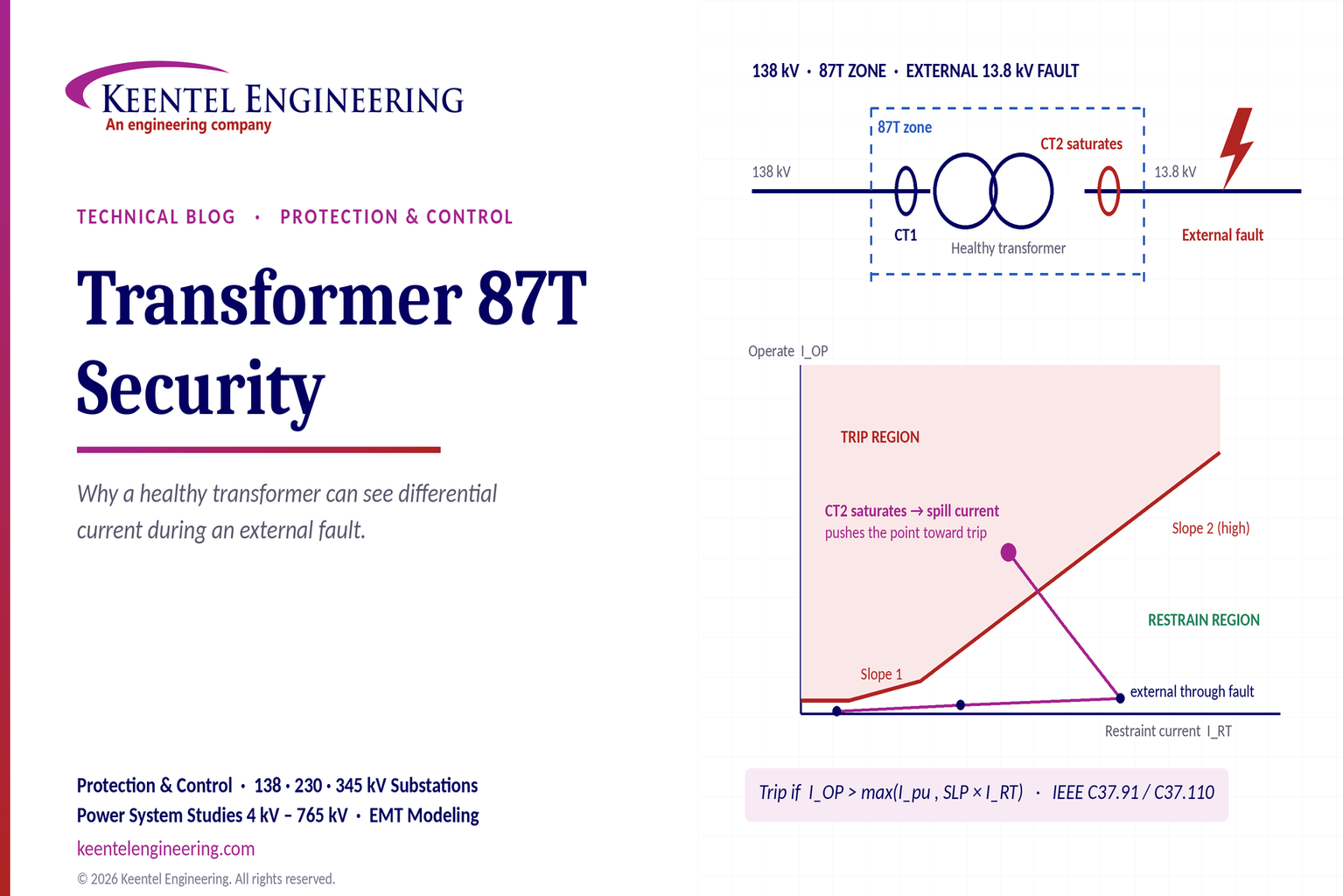
Challenge: Frequent false tripping using conventional electromechanical relays
Solution: SEL-487E integration with multi-terminal differential protection and dynamic inrush restraint
Result: 90% reduction in false trips, saving over $250,000 in downtime
Advanced Transmission Line Design Services Using Modern Software Platforms Keentel Electrical Engineering Design Capabilities
Apr 26, 2026 | Blog
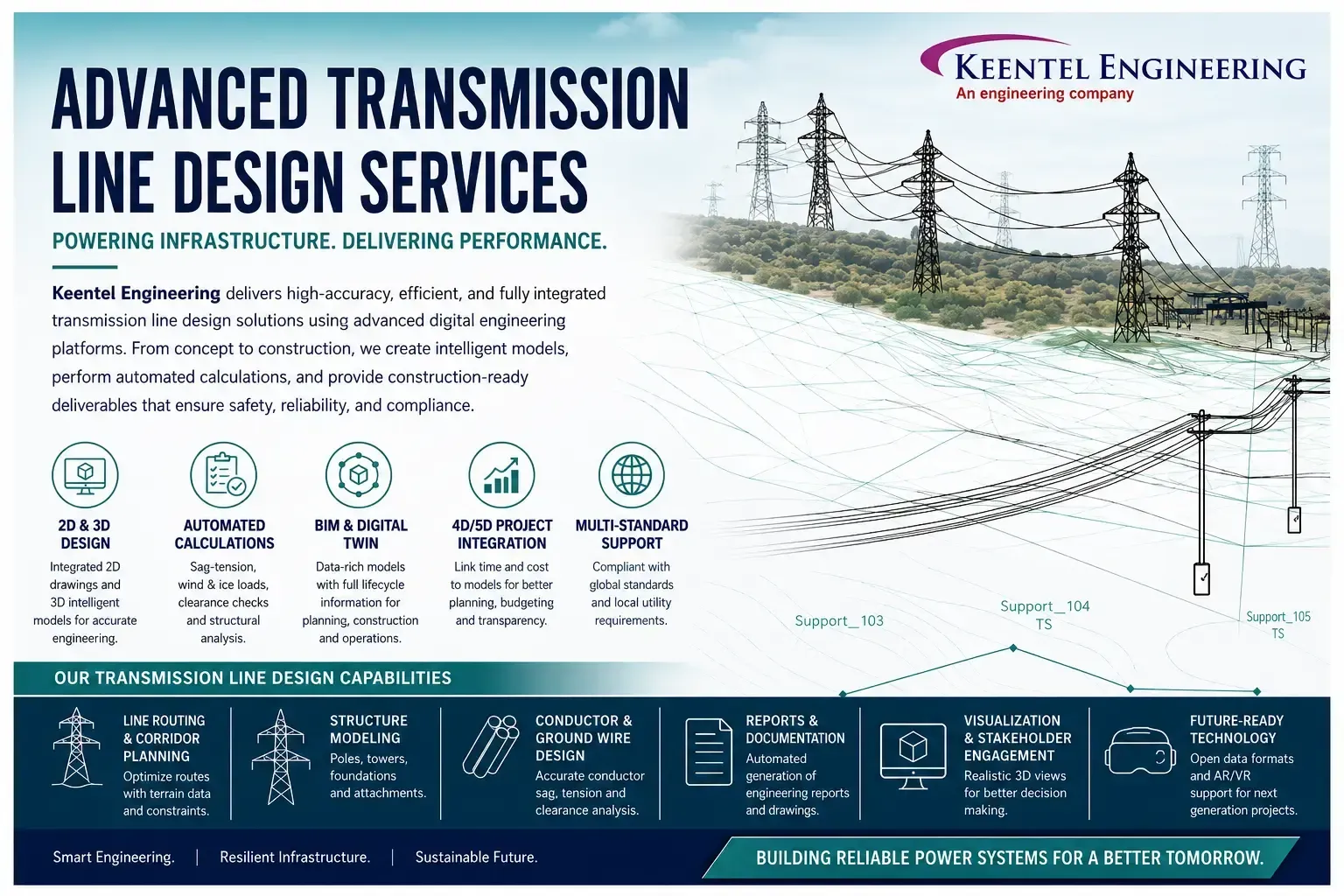
Modern transmission line engineering is no longer limited to manual calculations, spreadsheets, and disconnected CAD drawings. Today, successful power infrastructure projects require integrated digital design software, where engineering, visualization, calculations, and construction planning are seamlessly connected.
At Keentel Engineering, we utilize advanced transmission line design software platforms to deliver high-accuracy, efficient, and fully coordinated engineering solutions for:
- Transmission systems (HV/EHV)
- Sub-transmission and distribution lines
- Renewable energy collector systems
- Underground and overhead cable systems
- Utility interconnection infrastructure
- Industrial power distribution networks
Why Digital Transmission Line Design Matters
Traditional engineering approaches often suffer from:
- Disconnected drawings and calculations
- Manual data transfer errors
- Limited visualization for stakeholders
- Delays in design iteration cycles
- Poor coordination between disciplines
Modern transmission line design platforms solve these challenges by enabling:
- Integrated 2D and 3D engineering workflows
- Automated calculation engines
- Real-time model updates
- Full lifecycle project visualization
- Improved collaboration across teams
As shown in the uploaded brochure, modern tools enable faster workflows, improved transparency, and cost efficiency through digital modeling and automation.
Keentel Engineering Digital Design Approach
1. Integrated 2D and 3D Engineering
Keentel develops both:
- 2D engineering drawings (construction-ready documents)
- 3D intelligent models (engineering + visualization + analysis)
This dual approach ensures:
- Compliance with permitting and construction requirements
- Enhanced coordination between civil, structural, and electrical teams
- Improved clash detection and constructability review
Modern platforms allow engineers to move seamlessly between schematic design and full 3D modeling environments, improving design accuracy and reducing rework.
2. Intelligent Transmission Line Modeling
Using advanced transmission line software, we create data-rich models that include:
- Tower and pole geometry
- Conductor configuration
- Insulator strings
- Ground wires
- Foundations
- Terrain profiles
- Right-of-way constraints
These models are not just graphical they contain engineering data linked to each element, enabling:
- Design validation
- Automatic reporting
- Lifecycle tracking
As illustrated in the brochure’s page 3 diagram, each transmission element (pole, conductor, insulation, material, voltage level) is stored as structured engineering
data, enabling full project intelligence .
3. Automated Sag-Tension and Mechanical Calculations
A critical capability of modern transmission line software is automated calculation of:
- Sag and tension under varying conditions
- Wind loading
- Ice loading
- Temperature effects
- Clearance verification
- Structural loading on poles/towers
These calculations are essential for:
- Ensuring compliance with NESC/utility standards
- Verifying mechanical integrity
- Preventing conductor clashing
- Maintaining safety clearances
The brochure highlights that modern tools generate load and weather-based calculations automatically, significantly improving engineering efficiency .
4. BIM-Based Digital Twin Development
Keentel leverages advanced platforms to create digital twins of transmission systems.
This includes:
- Geometry + electrical data + material data
- Construction sequencing capability
- Cost integration (4D/5D modeling)
- Asset lifecycle management
This approach enables:
- Pre-construction validation
- Real-time stakeholder visualization
- Improved planning and scheduling
- Reduced project risk
As noted in the brochure, digital modeling enables integration of time (4D) and cost (5D) into engineering models, significantly improving project transparency and planning .
5. Multi-Standard and Utility Compliance
Transmission projects must comply with:
- NESC / NEC
- IEEE standards
- IEC standards
- Utility-specific requirements
- ISO/RTO grid requirements
Keentel’s design approach ensures:
- Localization for project-specific standards
- Custom parameter integration
- Region-specific design adaptation
The software capabilities described in the brochure allow designs to be adapted to different standards and regional requirements, making them suitable for global deployment .
6. Enhanced Project Visualization and Client Communication
One of the most powerful benefits of modern transmission line software is visualization.
Keentel provides:
- 3D project walkthroughs
- Terrain-integrated line routing views
- Structure-level visualization
- Construction-stage simulations
This enables:
- Clear communication with stakeholders
- Faster approvals
- Reduced design misunderstandings
- Better client confidence
The brochure emphasizes that visualization tools enable clear demonstration of projects and full understanding among stakeholders .
7. Lifecycle Engineering Support
Modern transmission line design is not limited to engineering—it extends across:
- Planning
- Design
- Construction
- Operation
- Maintenance
Keentel’s digital approach ensures that models can be used for:
- Asset management
- Inspection planning
- Maintenance scheduling
- Future upgrades
- System expansion
This aligns with the concept of continuous
lifecycle management through digital models, as highlighted in the brochure’s final section .
Key Benefits of Keentel Transmission Line Design Services
Faster Project Delivery
Automation reduces manual calculations and accelerates design timelines.
Improved Accuracy
Integrated models eliminate inconsistencies between drawings and calculations.
Reduced Project Risk
Early-stage validation prevents costly construction errors.
Better Cost Control
Digital modeling enables accurate estimation and planning.
Enhanced Collaboration
All stakeholders work on a unified design platform.
Scalable Solutions
Applicable to small distribution projects and large EHV transmission systems.
Technical FAQs – Transmission Line Design Software & Engineering
1. What is transmission line design software?
It is an advanced engineering platform that integrates modeling, calculations, and documentation for designing power transmission and distribution systems.
2. Why is 3D modeling important in transmission line design?
3D modeling allows engineers to visualize terrain, structures, and conductor configurations, improving accuracy and constructability while reducing field errors.
3. What is a digital twin in power line design?
A digital twin is a virtual representation of a physical transmission system that includes geometry, electrical data, and lifecycle information for planning, design, and operation.
4. How does software improve sag-tension analysis?
Modern tools automatically calculate sag and tension under different environmental conditions, ensuring compliance with safety and clearance requirements.
5. What are 4D and 5D modeling in transmission projects?
- 4D = time-based construction simulation
- 5D = cost-integrated modeling
These allow better project planning and budgeting.
6. How does software improve project transparency?
All design data is centralized, allowing real-time updates and visibility across teams, reducing miscommunication and delays.
7. Can transmission line software support multiple standards?
Yes, advanced platforms allow localization to different utility, regional, and international standards.
8. How does digital modeling reduce cost?
By minimizing rework, improving accuracy, optimizing materials, and enabling better planning, overall project costs are reduced.
9. What role does visualization play in engineering design?
Visualization helps stakeholders understand the design, identify issues early, and approve projects faster.
10. Is transmission line software only for large utilities?
No. It is equally valuable for:
- Renewable energy developers
- EPC contractors
- Industrial facilities
- Consulting engineers
11. How does software help during construction?
It provides accurate drawings, 3D references, and sequencing models, reducing field errors and improving execution.
12. What types of projects benefit most from digital transmission design?
- Long transmission lines
- Renewable energy collector systems
- Urban underground cable networks
- Complex terrain routing
- High-voltage substations

About the Author:
Sonny Patel P.E. EC
IEEE Senior Member
In 1995, Sandip (Sonny) R. Patel earned his Electrical Engineering degree from the University of Illinois, specializing in Electrical Engineering . But degrees don’t build legacies—action does. For three decades, he’s been shaping the future of engineering, not just as a licensed Professional Engineer across multiple states (Florida, California, New York, West Virginia, and Minnesota), but as a doer. A builder. A leader. Not just an engineer. A Licensed Electrical Contractor in Florida with an Unlimited EC license. Not just an executive. The founder and CEO of KEENTEL LLC—where expertise meets execution. Three decades. Multiple states. Endless impact.
Services

Let's Discuss Your Project
Let's book a call to discuss your electrical engineering project that we can help you with.

About the Author:
Sonny Patel P.E. EC
IEEE Senior Member
In 1995, Sandip (Sonny) R. Patel earned his Electrical Engineering degree from the University of Illinois, specializing in Electrical Engineering . But degrees don’t build legacies—action does. For three decades, he’s been shaping the future of engineering, not just as a licensed Professional Engineer across multiple states (Florida, California, New York, West Virginia, and Minnesota), but as a doer. A builder. A leader. Not just an engineer. A Licensed Electrical Contractor in Florida with an Unlimited EC license. Not just an executive. The founder and CEO of KEENTEL LLC—where expertise meets execution. Three decades. Multiple states. Endless impact.
Leave a Comment
We will get back to you as soon as possible.
Please try again later.