A Coordinated Electric System Interconnection Review—the utility’s deep-dive on technical and cost impacts of your project.
Challenge: Frequent false tripping using conventional electromechanical relays
Solution: SEL-487E integration with multi-terminal differential protection and dynamic inrush restraint
Result: 90% reduction in false trips, saving over $250,000 in downtime
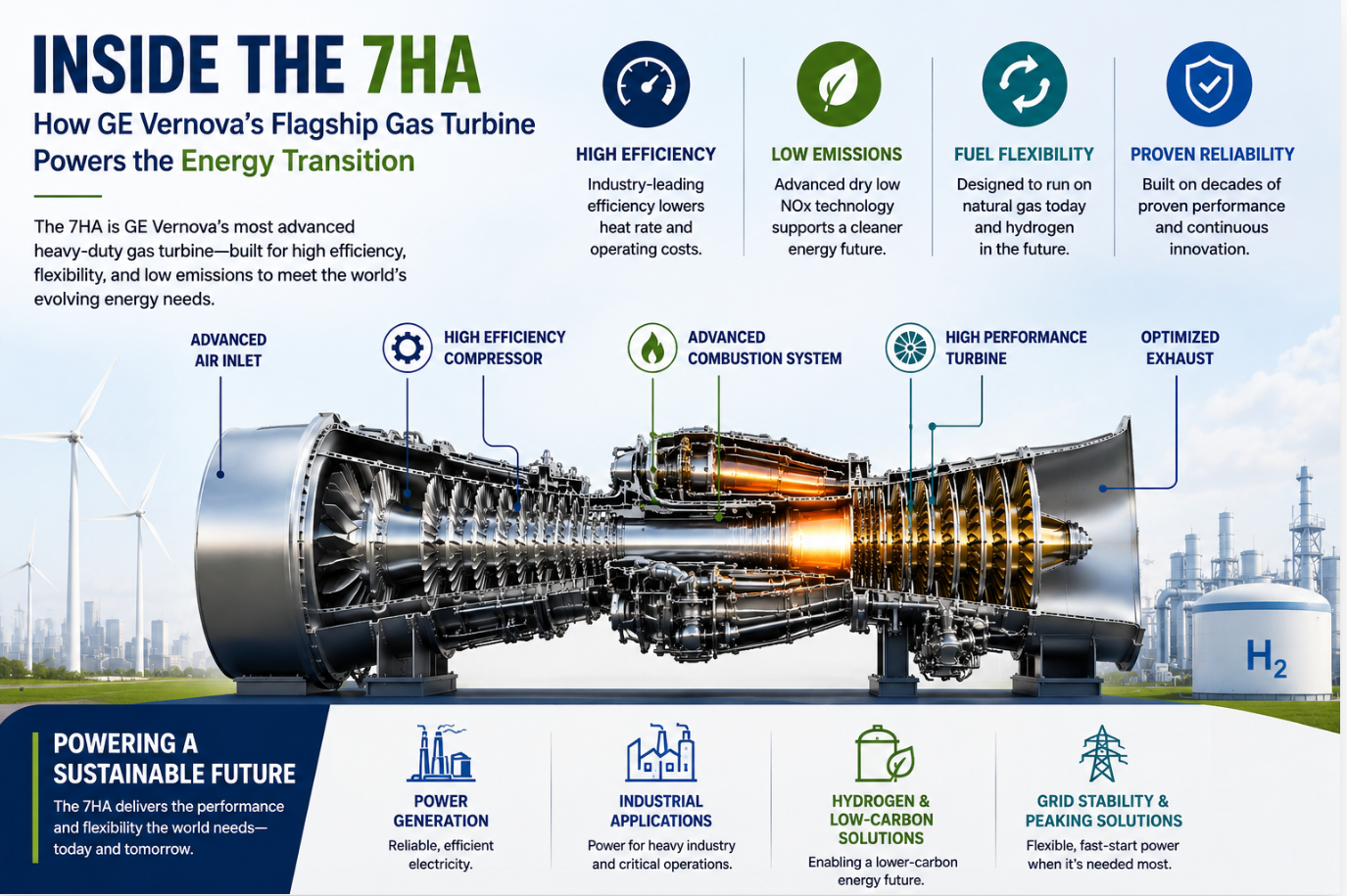
Inside the 7HA: How GE Vernova's Flagship Gas Turbine Powers the Energy Transition
May 29, 2026 | Blog
Why this machine, and why now
The power grid is being asked to do two things at once that used to be in tension: decarbonize, and stay reliable. Wind and solar are now the cheapest new generation in many markets, but they're also intermittent — the sun sets, the wind drops, and demand doesn't politely wait for either. That intermittency creates a need for dispatchable generation that can fill the gaps quickly, cleanly, and economically.
For decades, the answer to "fill the gap" was a coal plant running steadily in the background, or an older gas plant that was slow to start and inefficient at part load. Neither fits a grid where the residual demand curve swings hard from hour to hour. What the modern grid actually needs is a thermal asset that can start fast, ramp hard, idle cheaply, burn cleaner fuel, and still post world-class efficiency when it's running flat out.
That is the design brief the HA-class gas turbine was built against. GE Vernova's 7HA family — the 60 Hz members of the HA platform — is one of the clearest expressions of where heavy-duty gas turbine technology has landed in the energy transition. At Keentle Engineering, we follow this class of equipment closely, and in this piece we'll walk through the full 7HA lineup, explain what the headline numbers actually mean for a developer or operator, and spotlight why the newest frame, the 7HA.03, represents a genuine step change rather than an incremental refresh.
A quick primer: what "heavy-duty," "60 Hz," and "combined cycle" actually mean
Before the numbers, a little grounding, because the specs only make sense against the fundamentals.
heavy-duty gas turbine is a large, stationary industrial machine — distinct from the lighter aeroderivative turbines adapted from jet engines. Heavy-duty frames trade some start speed for far greater output, durability, and efficiency at scale, which is why they anchor utility-scale power plants.
60 Hz refers to the grid frequency. The Americas, parts of Asia, and a handful of other markets run on 60 Hz; much of Europe, Africa, and Asia run on 50 Hz. GE Vernova builds the HA platform in both flavors — the 7HA serves 60 Hz markets, while the larger-displacement 9HA serves 50 Hz markets. The frequency dictates shaft speed and therefore the physical sizing of the machine, so the two are not interchangeable.
Simple cycle means the gas turbine alone: air is compressed, mixed with fuel and burned, and the hot expanding gas spins the turbine to drive a generator. It's fast to start but leaves a lot of energy in the exhaust.
Combined cycle captures that wasted exhaust heat. The hot turbine exhaust passes through a heat recovery steam generator (HRSG), which raises steam to drive a second, steam turbine generator. By harvesting energy twice from the same fuel, combined cycle plants reach efficiencies simple cycle can't touch — which is exactly why the 7HA's headline efficiency figures are quoted in combined cycle. A "1x1" block is one gas turbine paired with one steam turbine; a "2x1" block pairs two gas turbines with a single shared steam turbine, gaining scale and a small efficiency bump.
Two more terms you'll see throughout: ISO conditions are the standardized reference conditions (roughly 15°C ambient, sea level, 60% relative humidity) that let you compare machines apples-to-apples, and LHV (lower heating value) is the fuel energy basis these efficiencies are quoted against. Real sites are hotter, higher, or more humid than ISO, which is why every honest spec sheet — including GE Vernova's — notes that actual performance will vary.
The full 7HA lineup
The 7HA comes in three frames of increasing size and capability: the 7HA.01, 7HA.02, and 7HA.03. Here's the complete performance picture across all three configurations, based on GE Vernova's published ratings at ISO conditions on natural gas:
| Performance Metric | 7HA.01c | 7HA.02 | 7HA.03 |
|---|---|---|---|
| Simple cycle | |||
| Net output (MW) | 290 | 384 | 430 |
| Net heat rate (Btu/kWh, LHV) | 8,120 | 8,009 | 7,897 |
| Net efficiency (%, LHV) | 42.0% | 42.6% | 43.2% |
| 1x1 combined cycle | |||
| Net output (MW) | 438 | 573 | 640 |
| Net heat rate (Btu/kWh, LHV) | 5,481 | 5,381 | 5,342 |
| Net efficiency (%, LHV) | 62.3% | 63.4% | 63.9% |
| Ramp rate (MW/min) | 55 | 60 | 75 |
| Hot start time | <30 min | <30 min | <30 min |
| 2x1 combined cycle | |||
| Net output (MW) | 880 | 1,148 | 1,282 |
| Net efficiency (%, LHV) | 62.6%c | 63.6% | >64.0% |
| Ramp rate (MW/min) | 110 | 120 | 150 |
The progression is straightforward: each step up the family buys more output and better efficiency. What's striking is the ceiling — a 7HA.03 in 2x1 combined cycle crosses 64% net efficiency, a number that puts daylight between this generation of machine and the fleet it's replacing.
The efficiency story, and why a single percentage point is worth so much
Heat rate and efficiency are two sides of the same coin. Heat rate is the amount of fuel energy needed to produce a kilowatt-hour of electricity — lower is better. Efficiency is its inverse, expressed as a percentage — higher is better. The 7HA.03's 1x1 combined cycle heat rate of 5,342 Btu/kWh corresponds to that 63.9% net efficiency.
It's easy to glance past a jump from, say, 62.3% to 63.9% as a rounding difference. It isn't. On a large baseload plant running thousands of hours a year, each percentage point of efficiency translates into a measurable reduction in annual fuel spend — fuel being by far the largest lifetime operating cost of a gas plant — and a proportional cut in CO₂ emissions, since less fuel burned means less carbon released. Over a 25- to 30-year asset life, fractions of a percent compound into very large numbers on both the cost and emissions ledgers.
GE Vernova frames the emissions case directly against coal: a 7HA combined cycle plant can deliver up to a 60% reduction in CO₂ emissions compared with a similarly sized coal-fired asset. That figure is the combined result of two effects — gas has a lower carbon content per unit of energy than coal to begin with, and the combined cycle converts that energy far more efficiently. For utilities under pressure to retire coal, a high-efficiency gas plant is one of the most immediate levers available to cut emissions without sacrificing dispatchable capacity.
Flexibility: the capability that actually pays the bills
On a grid with a lot of renewables, a plant's value increasingly comes not from running constantly, but from being there exactly when renewables aren't. That makes operational flexibility — how fast you can start, how hard you can ramp, and how cheaply you can idle — at least as important as peak efficiency.
The 7HA family is engineered around this. The 7HA.03 reaches full gas turbine load in roughly 10 minutes and full combined cycle plant load in under 30 minutes from a hot start. Its ramp rate of 75 MW/min in 1x1 configuration (and up to 150 MW/min in 2x1) means it can chase a steep evening demand ramp or backfill a sudden drop in wind output almost in real time.
The more subtle innovation is at the bottom of the load curve. The 7HA.03 offers a park mode that lets the plant hold at around 15% of capacity during periods of low demand or low power prices. This matters economically because the alternative — a full shutdown — is expensive: shutdowns and startups burn fuel, consume operating hours and component life through thermal cycling, and leave the plant slow to respond when demand returns. By parking instead of stopping, an operator minimizes fuel burn and wear while keeping the unit primed to ramp rapidly back to full load. In a market where a plant might cycle daily around the solar curve, that capability directly protects both margins and equipment life.
Plant turndown — the minimum stable load — tells a related story. A deep turndown lets a plant stay online and synchronized at low output rather than tripping off, which preserves its ability to ramp back up quickly and to provide grid services like frequency support.
Fuel flexibility and the hydrogen pathway
One of the strongest arguments for investing in an HA-class machine today is that it isn't a bet locked to one fuel forever. The 7HA platform can run on natural gas blended with up to 50% hydrogen by volume today, and GE Vernova has published a technology pathway aimed at 100% hydrogen capability in the future.
The 7HA.03 pushes this further than its predecessors, offering roughly double the fuel flexibility of the 7HA.02. That gain comes from a redesigned combustion system featuring an advanced premixer and axial fuel staging — combustion architecture matters enormously for hydrogen, because hydrogen burns faster and hotter than natural gas and behaves very differently in the combustor, which is precisely the engineering challenge that more capable combustion systems are built to manage.
The strategic value here is optionality and risk reduction. A plant commissioned now on natural gas has a defined route to progressively decarbonize its fuel as hydrogen production and delivery infrastructure mature, rather than facing premature retirement as carbon policy tightens. For an owner weighing a multi-decade capital commitment, a credible path to low- and zero-carbon fuel is meaningful insurance against the asset becoming stranded.
Engineered for a faster, lower-risk build
A power plant's economics are set long before it generates electricity — they're shaped on the construction site, where schedule overruns and rework quietly destroy project returns. The 7HA.03 was designed with this in mind through modular packaging that GE Vernova says shortens the critical-path installation cycle by about eight weeks.
The mechanism behind that schedule gain is a dramatic reduction in field labor and in the number of things that can go wrong in the field:
- 98% fewer field-installed valves
- 64% fewer electrical termination points
- 63% fewer field connections
- 55% fewer turbine field welds
Every one of those reductions is a reduction in risk. Field welds and connections are where leaks, faults, and commissioning delays originate; doing that work in a controlled factory environment instead of on a muddy site improves quality and compresses schedule simultaneously. For an EPC contractor, fewer field connections mean a more predictable schedule and lower commissioning risk for an owner, it means earlier commercial operation and earlier revenue.
Underpinning the performance side is the machine's 14-stage compressor, which increases airflow through the turbine. More airflow supports higher output, and it specifically helps preserve output on hot days — a real concern in many 60 Hz markets where peak demand and peak ambient temperature arrive together, exactly when output sag would hurt most.
A power plant's economics are set long before it generates electricity — they're shaped on the construction site, where schedule overruns and rework quietly destroy project returns. The 7HA.03 was designed with this in mind through modular packaging that GE Vernova says shortens the critical-path installation cycle by about eight weeks.
The mechanism behind that schedule gain is a dramatic reduction in field labor and in the number of things that can go wrong in the field:
- 98% fewer field-installed valves
- 64% fewer electrical termination points
- 63% fewer field connections
- 55% fewer turbine field welds
Every one of those reductions is a reduction in risk. Field welds and connections are where leaks, faults, and commissioning delays originate; doing that work in a controlled factory environment instead of on a muddy site improves quality and compresses schedule simultaneously. For an EPC contractor, fewer field connections mean a more predictable schedule and lower commissioning risk for an owner, it means earlier commercial operation and earlier revenue.
Underpinning the performance side is the machine's 14-stage compressor, which increases airflow through the turbine. More airflow supports higher output, and it specifically helps preserve output on hot days — a real concern in many 60 Hz markets where peak demand and peak ambient temperature arrive together, exactly when output sag would hurt most.
A proven platform, not a prototype
Advanced specifications are only worth what they deliver in the field, so it's worth emphasizing that the 7HA is an operating, fielded platform rather than a paper design. GE Vernova reports more than 70 7HA gas turbines installed worldwide, running across the full range of duty cycles — base load, load following, peaking, and cogeneration for district heating.
The broader HA platform also holds notable efficiency records. GE Vernova cites a 63.08% gross combined cycle efficiency mark achieved with a 7HA.01 at Chubu Electric's Nishi Nagoya plant in Japan, and a 62.22% net combined cycle efficiency figure with the 50 Hz 9HA.01 at EDF's Bouchain plant in France. Records make headlines, but the more important point for a buyer is the size and breadth of the operating fleet behind them: a large installed base converts spec-sheet promises into demonstrated, bankable reliability — and reliability is, ultimately, what a power producer is buying.
Where Keentle Engineering sees the 7HA fitting
Pulling it together, we see the 7HA family lining up cleanly against three of the defining needs in today's generation market.
Coal replacement:
Where a utility is retiring coal but still needs firm, dispatchable capacity, the 7HA's efficiency and emissions profile does double duty — cutting both fuel cost and carbon while preserving the around-the-clock reliability the grid still depends on.
Renewables firming:
On grids being reshaped by wind and solar, the fast starts, high ramp rate, deep turndown, and park mode make the 7HA a complement to renewables rather than a competitor. It earns its keep precisely in the hours renewables can't cover.
Future-proofing:
The hydrogen pathway lets an owner make a long-lived capital commitment today without betting against where fuel and carbon policy are heading. The hardware has somewhere to go.
The right choice within the family — frame size, 1x1 versus 2x1, and the balance-of-plant design around it — always comes down to project specifics: scale, site conditions, fuel supply, and the dispatch profile the plant is expected to run. Those project-specific factors invariably shift the real numbers away from the ISO baseline, in both directions. Translating published ratings into a credible, site-specific performance expectation is exactly the kind of engineering work that turns a promising spec sheet into a sound investment decision.
Frequently Asked Questions
What is the 7HA gas turbine, in plain terms?
The 7HA is GE Vernova's family of large, heavy-duty gas turbines designed for 60 Hz power grids — the frequency used across the Americas and parts of Asia. It comes in three sizes (the 7HA.01, 7HA.02, and 7HA.03) and is used to generate electricity at utility scale. These machines serve a wide range of roles: running continuously as base load, following the daily rise and fall of demand, covering short peaks, and supplying combined heat and power for district heating. It is the 60 Hz sibling of GE Vernova's 9HA, which serves 50 Hz markets such as much of Europe.
c
How much power does the 7HA produce?
It depends on the frame and configuration. In simple cycle (the gas turbine alone), output ranges from about 290 MW for the 7HA.01 up to 430 MW for the 7HA.03. In 1x1 combined cycle — one gas turbine paired with a steam turbine that recovers exhaust heat — output runs from 438 MW to 640 MW. In 2x1 combined cycle, where two gas turbines share one steam turbine, a block delivers from 880 MW up to 1,282 MW. The 7HA.03 in a 2x1 block is the largest configuration in the family.
c
Which model is the most powerful and efficient?
The 7HA.03 leads on both counts. GE Vernova positions it as the world's largest, most efficient, and most flexible 60 Hz gas turbine, with 430 MW of simple cycle output, a 640 MW 1x1 combined cycle block, and a 1,282 MW 2x1 block. It crosses 64% net combined cycle efficiency in the 2x1 configuration, and GE Vernova describes it as offering the lowest cost conversion of gas to electricity in its lineup.
c
What does ">64% efficiency" actually mean, and why is it impressive?
Efficiency here is net combined cycle efficiency measured on a lower-heating-value (LHV) basis at standardized ISO conditions. It means that more than 64% of the energy in the fuel ends up as electricity delivered from the plant — an exceptionally high figure for any thermal power plant. For context, a simple cycle gas turbine sits around 42–43%, and older coal plants are typically well below that. The combined cycle's trick is harvesting energy from the same fuel twice — once in the gas turbine and again from its exhaust heat via a steam turbine — which is what pushes efficiency this high.
Why does a difference of one or two efficiency points matter so much?
Because fuel is the single largest lifetime operating cost of a gas plant, and the plant may run for thousands of hours a year over a 25- to 30-year life. Even a fraction of a percentage point in efficiency compounds into a substantial reduction in fuel spend over that period. The same improvement also cuts CO₂ emissions proportionally, because burning less fuel for the same output releases less carbon. So small-looking efficiency gains translate into real money and real emissions reductions at scale.
c
How does the 7HA compare to coal on emissions?
According to GE Vernova, a 7HA combined cycle plant can deliver up to a 60% reduction in CO₂ emissions versus a similarly sized coal-fired plant. That comes from two compounding effects: natural gas inherently emits less carbon per unit of energy than coal, and the high-efficiency combined cycle extracts far more electricity from each unit of fuel. For utilities retiring coal but still needing dependable, dispatchable capacity, this makes a high-efficiency gas plant one of the faster levers for cutting emissions.
Can the 7HA run on hydrogen?
Yes. The 7HA platform can currently run on natural gas blended with up to 50% hydrogen by volume, and GE Vernova has published a technology pathway aimed at reaching 100% hydrogen capability in the future. The 7HA.03 in particular offers roughly double the fuel flexibility of the 7HA.02, thanks to a redesigned combustion system with an advanced premixer and axial fuel staging. Hydrogen is harder to burn cleanly than natural gas — it ignites faster and burns hotter — so more capable combustion hardware is central to handling higher hydrogen blends.
Why does the hydrogen pathway matter to a buyer today?
It reduces the risk of the asset becoming stranded. A plant built now on natural gas represents a multi-decade investment, over which carbon policy is likely to tighten. A defined route to blend in — and eventually run entirely on — hydrogen means the same physical plant can progressively decarbonize as hydrogen supply infrastructure matures, rather than facing early retirement. In effect, the hydrogen capability is insurance on the long-term value of the investment.
How flexible is the 7HA.03 for a grid with lots of wind and solar?
Very flexible, by design. It reaches full gas turbine load in about 10 minutes and full combined cycle plant load in under 30 minutes from a hot start, and it ramps at 75 MW/min in 1x1 configuration (up to 150 MW/min in 2x1). That speed lets it backfill a sudden drop in renewable output or chase a steep evening demand ramp almost in real time. Combined with its park mode and deep turndown, it's built to operate as a complement to intermittent renewables — there when they aren't, and able to step aside efficiently when they are.
What is "park mode," and why is it valuable?
Park mode lets the plant hold at a low output — around 15% of capacity — during periods of low demand or low electricity prices, instead of shutting down completely. This is valuable because full shutdowns and restarts are costly: they burn fuel, add thermal stress and wear to components, and leave the plant slow to respond when demand returns. By parking rather than stopping, an operator minimizes fuel burn and equipment wear while keeping the unit ready to ramp quickly back to full load. On a grid where a plant might cycle every day around the solar curve, that capability protects both margins and component life.
What specifically makes the 7HA.03 different from the 7HA.02?
Several upgrades stack up. The 7HA.03 uses a 14-stage compressor that increases airflow, supporting higher output — including better performance on hot days. Its combustion system, with an advanced premixer and axial fuel staging, delivers roughly double the fuel flexibility of the 7HA.02. It posts higher output and efficiency across simple and combined cycle, crossing 64% net efficiency in 2x1. And its modular packaging meaningfully speeds up construction. In short, it's a step change across power, efficiency, fuel flexibility, and constructability rather than a minor refresh.
c
Does the 7HA.03 actually make a plant faster or cheaper to build?
Yes, and this is one of its more underrated advantages. GE Vernova's modular packaging shortens the critical-path installation cycle by about eight weeks and sharply reduces the field work that tends to cause delays and quality problems: 98% fewer field-installed valves, 64% fewer electrical termination points, 63% fewer field connections, and 55% fewer turbine field welds. Doing more of that assembly in a controlled factory rather than on site improves quality and compresses the schedule at the same time — which for an owner means earlier commercial operation and earlier revenue, and for an EPC contractor means lower commissioning risk.
Is the 7HA proven, or is it new technology?
It's a proven, fielded platform. GE Vernova reports more than 70 7HA gas turbines installed around the world, operating across base load, load following, peaking, and cogeneration duty. The wider HA platform also holds efficiency records — a 63.08% gross combined cycle figure with a 7HA.01 at Chubu Electric's Nishi Nagoya plant in Japan, and a 62.22% net combined cycle figure with the 50 Hz 9HA.01 at EDF's Bouchain plant in France. For a buyer, the sizable operating fleet is more important than any single record, because it's what turns published specifications into demonstrated, bankable reliability.
Will my plant actually achieve these published numbers?
Not exactly, and any honest assessment should say so. All of GE Vernova's published ratings are based on ISO reference conditions (roughly 15°C, sea level, 60% humidity) and natural gas fuel. Real sites differ — higher ambient temperatures, altitude, humidity, and variations in fuel composition all shift performance, and plant configuration and balance-of-plant design matter too. Establishing a realistic, site-specific performance expectation requires project engineering that adjusts the published baseline for your actual conditions. That gap between ISO ratings and site reality is precisely where careful engineering analysis earns its value.

About the Author:
Sandip "Sonny" R. Patel, P.E.
IEEE Senior Member · Founder & CEO, Keentel Engineering
In 1995, Sonny Patel earned his Electrical Engineering degree from the University of Illinois. But degrees don't build legacies — action does.
For three decades, he has worked the power industry from every side of the table: 16 years as a utility engineer at Exelon/Commonwealth Edison; generation leadership across hydroelectric, industrial steam turbine, and a 9 GW renewable fleet; NERC Regional Entity Senior Compliance Engineer and Audit Team Lead, auditing some of the nation's largest utilities; and testing and commissioning lead on equipment up to 765 kV — the very top of the North American grid.Utility. Generator. Regulator. Consultant. Few engineers have seen all four seats. Fewer still have sat in them.
His experience spans nuclear, hydro, conventional generation, renewables, oil and gas, mining — and today's data centers, where he is authoring a three-book series on data center design. He is a Licensed Professional Engineer in six states and a Licensed Electrical Contractor in Florida (Unlimited EC) — he doesn't just design the work; he's qualified to stand behind its execution.Today, as Founder and CEO of Keentel Engineering, Sonny leads a nationwide team of engineers delivering substation design, power system studies, NERC compliance, and commissioning — done right, coast to coast.Three decades. Every side of the table. One standard: accountable engineering.
Services

Let's Discuss Your Project
Let's book a call to discuss your electrical engineering project that we can help you with.
About the Author:
Sandip "Sonny" R. Patel, P.E.
IEEE Senior Member · Founder & CEO, Keentel Engineering
In 1995, Sonny Patel earned his Electrical Engineering degree from the University of Illinois. But degrees don't build legacies — action does.
For three decades, he has worked the power industry from every side of the table: 16 years as a utility engineer at Exelon/Commonwealth Edison; generation leadership across hydroelectric, industrial steam turbine, and a 9 GW renewable fleet; NERC Regional Entity Senior Compliance Engineer and Audit Team Lead, auditing some of the nation's largest utilities; and testing and commissioning lead on equipment up to 765 kV — the very top of the North American grid.
Utility. Generator. Regulator. Consultant. Few engineers have seen all four seats. Fewer still have sat in them.
His experience spans nuclear, hydro, conventional generation, renewables, oil and gas, mining — and today's data centers, where he is authoring a three-book series on data center design. He is a Licensed Professional Engineer in six states and a Licensed Electrical Contractor in Florida (Unlimited EC) — he doesn't just design the work; he's qualified to stand behind its execution.
Today, as Founder and CEO of Keentel Engineering, Sonny leads a nationwide team of engineers delivering substation design, power system studies, NERC compliance, and commissioning — done right, coast to coast.Three decades. Every side of the table. One standard: accountable engineering.
Leave a Comment
Thank you for contacting us.
We will get back to you as soon as possible.
We will get back to you as soon as possible.
Oops, there was an error sending your message.
Please try again later.
Please try again later.
Related Posts
By SANDIP R PATEL
•
October 20, 2026
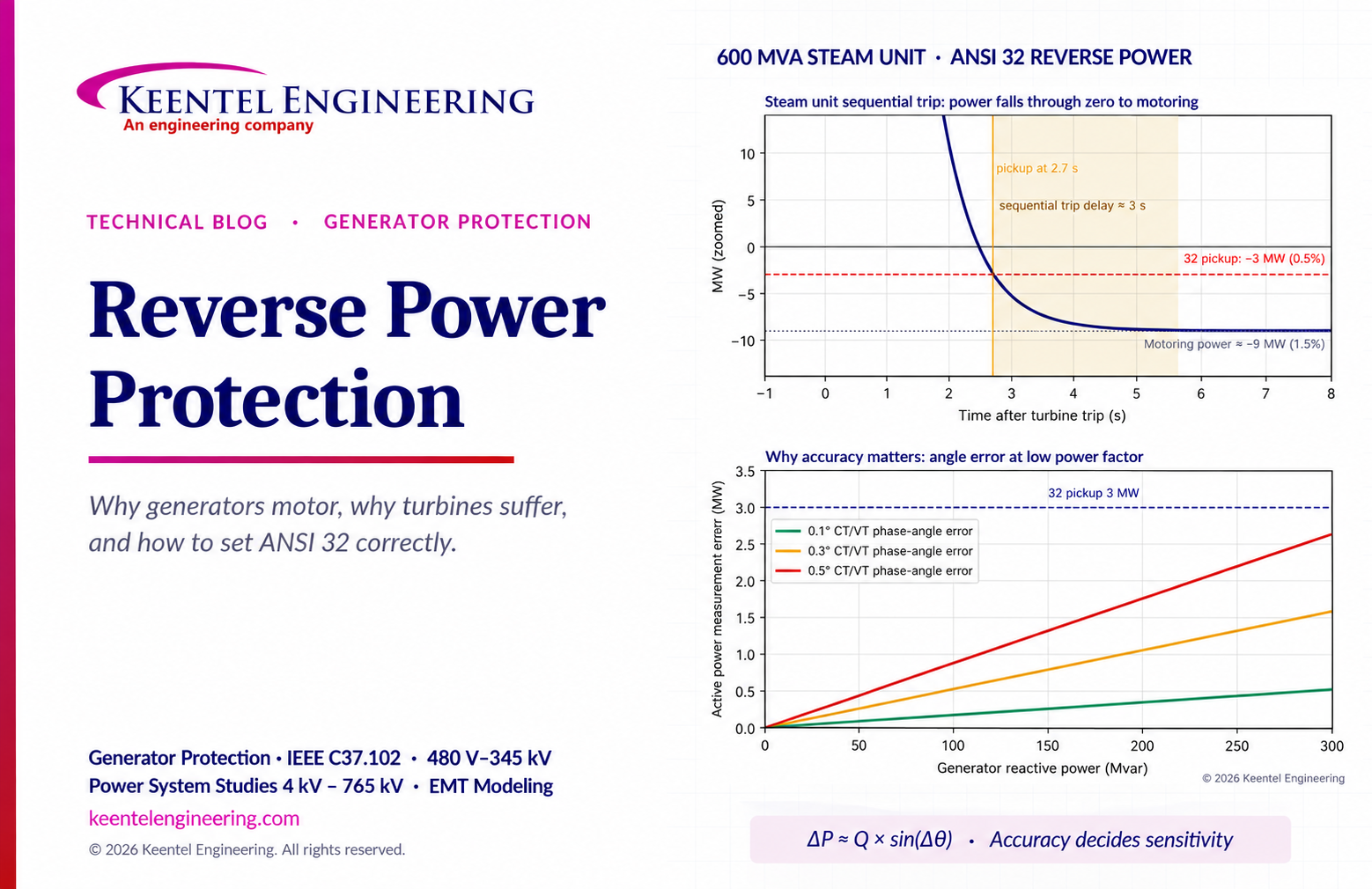
Learn reverse power protection (ANSI 32), generator motoring, relay pickup settings, time delays, sequential tripping and testing for US power plants.
Copy
By Team 2 Dexora
•
October 20, 2026
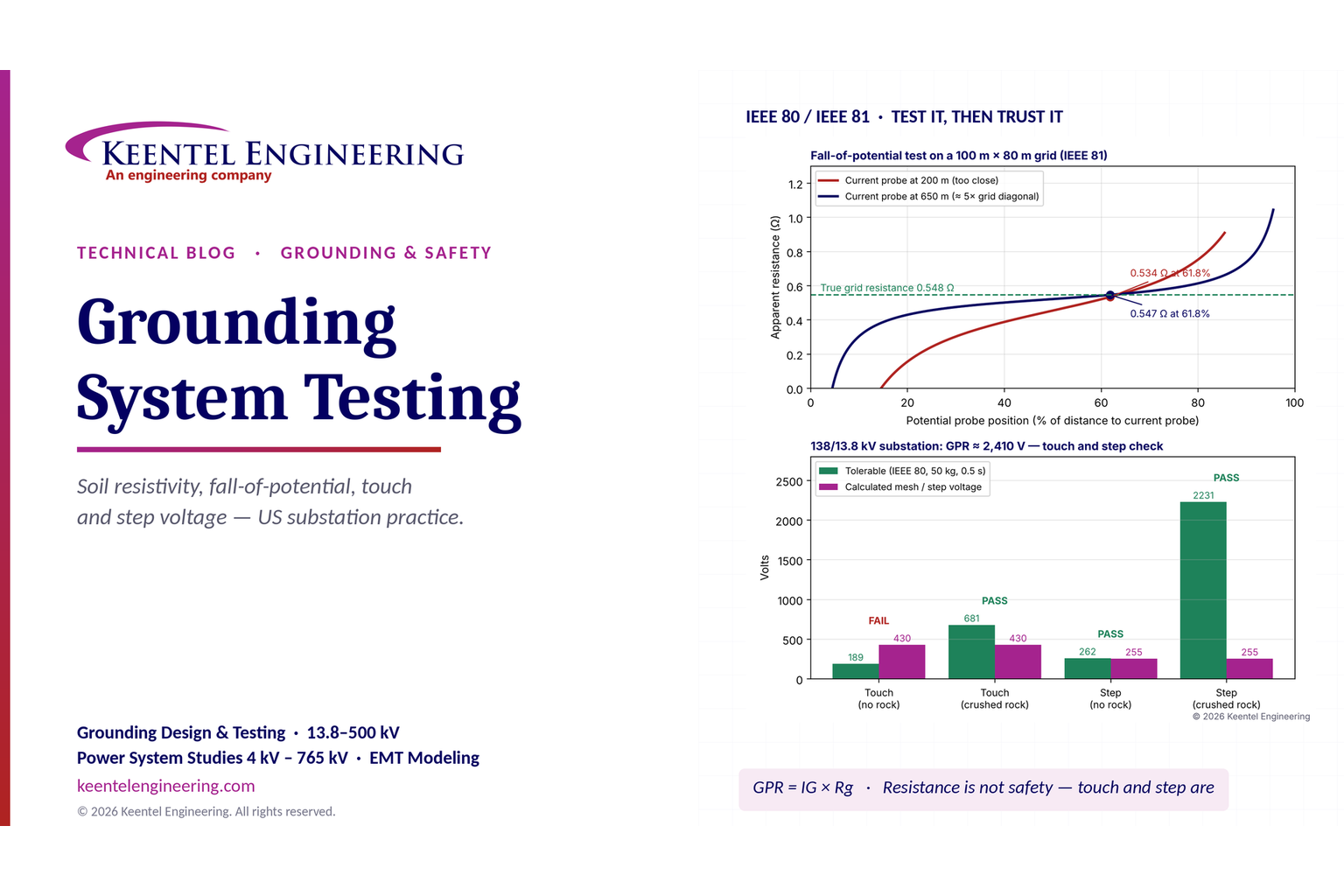
Explore grounding system testing with Keentel Engineering. Learn IEEE 80/81 methods, soil resistivity, ground resistance, and touch and step voltage safety.
By SANDIP R PATEL
•
October 13, 2026
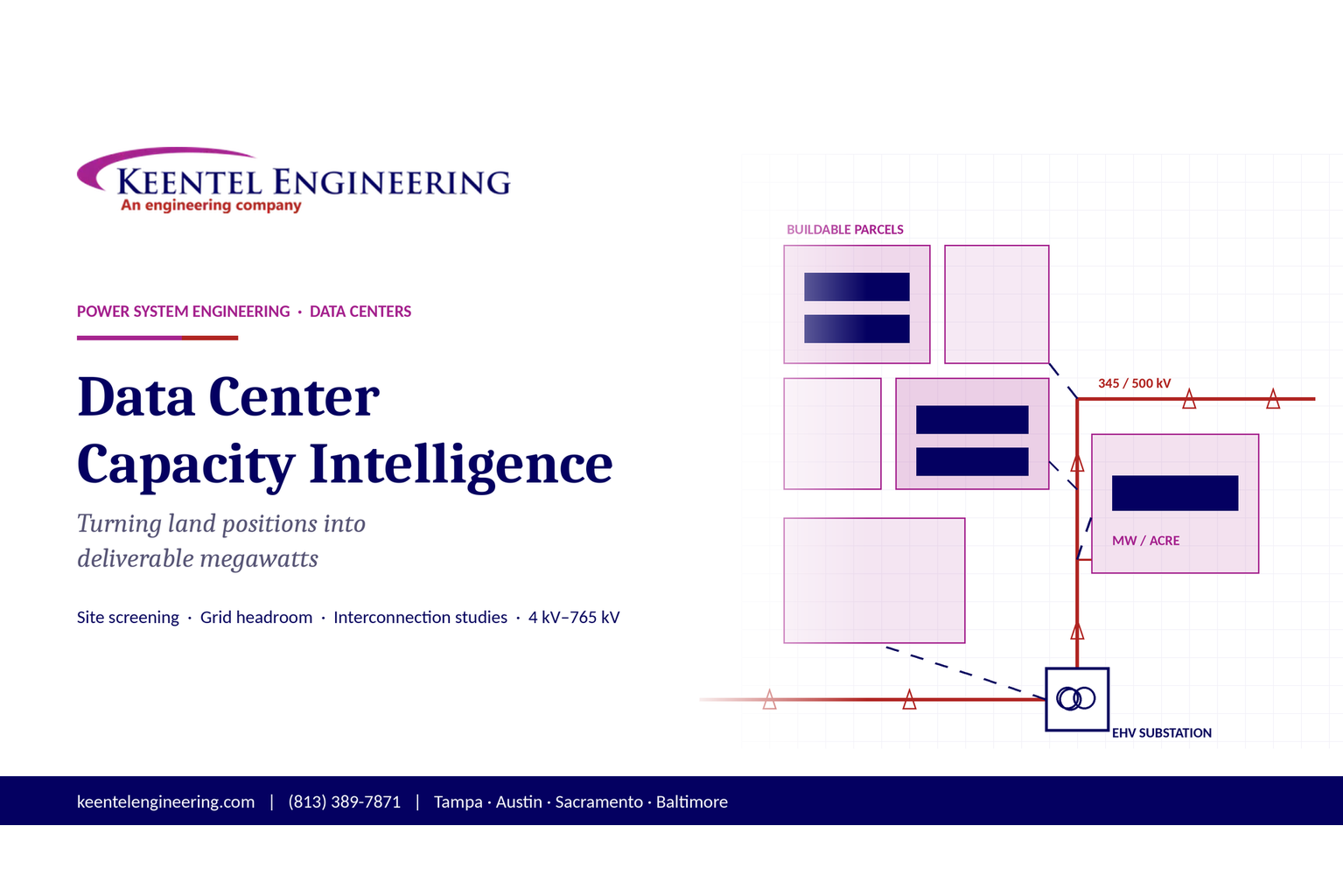
Plan data center capacity with land screening, MW-per-acre estimates, grid power availability and interconnection feasibility studies from Keentel Engineering.
By SANDIP R PATEL
•
October 11, 2026
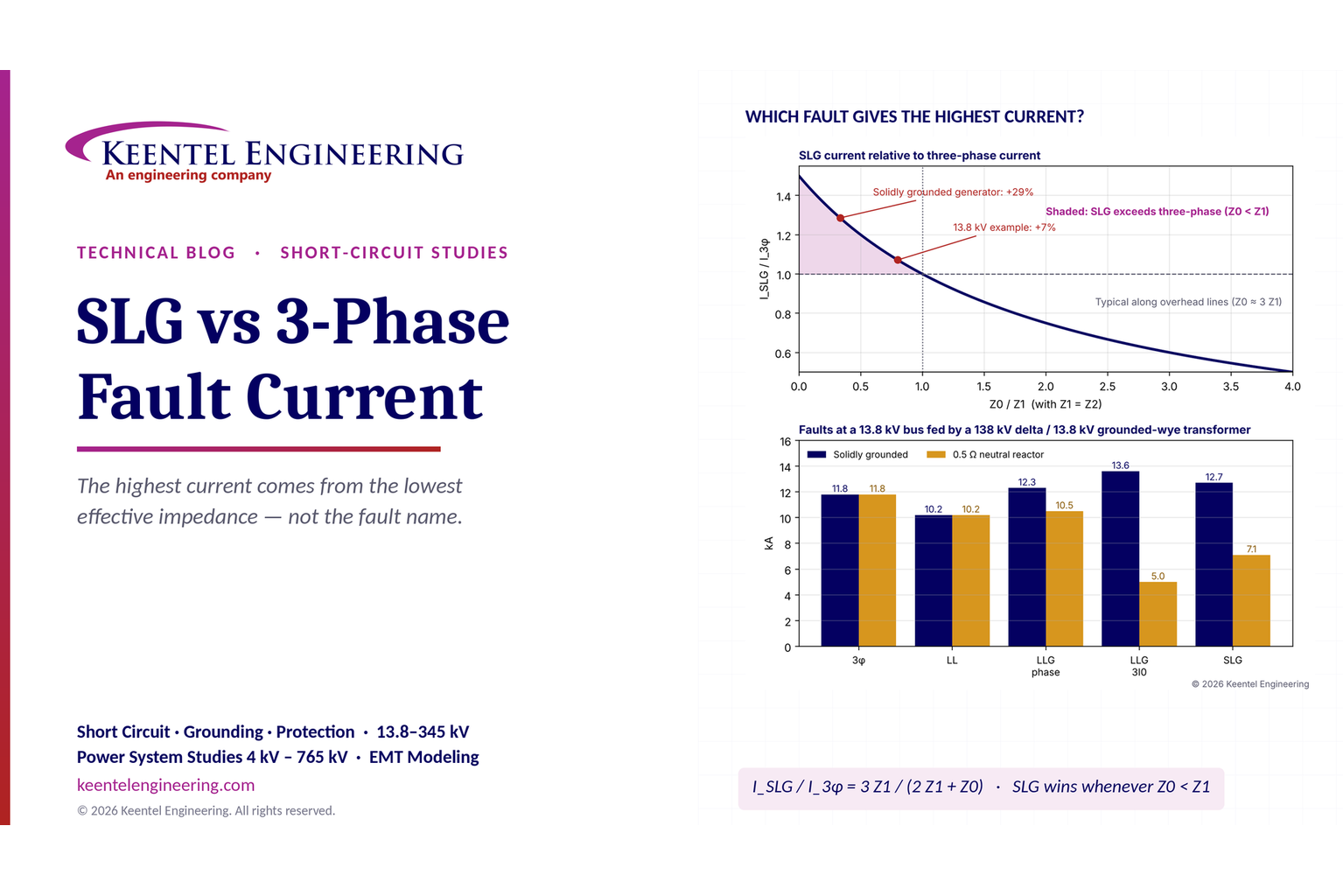
Learn which fault produces the highest current at a bus, why SLG faults can exceed three-phase faults, and how symmetrical components determine fault duty.
By SANDIP R PATEL
•
October 11, 2026
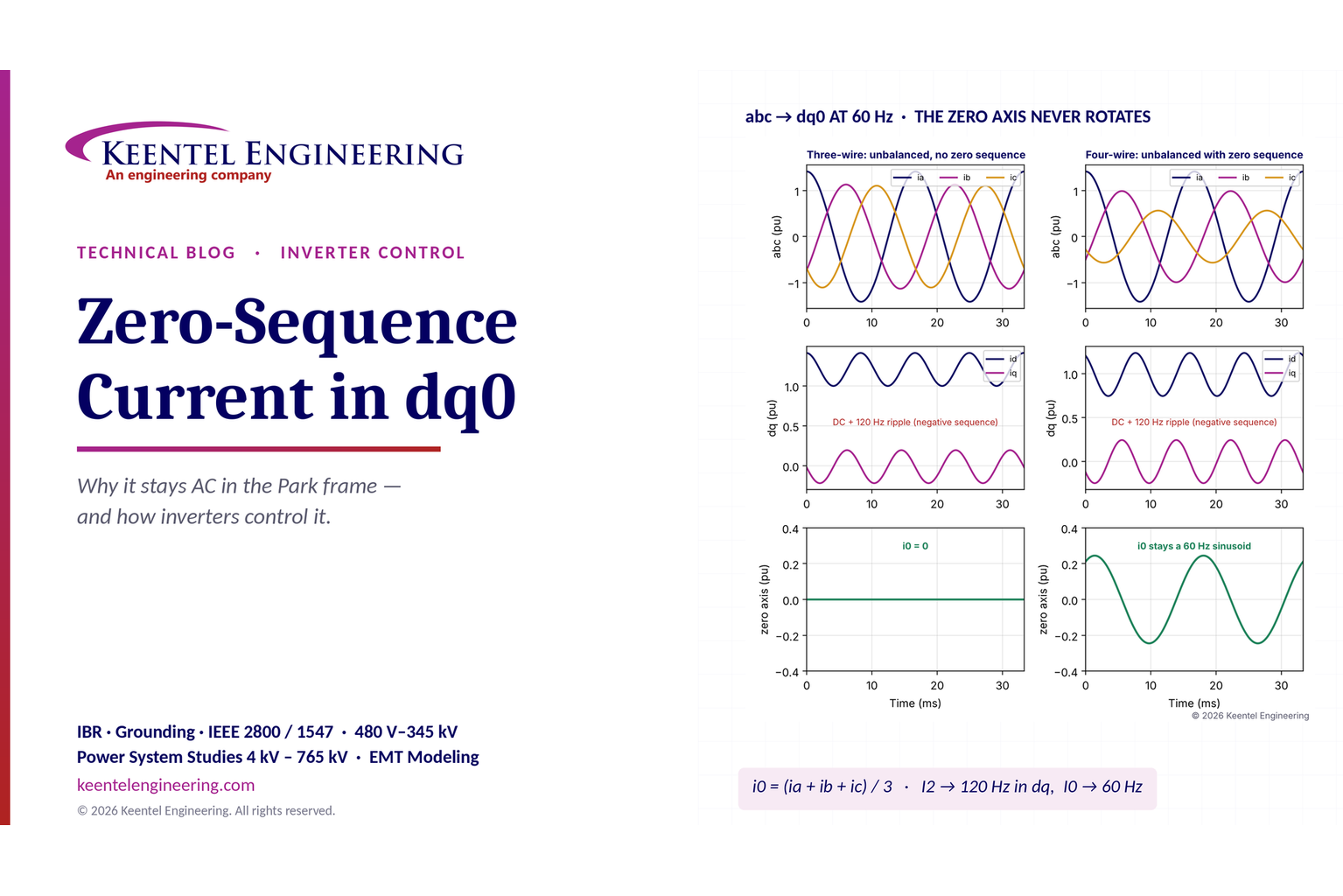
Learn why zero-sequence current pulsates in the dq0 frame, how Park's transformation works, and how inverter controls handle unbalance and ground faults.
By SANDIP R PATEL
•
October 11, 2026
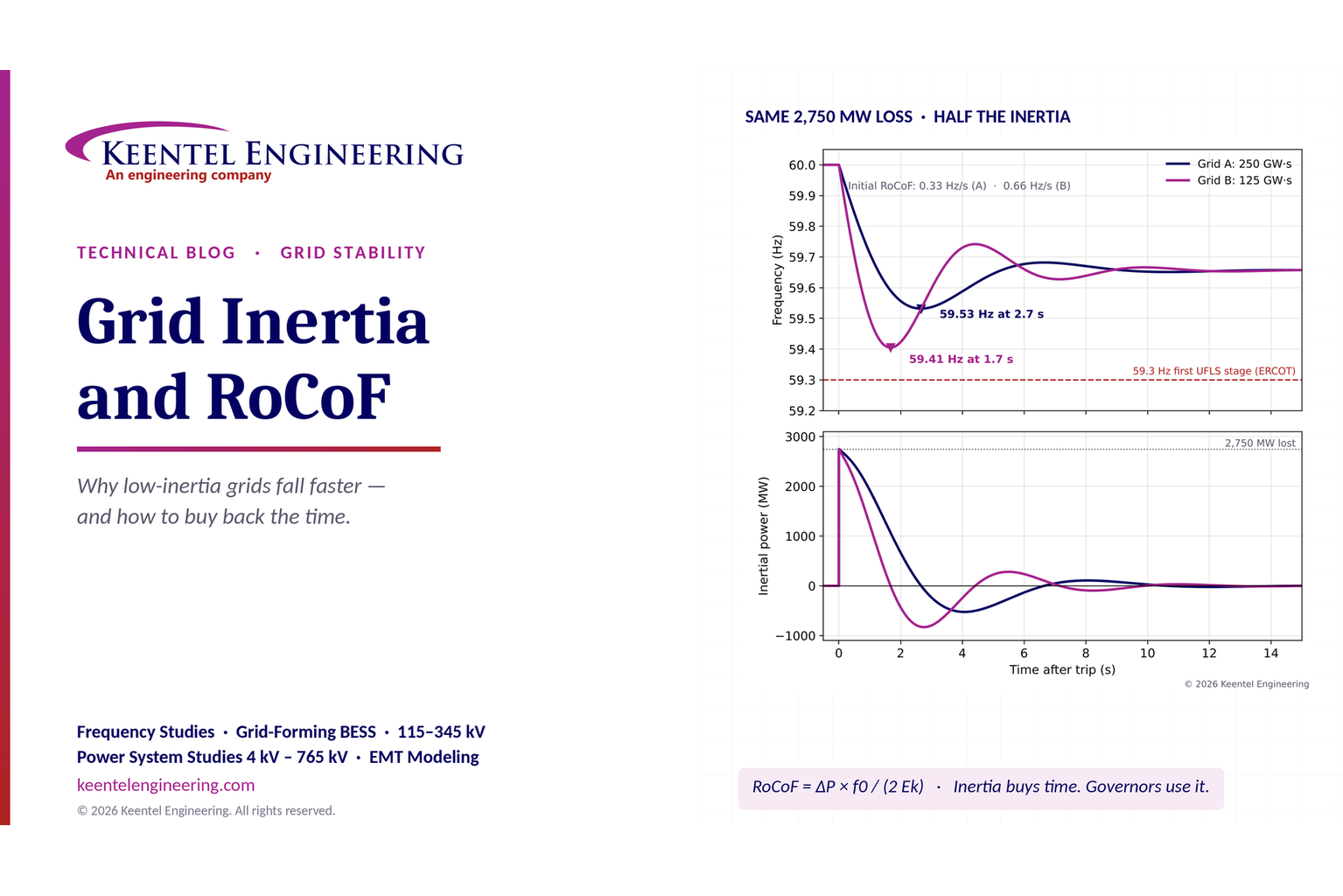
Explore grid inertia, RoCoF and frequency response, with swing equation calculations, frequency nadir analysis and US power system simulation examples.
By SANDIP R PATEL
•
October 11, 2026
Learn transient stability analysis, swing equation, equal-area criterion and critical clearing time with a 345 kV worked example and NERC TPL-001 guidance.
By SANDIP R PATEL
•
October 11, 2026
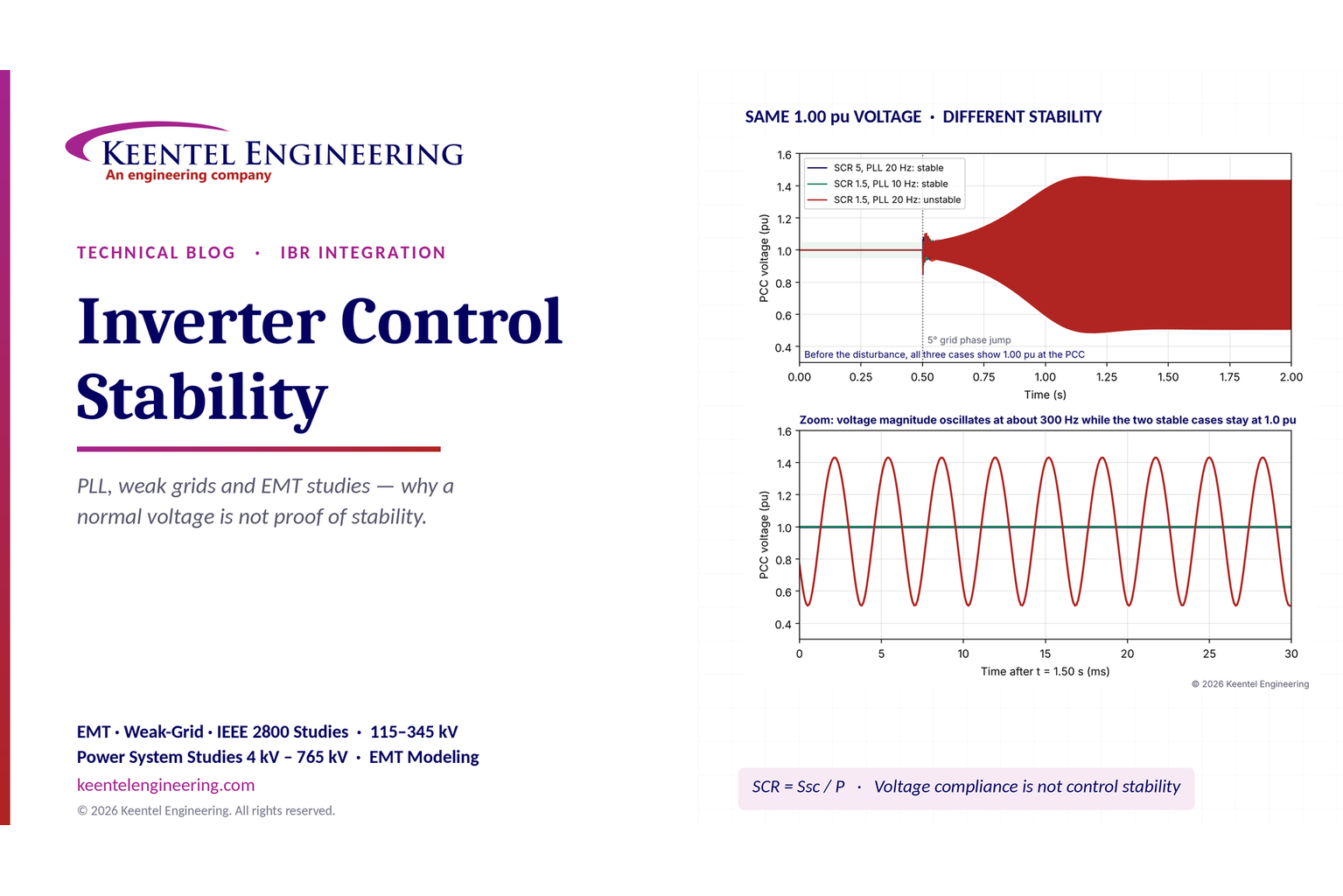
Learn why inverter controls become unstable in weak grids, how PLL bandwidth and SCR affect stability, and how PSCAD EMT studies identify and mitigate oscillations.
By SANDIP R PATEL
•
October 11, 2026
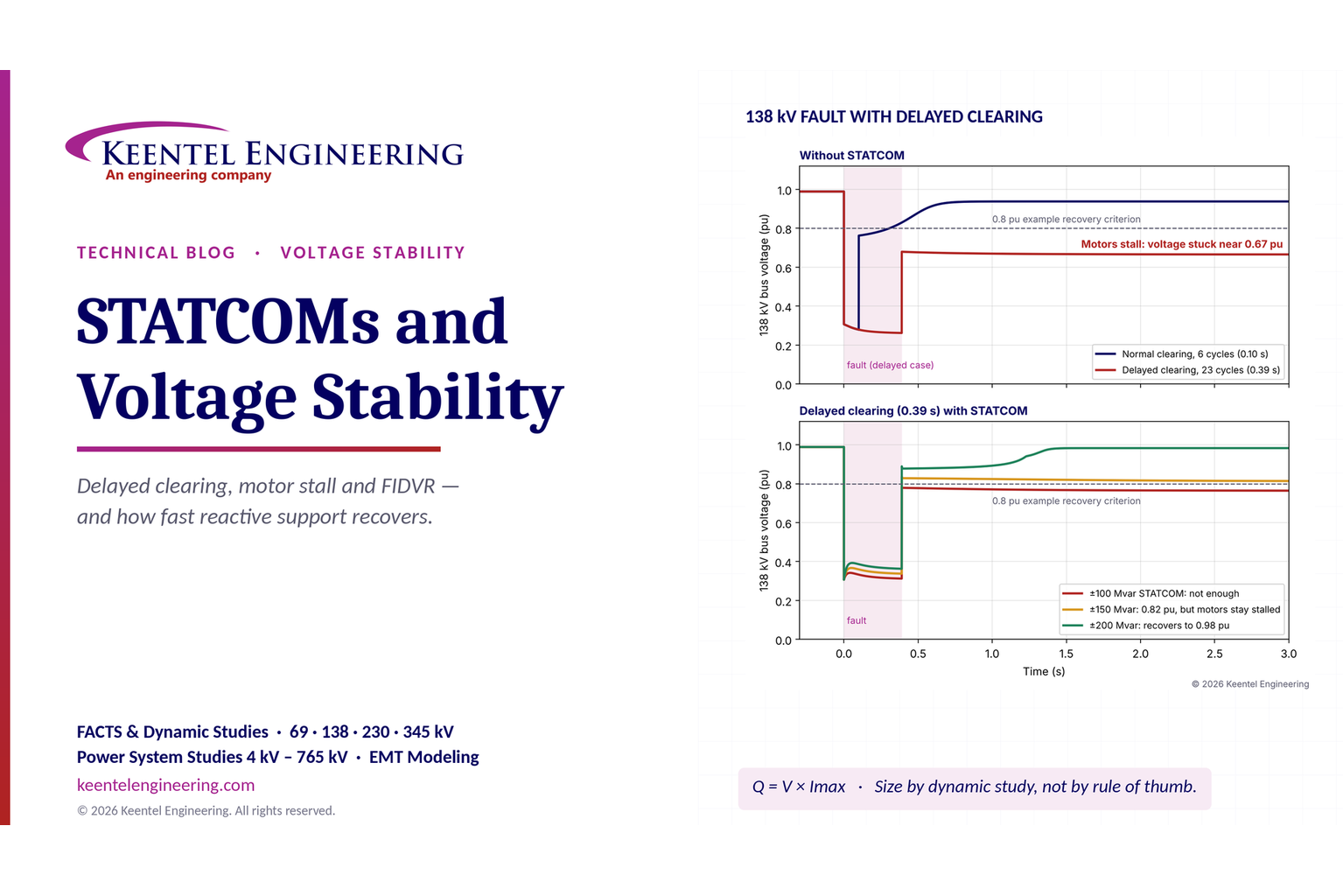
Learn how STATCOMs improve voltage stability and prevent FIDVR. Explore reactive power sizing, delayed fault clearing, NERC criteria and 138 kV simulation results.