A Coordinated Electric System Interconnection Review—the utility’s deep-dive on technical and cost impacts of your project.
Challenge: Frequent false tripping using conventional electromechanical relays
Solution: SEL-487E integration with multi-terminal differential protection and dynamic inrush restraint
Result: 90% reduction in false trips, saving over $250,000 in downtime
ERCOT enforces all of the above through simulation, which means your model is your compliance case. The bar is now high:
- Whole-facility scope. The model must represent everything the IT load, the UPS and power conversion, the cooling plant, the protection and control systems in formats compatible with ERCOT's study platforms (PSS/E, PSCAD, TSAT).
- Real control loops, not approximations. Generic textbook representations are unacceptable. The model must capture the actual inner control behavior of your power electronics.
- Hardware-validated converter models. For electronic loads, the PSCAD model must be benchmarked against actual hardware testing including voltage ride-through and subsynchronous response. A model assembled from standard PSCAD library blocks fails by definition, because a generic block has never been tested against your vendor's hardware. The good news: validation is a hardware-type test, so results for a given converter product are reusable across every facility that uses it.
- Format migration. Facilities that previously submitted the older composite load model (CMLD) format must transition to EPRI's PERC1 format.
- Three checkpoints. Models are reviewed before the stability study begins (no model, no study), before each quarterly stability assessment, and for electronic loads one final time before energization, when you must submit as-built models with a documented comparison against the previously studied data and a sworn attestation that the model matches actual field settings. ERCOT's review takes 10 business days, extendable by 20 put it on your critical path.
- A living obligation. Change your technology, controls, or relay settings in a way that affects ride-through including converting a crypto mining site to an AI data center — and you've triggered a new interconnection study, even if your megawatts don't change.
| Parameter | Detail |
|---|---|
| System | 230 kV / 138 kV transmission corridors, wind and wet-snow icing exposure |
| Data basis | 15 years of minute-resolution forced-outage records + regional weather observations |
| Core methods | Event grouping, MVA performance curves, time-to-95%-restore, area outage rate curves, fragility modeling, rerun-history benefits, exceedance and log-domain risk metrics |
| Headline result | ≈85% of maximum resilience benefit at 60% of original capital; worst-event restoration window cut from 11 days to 5 in rerun-history terms |
| Decision supported | Capital portfolio selection; resilience plan filing; post-investment verification framework |
| System / Topic | Governing Standard(s) | What It Controls |
|---|---|---|
| Overall plant electrical distribution | IEEE 141 (Red Book); IEEE 666 | Distribution architecture, voltage selection, design of generating station auxiliary service systems |
| Power system studies | IEEE 399 (Brown Book); IEEE 551 | Load flow, symmetrical/asymmetrical short circuit, motor starting methodologies down to the lowest LV panelboard |
| Protection & coordination | IEEE 242 (Buff Book); IEEE 3004.5; IEEE C37 series | Generator relaying (21, 59N, 87G), time-current coordination, selective clearing between LV and MV tiers |
| GSU / UAT / SST transformers | IEEE C57.12.00 and C57 family | Transformer ratings, impedance, testing, loading |
| HV switchyard breakers | IEEE C37.06 | AC high-voltage circuit breaker preferred ratings |
| MV switchgear (13.8 kV) | IEEE C37.20.2; IEEE C37.20.7 | Metal-clad construction, compartmentalization, vacuum breakers; arc-resistant design with plenum venting |
| MV cable | UL 1072; ICEA S-93-639 (NEMA WC 74) | Type MV-105 shielded cable, 133% insulation level for HRG systems |
| LV switchgear (480 V) | IEEE C37.13; UL 1558 | Metal-enclosed LV power circuit breaker switchgear to 635 V, draw-out ACBs with electronic trip units |
| Motor control centers | UL 845; NEMA ICS 18 | LV-MCC construction, MCCB/MCP protection for motors under ~200 HP |
| Motors | NEMA MG-1 | Motor performance, starting characteristics, service factors |
| DC & battery systems | IEEE 485; IEEE 946 | Lead-acid battery sizing (125/250 VDC), DC auxiliary system design |
| Grounding | IEEE 80; IEEE 142 (Green Book) | Ground grid step/touch potential limits; system grounding including high-resistance grounding |
| Lightning protection | IEEE 998 | Direct-stroke shielding of switchyard and outdoor generator structures |
| Arc flash & electrical safety | IEEE 1584; NFPA 70E | Incident energy calculation; worker safety boundaries and PPE |
| Fire protection | NFPA 850 | Fire protection and risk management for combustion turbine generating plants |
| Installation code | NEC (NFPA 70); NESC | Wiring methods inside the plant fence; overhead/outdoor clearances at the switchyard |
| Interconnection & compliance | FERC LGIP; NERC MOD-025/026/027, PRC-019/024/029, FAC-008 | Interconnection process, model validation, protection/ride-through coordination, facility ratings |
| IFC / Construction Deliverable | Purpose |
|---|---|
| Stamped IFC packages | Legal basis for construction; P.E. responsible charge |
| Final relay settings & TCCs | Protection as-installed matches the coordination study |
| Calculation archive | Owner records; NERC audit evidence trail |
| Commissioning procedures | Safe, sequenced energization; MOD field testing |
| Construction support | RFIs, field changes, FAT/SAT witness |
| As-builts & model handoff | Operating baseline; future study currency |
| Metric | Outcome |
|---|---|
| Defects found pre-occupancy | Three topology defects and one settings-mismatch family corrected before load migration; the shared-switchboard defect alone would have invalidated the concurrently-maintainable claim on day one |
| IST findings | Fourteen additional discrepancies surfaced under scenario testing (control logic, alarm mapping, one generator sequencing fault) — all closed before handover instead of during operations |
| Black-building test | Passed on second execution; the first attempt exposed the generator sequencing fault under true block load, exactly the failure the compressed plan would never have found |
| Handover quality | Operations team certified on the actual failure scenarios; corrected EOPs and settings documentation delivered as controlled documents |
| Business outcome | Occupancy proceeded three weeks behind the original date — against an independent estimate that the uncorrected sequencing fault carried a high probability of a full facility outage within the first year |
Interconnecting a Utility-Scale BESS in ERCOT: The Complete Guide to the TNMP and AEP Texas Process
Jul 13, 2026 | Blog
Battery Energy Storage Systems (BESS) are being deployed across Texas at a record pace, and for good reason. ERCOT's volatile energy prices, growing ancillary service markets, and rapid load growth make the grid one of the most attractive storage markets in the world. But between a signed land lease and a battery earning revenue sits one of the most consequential — and most frequently underestimated — phases of any project: interconnection.
This guide walks through the full interconnection process for a utility-scale BESS in the ERCOT region, with a specific focus on projects in Texas-New Mexico Power (TNMP) and AEP Texas service territories. It covers the classification thresholds that determine your pathway, the ERCOT study and registration process, the utility-side coordination, fees, timelines, and the commissioning gauntlet at the end. We close with answers to the questions developers ask us most, and four anonymized case studies from real projects in TNMP and AEP territory.
Why the 10 MW Threshold Changes Everything
Before anything else, a developer needs to know which of two very different pathways their project falls into, because the answer drives the timeline, the fees, the study burden, and the engineering scope.
In ERCOT, generation and storage resources below 10 MW are generally treated as Distributed Generation (DG). These projects avoid the full transmission-level review and are handled primarily through the local utility's (the Transmission/Distribution Service Provider, or TDSP's) streamlined interconnection process. The evaluation focuses on the local distribution system — line loading, voltage impacts, protection coordination — rather than the statewide transmission grid. DG projects commonly clear the process in 8 to 12 months.
Projects at 10 MW and above are a different animal. They enter ERCOT's Generation Interconnection or Change Request (GINR) process — the full large-resource pathway — with a rigorous sequence of interconnection studies, comprehensive modeling requirements, a standardized interconnection agreement, quarterly stability assessments, and a formal commissioning and registration program. These projects typically take 18 to 30 months from application to commercial operation.
An important nuance that trips up many developers: the threshold is measured in megawatts of power, not megawatt-hours of energy. A 10 MW / 20 MWh system is a 10 MW resource for classification purposes — the 20 MWh simply means it can sustain full output for two hours. And because the DG pathway applies to resources
under 10 MW, a project at exactly 10 MW does not qualify for the streamlined treatment. It goes through the full GINR process.
This is also why nameplate strategy is a genuine engineering and commercial decision. ERCOT's framework recognizes Self-Limiting Facilities — projects that are physically and contractually limited to inject below a threshold at the point of interconnection. For some developers, configuring a project at 9.9 MW instead of 10 MW is the difference between a one-year process and a three-year process. For others, offtake commitments, market participation plans, or project economics make the full 10 MW (or more) worth the longer road. An experienced owner's engineer should pressure-test this decision before the first application is filed, because changing course mid-queue is expensive.
The remainder of this guide assumes a project of 10 MW or greater following the full GINR pathway, with notes on where the TNMP and AEP tracks differ.
The ERCOT GINR Process, Phase by Phase
ERCOT is unusual among North American grid operators. There is no traditional cluster queue; each project moves on its own schedule through a defined sequence of studies, though projects can still be affected by others studying the same part of the grid. The process is administered through ERCOT's online Resource Integration and Ongoing Operations – Interconnection Services (RIOO-IS) portal, and the governing requirements live in Planning Guide Section 5.
Phase 0: Preparation and Application
The entity submitting the request — the Interconnecting Entity (IE) — begins by creating a RIOO-IS user account, which requires registration and multi-factor authentication setup. The GINR application itself demands a well-developed project definition: the point of interconnection (POI), the proposed in-service date, equipment selections, and preliminary electrical design. Application quality matters. Deficient or incomplete submissions get kicked back, and in a process where a missed window can cost a full quarter, rework is expensive.
Applicable fees are set by the ERCOT Fee Schedule. For a project at or above 10 MW, the administrative fees paid directly to ERCOT stack up as follows:
| Fee | Amount |
|---|---|
| Generator Interconnection / Modification Fee (≥ 10 MW) | $14,000 |
| Full Interconnection Study (FIS) Application Fee | $3,000 |
| System Coordination Study Fee ($15 per MW) | $150 for a 10 MW project |
| Resource Entity Registration Fee | $500 |
| Total ERCOT administrative fees (10 MW project) | $17,150 (non-refundable) |
These figures reflect the fee schedule at the time of writing and should always be verified against the current ERCOT Protocols before budgeting, as they are periodically revised. They also exclude TDSP study costs, third-party engineering, and — critically — financial security.
Phase 1: Screening Study (approximately 90 days)
Once the application is validated, ERCOT performs a screening evaluation of the proposed POI, looking for immediate fatal flaws and system constraints. Results are typically returned within 90 calendar days of a validated application.
After screening, the project must post interconnection financial security of $50,000 per MW to hold its position — $500,000 for a 10 MW project. A portion (roughly 20%) is refundable if the project withdraws early in the process, but the security converts to fully non-refundable once construction-stage agreements are finalized. This deposit, far more than the administrative fees, is the number that disciplines speculative projects out of the ERCOT development pipeline.
Phase 2: Full Interconnection Study (roughly 120 to 180 days)
The FIS is the technical heart of the process, and here is a detail many developers miss: the FIS is conducted by the TDSP — TNMP or AEP Texas for the projects this guide covers — under ERCOT's framework. The study package includes steady-state power flow analysis, dynamic stability simulation, short-circuit analysis, and facility design evaluation, with individual studies typically running 45 to 60 days each in sequence across a four-to-six-month block.
The FIS phase is also where the project's modeling obligations come due. Within 90 days of application, the IE must deliver comprehensive technical models: steady-state, dynamic, and transient inverter models suitable for ERCOT's simulation platforms. ERCOT's Model Quality Guide — which now includes formal Model Quality Testing requirements along with UDM and PSCAD model guidelines — governs what is acceptable. Inverter-based resources like BESS receive particular scrutiny here, because their behavior during grid disturbances is defined by control software rather than physics, and poorly validated models are one of the most common causes of study delays and restudy cycles.
Depending on the location and technology, ERCOT may also require a subsynchronous resonance (SSR) vulnerability study and will require a Reactive Power study demonstrating that the resource meets the reactive capability requirements of Nodal Protocol Section 3.15.
Phase 3: Agreements, Registration, and the QSA Cycle
With studies complete and any required network upgrades defined, the project executes a Standard Generation Interconnection Agreement (SGIA) with the TDSP. Note for current projects: all SGIAs executed on or after January 1, 2026 must use the updated SGIA form dated November 6, 2025, which incorporates changes approved by the Public Utility Commission of Texas in Project 58211. The older 2019 form survives only for amendments to pre-2026 agreements.
After the interconnection agreement is signed, BESS projects submit the Battery Request for Information Template through RIOO-IS, and the project enters ERCOT's Quarterly Stability Assessment (QSA) cycle, with submission requirements defined in Planning Guide 5.3.5. The QSA runs on fixed quarterly windows, and this is one of the least forgiving schedule mechanics in the entire process: miss a data-submission deadline and the project does not slip by a week — it slips into the next 90-day quarterly window. Disciplined data management during this phase is worth real money.
In parallel, once the planned resource has met the requirements of Planning Guide Section 6.9 for addition to the planning models, it can be registered with ERCOT. The entity that registers and takes responsibility for the resource — the Resource Entity (RE) — may be the same as the IE or a different entity. Registration involves the Resource Asset Registration Forms (RARF), which feed ERCOT's network operations model, along with the Collector System Template covering the site's internal cable segments and the Dynamic Model Templates with the Model Quality Test report. Projects planning to co-locate load under 75 MW with the storage resource also complete a Load Information Form to coordinate that arrangement during interconnection.
Phase 4: Commissioning and Energization (roughly 90 to 120 days)
The final phase transforms a construction project into a market-registered, dispatchable ERCOT resource. Key elements include the Commissioning Plan, submitted for ERCOT approval to energize, synchronize, and complete required testing; AVR (automatic voltage regulator) testing tailored to BESS resources, with data submitted on ERCOT's standard templates; PMU (phasor measurement unit) sample data submission for transmission-connected resources; frequency ride-through and voltage ride-through capability reporting; the New Generator Commissioning Checklist, executed with the project's Qualified Scheduling Entity (QSE) across ERCOT's market and control systems; and the attestation required under the Lone Star Infrastructure Protection Act.
Only after this sequence — plus telemetry validation and settlement metering verification — does ERCOT grant approval to connect and, ultimately, commercial operation status that allows the battery to transact in the wholesale energy market and provide ancillary services.
The TNMP Track: What to Expect in Texas-New Mexico Power Territory
For a project in TNMP territory, the TDSP coordination track runs alongside the ERCOT process. TNMP administers interconnection applications through its PowerClerk-based portal, where the applicant registers an account and works through a structured application covering customer and installer information, the service point and its ESI ID (TNMP ESI IDs are 17-digit identifiers), and the generation configuration — with Energy Storage as its own generator type, including configurations for integrated storage systems and separate inverter-plus-battery arrangements, and DC-coupled versus AC-coupled designs for hybrid projects.
The application requires the technical package that defines the project electrically: a one-line diagram, a layout sketch showing a lockable, visible disconnect device, equipment certifications (IEEE 1547 / UL 1741), voltage and phase configuration, kVA rating and power factor, export intentions, and confirmation that the inverter manufacturer has supplied dynamic modeling values to the utility. The application concludes with selection of the interconnection agreement party structure — TNMP's agreement contemplates four options depending on whether the end-use customer, a separate generator owner, the premises owner, or a contracted energy-rights holder acts as the counterparty.
From there, TNMP's workflow proceeds through defined stages: application review (TNMP targets returning an executable interconnection agreement within about ten business days for standard applications), electronic signatures, construction, field inspection, service order generation, meter installation, and finally Permission to Operate. For utility-scale projects, expect substantially deeper engagement than the standard portal flow implies — direct coordination with TNMP engineering on substation or feeder connection design, easement and right-of-way review where TNMP facilities cross the project property or third-party land, and encroachment review for any construction near existing TNMP facilities. And as noted above, for a ≥10 MW project TNMP is also the entity conducting the ERCOT Full Interconnection Study, which makes a constructive working relationship with TNMP's planning engineers doubly valuable.
The AEP Texas Track: What to Expect in AEP Territory
AEP Texas administers its interconnection intake through the AEP Texas interconnection portal, with an application fee and a documentation package that will look familiar: one-line wiring diagram, inverter specification sheets, site plans, and a visible AC disconnect diagram. AEP engineering performs impact and safety studies evaluating whether the project will overload local facilities or cause voltage disruptions, and approved projects execute an Interconnection Service Agreement (ISA) with AEP, including payment for any physical grid upgrades the studies identify.
For projects below the DG threshold, AEP's process is the streamlined path — the utility-level review substitutes for the full ERCOT study sequence, and the ERCOT side reduces to registration, EPS (ERCOT-Polled Settlement) metering, and model verification with ride-through testing. For projects at 10 MW and above, the AEP track functions like the TNMP track described above: the utility coordination and ISA run alongside the full GINR process, with AEP as the studying TDSP.
In both territories, the closing sequence is the same shape: construction, utility field verification, bidirectional/settlement meter installation, the utility's Permission to Operate letter, and then ERCOT commercial operation status.
Beyond the Utilities: Permitting, Codes, and Fire Protection
Interconnection is necessary but not sufficient. Before energization, a BESS project must also clear local and state permitting, and battery storage presents a wrinkle: most local zoning ordinances were written before BESS existed, so the use is rarely listed. Projects frequently need a Conditional Use Permit (CUP) or Special Use Permit (SUP) from the local authority having jurisdiction, which introduces a public-facing, discretionary approval into the schedule.
On the code side, the installation must comply with the National Electrical Code and, centrally for BESS, NFPA 855, the Standard for the Installation of Stationary Energy Storage Systems. NFPA 855 drives siting and separation distances, fire suppression and detection design, deflagration protection, emergency response planning, and the hazard mitigation analysis that fire marshals increasingly demand. Fire protection engineering is not a checkbox at the end of design — separation requirements and suppression infrastructure affect site layout, and site layout affects the one-line, the collector system design, and even the interconnection application. It belongs in the design process from day one.
Case Studies
The following case studies are drawn from utility-scale BESS interconnection projects in ERCOT. Client names, locations, and identifying details have been anonymized.
Case Study 1 — TNMP Territory: The Threshold Decision That Saved a Year
A developer approached us with a planned 10 MW / 20 MWh standalone BESS on a distribution-adjacent site in west Texas TNMP territory, assuming the project would follow the utility's standard DG process. Our first-week screening flagged the problem: at exactly 10 MW, the project sat on the wrong side of ERCOT's DG threshold and was headed into the full GINR pathway — roughly $17,000 in ERCOT fees, a half-million-dollar security posting, and an 18-to-30-month clock, against a revenue model built on a 12-month energization target.
We ran a two-track analysis: the market revenue impact of derating to a 9.9 MW self-limiting configuration versus the carrying cost and schedule risk of the full GINR route. For this project's merchant strategy, the lost margin on 0.1 MW was immaterial next to a year of earlier revenue. We redesigned the power conversion system controls and protection settings to enforce the self-limiting configuration at the POI, documented it to ERCOT's self-limiting facility requirements, and filed through TNMP's process with a complete one-line, layout with lockable visible disconnect, and manufacturer dynamic modeling data on day one. The project cleared studies without a restudy cycle and energized inside its original financing window — approximately 14 months ahead of the GINR counterfactual.
Case Study 2 — TNMP Territory: Recovering a Stalled Application
A storage owner-operator engaged us to rescue a BESS interconnection in TNMP territory that had been in process for months without reaching an executable interconnection agreement. Our review found the application had been submitted with an incomplete technical package: the one-line diagram did not match the as-designed collector system, the layout sketch omitted the required lockable visible disconnect detail, and the inverter manufacturer's dynamic modeling values had never been transmitted to the utility — each deficiency individually minor, collectively fatal to review progress.
We rebuilt the submission as a coherent package: corrected one-line and site layout, IEEE 1547/UL 1741 certification documentation, complete generation detail with verified kVA and power factor data, and direct coordination with the inverter OEM to deliver validated dynamic models. We also restructured the interconnection agreement party designation, which had been filed under the wrong option for the project's ownership structure. The resubmitted application moved through TNMP review to an executable agreement in under three weeks, and the project proceeded through inspection and meter installation to Permission to Operate without further deficiency notices. The lesson we emphasize from this engagement: in interconnection, application quality is schedule.
Case Study 3 — AEP Texas Territory: Parallel-Tracking Utility and ERCOT Workstreams
A developer of a 9.95 MW / 20 MWh BESS in AEP Texas territory engaged us as owner's engineer with a hard commercial operation deadline driven by an offtake commitment. The project qualified for AEP's streamlined DER pathway, but the developer's baseline schedule treated the process as sequential: AEP application, then studies, then agreement, then ERCOT registration, then metering, then testing. Run that way, the timeline missed the deadline by roughly a quarter.
We restructured the program to run the tracks in parallel. While AEP's engineers conducted their impact and safety studies, we simultaneously prepared the ERCOT registration package — RARF data, collector system information, and dynamic models — and pre-coordinated the EPS settlement metering design so meter procurement started before the
Interconnection Service Agreement was signed. Ride-through capability documentation was assembled from manufacturer test data during construction rather than after it. When AEP issued Permission to Operate, the ERCOT side was already staged: commissioning tests were scheduled, telemetry was validated within days, and the project reached commercial operation about ten weeks sooner than the sequential baseline — inside the offtake deadline.
Case Study 4 — AEP Texas Territory: Fire Protection as a Design Driver, Not an Afterthought
A 10 MW-class BESS project in a growing AEP Texas municipality came to us after receiving pushback from the local fire marshal on its preliminary site plan. The original layout, produced before any fire-protection engineering, placed battery enclosures at spacings that did not satisfy NFPA 855 separation requirements once the enclosure listing and fire-testing documentation were examined — and the municipality, with limited prior BESS experience, was requiring a full hazard mitigation analysis and emergency response plan before it would advance the project's Special Use Permit.
We took over the fire protection engineering scope and integrated it with the electrical design rather than bolting it on. The site was re-planned around compliant separation distances and fire-apparatus access; enclosure-level detection, suppression, and deflagration protection were specified against the manufacturer's large-scale fire test data; and we produced the hazard mitigation analysis and emergency response plan, then supported the developer in working sessions with the fire marshal and at the public SUP hearing. The revised layout required rerouting the DC collection and shifting the interconnection switchgear — changes that would have been catastrophic if discovered after the utility design package was submitted, but manageable because the site plan, one-line, and AEP application were finalized together. The project secured its Special Use Permit, cleared AEP's review on the corrected package, and avoided what we conservatively estimate would have been a six-month redesign loop had the original plan reached the utility first.
The Bottom Line
Interconnecting a utility-scale BESS in ERCOT is a multi-front campaign: ERCOT's study, modeling, registration, and commissioning machinery on one front; the TDSP's application, design review, agreement, and inspection process on another; and local permitting, codes, and fire protection on a third. The projects that reach commercial operation on schedule are the ones that treat these fronts as one integrated program — where the nameplate strategy is settled before the application is filed, the models are validated before ERCOT asks, the QSA deadlines are managed like the schedule cliffs they are, and NFPA 855 shapes the site plan instead of tearing it up.
That integration is the core of what an owner's engineer does. If you are developing battery storage in TNMP, AEP Texas, or anywhere in the ERCOT region — whether you are sizing your first project against the 10 MW threshold or untangling a stalled application — our team has walked this road and can help you plan it, de-risk it, and deliver it.
Contact us to discuss your project's interconnection strategy.
Frequently Asked Questions
Does my 10 MW / 20 MWh project count as 10 MW or 20 MW for interconnection purposes?
It is a 10 MW resource. Classification is based on power output capability (MW), not stored energy (MWh). The 20 MWh rating means the system can deliver its full 10 MW for two hours.
Is a project at exactly 10 MW treated as Distributed Generation?
No. The DG pathway in ERCOT applies to resources under 10 MW. At exactly 10 MW, a project falls into the full GINR large-resource process. Developers with flexibility in their nameplate sometimes configure projects just below the threshold — for example, as a self-limiting facility — to access the streamlined pathway, but that choice has commercial consequences that deserve analysis before the application is filed.
How long does the full process take?
Plan on 18 to 30 months from GINR application to commercial operation for a ≥10 MW project, broken roughly into a 90-day screening study, a 120-to-180-day full interconnection study phase, the agreement and quarterly stability assessment cycle, and a 90-to-120-day commissioning and energization phase. Sub-10 MW DG projects commonly complete in 8 to 12 months.
What will I pay ERCOT directly?
For a 10 MW project, about $17,150 in non-refundable administrative fees: $14,000 at GINR application, $3,000 at the FIS stage, $150 in system coordination study fees, and $500 for Resource Entity registration. Verify current amounts against the ERCOT Fee Schedule, and budget separately for TDSP study and facility costs and for engineering.
What is the security deposit, and when is it due?
After the screening study, ERCOT requires interconnection financial security of $50,000 per MW — $500,000 for a 10 MW project. Roughly 20% is recoverable on early withdrawal; the full amount becomes non-refundable once construction-stage agreements are executed.
Who actually performs the interconnection studies?
ERCOT administers the process, but the Full Interconnection Study for your project is conducted by your TDSP — TNMP or AEP Texas — covering steady-state, dynamic, short-circuit, and facility design analyses.
What models do I have to provide, and when?
Comprehensive steady-state, dynamic, and transient inverter models are due within 90 days of application, and they must satisfy ERCOT's Model Quality Guide, including its Model Quality Testing requirements. For inverter-based resources, model quality is one of the most common schedule risks in the entire process.
What is the QSA, and why do people warn me about it?
The Quarterly Stability Assessment is ERCOT's recurring stability review after the interconnection agreement is signed. It operates on fixed quarterly windows, so a missed data-submission deadline pushes the project into the next 90-day cycle. It is the sharpest schedule cliff in the process.
What agreement will I sign, and which form applies?
With the TDSP, a Standard Generation Interconnection Agreement. Any SGIA executed on or after January 1, 2026 must use the updated form dated November 6, 2025, adopted through PUCT Project 58211. In AEP territory, DG-scale projects execute AEP's Interconnection Service Agreement.
What happens at commissioning?
An approved Commissioning Plan; AVR testing under ERCOT's BESS-specific procedures; PMU data submission for transmission-connected resources; frequency and voltage ride-through capability reporting; the New Generator Commissioning Checklist executed with your QSE; the Lone Star Infrastructure Protection Act attestation; and settlement metering and telemetry validation. Then ERCOT grants approval to connect and, finally, commercial operation status.
Do I need a QSE?
Yes. Every market-participating resource in ERCOT schedules and settles through a Qualified Scheduling Entity. Selecting and onboarding a QSE should happen well before commissioning, because the QSE executes the commissioning checklist with ERCOT and handles market and control-system testing.
What permits do I need beyond the utility and ERCOT?
Local zoning approval — often a Conditional Use Permit or Special Use Permit, since BESS is rarely a listed use — plus building and electrical permits, NEC compliance, and NFPA 855 fire-protection compliance, which typically involves the local fire marshal and a hazard mitigation analysis.
Can I co-locate load with my battery?
Yes. Projects planning to co-locate loads under 75 MW with a new or existing storage resource complete ERCOT's Load Information Form so the arrangement can be coordinated during the interconnection process. Co-location adds registration and metering complexity that should be designed in from the start.

About the Author:
Sandip "Sonny" R. Patel, P.E.
IEEE Senior Member · Founder & CEO, Keentel Engineering
In 1995, Sonny Patel earned his Electrical Engineering degree from the University of Illinois. But degrees don't build legacies — action does.
For three decades, he has worked the power industry from every side of the table: 16 years as a utility engineer at Exelon/Commonwealth Edison; generation leadership across hydroelectric, industrial steam turbine, and a 9 GW renewable fleet; NERC Regional Entity Senior Compliance Engineer and Audit Team Lead, auditing some of the nation's largest utilities; and testing and commissioning lead on equipment up to 765 kV — the very top of the North American grid.Utility. Generator. Regulator. Consultant. Few engineers have seen all four seats. Fewer still have sat in them.
His experience spans nuclear, hydro, conventional generation, renewables, oil and gas, mining — and today's data centers, where he is authoring a three-book series on data center design. He is a Licensed Professional Engineer in six states and a Licensed Electrical Contractor in Florida (Unlimited EC) — he doesn't just design the work; he's qualified to stand behind its execution.Today, as Founder and CEO of Keentel Engineering, Sonny leads a nationwide team of engineers delivering substation design, power system studies, NERC compliance, and commissioning — done right, coast to coast.Three decades. Every side of the table. One standard: accountable engineering.
Services

Let's Discuss Your Project
Let's book a call to discuss your electrical engineering project that we can help you with.
About the Author:
Sandip "Sonny" R. Patel, P.E.
IEEE Senior Member · Founder & CEO, Keentel Engineering
In 1995, Sonny Patel earned his Electrical Engineering degree from the University of Illinois. But degrees don't build legacies — action does.
For three decades, he has worked the power industry from every side of the table: 16 years as a utility engineer at Exelon/Commonwealth Edison; generation leadership across hydroelectric, industrial steam turbine, and a 9 GW renewable fleet; NERC Regional Entity Senior Compliance Engineer and Audit Team Lead, auditing some of the nation's largest utilities; and testing and commissioning lead on equipment up to 765 kV — the very top of the North American grid.
Utility. Generator. Regulator. Consultant. Few engineers have seen all four seats. Fewer still have sat in them.
His experience spans nuclear, hydro, conventional generation, renewables, oil and gas, mining — and today's data centers, where he is authoring a three-book series on data center design. He is a Licensed Professional Engineer in six states and a Licensed Electrical Contractor in Florida (Unlimited EC) — he doesn't just design the work; he's qualified to stand behind its execution.
Today, as Founder and CEO of Keentel Engineering, Sonny leads a nationwide team of engineers delivering substation design, power system studies, NERC compliance, and commissioning — done right, coast to coast.Three decades. Every side of the table. One standard: accountable engineering.
Leave a Comment
Thank you for contacting us.
We will get back to you as soon as possible.
We will get back to you as soon as possible.
Oops, there was an error sending your message.
Please try again later.
Please try again later.
Related Posts
By SANDIP R PATEL
•
October 11, 2026
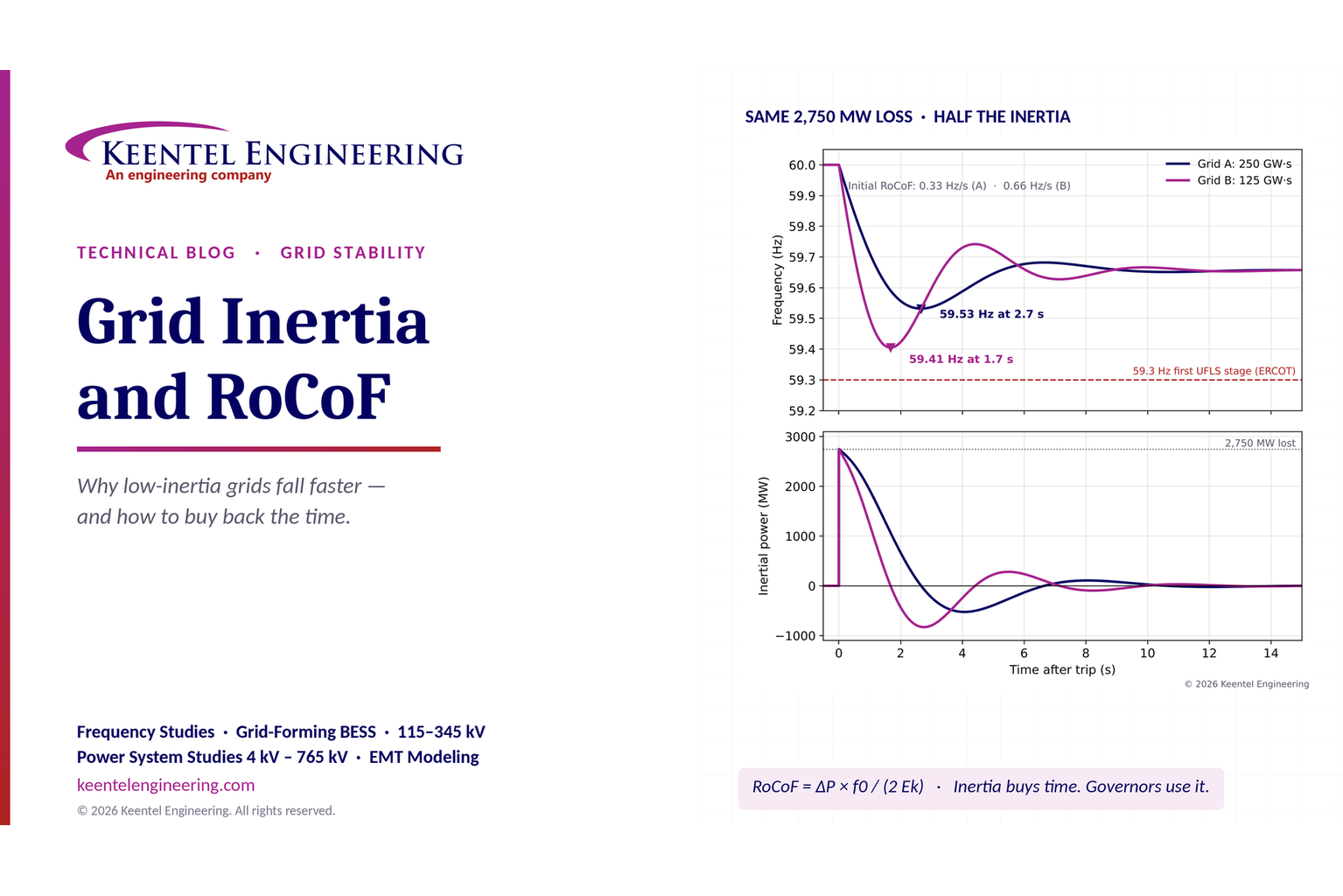
Explore grid inertia, RoCoF and frequency response, with swing equation calculations, frequency nadir analysis and US power system simulation examples.
By SANDIP R PATEL
•
October 10, 2026
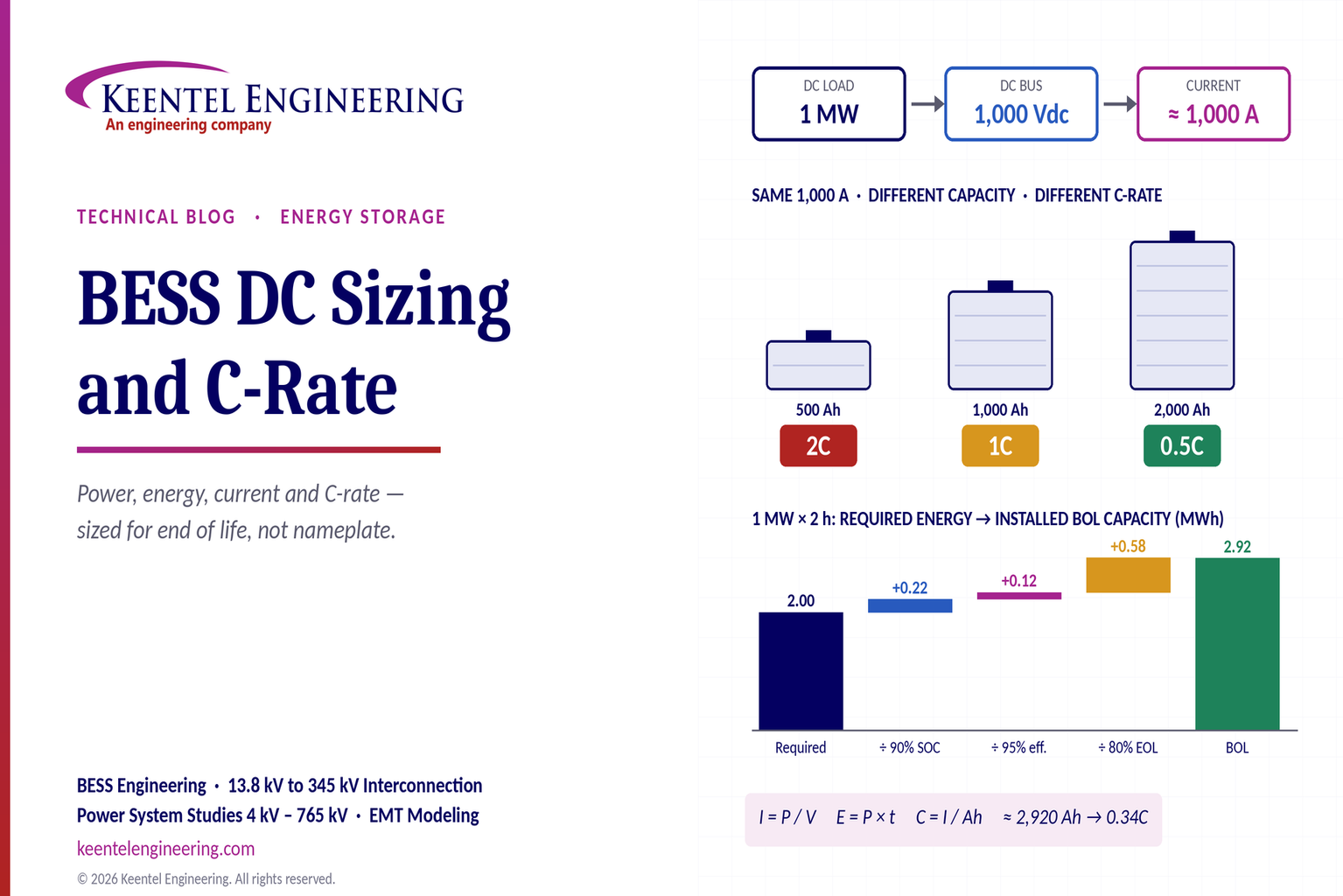
Learn BESS DC sizing with power, energy, current and C-rate calculations, battery losses, degradation and a 100 MW/400 MWh utility-scale example.
By SANDIP R PATEL
•
October 10, 2026
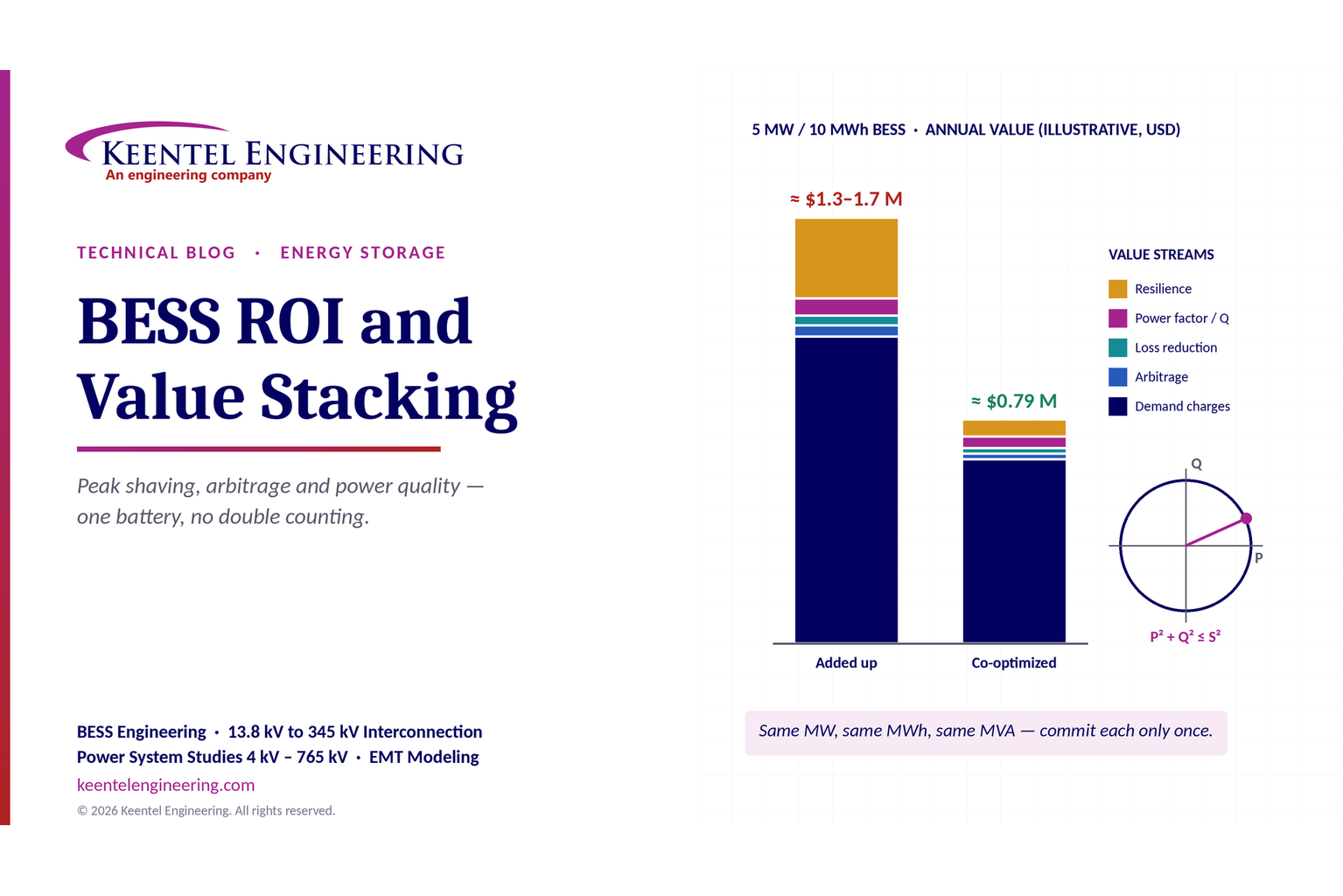
Learn how BESS ROI is calculated using peak shaving, energy arbitrage, power quality and battery storage economics, with a practical 5 MW/10 MWh example.
By SANDIP R PATEL
•
October 10, 2026
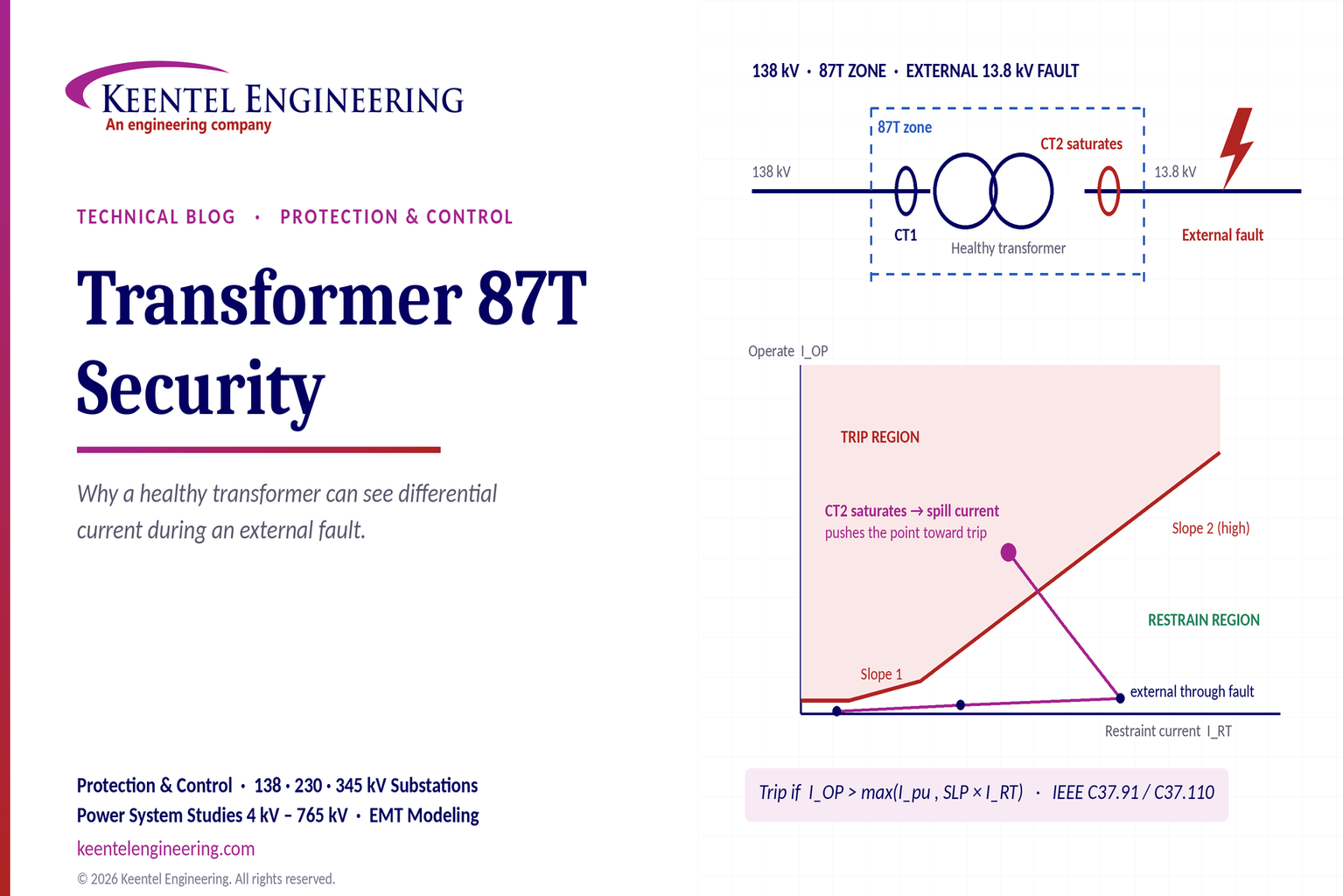
Learn why transformer differential relays detect current during external faults, how CT saturation causes spill current, and how secure 87T protection prevents trips.
By SANDIP R PATEL
•
October 10, 2026
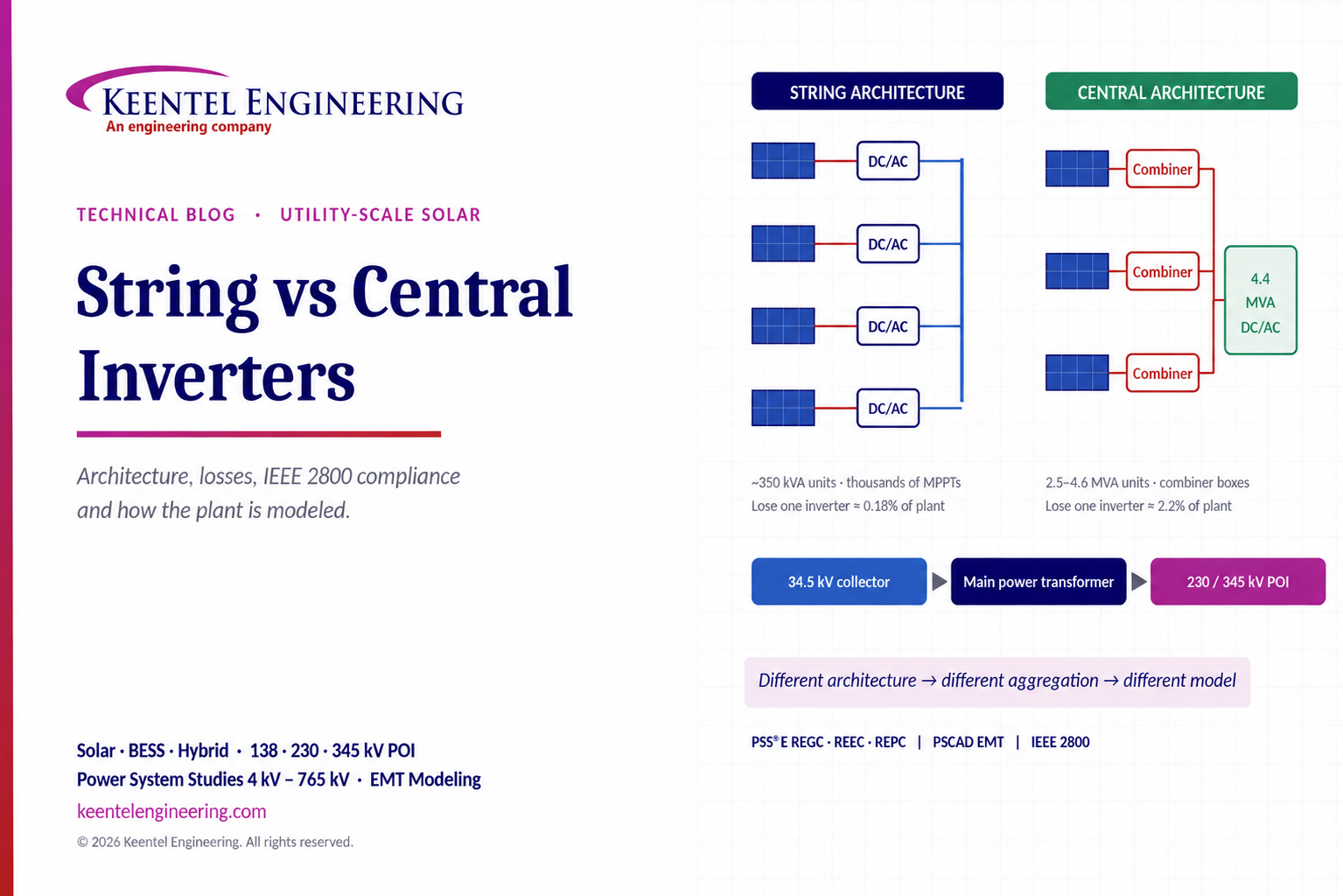
Compare string vs central inverters for utility-scale solar, including efficiency, maintenance, grid compliance, reactive power and interconnection studies.
By SANDIP R PATEL
•
October 9, 2026
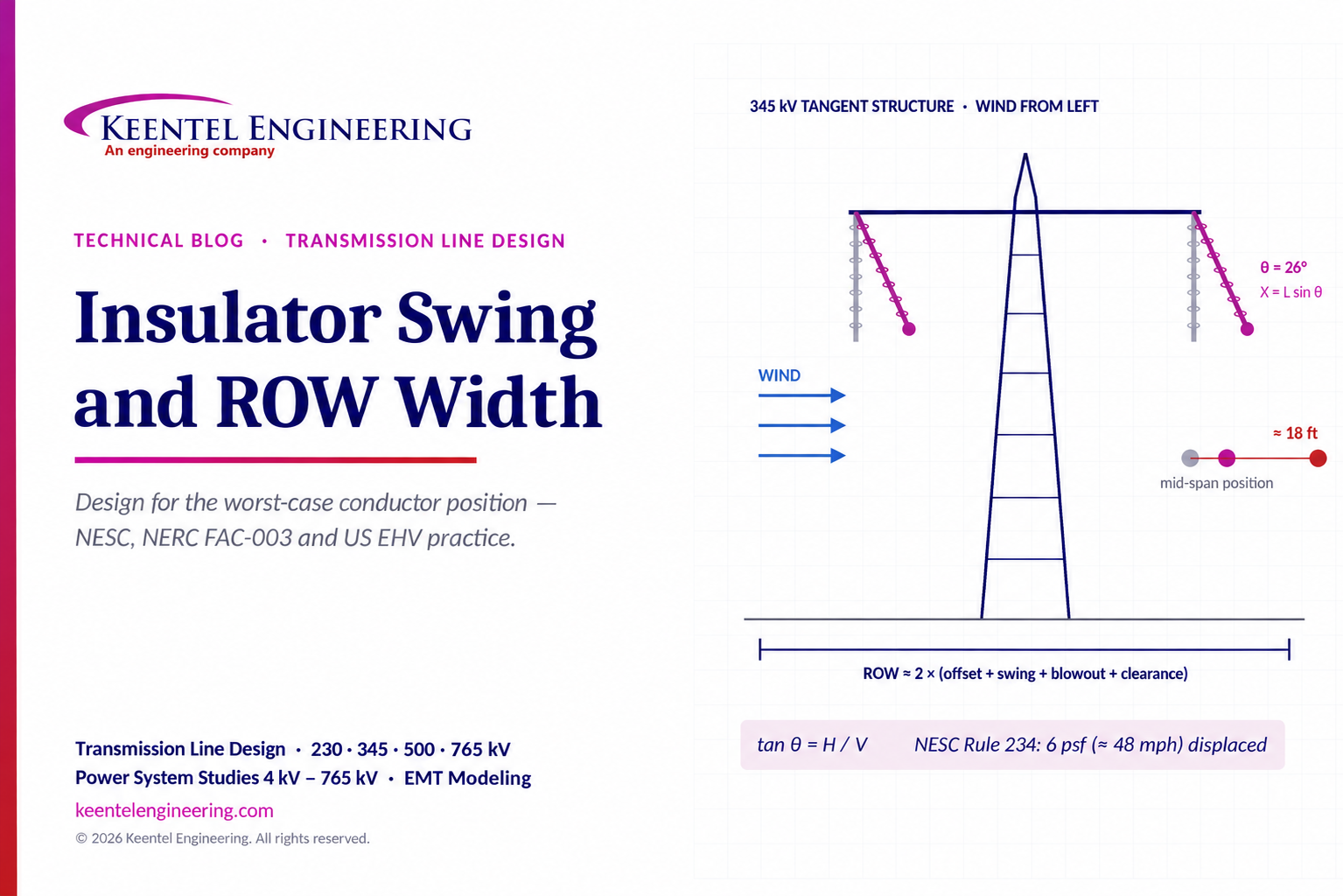
Learn how insulator swing angle and conductor blowout affect transmission line ROW width, with NESC clearances, NERC FAC-003 guidance, and a 345 kV example.
Copy
By SANDIP R PATEL
•
October 3, 2026
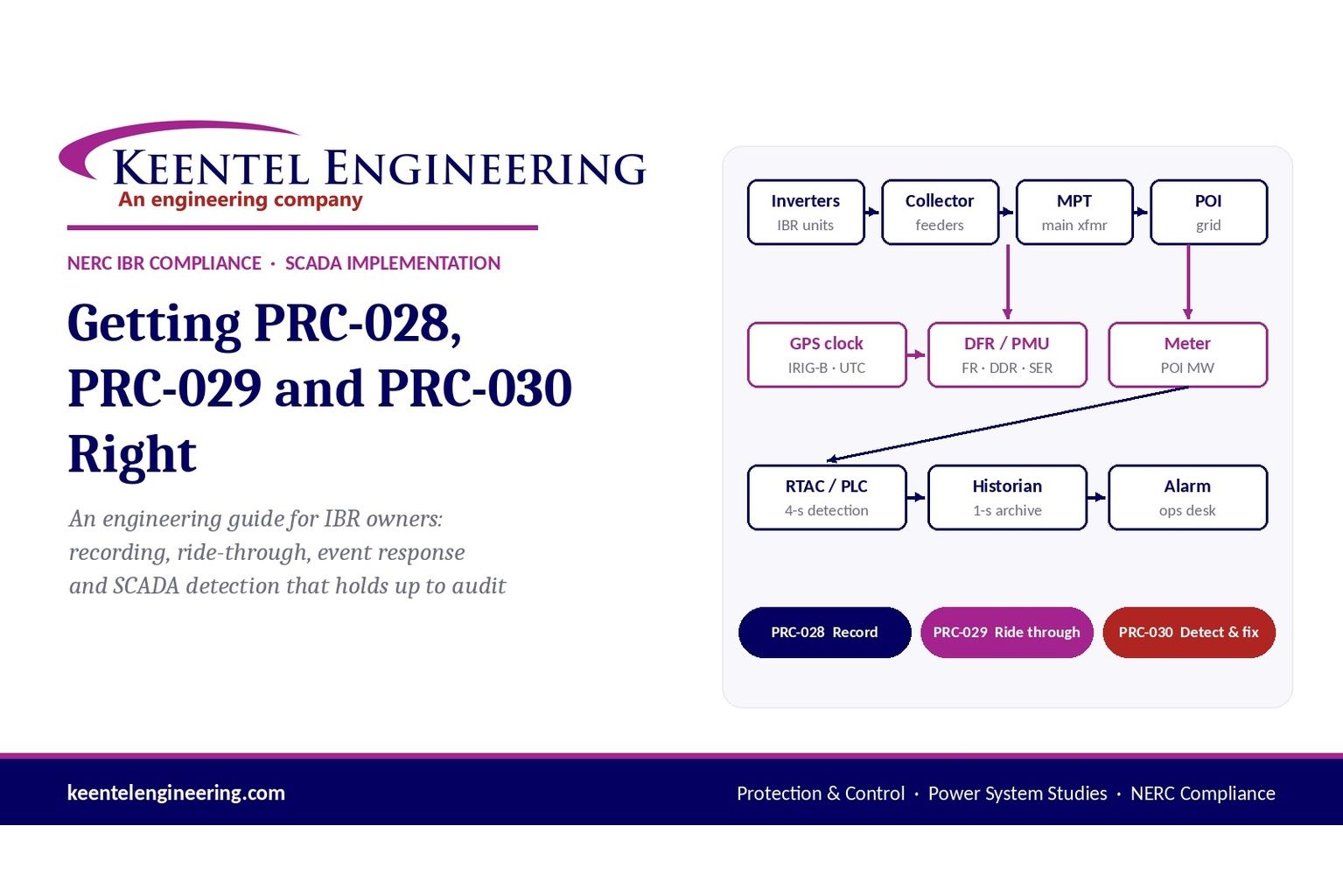
Engineering guide to PRC-028 disturbance recording, PRC-029 ride-through and PRC-030 event detection for inverter-based resources.
By SANDIP R PATEL
•
October 3, 2026
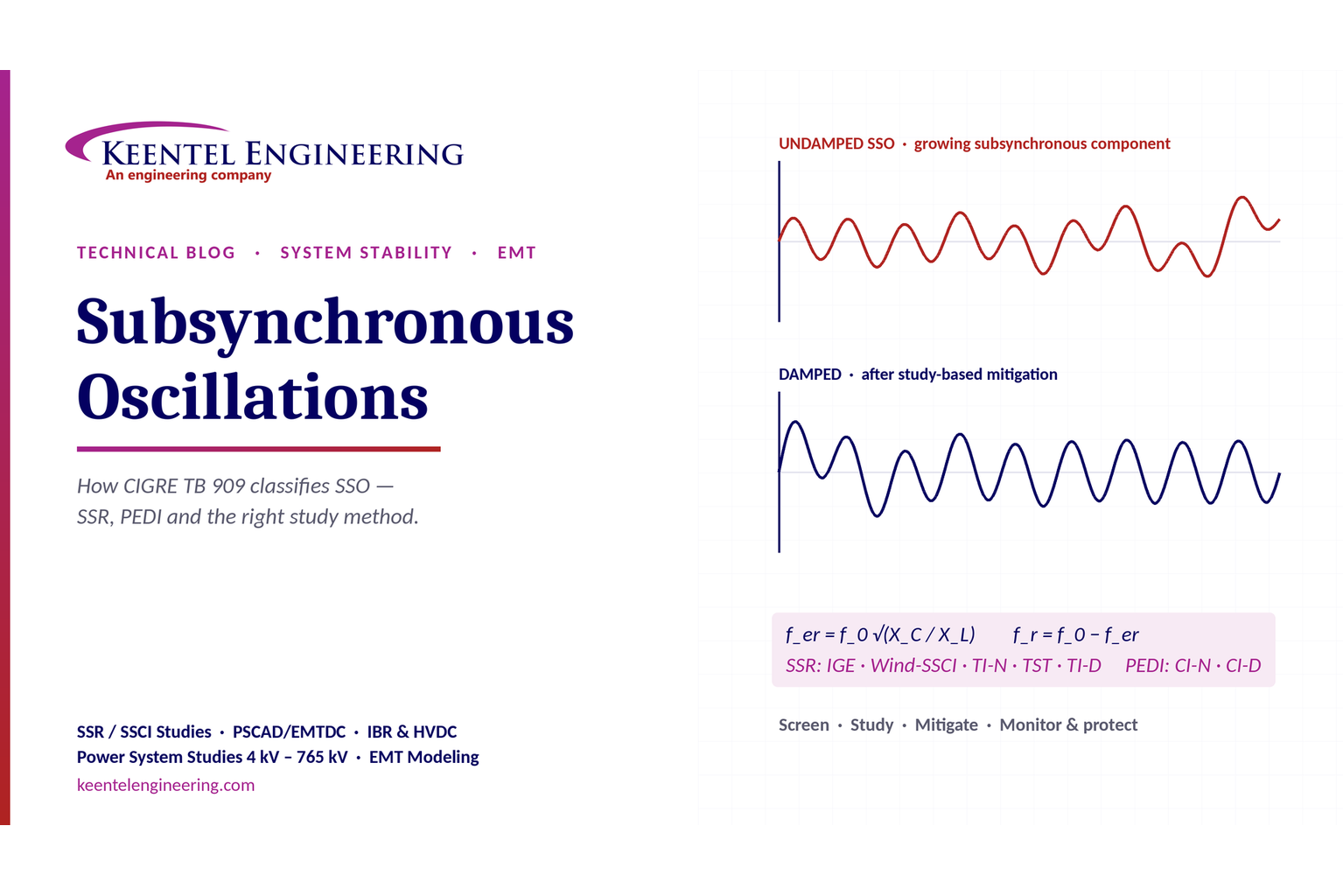
A practical guide to SSO classification, SSR, PEDI, Wind-SSCI, EMT analysis, mitigation and protection based on CIGRE TB 909.
By SANDIP R PATEL
•
October 3, 2026
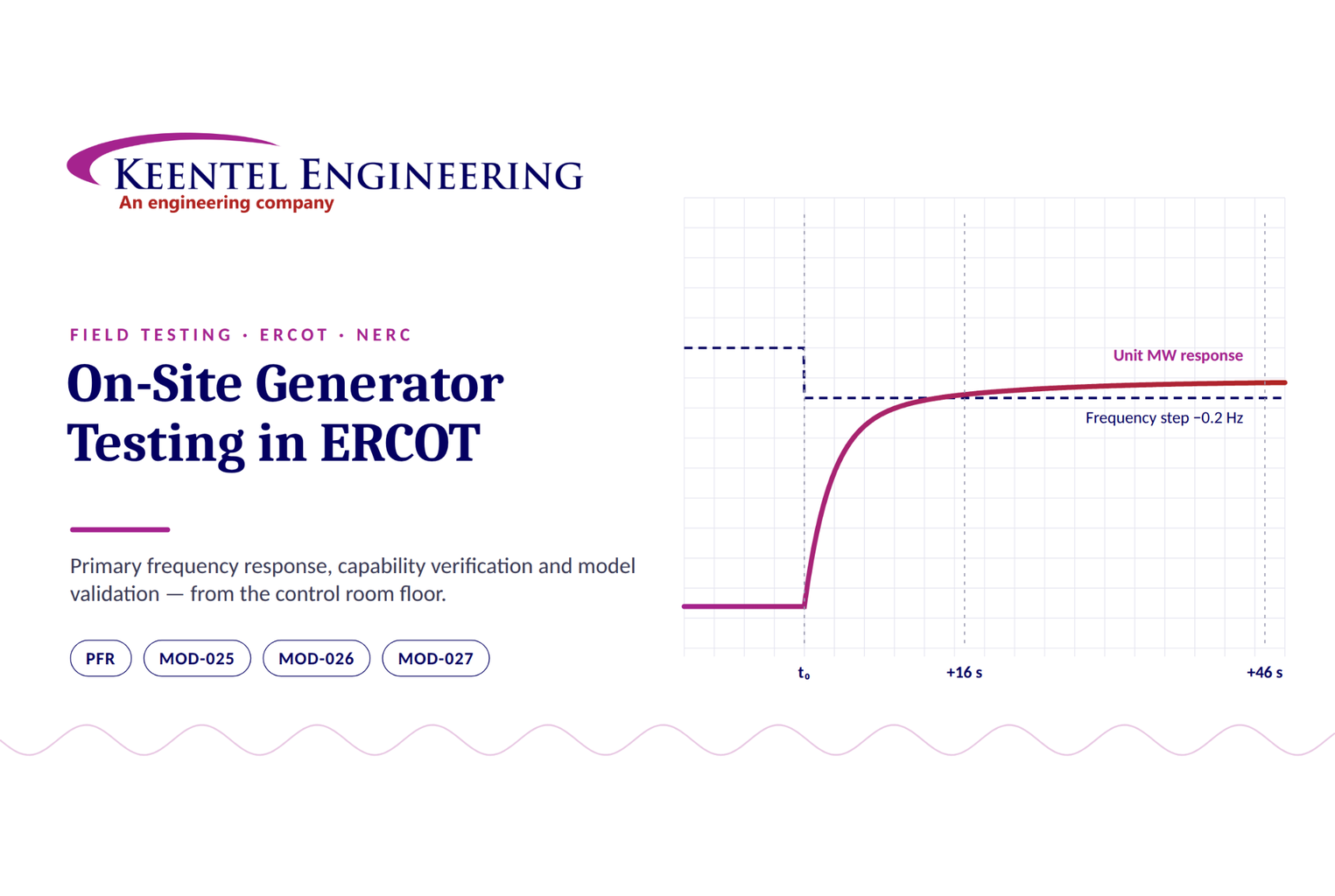
Learn ERCOT generator testing for PFR, MOD-025 and MOD-026/027, including staged tests, capability verification, dynamic models and field testing.