A Coordinated Electric System Interconnection Review—the utility’s deep-dive on technical and cost impacts of your project.
Challenge: Frequent false tripping using conventional electromechanical relays
Solution: SEL-487E integration with multi-terminal differential protection and dynamic inrush restraint
Result: 90% reduction in false trips, saving over $250,000 in downtime
The three operating regions you have to design to
| Device | Output vs voltage | Response | Best suited to | Main limitations |
|---|---|---|---|---|
| Mechanically switched capacitor or reactor | Proportional to voltage squared | Seconds; discrete steps; limited switching operations per day | Steady-state reactive supply, voltage profile, loss reduction | No dynamic capability; step voltage change on switching; capability collapses when most needed |
| Static var compensator | Capacitive branches proportional to voltage squared | A few cycles; continuously controllable | Continuous control where cost matters and deep voltage support is not the driver | Square-law capability loss; harmonic filters are part of the plant and interact with the network |
| STATCOM | Approximately proportional to voltage — constant current capability | One to two cycles closed loop; converter response faster still | Voltage stability margin, weak interconnections, fast disturbance recovery, flicker and unbalance compensation | Higher capital cost; converter losses; adds a converter and its control dynamics to the network |
| Synchronous condenser | Governed by machine capability and excitation | Excitation response in the hundreds of milliseconds; inherent inertial response instantaneous | System strength and inertia, short-circuit contribution, black start support | Rotating plant with maintenance and losses; slower controlled response than a converter |
| STATCOM with energy storage | Reactive as a STATCOM, plus real power within the storage rating | As STATCOM for reactive; real power limited by storage | Where a real power deficiency is part of the problem | Cost and complexity of the storage; different failure and maintenance profile |
A BESS in ERCOT: From RIOO to Real-Time Co-Optimization
September 5, 2026 | Blog
The Interconnection Path, the Model Package That Governs the Schedule, the Single-Model Energy Storage Resource, and the Engineering Obligations That Sit Underneath the Market Revenue
1. Executive Summary
ERCOT has more BESS capacity than any other market on the continent, and it got there because its interconnection process is structurally different from the organised markets outside Texas. There is no cluster study and no assignment of network upgrade costs to the interconnecting generator. A project pays for its own interconnection facilities, connects, and manages congestion through the nodal price. That single design choice explains most of what a developer experiences — fast queue movement, siting decisions dominated by nodal basis rather than upgrade cost, and technical review rather than cost allocation as the thing that determines schedule.
The market side changed fundamentally on December 5, 2025, when Real-Time Co-optimization plus Batteries went live. Storage stopped being modelled as two resources — a generation resource and a controllable load resource, coordinated manually — and became a single Energy Storage Resource spanning charge and discharge, with state of charge inside the dispatch engine. Energy and ancillary services now clear together every five minutes, ancillary service demand curves replaced the operating reserve demand curve, and state of charge accounting shapes both energy and ancillary awards directly. That has been operating for nine months, so the question is no longer what will change but what the settlement data shows.
Underneath both tracks sits a body of engineering obligation that most commercial coverage of ERCOT storage omits entirely. The interconnection schedule is governed by the model package — steady-state, dynamic and electromagnetic transient models with quality test results — not by the application. System strength screening determines whether an electromagnetic transient study is required. Ride-through requirements under the Nodal Operating Guide have been in force since October 2024 and are evaluated at the point of interconnection, not at the inverter terminals, with reliability assessments of exemption requests under way this year. And the reliability standard covering ride-through for inverter-based resources takes effect this month.
This paper covers both tracks and the engineering that connects them, and it corrects several items circulating in secondary summaries — including telemetry points that do not exist, a market trials programme that concluded last year being described as a current requirement, and a dispatch relaxation that is described backwards in a way that matters for asset protection.
The framing that separates the two tracks
The interconnection track is governed by models and system studies. The market track is governed by telemetry and state of charge feasibility.
They meet at one place: the plant control system, which has to satisfy the models it was studied against and respond to dispatch it did not choose. Most of the problems in this paper live at that junction.
2. What Makes ERCOT Different: Connect and Manage
ERCOT is not subject to the Federal Energy Regulatory Commission’s interconnection rules in the way the organised markets outside Texas are, and its process reflects a different philosophy.
In the cluster-study regions, projects are grouped into study cycles, network upgrades triggered by the group are identified, and the cost of those upgrades is allocated among the projects that caused them. Queue positions take years to resolve, cost allocations shift as projects withdraw, and the network upgrade assignment is frequently the item that kills a project.
ERCOT operates a connect-and-manage approach. The interconnecting entity funds the facilities required to physically connect — the interconnection facilities and any directly assigned equipment — and transmission network costs are recovered through transmission rates rather than assigned to the generator. Congestion that results is managed through nodal pricing and, where necessary, through generic transmission constraints that limit output from an area.
Three consequences follow for a storage developer:
- Speed. The absence of a cost allocation negotiation removes the single largest source of delay in the FERC-jurisdictional queues. ERCOT projects move from application to energisation on timelines that developers in other markets find implausible.
- Siting economics shift from upgrade cost to basis risk. Because the developer does not pay for network upgrades, the penalty for connecting to a congested location is not a bill — it is the nodal price at that bus and the possibility of curtailment under a transmission constraint. The analysis that matters is congestion and basis, not upgrade cost.
- Technical review becomes the gating item. With cost allocation removed, what remains on the critical path is the study process and the model package that feeds it. That is why Sections 5 and 6 matter more in ERCOT than the equivalent sections would elsewhere.
3. Two RIOO Portals, Two Different Jobs
Resource Integration and Ongoing Operations is the platform through which ERCOT manages resources across their lifecycle, and it has two faces that are frequently conflated in secondary material.
- Interconnection Services is where a project enters. Interconnection requests, project information, siting and point of interconnection data, and the interconnection study workflow live here, along with the model submittals that support the studies.
- Resource Services is where a resource lives once it is registered. Resource registration data, change requests, and ongoing data maintenance sit here — including the dedicated change request type ERCOT introduced for updating ride-through data after registration, which is the only mechanism for doing so.
The legacy spreadsheet Resource Asset Registration Form has largely been absorbed into structured data submittal within the platform. What has not changed is the substance: ERCOT still needs the same resource parameter set, and the burden of assembling accurate data has moved from filling a workbook to populating a portal with the same engineering behind it.
The practical point for a developer is that data submitted once is not finished. Ride-through capability, model parameters and resource data all have to be maintained as the project changes, and checklist milestones will not be approved where the data has not been reviewed and accepted.
4. The Interconnection Sequence
The sequence below is the shape of the process. Specific timelines and document names change, and the governing description is in the Planning Guide and the Resource Integration materials rather than in any summary.
- Screening and entry. The interconnecting entity submits the interconnection request through the portal with project information, siting data and a proposed point of interconnection. ERCOT and the transmission service provider evaluate the request and the project enters the study process.
- Initial model submittal. Steady-state and dynamic models are required early — within a defined period after the request — because the studies cannot proceed without them. This is where schedules are commonly lost, and it is discussed in Section 5.
- Steady-state studies. Thermal and voltage performance under contingency, establishing whether the point of interconnection works and what constraints result.
- Short-circuit studies. Fault current contribution and the consequences for protection and equipment duty at the interconnecting substation and nearby.
- Dynamic stability studies. System behaviour during and after disturbances, using the positive-sequence dynamic models.
- Electromagnetic transient studies where required. Triggered by system strength screening and by the character of the area — see Section 6.
- Interconnection agreement with the transmission service provider, and construction. Note that the agreement is with the transmission service provider, not with ERCOT, which is a distinction secondary summaries frequently get wrong.
- Resource registration, model finalisation and telemetry commissioning, leading to approval to energise and to participate.
Running alongside all of it is the ride-through data obligation, which attaches at multiple milestones rather than at one, and which is verified before checklist milestones are approved.
5. The Model Package Is the Long Pole
The item most likely to move a storage project’s energisation date is not the application, the land, or the equipment order. It is the
model package, and the reason is that ERCOT requires more of it than most developers expect and will not proceed without models that pass quality checks.
| Deliverable | What it is for | Where projects lose time |
|---|---|---|
| Steady-state model | Power flow representation for thermal and voltage studies, including the collector system and the interconnection facilities | Collector system representation submitted without the cable impedances and segment detail that lets it map into the network model without breaking it |
| Dynamic model | Positive-sequence representation for stability studies, in the accepted library or user-defined form | Generic library models supplied where the project has been specified with equipment whose behaviour differs; parameters that do not correspond to the deployed configuration |
| Electromagnetic transient model | Detailed converter representation for weak-grid, control interaction, ride-through and sub-synchronous assessment | Vendor model availability and licensing not secured at equipment procurement, so the model does not exist when the study needs it. This is the single most common schedule failure |
| Model quality test results | Evidence that the models behave correctly under defined disturbance tests before being accepted into the network model | Tests run late, tests that fail, or results that reveal the model does not represent the equipment as configured |
| BESS-specific data | Physical attributes of the array, duration, and the configuration of any self-limiting or coupled arrangement | Direct-current coupled and self-limiting configurations described inconsistently between the application, the model and the equipment specification |
| Ride-through capability data | Resource-specific voltage and frequency ride-through capability evaluated at the point of interconnection | Generic manufacturer statements submitted where resource-specific, plant-level data evaluated at the interconnection point is required |
The procurement clause that protects the schedule
Require the electromagnetic transient model, the positive-sequence dynamic model, their documentation, and the right to use and share them with ERCOT and the transmission service provider — in the equipment purchase specification, with delivery dates tied to milestones.
Requesting models after the order is placed puts the schedule inside a commercial negotiation the developer has already lost leverage in.
6. System Strength: WSCR and When EMT Is Required
ERCOT developed the weighted short-circuit ratio precisely because the conventional short-circuit ratio fails where inverter-based resources cluster — which describes West Texas, the Panhandle and much of the recent storage build-out.
The conventional ratio treats a plant as the only inverter-based resource at its point of interconnection. Where many resources sit electrically close, each one sees the others as part of a weakened network, and the individual ratios are optimistic. The weighted ratio aggregates the inverter-based capacity across an area against the short-circuit strength of that area, producing a metric for the group rather than the individual. ERCOT has used it to set operating limits on transmission from inverter-dominated regions, and it underlies the generic transmission constraints that curtail output from those areas.
The engineering consequence for a storage project is that its stability is a property of its neighbourhood. A favourable individual ratio does not mean the area is strong, and an area that is adequate today weakens as the queue ahead energises. Where the screening indicates low system strength, electromagnetic transient study follows — not as a formality but because positive-sequence stability tools structurally cannot represent the control interactions that occur there.
Two design responses belong in the project plan rather than in the study report. Establish the minimum system strength at which the plant is stable as a number and compare it against the worst credible condition, not the expected one. And treat control parameters as a controlled configuration item, because retuning to solve one problem changes the behaviour verified in the study and must be re-verified across the whole case set.
7. Ride-Through: NOGRR245 and the PRC Stack
Ride-through is the compliance area with the most activity and the tightest current dates, and it applies to storage in ERCOT through two overlapping frameworks.
7.1 The ERCOT Requirement
The Nodal Operating Guide revision covering inverter-based resource ride-through took effect on October 1, 2024. It replaced the older intermittent renewable resource voltage ride-through provisions with voltage and frequency ride-through requirements for inverter-based resources and for the older wind turbine types, drawn from and in places going beyond the interconnection performance standard for inverter-based resources.
Three features matter for a storage developer.
- Tiered applicability. Which requirement applies depends on when the standard generation interconnection agreement was executed and when any modification is implemented, with a preferred tier applying to agreements executed on or after August 1, 2024, and legacy provisions applying elsewhere. Projects in development now are in the preferred tier.
- Evaluated at the point of interconnection. Compliance is assessed at the interconnection point, not at the inverter terminals. Manufacturer capability documentation is an input; it is not the demonstration. Converting inverter-level capability into plant-level performance requires modelling and simulation — the collector system, the transformers and the plant controller all sit between the two.
- Maintained over the lifecycle. Ride-through data is required at multiple interconnection milestones and must be updated when performance changes, through the dedicated change request type. Milestone approvals depend on that data having been reviewed and accepted.
For resources unable to comply, an extension and exemption pathway exists under the applicable Public Utility Commission substantive rule, with supplemental data obligations that have already passed and reliability assessments of those requests under way during 2026.
7.2 The Reliability Standard
Running alongside the ERCOT requirement is the reliability standard covering frequency and voltage ride-through for inverter-based resources, which takes effect on October 1, 2026 — within weeks of this paper. Its requirements overlap the ERCOT provisions substantially but not identically, its exemption pathway is limited to documented hardware limitations rather than settings or software, and its compliance dates and enforcement posture are separate.
An ERCOT storage project therefore has two ride-through obligations with different applicability tests, different evidence, and different administering bodies. They should be tracked as one workstream with two outputs, because the underlying engineering — establishing plant-level ride-through capability at the point of interconnection by simulation — serves both.
8. The Single-Model Energy Storage Resource
Before December 2025, a BESS in ERCOT was two things. A generation resource represented discharge; a controllable load resource represented charge. They had separate telemetry, separate operating plans and separate offer structures, and keeping them consistent was manual work that produced errors.
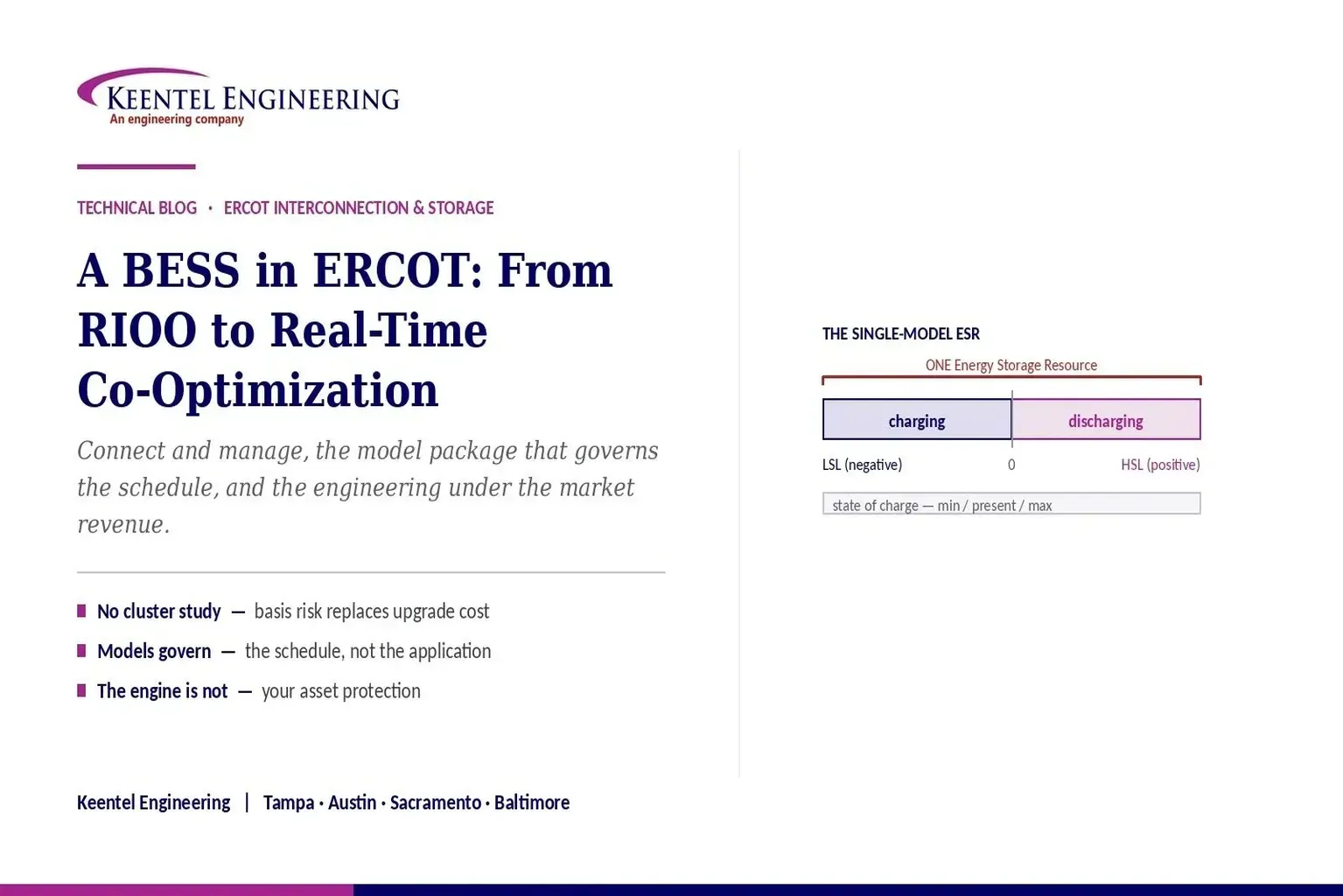
The single-model Energy Storage Resource replaced that with one device spanning the full range. The low sustained limit is negative for a resource that can charge; the high sustained limit is positive for discharge; and the resource has one set of telemetry, one operating plan, one offer curve and one settlement structure across the whole range. Every ERCOT system — the outage scheduler, the day-ahead market, the real-time market, reliability unit commitment and settlements — handles it as a single device.
State of charge moved inside the market model at the same time. Base points and ancillary service awards must be feasible against the telemetered state of charge, its minimum and maximum limits, and the duration required by the service. That is the substantive change: the engine now checks whether the BESS physically has the stored energy to do what it is being awarded, rather than assuming it does.
One modelling detail with real settlement consequence: net megawatt telemetry, when charging or at a zero base point, is not intended to include the internal losses of the battery and inverter. Getting that convention wrong at the meter and at the telemetry mapping produces a persistent discrepancy that is tedious to unwind later.
9. Telemetry: What the QSE Actually Sends
Telemetry is where the market obligation reaches into the plant, and the storage-specific point list is short enough to state precisely.
| Point | What it conveys | Why it matters |
|---|---|---|
| Resource status | The operating state of the resource, from the defined status set | Determines how the dispatch engine treats the resource and what it may be awarded |
| Net MW and net MVAr | Actual output, positive for discharge and negative for charge | The response measurement against base point. The convention excluding internal losses when charging or at zero base point matters here |
| Gross MW and gross MVAr | Output before internal consumption | Separates plant behaviour from auxiliary and loss accounting |
| High sustained limit | Maximum sustainable discharge capability | The upper bound of the dispatch and award range |
| Low sustained limit | Maximum sustainable charge capability, expressed as a negative value | The lower bound. On a single-model resource this is where the charging half of the range lives |
| State of charge in MWh | Present stored energy | The quantity the engine uses to test whether an award is physically deliverable |
| Maximum and minimum state of charge in MWh | The usable energy band the resource will operate within | Defines the feasibility envelope. These are telemetered values and therefore an operational decision, not a fixed nameplate property |
| Maximum operating discharge and charge power limits | Present power capability in each direction | Distinguishes present capability from sustained limits |
That is the storage-specific set. Points named in some circulating summaries — frequency responsive capacity high and low limits, for example — do not appear in the ERCOT storage telemetry requirements and should not be built into a specification on the strength of a secondary source.The authoritative lists are the ERCOT telemetry checklist and the protocol section on telemetry requirements.
The engineering point behind the list is that these values are produced by the plant control system and the battery management system, and their accuracy is a revenue and compliance matter rather than a monitoring nicety. A minimum state of charge telemetered conservatively protects the BESS and forgoes awards; telemetered aggressively it captures awards the plant may not be able to deliver. That trade is a control system configuration decision with commercial consequences, and it should be made deliberately.
10. State of Charge Feasibility and the Relaxation
This is the most consequential engineering detail in the whole RTC+B design, and it is described backwards in material now circulating.
The market engine tests whether a resource’s dispatch limits are compatible with its state of charge limits. Two infeasible situations can arise. A positive low sustained limit forces the resource to discharge, and if discharging at that floor would take it below its minimum state of charge, the requirement conflicts. A negative high sustained limit forces charging, and if charging at that ceiling would take it above its maximum state of charge, the same conflict arises in the other direction.
The engine does not fail. It relaxes. In the documented handling, the response is to adjust the dispatch limit — setting the offending sustained limit to zero — so that a feasible solution exists and the resource is not forced past its own energy bounds. The relaxation is applied to the limit that created the conflict, which is a materially different thing from abandoning the state of charge constraint and dispatching the BESS through it.
That distinction matters because it determines what the plant has to defend against. But the underlying engineering conclusion survives either reading and is worth stating plainly.
The conclusion for the plant control system
The market engine solves an optimisation using telemetered values. It is not the asset’s protection.
The plant controller and battery management system must be able to clamp or refuse a base point that would take the BESS outside its safe operating envelope — and the consequences of doing so, in deployment performance, in ancillary service qualification and in settlement, must be engineered and understood in advance rather than discovered during an event.
Where a resource is repeatedly hitting these boundaries, that is a design finding rather than an operating nuisance: the telemetered state of charge band, the duration, the ancillary service portfolio and the dispatch strategy are not consistent with each other.
11. Ancillary Services, Duration, and Qualification
Co-optimisation changed how ancillary services are procured, and duration is what determines whether a BESS can actually offer them.
- Ancillary services now clear in the real-time market alongside energy every five minutes, rather than being procured in the day-ahead market and largely left alone. Ancillary service demand curves replaced the operating reserve demand curve mechanism, and they are price-responsive and integrated into the co-optimisation directly.
- Day-ahead positions are financial. Physical dispatch is determined in real time, which changes what a day-ahead award means and how a portfolio should be constructed.
- Awards must be duration-feasible. The engine tests whether the resource has the stored energy to sustain the service for the required period. A BESS with capacity but insufficient duration for a service simply will not receive the award, which is the mechanism behind the shift in value toward longer-duration systems.
- Responsive reserve provision from storage carries a limit expressed as a proportion of the resource’s operating range, which constrains how much of the range can be committed to that service.
Qualification for each service is a separate matter from being able to offer it. Where a summary asserts that automatic qualifications were eliminated for particular services under the new design, that should be checked against the protocols before it is relied on commercially — the direction is plausible and the specifics govern.
12. What Changed Commercially
Nine months of operation under the new design have produced enough data to say something about behaviour, though a Keentel paper is careful about how far it goes on market outcomes.
Structurally, the change gives a BESS more freedom to move between energy and ancillary positions within the operating hour, because the two clear together rather than being locked by a day-ahead ancillary award. It also removes the manual coordination overhead of the two-model structure. Both are genuine improvements in flexibility.
Against that, complexity rose. Offer curves must be maintained for a resource whose feasible operating range depends on a state of charge that changes every interval, which raises the bar on automated bidding and on the quality of the telemetry feeding it. Small telemetry errors propagate into awards that cannot be delivered, and deliverability affects both settlement and standing.
On value, the widely observed pattern is a shift in the premium toward longer duration — driven by the duration feasibility test above, by ancillary service saturation as the storage fleet has grown, and by the arbitrage opportunity in the afternoon and evening ramp. Specific revenue figures move quickly and belong in a market analyst’s report rather than an engineering paper; the engineering observation is that duration, state of charge management and telemetry quality have become the technical determinants of commercial performance.
13. Registration and the Compliance Stack
A storage project in ERCOT sits inside a compliance framework that operates independently of the market rules and is frequently underestimated at development stage.
- Reliability registration. An inverter-based resource meeting the applicable capacity and voltage thresholds is registered and becomes subject to the reliability standards directly, with the associated obligations and evidence requirements.
- Ride-through. Both the ERCOT provisions and the reliability standard, as set out in Section 7, with the latter taking effect this month.
- Disturbance monitoring. Recording obligations for inverter-based resources, which also supply the evidence by which ride-through performance is demonstrated.
- Model verification and validation. Obligations to provide and verify models, which is the same model package the interconnection process required — and which must be updated when settings change, including the control parameter changes that weak-grid mitigation produces.
- Protection and control. Coordination, relay loadability, and the protection system maintenance obligations, within which the station direct-current supply is a protection system component.
- Post-disturbance performance analysis, where the resource participates in an event.
The practical instruction is that the evidence for all of this is generated during design and commissioning. Building it then is straightforward. Reconstructing it for an audit two years later, from a project team that has demobilised, is not.
14. Corrections to Material in Circulation
Storage in ERCOT attracts a large volume of secondary summaries, and several errors recur. They are worth naming because each one, acted on, costs something.
The market trials programme is over
Descriptions of application interface validation, fifteen-minute telemetry checkouts and closed-loop trials describe the 2025 transition programme that preceded go-live. That programme concluded. A resource entering ERCOT now follows the standing onboarding and qualification path, not the transition sequence, and presenting the latter as a current requirement misleads on both scope and schedule.
Some telemetry points do not exist
Frequency responsive capacity high and low limits appear in circulating summaries and are not in the ERCOT storage telemetry requirements. The actual storage-specific set is in Section 9. Building a control system specification around invented points is an expensive way to discover a source was unreliable.
The dispatch relaxation is described backwards
The documented handling adjusts the dispatch limit that created the infeasibility rather than abandoning the state of charge constraint. The difference matters when reasoning about what the plant must protect itself against, though the design conclusion in Section 10 holds either way.
The interconnection agreement is with the transmission service provider
Not with ERCOT. ERCOT administers the study process and the resource registration; the agreement is executed with the transmission service provider. Summaries that place the agreement with ERCOT also tend to sequence the model submittals incorrectly, placing them after execution when they are required to support the studies that precede it.
Terminology drifts
Acronym expansions vary between secondary sources, sometimes within the same document. Where a term is going into a specification, a contract or a filing, take the expansion from ERCOT’s own materials rather than from a summary.
Network upgrade cost allocation is not an ERCOT concept in the FERC sense
Applying the cluster-study mental model to ERCOT produces the wrong development strategy. The relevant risk is nodal basis and curtailment exposure, not an upgrade assignment.
15. Keentel ERCOT Storage Services
Keentel Engineering works on both sides of the boundary described in this paper — the studies and models that get a project through interconnection, and the plant engineering that determines whether it performs afterwards.
15.1 Interconnection and Studies
- Interconnection application support, study-phase technical packages, and coordination with ERCOT and the transmission service provider through the study sequence.
- Steady-state, dynamic and electromagnetic transient model development, collector system model preparation, model quality testing, and submittal packages in the required formats.
- System strength screening and weak-grid electromagnetic transient studies, including control interaction, ride-through verification and the determination of the minimum system strength for stable operation.
- Short-circuit, protective coordination, arc-flash, harmonic and reactive capability studies, with inverter-based resources represented as current-limited sources.
- Effective grounding and ground fault overvoltage assessment, and transformer connection, grounding and zero-sequence impedance specification.
15.2 Ride-Through and Reliability Compliance
- Plant-level ride-through capability assessment at the point of interconnection by simulation, converting inverter capability into the demonstration ERCOT and the reliability standard both require.
- Ride-through data preparation, capability reporting, model updates through the appropriate change request, and support for extension and exemption submissions.
- Reliability standard compliance support across ride-through, disturbance monitoring, model verification, protection coordination and maintenance obligations, with the evidence structured during design and commissioning.
- Registration applicability assessment against the capacity and voltage thresholds.
15.3 Plant Design and Controls
- Substation, collector system and point-of-interconnection design, auxiliary power and station service, grounding and lightning protection, and protection and control design.
- Plant controller and telemetry architecture, including the state of charge band, limit reporting and base point handling logic described in Section 10, with the commercial consequences of each configuration made explicit.
- Battery and power conversion system specification review, including model deliverable and usage-rights requirements written into procurement.
- Owner’s engineer services, EPC and vendor submittal review, and QA/QC of third-party study and model packages.
15.4 Commissioning and Performance
- Commissioning specification and test procedures including capacity and round-trip efficiency testing at the contract measurement point, telemetry verification, and control coordination checks.
- Model verification against staged test data and disturbance records, and cross-validation between positive-sequence and electromagnetic transient models.
- Performance investigation where a resource is underperforming, oscillating, failing deliverability, or repeatedly hitting state of charge boundaries.
Keentel Engineering holds a Florida Certificate of Authorization and maintains offices in Tampa, Austin, Sacramento, and Baltimore, supporting projects across the interconnections.
16. Frequently Asked Questions
Q1. Why does ERCOT interconnect projects so much faster than other markets?
Because it operates a connect-and-manage approach rather than a cluster study with network upgrade cost allocation. The developer funds the facilities needed to physically connect; transmission network costs are recovered through transmission rates rather than assigned to the generator. Removing the cost allocation negotiation removes the largest source of delay elsewhere.
Q2. So there is no cost risk from connecting to a congested location?
There is, but it takes a different form. Instead of an upgrade bill, the exposure is the nodal price at that bus and the possibility of curtailment under a transmission constraint. The siting analysis that matters is congestion and basis risk, not upgrade cost.
Q3. What is the difference between the two RIOO environments?
Interconnection Services handles projects entering the system — interconnection requests, siting, point of interconnection, study workflow and supporting models. Resource Services handles registered resources — registration data, change requests and ongoing maintenance, including the dedicated change request type for updating ride-through data after registration.
Q4. Is the RARF gone?
The legacy spreadsheet has largely been absorbed into structured submittal within the platform. The substance has not changed — ERCOT needs the same resource parameter set, and the engineering behind assembling it is the same. Only the delivery mechanism moved.
Q5. What actually determines the interconnection schedule?
The model package. Steady-state, dynamic and electromagnetic transient models with quality test results are what the studies need, and the studies cannot proceed without them. Land, equipment orders and applications rarely govern; models frequently do.
Q6. What is the single most common schedule failure?
Electromagnetic transient model availability. The vendor model and the right to use and share it were not secured at equipment procurement, so the model does not exist when the study needs it. Requesting it afterwards puts the schedule inside a negotiation the developer has already lost leverage in.
Q7. Who is the interconnection agreement with?
The transmission service provider, not ERCOT. ERCOT administers the study process and resource registration. Summaries that place the agreement with ERCOT also tend to sequence model submittals incorrectly, putting them after execution when they are needed to support the preceding studies.
Q8. What is the weighted short-circuit ratio and why did ERCOT develop it?
Because the conventional short-circuit ratio treats a plant as the only inverter-based resource at its point of interconnection, which is false where resources cluster. The weighted ratio aggregates inverter-based capacity across an area against the short-circuit strength of that area, producing a metric for the group. ERCOT has used it to set operating limits on transmission from inverter-dominated regions.
Q9. When is an EMT study required?
When the system strength conditions warrant it. Where screening indicates a weak or inverter-dominated area, electromagnetic transient study follows — because positive-sequence stability tools structurally cannot represent the converter control interactions that occur at low system strength.
Q10. Can system strength at my point of interconnection get worse after I connect?
Routinely. Contingencies raise the network impedance; every additional inverter-based resource in the area reduces the strength available to the others; and synchronous generation that provides strength is being displaced. A project studied as adequate can become marginal without any change on its own side.
Q11. What is NOGRR245 and when did it take effect?
The Nodal Operating Guide revision replacing the older intermittent renewable voltage ride-through provisions with voltage and frequency ride-through requirements for inverter-based resources and the older wind turbine types, drawn from and in places exceeding the interconnection performance standard for inverter-based resources. It took effect October 1, 2024.
Q12. Where is ride-through compliance evaluated?
At the point of interconnection, not at the inverter terminals. Manufacturer capability documentation is an input, not the demonstration. Converting inverter-level capability into plant-level performance requires simulation, because the collector system, the transformers and the plant controller all sit between the inverter and the interconnection point.
Q13. Which ride-through tier applies to my project?
It depends on when the standard generation interconnection agreement was executed and when any modification is implemented, with a preferred tier applying to agreements executed on or after August 1, 2024 and legacy provisions applying elsewhere. Projects in development now fall in the preferred tier.
Q14. Is ride-through data a one-time submittal?
No. It is required at multiple interconnection milestones and must be updated when performance changes, through the dedicated change request type. Milestone approvals depend on the data having been reviewed and accepted, so treating it as a single filing stalls the project later.
Q15. How does the reliability standard interact with the ERCOT requirement?
They overlap substantially but not identically, with different applicability tests, different evidence and different administering bodies — and the reliability standard covering ride-through for inverter-based resources takes effect October 1, 2026. Track them as one workstream with two outputs, because the underlying engineering serves both.
Q16. What changed with the single-model ESR?
Before December 2025 a BESS was two resources — a generation resource for discharge and a controllable load resource for charge — with separate telemetry, operating plans and offers, coordinated manually. Now it is one device spanning the range, with a negative low sustained limit for charging and a positive high sustained limit for discharging, one telemetry set, one offer curve and one settlement structure.
Q17. What does state of charge in the market model actually do?
It makes awards conditional on physical deliverability. Base points and ancillary service awards must be feasible against the telemetered state of charge, its minimum and maximum limits, and the duration the service requires. The engine now checks whether the BESS has the stored energy to do what it is being awarded.
Q18. What are the storage-specific telemetry points?
Resource status; net and gross MW and MVAr with positive for discharge and negative for charge; high and low sustained limits; state of charge in MWh; maximum and minimum state of charge in MWh; and maximum operating discharge and charge power limits. Points named in some circulating summaries, such as frequency responsive capacity limits, are not part of this set.
Q19. Is there a telemetry convention that catches people out?
Yes. Net MW telemetry, when charging or at a zero base point, is not intended to include the internal losses of the battery and inverter. Getting that convention wrong at the meter or in the telemetry mapping produces a persistent discrepancy that is tedious to unwind after the fact.
Q20. What happens when dispatch limits conflict with state of charge limits?
The engine relaxes rather than failing. In the documented handling it adjusts the dispatch limit that created the infeasibility — setting the offending sustained limit to zero — so a feasible solution exists. That is different from abandoning the state of charge constraint, and the distinction matters when reasoning about what the plant must protect itself against.
Q21. What is the design conclusion from that?
That the market engine solves an optimisation using telemetered values and is not the asset’s protection. The plant controller and battery management system must be able to clamp or refuse a base point that would take the BESS outside its safe envelope, and the consequences of doing so — in deployment performance, ancillary service standing and settlement — must be engineered in advance rather than discovered.
Q22. Why has duration become more valuable?
Partly the duration feasibility test — a BESS without the stored energy to sustain a service simply does not receive the award. Partly ancillary service saturation as the storage fleet has grown. And partly the arbitrage opportunity across the afternoon and evening ramp. The engineering observation is that duration, state of charge management and telemetry quality are now the technical determinants of commercial performance.
Q23. Are the RTC+B market trials still a requirement?
No. Application interface validation, fifteen-minute telemetry checkouts and closed-loop trials were part of the 2025 transition programme that preceded go-live, and that programme concluded. A resource entering now follows the standing onboarding and qualification path.
Q24. What compliance obligations does a storage project carry beyond the market rules?
Reliability registration where the capacity and voltage thresholds are met; ride-through under both frameworks; disturbance monitoring; model provision and verification, which must be updated when control settings change; protection coordination, relay loadability and protection system maintenance including the station direct-current supply; and post-disturbance performance analysis.
Q25. What is the single most useful thing to do differently?
Put the model deliverables and their usage rights into the equipment purchase specification, with delivery dates tied to project milestones. The models govern the interconnection schedule, they are required again for reliability compliance, and they must be updated whenever control parameters change. Securing them at procurement is cheap; chasing them afterwards is the most reliable way to lose a quarter.
References and Further Reading
The following are the primary sources for this paper. ERCOT market rules, protocols and guides are revised continuously; the current published version governs, and any project decision should be taken against it rather than against this or any other summary.
ERCOT Market Rules and Process
- ERCOT Planning Guide and Nodal Protocols — including the interconnection process, model submittal requirements and the telemetry requirements section — Electric Reliability Council of Texas
- ERCOT Nodal Operating Guide, including the inverter-based resource ride-through provisions, and the NOGRR245 issue record and associated market notices — Electric Reliability Council of Texas
- ERCOT Resource Integration and Ongoing Operations — Interconnection Services and Resource Services, and the associated resource integration guidance and checklists — Electric Reliability Council of Texas
Real-Time Co-Optimization Plus Batteries
- ERCOT news release, Goes Live with Real-Time Co-optimization Plus Batteries, December 5, 2025, and the associated market notice confirming implementation for that operating day — Electric Reliability Council of Texas
- ERCOT RTC+B Battery Overview, covering the single-model Energy Storage Resource, telemetry point set and the transition from the combo model — Electric Reliability Council of Texas
- ERCOT Energy Storage Resources operational requirements training material, covering telemetry, award constraints and state of charge feasibility — Electric Reliability Council of Texas
- ERCOT Security-Constrained Unit Commitment documentation covering explicit state of charge consideration and the handling of infeasible dispatch limit and state of charge combinations — Electric Reliability Council of Texas
System Strength, Ride-Through and Reliability Standards
- NERC Reliability Guideline, Integrating Inverter-Based Resources into Low Short Circuit Strength Systems, covering short-circuit ratio metrics including the weighted short-circuit ratio developed in Texas — North American Electric Reliability Corporation
- NERC Reliability Guideline on electromagnetic transient modelling and simulations for bulk power system connected inverter-based resources — North American Electric Reliability Corporation
- NERC Reliability Standards — including PRC-029-1 for frequency and voltage ride-through for inverter-based resources, PRC-028-1 for disturbance monitoring, the MOD series for modelling and model verification, and the PRC series for protection coordination and maintenance — North American Electric Reliability Corporation
- IEEE Std 2800, Standard for Interconnection and Interoperability of Inverter-Based Resources Interconnecting with Associated Transmission Electric Power Systems — IEEE Standards Association
Public Utility Commission of Texas Substantive Rule governing the exemption process for ERCOT reliability requirements — Public Utility Commission of Texas
Notice and Disclaimer
This document is original technical content prepared by Keentel Engineering LLC for general professional information. It is not legal, regulatory, market or project-specific engineering advice, and it does not constitute a study, a design, a filing recommendation, or a compliance determination for any project. ERCOT market rules, protocols, guides and processes are revised continuously and the current published versions govern.
Descriptions of process steps, requirements, telemetry points and dates are summaries current to the date of publication to the best of our knowledge, prepared from ERCOT published materials and applicable reliability standards. They are provided for orientation and must be verified against the governing documents and with ERCOT, the transmission service provider and the applicable regulator before any project decision. Where this document identifies errors in material circulating elsewhere, that identification is our engineering assessment and is likewise subject to verification against the source rules.
Commercial and market observations in this document are general engineering discussion and are not investment, trading or revenue advice. Market outcomes depend on conditions outside the scope of this paper.
Keentel Engineering LLC is an independent engineering consultancy. Reference to any market operator, regulator, standard, industry organisation, or equipment category in this document does not imply affiliation with, endorsement by, or sponsorship from any such organisation.

About the Author:
Sandip "Sonny" R. Patel, P.E.
IEEE Senior Member · Founder & CEO, Keentel Engineering
In 1995, Sonny Patel earned his Electrical Engineering degree from the University of Illinois. But degrees don't build legacies — action does.
For three decades, he has worked the power industry from every side of the table: 16 years as a utility engineer at Exelon/Commonwealth Edison; generation leadership across hydroelectric, industrial steam turbine, and a 9 GW renewable fleet; NERC Regional Entity Senior Compliance Engineer and Audit Team Lead, auditing some of the nation's largest utilities; and testing and commissioning lead on equipment up to 765 kV — the very top of the North American grid.Utility. Generator. Regulator. Consultant. Few engineers have seen all four seats. Fewer still have sat in them.
His experience spans nuclear, hydro, conventional generation, renewables, oil and gas, mining — and today's data centers, where he is authoring a three-book series on data center design. He is a Licensed Professional Engineer in six states and a Licensed Electrical Contractor in Florida (Unlimited EC) — he doesn't just design the work; he's qualified to stand behind its execution.Today, as Founder and CEO of Keentel Engineering, Sonny leads a nationwide team of engineers delivering substation design, power system studies, NERC compliance, and commissioning — done right, coast to coast.Three decades. Every side of the table. One standard: accountable engineering.
Services

Let's Discuss Your Project
Let's book a call to discuss your electrical engineering project that we can help you with.
About the Author:
Sandip "Sonny" R. Patel, P.E.
IEEE Senior Member · Founder & CEO, Keentel Engineering
In 1995, Sonny Patel earned his Electrical Engineering degree from the University of Illinois. But degrees don't build legacies — action does.
For three decades, he has worked the power industry from every side of the table: 16 years as a utility engineer at Exelon/Commonwealth Edison; generation leadership across hydroelectric, industrial steam turbine, and a 9 GW renewable fleet; NERC Regional Entity Senior Compliance Engineer and Audit Team Lead, auditing some of the nation's largest utilities; and testing and commissioning lead on equipment up to 765 kV — the very top of the North American grid.
Utility. Generator. Regulator. Consultant. Few engineers have seen all four seats. Fewer still have sat in them.
His experience spans nuclear, hydro, conventional generation, renewables, oil and gas, mining — and today's data centers, where he is authoring a three-book series on data center design. He is a Licensed Professional Engineer in six states and a Licensed Electrical Contractor in Florida (Unlimited EC) — he doesn't just design the work; he's qualified to stand behind its execution.
Today, as Founder and CEO of Keentel Engineering, Sonny leads a nationwide team of engineers delivering substation design, power system studies, NERC compliance, and commissioning — done right, coast to coast.Three decades. Every side of the table. One standard: accountable engineering.
Leave a Comment
Thank you for contacting us.
We will get back to you as soon as possible.
We will get back to you as soon as possible.
Oops, there was an error sending your message.
Please try again later.
Please try again later.
Related Posts
By Team 2 Dexora
•
October 20, 2026
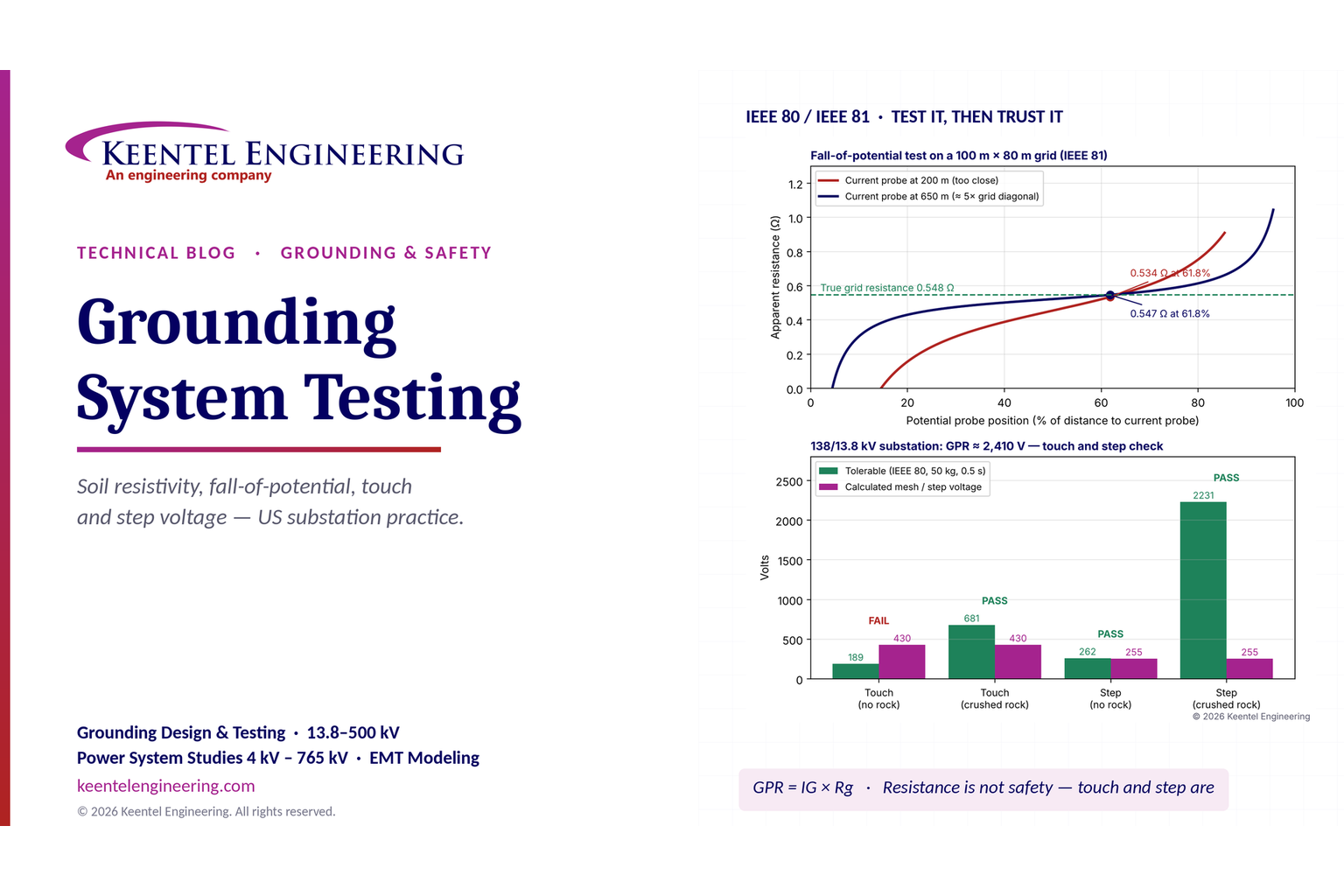
Explore grounding system testing with Keentel Engineering. Learn IEEE 80/81 methods, soil resistivity, ground resistance, and touch and step voltage safety.
By SANDIP R PATEL
•
October 13, 2026
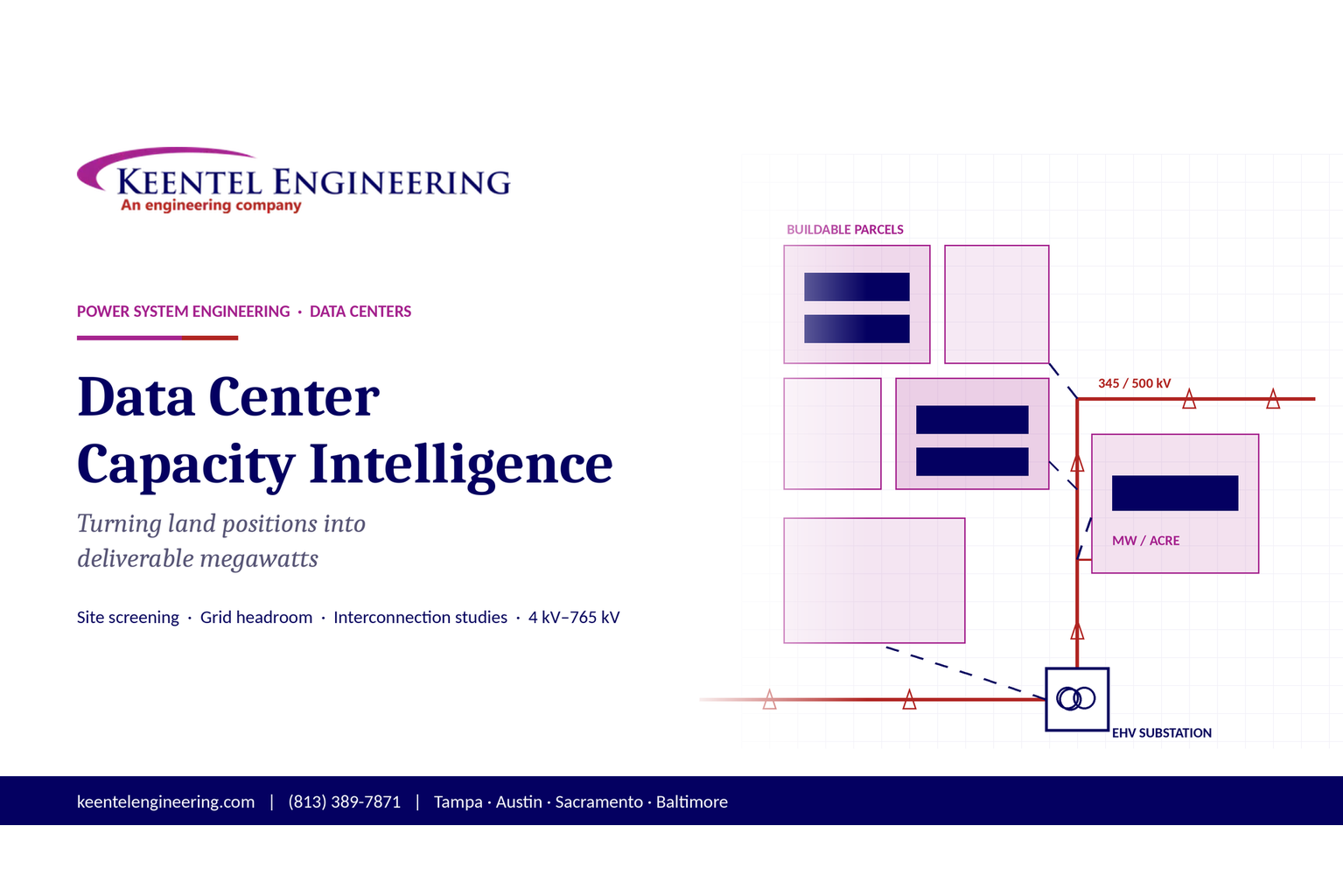
Plan data center capacity with land screening, MW-per-acre estimates, grid power availability and interconnection feasibility studies from Keentel Engineering.
By SANDIP R PATEL
•
October 11, 2026
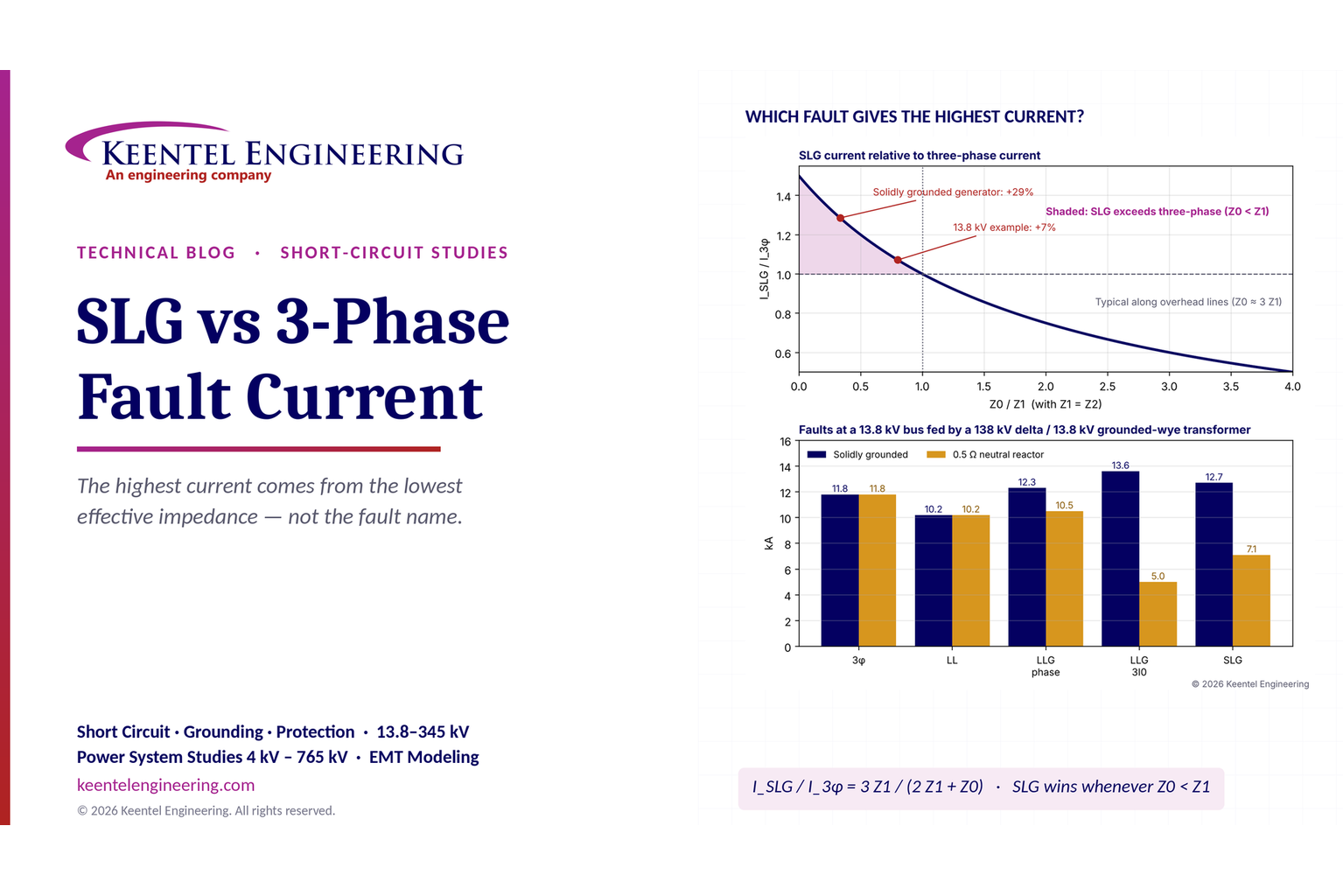
Learn which fault produces the highest current at a bus, why SLG faults can exceed three-phase faults, and how symmetrical components determine fault duty.
By SANDIP R PATEL
•
October 11, 2026
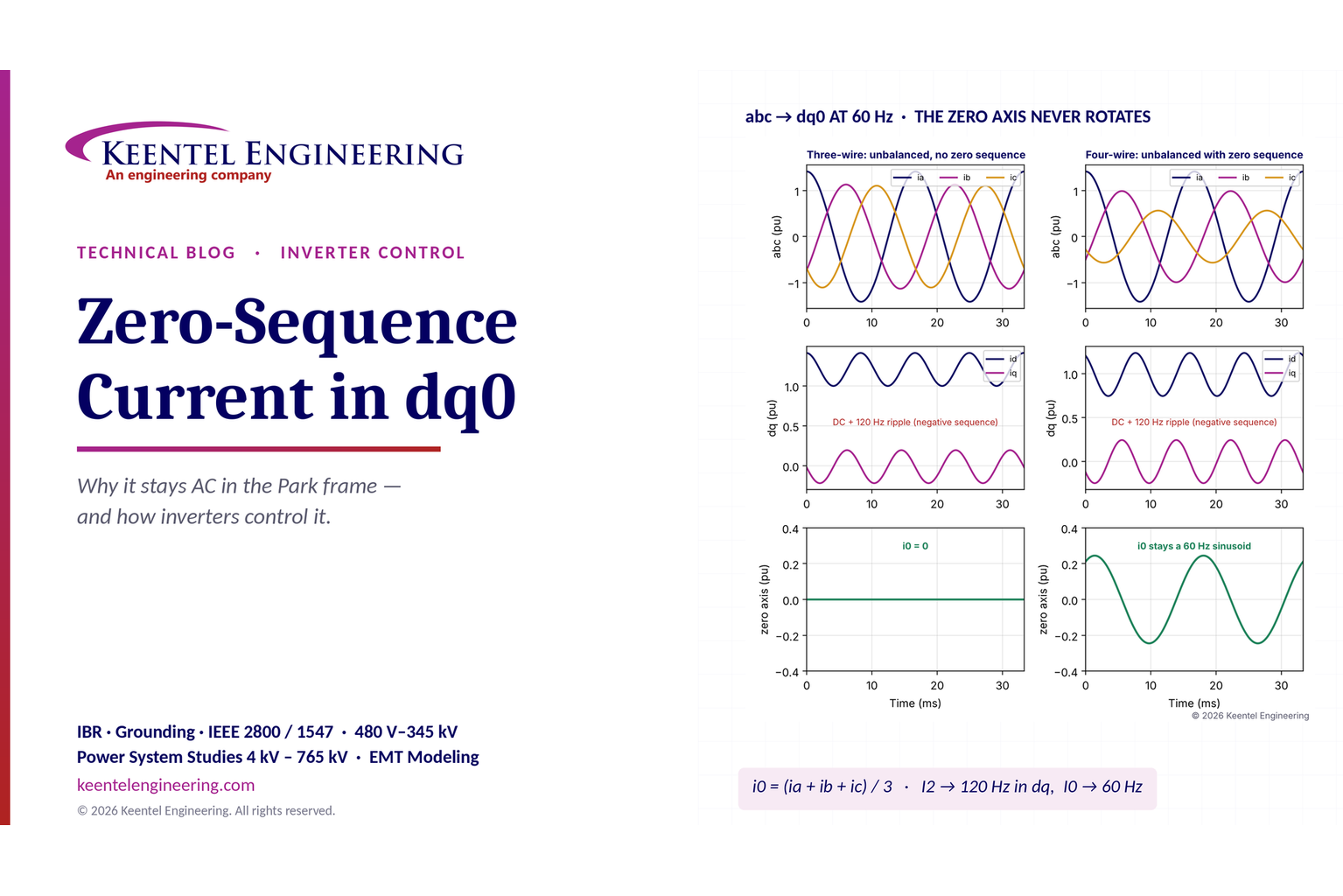
Learn why zero-sequence current pulsates in the dq0 frame, how Park's transformation works, and how inverter controls handle unbalance and ground faults.
By SANDIP R PATEL
•
October 11, 2026
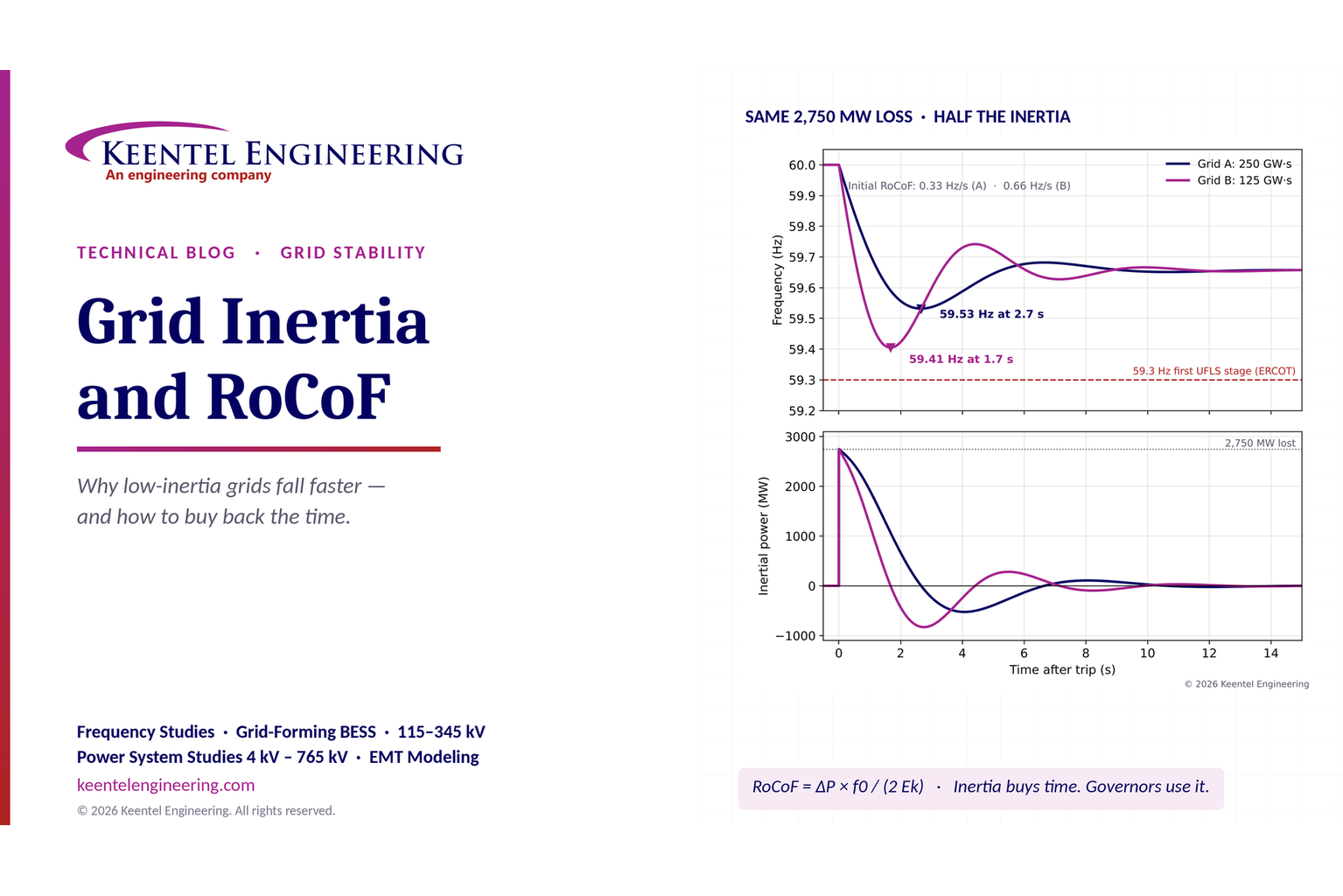
Explore grid inertia, RoCoF and frequency response, with swing equation calculations, frequency nadir analysis and US power system simulation examples.
By SANDIP R PATEL
•
October 11, 2026
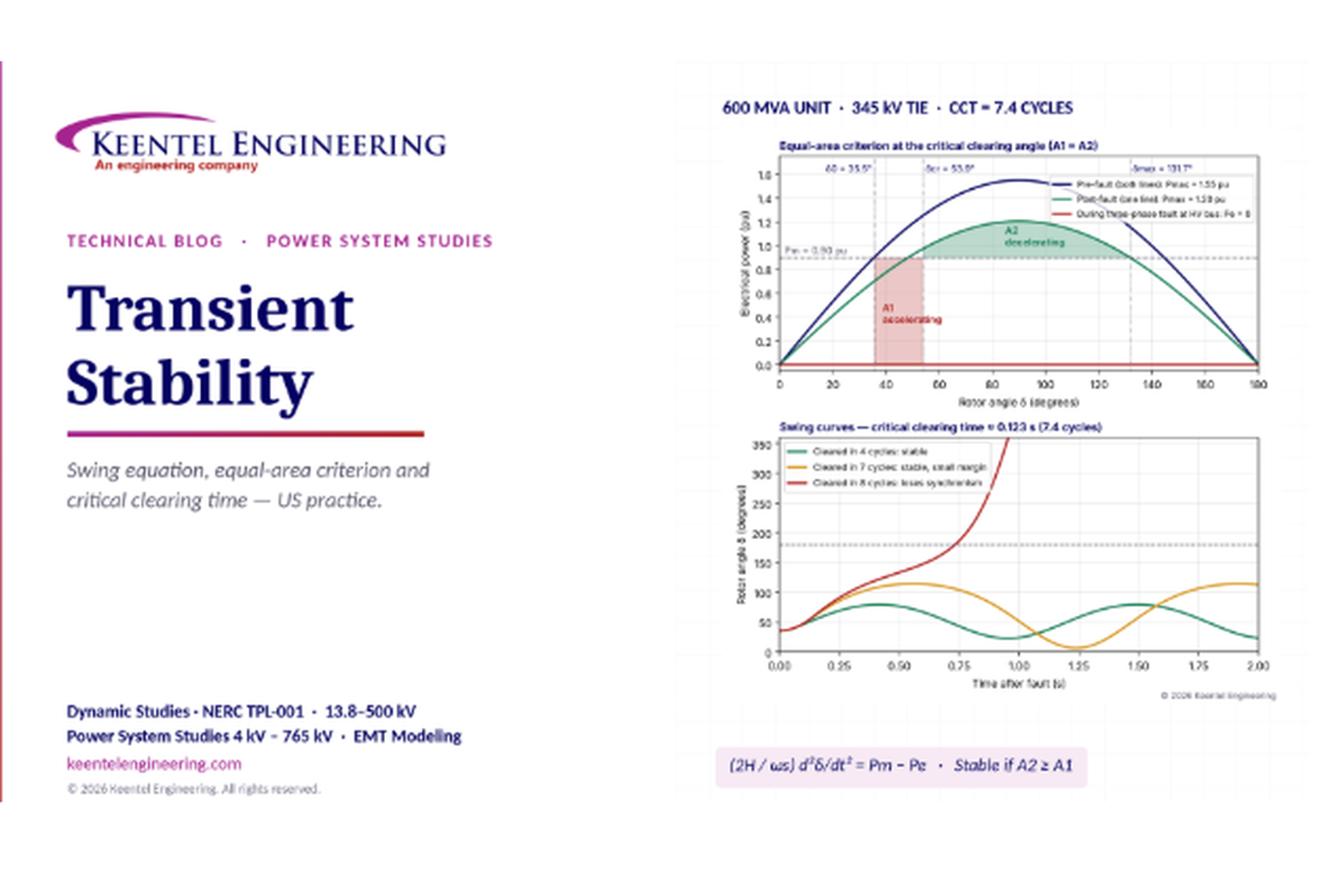
Learn transient stability analysis, swing equation, equal-area criterion and critical clearing time with a 345 kV worked example and NERC TPL-001 guidance.
By SANDIP R PATEL
•
October 11, 2026
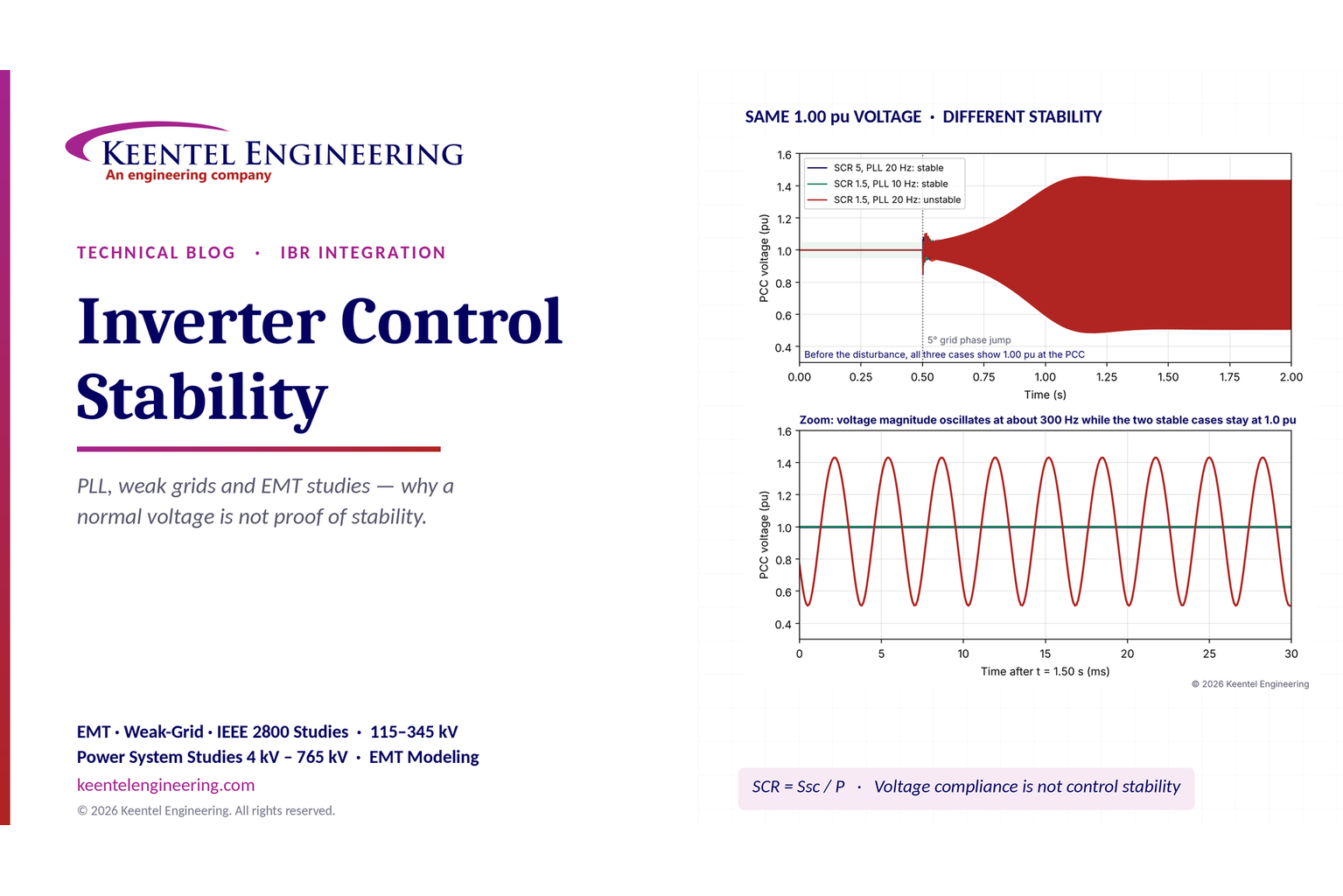
Learn why inverter controls become unstable in weak grids, how PLL bandwidth and SCR affect stability, and how PSCAD EMT studies identify and mitigate oscillations.
By SANDIP R PATEL
•
October 11, 2026
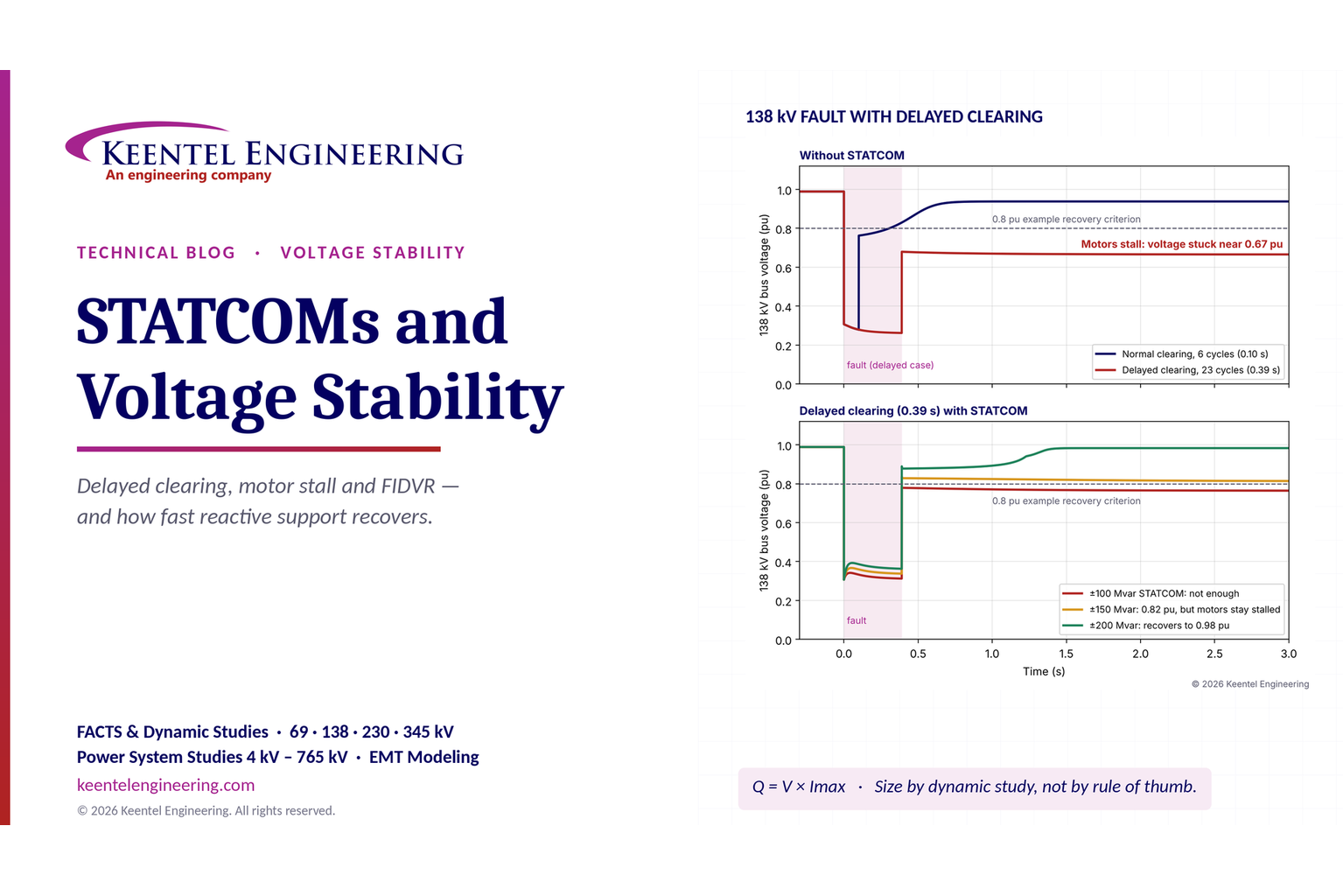
Learn how STATCOMs improve voltage stability and prevent FIDVR. Explore reactive power sizing, delayed fault clearing, NERC criteria and 138 kV simulation results.
By SANDIP R PATEL
•
October 10, 2026
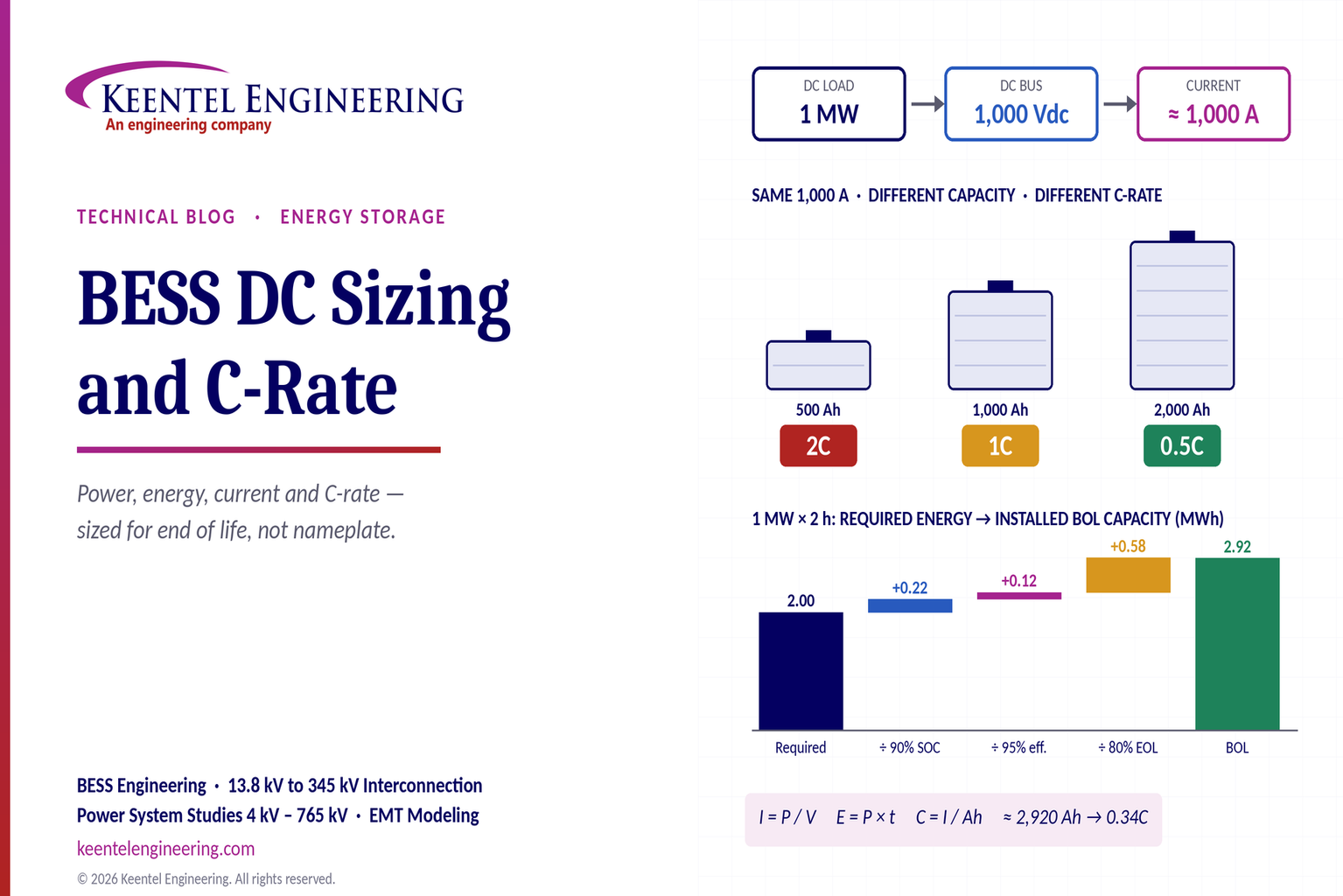
Learn BESS DC sizing with power, energy, current and C-rate calculations, battery losses, degradation and a 100 MW/400 MWh utility-scale example.