

A Coordinated Electric System Interconnection Review—the utility’s deep-dive on technical and cost impacts of your project.

PJM Dynamic Modeling & Interconnection Case Studies

Calendar icon. D

May 8, 2025 | Blog

Engineer in silhouette inspecting electrical power grid at sunset.

Navigating Texas’s Unique Reliability Requirements


Connecting to ERCOT’s independent grid of over 26 million customers means more than just meeting standard NERC mandates—it demands a Texas-tailored approach. Keentel Engineering’s ERCOT NERC compliance services guide Generation Owners (GOs), Transmission Owners (TOs), and Load-Serving Entities (LSEs) through the rigorous CIP, O&P, and RSAW standards to safeguard grid reliability and avoid costly penalties.


Understanding NERC vs. ERCOT

  • NERC sets and enforces continent-wide reliability standards (CIP, O&P, PRC, FAC, …).
  • ERCOT operates Texas’s isolated wholesale market and real-time grid—still bound by NERC rules despite no FERC oversight.
  • Compliance ensures ERCOT participants adhere to all applicable NERC standards, maintaining critical infrastructure protection and grid stability.

Why NERC Compliance Matters in ERCOT

  • Grid Reliability: Prevents outages and cascading failures.
  • Risk Management: Unchecked non-compliance can trigger $1 million + per-day fines and tarnish reputation.
  • Operational Integrity: Drives audit readiness, robust cybersecurity protocols, and transparent record-keeping.

ERCOT’s Unique Compliance Landscape

  1. Independent Market Structure: No FERC, yet NERC CIP & O&P still apply.
  2. High DER Penetration: Behind-the-meter solar PV, utility-scale BESS, and EV chargers demand advanced monitoring.
  3. Cyber-Physical Convergence: Heightened cybersecurity (“cyber assets”) needs in an isolated grid.
  4. State-Level Overlay: Texas PUC rules intersect with NERC reliability standards.

Core Components of an ERCOT NERC Compliance Program

  • Risk Assessment & Gap Analysis: Prioritize system vulnerabilities to maximize resource allocation.
  • Continuous Monitoring: Real-time dashboards and quarterly self-audits for audit readiness.
  • Training & Awareness: Role-based CIP/O&P workshops to embed a compliance culture.
  • Corrective Action & Enforcement: Rapid remediation plans when non-compliance arises.
  • Cybersecurity Controls: Full lifecycle CIP-002 through CIP-014 implementation.
  • Documentation & RSAW Support: Maintain evidence, logs, and record-keeping for audits.

Tailored Services for ERCOT Participants

  • Program Development & Consulting: Custom compliance roadmaps aligned with ERCOT protocols.
  • Policy & Procedure Authoring: Draft and update CIP and O&P manuals.
  • Audit Preparation & RSAW Technical Writing: Mock audits, RSAW packages, and corrective action planning.
  • Technology Enablement: Automated compliance management systems for real-time controls and alerts.

Explore our NERC service offerings: NERC O&P 693 Compliance Services


Regulatory Compliance Challenges & Solutions

  • Evolving Standards: Stay ahead of annual NERC and ERCOT protocol updates.
  • Cyber Threats: Layered defense-in-depth for OT/IT networks.
  • DER Integration: Incorporate BTM resources into reliability modeling and load flow analysis.
  • Resource Constraints: Balance compliance workload with daily operations.

Staying Ahead of Compliance in ERCOT

  1. Engage Early with NERC and ERCOT working groups.
  2. Invest in Training—biannual CIP & O&P tabletop exercises.
  3. Leverage AI-Enabled Monitoring for anomaly detection and predictive compliance.
  4. Foster Transparency—open communication lines and clear accountability.

FAQ

How must ERCOT entities implement NERC CIP standards?

ERCOT participants must satisfy the full CIP suite—from CIP-002 (Asset Classification) through CIP-014 (Physical Security)—while aligning with Texas PUC cybersecurity rules. A best-practice ERCOT CIP program includes:


➔ Asset Identification & Risk Tiering (CIP-002, CIP-003)
➔ Security Management Controls (CIP-004 through CIP-009)
➔ Incident Response & Recovery (CIP-008)
➔ Physical Security Measures (CIP-014)

Keentel Engineering delivers gap analyses, policy development, technical justifications, and automated monitoring to ensure you’re audit-ready.


Consequences of Non-Compliance

  • Financial Penalties: $1 million+ per day, per violation
  • Reputational Damage: Eroded trust among regulators and customers
  • Increased Scrutiny: More frequent audits and inspections
  • Operational Risk: Higher chance of system failures and outages

Call to Action

Secure your ERCOT NERC compliance program today.
Partner with Keentel Engineering for turnkey CIP, O&P, and RSAW solutions designed specifically for the ERCOT market.


A smiling man with glasses and a beard wearing a blue blazer stands in front of server racks in a data center.

About the Author:

Sandip "Sonny" R. Patel, P.E.

IEEE Senior Member · Founder & CEO, Keentel Engineering

In 1995, Sonny Patel earned his Electrical Engineering degree from the University of Illinois. But degrees don't build legacies — action does.

For three decades, he has worked the power industry from every side of the table: 16 years as a utility engineer at Exelon/Commonwealth Edison; generation leadership across hydroelectric, industrial steam turbine, and a 9 GW renewable fleet; NERC Regional Entity Senior Compliance Engineer and Audit Team Lead, auditing some of the nation's largest utilities; and testing and commissioning lead on equipment up to 765 kV — the very top of the North American grid.Utility. Generator. Regulator. Consultant. Few engineers have seen all four seats. Fewer still have sat in them.

His experience spans nuclear, hydro, conventional generation, renewables, oil and gas, mining — and today's data centers, where he is authoring a three-book series on data center design. He is a Licensed Professional Engineer in six states and a Licensed Electrical Contractor in Florida (Unlimited EC) — he doesn't just design the work; he's qualified to stand behind its execution.Today, as Founder and CEO of Keentel Engineering, Sonny leads a nationwide team of engineers delivering substation design, power system studies, NERC compliance, and commissioning — done right, coast to coast.Three decades. Every side of the table. One standard: accountable engineering.

Four workers in safety vests and helmets stand with arms crossed near wind turbines.

Let's Discuss Your Project

Let's book a call to discuss your electrical engineering project that we can help you with.

Man in a blazer and open shirt, looking at the camera, against a blurred background.

About the Author:

Sandip "Sonny" R. Patel, P.E.

IEEE Senior Member · Founder & CEO, Keentel Engineering

In 1995, Sonny Patel earned his Electrical Engineering degree from the University of Illinois. But degrees don't build legacies — action does.

For three decades, he has worked the power industry from every side of the table: 16 years as a utility engineer at Exelon/Commonwealth Edison; generation leadership across hydroelectric, industrial steam turbine, and a 9 GW renewable fleet; NERC Regional Entity Senior Compliance Engineer and Audit Team Lead, auditing some of the nation's largest utilities; and testing and commissioning lead on equipment up to 765 kV — the very top of the North American grid.

Utility. Generator. Regulator. Consultant. Few engineers have seen all four seats. Fewer still have sat in them.

His experience spans nuclear, hydro, conventional generation, renewables, oil and gas, mining — and today's data centers, where he is authoring a three-book series on data center design. He is a Licensed Professional Engineer in six states and a Licensed Electrical Contractor in Florida (Unlimited EC) — he doesn't just design the work; he's qualified to stand behind its execution.

Today, as Founder and CEO of Keentel Engineering, Sonny leads a nationwide team of engineers delivering substation design, power system studies, NERC compliance, and commissioning — done right, coast to coast.Three decades. Every side of the table. One standard: accountable engineering.

Leave a Comment

Related Posts

NERC large load registration guide showing data center grid reliability and computational load compl
By SANDIP R PATEL September 9, 2026
Learn how NERC computational load registration impacts data centers, CLO standards, ride-through requirements, modeling, and grid reliability compliance.
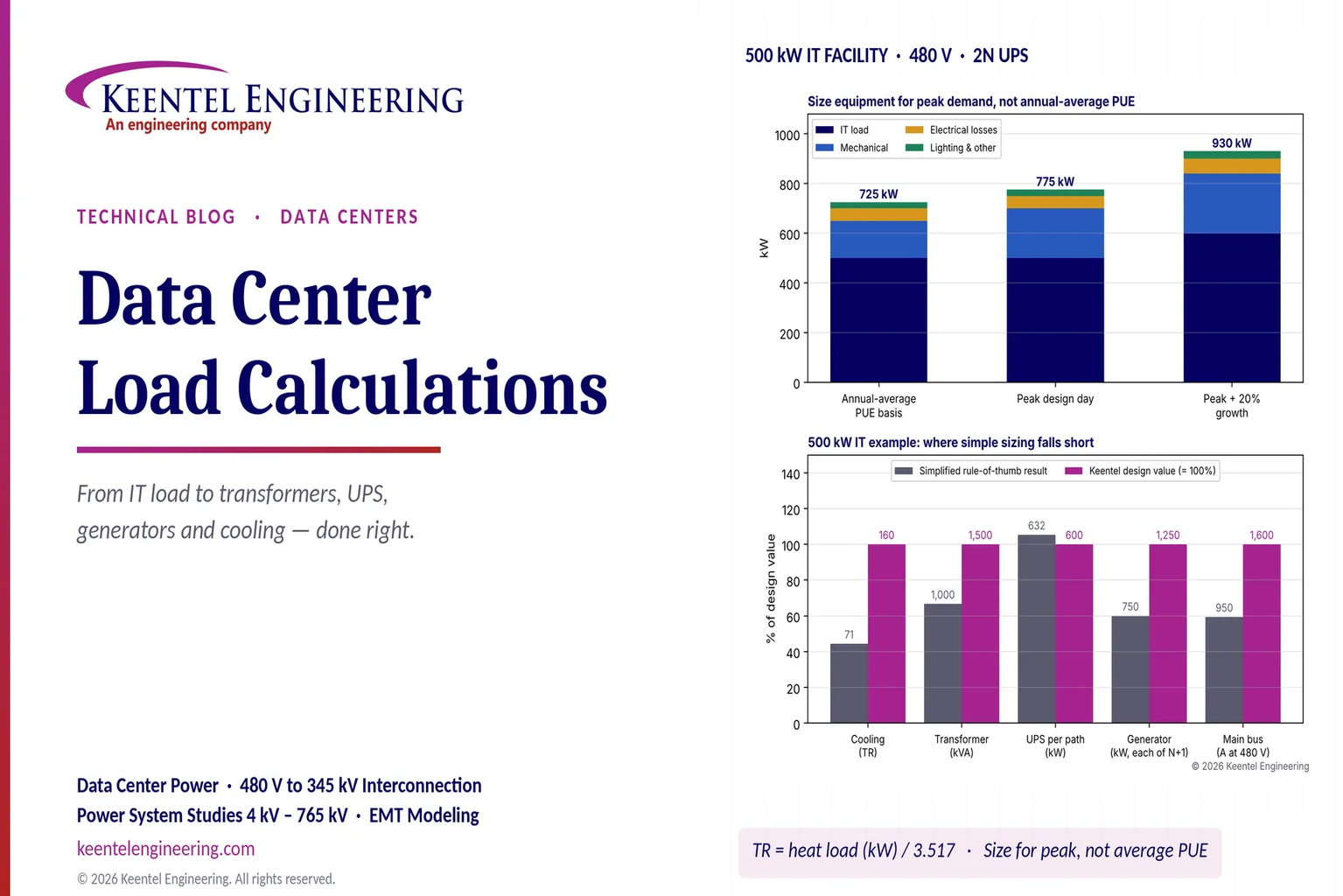
NEC 2026 load calculation guide showing Article 120 rules, 2 VA changes, EV charging and service siz
By SANDIP R PATEL September 7, 2026
Learn NEC 2026 load calculations, Article 120 changes, the 2 VA rule, EV charging requirements, service sizing, and dwelling calculation methods.
NEC calculations guide showing conduit fill, voltage drop, ampacity, motor circuits and transformer
By SANDIP R PATEL September 7, 2026
Learn five essential NEC calculations covering conduit fill, voltage drop, ampacity, motor circuits, and transformer protection with engineering examples.
CAISO IBR model review showing inverter-based resource validation and PRC-029-1 ride-through complia
By SANDIP R PATEL September 7, 2026
Learn how CAISO reviews IBR models using PSLF validation, PRC-029-1 ride-through requirements, WECC models, and inverter resource compliance testing.
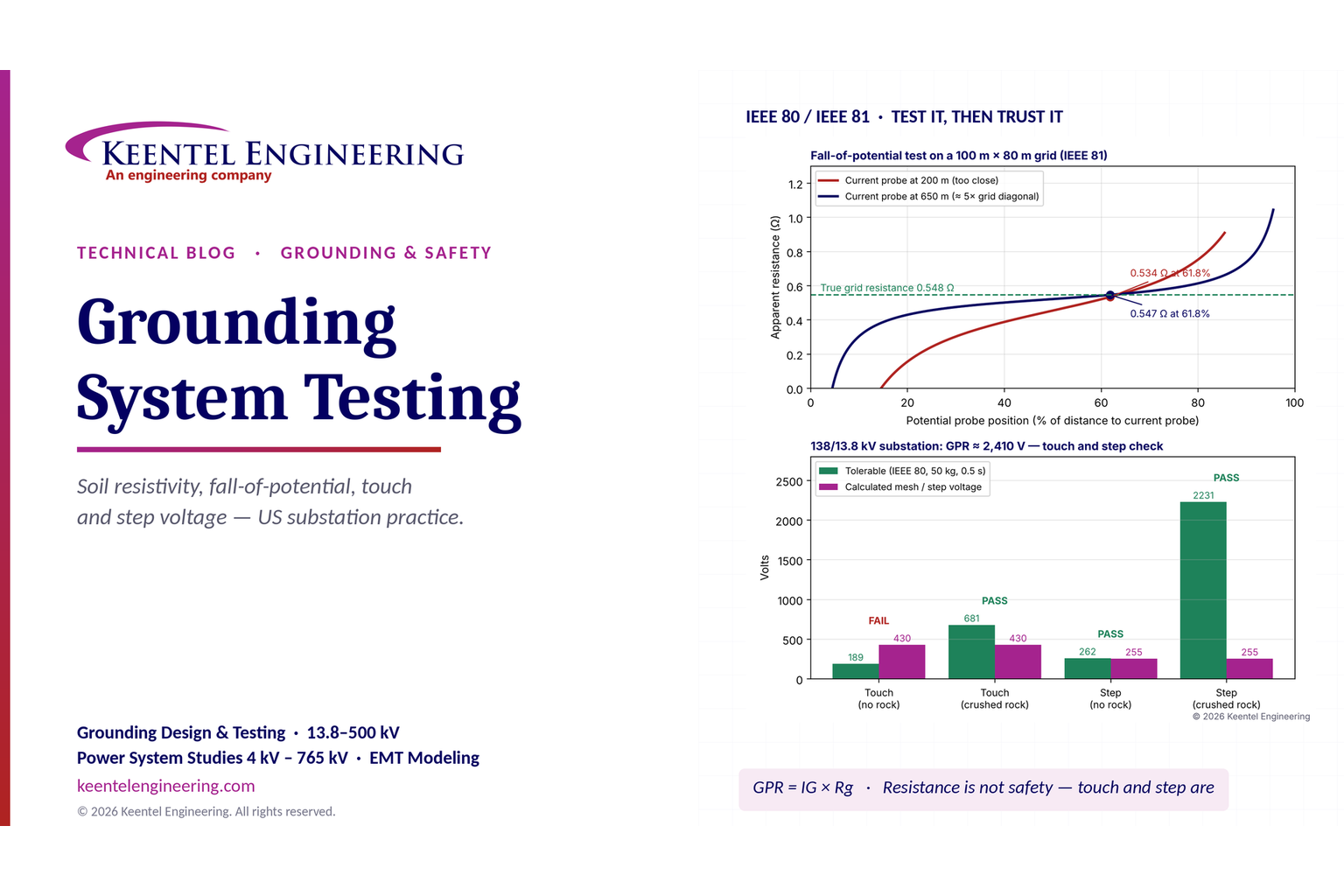
Protective earthing and system grounding during earth faults
By SANDIP R PATEL September 7, 2026
Understand system earthing and protective earthing, neutral grounding methods, effective grounding, ground grids, and insulation coordination for power systems
NERC MOD-032-1 CAISO generator data modeling and WECC compliance requirements
By SANDIP R PATEL September 6, 2026
Learn how NERC MOD-032-1 applies across CAISO, SCE, PG&E, VEA and SDG&E, including generator data, PSLF models, EMT requirements and WECC submissions.
PJM PSCAD model submission requirements for EMT model development
By SANDIP R PATEL September 6, 2026
Learn PJM PSCAD model requirements for inverter-based resources, EMT testing, PSS/E benchmarking, ride-through studies, and compliance submissions
Data center power plant turbine sizing and unit configuration comparison.
By SANDIP R PATEL September 6, 2026
Learn why data center power plants use multiple smaller gas turbines, covering 624 MW capacity, redundancy, grid connection, system strength, and engineering.
Station battery sizing design for substation DC auxiliary power system
By SANDIP R PATEL September 5, 2026
Understand ERCOT BESS interconnection requirements, including model packages, EMT studies, ride-through compliance, telemetry, and real-time co-optimization.