

A Coordinated Electric System Interconnection Review—the utility’s deep-dive on technical and cost impacts of your project.
Challenge: Frequent false tripping using conventional electromechanical relays
Solution: SEL-487E integration with multi-terminal differential protection and dynamic inrush restraint
Result: 90% reduction in false trips, saving over $250,000 in downtime
| Category | Metric |
|---|---|
| VPP capacity (Lunar Energy) | 650 MW |
| Lunar funding raised | US$232 million |
| Data center BESS example | 31 MW / 62 MWh |
| ERCOT grid-scale batteries | 15+ GW |
| LDES tenders (H1 2026) | Up to 9.3 GW |
| Lithium-ion share of LDES by 2030 | 77% |
| FEOC initial threshold | 55% |
| BESS tariff rate (2026) | ~55% |
| Capacity gain from analytics | 5–15% |
The Western Grid at a Turning Point: Why Harmonized EMT Modeling and IBR Performance Criteria Are Now Essential
february 25/2/2026
The Western Interconnection is undergoing one of the most significant transformations in its history. The rapid expansion of inverter-based resources (IBRs), HVDC transmission systems, grid-forming controls, and large AI-driven data center loads has fundamentally altered system behavior.
Traditional steady-state and phasor-domain simulations are no longer sufficient to evaluate emerging stability risks.
Electromagnetic Transient (EMT) modeling is no longer a niche analytical tool it is becoming a foundational requirement for maintaining Bulk Power System (BPS) reliability.
This article explores why harmonization of EMT modeling, screening methodologies, and performance testing is now critical for the West and what a structured regional framework could look like.
Why EMT Modeling Has Become a Core Reliability Requirement
Several converging trends have made EMT analysis indispensable:
- High penetration of inverter-based resources (solar, wind, BESS)
- Increasingly weak grid conditions in certain regions
- Rapid deployment of HVDC transmission
- Growth of nonlinear and large dynamic loads
- Deployment of grid-forming inverter technology
- Complex control interactions across multiple converter-based assets
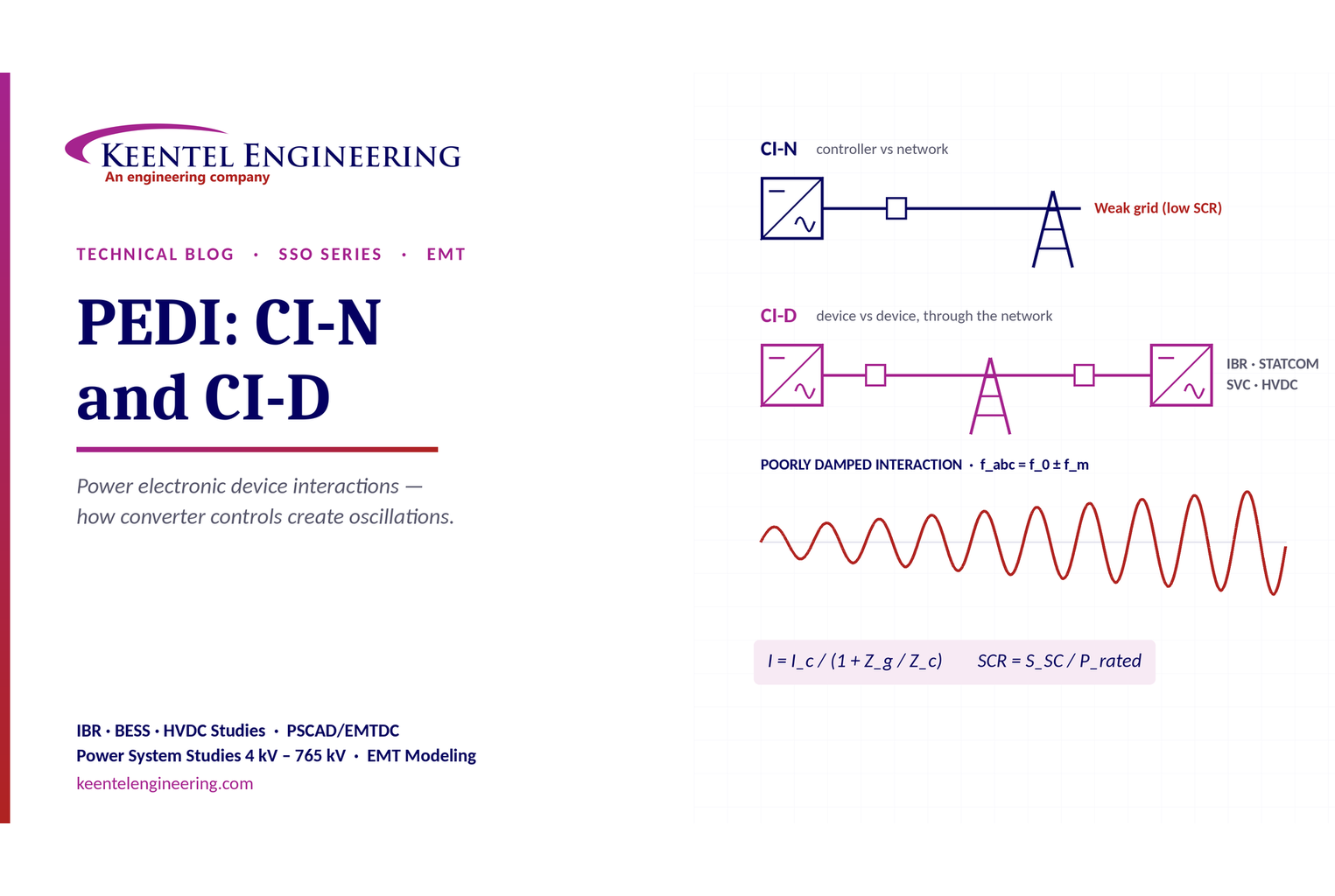
Unlike conventional synchronous machines, inverter-based resources operate through fast-acting control systems. These controllers interact with grid conditions in sub-cycle timeframes, creating dynamics that cannot be fully captured in positive-sequence models.
As a result:
- EMT analysis is increasingly required for interconnection studies
- Transfer path assessments now rely on time-domain simulations
- Grid-forming performance must be validated in EMT tools
- Large IBR clusters require detailed converter-level modeling
EMT capability is becoming a strategic competency for transmission planners and utilities.
The Fundamental Challenge: Model Quality and Lifecycle Governance
One of the most pressing issues in the Western Interconnection is not simply the need for EMT studies it is the quality and timing of the models used in those studies.
Common challenges include:
- Generic models that obscure actual controller behavior
- Late delivery of EMT models in the interconnection process
- Reverse-engineered models built only to pass specific tests
- Legacy sites operating without validated EMT models
- Inconsistent model acceptance criteria across utilities
These gaps create real risks:
- Interconnection study delays
- Expensive rework and restudies
- Unidentified control interactions
- Reliability vulnerabilities that only surface during operations
A recurring industry theme is clear:
Models must reflect as-left field conditions not theoretical design assumptions.
That requires structured verification, transparency, and lifecycle governance.
EMT Screening: Not Every Project Requires EMT But Many Do
Not every interconnection project demands EMT analysis. However, screening methodologies must be technically robust and consistent.
Current approaches often include:
- Short Circuit Ratio (SCR) thresholds
- Impedance-based stability metrics
- Radiality considerations (N-x conditions)
- Proximity to HVDC systems
- Size of IBR clusters
- Penetration of grid-forming inverters
The issue is not whether screening should occur — it is how consistently it is applied.
Without alignment, developers face:
- Conflicting regional requirements
- Duplicate analytical efforts
- Increased engineering cost
- Extended project timelines
A structured, harmonized screening framework would allow the West to:
- Focus EMT resources on high-risk scenarios
- Reduce redundant custom analysis
- Provide predictability for developers
- Preserve reliability margins
Harmonization: The Most Urgent Need
Across the industry, one theme stands out above all others
Harmonization is no longer optional.
Without a coordinated framework, the Western Interconnection risks fragmentation:
- Different modeling requirements per utility
- Conflicting performance tests
- Varying documentation standards
- Divergent screening thresholds
- Misaligned model validation processes
This patchwork environment increases costs and introduces reliability risk.
A unified regional approach would provide:
- Consistent EMT model requirements
- Standardized verification procedures
- Defined screening triggers
- Clear performance conformity tests
- Transparent documentation expectations
The result would be:
- Shorter interconnection timelines
- Lower engineering costs
- Reduced restudy burden
- Improved BPS reliability
- Greater confidence in IBR performance
A Structured Regional Framework: A Practical Path Forward
One practical solution is the development of a formal regional technical criterion focused on EMT modeling and IBR performance expectations.
Such a framework would:
- Promote consistency across the Western Interconnection
- Support existing reliability standards
- Be developed collaboratively among stakeholders
- Undergo public comment and balloting
- Carry institutional weight
- Provide guidance without adding unnecessary compliance burdens
This type of structured document can align expectations without becoming an enforceable reliability standard.
It can address both:
- The “what” required modeling and performance criteria
- The “how” verification, screening, testing, and governance processes
What a Harmonized EMT Criterion Could Include
A comprehensive regional framework could define:
1. IBR EMT Model Submission Requirements
- Required control system detail
- Inclusion of protection functions
- Parameter transparency expectations
- Confidential handling provisions
2. Model Quality Verification
- Standardized test benches
- Time-domain disturbance simulations
- Performance conformity validation
- Field-data benchmarking
3. Screening Methodology
- SCR-based triggers
- Impedance metrics
- HVDC proximity rules
- Grid-forming penetration thresholds
- Cluster size thresholds
4. Lifecycle Governance
- As-left model validation
- Model update timelines
- Change management procedures
- Ongoing performance monitoring
5. Alignment With National Standards
- IEEE 2800 performance expectations
- Emerging NERC reliability requirements
- Consistency with other ISOs and RTOs where appropriate
Strategic Implications for Transmission Planners and Developers
The Western grid is at an inflection point.
If harmonization succeeds:
- Project uncertainty decreases
- Engineering duplication declines
- Reliability improves
- Interconnection queues accelerate
- Study workloads become manageable
If fragmentation persists:
- Study rework increases
- Engineering costs rise
- Model inconsistencies persist
- Reliability vulnerabilities accumulate
- Delays become systemic
The scale and complexity of EMT studies particularly for large IBR clusters, AI load centers, and HVDC integration demand regional alignment.
EMT capability is no longer a niche expertise. It is strategic infrastructure.
Raising the Floor for Reliability
The objective is not to burden developers.
It is not to restrict innovation.
It is to ensure that the pace of grid transformation does not exceed the industry’s ability to model, test, and validate performance.
A harmonized framework would:
- Raise the minimum standard for model quality
- Improve confidence in study results
- Reduce latent operational risks
- Support faster, safer interconnections
The Western Interconnection has the technical expertise and institutional structure to implement this approach.
The opportunity now is to move from discussion to structured alignment.
Frequently Asked Questions (FAQs)
1. Why are EMT studies becoming more common?
Because inverter-based resources introduce fast control interactions that cannot be accurately modeled in phasor-domain tools.
2. What is the biggest modeling risk today?
Inaccurate or generic EMT models that do not represent as-built plant behavior.
3. Do all IBR projects require EMT analysis?
No. However, robust screening is required to identify projects where EMT risks are significant.
4. What is “as-left” validation?
Verification that the EMT model matches the final installed configuration and control settings.
5. Why is harmonization important?
Without it, inconsistent requirements increase costs, delays, and reliability risks.
6. How does grid strength affect EMT requirements?
Low SCR conditions increase sensitivity to control interactions, often requiring EMT-level analysis.
7. What are typical EMT screening triggers?
SCR thresholds, large IBR clusters, HVDC proximity, and high penetration of grid-forming controls.
8. What is the risk of generic models?
They may hide unstable control interactions or misrepresent plant behavior.
9. How do standardized test benches help?
They automate performance validation and improve regional consistency.
10. How can harmonization reduce interconnection timelines?
By eliminating conflicting modeling requirements and reducing restudies.
11. Does a regional framework replace reliability standards?
No. It supports and aligns implementation of existing standards.
12. What happens if harmonization does not occur?
Fragmentation, higher costs, longer queues, and potential reliability gaps.
13. Why are AI data centers relevant?
Large nonlinear loads introduce fast dynamics and harmonic interactions requiring detailed modeling.
14. Why is EMT expertise considered strategic?
Because converter-dominated systems require deep time-domain analysis capabilities.
15. What is the ultimate goal of harmonized EMT criteria?
To raise the floor for reliability while enabling faster integration of new resources.

About the Author:
Sonny Patel P.E. EC
IEEE Senior Member
In 1995, Sandip (Sonny) R. Patel earned his Electrical Engineering degree from the University of Illinois, specializing in Electrical Engineering . But degrees don’t build legacies—action does. For three decades, he’s been shaping the future of engineering, not just as a licensed Professional Engineer across multiple states (Florida, California, New York, West Virginia, and Minnesota), but as a doer. A builder. A leader. Not just an engineer. A Licensed Electrical Contractor in Florida with an Unlimited EC license. Not just an executive. The founder and CEO of KEENTEL LLC—where expertise meets execution. Three decades. Multiple states. Endless impact.
Services

Let's Discuss Your Project
Let's book a call to discuss your electrical engineering project that we can help you with.

About the Author:
Sonny Patel P.E. EC
IEEE Senior Member
In 1995, Sandip (Sonny) R. Patel earned his Electrical Engineering degree from the University of Illinois, specializing in Electrical Engineering . But degrees don’t build legacies—action does. For three decades, he’s been shaping the future of engineering, not just as a licensed Professional Engineer across multiple states (Florida, California, New York, West Virginia, and Minnesota), but as a doer. A builder. A leader. Not just an engineer. A Licensed Electrical Contractor in Florida with an Unlimited EC license. Not just an executive. The founder and CEO of KEENTEL LLC—where expertise meets execution. Three decades. Multiple states. Endless impact.
Leave a Comment
We will get back to you as soon as possible.
Please try again later.
Related Posts