

A Coordinated Electric System Interconnection Review—the utility’s deep-dive on technical and cost impacts of your project.

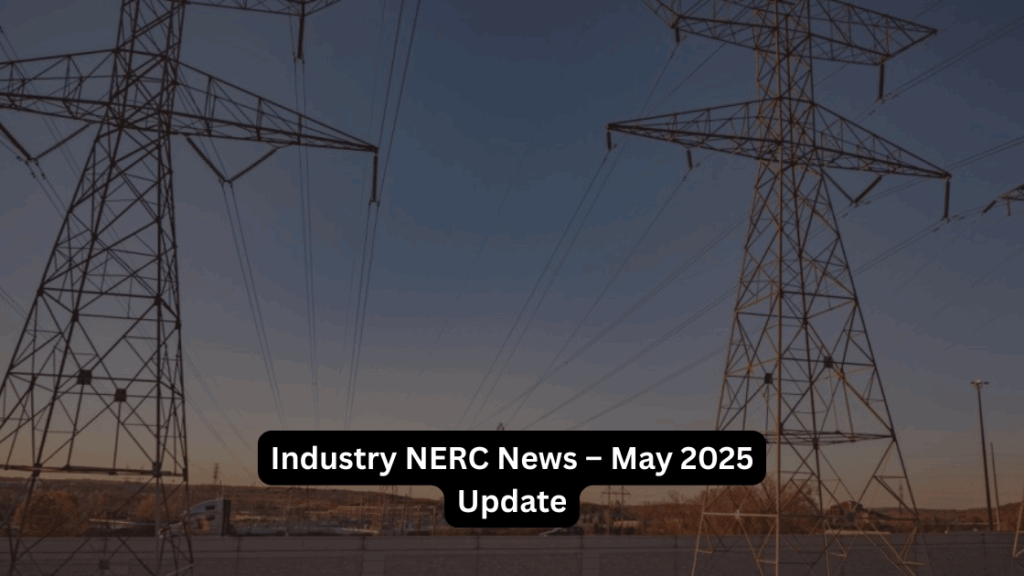
Industry NERC News – May 2025 Update

Calendar icon. D

May 19, 2025 | Blog

Power lines against a blue sky, with the text

Key Compliance Deadlines, IBR Modeling Deficiencies & Grid Reliability Insights

Stay informed with critical regulatory developments from NERC. This month’s update covers compliance deadlines, modeling alerts for inverter-based resources (IBRs), and upcoming industry standards that impact Bulk Power System (BPS) reliability.


Key NERC Compliance Deadlines & Events – May 2025

The NERC compliance calendar is packed with essential reporting deadlines, ballot events, and reliability workshops. Don’t miss these critical milestones:

May 15: Cold Weather Preparedness Reporting Due

All Generator Owners (GOs) must submit the Extreme Cold Weather Temperature Report by May 15, 2025, per FERC/NERC mandates. This report is vital for ensuring grid reliability during cold weather events. Access support tools and training via NERC’s Cold Weather Data Portal.


Active NERC Ballots & Comment Periods

Be proactive in shaping industry standards. The following projects are open for stakeholder feedback:

  • Project 2020-06: Verification of Models and Data for Generators
    (Initial ballot closed May 12, 2025)
  • Project 2022-02: Uniform Modeling Framework for IBRs
    (Ballot closes May 16, 2025)
  • Project 2021-01: System Model Validation with IBRs
    (Ballot closes May 21, 2025)

These efforts drive critical enhancements in dynamic modeling, especially as IBRs expand across the grid.


Spotlight: IBR Modeling Deficiencies – April 2025 Alert

NERC’s Level 2 Alert (April 2025) exposes major weaknesses in the quality of Inverter-Based Resource (IBR) models, sparking industry concern.

Key Findings:

  • 15,000+ MW of IBR loss during 10 major BPS events since 2016.
  • Model inconsistencies across .dyr/.dyd files, field data, and planning studies.
  • 66% of GOs apply protection settings that limit inverter ride-through—a major risk to grid stability.

NERC Recommendations:

  1. Validate all IBR models for real-world performance.
  2. Submit both standard and user-defined models to Transmission Planners (TPs) and Planning Coordinators (PCs).
  3. Enhance data access and collaboration with OEMs.
  4. Implement stronger benchmarking and verification practices.

This alert reinforces the urgency for model accuracy, proactive verification, and industry-wide adoption of modeling best practices.


Standards News: Ballot Results & Pending Standards

Recently Approved:

  • Project 2024-01: Revised GO/GOP definitions passed with 86% approval, clarifying compliance roles moving forward.

Standards to Watch:

  • TOP-003-6.1, IRO-010-5, and BAL-007-1
    Set for phased enforcement: July 2025 – April 2027

These standards focus on:


  • Data exchange protocols
  • Operations planning
  • Short-term system reliability

System Maintenance Updates

Align System Scheduled Downtime:

  • When: May 16 (8 PM ET) – May 17 (4 PM ET)
  • Update: Release 7.2.0 – Enhancing usability and data integrity.

Plan your compliance submissions accordingly.


👉 Explore Our Power System Studies


Upcoming NERC Events – May & June 2025

Date Event Name Type
May 13 Real-Time Operating Subcommittee Meeting Virtual
May 14 2025 Summer Reliability Assessment Webinar Online
May 15–29 Multiple Standards Drafting Team Meetings Virtual
June 3–5 IBR Milestone 3 Industry Engagement Workshop Arlington, VA / Virtual

Summary – Key Takeaways

  • Cold weather reporting and IBR modeling are top compliance priorities.
  • Inaccurate IBR models threaten system stability—address gaps proactively.
  • Engage with evolving standards to shape future grid reliability policies.

Frequently Asked Questions (FAQ)

  • 1. What is the deadline for the Cold Weather Generator Data Report?

    All Generator Owners (GOs) must submit the Extreme Cold Weather Temperature (ECWT) report by May 15, 2025. This year, NERC is allowing a grace period until June 15, 2025 for BES units.

  • 2. Who is required to submit the ECWT data report?

    Only NERC-registered Generator Owners with BES facilities in the United States are required to submit. Submissions must be completed by the Primary Compliance Contact or Entity Administrator.

  • 3. What resources are available to help GOs complete the ECWT worksheet?

    • A revised worksheet with instructions
    • Training videos and materials
    • ECWT FAQ document
    • All are available on the NERC Cold Weather Data Request page.
  • 4. What modeling standards ballots are currently open?

    • Project 2022-02 – Uniform Modeling Framework for IBRs (closes May 16, 2025)
    • Project 2021-01 – System Model Validation with IBRs (closes May 21, 2025).
  • 5. What did the IBR Model Quality Alert reveal?

    The April 2025 aggregated report revealed:


    • 66% of protection settings do not use full inverter capability
    • Systemic mismatches in model data formats (.dyr/.dyd, field data, and manual entries)
    • Insufficient use of equipment-specific models for interconnection studies.
  • 6. What are the key recommendations for improving IBR modeling?

    • Submit both standard library and user-written PSPD/EMT models
    • Maintain up-to-date and site-specific model parameters
    • Align models with FERC LGIP/SGIP interconnection standards
    • Enhance coordination with OEMs and TPs/PCs.
  • 7. Why is reactive power capability reporting important?

    20% of solar PV sites are operating under a “triangle” power factor limitation (0.95 PF), reducing the available reactive support to the grid. NERC urges accurate modeling to reflect true inverter capabilities.

  • 8. What is the Align system outage schedule?

    Planned maintenance for the Align system is scheduled from:

    May 16, 8:00 p.m. ET to May 17, 4:00 p.m. ET

    System updates will be outlined in Release Notes 7.2.0.

  • 9. Which standards are scheduled for enforcement in 2025–2027?

    • July 1, 2025: IRO-010-5, TOP-003-6.1
    • Oct 1, 2025: TOP-002-5
    • Apr 1, 2026: TPL-008-1, CIP-003-9
    • Jul 1, 2026: CIP-012-2
    • Apr 1, 2027: BAL-007-1.
  • 10. Where can I find registration links for upcoming NERC events?

    You can access all events and register through the official NERC Calendar, including:


    IBR Milestone 3 Workshop (June 3–5)


    Summer Reliability Webinar (May 14)


A smiling man with glasses and a beard wearing a blue blazer stands in front of server racks in a data center.

About the Author:

Sandip "Sonny" R. Patel, P.E.

IEEE Senior Member · Founder & CEO, Keentel Engineering

In 1995, Sonny Patel earned his Electrical Engineering degree from the University of Illinois. But degrees don't build legacies — action does.

For three decades, he has worked the power industry from every side of the table: 16 years as a utility engineer at Exelon/Commonwealth Edison; generation leadership across hydroelectric, industrial steam turbine, and a 9 GW renewable fleet; NERC Regional Entity Senior Compliance Engineer and Audit Team Lead, auditing some of the nation's largest utilities; and testing and commissioning lead on equipment up to 765 kV — the very top of the North American grid.Utility. Generator. Regulator. Consultant. Few engineers have seen all four seats. Fewer still have sat in them.

His experience spans nuclear, hydro, conventional generation, renewables, oil and gas, mining — and today's data centers, where he is authoring a three-book series on data center design. He is a Licensed Professional Engineer in six states and a Licensed Electrical Contractor in Florida (Unlimited EC) — he doesn't just design the work; he's qualified to stand behind its execution.Today, as Founder and CEO of Keentel Engineering, Sonny leads a nationwide team of engineers delivering substation design, power system studies, NERC compliance, and commissioning — done right, coast to coast.Three decades. Every side of the table. One standard: accountable engineering.

Four workers in safety vests and helmets stand with arms crossed near wind turbines.

Let's Discuss Your Project

Let's book a call to discuss your electrical engineering project that we can help you with.

Man in a blazer and open shirt, looking at the camera, against a blurred background.

About the Author:

Sandip "Sonny" R. Patel, P.E.

IEEE Senior Member · Founder & CEO, Keentel Engineering

In 1995, Sonny Patel earned his Electrical Engineering degree from the University of Illinois. But degrees don't build legacies — action does.

For three decades, he has worked the power industry from every side of the table: 16 years as a utility engineer at Exelon/Commonwealth Edison; generation leadership across hydroelectric, industrial steam turbine, and a 9 GW renewable fleet; NERC Regional Entity Senior Compliance Engineer and Audit Team Lead, auditing some of the nation's largest utilities; and testing and commissioning lead on equipment up to 765 kV — the very top of the North American grid.

Utility. Generator. Regulator. Consultant. Few engineers have seen all four seats. Fewer still have sat in them.

His experience spans nuclear, hydro, conventional generation, renewables, oil and gas, mining — and today's data centers, where he is authoring a three-book series on data center design. He is a Licensed Professional Engineer in six states and a Licensed Electrical Contractor in Florida (Unlimited EC) — he doesn't just design the work; he's qualified to stand behind its execution.

Today, as Founder and CEO of Keentel Engineering, Sonny leads a nationwide team of engineers delivering substation design, power system studies, NERC compliance, and commissioning — done right, coast to coast.Three decades. Every side of the table. One standard: accountable engineering.

Leave a Comment

Related Posts

NERC large load registration guide showing data center grid reliability and computational load compl
By SANDIP R PATEL September 9, 2026
Learn how NERC computational load registration impacts data centers, CLO standards, ride-through requirements, modeling, and grid reliability compliance.
NEC 2026 load calculation guide showing Article 120 rules, 2 VA changes, EV charging and service siz
By SANDIP R PATEL September 7, 2026
Learn NEC 2026 load calculations, Article 120 changes, the 2 VA rule, EV charging requirements, service sizing, and dwelling calculation methods.
NEC calculations guide showing conduit fill, voltage drop, ampacity, motor circuits and transformer
By SANDIP R PATEL September 7, 2026
Learn five essential NEC calculations covering conduit fill, voltage drop, ampacity, motor circuits, and transformer protection with engineering examples.
CAISO IBR model review showing inverter-based resource validation and PRC-029-1 ride-through complia
By SANDIP R PATEL September 7, 2026
Learn how CAISO reviews IBR models using PSLF validation, PRC-029-1 ride-through requirements, WECC models, and inverter resource compliance testing.
Protective earthing and system grounding during earth faults
By SANDIP R PATEL September 7, 2026
Understand system earthing and protective earthing, neutral grounding methods, effective grounding, ground grids, and insulation coordination for power systems
NERC MOD-032-1 CAISO generator data modeling and WECC compliance requirements
By SANDIP R PATEL September 6, 2026
Learn how NERC MOD-032-1 applies across CAISO, SCE, PG&E, VEA and SDG&E, including generator data, PSLF models, EMT requirements and WECC submissions.
PJM PSCAD model submission requirements for EMT model development
By SANDIP R PATEL September 6, 2026
Learn PJM PSCAD model requirements for inverter-based resources, EMT testing, PSS/E benchmarking, ride-through studies, and compliance submissions
Data center power plant turbine sizing and unit configuration comparison.
By SANDIP R PATEL September 6, 2026
Learn why data center power plants use multiple smaller gas turbines, covering 624 MW capacity, redundancy, grid connection, system strength, and engineering.
Station battery sizing design for substation DC auxiliary power system
By SANDIP R PATEL September 5, 2026
Understand ERCOT BESS interconnection requirements, including model packages, EMT studies, ride-through compliance, telemetry, and real-time co-optimization.