A Coordinated Electric System Interconnection Review—the utility’s deep-dive on technical and cost impacts of your project.
Challenge: Frequent false tripping using conventional electromechanical relays
Solution: SEL-487E integration with multi-terminal differential protection and dynamic inrush restraint
Result: 90% reduction in false trips, saving over $250,000 in downtime
Why Dynamic Models Matter for Grid Reliability: Keentel Engineering Takeaway
August 21, 2025 | Blog

Introduction
Dynamic models are the foundation of modern power system studies, enabling engineers to simulate, predict, and secure grid operations under increasingly complex conditions. As renewable penetration increases and the grid evolves with inverter-based resources (IBRs), validated and up-to-date dynamic models become essential for stability and compliance. Recent work in inverter-based loads modeling (latest research 2024–2025) highlights new aggregate load representations and control interactions that materially affect study outcomes. Keentel Engineering offers compliance and modeling support to translate these research advances into reliable, auditable models for planning and operations.
Recent inverter-based loads modeling research (2024–2025) highlights how aggregate load behavior and control interactions significantly impact dynamic study accuracy and grid reliability.
The WECC Approved Dynamic Model Library (January 2024) provides the most recent, rigorously tested set of models that utilities, developers, and independent power producers are required to use in planning, operational, and compliance studies.
In this blog, we break down the latest approved models, outline key retirements and transitions, and explain what engineers, developers, and asset owners need to know to remain compliant and ahead of regulatory expectations.
Background: The Role of WECC Dynamic Models
The Western Electricity Coordinating Council (WECC) dynamic models play a critical role in representing system behavior during both transient and steady-state events. These standardized models ensure consistency across utilities and system operators throughout the Western Interconnection. The WECC approved dynamic models library now incorporates recent inverter-based load templates and grid-forming inverter behavior, reducing cross-tool discrepancies. Keentel’s teams map WECC model updates into engineering workflows to improve study reproducibility and regulatory readiness.
- Purpose: WECC maintains a well-defined library of dynamic simulation models that represent how power equipment and control systems respond under different operating conditions.
- Scope: The models cover a wide range of components, including excitation systems, generators, power system stabilizers (PSS), load models, turbine/governor systems, renewable energy system models, and protective relays. This enables engineers to study stability, reliability, and grid performance with greater accuracy.
- Software Platforms: To ensure interoperability, WECC dynamic models are available for leading simulation tools such as GE PSLF, PTI PSS®E, and PowerWorld Simulator, and they align with IEEE dynamic model standards.
These updates reflect ongoing advancements in inverter-based loads modeling research, ensuring that modern dynamic models capture evolving grid behavior.
To ensure accurate implementation of these models, explore our
power system studies services for advanced modeling, validation, and compliance support.
Excitation System Models (Volt/Var Control)
Exciters play a critical role in generator voltage regulation and reactive power control. According to page 1 of the WECC-approved PDF, the organization maintains a detailed list of excitation system models that are valid for planning and compliance studies.
Key Updates
- Standardization: Many exciter models have been harmonized with IEEE 2005 standards (e.g., AC1A, AC2A, AC3A).
- Obsolete/Not Approved: Older models such as EXAC3 and MEXS (manual excitation) are no longer approved.
- Modern Use: Models like ESST7B and ST6C include advanced limiters and PI voltage controllers, aligning with modern exciter technologies.
Keentel Engineering Takeaway
Always verify exciter models in your PSLF/PSS®E submissions. Using outdated exciter definitions may lead to model validation issues or study rejection.
Explore our Power System Studies page to see how our engineers ensure accurate modeling and compliance in grid studies.
Generator Models: Transition to GENQEC
On page 2 of the WECC PDF, a significant update is outlined for generator modeling standards:
- GENROU (round rotor model) and GENTPJ (transient model) are being phased out.
- GENQEC (approved in December 2020) is now the standard generator model.
- WECC retirement deadline: The GENTPJ model will no longer be accepted after December 31, 2024.
Keentel Engineering Takeaway
GENROU and GENTPJ are being phased out in favor of GENQEC as the standard generator model. All projects must transition to GENQEC models moving forward to ensure compatibility with current dynamic libraries and validation tools. GENQEC adoption also simplifies integrated studies where advanced inverter and load models are included, supporting broader grid reliability modeling and ERCOT dynamic modeling needs. Keentel Engineering compliance and modeling support helps asset owners implement GENQEC and verify interactions with modern IBR and load representations.
Learn more about generator modeling best practices in our guide on
ieee 1110 synchronous generator modeling
Power System Stabilizer (PSS) Models
Power System Stabilizer (PSS) models are critical in damping power system oscillations and improving small-signal stability.
Highlights
- Approved Multi-Band Models: PSS4B and PSS4C (ABB designs).
- Generic Standards: PSS2A, PSS2C, PSS3B remain widely used in power system studies.
- Retired/Not Approved: Proprietary stabilizers like PSSSH (Siemens H∞) are not approved.
- Practical Note:
Multi-band stabilizers are recommended for wide-area oscillation damping, especially in renewable-rich grids where stability challenges are increasing.
Load Models and Composite Loads
Composite load modeling has become increasingly important as distribution-connected resources continue to reshape system load behavior.
- CMPLDW (Composite Load Model): Approved since 2013, this model represents load behavior with a combination of static, dynamic, and distributed equivalent components.
- CMPLDWG (Composite Load with DG): Approved in 2019, this enhanced model explicitly incorporates distributed generation (DG), improving the accuracy of simulations involving inverter-based resources.
- Motor Models: The MOTOR1 and MOTORW models remain valid and widely used for representing industrial and utility motor-driven loads.
- Industry Trend: Regulators and reliability coordinators are moving toward tighter compliance requirements for modeling Distributed Energy Resources (DERs), ensuring that their effects on stability and reliability are fully captured.
The latest research on inverter-based loads modeling (2024–2025) emphasizes the need to accurately represent distributed energy resources within composite load models.
Turbine & Governor Models Update
Governors remain a critical part of frequency control, but outdated models are no longer acceptable.
- GGOV1: Still the industry benchmark for gas turbines.
- PIDGOV & G2WSCC: Retired in 2021 — must be replaced by HYGOV or HYG3.
- New Approvals (2019): GGOV1D, IEEEG1D, HYGOVD, TGOV1D — all include speed deadband functions.
Keentel Engineering’s Takeaway
Utilities and generator owners must update their governor models to meet Fast Frequency Response (FFR) compliance.
Renewable Energy Models: A Rapidly Evolving Section
The most significant changes in renewable energy dynamic modeling (page 3–4 of the PDF) highlight the shift toward more advanced inverter-based resource (IBR) models.
Approved Models
- REGC_A / REGC_B – inverter/converter models for grid interaction.
- REEC_A, REEC_C, REEC_D – renewable electrical control models.
- REPC_A / REPC_B / REPC_C / REPC_D (2024) – plant controller models for solar PV, wind power, and energy storage integration.
- REGFM_A1 (Sept 2023) – droop-controlled, grid-forming inverter model, essential for IBR stability and NERC compliance.
Retired Models (April 2020)
- WT3G, WT4G, WT3E, WT4E – generic wind turbine models no longer accepted.
- WT3P, WT4T, WT2P – turbine/pitch models phased out.
Practical Implication
All renewable energy developers must migrate to Phase 2 WECC-approved models (REGC, REEC, REPC families). Failure to adopt these models can result in project study delays, compliance issues, or outright rejections by WECC and NERC reviewers.
While inverter-based resources refer to generation systems like solar and wind, inverter-based loads represent demand-side technologies, and understanding the difference between inverter-based loads vs inverter-based resources is essential for accurate system modeling.
Related Reading:
Ensuring NERC PRC-029-1 Compliance for Inverter-Based Resources
Protection and Relay Models
Page 5 of the PDF highlights approved protection relay models for compliance studies:
- Approved Models: LHFRT/LHVRT (low/high frequency ride-through), LOCTI (branch overcurrent), OOSLEN (out-of-step relay), and TIOC relay models.
- Retired Model: SVCWSC (Static Var Compensator, retired in 2012).
- New Approvals (2020): SCL1C, SCL2C, PF1/PF2, VAR1/VAR2.
Keentel Engineering Note
Grid codes require validated relay models for inverter-based resources (IBRs). Missing or outdated models may impact NERC PRC-024 and PRC-026 compliance studies.
What This Means for Developers, Utilities, and Consultants
- NERC & WECC Compliance Deadlines: Transition away from retired dynamic models (e.g., GENTPJ, WT3/4 series) before 2025 to remain fully compliant.
- IBR Model Integration: Adopt grid-forming inverter models (REGFM_A1) and advanced plant controller models (REPC_D) for reliable IBR compliance.
- Software Consistency in PSLF/PSS®E: Validate model conversions across platforms, as discrepancies can lead to simulation errors and compliance issues.
- Future Outlook:
Expect WECC to expand modeling requirements for Distributed Energy Resources (DERs), especially at the distribution level.
Conclusion: Engineering Readiness for 2024 and Beyond
The January 2024 WECC Approved Dynamic Model Library highlights the rapid pace of grid transformation. With synchronous machines retiring, inverter-based resources (IBRs) now dominating, and NERC/WECC compliance requirements tightening, accurate power system modeling is no longer optional—it’s essential for long-term grid reliability.
Keentel Engineering supports utilities, developers, and asset owners in navigating these updates—covering everything from dynamic model selection, validation studies, and power system analysis to full
NERC compliance documentation.
Frequently Asked Questions – WECC Dynamic Model Library & Compliance
1. What is the purpose of the WECC Approved Dynamic Model Library?
It provides a standardized set of WECC-approved dynamic models for system planning and operational studies, ensuring consistency, interoperability, and grid reliability across the Western Interconnection.
2. Which generator model replaces GENTPJ?
The GENQEC model (approved December 2020) replaces GENTPJ. WECC will not accept GENTPJ models after December 31, 2024.
3. Are older wind models (WT3G, WT4G, WT3E, WT4E) still valid?
No. These wind models were retired in April 2020. Developers must use updated combinations such as REGC_A/B + REEC_A/C/D + REPC_A–D.
4. What’s new in renewable energy modeling for 2024?
- REGFM_A1 (grid-forming inverter model, approved Sept 2023).
- REPC_D (advanced plant controller, approved Jan 2024).
5. Do excitation system models follow IEEE standards?
Yes, most approved models (e.g., AC1A, AC2A, AC4A) align with IEEE 2005 standards. Some legacy WECC-specific variants differ slightly.
6. Which governor models are approved for frequency response studies?
Recommended models include GGOV1, GGOV1D, IEEEG1D, HYGOVD, and TGOV1D, all of which support fast frequency response (FFR).
7. What load models should be used for DER-heavy systems?
Use the CMPLDWG model (Composite Load with Distributed Generation), approved in 2019, for DER-rich system simulations.
8. Are manual excitation models allowed?
No. MEXS and other simplified manual excitation models are no longer approved.
9. What happens if I use a retired model in my study?
Studies using retired models may be rejected by WECC, requiring resubmission with approved equivalents — leading to delays and additional costs.
10. How do plant controller models differ (REPC_A vs REPC_B/C/D)?
- REPC_A: Single renewable plant.
- REPC_B: Multi-device control.
- REPC_C: Single aggregated WTG.
- REPC_D (2024): Advanced multi-device flexibility and streamlined functions.
11. What relay models are required for ride-through compliance?
LHFRT (frequency ride-through) and LHVRT (voltage ride-through) models are mandatory for NERC PRC-024 compliance.
12. How are PSLF models converted to PSS®E?
Conversions are done via PTI’s official program. Some models (e.g., TEXS, STCON) are not directly converted and must be replaced with approved equivalents.
13. Is GENROU still valid?
GENROU remains valid but is being transitioned to GENQEC, which is now the WECC standard.
14. What about proprietary wind models (Vestas GENWRI, GEWTG)?
Proprietary vendor models are not approved. Developers must transition to generic WECC-approved renewable models.
15. How does WECC handle distributed energy resource (DER) modeling?
By requiring DER_A (2018) and CMPLDWG for composite loads with distributed generation.
16. What’s the difference between REGC_A and REGC_B?
Both are inverter/converter models, but REGC_B (2020) includes enhancements for improved IBR behavior.
17. Which excitation systems include OEL/UEL inputs?
IEEE 2005-compliant systems such as ESAC1A, ESAC2A, ESAC3A, and ESAC6A include OEL/UEL inputs.
18. Are plant-wide VAR controls modeled?
Yes, through REPC_A–D models, which handle plant-level reactive power and voltage control.
19. What’s the latest development in HVDC modeling?
CHVDC2 (2017) and VHVDC1 (2021) are approved for two-terminal HVDC systems.
20. Who needs to comply with WECC dynamic model requirements?
All entities submitting cases to WECC — including utilities, renewable developers, consultants, and asset owners — must comply.
Ready to ensure your system stays compliant and reliable?
Contact Keentel Engineering today to discuss your dynamic model validation and compliance support needs.

About the Author:
Sandip "Sonny" R. Patel, P.E.
IEEE Senior Member · Founder & CEO, Keentel Engineering
In 1995, Sonny Patel earned his Electrical Engineering degree from the University of Illinois. But degrees don't build legacies — action does.
For three decades, he has worked the power industry from every side of the table: 16 years as a utility engineer at Exelon/Commonwealth Edison; generation leadership across hydroelectric, industrial steam turbine, and a 9 GW renewable fleet; NERC Regional Entity Senior Compliance Engineer and Audit Team Lead, auditing some of the nation's largest utilities; and testing and commissioning lead on equipment up to 765 kV — the very top of the North American grid.Utility. Generator. Regulator. Consultant. Few engineers have seen all four seats. Fewer still have sat in them.
His experience spans nuclear, hydro, conventional generation, renewables, oil and gas, mining — and today's data centers, where he is authoring a three-book series on data center design. He is a Licensed Professional Engineer in six states and a Licensed Electrical Contractor in Florida (Unlimited EC) — he doesn't just design the work; he's qualified to stand behind its execution.Today, as Founder and CEO of Keentel Engineering, Sonny leads a nationwide team of engineers delivering substation design, power system studies, NERC compliance, and commissioning — done right, coast to coast.Three decades. Every side of the table. One standard: accountable engineering.
Services

Let's Discuss Your Project
Let's book a call to discuss your electrical engineering project that we can help you with.
About the Author:
Sandip "Sonny" R. Patel, P.E.
IEEE Senior Member · Founder & CEO, Keentel Engineering
In 1995, Sonny Patel earned his Electrical Engineering degree from the University of Illinois. But degrees don't build legacies — action does.
For three decades, he has worked the power industry from every side of the table: 16 years as a utility engineer at Exelon/Commonwealth Edison; generation leadership across hydroelectric, industrial steam turbine, and a 9 GW renewable fleet; NERC Regional Entity Senior Compliance Engineer and Audit Team Lead, auditing some of the nation's largest utilities; and testing and commissioning lead on equipment up to 765 kV — the very top of the North American grid.
Utility. Generator. Regulator. Consultant. Few engineers have seen all four seats. Fewer still have sat in them.
His experience spans nuclear, hydro, conventional generation, renewables, oil and gas, mining — and today's data centers, where he is authoring a three-book series on data center design. He is a Licensed Professional Engineer in six states and a Licensed Electrical Contractor in Florida (Unlimited EC) — he doesn't just design the work; he's qualified to stand behind its execution.
Today, as Founder and CEO of Keentel Engineering, Sonny leads a nationwide team of engineers delivering substation design, power system studies, NERC compliance, and commissioning — done right, coast to coast.Three decades. Every side of the table. One standard: accountable engineering.
Leave a Comment
Thank you for contacting us.
We will get back to you as soon as possible.
We will get back to you as soon as possible.
Oops, there was an error sending your message.
Please try again later.
Please try again later.
Related Posts
By SANDIP R PATEL
•
October 20, 2026
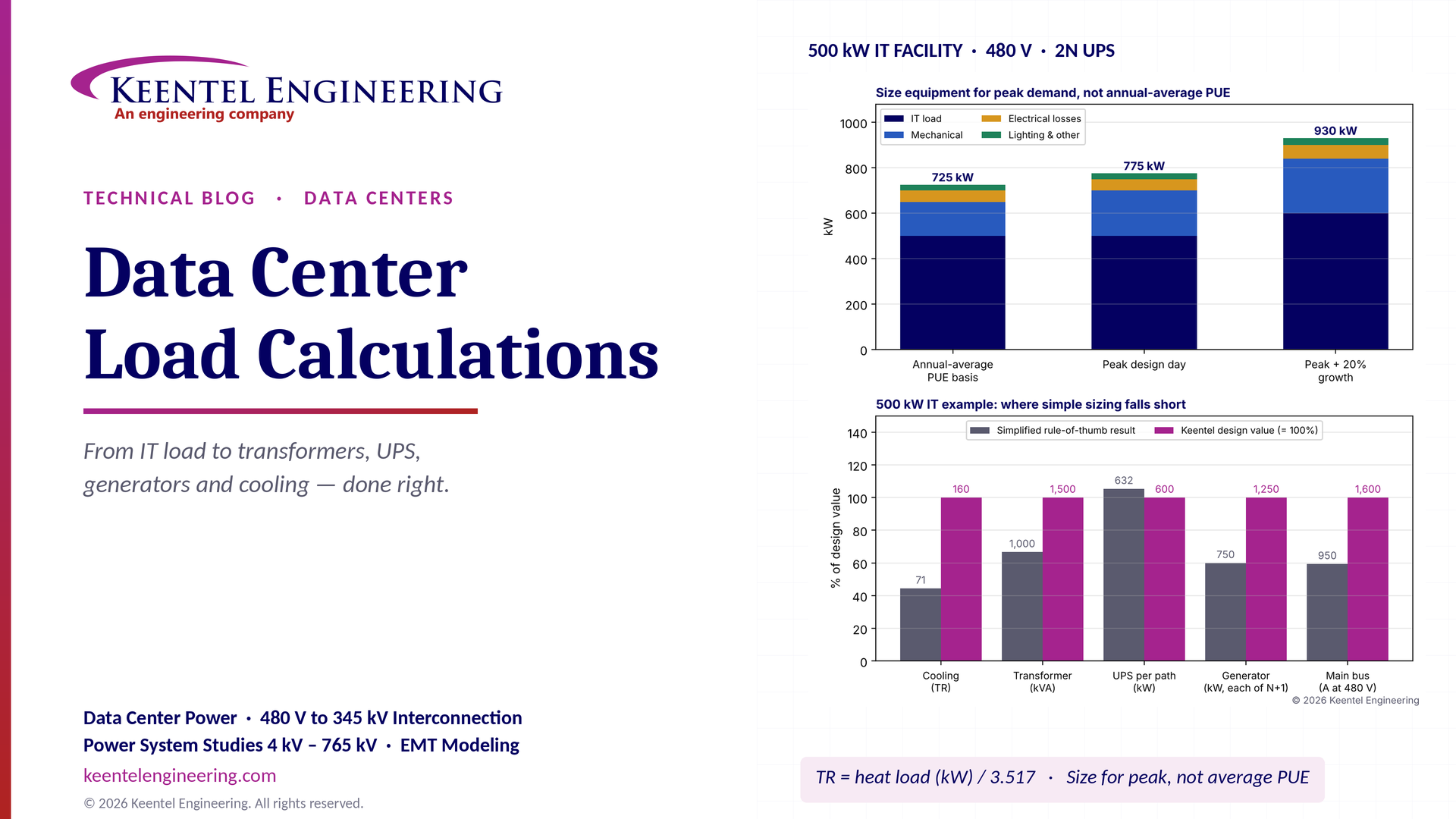
Learn data center electrical load calculations, including IT demand, PUE, UPS and generator sizing, cooling loads, redundancy, and worked US examples.
By SANDIP R PATEL
•
October 20, 2026
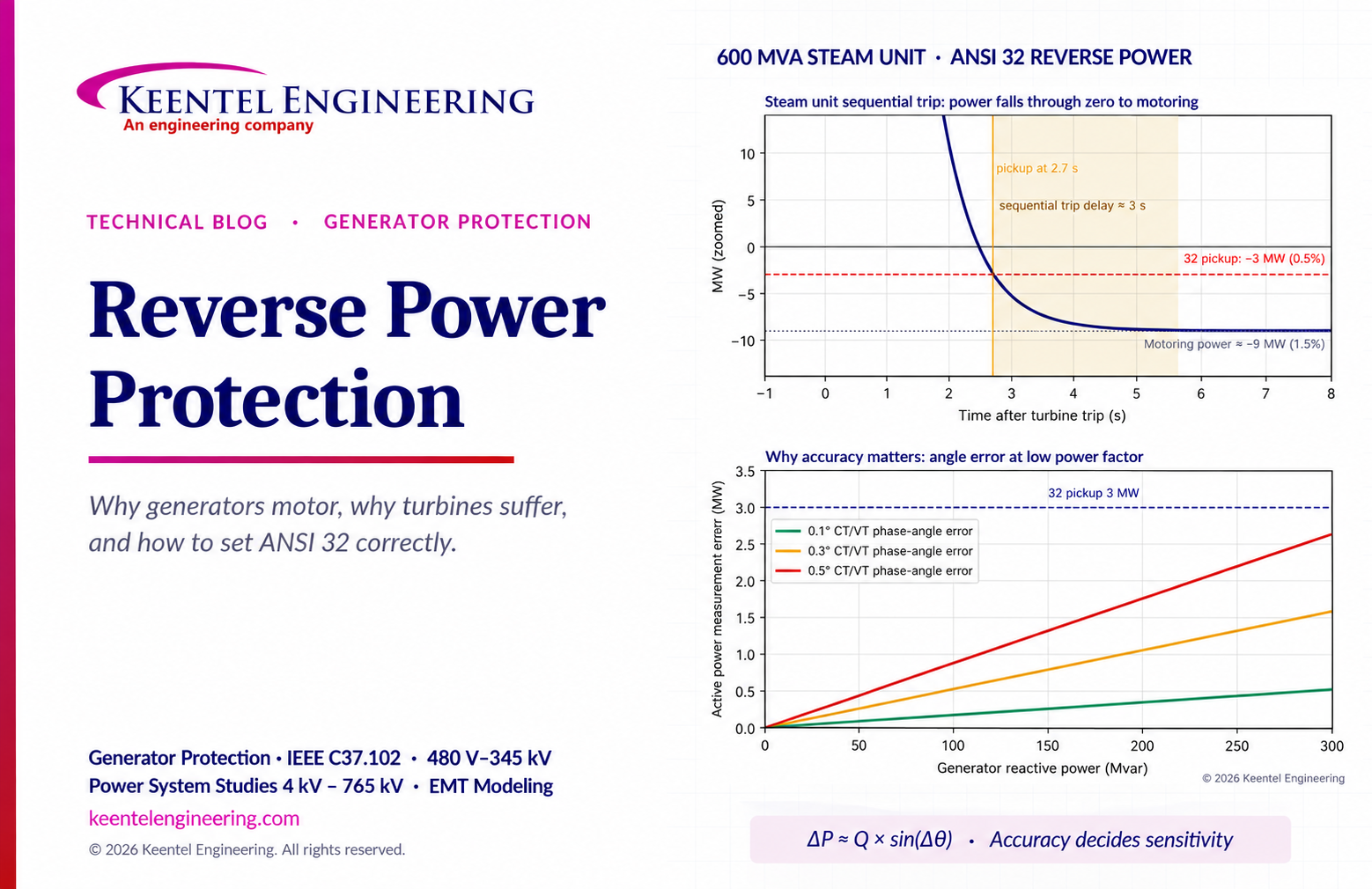
Learn reverse power protection (ANSI 32), generator motoring, relay pickup settings, time delays, sequential tripping and testing for US power plants.
Copy
By Team 2 Dexora
•
October 20, 2026
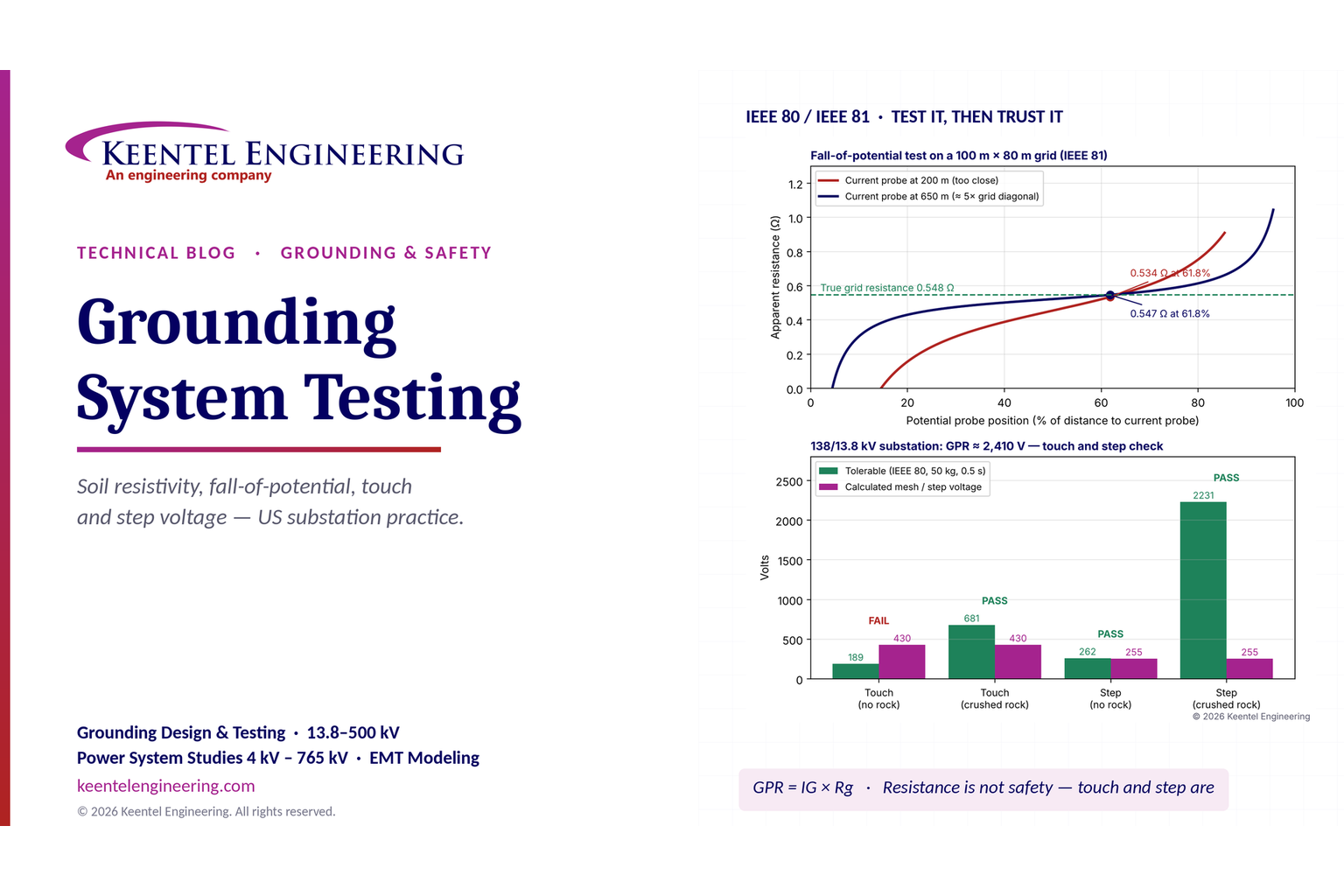
Explore grounding system testing with Keentel Engineering. Learn IEEE 80/81 methods, soil resistivity, ground resistance, and touch and step voltage safety.
By SANDIP R PATEL
•
October 13, 2026
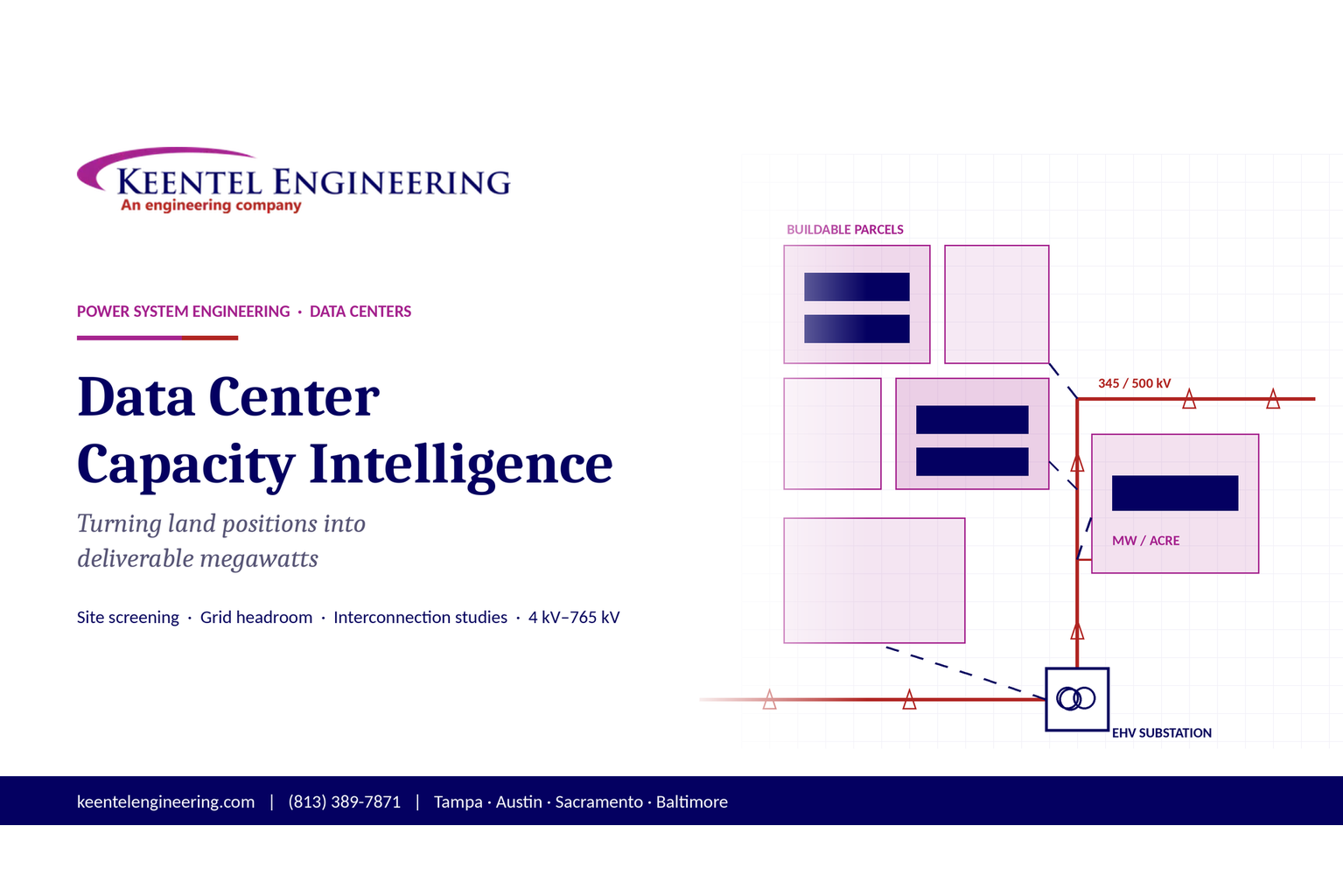
Plan data center capacity with land screening, MW-per-acre estimates, grid power availability and interconnection feasibility studies from Keentel Engineering.
By SANDIP R PATEL
•
October 11, 2026
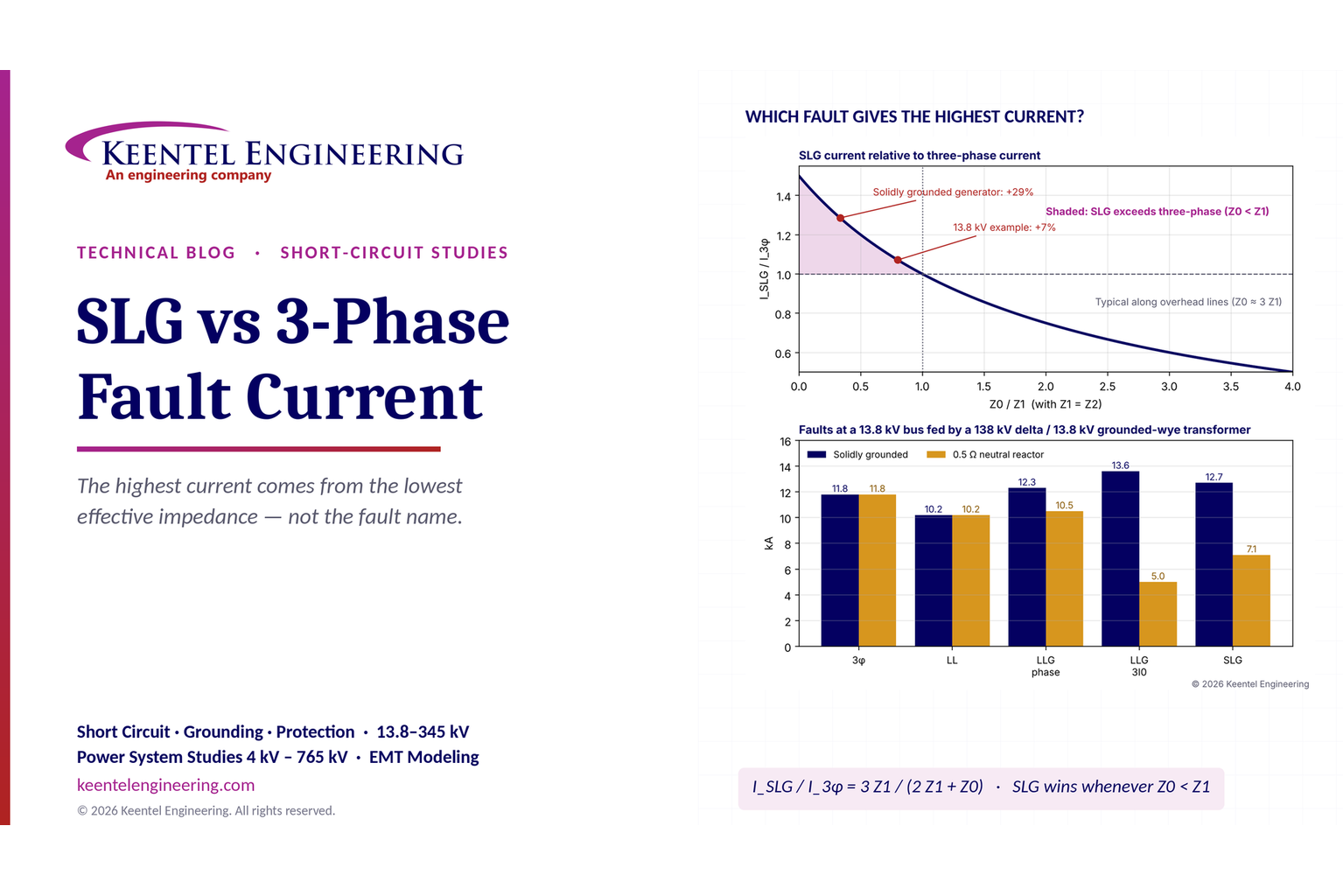
Learn which fault produces the highest current at a bus, why SLG faults can exceed three-phase faults, and how symmetrical components determine fault duty.
By SANDIP R PATEL
•
October 11, 2026
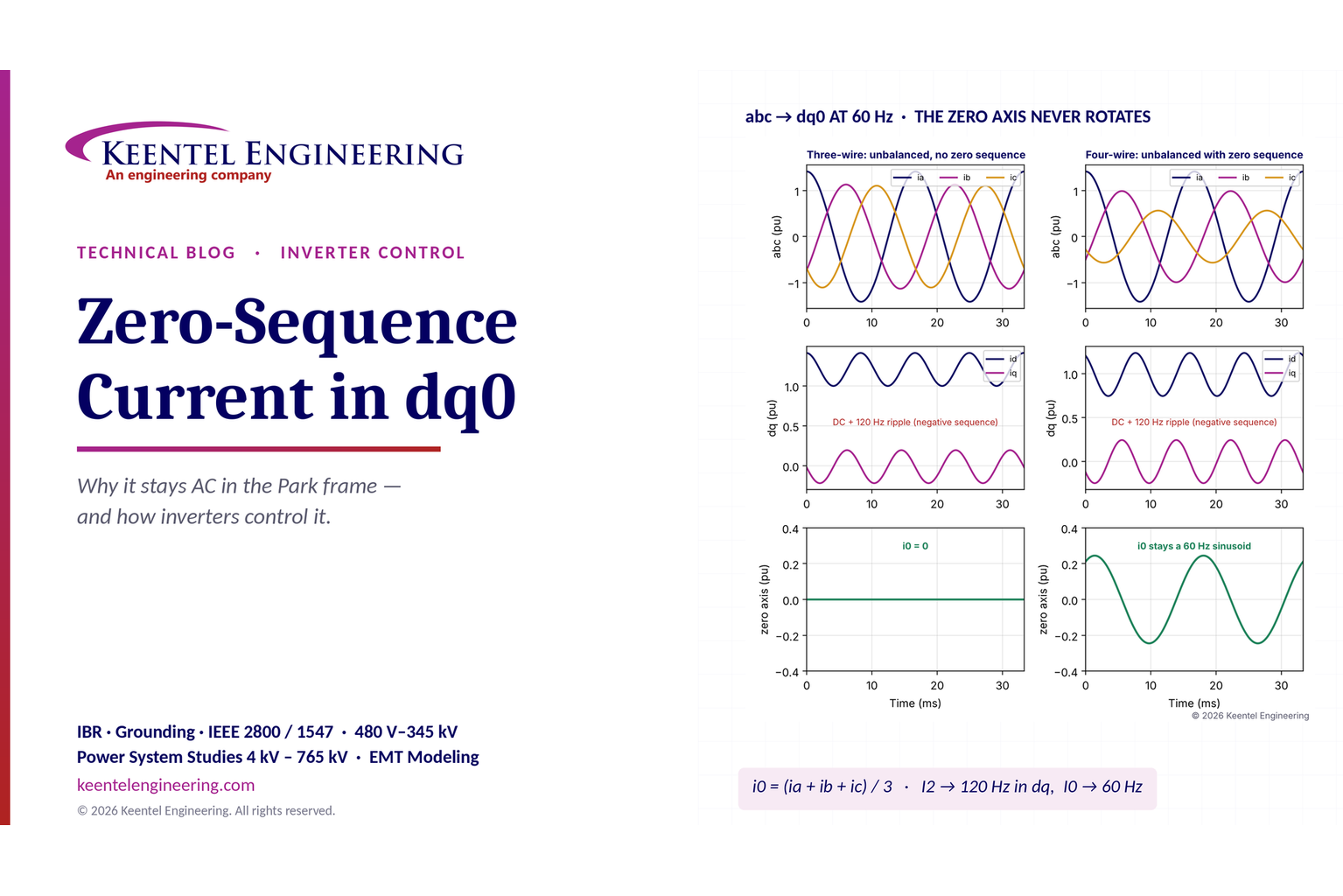
Learn why zero-sequence current pulsates in the dq0 frame, how Park's transformation works, and how inverter controls handle unbalance and ground faults.
By SANDIP R PATEL
•
October 11, 2026
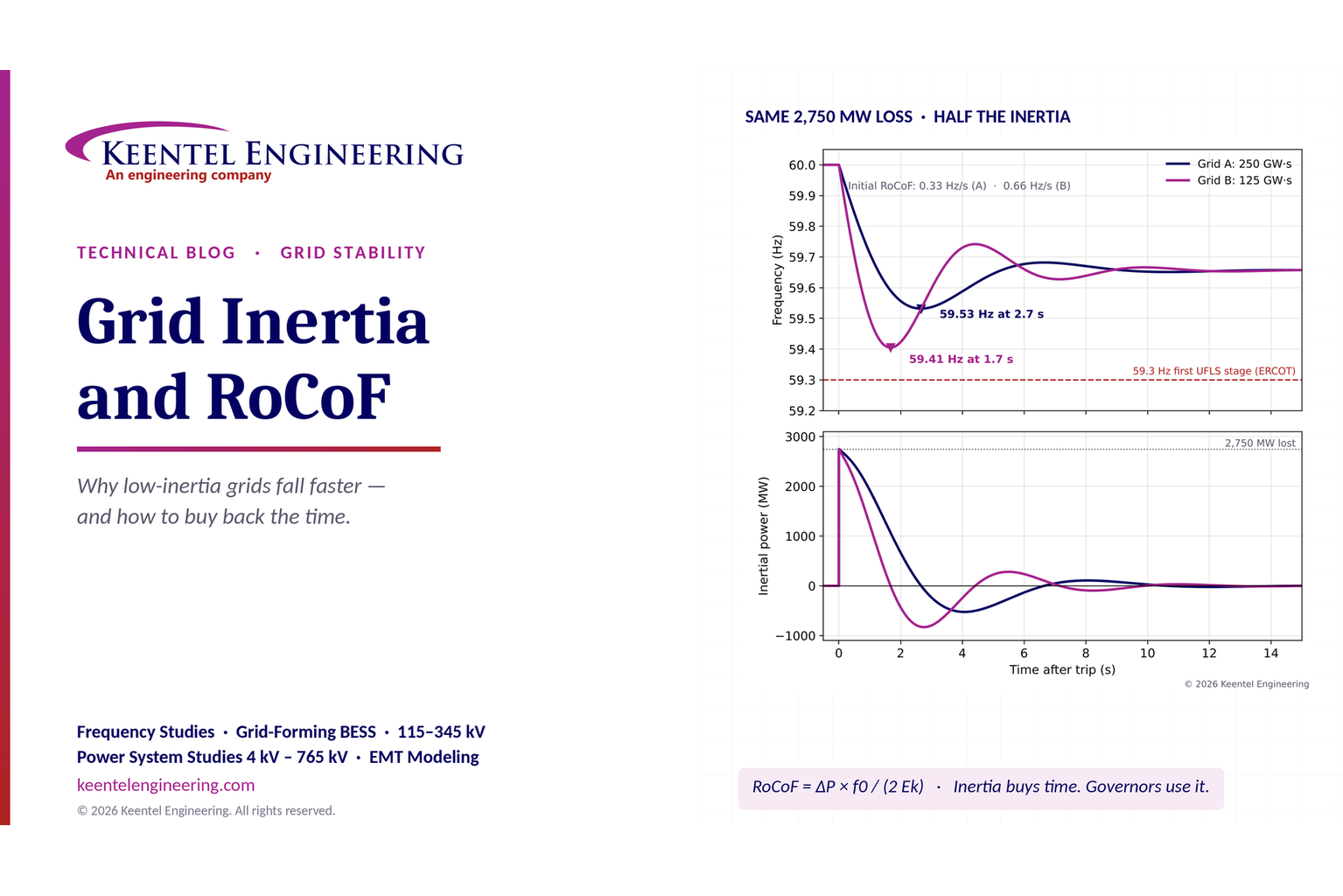
Explore grid inertia, RoCoF and frequency response, with swing equation calculations, frequency nadir analysis and US power system simulation examples.
By SANDIP R PATEL
•
October 11, 2026
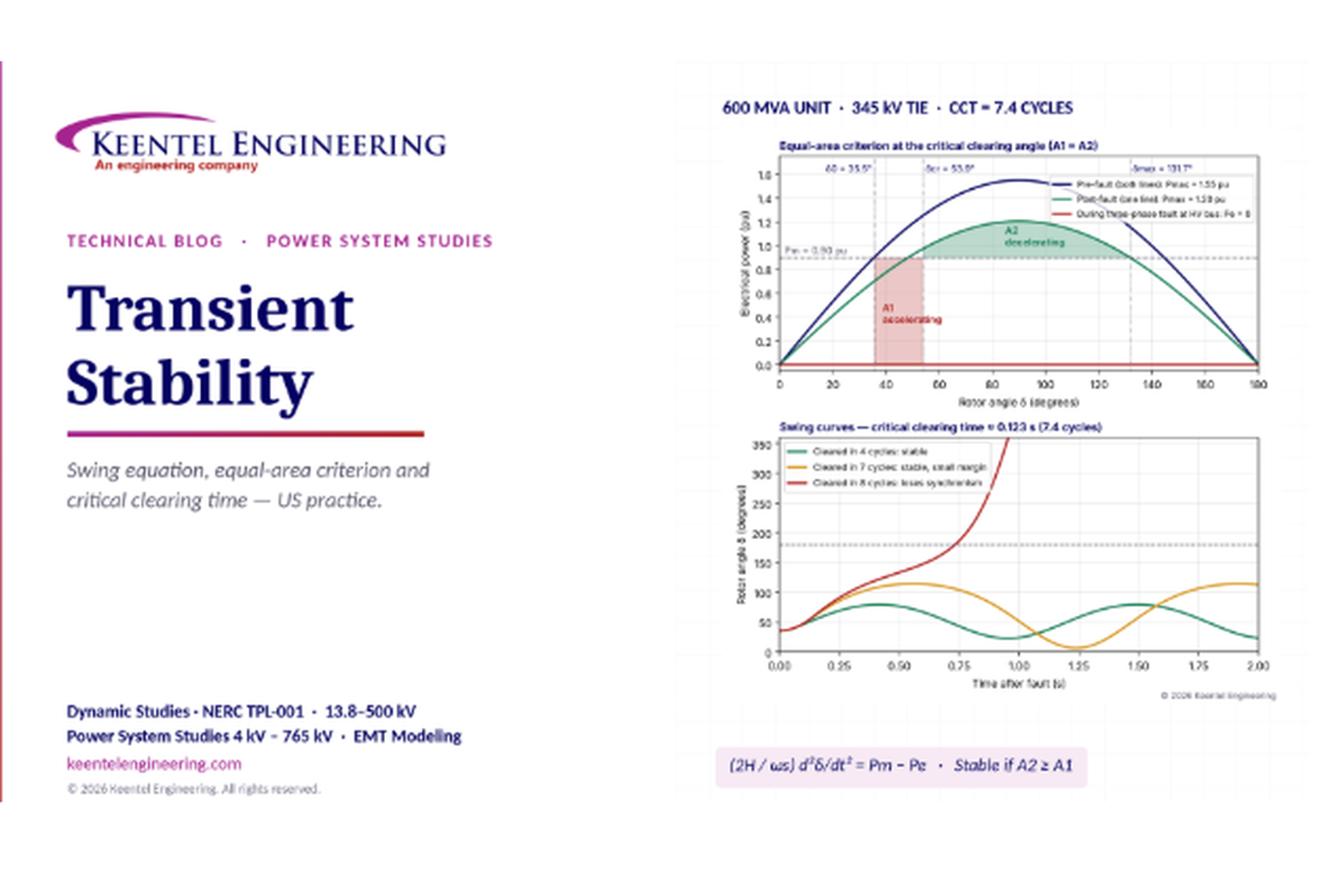
Learn transient stability analysis, swing equation, equal-area criterion and critical clearing time with a 345 kV worked example and NERC TPL-001 guidance.
By SANDIP R PATEL
•
October 11, 2026
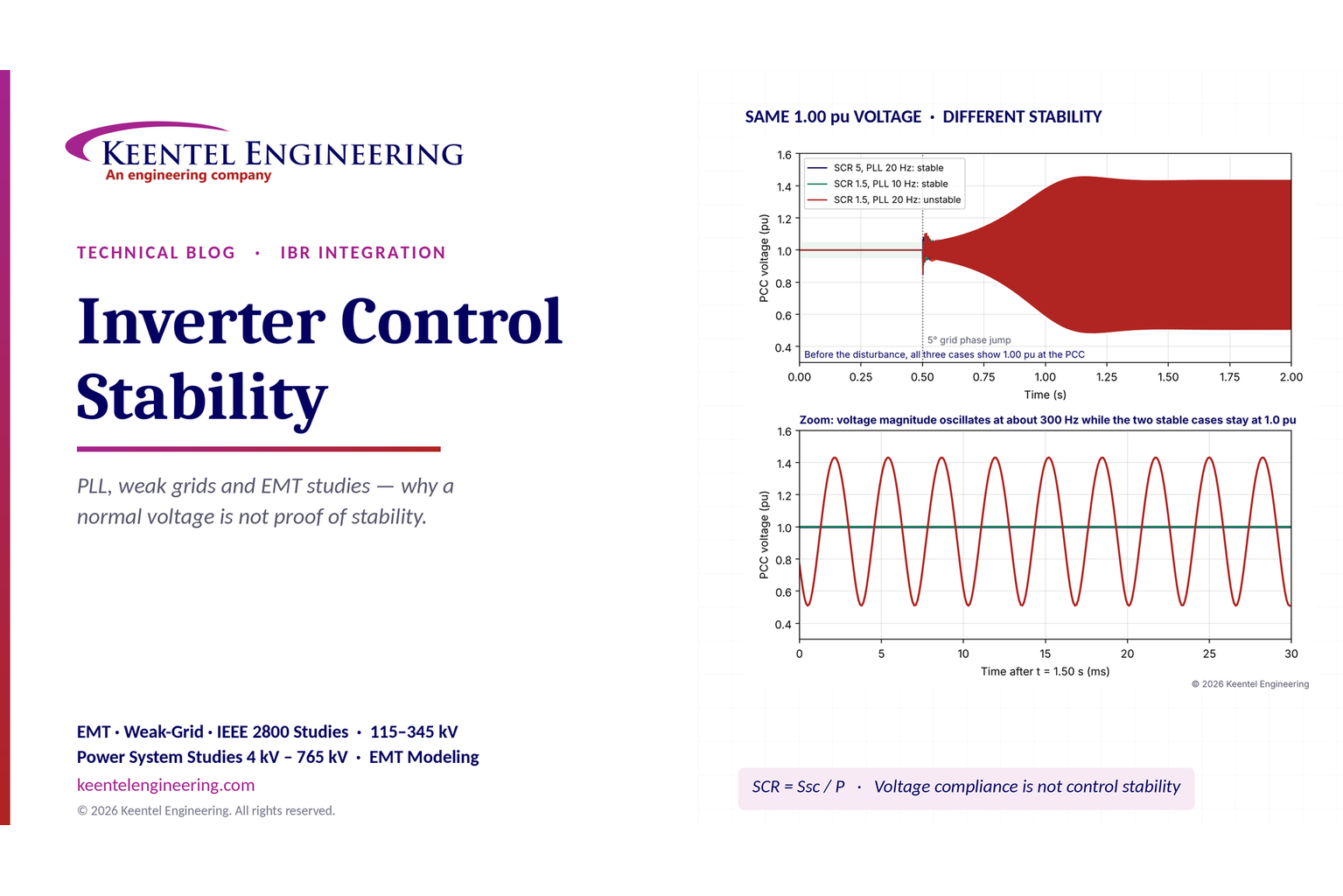
Learn why inverter controls become unstable in weak grids, how PLL bandwidth and SCR affect stability, and how PSCAD EMT studies identify and mitigate oscillations.