

A Coordinated Electric System Interconnection Review—the utility’s deep-dive on technical and cost impacts of your project.

Challenge: Frequent false tripping using conventional electromechanical relays
Solution: SEL-487E integration with multi-terminal differential protection and dynamic inrush restraint
Result: 90% reduction in false trips, saving over $250,000 in downtime

Battery Energy Storage Project Financing in the U.S: Tax Credits, Tariffs & Market Strategy

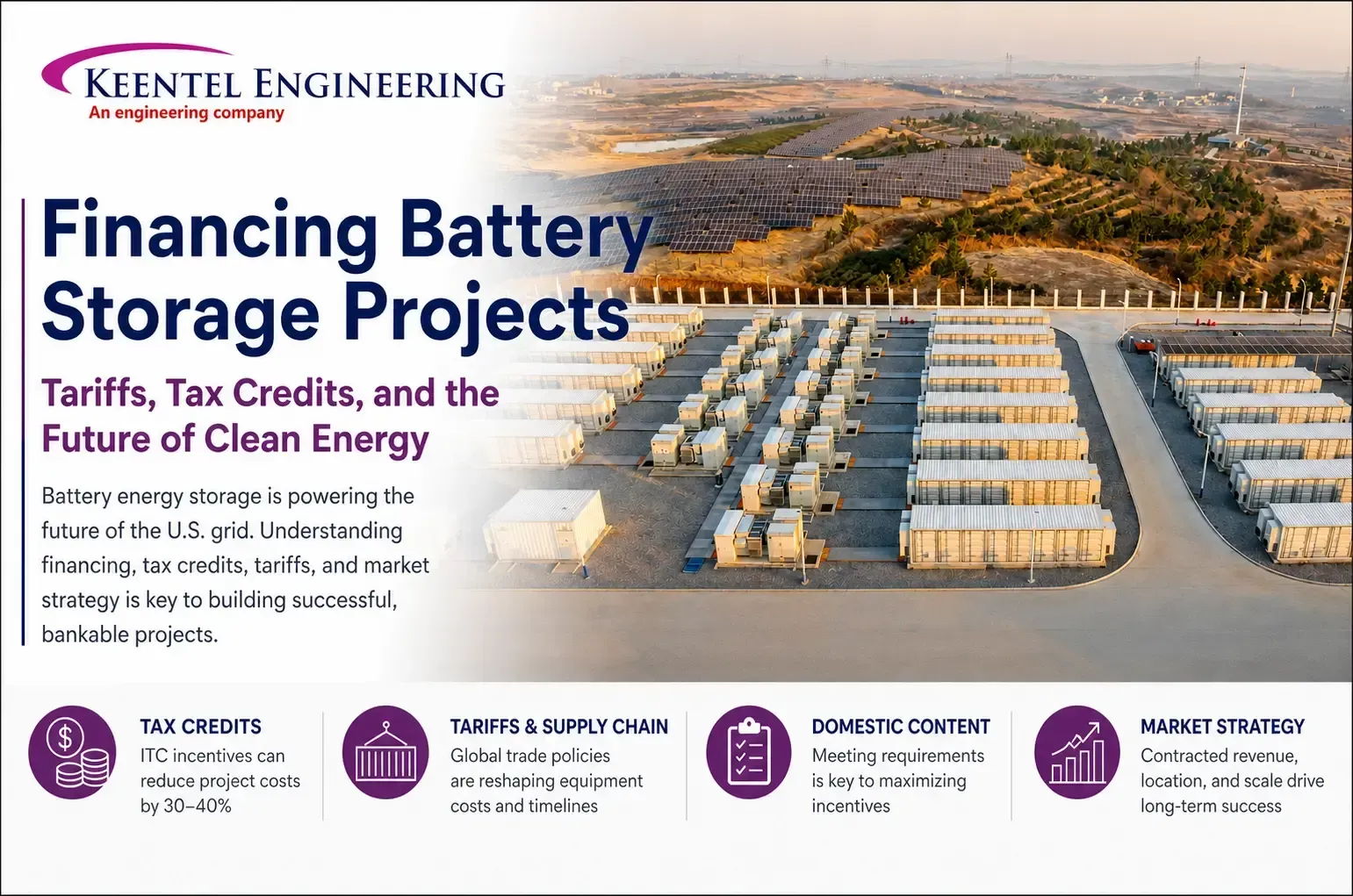
Battery storage financing project with utility-scale BESS and solar farm infrastructure
Calendar icon. D

May 2, 2026 | Blog

Introduction

Battery Energy Storage Systems (BESS) are no longer a niche technology—they are rapidly becoming the backbone of the modern electric grid. As renewable penetration increases and electricity demand surges—especially from AI data centers and electrification—energy storage is emerging as a critical infrastructure asset.


However, financing battery storage projects in the United States is becoming increasingly complex. Developers must navigate evolving tax policies, tariffs, supply chain constraints, and shifting revenue models. Insights from industry leaders reveal that success in this space requires not only capital—but strategic agility.


This article explores the real-world financing landscape of U.S. battery storage projects, focusing on tax credits, tariffs, domestic content challenges, and evolving business models.


1. The Rise of Battery Storage as Core Grid Infrastructure

Battery storage has transitioned from a supporting technology to a primary reliability tool for the grid.

Unlike traditional generation:


  • Batteries provide instantaneous response 
  • They enable energy arbitrage (buy low, sell high) 
  • They stabilize frequency and manage volatility 
  • They support peak demand and contingency events 


In fact, recent grid behavior demonstrates that batteries are already reshaping electricity markets. In regions like Texas, sustained high temperatures no longer result in extreme price spikes—largely due to battery deployment reducing volatility .


This signals a fundamental shift:


  • Batteries are not just storage they are market-makers.

2. The Evolution of Revenue Models: From Merchant to Contracted Cash Flows

Early battery developers relied heavily on merchant revenue models, including:


  • Energy arbitrage 
  • Ancillary services (frequency regulation) 


However, these revenue streams are declining due to market saturation.


As more batteries enter the grid:


  • Arbitrage spreads shrink 
  • Ancillary service prices collapse 
  • Revenue becomes less predictable 


This has forced a strategic shift.


New Financing Reality

Developers are increasingly prioritizing:


  • Long-term contracts (tolling agreements) 
  • Utility-backed revenue streams 
  • Corporate offtake agreements (e.g., data centers) 


As highlighted in the industry:


  • Long-term contracted revenue is becoming essential for financing large-scale battery portfolios .
  • This transition mirrors the evolution seen in wind and solar—but is happening much faster.

3. The Inflation Reduction Act (IRA) and Tax Credit Advantage

One of the most critical drivers of battery project financing is the Investment Tax Credit (ITC).


Key Observations


  • Batteries remain eligible for tax credits even as solar/wind face tighter deadlines 
  • Projects with ITC support can gain a 30–40% cost advantage 
  • Access to tax credits directly impacts project competitiveness 


The “Safe Harbor” Strategy


Developers are aggressively locking in tax credits by:


  • Procuring equipment early 
  • Initiating construction activities 
  • Making binding capital commitments 


This process—known as safe harboring—allows projects to qualify for tax incentives even if completed later.


Well-capitalized developers are already securing multi-year pipelines through early procurement strategies .


Market Impact


This creates a divide:


  • Winners: Capital-rich developers with tax credit access 
  • Losers: Smaller players without procurement or financing capacity 

4. Tariffs and Supply Chain Disruption

Battery storage economics are heavily influenced by global supply chains—especially China.


Key Challenge


  • ~80%+ of lithium iron phosphate (LFP) battery production is based in China 


Impact of Tariffs


  • Increased equipment costs 
  • Procurement uncertainty 
  • Accelerated buying before policy changes 


Developers are responding by:


  • Stockpiling equipment ahead of tariffs 
  • Diversifying suppliers 
  • Exploring domestic manufacturing 


Uncertainty Factor


Tariff policy volatility has reached unprecedented levels:


  • Rapid policy changes 
  • Political unpredictability 
  • Investment hesitation


This has made timing decisions critical in project financing.


5. Domestic Content Requirements: A Double-Edged Sword

To qualify for enhanced tax credits , projects must meet domestic content thresholds.


The Reality


  • Enclosures, inverters: Often U.S.-made 
  • Battery cells: Mostly imported 


This creates a major bottleneck:


  • The battery cell remains the most difficult component to localize in the U.S. supply chain .


Emerging Solutions


  • U.S. manufacturing plants (e.g., LG, AESC) 
  • Incentives under Section 45X 
  • Non-Chinese supply chains 


Risk for Developers


  • Domestic supply is insufficient today 
  • Projects risk missing eligibility thresholds 
  • Cost premiums for U.S.-based components 

6. Capital Strategy: The Importance of Financial Strength

One of the strongest themes in the market is clear:

Battery storage is becoming a capital-intensive, scale-driven business.


Key Trends


  • Large funds backing developers (e.g., private equity) 
  • Multi-gigawatt pipelines 
  • Portfolio-based risk management 


Developers are increasingly:


  • Investing ahead of certainty 
  • Accepting early-stage risk 
  • Leveraging scale advantages 


This leads to industry consolidation:


  • Smaller players struggle 
  • Larger, well-capitalized firms dominate 

7. New Demand Driver: AI and Data Centers

A major emerging factor in battery financing is hyperscale data center demand.


Why It Matters


Data centers:


  • Require massive, continuous power 
  • Demand speed and reliability 
  • Are willing to pay premium prices 


Battery Use Cases


  • Backup and reliability 
  • Load smoothing for AI fluctuations 
  • Microgrid and islanded operation 


AI-driven load variability can swing hundreds of megawatts in seconds—batteries are uniquely suited to manage this .


Financing Opportunity


  • Direct contracts with tech companies 
  • New long-term offtake structures 
  • Higher creditworthy counterparties


This could redefine battery project economics.


8. Strategic Differentiators for Successful Projects

From a financing perspective, successful battery developers are focusing on:


1. Location Strategy


  • Near demand centers (not just generation) 
  • On the “right side” of transmission constraints 


2. Technology Flexibility


  • Avoiding single-vendor dependency 
  • Maintaining procurement optionality 


3. Revenue Strategy


  • Contracted vs merchant balance 
  • Hybrid financing structures 


4. Operational Model


  • Third-party optimization vs in-house 
  • Data-driven trading strategies 

9. The Future Outlook: Rapid Growth with Market Consolidation

Battery storage is growing faster than any energy technology in history.


Key Expectations


  • Continued rapid deployment 
  • Increased role in grid stability 
  • Expansion into new markets 


But Also


  • Policy-driven uncertainty 
  • Capital concentration 
  • Supply chain evolution


Ultimately:


The winners will be those who can adapt quickly to changing market conditions and policy environments .


Frequently Asked Questions (FAQs)

  • 1. What is the primary revenue model for battery storage projects today?

    The industry is shifting from merchant-based revenues (arbitrage and ancillary services) toward long-term contracted revenues, such as tolling agreements and corporate offtake contracts. This provides predictable cash flow necessary for financing.


  • 2. How do tax credits impact battery storage project economics?

    Tax credits like the Investment Tax Credit (ITC) can reduce project costs by 30–40%, significantly improving returns and making projects competitive. Developers without access to these credits face a major disadvantage.


  • 3. What is “safe harboring” in battery project financing?

    Safe harboring is a strategy where developers:

    • Start construction or procurement early 
    • Commit capital 
    • Lock in tax credit eligibility 

    This allows projects to benefit from incentives even if completed later.


  • 4. Why are tariffs a major concern for battery projects?

    Tariffs increase the cost of imported battery components—especially from China, which dominates global supply. This impacts project economics and creates procurement uncertainty.


  • 5. What are domestic content requirements?

    To qualify for enhanced tax credits, a certain percentage of project components must be manufactured in the U.S. The challenge lies in sourcing battery cells domestically, which are still largely imported.


  • 6. Why are batteries critical for AI and data centers?

    AI data centers have highly volatile power demand. Batteries:

    • Stabilize load fluctuations 
    • Provide backup power 
    • Enable faster deployment of power infrastructure 

  • 7. What is the biggest risk in battery storage financing today?

    The biggest risks include:

    • Policy and regulatory uncertainty 
    • Supply chain dependency 
    • Revenue volatility from merchant markets 

  • 8. Are battery projects still profitable without tax credits?

    They can be, but margins are tighter. Tax credits significantly improve project economics. Without them, developers must rely more on strong contracts and efficient operations.


  • 9. Why are large, well-capitalized developers dominating the market?

    Because:

    • They can absorb risk 
    • They can secure equipment early 
    • They can lock in tax credits 
    • They operate at scale 

    This creates a barrier to entry for smaller developers.


  • 10. What is the future of battery storage financing in the U.S.?

    The future will likely include:

    • More structured, contract-based financing 
    • Increased involvement from institutional investors 
    • Greater integration with large energy consumers like tech companies 

  • 11. Should battery storage be co-located with renewables?

    Not necessarily. Many developers now prefer locating batteries near load centers to maximize value and reduce transmission constraints.


  • 12. How fast is the battery storage market growing?

    Faster than any previous energy technology. In just a few years, multiple gigawatts have been deployed—outpacing historical growth rates of wind and solar.


A smiling man with glasses and a beard wearing a blue blazer stands in front of server racks in a data center.

About the Author:

Sonny Patel P.E. EC

IEEE Senior Member

In 1995, Sandip (Sonny) R. Patel earned his Electrical Engineering degree from the University of Illinois, specializing in Electrical Engineering . But degrees don’t build legacies—action does. For three decades, he’s been shaping the future of engineering, not just as a licensed Professional Engineer across multiple states (Florida, California, New York, West Virginia, and Minnesota), but as a doer. A builder. A leader. Not just an engineer. A Licensed Electrical Contractor in Florida with an Unlimited EC license. Not just an executive. The founder and CEO of KEENTEL LLC—where expertise meets execution. Three decades. Multiple states. Endless impact.

Four workers in safety vests and helmets stand with arms crossed near wind turbines.

Let's Discuss Your Project

Let's book a call to discuss your electrical engineering project that we can help you with.

Man in a blazer and open shirt, looking at the camera, against a blurred background.

About the Author:

Sonny Patel P.E. EC

IEEE Senior Member

In 1995, Sandip (Sonny) R. Patel earned his Electrical Engineering degree from the University of Illinois, specializing in Electrical Engineering . But degrees don’t build legacies—action does. For three decades, he’s been shaping the future of engineering, not just as a licensed Professional Engineer across multiple states (Florida, California, New York, West Virginia, and Minnesota), but as a doer. A builder. A leader. Not just an engineer. A Licensed Electrical Contractor in Florida with an Unlimited EC license. Not just an executive. The founder and CEO of KEENTEL LLC—where expertise meets execution. Three decades. Multiple states. Endless impact.

Leave a Comment

Related Posts

US Grid Code Requirements – Droop Control & Fast Frequency Response (FFR) | BESS IEEE 2800
By SANDIP R PATEL May 4, 2026
Learn how droop control and fast frequency response (FFR) enable IEEE 2800 compliance for BESS, solar, and wind in US grid interconnections.
ASPEN OneLiner V15 advanced protection system modeling white paper cover for relay coordination
By SANDIP R PATEL May 3, 2026
Master ASPEN OneLiner V15 for protection system modeling, relay coordination, and fault analysis. Learn advanced power system workflows today.
PJM Cycle 1 Interconnection Infographic: 220 GW Storage & Grid Update
By SANDIP R PATEL May 2, 2026
PJM's Cycle 1 reform brings a 220 GW storage-led pipeline. See how BESS and new modeling impact grid reliability.
CAISO IPE 5.0 Cluster 16 deliverability and queue management infographic
By SANDIP R PATEL May 2, 2026
Discover CAISO IPE 5.0 interconnection updates, including queue reforms, deliverability changes, and Cluster 16 impacts. Learn how it affects your projects.
FERC Order 2023 interconnection process diagram showing power generation
By SANDIP R PATEL May 1, 2026
FERC Order 2023: interconnection reforms, cluster studies & grid impact. Learn key changes fast.
SEL-2240 Axion industrial automation platform
By SANDIP R PATEL May 1, 2026
Explore SEL-2240 Axion, a modular I/O control system with RTAC automation and EtherCAT networking. Discover applications, features, and benefits.
Transmission line design infographic with BIM and power engineering solutions
By SANDIP R PATEL April 27, 2026
Explore advanced transmission line design services with BIM modeling, automated calculations, digital twins, and power engineering solutions by Keentel.
PJM Dynamic Model Guidelines 2026 infographic for utility-scale interconnection,
By SANDIP R PATEL April 27, 2026
Learn PJM dynamic model development, PSS®E model validation, and interconnection compliance requirements. Discover expert strategies for approval.
PJM NextGen application guide for utility-scale energy projects with solar, wind and battery storage
By SANDIP R PATEL April 25, 2026
Master the PJM NextGen application guide for utility-scale projects. Learn interconnection steps, technical data, and avoid delays. Get started today.