
A Coordinated Electric System Interconnection Review—the utility’s deep-dive on technical and cost impacts of your project.
Challenge: Frequent false tripping using conventional electromechanical relays
Solution: SEL-487E integration with multi-terminal differential protection and dynamic inrush restraint
Result: 90% reduction in false trips, saving over $250,000 in downtime
The three operating regions you have to design to
| Device | Output vs voltage | Response | Best suited to | Main limitations |
|---|---|---|---|---|
| Mechanically switched capacitor or reactor | Proportional to voltage squared | Seconds; discrete steps; limited switching operations per day | Steady-state reactive supply, voltage profile, loss reduction | No dynamic capability; step voltage change on switching; capability collapses when most needed |
| Static var compensator | Capacitive branches proportional to voltage squared | A few cycles; continuously controllable | Continuous control where cost matters and deep voltage support is not the driver | Square-law capability loss; harmonic filters are part of the plant and interact with the network |
| STATCOM | Approximately proportional to voltage — constant current capability | One to two cycles closed loop; converter response faster still | Voltage stability margin, weak interconnections, fast disturbance recovery, flicker and unbalance compensation | Higher capital cost; converter losses; adds a converter and its control dynamics to the network |
| Synchronous condenser | Governed by machine capability and excitation | Excitation response in the hundreds of milliseconds; inherent inertial response instantaneous | System strength and inertia, short-circuit contribution, black start support | Rotating plant with maintenance and losses; slower controlled response than a converter |
| STATCOM with energy storage | Reactive as a STATCOM, plus real power within the storage rating | As STATCOM for reactive; real power limited by storage | Where a real power deficiency is part of the problem | Cost and complexity of the storage; different failure and maintenance profile |
| Stage | Keentel scope | Outcome |
|---|---|---|
| Screening | Series-compensation proximity, radial contingency review, UIF and short-circuit ratio screening, frequency scans | Early identification of which SSO types apply |
| Detailed studies | PSCAD/EMTDC EMT studies with vendor real-code models, impedance-based and frequency-scan analysis | Clear evidence of stability margins or risk |
| Model quality | EMT model review, benchmarking against positive-sequence models, model acceptance support | Models that system operators accept |
| Mitigation | Control retuning recommendations with vendors, SSDC and bypass logic requirements, protection and monitoring specifications | Practical, coordinated solutions |
| Interconnection support | SSR and SSO study reports for ISO and utility requirements, response to reviewer comments | Fewer delays in the interconnection process |
Resilience: designing CDUs to the facility Tier objective
Liquid cooling makes heat removal more critical, not less. Cold plates hold only seconds of thermal buffer. If TCS flow stops, processors throttle or shut down very quickly. Resilience design must therefore cover:
- Pump redundancy: N+1 pumps at minimum, with automatic changeover.
- CDU redundancy: N+1 CDUs on a common TCS header, or 2N CDUs serving A and B manifolds for fault-tolerant designs.
- Power to CDUs: dual-corded CDUs fed from A and B sources, with pumps and controls on UPS power so coolant keeps flowing through a utility failure and generator start. This is the liquid-cooling equivalent of continuous cooling.
- Facility water continuity: chilled water or condenser water must also continue, through thermal storage, UPS-backed pumps or a high enough FWS temperature that the TCS can coast on stored thermal mass for the transfer period.
- Concurrent maintainability: isolation valves so any CDU, pump, filter or manifold section can be serviced without stopping the others.
- Leak management: leak detection, drip trays, automatic isolation valves and procedures for fluid spills.
Electrical engineering considerations
CDUs and liquid-cooling plants are electrical loads with their own design requirements:
- Pump motors and VFDs. Large CDUs use variable-frequency drives on their pump motors. These introduce harmonic current that must be included in the facility's harmonic study and IEEE 519 evaluation.
- Critical mechanical load on UPS. Putting CDU pumps on UPS increases UPS and battery sizing. The mechanical UPS load must be included in redundancy and ride-through calculations.
- Feeder and protection design. Dual feeds, automatic transfer, selective coordination and arc-flash labelling apply to CDU power distribution just as they do to IT power.
- Generator transient response. CDU pumps restarting together after a transfer create motor inrush on the generators. Staged restarts and soft acceleration reduce the step load.
- Load dynamics. AI training loads can swing rapidly between high and low power. Cooling controls must track those swings without temperature overshoot, and electrical systems must handle both the IT and the cooling load changes.
Commissioning a liquid-cooled data hall
- Flush and clean the TCS piping and manifolds to the specified cleanliness, using high-purity flush water.
- Fill and vent with the specified coolant, verifying glycol concentration and chemistry.
- Pressure test for leaks at design and test pressures, including quick-disconnect fittings.
- Verify sensors and controls: flow meters, temperature sensors, pressure transmitters, leak detection and BMS points.
- Load test with heat load banks connected through the cold-plate interfaces or rack manifolds, across the operating range.
- Prove the heat balance on both loops at several load steps, and the approach temperature against the design.
- Test failure scenarios: pump failure, CDU failure, power transfer to generator, valve failure and loss of facility water, confirming temperatures stay within the IT vendor's limits.
How Keentel Engineering helps
Keentel Engineering supports data center owners, developers and EPCs with the electrical engineering that liquid-cooled facilities depend on, and coordinates with the mechanical engineer of record and cooling vendors on the integrated design.
BESS ROI: Peak Shaving, Energy Arbitrage and Power Quality Value — A US Engineering and Economics Guide
October 10, 2026 | Blog
Part A — BESS ROI at a Glance
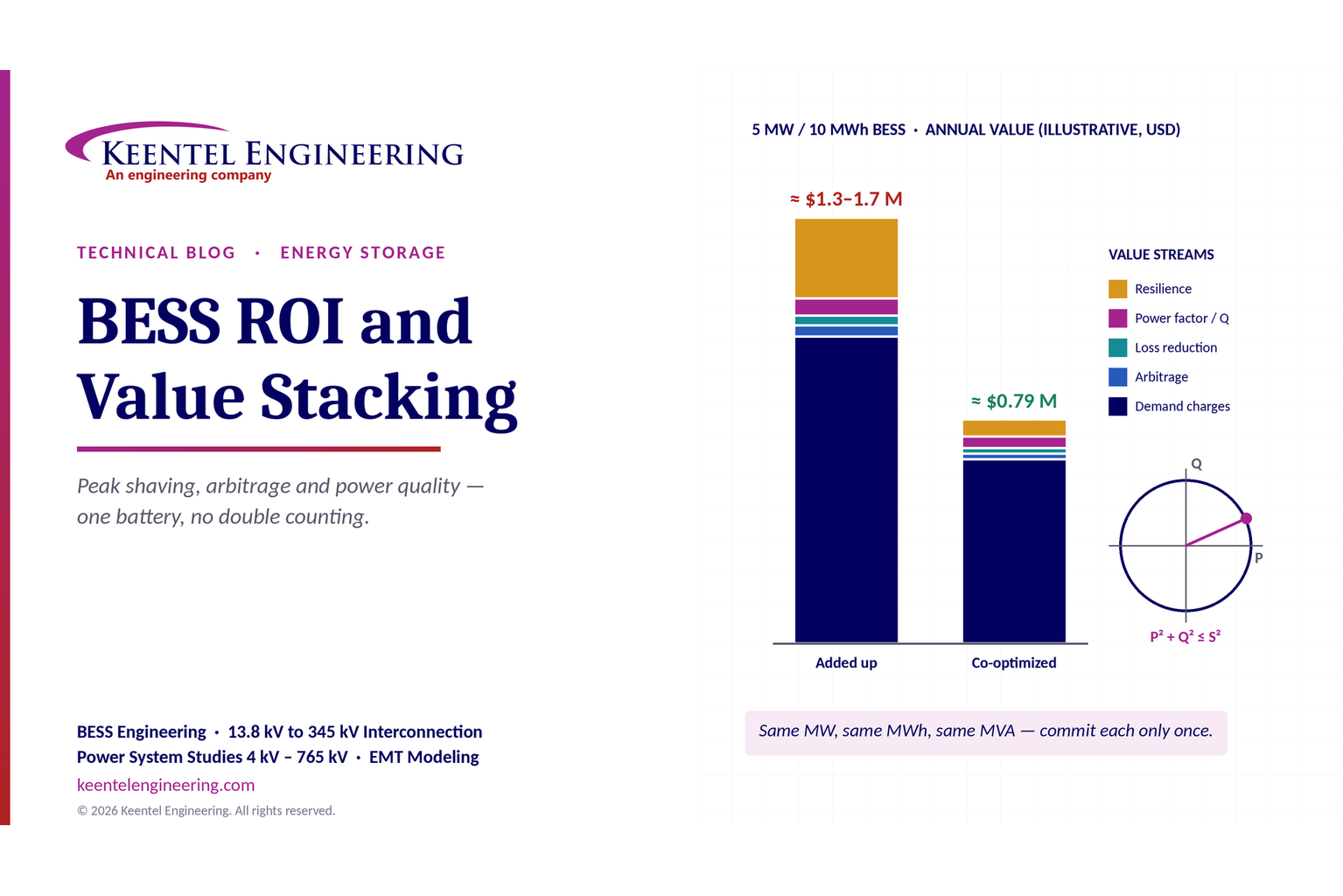
A battery energy storage system (BESS) does not create value simply by storing electricity. Its value comes from knowing when to charge, when to discharge, when to support the grid and when to hold capacity back for something more important. A single battery can serve several value streams, but it has one set of physical limits: one MW rating, one MWh capacity and one inverter (PCS) apparent-power rating.
One battery, multiple value streams
| Value stream | What the BESS does | What limits it |
|---|---|---|
| Peak shaving (demand charge reduction) | Discharges during the facility's peak billing intervals to lower billed demand | MW rating, MWh to sustain the reduction, forecast accuracy, tariff design |
| Energy arbitrage | Charges when energy is cheap and discharges when it is expensive (time-of-use or wholesale LMP) | Price spread, round-trip efficiency, degradation cost, cycle limits |
| Loss reduction | Supplies load locally, reducing current and I²R losses in transformers and feeders | Only during discharge; charging can increase losses elsewhere |
| Power quality | Provides reactive power, voltage support, power factor correction and flicker mitigation | PCS apparent-power limit shared with active power |
| Outage support (resilience) | Supplies critical loads during a grid outage | Reserved state of charge, islanding capability, critical load size |
The core rules
- The same MW cannot be committed twice. Peak shaving and grid services both draw on the same power rating.
- The same MWh cannot be discharged twice. Arbitrage, peak shaving and backup compete for the same stored energy.
- The same MVA cannot be used twice. Active and reactive power share the PCS rating: P² + Q² ≤ S².
- A lower peak is not automatically a lower bill. The tariff, billing interval and ratchet clauses decide what a reduction is worth.
BESS ROI is not value stacking. It is value orchestration. The smartest battery is not the one that cycles most — it is the one that knows when not to cycle.
Part B — BESS ROI: Peak Shaving, Energy Arbitrage and Power Quality Value — A US Engineering and Economics Guide
Commercial and industrial (C&I) battery storage in the US has moved from pilot projects to standard practice for facilities with high demand charges, critical processes or weak supply points. At the same time, utility-scale storage participates in wholesale energy, capacity and ancillary service markets. In both cases the investment case usually rests on several value streams. This guide explains how each stream works under US tariffs and markets, why the values cannot simply be added, and how engineers build a bankable return on investment (ROI) using chronological co-optimization.
A typical US C&I BESS configuration
The example in this guide is a 5 MW / 10 MWh lithium iron phosphate (LFP) BESS at an industrial facility with a 21 MW peak load.
| Element | Typical US configuration |
|---|---|
| Utility service | 69 kV or 138 kV transmission service, or 13.8 kV to 34.5 kV primary distribution service |
| Facility distribution | 13.8 kV or 4.16 kV switchgear, 480 V low-voltage distribution |
| BESS connection | PCS output at 480 to 690 V, stepped up to the 13.8 kV facility bus |
| Metering | Utility revenue meter with 15-minute (sometimes 30-minute) demand intervals |
| Controls | Energy management system (EMS) with load, price and weather forecasts, interfaced with SCADA and protection |
| Codes and standards | NFPA 855, UL 9540 and UL 9540A, NEC Article 706, IEEE 1547-2018 for distribution interconnection, IEEE 2800-2022 for transmission-connected plants, IEEE 519 for harmonics |
Value stream 1: peak shaving and demand charges
How US demand charges work
Most US C&I tariffs bill demand in dollars per kW per month, based on the highest average demand in any 15-minute interval of the billing period. Many tariffs add:
- Time-differentiated demand: separate on-peak, mid-peak and facility-wide demand charges.
- Ratchets: billed demand may not fall below a percentage, often 50 to 80%, of the highest demand in the previous 11 months.
- Coincident peak charges: transmission or capacity costs allocated on the facility's load during system peaks, such as ERCOT's four coincident peak (4CP) intervals or PJM's peak load contribution.
The theoretical annual saving from a sustained reduction is:

where ΔP is the demand reduction in kW and DC is the demand charge in $/kW-month. For a 5,000 kW reduction at $18/kW-month, the theoretical saving is $1,080,000 per year.
Can the battery sustain the reduction?
A 21 MW peak can fall to 16 MW with 5 MW of discharge, but only if the battery holds that reduction for the entire peak. The energy required is the area of the load profile above the target:

With 10 MWh nameplate and 90% usable depth of discharge, about 9 MWh is available:
- Short, sharp peak: if load exceeds 16 MW for 3 hours in a triangular profile, the energy required is ½ × 5 MW × 3 h = 7.5 MWh. The full 5 MW reduction is achievable.
- Broad plateau: if load stays at 21 MW for 2.5 hours, the energy required is 12.5 MWh. The battery can sustain only about 9 ÷ 2.5 = 3.6 MW of reduction.
- One missed interval: a single 15-minute interval in which the battery runs out or the forecast is wrong sets the billed demand for the entire month.
A lower peak is not automatically a lower bill. Peak shaving value is only realized if the reduction holds in every billing interval — and the tariff actually rewards it.
Value stream 2: energy arbitrage
Behind-the-meter and front-of-meter arbitrage
- Behind the meter: the BESS shifts facility consumption from high-price time-of-use (TOU) periods to low-price periods. The value is the TOU energy rate spread.
- Front of the meter: under FERC Order No. 841, storage can participate in ISO/RTO wholesale markets (ERCOT, PJM, MISO, SPP, CAISO, NYISO and ISO-NE) and earn the difference between locational marginal prices (LMPs) at charge and discharge times.
Net value per cycle
The net value of one charge-discharge cycle is:

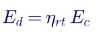
where Ed is energy discharged, Ec is energy charged, p is price and cdeg is the degradation (cycling) cost per MWh discharged. Discharged and charged energy are related by round-trip efficiency:
Example
| Parameter | Value |
|---|---|
| Energy charged | 9.0 MWh |
| Round-trip efficiency | 90% |
| Energy discharged | 8.1 MWh |
| On-peak TOU energy price | $90/MWh |
| Off-peak TOU energy price | $50/MWh |
| Degradation cost | $15/MWh discharged |
| Net value per cycle | 8.1 × 90 − 9.0 × 50 − 8.1 × 15 = $157.50 |
| Annual value at 250 cycles | ≈ $39,400 |
Two lessons follow. First, behind-the-meter TOU spreads in many US tariffs are modest, so arbitrage alone rarely justifies a C&I battery. Second, the degradation term matters: if the price spread is smaller than the cost of wear plus efficiency losses, the battery should not cycle. Wholesale markets can offer much larger spreads during scarcity events, but they are volatile and require market registration, telemetry and settlement.
Value stream 3: loss reduction
When the BESS discharges at the load, the current supplied from the utility through transformers and feeders falls. Losses fall with the square of current:
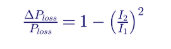
Reducing current from 1,000 A to 700 A reduces instantaneous I²R losses by 1 − 0.49 = 51%, assuming constant resistance. That is physics. But annual savings are much smaller than the instantaneous figure suggests:
- Losses fall only during discharge, typically a few hours per day.
- Charging adds current in other hours and can increase losses elsewhere in the facility or network.
- BESS conversion losses (PCS, transformer and auxiliary loads) can exceed the network losses saved.
- Facility network losses are typically a small percentage of total energy, so the dollar value is usually modest.
Annual loss savings must be calculated with an hourly or 15-minute time-series simulation, not from a single operating point.
Value stream 4: power quality and reactive power
Modern four-quadrant PCS units can provide:
- Reactive power and power factor correction, avoiding utility power factor penalties, which many US tariffs apply below 0.90 or 0.95 power factor.
- Voltage support through volt-var control, valuable at weak supply points and long distribution feeders.
- Flicker mitigation for fluctuating loads such as arc furnaces, welders and large motor starts, assessed under IEEE 1453.
- Harmonic compensation, only if the PCS and its controls are specifically designed for active filtering; compliance at the point of common coupling is judged against IEEE 519.
PCS capability is bounded by its apparent-power rating:

A 5 MVA PCS discharging 5 MW has no reactive capability left. If 2 Mvar is needed for power factor support during peak shaving, active power is limited to about 4.6 MW. Where reactive support is a design objective, the PCS is often oversized in MVA relative to battery MW.
Value stream 5: outage support and resilience
For facilities with costly downtime, backup value can be the largest stream. Real autonomy, however, is much less than nameplate:
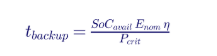
- Ideal case: with 9 MWh usable, 95% conversion efficiency and a 4 MW critical load, backup is about 2.1 hours.
- With other services active: if the EMS reserves only 40% state of charge (4 MWh) for backup because the rest is used for peak shaving and arbitrage, backup falls to about 0.95 hours.
- Islanding capability: the BESS needs grid-forming or islanded operation, a utility-approved disconnect and transfer scheme, and protection that works with limited inverter fault current. IEEE 1547-2018 governs intentional islanding behavior for distribution-connected resources.
- Auxiliary loads: HVAC, fire protection and controls draw from the battery during the outage.
The value of resilience is usually estimated from the cost of lost production per hour, outage frequency and duration, and BESS availability. It is a probability-weighted value, not a guaranteed cash flow.
The real ROI question: can one battery capture all these values?
Not without constraints.
| Requirement | Uses | Conflicts with |
|---|---|---|
| Peak shaving | MW and MWh at the facility peak | Arbitrage cycles that leave the battery empty before the peak |
| Arbitrage | MWh and cycle life | Peak shaving and backup reserves |
| Backup | Reserved state of charge at all times | Every value stream that discharges energy |
| Reactive support | PCS MVA headroom | Full-power active discharge |
| Wholesale or demand response programs | Committed MW during program events | Facility peak shaving if events do not coincide |
Illustrative value comparison for the 5 MW / 10 MWh example
| Value stream | Standalone theoretical value ($/year) | Co-optimized value ($/year) | Why it differs |
|---|---|---|---|
| Demand charge reduction | 1,080,000 | 648,000 | Energy-limited on broad peaks; forecast margin; average sustained reduction ≈ 3.0 MW |
| TOU energy arbitrage | 39,400 | 20,000 | Fewer cycles on days the battery is held for peak shaving |
| Loss reduction | 35,000 | 20,000 | Discharge hours only; charging losses offset part of the saving |
| Power factor and reactive support | 60,000 | 40,000 | PCS headroom limited during peak discharge |
| Resilience (expected value) | 95,000 to 475,000 | 60,000 | Reduced backup duration with reserved SoC; probability-weighted |
| Total | 1,309,400 to 1,689,400 | 788,000 | Theoretical values cannot be added |
The co-optimized total is roughly half to two-thirds of the theoretical sum. This is normal. A business case built on the theoretical sum will not survive due diligence.
Building a bankable ROI
Investment
| Item | Illustrative cost (USD) |
|---|---|
| BESS (battery, PCS, transformer, protection) | 3,500,000 |
| 13.8 kV switchgear, interconnection and site work | 500,000 |
| Engineering, EMS, SCADA and commissioning | 400,000 |
| Total installed cost | 4,400,000 |
Cash flow and payback
- Net annual value: $788,000 co-optimized value less about $75,000 per year for O&M, augmentation reserve and auxiliary energy gives about $713,000.
- Simple payback before incentives: about 6.2 years.
- With a 30% federal investment tax credit, if eligible: net cost of about $3.08 million and a simple payback of about 4.3 years. Eligibility, domestic content, prohibited foreign entity rules and bonus adders must be confirmed with tax counsel under current IRS guidance.
A bankable model goes beyond simple payback:
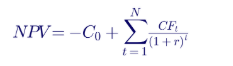
- Chronological simulation: 8,760-hour or 15-minute simulation using actual interval meter data, tariffs and price curves.
- EMS co-optimization: dispatch that decides each interval which service gets the MW, MWh and MVA.
- Degradation modeling: capacity fade as a function of cycles, depth of discharge, C-rate and temperature, with an augmentation plan.
- Tariff and market risk: sensitivity to tariff redesign, ratchet clauses, price volatility and program rule changes.
- Availability: planned and forced outages of the BESS reduce every value stream.
Bankable ROI requires chronological EMS co-optimization, degradation modeling and actual cash flows — not simply adding theoretical savings.
Engineering requirements that affect ROI
ROI depends on engineering decisions made early in the project:
- Interconnection: utility interconnection review under the state's process, IEEE 1547-2018 settings for distribution-connected systems, export or non-export agreements, and transmission-level studies for larger plants.
- Protection: relay coordination with the facility and utility system, direct transfer trip where required, and protection that works with limited inverter fault current.
- Power system studies: load flow, short circuit, arc flash (IEEE 1584), harmonic analysis (IEEE 519) and, for islanding, dynamic studies.
- Fire and life safety: NFPA 855 spacing and hazard mitigation analysis, UL 9540A large-scale fire test data, and coordination with the authority having jurisdiction.
- Metering and telemetry: revenue-grade metering for each value stream, ISO/RTO telemetry for market participation, and data to verify savings.
- EMS design: forecasting, dispatch logic, state-of-charge reserves and cybersecurity for the control system.
A BESS ROI checklist
- Collect at least 12 months of 15-minute interval data for the facility and the current tariff, including ratchets and coincident peak charges.
- Size MW and MWh from the load profile, not from the single annual peak.
- Define service priorities: which value stream wins when they conflict, especially backup reserve.
- Size the PCS in MVA if reactive power or power quality is a value stream.
- Run chronological co-optimization with realistic forecast error.
- Model degradation and augmentation over the project life.
- Confirm interconnection, protection and fire safety requirements before finalizing cost.
- Test sensitivities: tariff changes, price spreads, incentive eligibility and availability.
How Keentel Engineering helps
Keentel Engineering supports
battery storage projects from feasibility to commissioning, for C&I facilities, utilities and independent power producers, with power system studies from 4 kV to 765 kV.
| Stage | Keentel scope | Outcome |
|---|---|---|
| Feasibility and sizing | Interval data analysis, tariff review, MW/MWh/MVA sizing and value stream screening | A right-sized BESS with a realistic value case |
| ROI and dispatch analysis | Chronological co-optimization, degradation and sensitivity analysis | A bankable business case for owners and lenders |
| Interconnection | Utility applications, IEEE 1547 and IEEE 2800 assessments, load flow and short-circuit studies | Faster, cleaner interconnection approvals |
| Electrical design | 13.8 kV to 34.5 kV collection and switchgear design, grounding, protection and SCADA integration | Constructible, code-compliant designs |
| Power system studies | Arc flash, harmonics, protection coordination and islanding studies | Safe, reliable operation in every mode |
| Owner's engineer and commissioning | Vendor review, EMS specification, testing and performance verification | Systems that deliver the value they were sold on |
| Utility-scale storage | POI interconnection studies, EMT modeling, NERC compliance and market participation support | Grid-ready storage at 115 kV to 345 kV |
Why owners and developers choose Keentel Engineering
- Engineering and economics in one team: the same engineers who size the battery also model its value, so the business case matches what the equipment can physically deliver.
- Independent of vendors: Keentel does not sell batteries, so sizing and dispatch recommendations are based on the owner's data and interests.
- Grid expertise from 4 kV to 765 kV: from 13.8 kV facility switchgear to 345 kV points of interconnection, including NERC compliance and EMT modeling.
- Licensed professional engineering: a Florida-registered firm with offices in Tampa, Austin, Sacramento and Baltimore, supporting projects nationwide.
- From study to commissioning: one partner from feasibility and ROI analysis through design, interconnection, testing and performance verification.
Evaluating a battery for your facility or portfolio? Talk to Keentel Engineering at (813) 389-7871, contact@keentelengineering.com, or book a 15-minute scoping call at calendly.com/keentel-engineering/15min.
Part C — Case Studies
The following are illustrative scenarios based on conditions typical of US commercial, industrial and utility storage projects. They show how Keentel Engineering approaches BESS value and engineering problems; site details are generalised and figures are rounded.
Case Study 1 — Texas manufacturing plant: demand charges versus 4CP
Situation
A manufacturing plant with a 24 MW peak, served at 138 kV in the ERCOT region, is evaluating a 6 MW / 12 MWh BESS. The vendor proposal adds full demand charge savings, 4CP transmission savings and wholesale arbitrage into a single annual figure.
Analysis
Keentel's chronological simulation using two years of 15-minute interval data shows that the summer afternoon windows for 4CP, facility demand peaks and the highest wholesale prices overlap. The battery cannot serve all three at full value on the same days, and holding energy for possible 4CP intervals reduces arbitrage cycles.
Engineered solution
The EMS strategy prioritizes 4CP response during summer alert windows, shifts to demand charge management outside them, and limits arbitrage to days with clear spreads. PCS sizing is confirmed for the facility's power factor requirements.
Outcome
The co-optimized value is about 60% of the vendor's stacked figure, but it is supported by interval data and tariff analysis. The owner proceeds with a revised performance guarantee and an EMS specification tied to the modeled dispatch.
Case Study 2 — Mid-Atlantic cold storage facility: resilience and peak shaving
Situation
A refrigerated distribution center served at 13.8 kV wants a BESS for both demand charge reduction and backup of 3 MW of critical refrigeration load. Outages cost the facility significant product losses.
Analysis
The initial design assumed four hours of backup from a 4 MW / 12 MWh system while also cycling daily for peak shaving. Keentel's analysis shows that, at the state of charge typical after evening peak shaving, real autonomy would be less than 1.5 hours, and that islanded operation required a grid-forming PCS, a utility-approved transfer scheme and revised protection.
Engineered solution
The EMS reserves a minimum state of charge sized for two hours of critical load, increasing during severe weather alerts. Keentel designs the islanding scheme, IEEE 1547-2018 settings, protection coordination and arc flash study, and coordinates NFPA 855 requirements with the local authority.
Outcome
The facility receives a smaller but dependable peak shaving value plus verified backup capability, with a clear operating procedure that both operations staff and the utility accept.
Case Study 3 — Southeast industrial plant: power factor penalties and flicker
Situation
A plant with large motor drives and a resistance welding line, served at 69 kV through a 69/13.8 kV transformer, pays recurring power factor penalties and receives flicker complaints from the utility. A BESS is proposed mainly for peak shaving.
Analysis
Keentel's power quality study identifies reactive power and flicker mitigation as significant value streams, but the proposed 5 MVA PCS would have little reactive capacity during peak discharge. Flicker assessment to IEEE 1453 and harmonic analysis to IEEE 519 define the support required at the point of common coupling.
Engineered solution
The PCS is upsized to 6.5 MVA for a 5 MW battery, preserving about 4 Mvar of reactive capability at full active power. The EMS prioritizes dynamic reactive support during welding operations and schedules peak shaving to avoid conflicts.
Outcome
Power factor penalties are eliminated, flicker falls within utility planning levels, and peak shaving continues with only a modest reduction in active power during welding periods.
Part D — Technical FAQ: BESS ROI and Value Stacking
1. What is BESS value stacking?
Value stacking is using one battery for several services, such as peak shaving, arbitrage, power quality and backup. Because these services share the same MW, MWh and MVA, their values cannot simply be added; they must be co-optimized.
2. Why can't theoretical savings be added together?
Each standalone estimate assumes the battery is fully available for that service. In reality, discharging for arbitrage reduces energy for peak shaving and backup, and reactive support reduces active power capability. Adding standalone values double-counts the same resources.
3. How do US demand charges work?
Most C&I tariffs bill the highest 15-minute average demand in the billing period in $/kW-month. Many add on-peak demand charges, ratchets based on the previous 11 months and coincident peak charges for transmission or capacity costs.
4. Why might a lower peak not lower the bill?
If the tariff has a ratchet, if the reduction fails in even one 15-minute interval, or if the peak occurs outside the on-peak demand window, the billed demand may not fall as expected.
5. How is the energy needed for peak shaving calculated?
It is the area of the load profile above the target demand during the peak. Broad, flat peaks require much more energy than short, sharp peaks for the same MW reduction.
6. What is ERCOT 4CP?
ERCOT allocates transmission costs to large customers based on their demand during the four monthly system peak intervals in June through September. Reducing load during those intervals can substantially lower transmission charges, but the intervals must be forecast.
7. How is arbitrage value calculated?
Net value per cycle equals energy discharged times sell price, minus energy charged times buy price, minus degradation cost on the discharged energy. Round-trip efficiency links charged and discharged energy.
8. Why include degradation cost?
Every cycle consumes battery life. If the price spread does not cover efficiency losses and degradation cost, cycling destroys value. The EMS should decline unprofitable cycles.
9. Can a BESS participate in US wholesale markets?
Yes. FERC Order No. 841 requires ISOs and RTOs to allow storage to participate in energy, capacity and ancillary service markets. FERC Order No. 2222 extends participation to aggregations of distributed resources. Each market has its own registration, telemetry and settlement rules.
10. How much does a BESS reduce losses?
Instantaneous I²R losses fall with the square of current, so reducing current by 30% cuts losses by about 51%. Annual savings are much smaller because losses fall only during discharge and charging adds losses at other times.
11. What power quality services can a BESS provide?
A four-quadrant PCS can provide reactive power, power factor correction, voltage support and flicker mitigation. Harmonic compensation requires a PCS specifically designed for active filtering.
12. What does P² + Q² ≤ S² mean for a BESS?
The PCS has a fixed apparent-power rating. Any reactive power reduces the active power available. A PCS discharging at full MW rating has no reactive capability unless it is oversized in MVA.
13. How long can a BESS supply backup power?
Backup time equals available state of charge times nominal energy times conversion efficiency, divided by critical load. If the battery is also cycling for other services, available state of charge, and therefore backup time, may be much lower than nameplate suggests.
14. What is needed for a BESS to island a facility?
A grid-forming or islanding-capable PCS, a utility-approved disconnect and transfer scheme, protection that works with limited inverter fault current, IEEE 1547-2018 compliant settings and black-start capability for auxiliary loads.
15. Which codes govern C&I battery installations in the US?
Key requirements include NFPA 855 for installation and fire safety, UL 9540 for system listing, UL 9540A for fire test data, NEC Article 706 for energy storage systems, and IEEE 1547-2018 for distribution interconnection.
16. What is chronological co-optimization?
It is a time-series simulation, typically hourly or 15-minute, in which the EMS decides how to allocate MW, MWh and MVA among services in each interval, using forecasts, tariffs and prices. It produces realistic, achievable value.
17. How is battery degradation modeled?
Degradation is modeled as capacity fade from calendar aging and cycling, influenced by depth of discharge, C-rate, temperature and state of charge. Models include an augmentation plan to maintain usable energy over the project life.
18. Is the federal investment tax credit available for storage?
Standalone energy storage has been eligible for the federal investment tax credit, subject to current law, IRS guidance, domestic content, prohibited foreign entity rules and other requirements. Eligibility must be confirmed with qualified tax counsel for each project.
19. What makes a BESS business case bankable?
Use of actual interval data and tariffs, chronological co-optimized dispatch, degradation and augmentation modeling, realistic availability, sensitivity analysis and engineering cost estimates that include interconnection, protection and fire safety.
20. What is the most common mistake in BESS ROI analysis?
Adding standalone theoretical values for each service. The second most common is ignoring the engineering requirements, such as interconnection, protection, fire safety and PCS sizing, that change both cost and achievable value.
References and Further Reading
Links were current at publication (October 2026).
- IEEE Std 1547-2018, Standard for Interconnection and Interoperability of Distributed Energy Resources with Associated Electric Power Systems Interfaces. IEEE.
- IEEE Std 2800-2022, Standard for Interconnection and Interoperability of Inverter-Based Resources Interconnecting with Associated Transmission Electric Power Systems. IEEE.
- IEEE Std 519-2022, Standard for Harmonic Control in Electric Power Systems; IEEE Std 1453, Recommended Practice for the Analysis of Fluctuating Installations on Power Systems. IEEE.
- NFPA 855, Standard for the Installation of Stationary Energy Storage Systems; NFPA 70, National Electrical Code, Article 706. National Fire Protection Association.
- UL 9540, Energy Storage Systems and Equipment; UL 9540A, Test Method for Evaluating Thermal Runaway Fire Propagation. UL Solutions.
- FERC Order No. 841, Electric Storage Participation in Markets Operated by Regional Transmission Organizations and Independent System Operators; FERC Order No. 2222. Federal Energy Regulatory Commission.
- The One Big Beautiful Bill Act Brought Changes and Some Clarity to US Energy Storage Development. Energy-Storage.news.
Disclaimer
This article is general technical and economic information for educational purposes. It is not engineering, financial, tax or legal advice for any specific project and does not create a professional relationship. Tariffs, prices, costs, savings, payback periods and incentive assumptions are illustrative; actual results depend on site-specific load data, current tariffs and market rules, equipment performance, incentive eligibility and project-specific engineering analysis, sealed by a licensed professional engineer where required. Consult qualified financial and tax advisors before making investment decisions.
Case studies are illustrative scenarios based on typical project conditions, not records of specific client projects. Figures are rounded and indicative.
IEEE, NFPA, UL, FERC, ERCOT, PJM and other names are the property of their respective owners. Keentel Engineering is not affiliated with or endorsed by these organisations or any equipment manufacturer.
| Office | Address | Phone |
|---|---|---|
| Head Office — Tampa | 400 N Ashley Dr STE #2600, Tampa FL 33602 | (813) 389-7871 |
| Austin | 5900 Balcones Drive STE 100, Austin TX 78731 | (512) 591-0752 |
| Sacramento | 1401 21st St Ste R, Sacramento CA 95811 | (916) 913-4524 |
| Baltimore | 306 W Redwood St STE 200, Baltimore MD 21201 | (410) 225-2181 |
contact@keentelengineering.com · keentelengineering.com · calendly.com/keentel-engineering/15min
State of Florida — Registry No. 36853, KEENTEL LLC, DBA: KEENTEL ENGINEERING
Copyright 1995–2026 Keentel Engineering. All Rights Reserved.

About the Author:
Sandip "Sonny" R. Patel, P.E.
IEEE Senior Member · Founder & CEO, Keentel Engineering
In 1995, Sonny Patel earned his Electrical Engineering degree from the University of Illinois. But degrees don't build legacies — action does.
For three decades, he has worked the power industry from every side of the table: 16 years as a utility engineer at Exelon/Commonwealth Edison; generation leadership across hydroelectric, industrial steam turbine, and a 9 GW renewable fleet; NERC Regional Entity Senior Compliance Engineer and Audit Team Lead, auditing some of the nation's largest utilities; and testing and commissioning lead on equipment up to 765 kV — the very top of the North American grid.Utility. Generator. Regulator. Consultant. Few engineers have seen all four seats. Fewer still have sat in them.
His experience spans nuclear, hydro, conventional generation, renewables, oil and gas, mining — and today's data centers, where he is authoring a three-book series on data center design. He is a Licensed Professional Engineer in six states and a Licensed Electrical Contractor in Florida (Unlimited EC) — he doesn't just design the work; he's qualified to stand behind its execution.Today, as Founder and CEO of Keentel Engineering, Sonny leads a nationwide team of engineers delivering substation design, power system studies, NERC compliance, and commissioning — done right, coast to coast.Three decades. Every side of the table. One standard: accountable engineering.
Services

Let's Discuss Your Project
Let's book a call to discuss your electrical engineering project that we can help you with.
About the Author:
Sandip "Sonny" R. Patel, P.E.
IEEE Senior Member · Founder & CEO, Keentel Engineering
In 1995, Sonny Patel earned his Electrical Engineering degree from the University of Illinois. But degrees don't build legacies — action does.
For three decades, he has worked the power industry from every side of the table: 16 years as a utility engineer at Exelon/Commonwealth Edison; generation leadership across hydroelectric, industrial steam turbine, and a 9 GW renewable fleet; NERC Regional Entity Senior Compliance Engineer and Audit Team Lead, auditing some of the nation's largest utilities; and testing and commissioning lead on equipment up to 765 kV — the very top of the North American grid.
Utility. Generator. Regulator. Consultant. Few engineers have seen all four seats. Fewer still have sat in them.
His experience spans nuclear, hydro, conventional generation, renewables, oil and gas, mining — and today's data centers, where he is authoring a three-book series on data center design. He is a Licensed Professional Engineer in six states and a Licensed Electrical Contractor in Florida (Unlimited EC) — he doesn't just design the work; he's qualified to stand behind its execution.
Today, as Founder and CEO of Keentel Engineering, Sonny leads a nationwide team of engineers delivering substation design, power system studies, NERC compliance, and commissioning — done right, coast to coast.Three decades. Every side of the table. One standard: accountable engineering.
Leave a Comment
Thank you for contacting us.
We will get back to you as soon as possible.
We will get back to you as soon as possible.
Oops, there was an error sending your message.
Please try again later.
Please try again later.
Related Posts
By SANDIP R PATEL
•
October 11, 2026
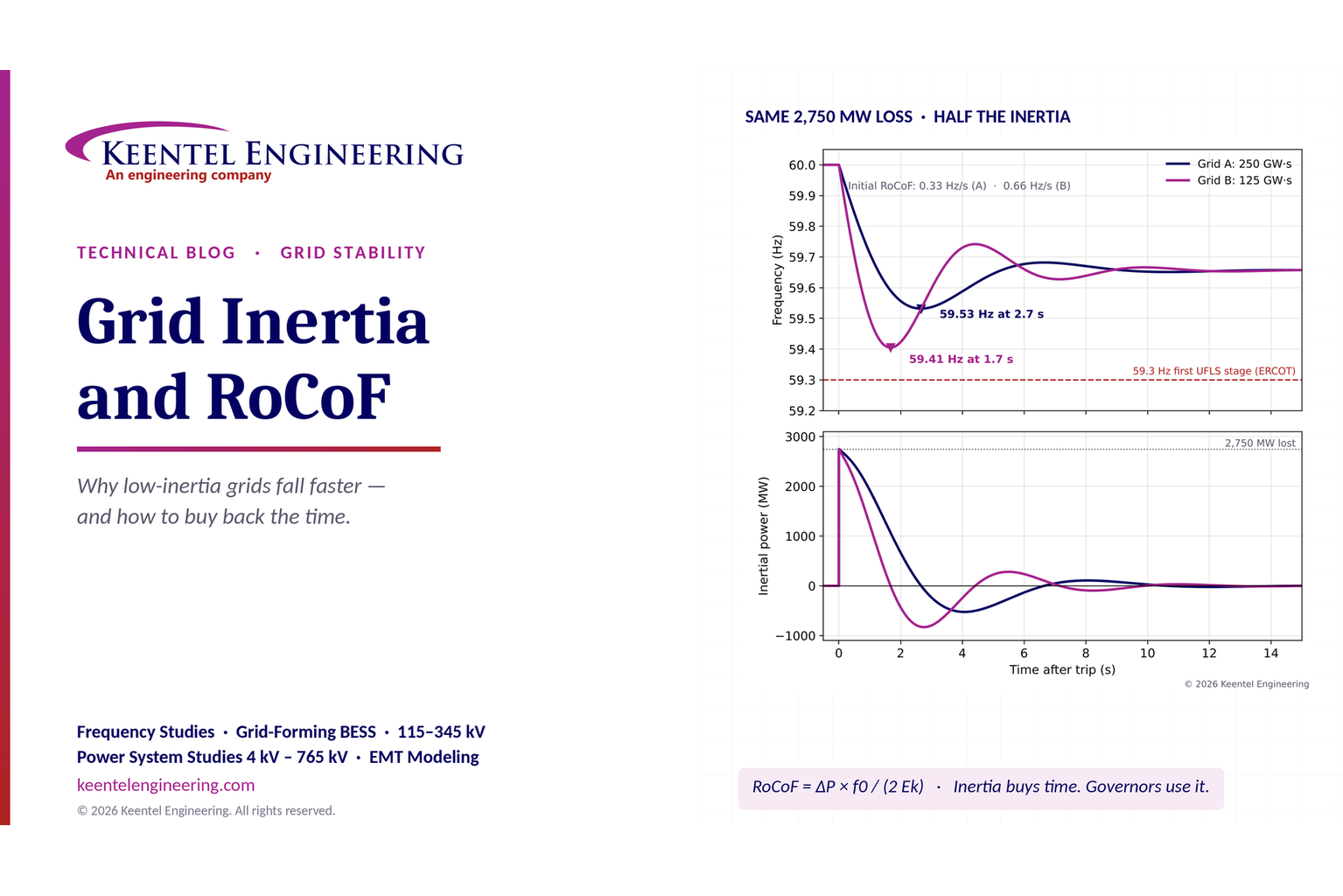
Explore grid inertia, RoCoF and frequency response, with swing equation calculations, frequency nadir analysis and US power system simulation examples.
By SANDIP R PATEL
•
October 10, 2026
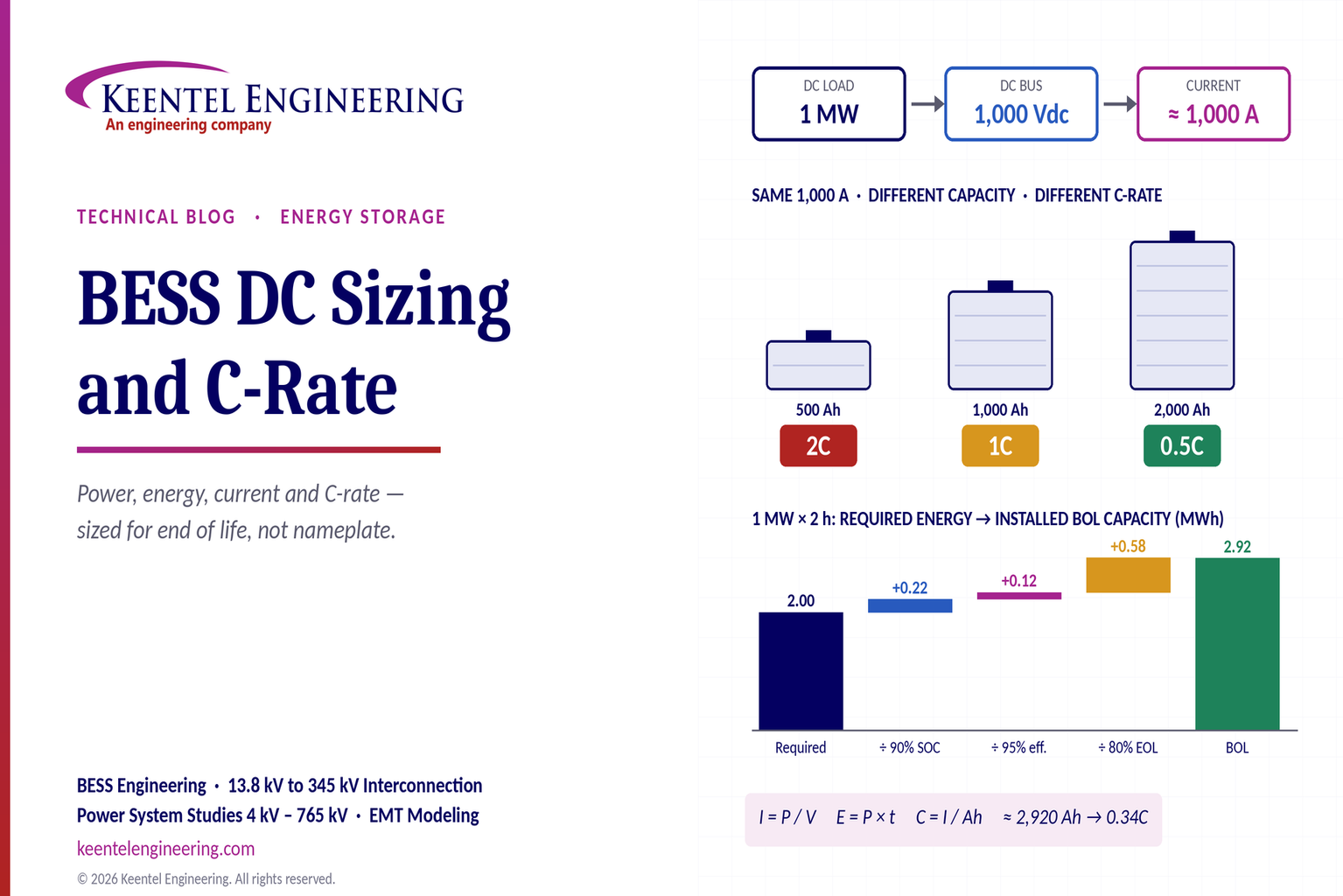
Learn BESS DC sizing with power, energy, current and C-rate calculations, battery losses, degradation and a 100 MW/400 MWh utility-scale example.
By SANDIP R PATEL
•
October 10, 2026
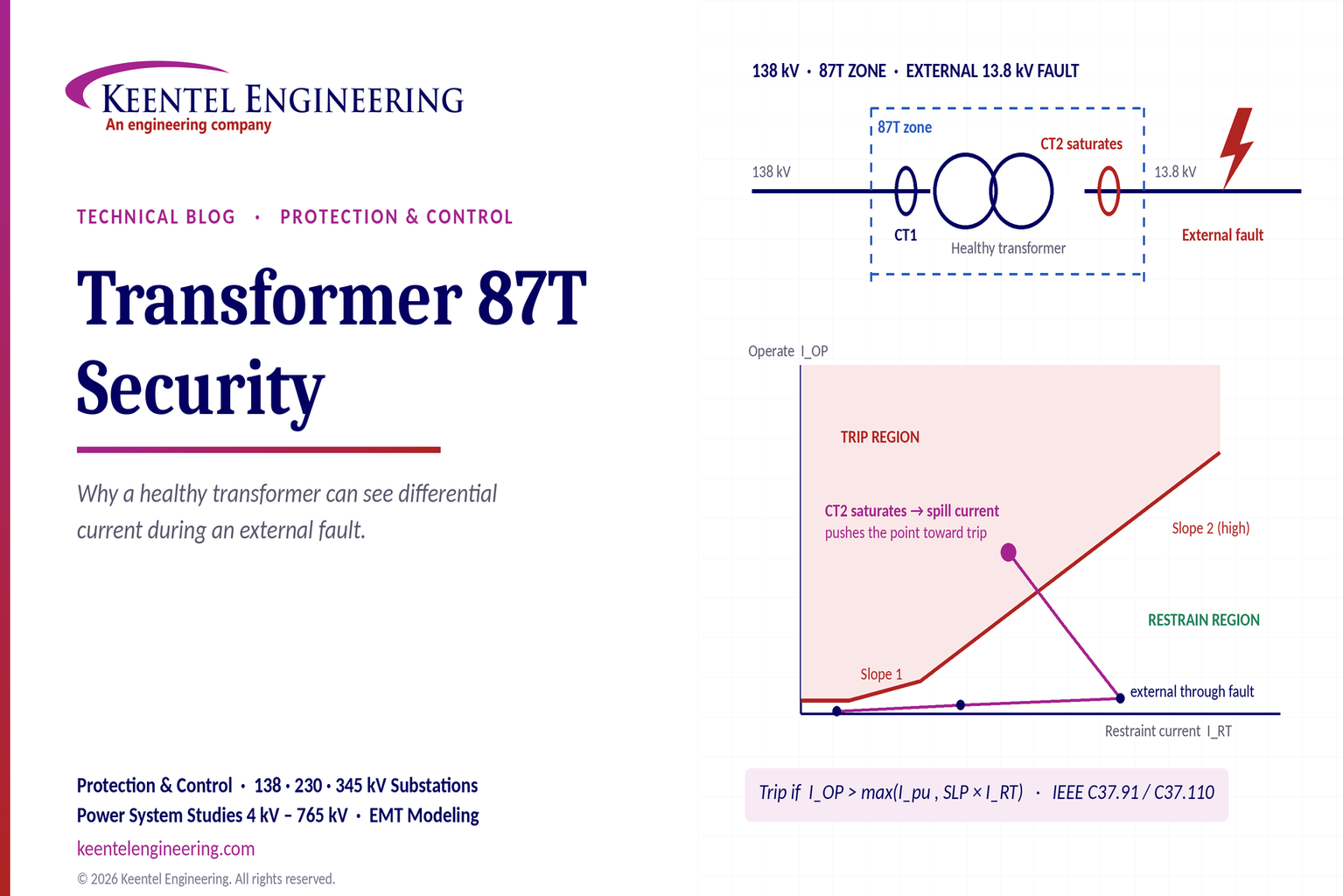
Learn why transformer differential relays detect current during external faults, how CT saturation causes spill current, and how secure 87T protection prevents trips.
By SANDIP R PATEL
•
October 10, 2026
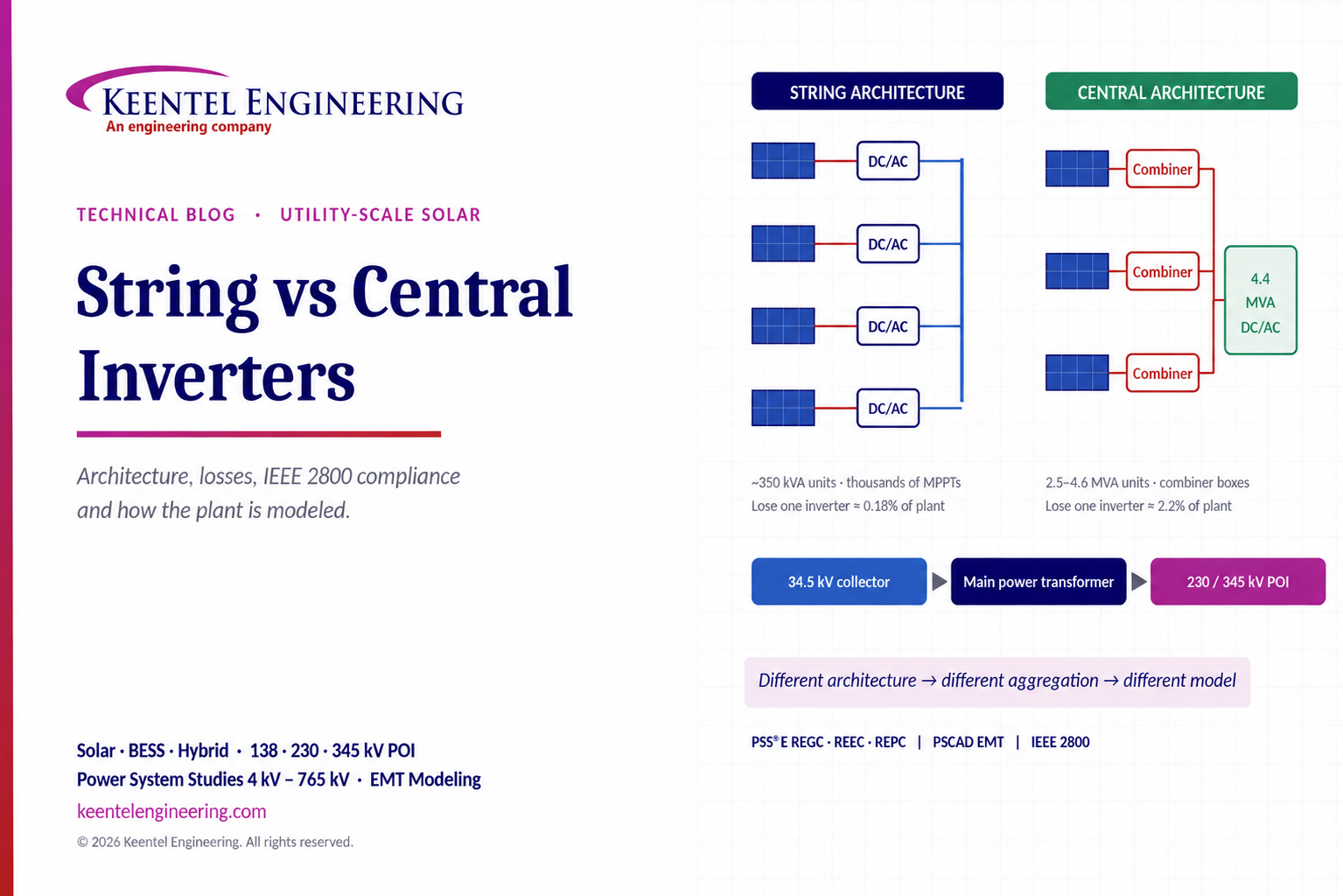
Compare string vs central inverters for utility-scale solar, including efficiency, maintenance, grid compliance, reactive power and interconnection studies.
By SANDIP R PATEL
•
October 3, 2026
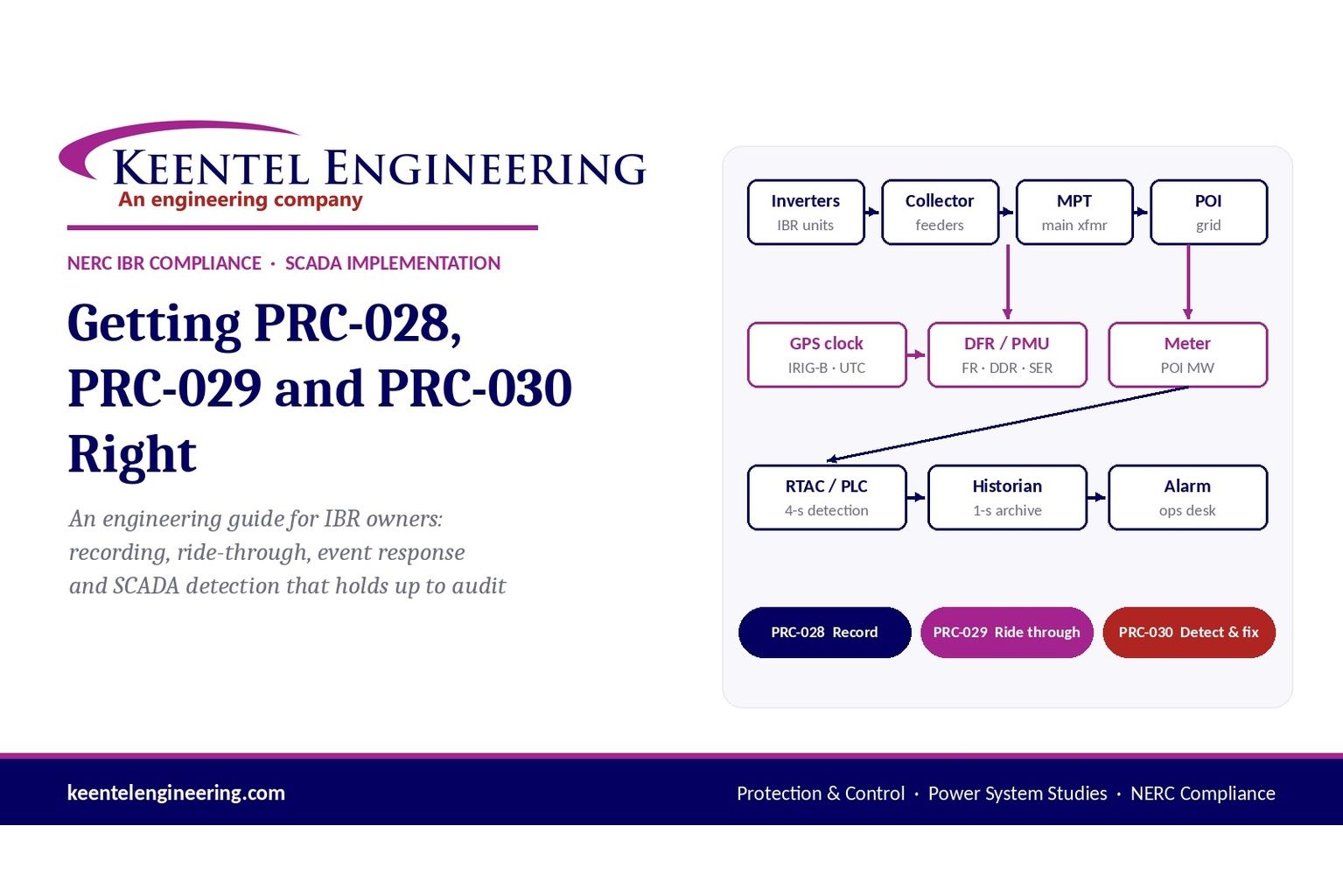
Engineering guide to PRC-028 disturbance recording, PRC-029 ride-through and PRC-030 event detection for inverter-based resources.
By SANDIP R PATEL
•
October 3, 2026
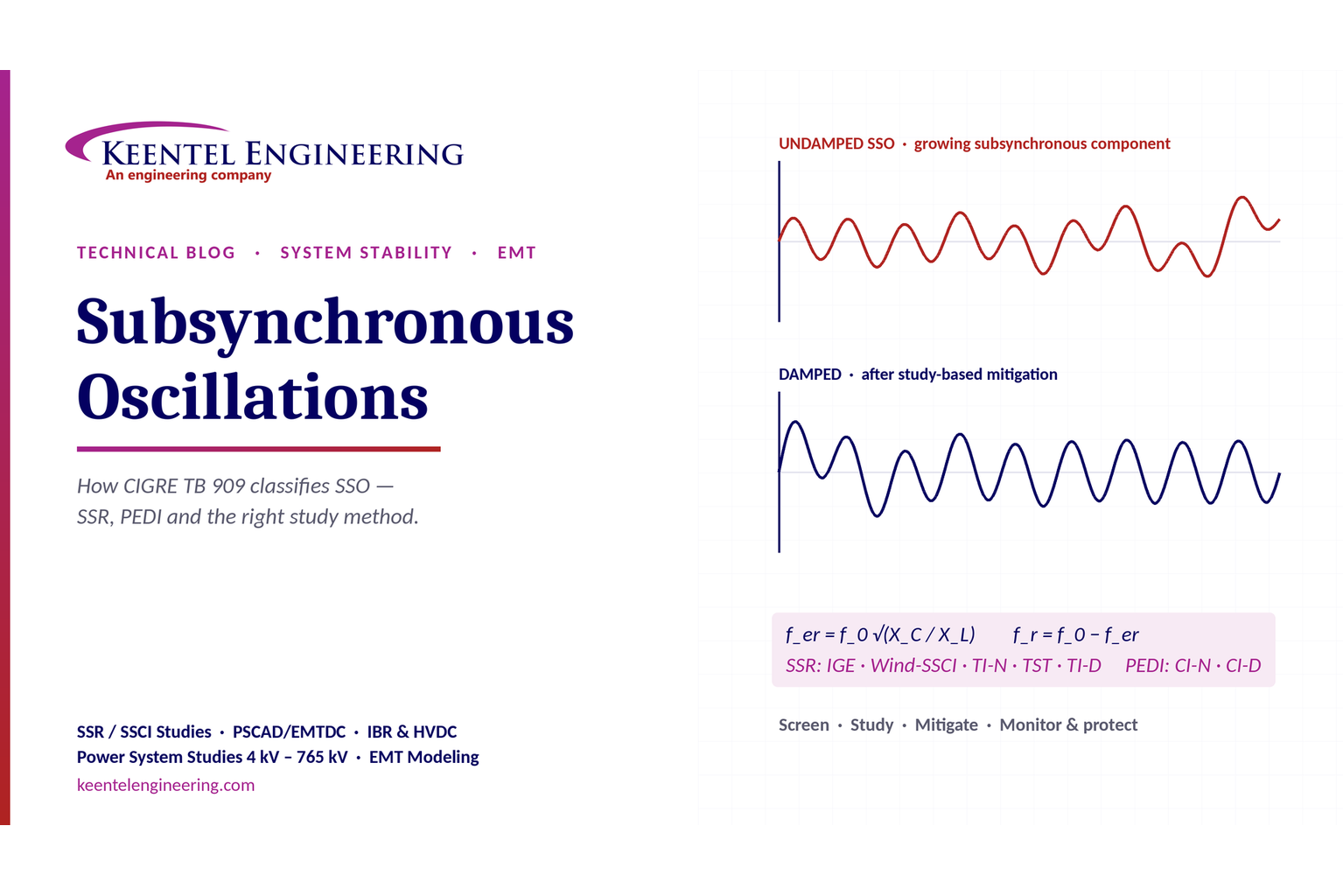
A practical guide to SSO classification, SSR, PEDI, Wind-SSCI, EMT analysis, mitigation and protection based on CIGRE TB 909.
By SANDIP R PATEL
•
October 3, 2026
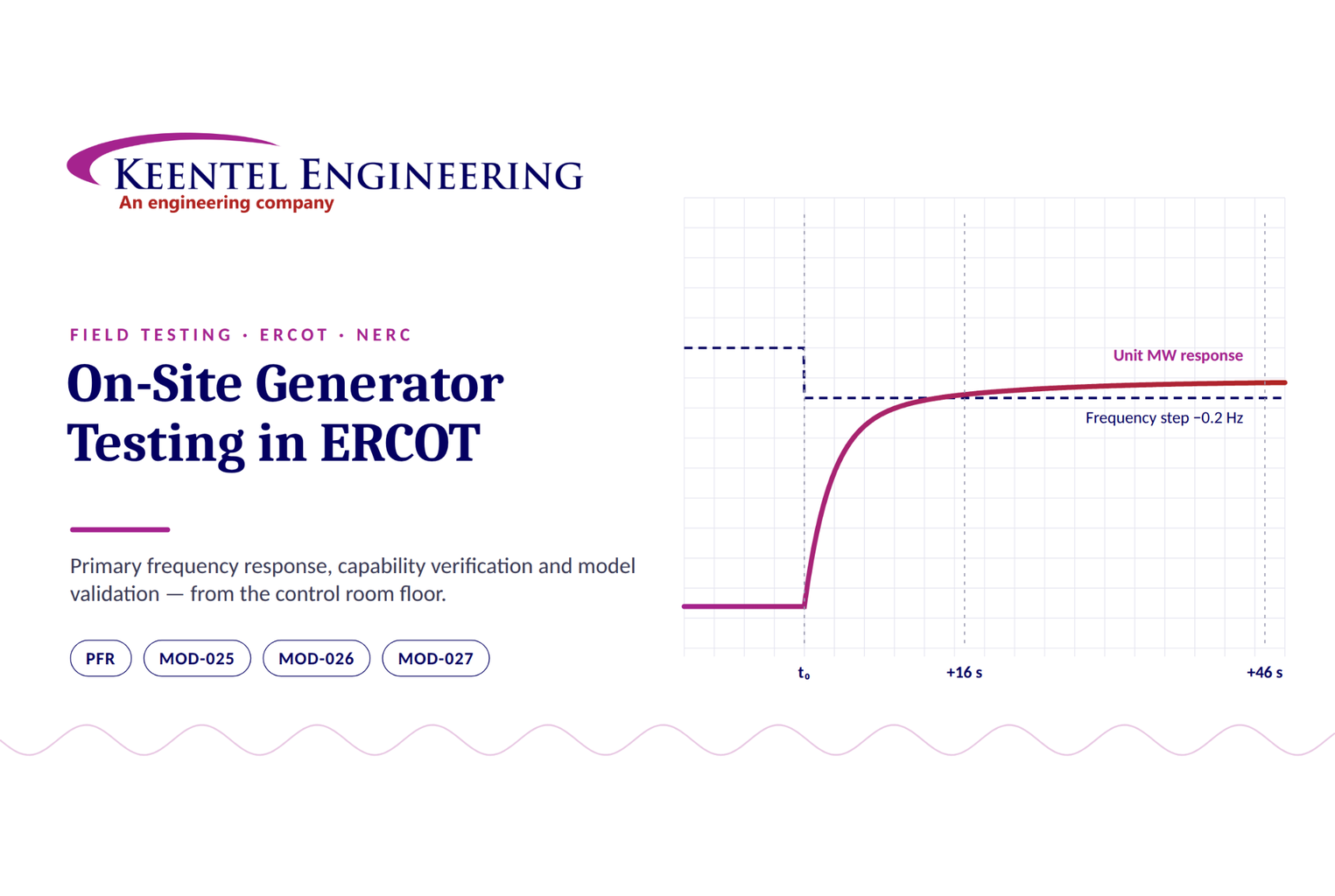
Learn ERCOT generator testing for PFR, MOD-025 and MOD-026/027, including staged tests, capability verification, dynamic models and field testing.
By SANDIP R PATEL
•
October 3, 2026
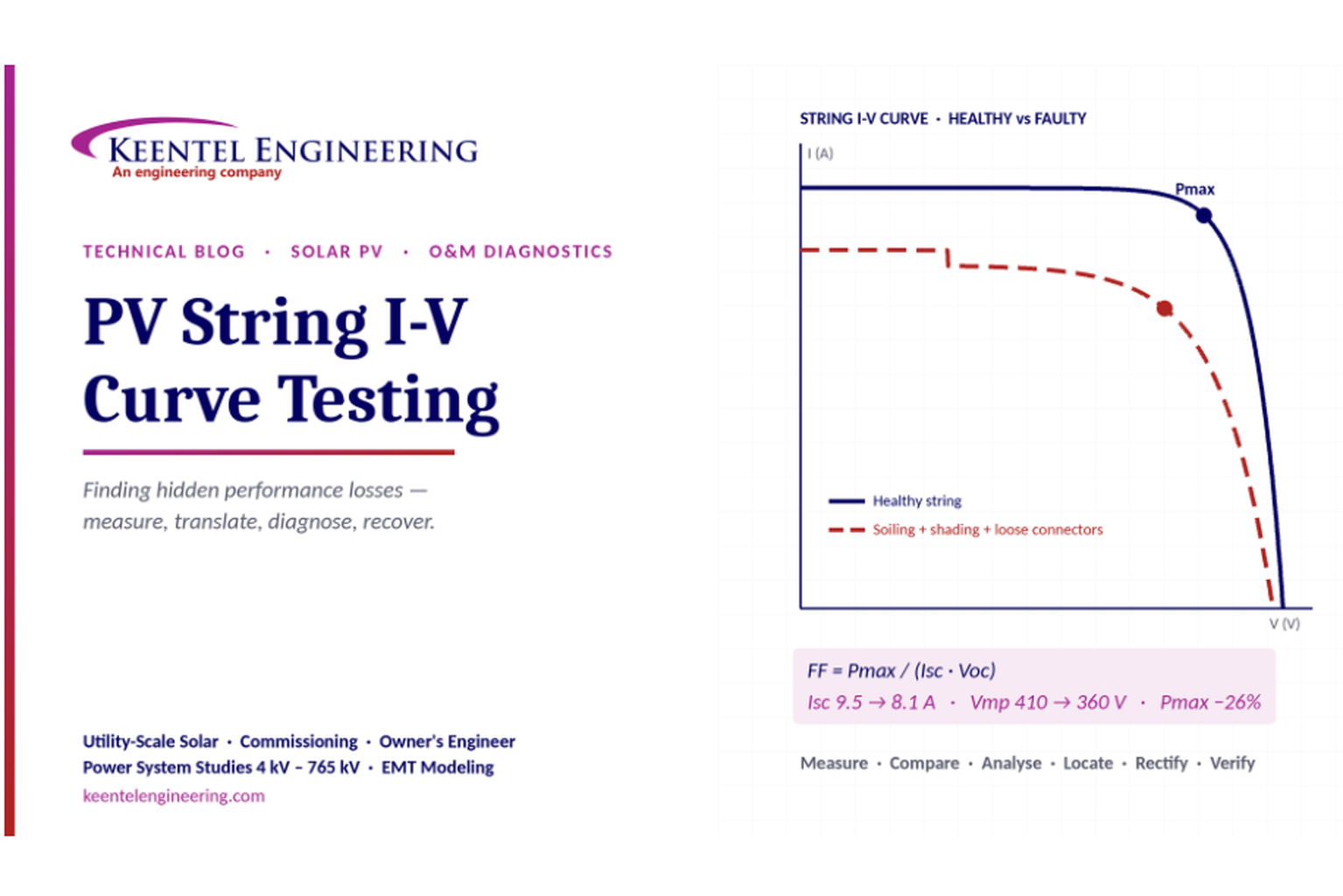
Learn how PV string I-V curve testing identifies hidden solar performance losses, including soiling, shading, mismatch, degradation, and wiring faults.
By SANDIP R PATEL
•
October 3, 2026
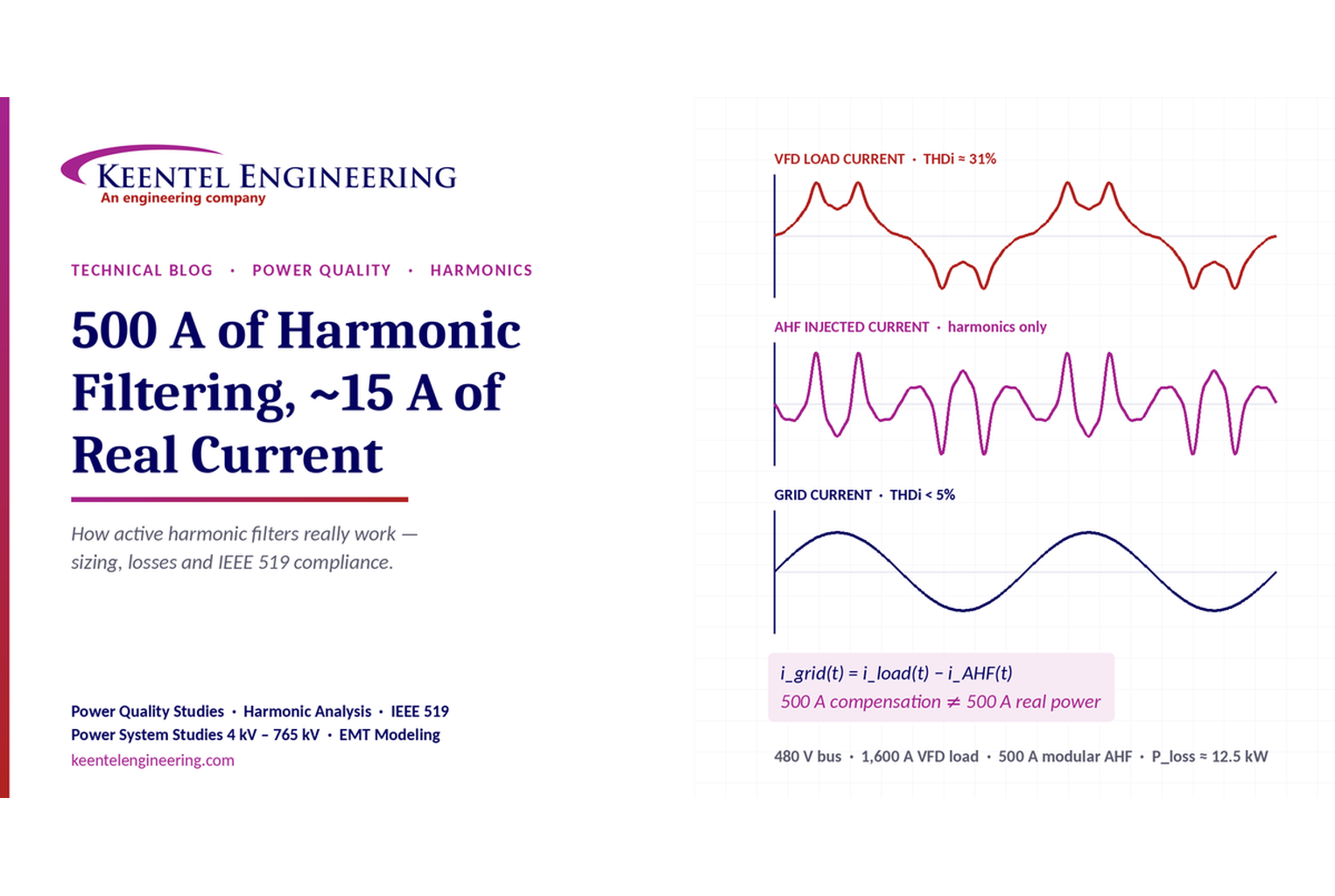
Learn how active harmonic filters work, how to size AHF systems, reduce VFD harmonics, calculate losses, and meet IEEE 519 TDD limits at the PCC.





