A Coordinated Electric System Interconnection Review—the utility’s deep-dive on technical and cost impacts of your project.
Challenge: Frequent false tripping using conventional electromechanical relays
Solution: SEL-487E integration with multi-terminal differential protection and dynamic inrush restraint
Result: 90% reduction in false trips, saving over $250,000 in downtime
| Category | Metric |
|---|---|
| VPP capacity (Lunar Energy) | 650 MW |
| Lunar funding raised | US$232 million |
| Data center BESS example | 31 MW / 62 MWh |
| ERCOT grid-scale batteries | 15+ GW |
| LDES tenders (H1 2026) | Up to 9.3 GW |
| Lithium-ion share of LDES by 2030 | 77% |
| FEOC initial threshold | 55% |
| BESS tariff rate (2026) | ~55% |
| Capacity gain from analytics | 5–15% |
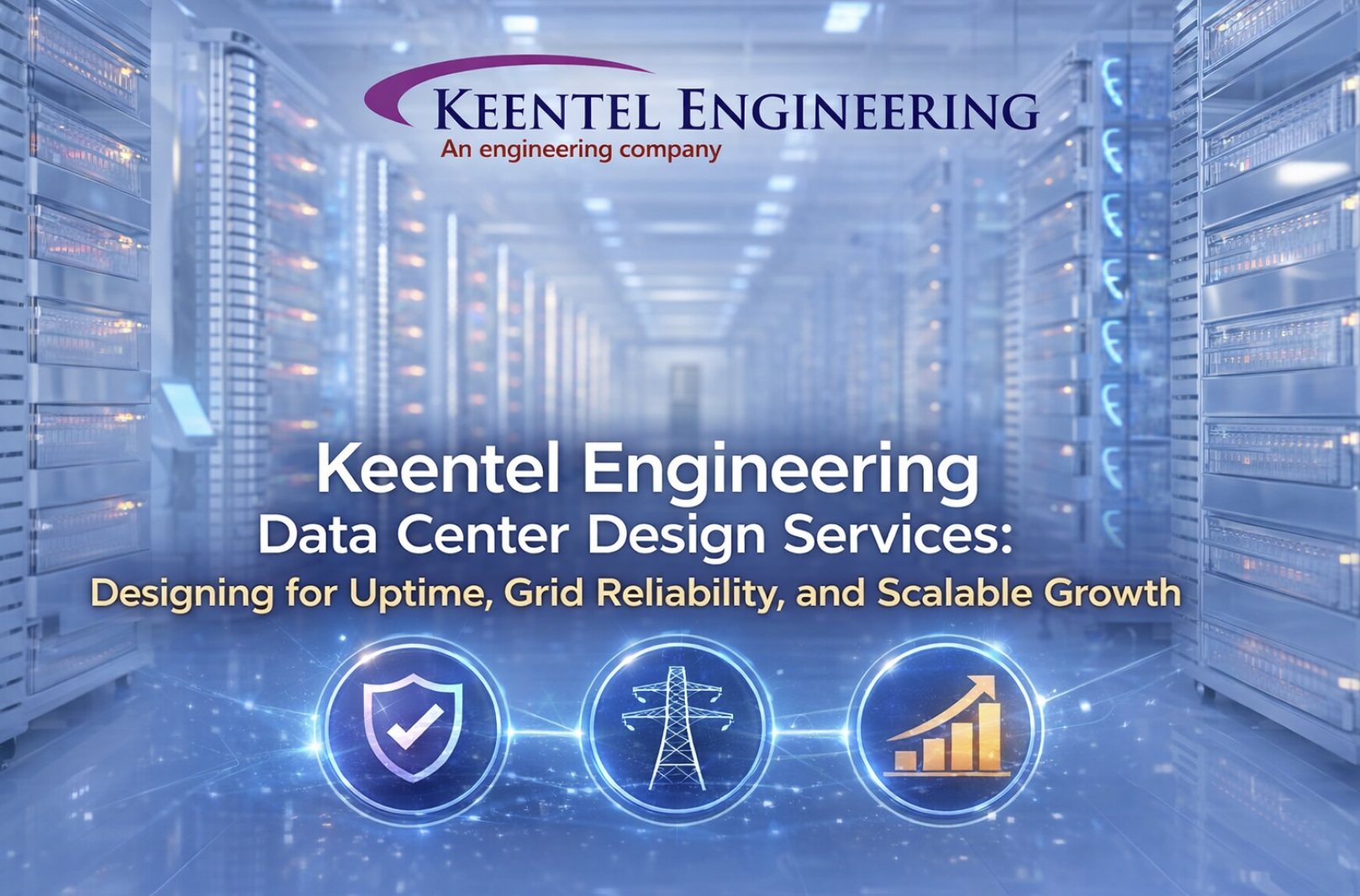
Keentel Engineering Data Center Design Services: Designing for Uptime, Grid Reliability, and Scalable Growth
Apr 6, 2026 | blog
The data center industry has entered a different era. What used to be treated as a high-reliability commercial facility is now increasingly viewed as an emerging large load with direct implications for transmission planning, grid operations, system stability, power quality, and long-term resource adequacy. NERC’s July 2025 white paper makes that shift unmistakable. It explains that data centers are among the fastest-growing energy consumers in North America, and it notes forecasts that data centers alone may account for as much as 12% of all U.S. electricity consumption by 2028, up from 4.4% in 2023.
For owners, developers, hyperscalers, utilities, and EPC teams, this means one thing: data center electrical design can no longer stop at the building fence. The facility must be engineered as part of a larger electrical ecosystem. That is where Keentel Engineering’s data center design services can create real value by helping clients design facilities that do not just achieve uptime targets, but also satisfy interconnection expectations, reduce operational surprises, and support reliable long-term expansion. This service positioning is a practical engineering response to the risks and design implications described throughout the NERC paper.
Why modern data center design is different
NERC defines large loads as commercial or industrial facilities, or aggregations of load at a single site, that can create reliability risks due to demand, operational characteristics, or other factors. Importantly, the paper does not reduce the issue to a single MW threshold. It emphasizes that while many industry participants mentioned 50 MW or 75 MW as useful reference points, a meaningful large-load definition must also account for factors such as ramp rate, real-time behavior, flexibility, protection systems, backup power schemes, voltage sensitivity, and interconnection context. That is a major insight for data center developers: the engineering challenge is not just how big the facility is, but how it behaves electrically.
That behavior matters because modern data centers are not simple static loads. NERC describes data centers and other computational loads as power-electronic-load-heavy facilities with high energy consumption, variable operational demand, significant cooling requirements, internal protection logic, and backup power systems. Some data center loads are pulsed and non-linear, with extremely fast ramping characteristics that can introduce both stability and power quality concerns. In other words, the electrical design problem is no longer just service entrance sizing and generator redundancy. It is now a matter of dynamic system integration.
The four building blocks that shape data center electrical design
The white paper identifies four main data center components:
IT-related equipment, power delivery systems, cooling systems, and miscellaneous lighting/security loads. It further notes that IT-related equipment may represent 60% to 95% of total facility demand, while cooling systems commonly rely on
power electronics such as variable-speed drives and inverters that can create harmonics and increase reactive power demand. It also highlights that AI-oriented HPC facilities may use different power continuity strategies than traditional data centers, sometimes favoring checkpoint recovery rather than full UPS coverage for all IT equipment.
For Keentel Engineering, this points to a strong service message: successful data center design requires coordinated engineering across medium-voltage distribution, backup generation, UPS strategy, low-voltage distribution, thermal plant integration, harmonic mitigation, grounding, protection coordination, and utility-facing interconnection design. If those pieces are engineered separately, the owner may end up with a facility that functions internally but creates unnecessary risk at the point of interconnection. The better approach is an integrated design philosophy where building power architecture and grid-facing behavior are developed together. That is the practical takeaway from the paper’s description of modern data center configuration and risk.
Traditional data centers are not the same as AI training facilities
One of the most important insights in the NERC paper is that “data center” is too broad a term to support one-size-fits-all engineering. Traditional data centers have historically been smaller, often under 30 MW, with high redundancy and relatively limited variability. By contrast, AI training data centers may exhibit sharp load changes tied to training runs and checkpoint events. NERC cites an example in which a 50 MW block of a larger 200 MW AI training data center changed demand at a rate of 1.9 p.u. per second for about 250 milliseconds, and it notes that transitions between training and checkpoint saving can occur in under one second. AI inference facilities may still be high-power facilities, but current inference methods do not necessarily show the same rapid ramping pattern observed in training loads.
This distinction matters because owners often ask for “data center electrical design” as if every facility has the same load signature. It does not. Keentel Engineering can differentiate itself by framing its design process around workload-informed electrical engineering. A cloud facility with steady utilization should not be studied exactly the same way as an AI training campus with rapid transitions, nor should either be treated like a behind-the-meter hybrid load with co-located generation. The NERC paper strongly supports a design philosophy based on facility-specific electrical characterization, not generic templates.
Grid interconnection is now a design issue, not a late-stage paperwork issue
Another major lesson from the white paper is that utilities, ISOs, and transmission planners are being pushed to revisit how they handle large load interconnections. NERC documents existing constructs such as ERCOT’s 75 MW threshold for large loads and Dominion Energy’s 100 MW transmission-tap threshold, along with Dominion’s planning limits such as ring-bus expectations above 100 MW, substation loading constraints, and information requirements tied to ride-through capabilities. These examples show that the utility side of the project is becoming more structured, more technical, and more dependent on customer-provided data.
For Keentel Engineering, this creates a clear market position: help clients arrive at interconnection discussions with the right technical package the first time. That means developing conceptual one-lines, demand block definitions, staged energization strategy, ride-through expectations, backup system operating philosophy, load segmentation logic, and the necessary studies that demonstrate the project can be connected reliably. The paper repeatedly shows that missing models, unclear protection behavior, and insufficient visibility into load characteristics can create planning and operating risks. In that environment, engineering firms that can translate owner intent into a utility-ready technical submittal will be increasingly valuable.
Observability and modeling are now part of good design
The paper states that operators and planners need accurate information on interconnection timelines, peak demand, load behaviors, protection and control settings, and dynamic models in order to study large loads properly. It also warns that lack of high-speed recording data, PMUs, and other monitoring can make root-cause analysis difficult or impossible after an event. NERC further notes that large loads are not required to register as NERC entities under current criteria, which can make it harder for system operators to obtain timely information after disturbances.
That means a modern data center design scope should go beyond wires and breakers. Keentel Engineering can position observability as a core service deliverable: telemetry architecture, metering philosophy, high-resolution disturbance recording, event visibility, and model-ready data collection. Owners often think of these items as operational extras. The NERC paper suggests they are increasingly part of the reliability foundation. A well-designed facility should not only consume power safely; it should also make its behavior understandable to the owner, operator, utility, and planning teams.
Planning for ramping, reserves, and forecasting
One of the strongest sections in the white paper concerns operations and balancing. NERC explains that large loads, especially power-electronic-rich loads, can change consumption in seconds, much faster than conventional generators can ramp. It gives a data center example in which load dropped from roughly 450 MW to 40 MW in 36 seconds, remained near 7 MW for about four hours, and later returned to 450 MW within minutes. NERC warns that such rapid shifts can challenge reserve procurement, frequency regulation, and voltage control. It also notes that many large loads do not submit real-time or day-ahead operating profiles, which degrades forecasting accuracy.
For data center developers, this means the load profile itself is now an engineering deliverable. Keentel Engineering can create value by helping owners characterize expected ramp behavior, identify load blocks, define operating modes, and coordinate expected transitions with utilities and balancing authorities where relevant. This is especially important for AI facilities, phased campuses, and sites with flexible computational strategies. A project that cannot explain how it ramps, recovers, sheds, or restarts is a harder project to interconnect and a riskier one to operate. The paper makes clear that forecasting and reserve challenges are not abstract concerns; they are direct consequences of poor visibility into load behavior.
Stability and ride-through cannot be left to chance
NERC identifies several high-priority risks associated with emerging large loads, including resource adequacy, balancing and reserves, ride-through, voltage stability, angular stability, and oscillations. The ride-through discussion is especially important for data centers. The paper notes that some facilities may switch to backup systems after multiple transient voltage disturbances in a short period and cites real-world events in which roughly 1,500 MW of voltage-sensitive load, primarily from data centers, was lost following transmission faults. NERC also stresses that many stability concerns arise because loads have not been modeled accurately enough in planning studies.
This is a major opportunity for Keentel Engineering’s service messaging. Data center electrical design should include explicit attention to ride-through philosophy, transfer logic, protection coordination, backup generation sequencing, voltage sensitivity, reconnection behavior, and dynamic study support. In the old model, the goal was often to keep the data center itself alive. In the new model, the facility must also avoid becoming a source of sudden, system-wide disturbance. The strongest engineering service providers will be the ones who help owners satisfy both objectives at once.
Harmonics, flicker, and reactive behavior are not secondary issues
NERC’s power quality discussion confirms what many experienced engineers already suspect: modern data centers are major users of power electronics on both the IT side and the cooling side. The paper explains that these devices can make data centers significant sources of harmonics, especially if filtering is not designed deliberately. It also warns that transitions to higher-power pulses can create voltage fluctuations, flicker, unbalance, and broader power quality concerns. In one cited case, voltage distortion was significantly reduced after harmonic mitigation measures were implemented. The paper also notes reported oscillation behavior associated with data center UPS input units in at least one system.
For
Keentel Engineering this supports a data center design offering that includes harmonic studies, reactive power assessment, filter evaluation, grounding and bonding review, VFD/UPS interaction analysis, and power quality mitigation strategy. Owners often focus on availability, but a facility that produces power quality problems may face utility pushback, nuisance trips, thermal stress, and long-term operational friction. Harmonic and power quality engineering should be treated as part of the core design package, not as a corrective measure after commissioning problems appear.
Behind-the-meter and co-located generation add another layer of complexity
The white paper devotes attention to the difference between front-of-meter and behind-the-meter large load configurations. It explains that behind-the-meter large loads may have less operational visibility and that unexpected transitions from co-located generation to grid supply can create sudden demand spikes and stability concerns. It emphasizes the need for clear standards, monitoring, and coordination to prevent unplanned swings in demand.
That is especially relevant as more data center projects explore gas generation, renewable integration, hybrid architectures, and island-capable strategies. Keentel Engineering can strengthen its value proposition by offering design support for front-of-meter/behind-the-meter architecture evaluation, transition studies, protection schemes, synchronization logic, backup and primary-source operating modes, and utility coordination for hybrid sites. The NERC paper suggests that these configurations must be engineered with disciplined attention to failure modes, because the grid impact of a transition event may be much larger than the owner first assumes.
Restoration and segmentation should be designed before the emergency happens
A particularly underappreciated insight in the white paper is the importance of load segmentation during system restoration. NERC explains that large loads may need to be restored in smaller, manageable, predictable blocks and warns that unclear segmentation can lead to frequency decline, voltage collapse, unintended UFLS operation, or the need for additional load shedding. It also notes that as large loads grow, UFLS obligations and manual load-shed planning may need to be revisited more often than traditional review cycles assumed.
This means staged energization and restoration logic should be built into the design, not left to operations manuals after construction. Keentel Engineering can translate this into tangible deliverables: segmented load block planning, restoration sequences, blackstart-aware re-energization philosophy, generator pickup logic, and load-shed coordination concepts. Owners care deeply about how fast they can return to service after a disturbance. Utilities care deeply about whether that return happens in a stable and predictable way. Good engineering has to satisfy both.
What Keentel Engineering’s data center design services should emphasize
Based on the NERC paper, the strongest technical message for Keentel Engineering is that data center design must be approached as a whole-system electrical engineering problem. That means combining:
- utility and interconnection readiness,
- medium- and low-voltage electrical system design,
- backup generation and UPS architecture,
- ride-through and protection coordination,
- load characterization and dynamic behavior review,
- harmonics and reactive power mitigation,
- telemetry and observability design,
- phased energization and restoration planning,
- and study support for reliability-driven stakeholder review.
This service framing is an engineering inference drawn from the risks, characteristics, and recommendations presented in the NERC white paper. The paper explicitly calls for better classification of large loads, improved mitigation approaches, better load models, stronger understanding of protection impacts, and improved methods for assessing resource adequacy risks. A data center engineering consultant that helps clients address those needs early is well aligned with where the industry is heading.
Final thought
The future of data center design belongs to engineering teams that understand both facility resilience and grid consequences. NERC’s July 2025 white paper makes clear that modern data centers—especially AI-oriented facilities—are no longer passive loads. They are electrically dynamic, operationally consequential, and increasingly central to transmission and reliability planning. For Keentel Engineering, that creates a powerful market position: help clients build data centers that are not only scalable and reliable inside the fence, but also credible, stable, and utility-ready at the point of interconnection.
Detailed FAQ Draft
Frequently Asked Questions About Keentel Engineering’s Data Center Design Services
1. Why do modern data centers require specialized electrical engineering instead of standard commercial building design?
Modern data centers now behave more like complex industrial power systems than ordinary commercial buildings. According to the NERC white paper, data centers are among the fastest-growing energy consumers in North America and are increasingly being studied as large loads because of their demand magnitude, power-electronic-heavy composition, variable operating behavior, cooling intensity, backup systems, and potential impact on grid reliability. That means the engineering problem is no longer limited to feeder sizing, generator redundancy, and code compliance. It now includes interconnection readiness, load behavior characterization, system stability implications, harmonic performance, reactive power effects, ride-through behavior, and coordination with utilities or transmission providers. Keentel Engineering’s value in this space is the ability to approach data center design as a whole electrical ecosystem rather than as a standalone building package.
2. What makes AI data centers different from traditional data centers from a design standpoint?
The NERC paper makes a clear distinction between traditional data centers and AI-oriented facilities. Traditional data centers have historically been smaller, more redundant, and relatively stable in their load behavior. AI training facilities, by contrast, may show rapid changes in demand associated with training runs and checkpoint events. NERC cites an example where a 50 MW block of a larger 200 MW AI training facility changed demand at 1.9 p.u. per second for about 250 milliseconds, and it notes that transitions between training and checkpoint saving can occur in under one second. That means electrical design for AI data centers must pay much closer attention to ramp rates, dynamic performance, cooling variability, power continuity philosophy, and the possible effect of sudden load changes on both the facility and the external grid. Keentel Engineering can use that distinction to tailor the design approach to the workload, rather than applying one generic template to every project.
3. What core electrical systems should be coordinated in a modern data center design?
The white paper identifies four core components in data centers: IT-related equipment, power delivery systems, cooling systems, and miscellaneous lighting/security loads. IT-related equipment may account for 60% to 95% of facility energy use, while cooling systems often use variable-speed drives and other power electronics that can create harmonics and increase reactive power demand. Power delivery systems may include multiple utility sources, internal distribution, UPS, on-site generation, and sophisticated control schemes. Because all of these systems interact electrically, a data center design must coordinate medium-voltage service, transformers, switchgear, UPS architecture, generator plant, cooling plant loads, harmonic mitigation, grounding, controls, and protection. Keentel Engineering’s data center service offering should therefore emphasize integrated system coordination instead of fragmented discipline-by-discipline design.
4. Why is utility interconnection such a critical part of data center design today?
NERC’s paper shows that utilities and grid operators are increasingly formalizing how they evaluate large loads. It cites examples such as ERCOT’s 75 MW large-load framework and Dominion’s 100 MW threshold for transmission taps, along with planning criteria tied to ride-through information, substation loading limits, and connection configuration requirements. The larger point is that utility interconnection has become a technical engineering issue, not a simple application process. A data center that cannot clearly define its demand blocks, operating modes, backup transfer behavior, and electrical characteristics is harder to study and harder to approve. Keentel Engineering can help owners prepare utility-ready one-lines, interconnection packages, operating philosophies, and study assumptions early, which reduces redesign risk and improves project credibility during stakeholder review.
5. Why are load modeling and high-speed monitoring important for data center projects?
NERC states that planners and operators need reliable information about peak demand, operating behavior, protection and control settings, dynamic models, and interconnection timing in order to study large loads properly. It also warns that lack of PMUs, high-speed recorders, or other detailed measurement tools can make event analysis difficult or impossible. In practical terms, that means good data center design must include an observability strategy. Keentel Engineering can help define telemetry points, disturbance recording, metering architecture, and model-support data so that the owner, utility, and operators understand how the facility behaves during both normal operation and disturbances. This is especially important for AI campuses and other dynamic facilities where steady-state nameplate demand does not tell the full story.
6. What does the NERC paper say about fast ramping, and why does it matter to data center owners?
The paper explains that large loads, especially power-electronic-rich loads, can change consumption in seconds—faster than many conventional generators can respond. It gives a data center example where load dropped from about 450 MW to 40 MW in 36 seconds and later returned to 450 MW within minutes. NERC warns that this kind of behavior can stress balancing reserves, frequency regulation, and voltage control. For owners, this matters because the electrical profile of the site can affect utility planning, reserve assumptions, and even how the project is viewed during interconnection review. Keentel Engineering can provide value by helping owners define expected ramp behavior, operating states, phased energization plans, and transition logic so the project is not treated as an unknown risk by the serving utility or planning authority.
7. Why is ride-through behavior so important for data center design?
Ride-through refers to how a facility behaves during voltage and frequency disturbances—whether it stays connected, how its real and reactive demand changes, whether it transfers to backup power, and how it returns to normal operation. NERC highlights ride-through as one of the highest-priority risk areas for emerging large loads. It cites examples where data center-related load loss reached about 1,500 MW after transmission disturbances and notes that some facilities may switch to backup after repeated transient voltage disturbances within a short period. For data center owners, this means backup transfer logic, UPS behavior, protection settings, and reconnection philosophy all have system-level consequences. Keentel Engineering can help clients design these functions deliberately so the project supports uptime without unintentionally becoming a source of broader system instability.
8. How do harmonics and power quality affect data center projects?
The NERC paper states that data centers can be significant sources of harmonics because of extensive power electronics in both IT systems and cooling infrastructure. It also warns that sudden changes in demand can contribute to voltage fluctuations, flicker, unbalance, and broader power quality issues. In one example cited by the paper, voltage distortion was significantly reduced after a harmonic mitigation solution was implemented. This means power quality is not a secondary topic reserved for troubleshooting after commissioning. It should be part of the initial design basis. Keentel Engineering can use harmonic studies, filter strategy, reactive power review, grounding analysis, and coordinated equipment selection to reduce distortion risk before the site is energized. That helps protect both internal equipment performance and the owner’s relationship with the serving utility.
9. What special issues arise when a data center includes behind-the-meter or co-located generation?
NERC emphasizes that behind-the-meter large loads can have lower operational visibility and can create serious issues if co-located generation trips and the facility unexpectedly shifts to grid supply. The paper notes that these events can create sudden demand spikes, resource adequacy problems, and system stability concerns, especially if standards, monitoring, and coordination are weak. For owners considering hybrid architectures, on-site generation, or partial islanding strategies, the design must account for failure modes, transition behavior, protection sequencing, and utility coordination from the start. Keentel Engineering can support front-of-meter versus behind-the-meter configuration review, transfer logic design, synchronization schemes, protection coordination, and study assumptions for hybrid sites so that operational flexibility does not create hidden grid risk.
10. Why should data center projects include restoration and load segmentation planning?
One of the more practical insights in the NERC paper is that large loads may need to be restored in smaller, manageable, and predictable segments during system restoration. NERC warns that poor segmentation can contribute to frequency decline, voltage collapse, unintended UFLS operation, or extra load shedding. In other words, the way the facility comes back online matters almost as much as how it normally runs. Keentel Engineering can help owners define electrical load blocks, staged pickup strategy, energization order, generator sequencing, and restoration logic so the site can return to service in a controlled and utility-compatible manner. This is especially valuable for large campuses and phased facilities where “all at once” restoration may be technically possible inside the fence but operationally risky for the wider system.
11. Does a project only become a “large load” once it reaches a specific MW threshold?
Not necessarily. The NERC paper explicitly cautions against relying only on one MW number. While many respondents in NERC’s survey mentioned thresholds above 50 MW and often pointed to 75 MW, the paper stresses that large-load impact depends on more than size. Voltage level, interconnection location, load predictability, ramp rates, backup schemes, voltage sensitivity, and the characteristics of the surrounding system all affect how consequential a load really is. A 20 MW facility may be relatively modest at one voltage level and highly significant at another. Keentel Engineering can help owners evaluate whether a project should be treated as a large-load-style design challenge based on its actual electrical behavior and interconnection context, not just on its headline MW figure.
12. What should owners and utilities exchange during the design process for a data center project?
Based on the NERC paper, the most important information includes expected interconnection timelines, peak demand, load blocks, operating modes, real-time behavior, protection and control settings, backup power logic, ride-through characteristics, and dynamic models where applicable. The paper repeatedly shows that poor visibility into those items can lead to weak forecasting, reserve problems, inaccurate studies, and difficulty analyzing real events after they occur. Keentel Engineering can play a central role by translating the owner’s operational intent into utility-usable technical information. That includes conceptual and detailed one-lines, ramp assumptions, load segmentation, protection philosophy, telemetry plans, and study-ready electrical models. The better this exchange is handled early, the more predictable the path to interconnection, energization, and reliable long-term operation becomes.
13. Why should a data center owner hire an engineering firm that understands grid reliability, not just facility design?
Because the NERC paper makes clear that the most serious risks from emerging data centers are no longer limited to internal reliability. The highest-priority concerns identified in the paper include resource adequacy, balancing and reserves, ride-through, voltage stability, angular stability, and oscillations. Medium-priority concerns include forecasting, real-time coordination, transmission adequacy, cyber security, and UFLS-related obligations. That means the owner needs an engineering partner who can see both sides of the project: the internal need for uptime and the external requirement for stable interconnection and predictable system behavior. Keentel Engineering can position itself strongly here by offering data center design services that connect facility engineering with utility expectations, study support, and long-term electrical risk management.
14. How can Keentel Engineering position its data center design services based on this NERC paper?
The strongest position is to present Keentel as a firm that helps clients design data centers that are not only reliable inside the building, but also technically credible at the grid edge. The NERC paper calls for better identification of process gaps, stronger mitigation approaches, clearer classification frameworks, improved load models, better understanding of protection impacts, and stronger methods for assessing resource adequacy risk. A Keentel service offering that includes interconnection support, medium-voltage and low-voltage design, generator and UPS coordination, harmonic and reactive power studies, ride-through and protection analysis, telemetry design, and staged restoration planning aligns very well with that direction. This is an engineering-market inference based on the white paper’s recommendations and risk findings, and it provides a strong foundation for Keentel’s service messaging

About the Author:
Sandip "Sonny" R. Patel, P.E.
IEEE Senior Member · Founder & CEO, Keentel Engineering
In 1995, Sonny Patel earned his Electrical Engineering degree from the University of Illinois. But degrees don't build legacies — action does.
For three decades, he has worked the power industry from every side of the table: 16 years as a utility engineer at Exelon/Commonwealth Edison; generation leadership across hydroelectric, industrial steam turbine, and a 9 GW renewable fleet; NERC Regional Entity Senior Compliance Engineer and Audit Team Lead, auditing some of the nation's largest utilities; and testing and commissioning lead on equipment up to 765 kV — the very top of the North American grid.Utility. Generator. Regulator. Consultant. Few engineers have seen all four seats. Fewer still have sat in them.
His experience spans nuclear, hydro, conventional generation, renewables, oil and gas, mining — and today's data centers, where he is authoring a three-book series on data center design. He is a Licensed Professional Engineer in six states and a Licensed Electrical Contractor in Florida (Unlimited EC) — he doesn't just design the work; he's qualified to stand behind its execution.Today, as Founder and CEO of Keentel Engineering, Sonny leads a nationwide team of engineers delivering substation design, power system studies, NERC compliance, and commissioning — done right, coast to coast.Three decades. Every side of the table. One standard: accountable engineering.
Services

Let's Discuss Your Project
Let's book a call to discuss your electrical engineering project that we can help you with.
About the Author:
Sandip "Sonny" R. Patel, P.E.
IEEE Senior Member · Founder & CEO, Keentel Engineering
In 1995, Sonny Patel earned his Electrical Engineering degree from the University of Illinois. But degrees don't build legacies — action does.
For three decades, he has worked the power industry from every side of the table: 16 years as a utility engineer at Exelon/Commonwealth Edison; generation leadership across hydroelectric, industrial steam turbine, and a 9 GW renewable fleet; NERC Regional Entity Senior Compliance Engineer and Audit Team Lead, auditing some of the nation's largest utilities; and testing and commissioning lead on equipment up to 765 kV — the very top of the North American grid.
Utility. Generator. Regulator. Consultant. Few engineers have seen all four seats. Fewer still have sat in them.
His experience spans nuclear, hydro, conventional generation, renewables, oil and gas, mining — and today's data centers, where he is authoring a three-book series on data center design. He is a Licensed Professional Engineer in six states and a Licensed Electrical Contractor in Florida (Unlimited EC) — he doesn't just design the work; he's qualified to stand behind its execution.
Today, as Founder and CEO of Keentel Engineering, Sonny leads a nationwide team of engineers delivering substation design, power system studies, NERC compliance, and commissioning — done right, coast to coast.Three decades. Every side of the table. One standard: accountable engineering.
Leave a Comment
Thank you for contacting us.
We will get back to you as soon as possible.
We will get back to you as soon as possible.
Oops, there was an error sending your message.
Please try again later.
Please try again later.
Related Posts
By SANDIP R PATEL
•
October 20, 2026
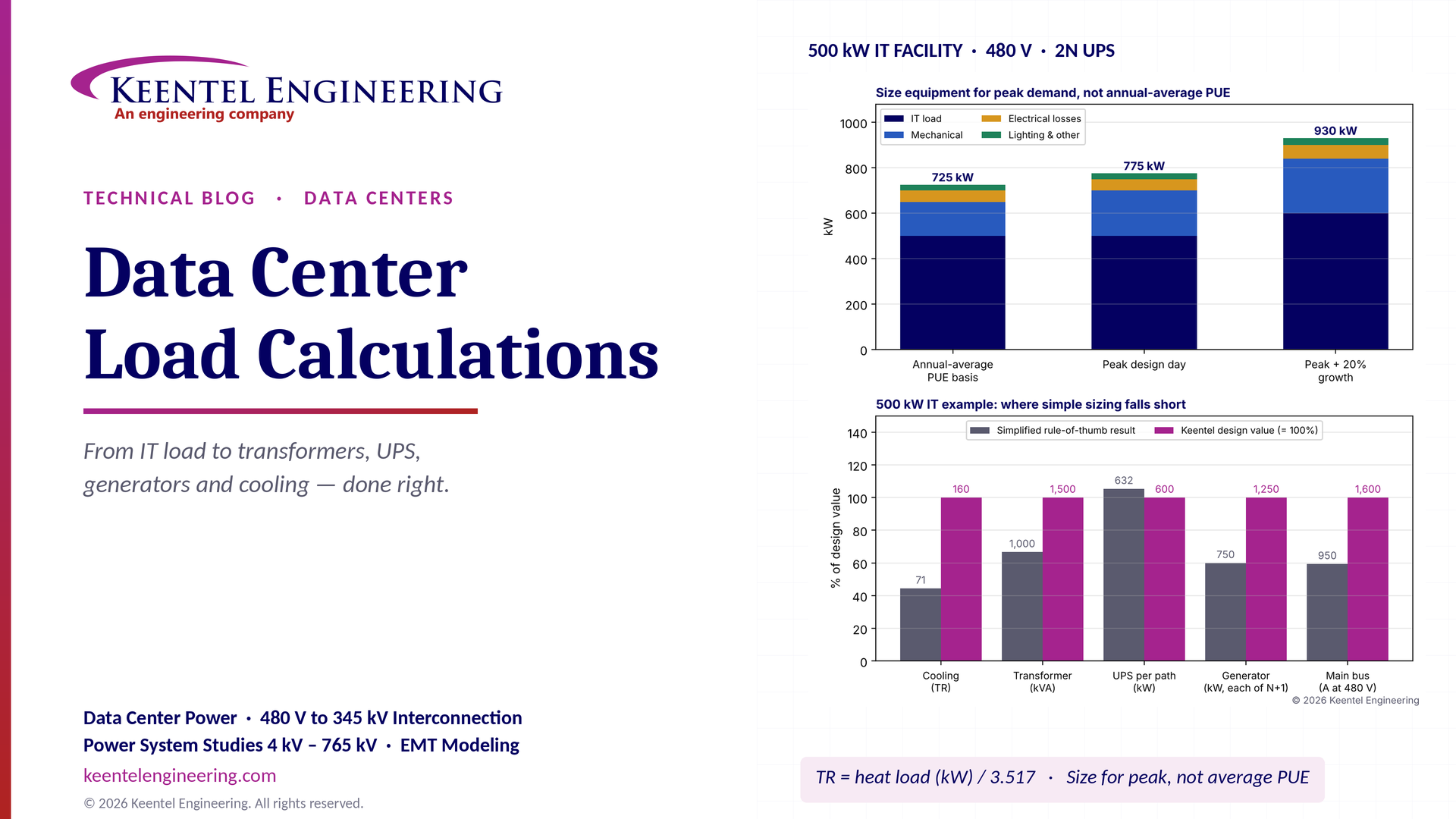
Learn data center electrical load calculations, including IT demand, PUE, UPS and generator sizing, cooling loads, redundancy, and worked US examples.
By SANDIP R PATEL
•
October 20, 2026
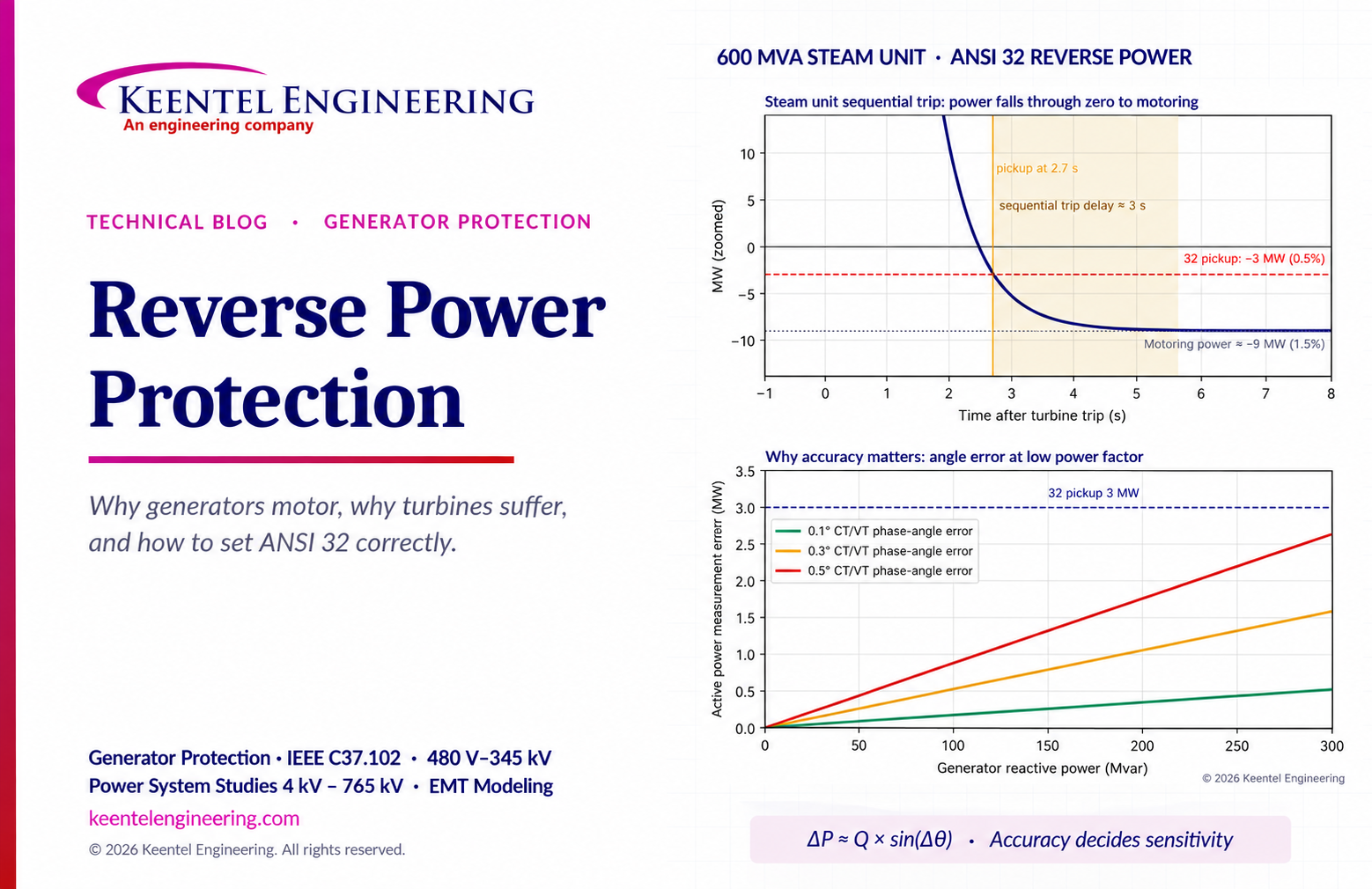
Learn reverse power protection (ANSI 32), generator motoring, relay pickup settings, time delays, sequential tripping and testing for US power plants.
Copy
By Team 2 Dexora
•
October 20, 2026
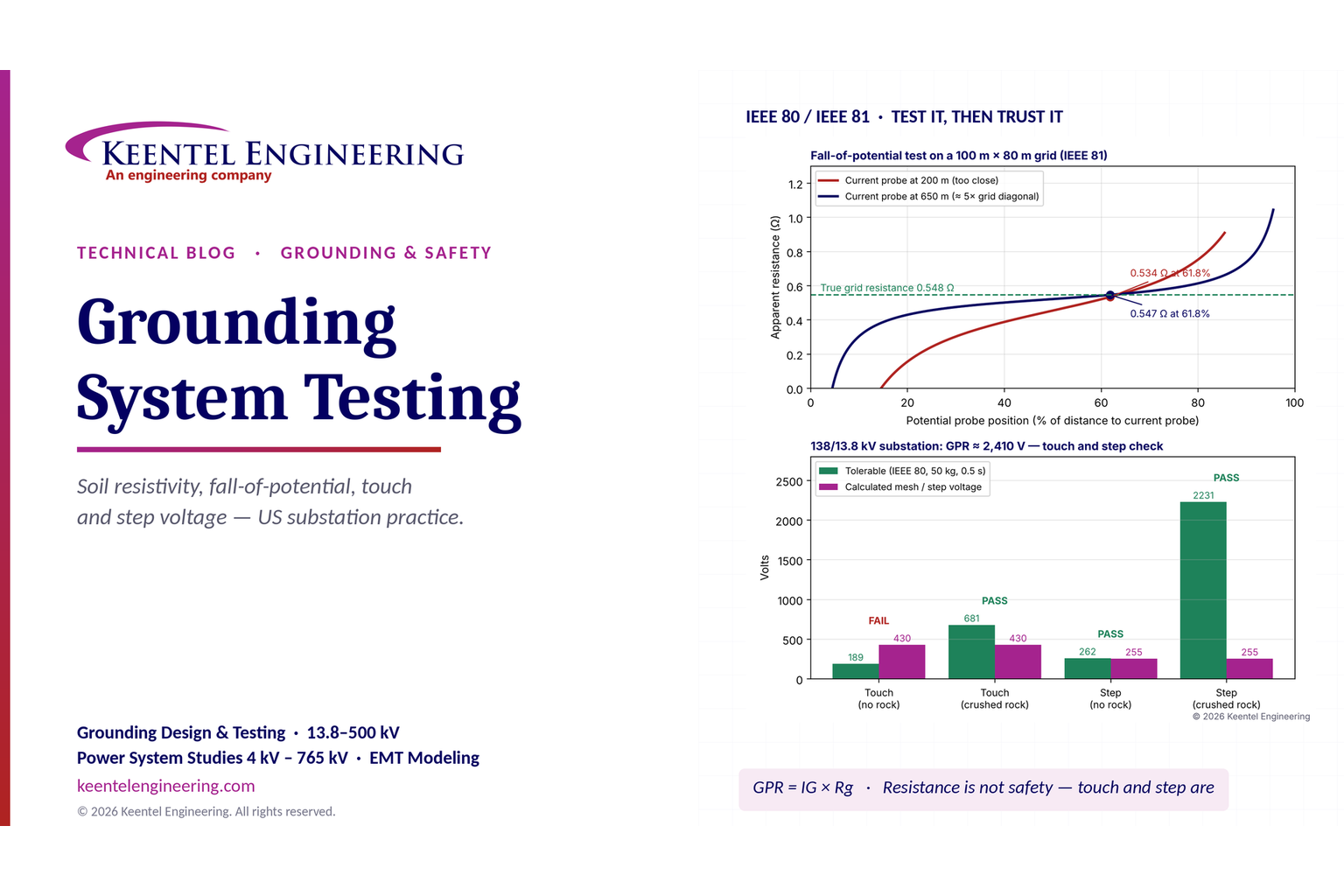
Explore grounding system testing with Keentel Engineering. Learn IEEE 80/81 methods, soil resistivity, ground resistance, and touch and step voltage safety.
By SANDIP R PATEL
•
October 13, 2026
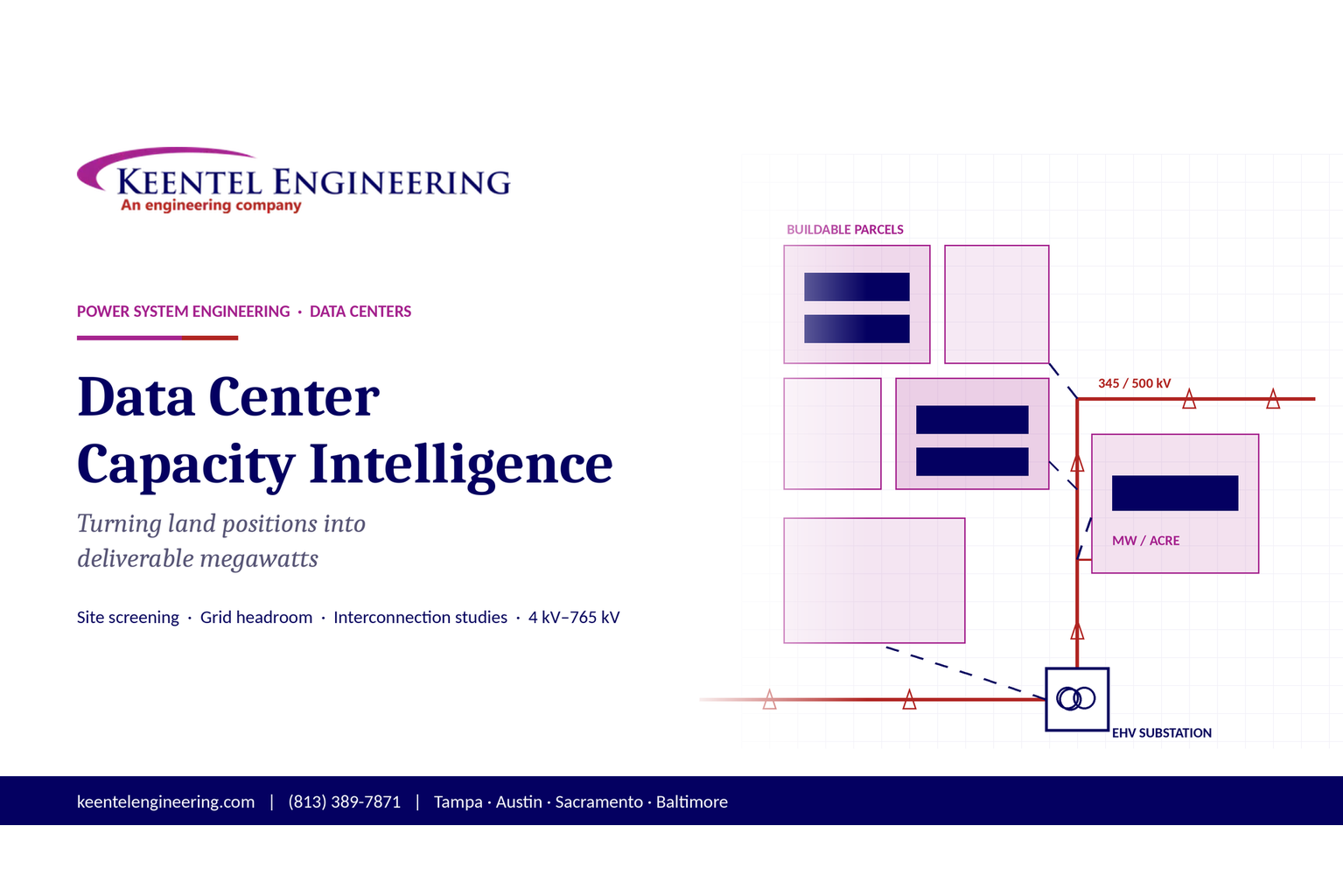
Plan data center capacity with land screening, MW-per-acre estimates, grid power availability and interconnection feasibility studies from Keentel Engineering.
By SANDIP R PATEL
•
October 11, 2026
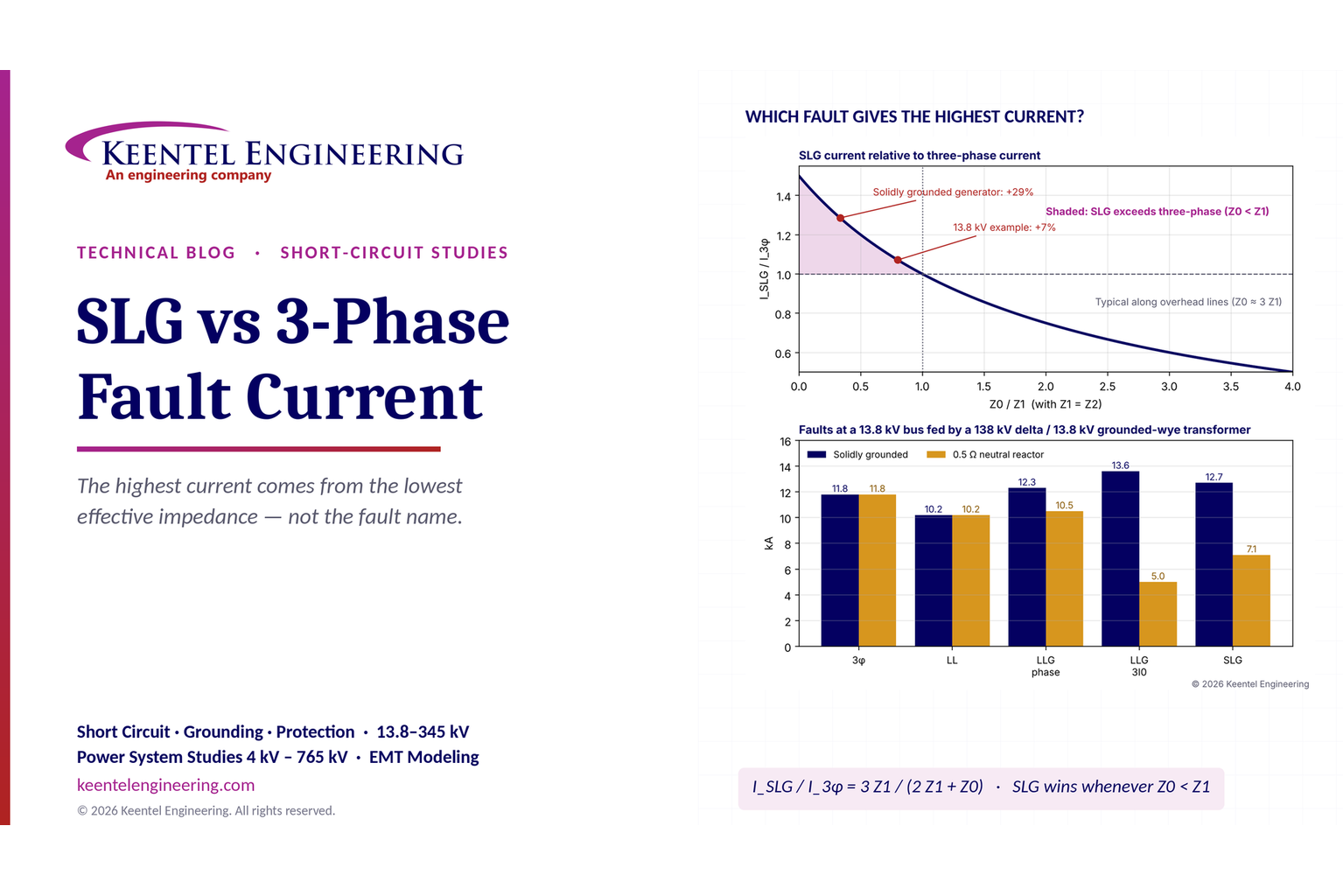
Learn which fault produces the highest current at a bus, why SLG faults can exceed three-phase faults, and how symmetrical components determine fault duty.
By SANDIP R PATEL
•
October 11, 2026
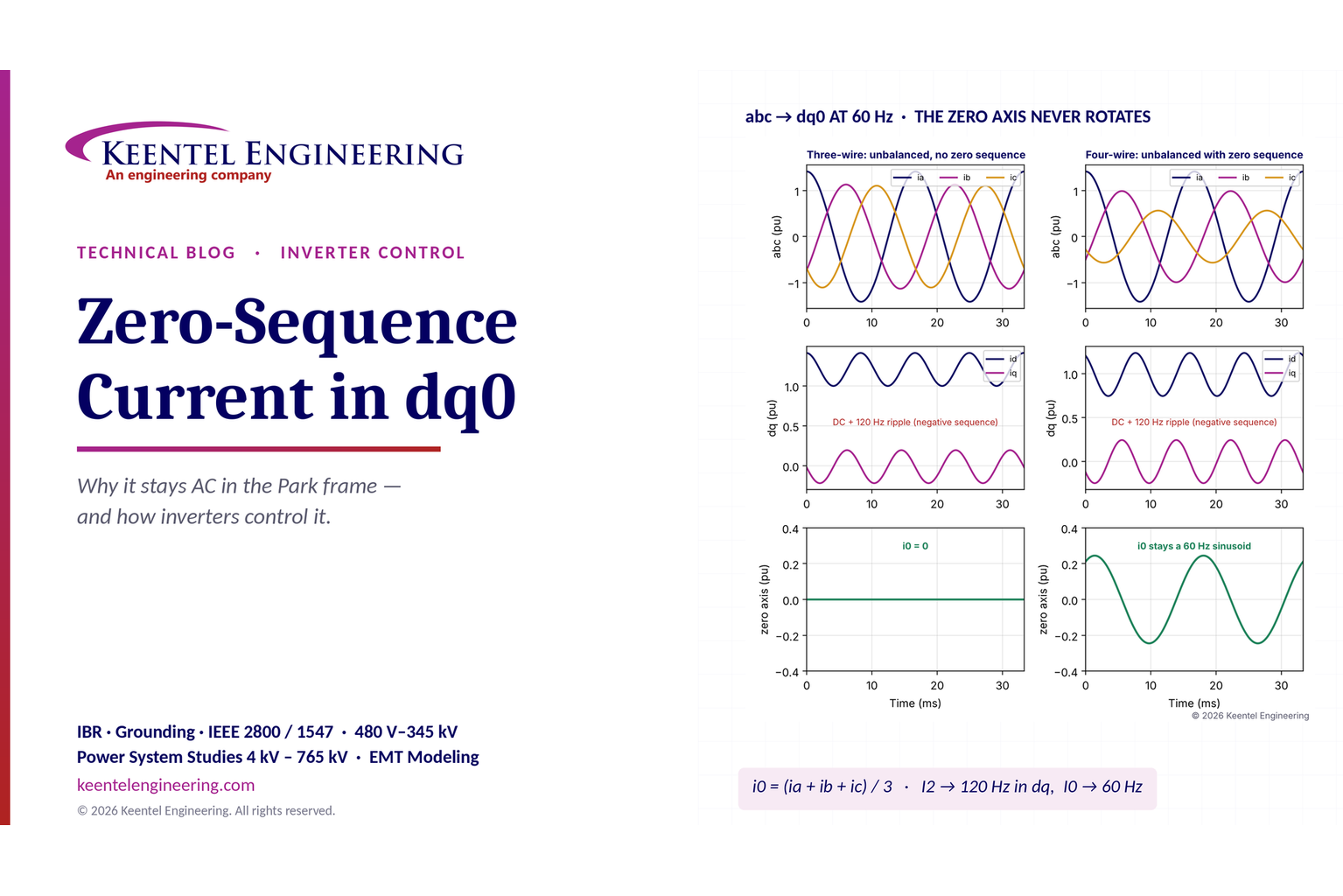
Learn why zero-sequence current pulsates in the dq0 frame, how Park's transformation works, and how inverter controls handle unbalance and ground faults.
By SANDIP R PATEL
•
October 11, 2026
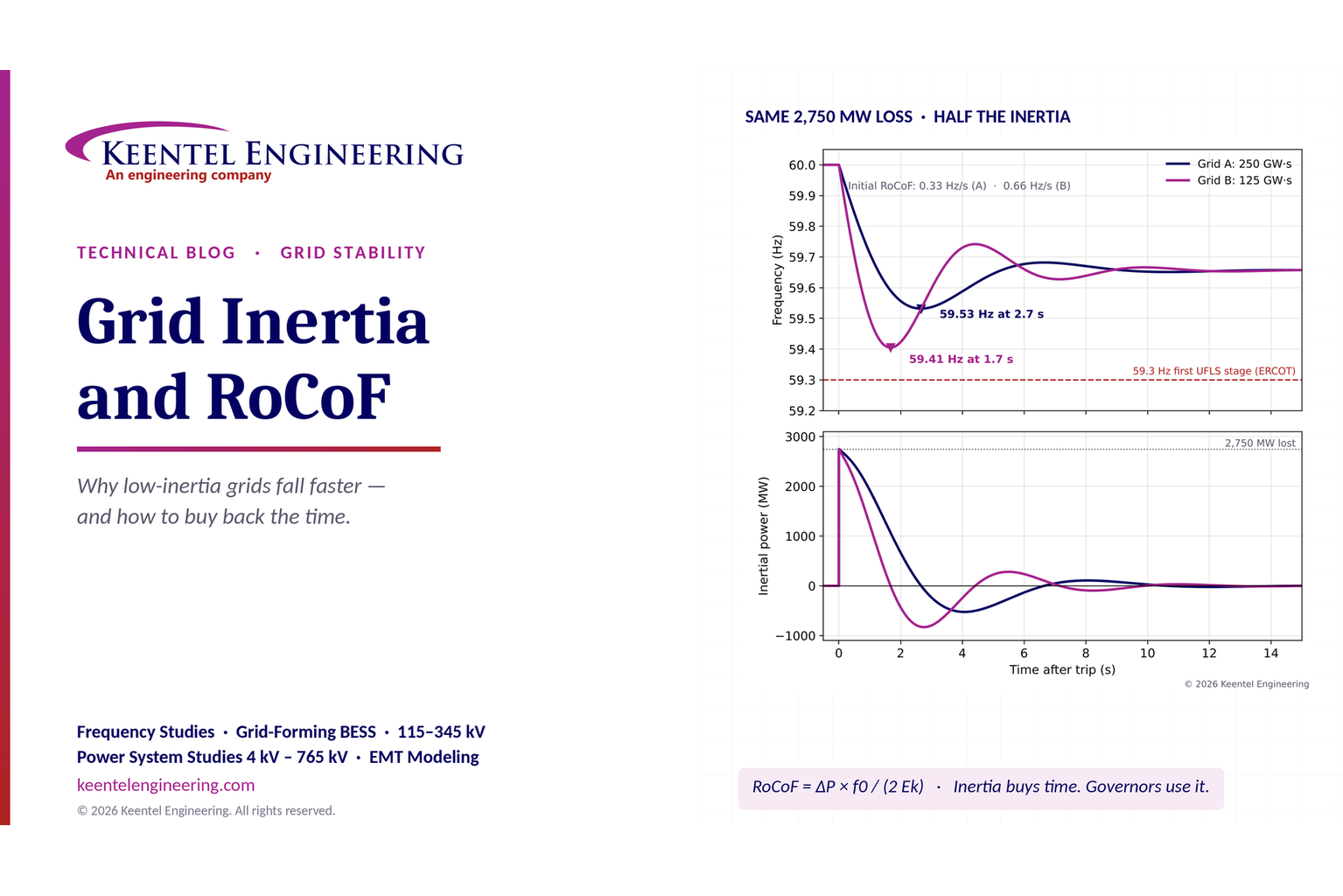
Explore grid inertia, RoCoF and frequency response, with swing equation calculations, frequency nadir analysis and US power system simulation examples.
By SANDIP R PATEL
•
October 11, 2026
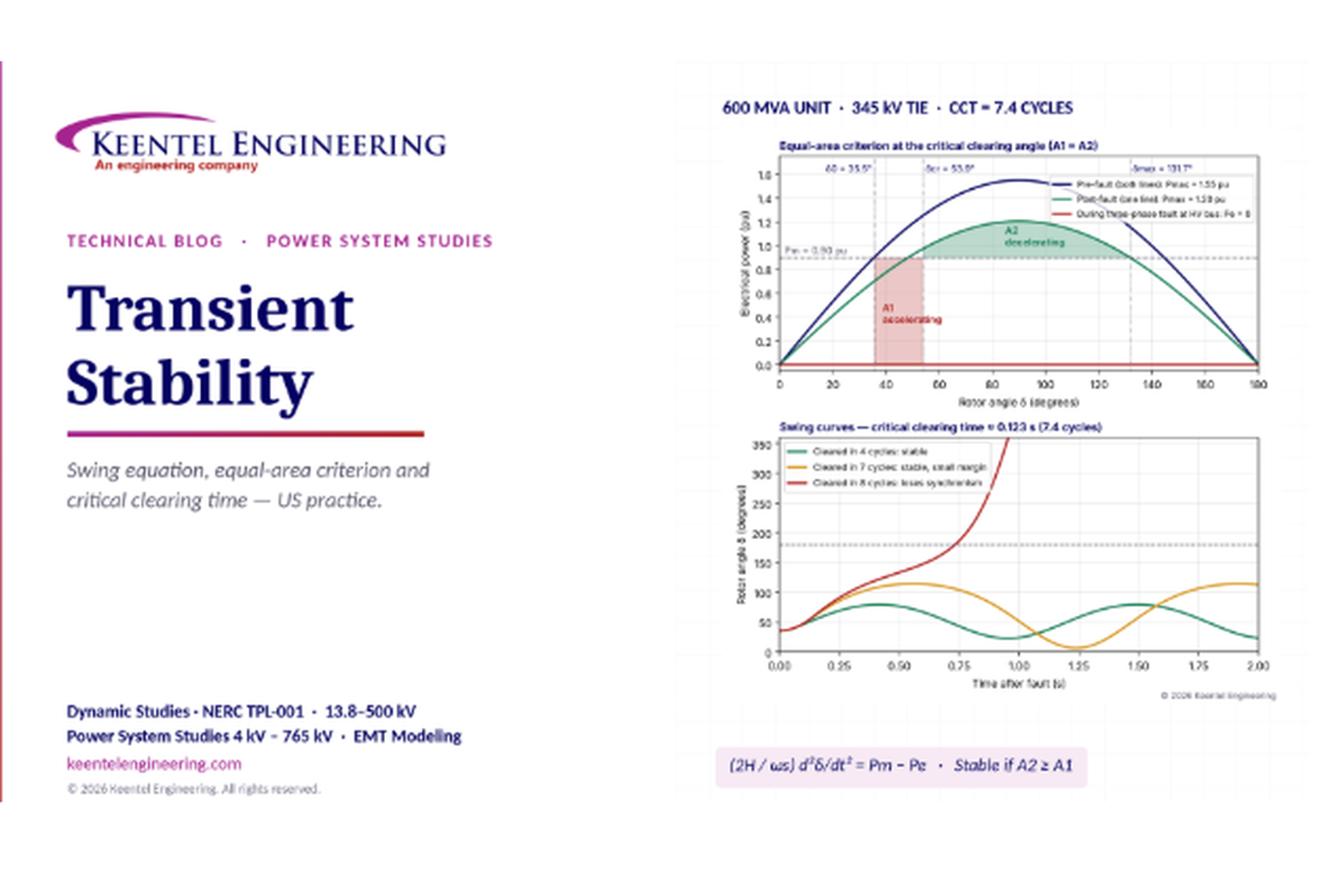
Learn transient stability analysis, swing equation, equal-area criterion and critical clearing time with a 345 kV worked example and NERC TPL-001 guidance.
By SANDIP R PATEL
•
October 11, 2026
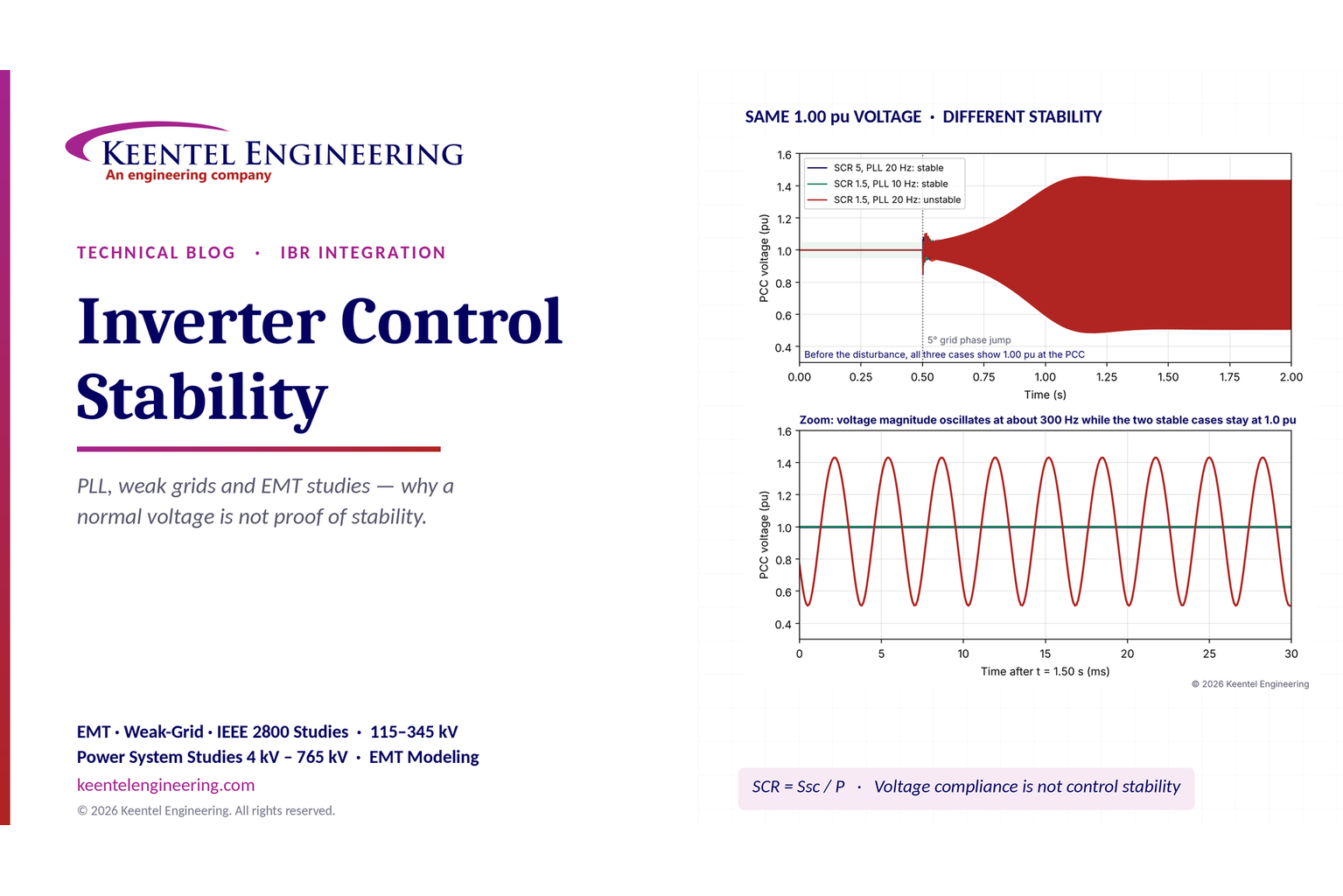
Learn why inverter controls become unstable in weak grids, how PLL bandwidth and SCR affect stability, and how PSCAD EMT studies identify and mitigate oscillations.