
A Coordinated Electric System Interconnection Review—the utility’s deep-dive on technical and cost impacts of your project.
Challenge: Frequent false tripping using conventional electromechanical relays
Solution: SEL-487E integration with multi-terminal differential protection and dynamic inrush restraint
Result: 90% reduction in false trips, saving over $250,000 in downtime
The three operating regions you have to design to
| Device | Output vs voltage | Response | Best suited to | Main limitations |
|---|---|---|---|---|
| Mechanically switched capacitor or reactor | Proportional to voltage squared | Seconds; discrete steps; limited switching operations per day | Steady-state reactive supply, voltage profile, loss reduction | No dynamic capability; step voltage change on switching; capability collapses when most needed |
| Static var compensator | Capacitive branches proportional to voltage squared | A few cycles; continuously controllable | Continuous control where cost matters and deep voltage support is not the driver | Square-law capability loss; harmonic filters are part of the plant and interact with the network |
| STATCOM | Approximately proportional to voltage — constant current capability | One to two cycles closed loop; converter response faster still | Voltage stability margin, weak interconnections, fast disturbance recovery, flicker and unbalance compensation | Higher capital cost; converter losses; adds a converter and its control dynamics to the network |
| Synchronous condenser | Governed by machine capability and excitation | Excitation response in the hundreds of milliseconds; inherent inertial response instantaneous | System strength and inertia, short-circuit contribution, black start support | Rotating plant with maintenance and losses; slower controlled response than a converter |
| STATCOM with energy storage | Reactive as a STATCOM, plus real power within the storage rating | As STATCOM for reactive; real power limited by storage | Where a real power deficiency is part of the problem | Cost and complexity of the storage; different failure and maintenance profile |
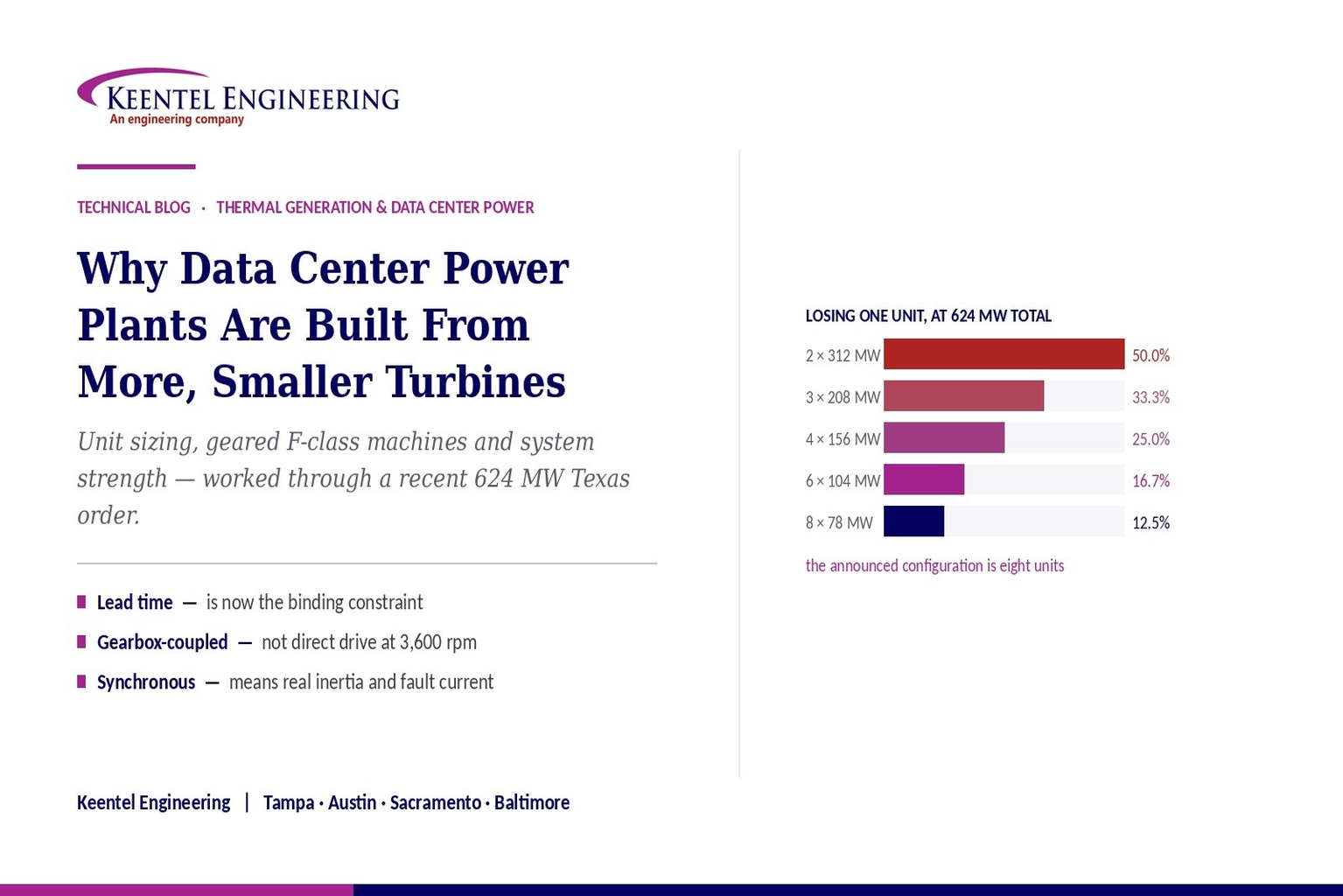
Why Data Center Power Plants Are Built From More, Smaller Turbines
September 6, 2026 | Blog
Unit Sizing, Geared F-Class Machines and System Strength — Worked Through a Recent 624 MW Texas Order, and the Engineering a Decision Like This Actually Creates
1. Executive Summary
In July 2026, Ansaldo Energia announced a contract with Pacifico Energy for eight AE64.3A gas turbines in a sixty hertz configuration, with associated generators, supporting a data center power project in Texas. First deliveries are scheduled for 2027. For Ansaldo it is a return to the United States new-build generation market after more than thirty years.
The coverage has focused on the return, which is the right headline for a trade publication and the least interesting part of the story for an engineer. Three things in the announcement carry more information.
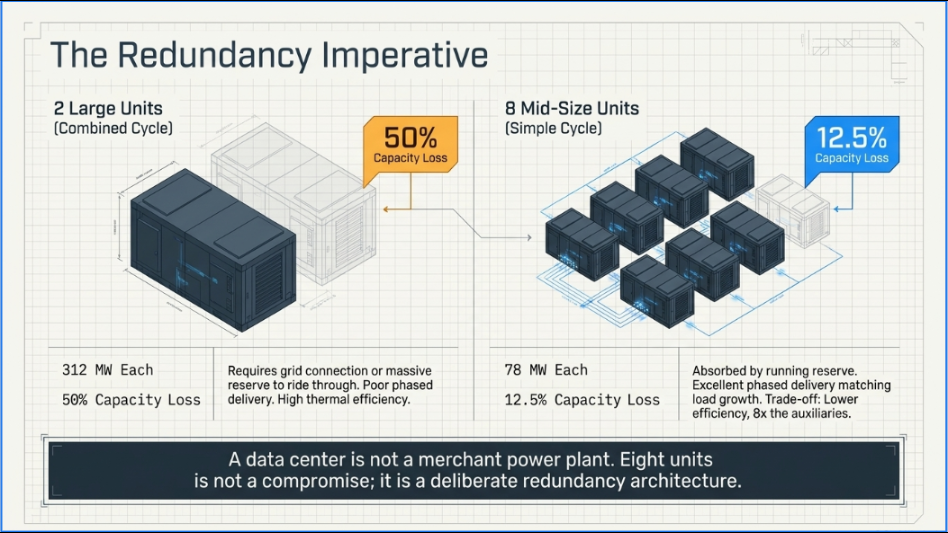
The first is the unit count. Eight machines at a simple-cycle rating of about seventy-eight megawatts gives roughly six hundred and twenty-four megawatts. The same capacity could have been bought as two large combined-cycle blocks. Choosing eight mid-size units instead is a deliberate trade of thermal efficiency for granularity, redundancy and delivery time — and losing one unit costs twelve and a half percent of the plant rather than half of it.
The second is that the machine is gearbox-coupled for sixty hertz service rather than direct-drive at synchronous speed. That is unusual among F-class frames in the American market and it has real consequences for the mechanical package, the auxiliaries and the maintenance model.
The third is what the order reveals about why a manufacturer absent for three decades can win work now. The established suppliers have order books extending years out. Delivery slot availability has become a competitive variable, and in some cases the dominant one. That is a market condition rather than a technology shift, and it will not last indefinitely.
This paper works through what was actually announced, the machine and its configuration, the engineering logic behind the unit count, the behind-the-meter versus grid-connected question that determines most of the regulatory workload, what six hundred megawatts of synchronous generation does for a grid that is losing it, and the engineering an order like this creates — including one risk that is routinely underpriced.
The point most coverage misses
A data center power plant is not a merchant power plant with a different customer. The reliability requirement is different, the load profile is different, and the unit sizing follows from that.
Eight units is not a compromise forced by equipment availability. It is a redundancy architecture, and it happens to align with what is deliverable.
2. What Was Announced
Stated plainly, from Ansaldo’s own release and the trade coverage that followed:
- Eight AE64.3A gas turbines in a sixty hertz configuration, together with the associated generators.
- Customer is Pacifico Energy, a California-based energy infrastructure developer.
- The project supports major data center infrastructure in Texas.
- First deliveries scheduled to begin in 2027.
- Ansaldo describes the machine as suited to modular and redundant architectures, for both grid-connected and behind-the-meter applications, and as capable of supporting cogeneration.
- The company describes this as a foundation for further collaboration.
At the commonly cited simple-cycle rating of about seventy-eight megawatts per unit, eight machines represent approximately six hundred and twenty-four megawatts of nominal capacity before any steam cycle is added.
Several things were not announced and should not be assumed. The site has not been publicly identified. Whether the plant is simple cycle, combined cycle or cogeneration has not been stated. Whether it connects behind the meter or to the grid has not been confirmed. Nor has the contract value. Commentary linking the order to any particular development in the developer’s portfolio is speculation until confirmed, and this paper treats it that way.
3. Why a Thirty-Year Absence Ended
The explanation is not that the machine improved or that the manufacturer discovered the American market. It is that demand outran supply.
Ansaldo’s own reporting puts final sales in the broader sixty hertz gas turbine market above sixty-one gigawatts in 2025, described as the second-best result since 1980, driven particularly by United States demand for data center applications. The established suppliers have absorbed that demand into order books that now extend years into the future, and delivery slots have become scarce.
When lead time becomes the binding constraint rather than price or efficiency, the competitive landscape changes shape. A buyer who needs capacity operating in a defined window will consider a supplier they would not otherwise have shortlisted, provided the machine is proven somewhere. The AE64.3A is: more than seventy units installed worldwide with over four million equivalent operating hours. It is not a new design being introduced to a new market; it is an established design entering a market it has been absent from.
Two implications follow for anyone planning a project. Delivery slot availability should be evaluated as a first-order commercial variable alongside price and heat rate, not as a schedule detail discovered after selection. And the window in which a less-established supplier is competitive on that basis is a market condition, so a procurement strategy built entirely on it carries timing risk of its own.
4. The Machine
The AE64.3A is the small F-class machine in Ansaldo’s portfolio. The published characteristics relevant to a project team:
| Attribute | What is stated | What it means for a project |
|---|---|---|
| Class | F-class, mid-size | Firing temperature and efficiency in the F-class band rather than the higher output and efficiency of modern H and J-class machines |
| Simple-cycle output | Approximately 78 MW per unit at the commonly cited rating | Site rating will differ. Ambient temperature, elevation, inlet and exhaust losses and fuel composition all move it, and Texas summer ambient moves it downward |
| Frequency configuration | Sixty hertz through a gearbox and dedicated generator package | The machine runs at its own optimal speed with a reduction gearbox to the generator — see Section 5 |
| Compressor | Fifteen-stage axial | Conventional axial arrangement for the class |
| Combustion | Annular combustion chamber | Relevant to emissions performance and to combustion tuning across load range and fuel variation |
| Fleet experience | More than 70 units installed, over 4 million equivalent operating hours | A proven machine, though the operating experience base is outside the United States |
| Operating characteristics | Fast start, high availability, operational flexibility, fuel flexibility | Aligns with a data center duty profile rather than a baseload merchant profile |
One caution on the output figure. A gas turbine rating is a reference condition, and a simple-cycle nameplate in a press release is not the capacity a plant will deliver in August in Texas. Ambient temperature reduces output substantially on a machine of this type, which is why inlet air conditioning — evaporative cooling, chilling or fogging — is a standard consideration on hot-climate sites and a real capital and water decision.
5. The Gearbox Is the Interesting Part
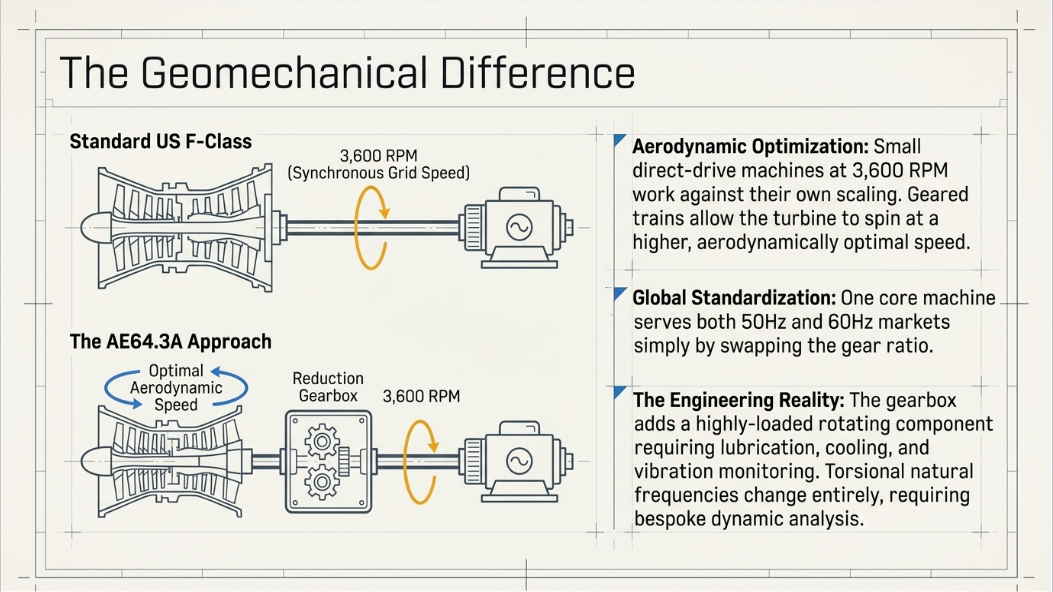
Ansaldo states that the AE64.3A is suited to sixty hertz applications specifically through its gearbox-based configuration and dedicated generator package. That is worth explaining, because it is a genuine architectural difference from most F-class machines in American service.
A synchronous generator on a sixty hertz system with two poles turns at 3,600 revolutions per minute. Most large frame machines sold into sixty hertz markets are designed to run at that speed and couple directly to the generator. Machines designed primarily for fifty hertz markets run at 3,000 revolutions per minute, and a fifty hertz frame scaled to sixty hertz is a different machine, not a rewired one.
The alternative is to let the turbine run at whatever speed is aerodynamically optimal for its size and use a reduction gearbox to drive the generator at synchronous speed. That is the approach here, and it has consequences worth understanding.
- It decouples turbine design from grid frequency. One machine serves both fifty and sixty hertz markets with a different gear ratio, which is why the same design can be offered into a market it has been absent from without a redesign.
- It permits a higher rotational speed for a smaller machine, which is aerodynamically favourable at this output. Small direct-drive machines at 3,600 revolutions per minute are working against their own scaling.
- It adds a component. The gearbox is a highly loaded piece of rotating machinery with its own lubrication, cooling, alignment, vibration monitoring and maintenance requirements, and it is a serviceable item in the train.
- It changes the torsional picture. A geared train has different torsional natural frequencies from a direct-coupled one, and torsional interaction with electrical phenomena — grid faults, out-of-phase synchronisation, subsynchronous conditions where series compensation is present — has to be assessed on the actual train, not by analogy.
None of this is a criticism. Geared gas turbine and generator trains have a long and successful operating record, and the arrangement is standard in the aeroderivative and industrial-frame world. It is simply a different machine to engineer around, and a project team whose experience is entirely with direct-drive frames should recognise that.
6. Why Eight Mid-Size Units Instead of Two Large Ones
This is the decision that tells you the most about what the plant is for.
Six hundred and twenty-four megawatts could be procured as two large combined-cycle blocks, three intermediate frames, or eight mid-size machines. The efficiency argument favours fewer, larger units in combined cycle. The reliability argument favours more, smaller ones. For a data center, the reliability argument wins, and the reason is what happens when a unit trips.
| Configuration | Unit size | Loss of one unit | What that means |
|---|---|---|---|
| 2 units | 312 MW | 50% of plant capacity | A single trip removes half the plant. Ride-through depends entirely on the grid connection or on very substantial reserve |
| 3 units | 208 MW | 33% | Still a severe step. Reserve requirement is a third of the plant |
| 4 units | 156 MW | 25% | Manageable with meaningful reserve margin |
| 6 units | 104 MW | 17% | Approaching conventional redundancy arithmetic |
| 8 units | 78 MW | 12.5% | A single trip is absorbed by running reserve across the remaining fleet. This is the announced configuration |
Four further advantages follow from granularity, and one significant cost.
- Load following. Eight units can be staged so that running machines sit near their efficient loading point rather than all running at part load. Gas turbine efficiency falls off at part load, so a fleet that stages well can outperform a smaller number of larger machines operating below their design point.
- Maintenance without capacity loss. Major inspections on one unit remove an eighth of the plant. On a two-unit plant, a hot gas path inspection removes half of it for weeks.
- Phased delivery and phased revenue. Units arriving over a period allow capacity to be commissioned progressively rather than waiting for a complete block, which matters when the load is arriving progressively too.
- Delivery slot availability. Mid-size machines from a supplier with capacity are obtainable when large frames from the established suppliers are not.
- The cost is efficiency and unit capital. Eight machines mean eight sets of auxiliaries, eight fuel skids, eight generators, eight step-up transformers, eight breakers and eight of everything else, and simple-cycle F-class heat rate is well short of a modern large combined cycle. Whether that trade is right depends on the duty, and for a plant whose job is high-availability supply to a critical load rather than lowest-cost energy, it frequently is.
7. Simple Cycle, Combined Cycle, or Cogeneration
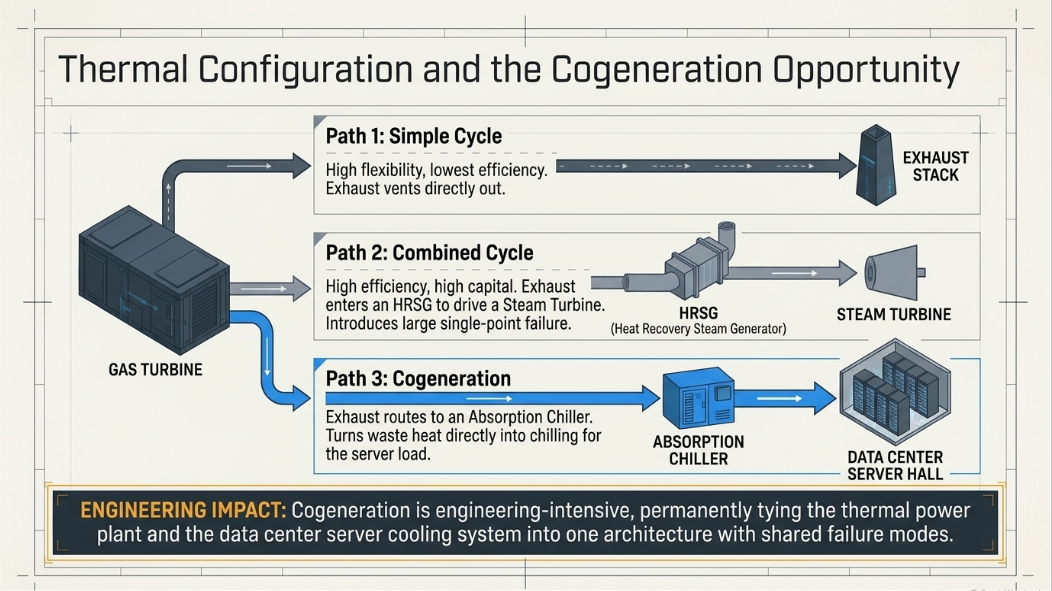
The announcement covers turbines and generators. It does not state the plant configuration, and the three options have very different implications.
- Simple cycle. Lowest capital, fastest to build, best start and ramp flexibility, worst heat rate. Suits a plant whose value is availability and response rather than fuel efficiency, and suits phased delivery because each unit is independent.
- Combined cycle. Add heat recovery steam generators and a steam turbine and efficiency improves dramatically — but the plant becomes more capital intensive, slower to build, slower to start, and the steam turbine introduces a new large single unit whose loss is significant. On an eight-unit plant, the steam block sizing and how many gas turbines feed it becomes an availability question in its own right.
- Cogeneration. Ansaldo specifically notes the machine supports cogeneration, and on a data center site the obvious application is absorption chilling driven by exhaust heat — turning waste heat into cooling capacity for the load the plant exists to serve. That is a genuinely attractive coupling and it is engineering-intensive, because it ties the thermal plant and the cooling plant into one system with shared failure modes.
The choice is not purely technical. It depends on the offtake structure, on whether the plant sells into the market when the data center does not need it, on emissions permitting, and on how much site area and water are available. Announcing turbines before announcing configuration is normal — the long-lead equipment is ordered first because it has to be.
8. Behind the Meter or Grid Connected
This is the question that determines most of the regulatory and engineering workload, and it has not been answered publicly. Ansaldo notes the machine suits both.
| Behind the meter | Grid connected | |
|---|---|---|
| Basic arrangement | Generation and load on the customer side of the meter, supplying the data center directly | Generation interconnects to the transmission or distribution system; the load interconnects separately |
| Interconnection process | Simpler or avoided for the generation, but the load still requires a large load interconnection process where it exceeds thresholds | Full generation interconnection process with studies, agreements and models |
| Islanding | Central to the value proposition. The plant must be able to carry the load independently, which is a demanding control and protection problem | Optional. If the plant can island with its load, that capability must be designed and proven |
| Market participation | Limited or none for the generation, depending on the arrangement | Full participation possible, which changes the economics when the data center is not consuming everything |
| Regulatory exposure | Fewer generation obligations, but the co-location question is under active examination in several markets | Established framework, including registration and reliability standard obligations |
| Reliability obligations | Depends heavily on the specific arrangement and jurisdiction | Clear — generator owner and operator registration with the associated standards |
The engineering difference is largest in the islanding case. A plant that must pick up and carry a large data center load without the grid behind it faces load rejection, block loading, frequency and voltage control on an isolated system, and protection coordination without an infinite bus — all substantially harder than the grid-parallel case. Fast-start capability, which is cited as a strength of this machine, is directly relevant to that duty.
The co-location question more broadly — large loads sited next to generation, and what obligations attach — is under active examination by regulators and system operators, and the answers are still moving. A project team should treat the regulatory position as a live design input rather than a settled background condition.
9. What 624 MW of Synchronous Generation Does for the Grid
There is a system-level point here that the market coverage does not make, and it matters more than it looks.
These are synchronous machines. Unlike inverter-based resources, a synchronous generator is physically coupled to system frequency through a rotating mass, and it provides three things that converter-based generation does not provide inherently.
- Inertia. Rotating mass resists frequency change, slowing the rate of change of frequency after a disturbance and buying time for governor response and protection. The declining inertia of modern systems is a recognised reliability concern.
- Short-circuit current. A synchronous machine contributes substantial fault current, which raises system strength at its point of connection. Converter-based resources are current-limited and contribute comparatively little, which is the root of the weak-grid control interaction problems now dominating interconnection study work.
- A voltage source behind an impedance. The machine presents a genuine voltage reference that other equipment can synchronise to, rather than tracking a measured phase.
So a six-hundred-megawatt synchronous plant is not simply capacity added next to a large load. Depending on where and how it connects, it is a system strength asset in a region that has a great deal of inverter-based generation and a documented interest in system strength. That is a genuine reliability contribution and it is one of the more compelling arguments for gas generation co-located with large loads, distinct from the energy argument.
The connection to a problem we write about often
Interconnection study work across the country is increasingly dominated by weak-grid stability and converter control interaction — problems that exist because converter-based resources do not contribute system strength.
Adding synchronous generation is one of the few things that genuinely raises it. Whether that benefit is realised depends entirely on how the plant is connected and controlled, which is an engineering question, not a procurement one.
10. The Engineering Work an Order Like This Creates
Eight gas turbines and generators is a long-lead equipment order. It is a small fraction of the engineering the project requires.
- Electrical balance of plant. Eight generator step-up transformers, generator circuit breakers or high-side breakers, a collector bus arrangement, and a switchyard. The bus configuration — how many sections, how they tie, what a bus fault removes — is a reliability decision equivalent in weight to the unit count decision.
- Excitation, governing and control. Automatic voltage regulation, power system stabilisers where required, governor droop and frequency response settings, and the plant-level control that coordinates eight units.
- Protection. Generator protection for each machine, transformer differential, bus protection, and coordination through to the interconnection. On a plant with islanding capability, an additional set of schemes for the transition.
- Studies. Load flow, short circuit, protective coordination, arc flash, motor starting, transient stability, and torsional analysis appropriate to a geared train. If the plant islands, dynamic simulation of load rejection and block loading.
- Auxiliary and station service. Eight machines have substantial auxiliary loads, and the station service design determines what happens to the plant when the grid is not there — which is the whole point on a behind-the-meter arrangement.
- Grounding, lightning protection and insulation coordination for the plant and switchyard.
- Fuel supply. Gas pressure, conditioning, metering, and the pipeline interconnection, which has its own long lead time and its own permitting.
- Interconnection engineering, application support and the study process with the transmission provider and system operator.
The ordering of long-lead equipment ahead of the balance of the design is normal and correct, because the turbines gate the schedule. It also means that a number of design decisions are now constrained by equipment already ordered, which is an argument for having the electrical and interconnection engineering underway in parallel rather than sequentially.
11. Models: The Risk Nobody Prices
This deserves its own section because it is the failure mode most specific to a manufacturer new to a market, and it is routinely discovered late.
Every interconnection process in North America requires validated dynamic models of the generating equipment, in the formats the transmission planner and system operator specify — positive-sequence models for stability studies, and increasingly electromagnetic transient models as well. Those models must represent the machine as configured, at the parameters actually deployed, and must be supplied with documentation adequate for the study engineer to use them.
For equipment with a long American service history, those models exist, are familiar to the reviewing engineers, and have been used in dozens of prior studies. For a machine returning to the market after thirty years, several questions arise that a project team should ask before the purchase order is signed rather than after.
- Do validated models exist in the required formats, at the required fidelity, for this machine in this configuration?
- Do they represent the gearbox-coupled train, the excitation system and the governor as they will actually be supplied and set?
- Does the developer have the right to use and share those models with the transmission provider, the system operator and their consultants?
- If the plant may be required to demonstrate ride-through, fast frequency response or islanding, do the models support demonstrating it?
- Who provides modelling support when the study engineer has a question, and in what time zone?
The consequence of getting this wrong is not a technical dispute, it is a schedule loss. An interconnection study cannot proceed without models, and a study that stalls waiting for a model package pushes every downstream date. Model deliverables, formats, usage rights and support obligations belong in the equipment purchase specification, with delivery dates tied to project milestones — which is the same lesson the inverter-based world learned expensively over the last several years.
12. Fuel, Emissions, and Permitting
Eight F-class machines in Texas carry a permitting workload that runs in parallel with the engineering and frequently governs the schedule.
- Air permitting. Nitrogen oxide and carbon monoxide emissions drive combustion system selection and post-combustion treatment. Dry low-emissions combustion, water or steam injection, and selective catalytic reduction are the levers, and each has capital, efficiency, water and space consequences. The annular combustion chamber and its emissions performance across load range is directly relevant here.
- Load-range emissions. A plant that starts frequently and operates at varying load has a different emissions profile from a baseload plant, and permits are written against operating scenarios. A flexibility-driven duty needs a permit that accommodates it.
- Water. Inlet air cooling, any steam cycle, and emissions control can all consume water, and water availability in parts of Texas is a real constraint that shapes plant configuration.
- Fuel supply. Pipeline capacity, delivery pressure, gas quality and its variability, and the interconnection agreement with the pipeline. Fuel flexibility is cited as a machine strength, and where an alternative fuel is intended, its storage and handling become part of the permit.
- Noise and siting. Eight turbines is a substantial acoustic source, and the surrounding land use determines how much attenuation is required.
13. What a New OEM Entry Means for a Project Team
| Consideration | The opportunity | The diligence |
|---|---|---|
| Delivery | Slots available when established suppliers are booked out for years | Confirm the delivery schedule is contractual with meaningful remedies, and that it accounts for shipping, customs and site logistics |
| Price | A supplier building market position may price competitively | Evaluate total installed cost and lifecycle cost, not equipment price. Auxiliaries, spares and service dominate over a plant life |
| Technology maturity | An established design with a substantial fleet and operating hours | The operating experience is largely outside the United States. Ask for reference plants, availability data and failure history in comparable duty |
| Service and parts | An OEM entering a market has an incentive to support its first projects well | Confirm the North American service organisation, parts stocking, response times and field service depth as they will exist in 2028, not as promised |
| Models and studies | A proven machine should have a model base | See Section 11. Confirm formats, fidelity, usage rights and support before the order, not after |
| Codes and standards | The machine is built to recognised international standards | Confirm compliance with the American standards, listings and code requirements the authority having jurisdiction will apply, including electrical equipment listing and pressure equipment requirements |
| Interfaces | A dedicated generator package simplifies the scope split | Interface definition between the turbine island and balance of plant is where scope gaps live. Define it in the contract, in engineering terms |
None of these are objections. They are the ordinary diligence that any first-of-a-kind supplier relationship warrants, and a developer who does them properly is better positioned than one buying familiar equipment without asking.
14. The Broader Signal
Set aside the specific order and the pattern is clear enough.
Data center load growth has moved the constraint on new generation from capital and permitting to manufacturing capacity. When the binding constraint is a factory slot, the market reorganises: suppliers who were not competitive on price or efficiency become competitive on availability, buyers accept configurations they would not previously have chosen, and equipment decisions get made earlier and with less design definition behind them.
Three consequences follow that are worth naming.
- More projects will be configured around what is deliverable rather than what is optimal. That is a rational response to the constraint, and it means more plants built from more, smaller units — with the redundancy benefit and the efficiency penalty that implies.
- More equipment will be new to the American market. Which raises the model, service, parts and standards questions in Sections 11 and 13 across a growing share of projects.
- More synchronous capacity will be added near large loads. Which, if it is connected and controlled well, is a genuine benefit to systems that have been losing system strength for a decade.
The window will close. Manufacturing capacity is being added, and at some point lead times normalise and the competitive basis reverts to price, efficiency and service. Projects being configured now are being configured inside an unusual market, and the plants will operate for thirty years in a normal one.
15. Keentel Engineering Services for Thermal Generation Projects
Keentel Engineering provides the electrical power systems engineering behind thermal generation and the loads it serves — from interconnection through detailed design to commissioning and compliance.
15.1 Interconnection and System Studies
- Generation and large load interconnection engineering, application support, study-phase technical packages, and coordination with the utility, transmission provider and system operator.
- Load flow, short-circuit, protective coordination, arc-flash, motor starting and reactive capability studies across the plant and the interconnection.
- Transient stability analysis, and electromagnetic transient studies where system strength, control interaction or switching transients require them.
- Islanding and load rejection analysis for behind-the-meter and campus arrangements, including block loading, frequency and voltage control on an isolated system.
- System strength and grid contribution assessment, quantifying what synchronous generation actually delivers at a given point of connection.
15.2 Models and Compliance
- Model deliverable, format, fidelity and usage-rights requirements written into equipment purchase specifications, with delivery dates tied to project milestones.
- Positive-sequence and electromagnetic transient model development, review, cross-validation and submittal packages prepared to the transmission planner’s format.
- Model verification and validation against staged test data and disturbance records.
- Reliability standard applicability assessment and compliance programme support for registered generation, with evidence structured during design and commissioning.
15.3 Plant Electrical Design
- Generator step-up transformer and generator breaker specification, switchyard and collector bus arrangement, and medium-voltage distribution design.
- Generator, transformer, bus and interconnection protection design, settings and coordination, including schemes for grid-parallel and islanded operation.
- Excitation, voltage regulation and governor settings coordination, and plant-level control architecture across multiple units.
- Auxiliary and station service design, direct-current systems, grounding and lightning protection, and insulation coordination.
- Equipment specification with the behavioural, test and model deliverable requirements that make a specification enforceable.
15.4 Owner’s Engineer, Commissioning, and Diligence
- Technical due diligence on equipment selection, including first-of-a-kind supplier assessment, service and parts capability, standards compliance and interface definition.
- Bid normalisation so that competing proposals from different suppliers can be compared on equivalent terms.
- Design review of EPC and vendor submittals, and QA/QC of third-party studies and model packages.
- Commissioning specification and integrated test programme development, including load rejection, islanding transition and protection verification.
Keentel Engineering holds a Florida Certificate of Authorization and maintains offices in Tampa, Austin, Sacramento, and Baltimore, supporting projects across the interconnections.
16.References and Further Reading
Facts about the order in this paper are taken from the manufacturer’s public announcement and contemporaneous trade coverage. Market conditions and project details change; check for more recent information before relying on any of it.
The Announcement
- Ansaldo Energia press release, "Ansaldo Energia returns to the USA market with an order for eight AE64.3A gas turbines for a Texas data center project", July 2026, and the associated equipment pages — Ansaldo Energia
https://www.ansaldoenergia.com/about-us/media-center/power-generation-news-insights - Trade coverage of the order and of the gas turbine supply constraint, including POWER Magazine, Gas Turbine World, Gas to Power Journal and Offshore Technology — Various trade press
https://www.powermag.com/ansaldo-us-gas-turbine-market-equipment-crunch/ - Ansaldo Energia 2025 consolidated reporting, source of the sixty hertz gas turbine market figure cited in this paper — Ansaldo Energia
https://www.ansaldoenergia.com/
Machine and Plant Engineering
- ISO 3977 series, Gas turbines — procurement, covering rating conditions, and ASME PTC 22 for gas turbine performance testing — ISO and ASME
https://www.asme.org/ - API 616 for gas turbines for petroleum and industrial service, API 613 and API 677 for special-purpose and general-purpose gear units, and API 670 for machinery protection systems — American Petroleum Institute
https://www.api.org/ - IEEE Std C50.13 for cylindrical-rotor synchronous generators, IEEE Std C37.102 for generator protection, IEEE Std C37.101 for generator ground protection, and IEEE Std C37.013 for generator circuit breakers — IEEE Standards Association
https://standards.ieee.org/ - IEEE Std 421 series for excitation systems, and the IEEE and CIGRE guidance on subsynchronous and torsional interaction applicable to geared turbine-generator trains — IEEE Standards Association and CIGRE
https://standards.ieee.org/
Interconnection, Compliance, and Studies
- NERC Reliability Standards — including the MOD series covering modelling data and model verification, the PRC series for protection and disturbance monitoring, and the FAC series for facility ratings and interconnection — North American Electric Reliability Corporation
https://www.nerc.com/pa/Stand/Pages/ReliabilityStandards.aspx - ERCOT Planning Guide, Nodal Protocols and Nodal Operating Guide, and the ERCOT resource integration and large load interconnection materials — Electric Reliability Council of Texas
https://www.ercot.com/mktrules/guides/planning - IEEE Std 3002.3 for short-circuit studies, IEEE Std 3002.7 for motor starting studies, IEEE Std 1584 for arc-flash calculation, and IEEE Std 399 legacy guidance on industrial and commercial power system analysis — IEEE Standards Association
https://standards.ieee.org/
17. Frequently Asked Questions
Q1. What exactly was announced?
Ansaldo Energia signed a contract with Pacifico Energy for eight AE64.3A gas turbines in a sixty hertz configuration, together with the associated generators, for a power generation project supporting major data center infrastructure in Texas. First deliveries are scheduled to begin in 2027. It marks Ansaldo’s return to the United States new-build power generation market after more than thirty years.
Q2. How much capacity is that?
At the commonly cited simple-cycle rating of about seventy-eight megawatts per unit, eight machines represent roughly six hundred and twenty-four megawatts nominal, before any steam cycle is added.
Q3. Is that the capacity the plant will actually deliver?
Not exactly. A gas turbine rating is stated at reference conditions. Site output depends on ambient temperature, elevation, inlet and exhaust pressure losses and fuel composition, and hot-weather output on a machine of this type is meaningfully below the reference figure. This is why inlet air cooling is a standard consideration on hot-climate sites.
Q4. What has not been announced?
The site, the plant configuration — simple cycle, combined cycle or cogeneration — whether the arrangement is behind the meter or grid connected, and the contract value. Commentary linking the order to any particular development in the developer’s portfolio is speculation until confirmed.
Q5. Why is a manufacturer absent for thirty years suddenly winning work?
Because lead time has become the binding constraint. Ansaldo’s reporting puts the sixty hertz gas turbine market above sixty-one gigawatts in 2025, described as the second-best result since 1980, driven by United States data center demand. Established suppliers have order books extending years out, and delivery slot availability has become a competitive variable.
Q6. Is this a new or unproven machine?
No. Ansaldo states more than seventy units installed worldwide with over four million equivalent operating hours. It is an established design entering a market it has been absent from, rather than a new design. The operating experience base is, however, largely outside the United States.
Q7. What is unusual about the machine’s configuration?
It is gearbox-coupled for sixty hertz service rather than direct-drive at synchronous speed. The turbine runs at its own optimal speed and a reduction gearbox drives the generator at 3,600 revolutions per minute. Most F-class frames in American service are direct-drive.
Q8. Why does a manufacturer choose a geared arrangement?
It decouples turbine design from grid frequency, so one machine serves both fifty and sixty hertz markets with a different gear ratio. It also permits a higher, aerodynamically favourable rotational speed for a machine of this output, which small direct-drive machines at 3,600 revolutions per minute cannot achieve.
Q9. What does the gearbox add in engineering terms?
A highly loaded piece of rotating machinery with its own lubrication, cooling, alignment, vibration monitoring and maintenance requirements. It also changes the torsional characteristics of the train, so torsional analysis has to be performed on the actual geared arrangement rather than by analogy to a direct-coupled one.
Q10. Is that a disadvantage?
Not inherently. Geared turbine-generator trains have a long and successful record and are standard in the aeroderivative and industrial-frame world. It is a different machine to engineer around, and a project team whose experience is entirely with direct-drive frames should recognise that rather than assume equivalence.
Q11. Why eight units rather than two or three larger ones?
Redundancy arithmetic. Losing one of eight units costs twelve and a half percent of plant capacity; losing one of two costs fifty percent. For a plant whose job is high-availability supply to a critical load, that difference dominates the efficiency advantage of fewer, larger machines.
Q12. What else does granularity buy?
Load following with units near their efficient loading point rather than all at part load; maintenance that removes an eighth of the plant rather than half; phased delivery and progressive commissioning that matches load arriving progressively; and access to delivery slots that larger frames do not have.
Q13. What does it cost?
Efficiency and unit capital. Simple-cycle F-class heat rate is well short of a modern large combined cycle, and eight machines mean eight sets of auxiliaries, generators, step-up transformers, breakers and everything else. Whether the trade is right depends on whether the plant’s value is availability or lowest-cost energy.
Q14. Does the plant configuration matter much?
Considerably. Simple cycle is cheapest and fastest with the best flexibility and worst heat rate. Combined cycle improves efficiency dramatically but adds capital, build time and a large steam unit whose loss is significant. Cogeneration — which Ansaldo specifically notes the machine supports — could drive absorption chilling from exhaust heat, coupling the power plant and the cooling plant into one system.
Q15. Why does behind-the-meter versus grid-connected matter so much?
It determines most of the regulatory and engineering workload — which interconnection process applies, whether market participation is possible, what reliability obligations attach, and above all whether the plant must be able to island and carry the load without the grid behind it.
Q16. Why is islanding so much harder?
Because load rejection, block loading, frequency and voltage control on an isolated system, and protection coordination without an infinite bus are all substantially more demanding than grid-parallel operation. Fast-start capability, cited as a strength of this machine, is directly relevant to that duty.
Q17. What do synchronous machines give the grid that inverters do not?
Three things: inertia from rotating mass, which slows the rate of change of frequency after a disturbance; substantial short-circuit current, which raises system strength; and a genuine voltage source behind an impedance that other equipment can synchronise to rather than tracking a measured phase.
Q18. Why does that matter now?
Because interconnection study work is increasingly dominated by weak-grid stability and converter control interaction — problems that exist precisely because converter-based resources do not contribute system strength. Adding synchronous generation is one of the few things that genuinely raises it.
Q19. Does that benefit happen automatically?
No. Whether it is realised depends on where and how the plant connects and how it is controlled. It is an engineering outcome, not a property of having bought synchronous machines.
Q20. What is the most underpriced risk on a project like this?
Models. Every interconnection process requires validated dynamic models in specified formats, and for equipment with a long American service history those exist and are familiar. For a machine returning after thirty years, model availability, fidelity, usage rights and support are open questions that should be settled before the purchase order, not after.
Q21. Why is that a schedule risk rather than a technical one?
Because an interconnection study cannot proceed without models. A study that stalls waiting for a model package pushes every downstream date. Model deliverables, formats, usage rights and support obligations belong in the purchase specification with delivery dates tied to milestones — the same lesson the inverter-based world learned expensively.
Q22. What diligence does a first-of-a-kind supplier warrant?
Contractual delivery with meaningful remedies; total installed and lifecycle cost rather than equipment price; reference plants and availability data in comparable duty; the North American service and parts organisation as it will exist when the plant operates; model availability; compliance with the American standards and listings the authority having jurisdiction will apply; and rigorous interface definition between the turbine island and balance of plant.
Q23. What engineering does the turbine order not cover?
Most of it. Generator step-up transformers, breakers, collector bus and switchyard; excitation, governing and plant control; generator, transformer and bus protection; the full study set including torsional analysis appropriate to a geared train; auxiliary and station service; grounding and lightning protection; fuel supply and its own interconnection; and the interconnection engineering itself.
Q24. What does this order signal about the market generally?
That the constraint on new generation has moved from capital and permitting to manufacturing capacity. When a factory slot is the binding constraint, suppliers become competitive on availability, buyers accept configurations they would not otherwise choose, and equipment decisions get made earlier with less design definition behind them.
Q25. Will that persist?
Manufacturing capacity is being added, and at some point lead times normalise and the competitive basis reverts to price, efficiency and service. The relevant point for a project team is that plants being configured inside this unusual market will operate for thirty years in a normal one, so the configuration should be defensible on its own merits and not only on availability.
Notice and Disclaimer
This document is original technical content prepared by Keentel Engineering LLC for general professional information. It is not project-specific engineering advice, investment advice, or a recommendation regarding any equipment, supplier, developer or project, and it does not constitute a design, a study, or an evaluation of any installation.
Facts regarding the order described are taken from the manufacturer’s public announcement and contemporaneous trade press as at the date of publication. Where this paper notes that a matter has not been publicly confirmed — including plant configuration, site, interconnection arrangement and contract value — that reflects the state of public information and not any private knowledge. Analysis, inference and commentary are Keentel Engineering’s own engineering assessment and should not be attributed to any party named.
Equipment ratings, outputs, configurations and performance characteristics are as published by the manufacturer at reference conditions. Site performance differs and must be established from project-specific conditions and manufacturer data. Nothing here should be relied upon for equipment selection.
Keentel Engineering LLC is an independent engineering consultancy. Reference to any manufacturer, developer, standard, code, industry organisation, regulator, or market operator in this document does not imply affiliation with, endorsement by, or sponsorship from any such organisation, nor any commercial relationship with any party named.

About the Author:
Sandip "Sonny" R. Patel, P.E.
IEEE Senior Member · Founder & CEO, Keentel Engineering
In 1995, Sonny Patel earned his Electrical Engineering degree from the University of Illinois. But degrees don't build legacies — action does.
For three decades, he has worked the power industry from every side of the table: 16 years as a utility engineer at Exelon/Commonwealth Edison; generation leadership across hydroelectric, industrial steam turbine, and a 9 GW renewable fleet; NERC Regional Entity Senior Compliance Engineer and Audit Team Lead, auditing some of the nation's largest utilities; and testing and commissioning lead on equipment up to 765 kV — the very top of the North American grid.Utility. Generator. Regulator. Consultant. Few engineers have seen all four seats. Fewer still have sat in them.
His experience spans nuclear, hydro, conventional generation, renewables, oil and gas, mining — and today's data centers, where he is authoring a three-book series on data center design. He is a Licensed Professional Engineer in six states and a Licensed Electrical Contractor in Florida (Unlimited EC) — he doesn't just design the work; he's qualified to stand behind its execution.Today, as Founder and CEO of Keentel Engineering, Sonny leads a nationwide team of engineers delivering substation design, power system studies, NERC compliance, and commissioning — done right, coast to coast.Three decades. Every side of the table. One standard: accountable engineering.
Services

Let's Discuss Your Project
Let's book a call to discuss your electrical engineering project that we can help you with.
About the Author:
Sandip "Sonny" R. Patel, P.E.
IEEE Senior Member · Founder & CEO, Keentel Engineering
In 1995, Sonny Patel earned his Electrical Engineering degree from the University of Illinois. But degrees don't build legacies — action does.
For three decades, he has worked the power industry from every side of the table: 16 years as a utility engineer at Exelon/Commonwealth Edison; generation leadership across hydroelectric, industrial steam turbine, and a 9 GW renewable fleet; NERC Regional Entity Senior Compliance Engineer and Audit Team Lead, auditing some of the nation's largest utilities; and testing and commissioning lead on equipment up to 765 kV — the very top of the North American grid.
Utility. Generator. Regulator. Consultant. Few engineers have seen all four seats. Fewer still have sat in them.
His experience spans nuclear, hydro, conventional generation, renewables, oil and gas, mining — and today's data centers, where he is authoring a three-book series on data center design. He is a Licensed Professional Engineer in six states and a Licensed Electrical Contractor in Florida (Unlimited EC) — he doesn't just design the work; he's qualified to stand behind its execution.
Today, as Founder and CEO of Keentel Engineering, Sonny leads a nationwide team of engineers delivering substation design, power system studies, NERC compliance, and commissioning — done right, coast to coast.Three decades. Every side of the table. One standard: accountable engineering.
Leave a Comment
Thank you for contacting us.
We will get back to you as soon as possible.
We will get back to you as soon as possible.
Oops, there was an error sending your message.
Please try again later.
Please try again later.
Related Posts
By SANDIP R PATEL
•
October 20, 2026
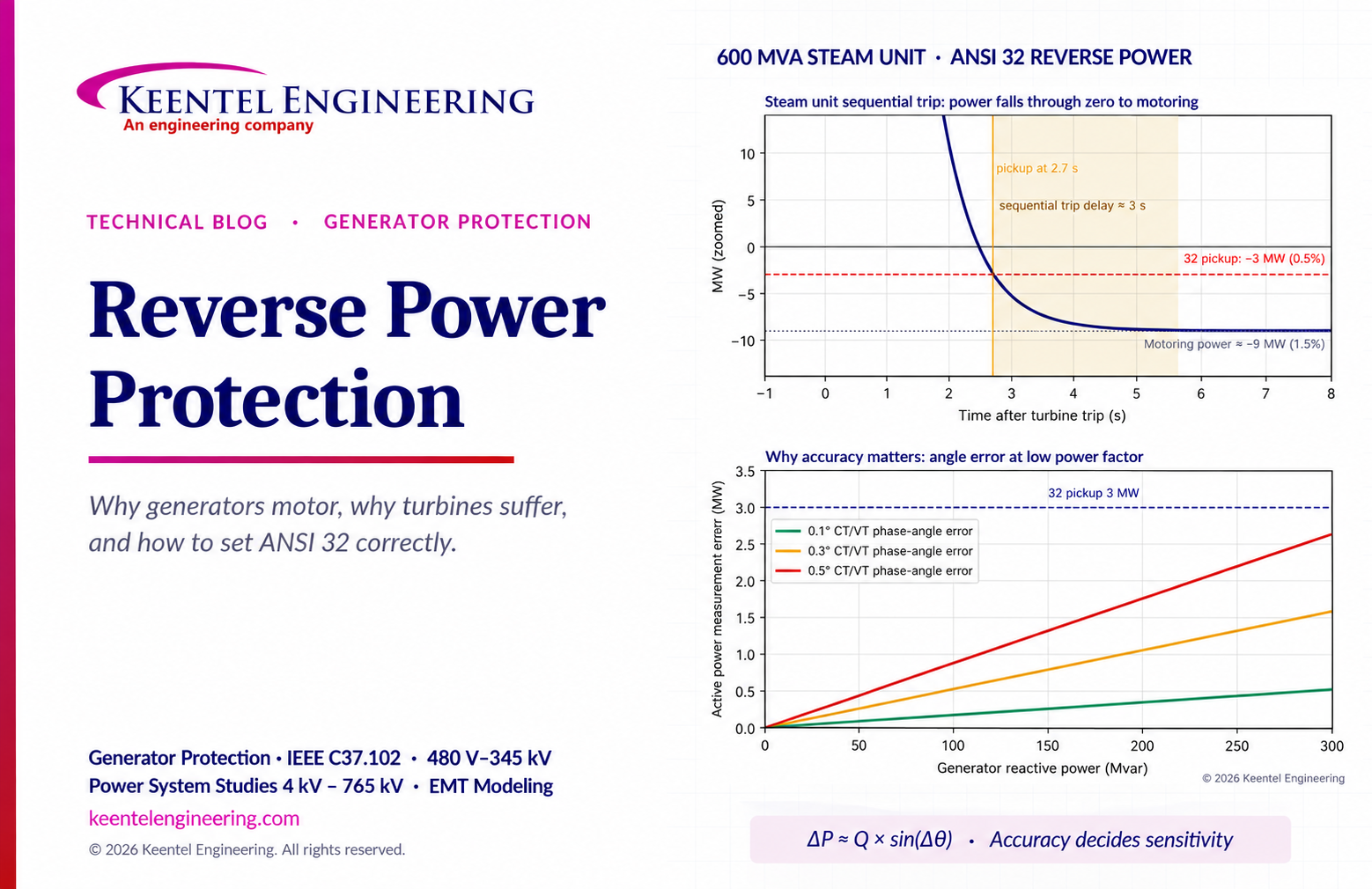
Learn reverse power protection (ANSI 32), generator motoring, relay pickup settings, time delays, sequential tripping and testing for US power plants.
Copy
By Team 2 Dexora
•
October 20, 2026
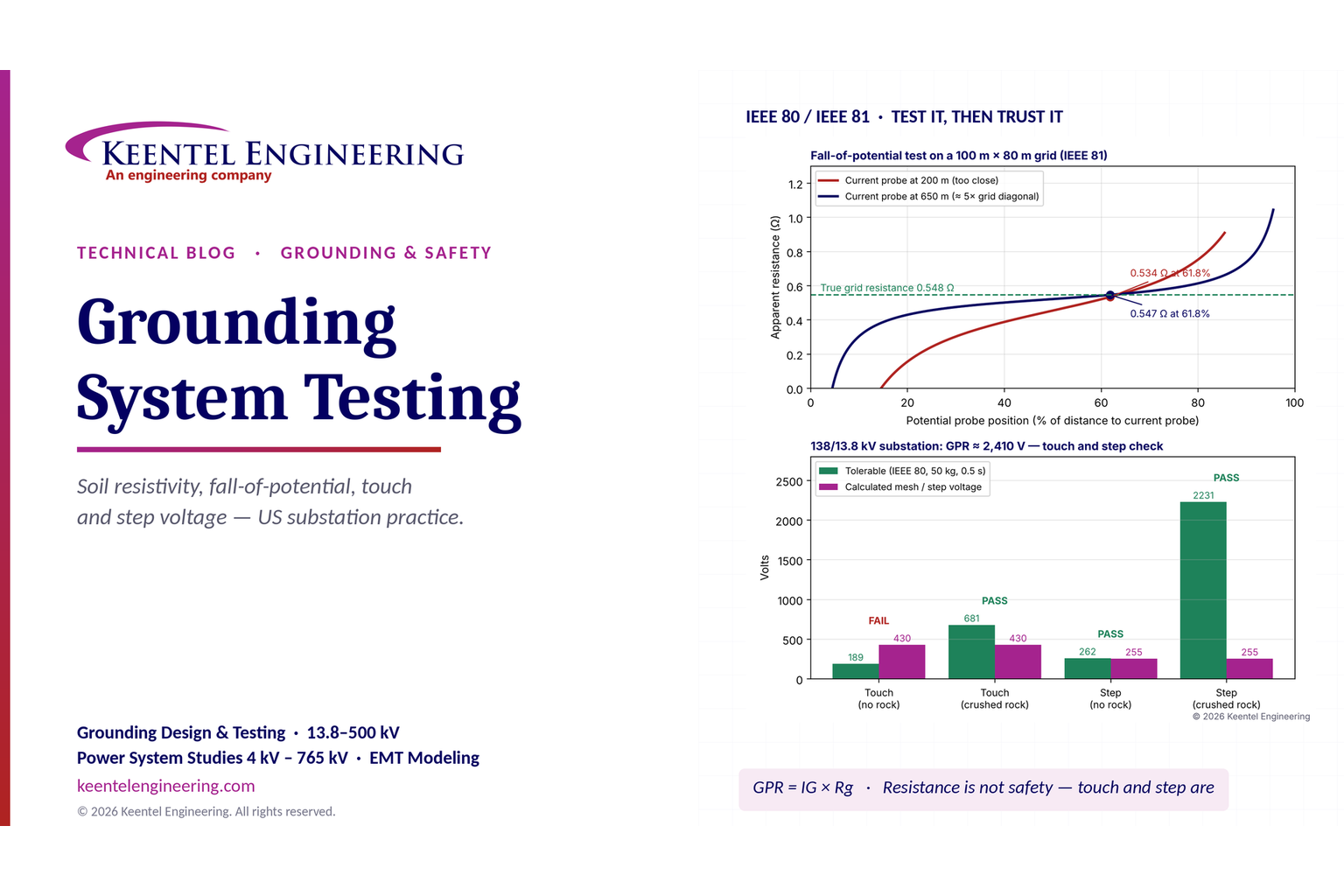
Explore grounding system testing with Keentel Engineering. Learn IEEE 80/81 methods, soil resistivity, ground resistance, and touch and step voltage safety.
By SANDIP R PATEL
•
October 13, 2026
Plan data center capacity with land screening, MW-per-acre estimates, grid power availability and interconnection feasibility studies from Keentel Engineering.
By SANDIP R PATEL
•
October 11, 2026
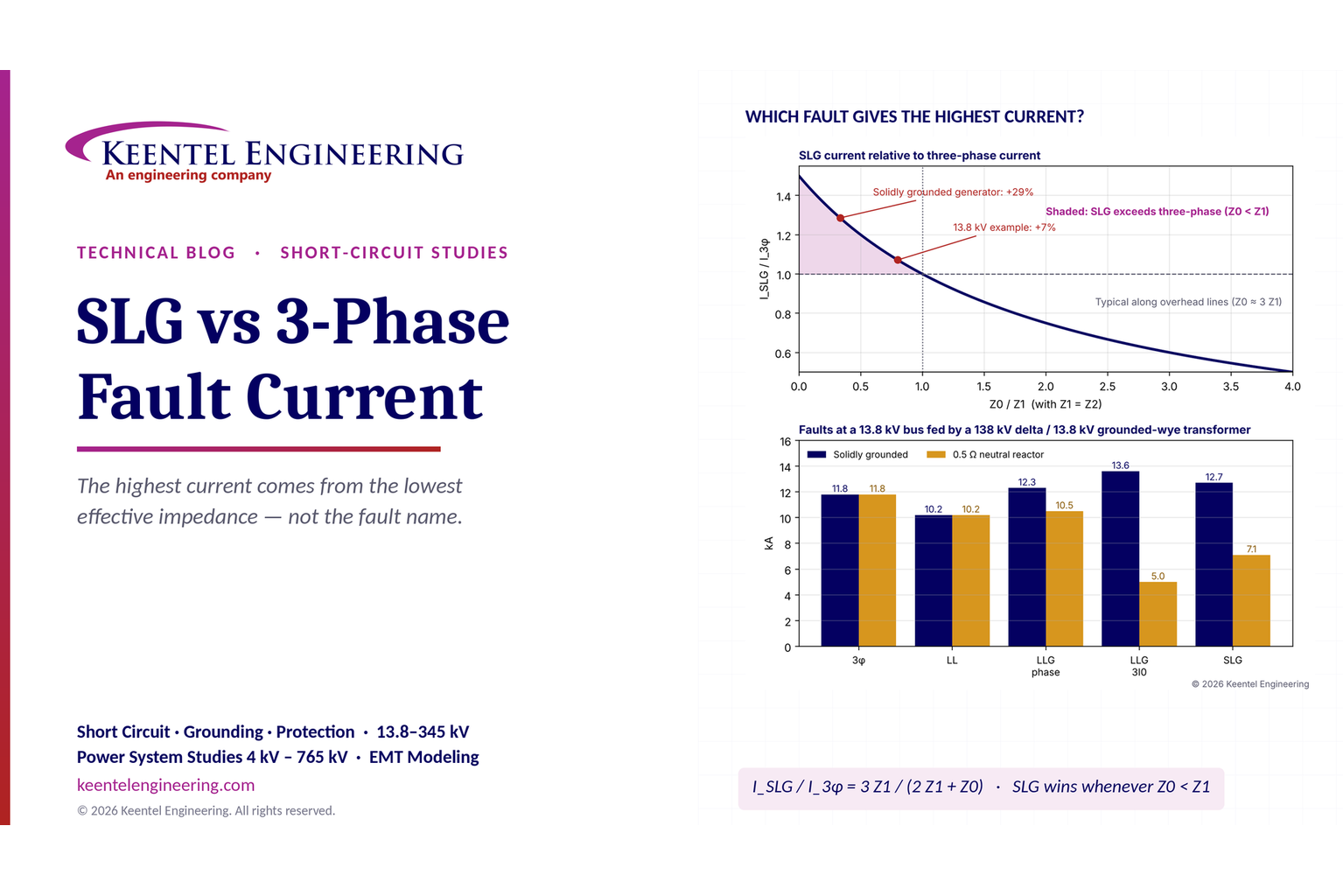
Learn which fault produces the highest current at a bus, why SLG faults can exceed three-phase faults, and how symmetrical components determine fault duty.
By SANDIP R PATEL
•
October 11, 2026
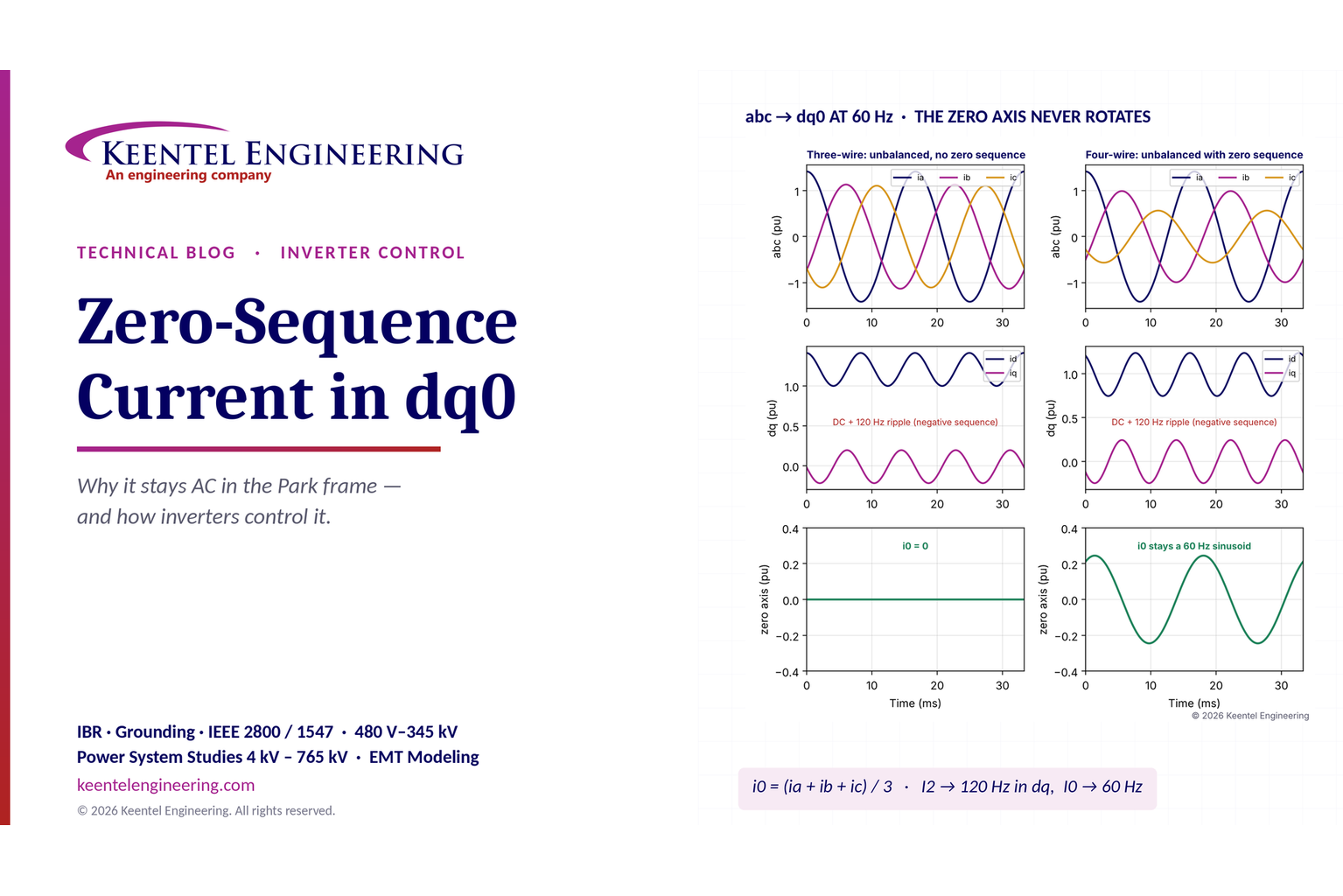
Learn why zero-sequence current pulsates in the dq0 frame, how Park's transformation works, and how inverter controls handle unbalance and ground faults.
By SANDIP R PATEL
•
October 11, 2026
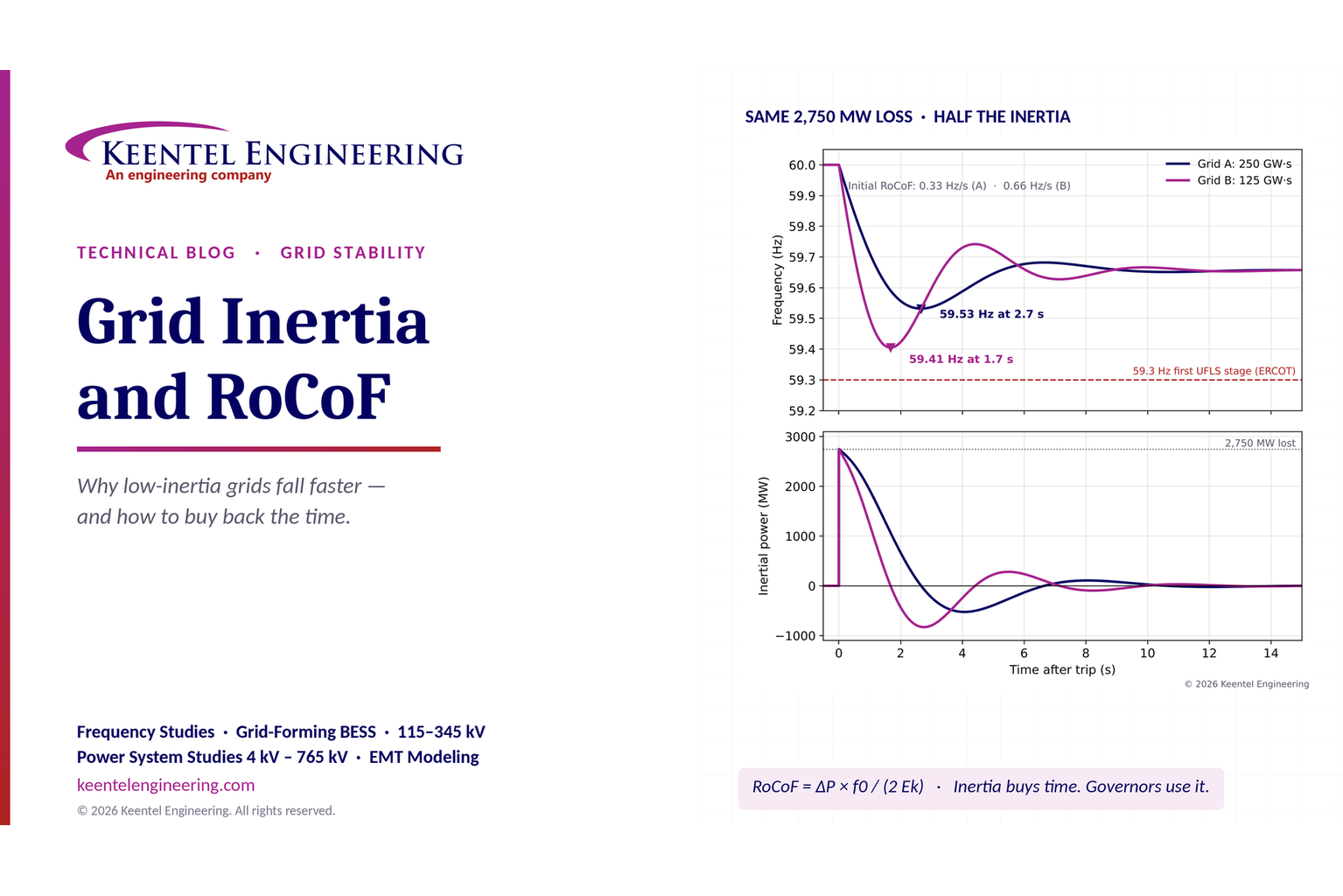
Explore grid inertia, RoCoF and frequency response, with swing equation calculations, frequency nadir analysis and US power system simulation examples.
By SANDIP R PATEL
•
October 11, 2026
Learn transient stability analysis, swing equation, equal-area criterion and critical clearing time with a 345 kV worked example and NERC TPL-001 guidance.
By SANDIP R PATEL
•
October 11, 2026
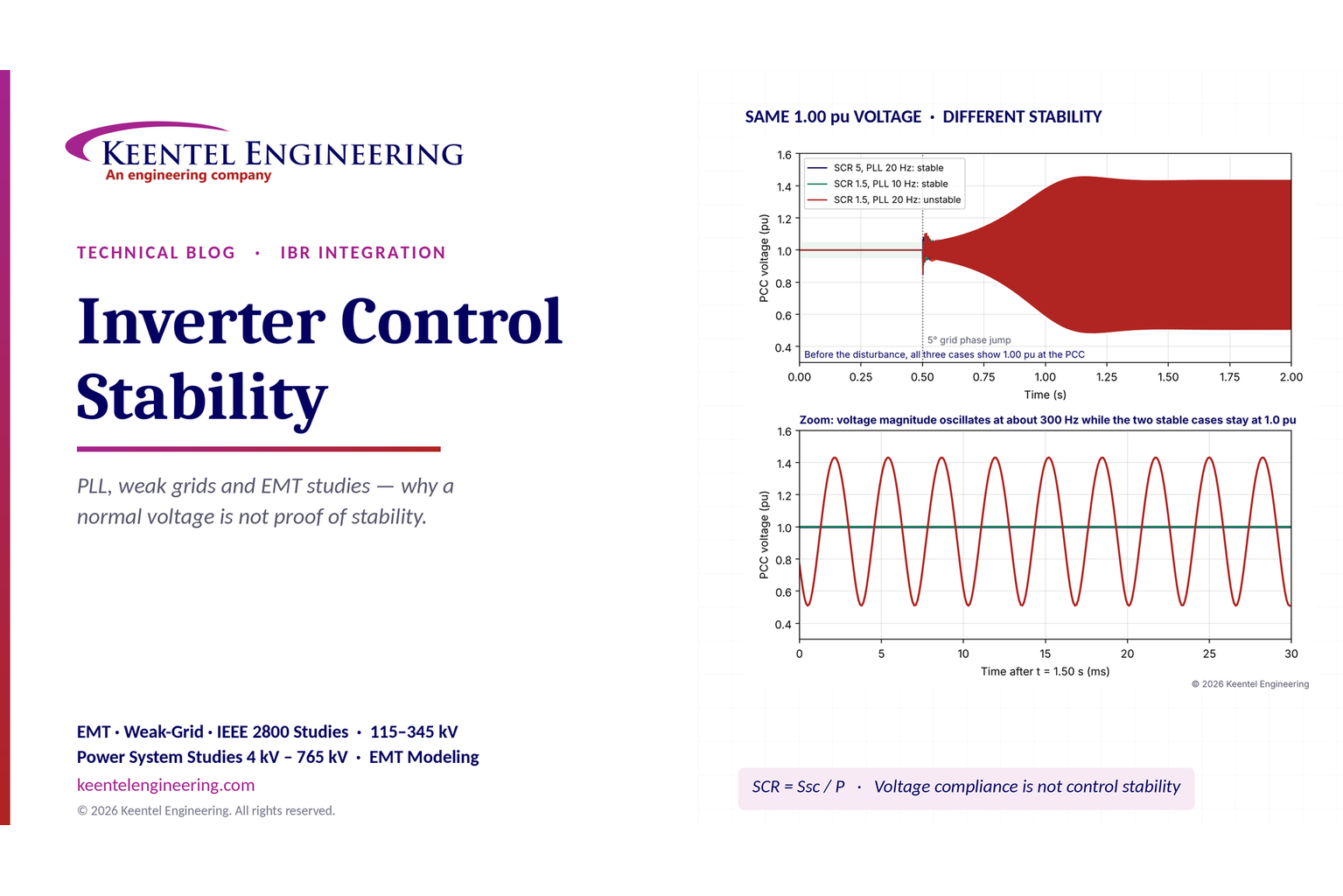
Learn why inverter controls become unstable in weak grids, how PLL bandwidth and SCR affect stability, and how PSCAD EMT studies identify and mitigate oscillations.
By SANDIP R PATEL
•
October 11, 2026
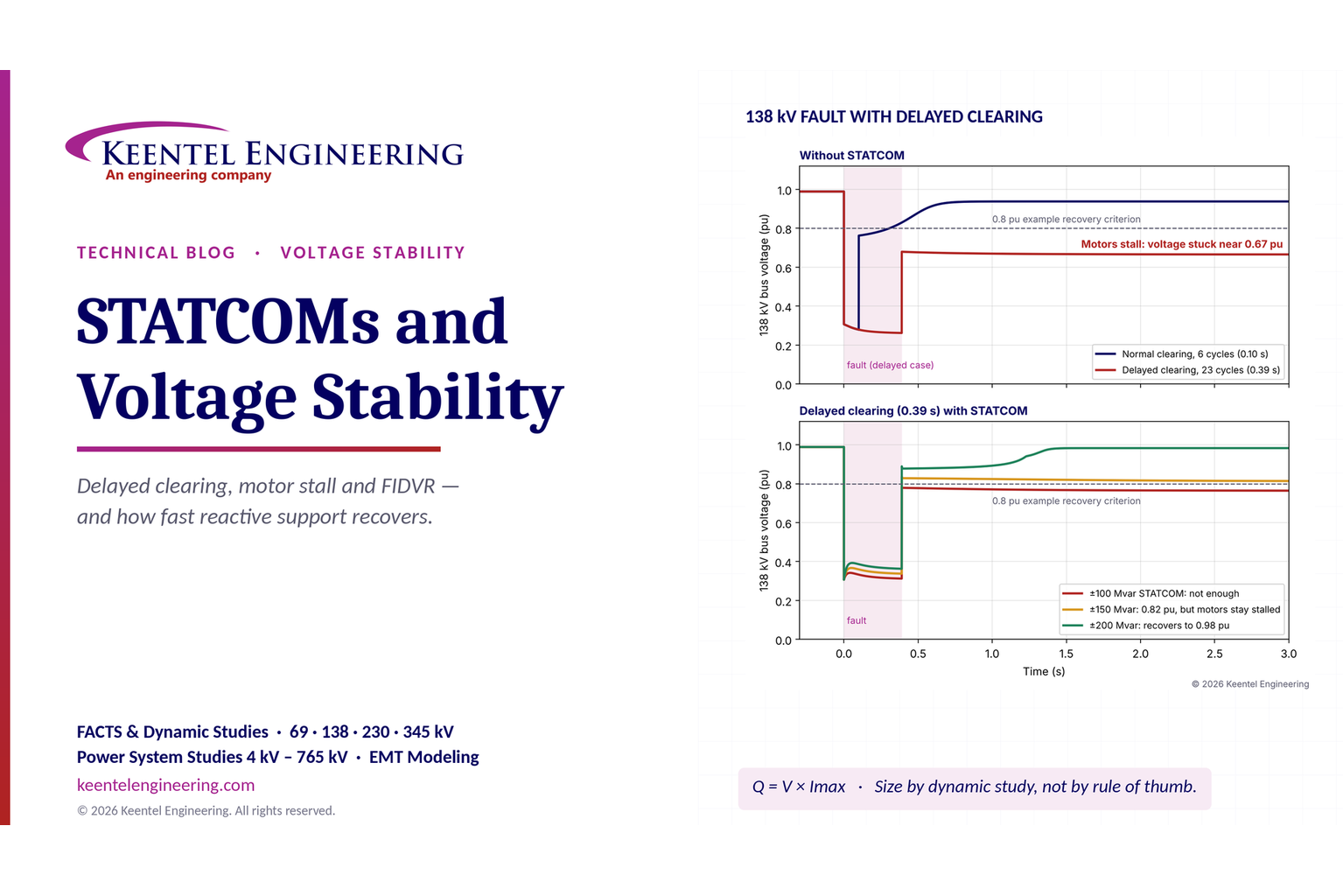
Learn how STATCOMs improve voltage stability and prevent FIDVR. Explore reactive power sizing, delayed fault clearing, NERC criteria and 138 kV simulation results.





