
A Coordinated Electric System Interconnection Review—the utility’s deep-dive on technical and cost impacts of your project.
Challenge: Frequent false tripping using conventional electromechanical relays
Solution: SEL-487E integration with multi-terminal differential protection and dynamic inrush restraint
Result: 90% reduction in false trips, saving over $250,000 in downtime
| Category | Metric |
|---|---|
| VPP capacity (Lunar Energy) | 650 MW |
| Lunar funding raised | US$232 million |
| Data center BESS example | 31 MW / 62 MWh |
| ERCOT grid-scale batteries | 15+ GW |
| LDES tenders (H1 2026) | Up to 9.3 GW |
| Lithium-ion share of LDES by 2030 | 77% |
| FEOC initial threshold | 55% |
| BESS tariff rate (2026) | ~55% |
| Capacity gain from analytics | 5–15% |
What is T&D Co-Simulation?
Electromagnetic Transient (EMT) Modeling of Data Centers: A Complete Guide for Grid Integration Stability and Compliance By Keentel Engineering
Apr 10, 2026 | blog
1. Introduction: Why Data Centers Are a Grid Challeng
Modern data centers especially AI-driven hyperscale facilities are no longer passive loads. They are dynamic, power-electronics-dominated systems that can significantly impact:
- Grid stability
- Voltage and frequency regulation
- Harmonic distortion
- Oscillatory interactions
The report highlights that data center loads are growing in both magnitude and complexity, requiring advanced modeling techniques such as EMT (Electromagnetic Transient) simulations for accurate grid-level analysis .
At Keentel Engineering, we specialize in high-fidelity EMT modeling, grid interconnection studies, and NERC compliance for large industrial and data center clients.
2. What is EMT Modeling and Why It Matters
EMT modeling is the highest-fidelity simulation method in power systems used to analyze:
- Fast transients (microseconds to milliseconds)
- Converter-based systems (UPS, inverters, PFC converters)
- Grid disturbances (faults, oscillations, switching events)
Unlike traditional phasor models, EMT captures:
- Switching behavior of power electronics
- Control system dynamics
- Sub-synchronous interactions
The report emphasizes that EMT modeling is essential for evaluating data center impacts on the grid, particularly during interconnection studies .
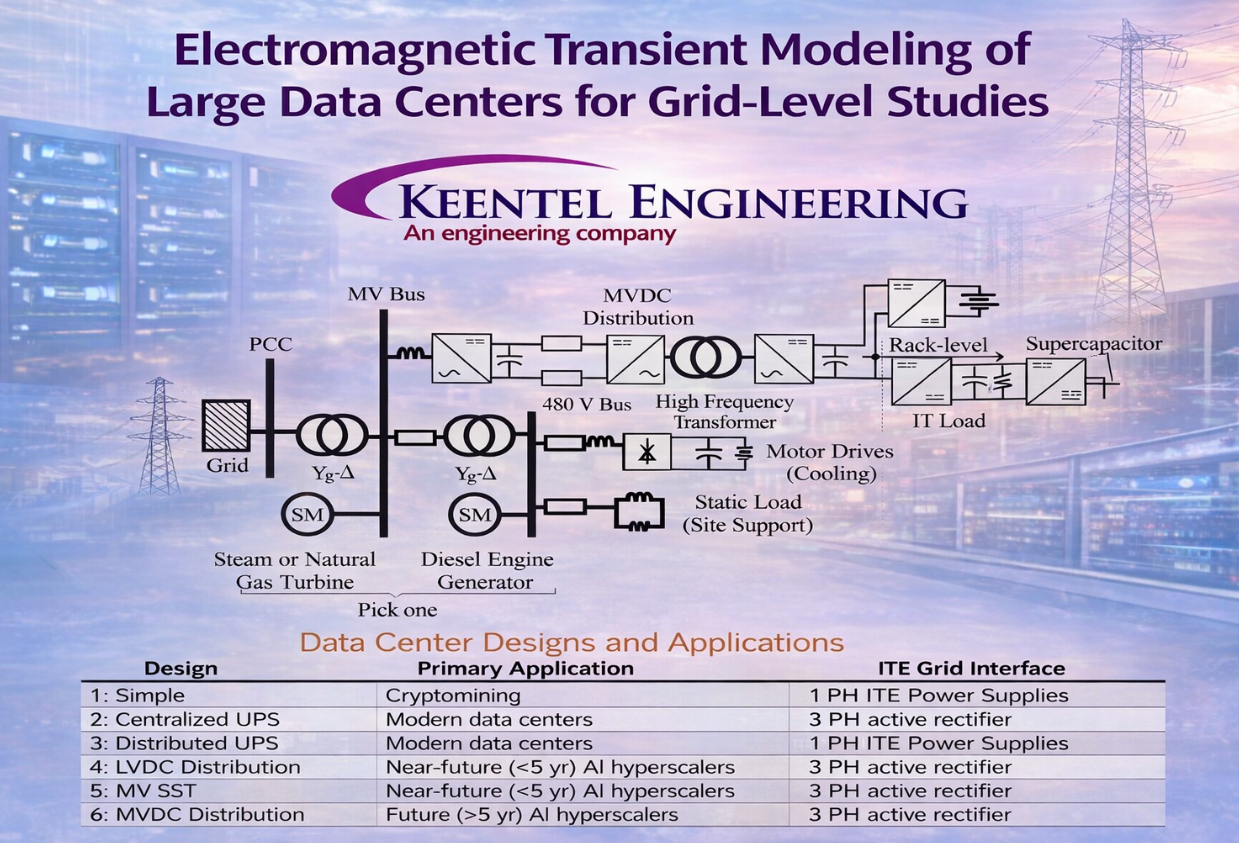
3. Data Center Electrical Architecture Overview
3.1 Six Major Data Center Designs
The report identifies six archetypes of
data center power systems:
| Design | Description | Industry Status |
|---|---|---|
| Simple | No UPS, basic PFC | Crypto mining |
| Centralized UPS | Large 3-phase UPS | Most common |
| Distributed UPS | Rack-level batteries | Emerging |
| MV Solid-State Transformer | Advanced DC architecture | R&D |
| MVDC Distribution | Full DC grid |
Most modern facilities use centralized UPS, where power electronics dominate system behavior .
3.2 Key Electrical Components
1. UPS (Uninterruptible Power Supply)
- Typically double-conversion systems
- Rated ~1 MVA each
- Provide ride-through during faults
- Dominant factor in grid interaction
2. Power Electronics
- Rectifiers, inverters, DC/DC converters
- PFC converters at rack level
- Increasing use of grid-forming (GFM) and grid-following (GFL) controls
3. IT Load (ITE)
- CPUs, GPUs, AI training hardware
- Highly dynamic and variable load profiles
4. Cooling Systems
- 10–40% of total load
- Motor-driven HVAC and chillers
4. Reliability Study Integration
4.1 High Power Density
- AI racks now exceed 100 kW per rack
- Future systems approaching 1 MW per rack
4.2 Rapid Load Variability
AI training causes fast load oscillations, unlike traditional steady loads.
4.3 Converter-Dominated Behavior
Data centers behave similar to:
- Inverter-Based Resources (IBRs)
- Renewable plants
5. Critical EMT Study Areas for Data Centers
The report categorizes EMT studies into three key domains:
5.1 Oscillatory Interactions (MOST CRITICAL)
Data centers can cause:
- Sub-synchronous control interaction (SSCI)
- Sub-synchronous resonance (SSR)
- Forced oscillations from AI loads
Example:
- AI training introduces oscillations in 5–60 Hz range
- Can damage turbine shafts or destabilize grid
5.2 Voltage & Frequency Regulation
EMT is required when:
- New inverter technologies are used
- Ride-through performance is uncertain
- Grid is weak
5.3 Power Quality Issues
Includes:
- Harmonics
- Flicker from rapid load changes
Traditional methods are insufficient due to:
- Complex switching behavior
- OEM-specific control dynamics
6. AI Data Centers: A Game Changer
6.1 Unique Load Profile
AI training introduces cyclic load patterns:
- Synchronization phase → low load
- Forward propagation → high load
- Reconfiguration → variable
- Backpropagation → peak load
This creates grid-visible oscillations, unlike traditional data centers .
6.2 Risk to Power Systems
- Forced oscillations in generators
- Voltage flicker
- Grid instability
7. Energy Storage & Grid Support
Modern data centers integrate:
- Battery Energy Storage Systems (BESS)
- Supercapacitors
- E-STATCOMs
These are used for:
- Load smoothing
- Ride-through
- Grid support
E-STATCOMs can reduce oscillations by >95% .
How Keentel Engineering Helps
1. EMT Modeling & PSCAD Studies
- Full EMT modeling of data centers
- PSCAD / RTDS / EMTDC simulations
- OEM-specific model integration
2. Interconnection Studies
- Oscillation analysis (SSCI, SSR)
- Voltage & frequency stability
- Weak grid analysis
3. NERC & Grid Compliance
- PRC, MOD, TPL compliance
- Large Load Interconnection requirements
- IEEE 2800 alignment
4. Power Quality & Harmonics
- Harmonic modeling & mitigation
- Flicker studies
- Filter design
5. AI Data Center Consulting
- Load profile modeling
- Grid impact mitigation strategies
- Storage optimization
6. Substation & Electrical Design
- HV/MV substation engineering
- Protection & control design
- SCADA & automation
Why Choose Keentel Engineering
- 30+ years of power system expertise
- Deep experience with:
- Renewable integration
- Inverter-based resources
- NERC compliance
- Advanced tools:
- PSCAD
- PSS®E
- DigSILENT
- MATLAB / RTDS
Frequently Asked Questions (FAQs)
1. What is EMT modeling in power systems?
EMT modeling simulates fast electrical transients and power electronics behavior, providing high-fidelity analysis beyond traditional phasor methods.
2. Why are data centers difficult to model?
Because they rely heavily on power electronics and dynamic loads, especially AI-driven workloads.
3. When is EMT modeling required for data centers?
- Large (>100 MW) loads
- Weak grid connections
- High inverter penetration
- Oscillation risks
4. What are oscillatory interactions?
They are instability phenomena caused by interactions between:
- Power electronics
- Grid impedance
- Generators
5. How do AI data centers affect the grid?
They create rapid, cyclic load variations, which can excite grid oscillations.
6. What is SSCI and why is it important?
Sub-Synchronous Control Interaction (SSCI) is instability caused by interaction between converters and grid elements.
7. What is the role of UPS in grid behavior?
UPS systems dominate data center response to disturbances and define ride-through capability.
8. Can data centers support the grid?
Yes through:
- Reactive power control
- Energy storage
- Fast frequency response
9. Why are harmonics challenging in data centers?
Because switching behavior depends on:
- Converter design
- Control strategy
- Semiconductor characteristics
10. What is LVDC distribution?
A future architecture using 400–800 V DC instead of AC for higher efficiency and power density.
11. What is a solid-state transformer (SST)?
A power-electronics-based transformer enabling DC distribution and improved efficiency.
12. How does EMT differ from RMS simulation?
- EMT → microsecond-level detail
- RMS → averaged system behavior
13. Do all data centers need EMT studies?
No only large or complex ones with grid impact risks.
14. What causes voltage flicker?
Rapid load changes, especially from AI workloads.
15. What is the Data Center Modeling Library (DML)?
A set of generic EMT models developed by PNNL for grid-level studies .
16. Can EMT models be used directly?
No—models must be customized using site-specific data.
17. What is grid-forming vs grid-following?
- GFL → follows grid
- GFM → can control voltage and frequency
18. Why is energy storage important in data centers?
It enables:
- Ride-through
- Load smoothing
- Grid services
19. What is NERC’s role in data center modeling?
NERC is developing guidelines for large load modeling and interconnection requirements.
20. How can Keentel Engineering support my project?
We provide:
- End-to-end EMT modeling
- Grid studies
- Compliance support
- Design & implementation
Work With Keentel Engineering
If you're developing or interconnecting a data center, AI facility, or large industrial load
Keentel Engineering provides:
- Accurate EMT models
- Faster interconnection approvals
- Reduced grid risk
- Full compliance support

About the Author:
Sonny Patel P.E. EC
IEEE Senior Member
In 1995, Sandip (Sonny) R. Patel earned his Electrical Engineering degree from the University of Illinois, specializing in Electrical Engineering . But degrees don’t build legacies—action does. For three decades, he’s been shaping the future of engineering, not just as a licensed Professional Engineer across multiple states (Florida, California, New York, West Virginia, and Minnesota), but as a doer. A builder. A leader. Not just an engineer. A Licensed Electrical Contractor in Florida with an Unlimited EC license. Not just an executive. The founder and CEO of KEENTEL LLC—where expertise meets execution. Three decades. Multiple states. Endless impact.
Services

Let's Discuss Your Project
Let's book a call to discuss your electrical engineering project that we can help you with.

About the Author:
Sonny Patel P.E. EC
IEEE Senior Member
In 1995, Sandip (Sonny) R. Patel earned his Electrical Engineering degree from the University of Illinois, specializing in Electrical Engineering . But degrees don’t build legacies—action does. For three decades, he’s been shaping the future of engineering, not just as a licensed Professional Engineer across multiple states (Florida, California, New York, West Virginia, and Minnesota), but as a doer. A builder. A leader. Not just an engineer. A Licensed Electrical Contractor in Florida with an Unlimited EC license. Not just an executive. The founder and CEO of KEENTEL LLC—where expertise meets execution. Three decades. Multiple states. Endless impact.
Leave a Comment
We will get back to you as soon as possible.
Please try again later.