

A Coordinated Electric System Interconnection Review—the utility’s deep-dive on technical and cost impacts of your project.

Challenge: Frequent false tripping using conventional electromechanical relays
Solution: SEL-487E integration with multi-terminal differential protection and dynamic inrush restraint
Result: 90% reduction in false trips, saving over $250,000 in downtime

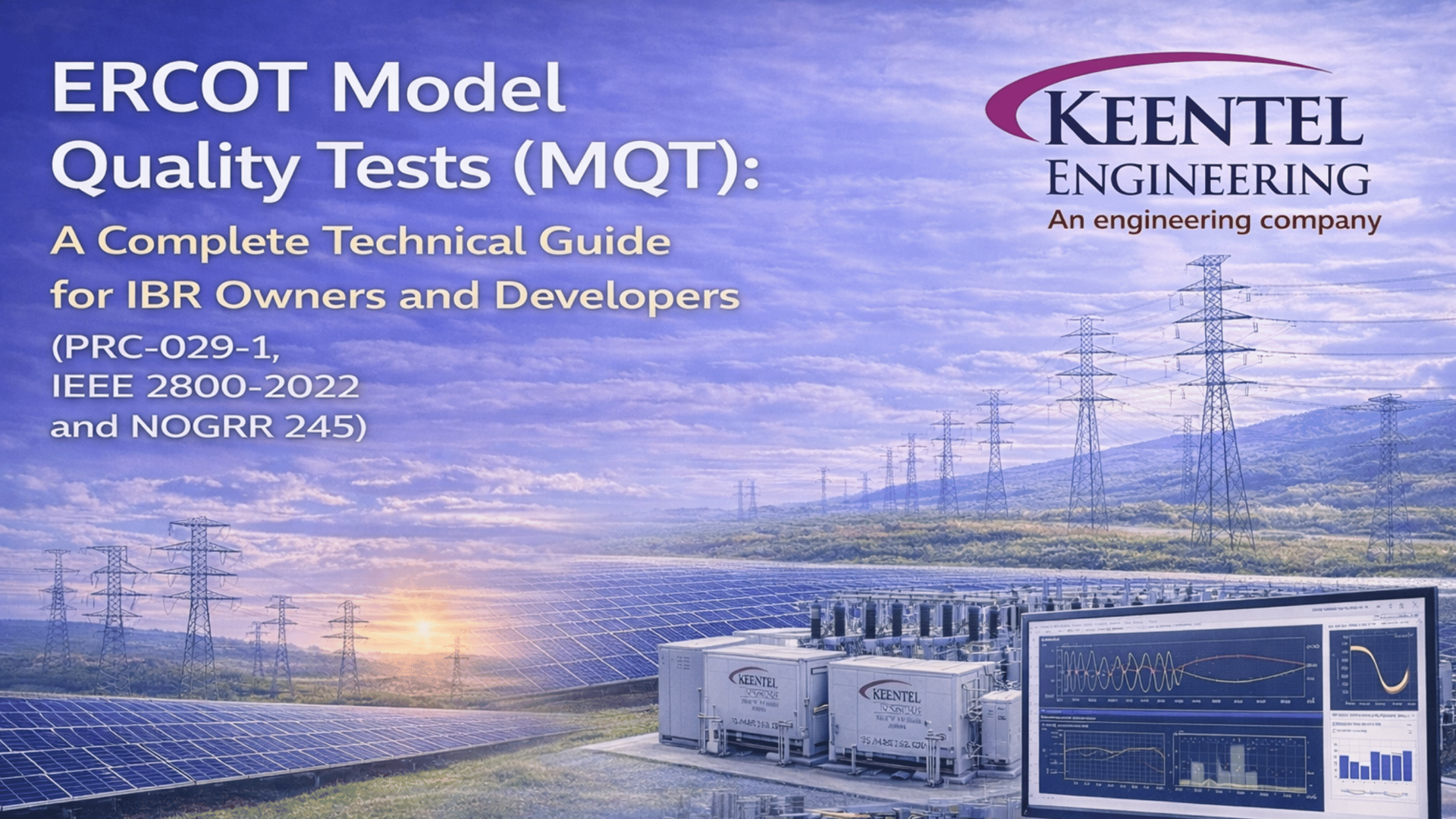
ERCOT Model Quality Tests (MQT): A Complete Technical Guide for IBR Owners and Developers. (PRC-029-1, IEEE 2800-2022, and NOGRR 245)

Solar panels in rows with a power plant featuring smokestacks emitting steam.
Calendar icon. D

December 26, 2025 | Blog

Introduction

As inverter-based resources (IBRs) continue to dominate new generation additions in ERCOT, the accuracy and reliability of dynamic models have become critical to system planning, operations, and reliability. ERCOT’s Model Quality Tests (MQT) defined in the Dynamics Working Group (DWG) Procedure Manual form the backbone of ERCOT’s model validation framework.

MQT ensures that resource models do not merely run, but respond correctly to realistic grid disturbances, providing confidence that planning and operational studies reflect actual system behavior. For Generator Owners, passing MQT is not optional it is a prerequisite for ERCOT acceptance of dynamic models and directly affects interconnection schedules and compliance obligations.


What Are ERCOT Model Quality Tests (MQT)?

ERCOT Model Quality Tests (MQT) are standardized dynamic simulation tests used to validate the performance of resource models submitted for ERCOT studies. These tests apply to:

  • Solar PV plants
  • Wind generation (Type 1–4)
  • Battery Energy Storage Systems (BESS)
  • Hybrid resources (solar + storage, wind + storage)
  • Synchronous generation
  • Dynamic reactive devices (STATCOM, SVC)

The purpose of MQT is to confirm that models:

  • Initialize properly,
  • Respond stably to voltage and frequency disturbances,
  • Exhibit correct ride-through behavior,
  • Provide appropriate reactive and frequency support,
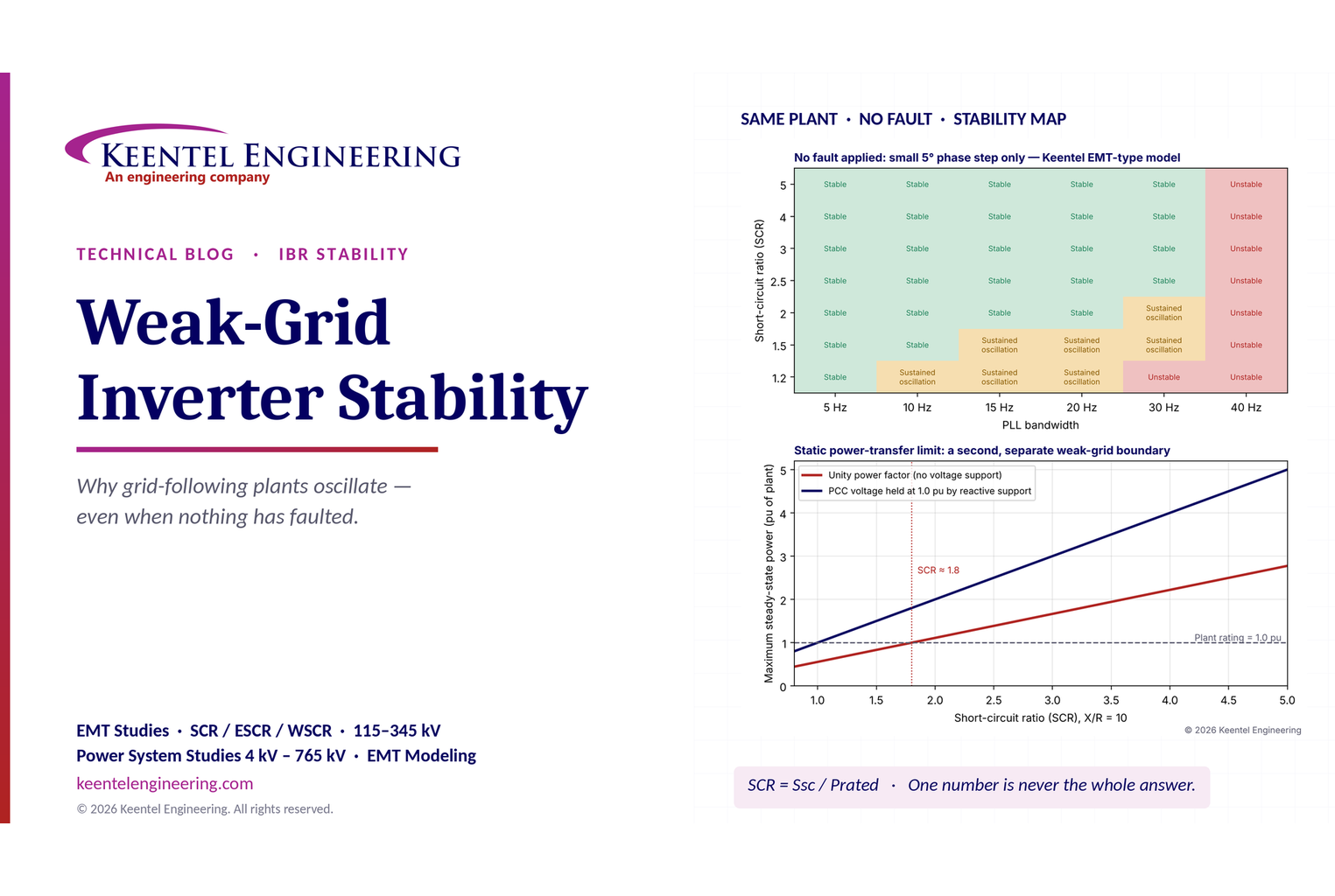
  • Remain stable across required system strength (SCR) conditions.

Why ERCOT Uses a Controlled Testbench

MQT simulations are performed using a controlled testbench configuration:

Resource → Point of Interconnection (POI) → Infinite Bus

This framework:

  • Removes dependency on ERCOT system topology,
  • Ensures consistent and repeatable testing,
  • Allows fair comparison across different resources and technologies,
  • Prevents masking of model deficiencies by strong grid conditions.


In short, if a model performs correctly in the MQT testbench, ERCOT can trust it to behave appropriately in broader system studies.

See Keentel Engineering POI Services.


Core ERCOT MQT Simulation Tests

1. Flat Start Test

Validates:

  • Proper model initialization,
  • Steady-state convergence,
  • Absence of numerical instability.

Failure here typically indicates incorrect parameterization or model incompatibility.

2. Small Voltage Disturbance Test (±3%)

Validates:

  • Voltage control behavior,
  • Reactive current direction,
  • Damping and settling time.

This test is critical for verifying IEEE 2800 voltage support expectations.

3. Low Voltage Ride-Through (LVRT)

Validates:

  • Ride-through capability during voltage depressions,
  • Reactive current injection,
  • Recovery behavior without tripping.

LVRT tests directly support PRC-029-1 R1 and R2 and ERCOT NOG 2.9 requirements.

4. High Voltage Ride-Through (HVRT)

Validates:

  • Overvoltage tolerance,
  • Control stability,
  • Smooth recovery back to nominal conditions.

5. Small Frequency Disturbance Test (±0.3 Hz)

Validates:

  • Frequency response behavior,
  • Droop characteristics,
  • Proper response with and without headroom.

This test supports PRC-029-1 R3 and ERCOT NOG 2.6 requirements.

6. System Strength / SCR Sensitivity Testing

Required for IBRs to validate:

  • Stable operation at low SCR,
  • Control robustness,
  • Absence of oscillatory or unstable behavior.

This test is central to IEEE 2800-2022 performance expectations.

7. Phase Angle Jump Test (PSCAD-Only)

Required for inverter-based resources and performed in PSCAD (EMT).

Validates:

  • Control stability during sudden phase shifts,
  • PLL behavior,
  • Fast transient response not captured by RMS models.

This is the primary reason PSCAD is conditionally required under ERCOT rules.


Pass/Fail Criteria

ERCOT evaluates MQT results based on:

  • Correct reactive current direction and magnitude,
  • Stable damping and settling,
  • Successful ride-through and recovery,
  • Appropriate frequency response,
  • Stability at required SCR levels.

Passing MQT means ERCOT accepts the model.


Failing MQT may result in:

  • Model rejection,
  • Required retuning,
  • Re-submission delays,
  • Interconnection schedule impacts.

Relationship Between MQT, PRC-029-1, IEEE 2800, and NOGRR 245

MQT and PRC-029-1

  • LVRT/HVRT tests support R1 and R2.
  • Frequency disturbance tests support R3.
  • Post-event validation supports R4 and disturbance evidence.

MQT and IEEE 2800-2022

  • Voltage support (Section 5),
  • Frequency response (Section 7),
  • Stability and system strength (Section 9).

ERCOT MQT effectively operationalizes IEEE 2800 requirements.

MQT and NOGRR 245

  • Aligns with updated VRT/FRT requirements,
  • Supports performance maximization documentation,
  • Required after ride-through performance failures (NOG 2.13).

Why PSCAD Is Conditional, Not Universal

PSCAD is required only when EMT-level behavior must be evaluated, primarily for:

  • Phase angle jump tests,
  • Performance failure investigations,
  • Complex hybrid interactions.

Most MQT tests can be completed using PSS®E or TSAT, making PSCAD an as-needed, additional scope.


Best Practices for Generator Owners

  • Perform internal MQT checks before submission.
  • Coordinate closely with OEMs for accurate models.
  • Validate models against real disturbance data.
  • Address MQT failures early to avoid schedule risk.
  • Treat PSCAD as a contingency, not a baseline requirement.

Conclusion

ERCOT Model Quality Tests are not a formality they are a critical gatekeeper for model acceptance, system reliability, and regulatory compliance. Understanding MQT and its relationship to PRC-029-1, IEEE 2800-2022, and NOGRR 245 is essential for any Generator Owner operating in ERCOT.

Keentel Engineering supports clients through MQT preparation, model validation, PSCAD EMT analysis, and regulatory coordination, ensuring models are accepted the first time.


Frequently Asked Questions (FAQ)

  • 1. What is the purpose of ERCOT MQT?

    To verify that dynamic models accurately represent real-world grid behavior under disturbances.


  • 2. Is MQT required for all ERCOT resources?

    Yes, for any resource submitting dynamic models for ERCOT studies.


  • 3. Does passing MQT guarantee PRC-029-1 compliance?

    No, but it strongly supports Ride-through compliance evidence.


  • 4. Is PSCAD always required for MQT?

    No. PSCAD is required only for phase angle jump tests and specific EMT investigations.

  • 5. Which tools are typically used for MQT?

    PSS®E, TSAT, and PSCAD (when required).


  • 6. What happens if a model fails MQT?

    ERCOT may reject the model and require retuning and re-submission.


  • 7. How does MQT affect interconnection schedules?

    Failed MQT can delay studies and commercial operation timelines.


  • 8. Are hybrid plants treated differently in MQT?

    Yes. Control interactions between resources are closely evaluated.


  • 9. How does SCR affect MQT results?

    Low SCR can expose control instability not visible at strong grid conditions.


  • 10. Is MQT required after firmware updates?

    Often yes, especially if control behavior changes.


  • 11. Who is responsible for MQT submissions?

    The Resource Entity / Generator Owner.


  • 12. Can OEM models fail MQT?

    Yes. OEM models frequently require tuning for ERCOT conditions.


  • 13. What is the flat start test checking?

    Initialization stability and steady-state convergence.


  • 14. Why is phase angle jump tested in PSCAD?

    RMS models cannot capture fast electromagnetic transients.


  • 15. Does MQT replace event-based model validation?

    No. Both are required when applicable.


  • 16. How does MQT support IEEE 2800 compliance?

    It validates voltage, frequency, and stability performance.


  • 17. Are MQT plots reviewed manually by ERCOT?

    Yes, by ERCOT and DWG reviewers.


  • 18. Can Keentel Engineering support MQT preparation?

    Yes—full MQT, PSCAD, and compliance support.


  • 19. Is MQT required for BESS-only plants?

    Yes, if they provide dynamic grid services.


  • 20. Can MQT results be reused?

    Only if models and configurations remain unchanged.


  • 21. Does NOGRR 245 increase MQT scrutiny?

    Yes, especially for Ride-through performance.


  • 22. What data is needed for MQT?

    Dynamic models, control settings, and plant configuration.


  • 23. How long does MQT typically take?

    Several weeks, depending on complexity and revisions.


  • 24. Can MQT trigger PSCAD scope later?

    Yes, if EMT behavior needs investigation.


  • 25. What is the biggest MQT failure risk?

    Inaccurate or untuned inverter control parameters


Man in a blazer and open shirt, looking at the camera, against a blurred background.

About the Author:

Sonny Patel P.E. EC

IEEE Senior Member

In 1995, Sandip (Sonny) R. Patel earned his Electrical Engineering degree from the University of Illinois, specializing in Electrical Engineering . But degrees don’t build legacies—action does. For three decades, he’s been shaping the future of engineering, not just as a licensed Professional Engineer across multiple states (Florida, California, New York, West Virginia, and Minnesota), but as a doer. A builder. A leader. Not just an engineer. A Licensed Electrical Contractor in Florida with an Unlimited EC license. Not just an executive. The founder and CEO of KEENTEL LLC—where expertise meets execution. Three decades. Multiple states. Endless impact.

Four workers in safety vests and helmets stand with arms crossed near wind turbines.

Let's Discuss Your Project

Let's book a call to discuss your electrical engineering project that we can help you with.

Man in a blazer and open shirt, looking at the camera, against a blurred background.

About the Author:

Sonny Patel P.E. EC

IEEE Senior Member

In 1995, Sandip (Sonny) R. Patel earned his Electrical Engineering degree from the University of Illinois, specializing in Electrical Engineering . But degrees don’t build legacies—action does. For three decades, he’s been shaping the future of engineering, not just as a licensed Professional Engineer across multiple states (Florida, California, New York, West Virginia, and Minnesota), but as a doer. A builder. A leader. Not just an engineer. A Licensed Electrical Contractor in Florida with an Unlimited EC license. Not just an executive. The founder and CEO of KEENTEL LLC—where expertise meets execution. Three decades. Multiple states. Endless impact.

Leave a Comment

Related Posts

By SANDIP R PATEL December 26, 2025
PRC-030-1 compliance guide for Generator Owners covering IBR event analysis, corrective action plans, audit requirements, and post-disturbance obligations.
Power lines against a twilight sky with digital network lines overlayed, spanning an open field.
By SANDIP R PATEL December 19, 2025
A practical guide to NERC PRC-029-1 for inverter-based resource owners. Learn ride-through requirements, compliance timelines, exemptions, and how Keentel Engineering supports PRC-029-1 readiness.
Electrical substation with high-voltage equipment, wires, and insulators against a blue sky.
By SANDIP R PATEL November 26, 2025
Learn how to stay compliant with NERC PRC-004-6 and MIDAS reporting. Keentel Engineering provides misoperation analysis, CAP support, and audit-ready documentation.
ISO-NE DDMS Guide
By SANDIP R PATEL November 26, 2025
Technical guide to ISO-NE’s DDMS for power system engineers — model submissions, file formats (RAW/DYR), certification workflow, and annual recertification for MOD-032, MOD-026, MOD-027.
Learn how PRC-004-6 misoperations and MIDAS reporting work.
By SANDIP R PATEL November 15, 2025
Learn how PRC-004-6 misoperations and MIDAS reporting work. A complete NERC compliance guide from Keentel Engineering for utilities and power entities.
Solar panels field and power plant with smokestacks on a cloudy day.
By SANDIP R PATEL October 30, 2025
Learn how Generator and Transmission Owners meet PJM MOD-032 data submission requirements using Gen Model, Model on Demand, and ASPEN tools for NERC compliance.
An aerial view of a large battery storage facility with numerous white shipping container-like units. Wind turbines in background.
By SANDIP R PATEL October 27, 2025
Learn how utility-scale BESS meet IEEE 2800 voltage and frequency ride-through requirements with simulation, validation, and compliance reporting.
Diagram of a redundant power distribution system with utility, UPS, and critical/non-critical loads.
By SANDIP R PATEL October 19, 2025
Explore NERC’s 2025 review on simultaneous voltage-sensitive load reductions amid industrial electrification, data center growth, and crypto mining.
Diagram showing frequency monitoring and point of interconnection with a Tesla 400E box.
By SANDIP R PATEL October 16, 2025
Discover how the TESLA 4000 IED enables precise frequency monitoring at the Point of Interconnection for reliable, compliant grid operations.