

A Coordinated Electric System Interconnection Review—the utility’s deep-dive on technical and cost impacts of your project.

Challenge: Frequent false tripping using conventional electromechanical relays
Solution: SEL-487E integration with multi-terminal differential protection and dynamic inrush restraint
Result: 90% reduction in false trips, saving over $250,000 in downtime

GIC Mitigation and Transformer Thermal Assessment Expertise at Keentel Engineering

Calendar icon. D

April 26, 2025 | Blog

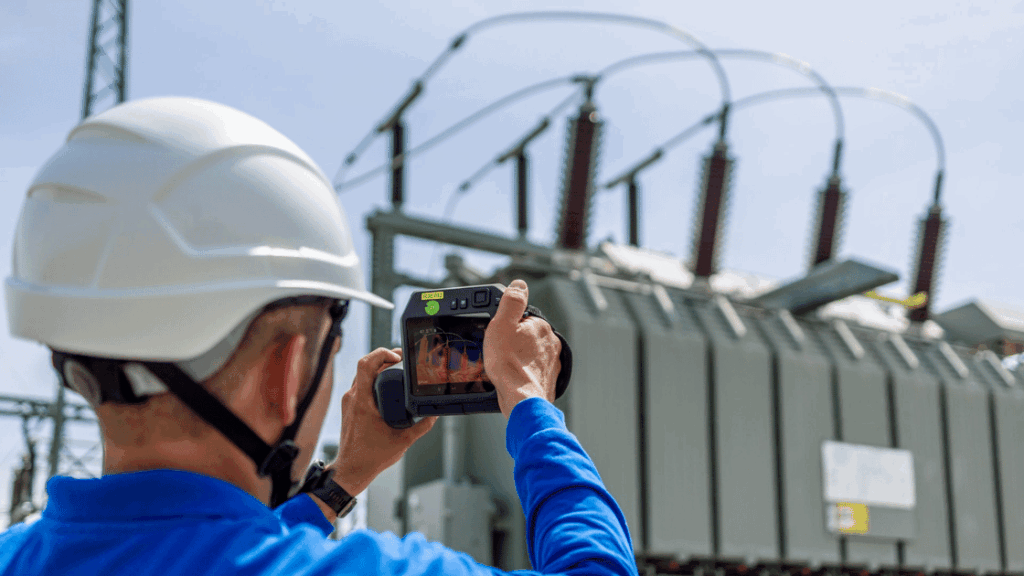
Electrician in a hard hat using a thermal camera to inspect a power transformer in an outdoor setting.

As the energy landscape evolves, grid resilience against geomagnetic disturbances (GMDs) is more critical than ever. GMDs can induce geomagnetically-induced currents (GICs), posing severe risks to high-voltage transformers and the stability of the bulk power system.


At Keentel Engineering, we specialize in GIC modeling and transformer thermal impact assessments, ensuring full compliance with NERC TPL-007-1 standards and supporting long-term grid reliability.


What Are GICs and Why Do They Matter?

Geomagnetically-induced currents (GICs) are quasi-dc currents resulting from fluctuations in the Earth’s magnetic field during solar storms. As these electric fields interact with transmission systems, they create harmful currents that:

  • Cause half-cycle saturation in transformer cores
  • Increase reactive power demand
  • Generate harmonics and unwanted noise
  • Lead to overheating, insulation degradation, and accelerated aging

Without mitigation, GIC events can result in costly transformer failures and widespread system outages.


NERC TPL-007-1 Compliance Overview

To strengthen grid protection, NERC’s TPL-007-1 standard mandates:

  • Benchmark GMD event modeling (1-in-100-year scenarios)
  • Transformer thermal impact assessments
  • Corrective action plans if vulnerabilities are identified

Keentel Engineering delivers both steady-state and time-domain GIC studies using validated, audit-ready models.


Our GIC Modeling Services

We provide end-to-end GIC analysis and transformer risk assessment, including:

1. Geoelectric Field Calculation

  • Utilize regional geomagnetic data and conductivity models
  • Perform FFT-based electric field analysis for precision

2. DC Network Modeling

  • Simulate grounded-wye transformer connections, substation grounding grids, and transmission line resistances

3. Time-Series GIC(t) Estimation

  • Apply time-varying geoelectric field data to create dynamic GIC profiles
  • Model transformer admittance for real-world conditions

Transformer Thermal Impact Assessment

At Keentel, we perform two key approaches:

Manufacturer Capability Curve Method

  • Compare GIC exposure against factory-defined transformer withstand limits
  • Adjust for real-time loading and transformer age

Thermal Response Simulation

  • Run dynamic simulations using GIC(t) profiles
  • Assess hot spot temperatures per IEEE Std C57.91 emergency ratings (typically 180–200°C)

Our assessments integrate winding temperature rise, core heating models, and cooling time constants to accurately predict transformer vulnerability.


Engineering Judgment and Regional Scaling

Keentel’s comprehensive GIC evaluations account for:

  • Geomagnetic latitude scaling (α factors)
  • Local Earth conductivity (β scaling)
  • Transmission system grounding configurations
  • Transformer topology (e.g., auto-transformers vs. two-winding units)

We ensure region-specific accuracy while maintaining compliance with NERC requirements.


Need GIC and Transformer Thermal Assessments Done Right?

Keentel Engineering helps utilities meet NERC compliance, protect transformer fleets, and future-proof their transmission assets.
Our technical expertise and regulatory insight ensure your system is prepared for the challenges posed by geomagnetic storms.

Call us: 813-389-7871
Visit Website:
 keentelengineering.com


FAQs on GIC and Transformer Thermal Assessment

  • What is a Geomagnetically-Induced Current (GIC) in power systems?

    A GIC is a quasi-dc current induced by geomagnetic disturbances (GMDs) during solar storms. It flows through transmission lines, transformers, and grounding networks, posing serious risks to grid stability.

  • What causes GICs during solar events?

    Changes in the Earth’s magnetic field generate geoelectric fields, which drive electric currents into conductive structures like high-voltage transmission systems, leading to GIC flow.

  • How do GICs impact transformers?

    GICs cause half-cycle saturation of transformer cores, leading to overheating, harmonic distortion, increased noise, and eventual insulation degradation or failure.

  • What is the NERC TPL-007-1 standard for GIC mitigation?

    NERC TPL-007-1 requires utilities and transmission operators to evaluate their systems against a benchmark GMD event, assess thermal risks to transformers, and implement mitigation strategies if necessary.

  • What defines the benchmark GMD event in NERC compliance?

    The benchmark event includes a peak geoelectric field of up to 20 V/km, scaled according to geomagnetic latitude and Earth conductivity variations across regions.

  • What software tools are typically used for GIC modeling?

    Professional engineering teams use PSCAD, PowerWorld, and EMTP-RV to simulate GIC flows and transformer responses accurately. Keentel Engineering uses validated NERC-compliant modeling tools.

  • Why is Earth conductivity critical in GIC modeling?

    Earth conductivity affects how electric fields propagate and how much current is induced. 1D or 3D conductivity models determine the system’s exposure to GICs accurately.

  • How is the geoelectric field calculated in GIC studies?

    We derive geoelectric fields by processing magnetic field measurements through Fast Fourier Transform (FFT) algorithms and Earth impedance models.

  • What is skin depth in the context of geomagnetic studies?

    Skin depth refers to the penetration depth of magnetic fields into the Earth’s surface, often extending hundreds of kilometers depending on frequency and soil conductivity.

  • Which transformer types are most susceptible to GICs?

    Grounded-wye windings are highly susceptible because they provide a direct path for GIC flow. Delta windings, in contrast, offer natural resistance to GICs.

  • What is half-cycle saturation in transformers?

    It occurs when GICs bias the magnetic core, causing asymmetrical flux, increased core losses, overheating, and elevated harmonic generation.

  • What are transformer hot spot temperatures?

    These are localized points inside transformer windings or metallic structures that experience excessive heating due to GIC-induced half-cycle saturation.

  • What temperature thresholds indicate GIC-related thermal risk?

    According to IEEE Std C57.91, emergency metallic hot spot temperatures beyond 180°C–200°C can damage transformer insulation and reduce equipment lifespan.

  • What is effective GIC (Idc,eq) in transformer studies?

    Effective GIC represents the equivalent dc current across a transformer’s windings, accounting for autotransformer turns ratios and multi-winding configurations.

  • How is time-series GIC(t) computed?

    We use real-time electric field vectors (EE(t) and EN(t)) combined with directional scaling matrices (GICE and GICN) to generate dynamic GIC profiles over time.

  • Is it necessary to model shield wires in GIC simulations?

    For most steady-state GIC studies, shield wires have minimal impact and are often excluded unless evaluating secondary effects.

  • What’s the difference between Rac and Rdc in conductor modeling?

    Rdc (direct current resistance) is used for GIC studies because it better reflects low-frequency dc current behavior, unlike Rac, which is impacted by skin effects.

  • How do ground grid resistances affect GIC flow?

    Lower substation ground resistances facilitate higher GIC injection into transformer neutrals, making ground grid modeling a key element in GIC risk analysis.

  • What are GIC blocking devices and how do they work?

    GIC blocking devices (resistors or capacitors installed at the neutral point) prevent or limit GICs from flowing into transformer windings without disrupting normal ac operation.

  • What factors influence a transformer’s thermal vulnerability to GICs?

    Important factors include transformer design (core size, winding geometry), insulation aging, cooling system efficiency, and moisture content in insulation materials.

  • What are thermal time constants in transformers?

    Thermal time constants define how long transformer parts (windings, tank, core) take to heat up after GIC exposure—typically 2–10 minutes for windings.

  • What is the reference geoelectric field used in simulations?

    It’s a standardized time series waveform representing historical geomagnetic storm data, used for benchmarking GIC modeling scenarios.

  • Is GIC modeling performed on a three-phase basis?

    No. GIC modeling is single-phase, assuming equal division of GIC across phases unless asymmetrical system behavior warrants detailed study.

  • How does latitude scaling (α-factor) impact GIC analysis?

    Latitude scaling adjusts the geoelectric field magnitude based on geomagnetic latitude, reflecting stronger disturbances closer to the poles.

  • How does Keentel Engineering ensure NERC-compliant GIC assessments

    Keentel uses validated software, thermal simulation methods, and expert engineering judgment to deliver complete TPL-007-1 compliance solutions, protecting both transformers and grid reliability.


Man in a blazer and open shirt, looking at the camera, against a blurred background.

About the Author:

Sonny Patel P.E. EC

IEEE Senior Member

In 1995, Sandip (Sonny) R. Patel earned his Electrical Engineering degree from the University of Illinois, specializing in Electrical Engineering . But degrees don’t build legacies—action does. For three decades, he’s been shaping the future of engineering, not just as a licensed Professional Engineer across multiple states (Florida, California, New York, West Virginia, and Minnesota), but as a doer. A builder. A leader. Not just an engineer. A Licensed Electrical Contractor in Florida with an Unlimited EC license. Not just an executive. The founder and CEO of KEENTEL LLC—where expertise meets execution. Three decades. Multiple states. Endless impact.

Four workers in safety vests and helmets stand with arms crossed near wind turbines.

Let's Discuss Your Project

Let's book a call to discuss your electrical engineering project that we can help you with.

Man in a blazer and open shirt, looking at the camera, against a blurred background.

About the Author:

Sonny Patel P.E. EC

IEEE Senior Member

In 1995, Sandip (Sonny) R. Patel earned his Electrical Engineering degree from the University of Illinois, specializing in Electrical Engineering . But degrees don’t build legacies—action does. For three decades, he’s been shaping the future of engineering, not just as a licensed Professional Engineer across multiple states (Florida, California, New York, West Virginia, and Minnesota), but as a doer. A builder. A leader. Not just an engineer. A Licensed Electrical Contractor in Florida with an Unlimited EC license. Not just an executive. The founder and CEO of KEENTEL LLC—where expertise meets execution. Three decades. Multiple states. Endless impact.

Leave a Comment

Related Posts

Power system engineering services for data centers and industrial large load integration
By SANDIP R PATEL March 19, 2026
Large load integration solutions for grid reliability, data centers, and industrial power systems with advanced engineering and compliance support.
Large load grid reliability solutions for AI data centers and industrial power systems
By SANDIP R PATEL March 19, 2026
Large loads are reshaping grid behavior. Discover risks, interconnection challenges, and engineering solutions for reliable power system integration.
Keentel Engineering transmission infrastructure project with utility truck, construction loader.
By SANDIP R PATEL March 13, 2026
FERC Order 1920-B introduces long-term regional transmission planning reforms in the U.S. Learn how the rule affects utilities, renewable integration, and grid infrastructure development.
High voltage electrical substation construction with transmission equipment and switchgear infrastru
By SANDIP R PATEL March 11, 2026
Discover best practices for high-voltage substation construction, including engineering planning, labor productivity benchmarking, equipment installation, and project control strategies.
Large baseload power plant cooling towers connected to high-voltage transmission grid infrastructure
By SANDIP R PATEL March 11, 2026
Engineering guide to grid integration of large baseload power plants covering system stability, substation design, transformer configuration, and reliability requirements.
IEC 61439 low oltage switchgear and controlgear assembly panel
By SANDIP R PATEL March 11, 2026
Learn how IEC 61439 governs low-voltage switchgear assemblies, including design verification, safety requirements, temperature rise limits, and engineering practices for compliant power distribution systems.
Protection relay testing equipment (Omicron CMC 356) used in power plant commissioning and electrica
By SANDIP R PATEL March 11, 2026
Learn the hidden problems in power plant commissioning and how engineering testing, relay verification, and system validation prevent failures.
High-voltage electrical substation with transmission towers, power lines, and switching equipment il
By SANDIP R PATEL March 8, 2026
Explore advanced power system protection and relaying used in modern substations, including SCADA integration, relay coordination, fault detection, and digital protection technologies.
NERC PRC-012-2 compliance for solar, wind, and battery energy storage systems.
By SANDIP R PATEL March 7, 2026
Guide to NERC PRC-012-2 compliance for solar plants, wind farms, and BESS. Understand RAS requirements, generator owner obligations, and testing rules.