A Coordinated Electric System Interconnection Review—the utility’s deep-dive on technical and cost impacts of your project.
Challenge: Frequent false tripping using conventional electromechanical relays
Solution: SEL-487E integration with multi-terminal differential protection and dynamic inrush restraint
Result: 90% reduction in false trips, saving over $250,000 in downtime
The three operating regions you have to design to
| Device | Output vs voltage | Response | Best suited to | Main limitations |
|---|---|---|---|---|
| Mechanically switched capacitor or reactor | Proportional to voltage squared | Seconds; discrete steps; limited switching operations per day | Steady-state reactive supply, voltage profile, loss reduction | No dynamic capability; step voltage change on switching; capability collapses when most needed |
| Static var compensator | Capacitive branches proportional to voltage squared | A few cycles; continuously controllable | Continuous control where cost matters and deep voltage support is not the driver | Square-law capability loss; harmonic filters are part of the plant and interact with the network |
| STATCOM | Approximately proportional to voltage — constant current capability | One to two cycles closed loop; converter response faster still | Voltage stability margin, weak interconnections, fast disturbance recovery, flicker and unbalance compensation | Higher capital cost; converter losses; adds a converter and its control dynamics to the network |
| Synchronous condenser | Governed by machine capability and excitation | Excitation response in the hundreds of milliseconds; inherent inertial response instantaneous | System strength and inertia, short-circuit contribution, black start support | Rotating plant with maintenance and losses; slower controlled response than a converter |
| STATCOM with energy storage | Reactive as a STATCOM, plus real power within the storage rating | As STATCOM for reactive; real power limited by storage | Where a real power deficiency is part of the problem | Cost and complexity of the storage; different failure and maintenance profile |
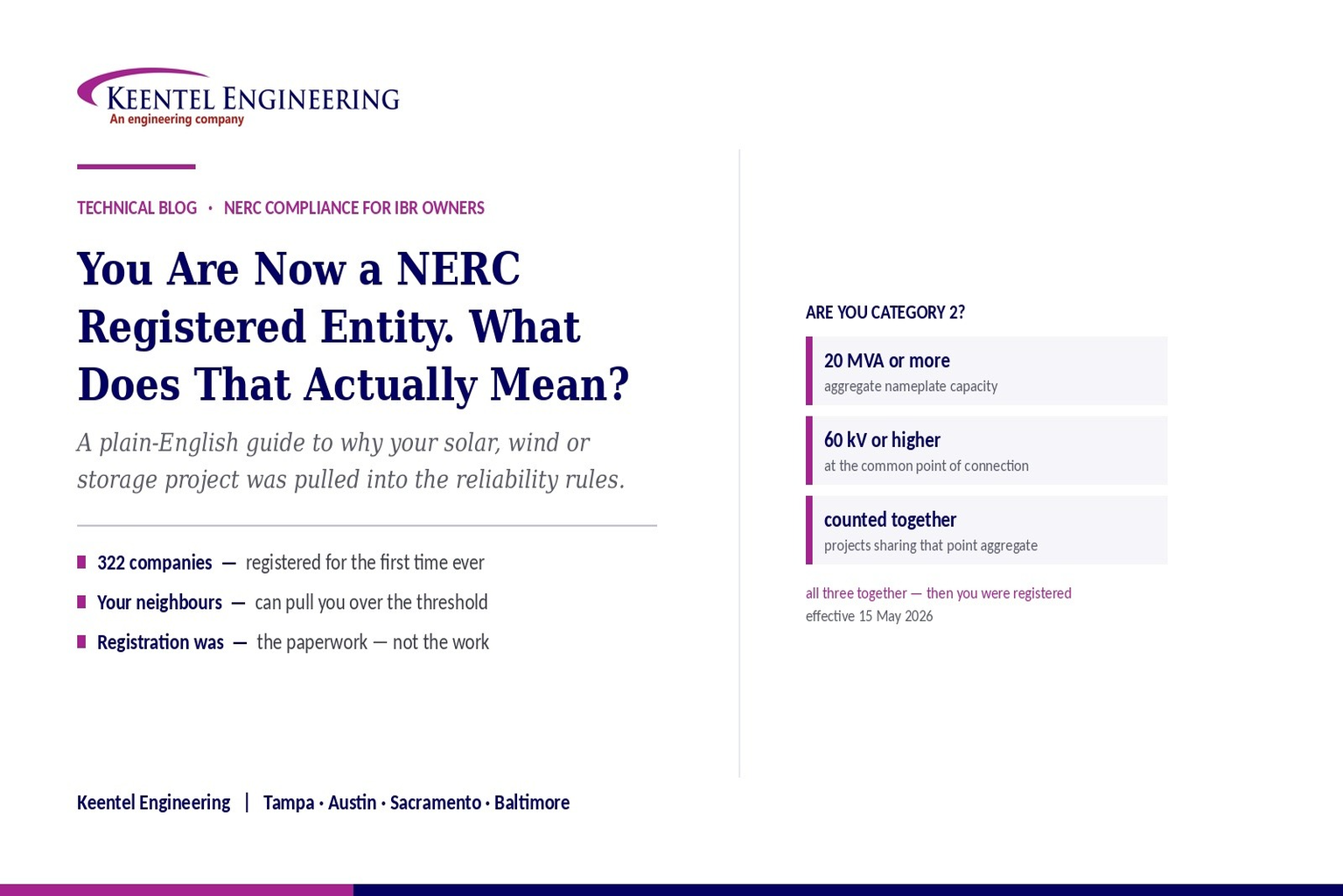
You Are Now a NERC Registered Entity. What Does That Actually Mean?
September 5, 2026 | Blog
A Plain-English Guide to the IBR Registration Initiative — What NERC Was Trying to Fix, Why Your Solar, Wind or Storage Project Was Pulled In, and What You Are Responsible For Now
1. In Plain Terms: What Happened
On 15 May 2026, several hundred solar, wind and battery storage companies woke up subject to a body of federal reliability rules they had never had to follow before. Most of them had done nothing wrong. Their projects had simply been too small, or connected in the wrong way, to fall inside the old rules — and the rules changed.
This paper explains what happened, in ordinary language. What NERC was trying to fix. Why your project was caught. What you are now responsible for. And what to do if you are one of the owners who has only just realised this applies to you.
The short version is this. North America has an organisation called NERC that writes and enforces mandatory rules for keeping the electric grid stable. For decades, those rules only reached large power plants. As solar, wind and storage grew, thousands of smaller projects ended up connected to the grid but outside the rules — invisible to the people responsible for keeping the lights on. After several large disturbances where inverter-based projects disconnected unexpectedly and made things worse, the federal energy regulator told NERC to fix it. NERC did, by widening who has to register.
If you own or operate an inverter-based project of at least 20 MVA connected at 60 kV or above — counting projects that share a connection point together — you were probably caught. You are now what NERC calls a Category 2 Generator Owner, or a Category 2 Generator Operator, or both.
The sentence that matters most
Registration was the paperwork. The obligations are the work.
Being on the register means the rules apply to you, that you must be able to prove you follow them, and that there is no informal grace period. Four months in, that is the part most newly registered owners are still catching up on.
2. The Problem NERC Was Trying to Solve
It helps to understand why any of this happened, because the reasoning explains most of the obligations that follow.
A traditional power plant uses a large spinning machine. Spinning machines are heavy, they behave in predictable ways when the grid has a problem, and they tend to ride through disturbances because physics makes them do so.
Solar farms, wind farms and battery storage do not work that way. They connect through inverters — electronic devices that convert direct current into alternating current and decide, in software, exactly what to do from one millisecond to the next. That is a genuine advantage in many ways. It is also a risk, because what an inverter does during a grid disturbance is whatever its settings tell it to do.
Over the past decade there have been repeated events where a fault on the transmission system was cleared normally, and hundreds or thousands of megawatts of inverter-based generation disconnected anyway. The grid lost generation it was counting on, for a fault that should have been a non-event. In several of those investigations the same finding appeared: nobody had complete information about what was connected, what settings it had, or how it would behave.
That is the problem. Not that inverter-based projects are bad, but that a growing share of the generation fleet was operating outside the framework that keeps track of these things. NERC could not model what it could not see, and could not require performance from owners it had no authority over.
So the federal regulator issued two directions. First, find these owners and register them. Second, write new reliability rules covering how inverter-based projects must be modelled, monitored and how they must perform during disturbances. The first of those became the IBR Registration Initiative. The second is still in progress.
3. Who NERC Is, and Who Actually Contacts You
A few names, kept simple.
- FERC — the Federal Energy Regulatory Commission — is the United States federal energy regulator. It does not write the reliability rules itself. It approves them and directs the organisation that does.
- NERC — the North American Electric Reliability Corporation — is that organisation. Congress created the role in 2005 and FERC designated NERC in 2006. NERC writes the reliability rules, called Reliability Standards, and enforces them. Its rules cover the United States and, through separate arrangements, much of Canada.
- The six Regional Entities do most of the day-to-day work. NERC delegates authority to them. In practice your Regional Entity is who contacts you, who reviews your registration, and who audits you. Which one applies depends on where your project physically connects to the grid, not where your company is based.
- The ERO Enterprise is simply NERC and the six Regional Entities together.
- E-ISAC — the Electricity Information Sharing and Analysis Center — is a separate arm of NERC that shares information about cyber and physical security threats. Membership is free for registered entities and it is deliberately kept separate from enforcement, so engaging with it does not create compliance exposure. It is a genuine benefit and many new registrants do not know it exists.
If you own projects that connect in more than one region, you may deal with more than one Regional Entity, each on its own schedule. There is a programme called Coordinated Oversight that reduces duplication for entities in two or more regions, and it is worth asking about if that describes you.
4. What "Registered" Really Means
Registration is not a licence or a certification. It is a determination that certain mandatory rules now apply to your organisation, and that you can be audited and penalised against them.
Three things follow from it, and all three surprise people.
- The rules apply to functions, not companies. NERC registers you as performing a role — Generator Owner, Generator Operator, or both. The obligations attach to the role. If you own a project but a third party operates it, you may be the Generator Owner while they are the Generator Operator, and each of you carries a different set of requirements.
- Compliance means being able to prove it. It is not enough to do the right thing. You must hold records demonstrating that you did it, for the retention periods the rules specify. An auditor who cannot see evidence treats the requirement as unmet.
- There is no informal grace period. Once the registration is effective, the applicable requirements are enforceable. NERC has been supportive and has run outreach sessions, and that support is real — but it is not an extension.
Enforcement carries financial penalties. They are assessed by requirement and can accrue per day. The purpose of saying so is not alarm; it is that a compliance programme is cheaper than a violation, and the people who need to hear that are usually the ones deciding whether to fund it.
5. Category 1 and Category 2, Explained Simply
NERC changed its own rulebook — the Rules of Procedure — to create two categories of Generator Owner and Generator Operator. The distinction confuses people because the numbers sound like ranks. They are not.
| Category 1 | Category 2 | |
|---|---|---|
| Who it covers | Generator Owners and Operators who were already registered under the existing thresholds — the traditional large-plant population | Owners and Operators of inverter-based projects brought in by the new criteria, who were mostly not registered before |
| How you get there | Through the long-standing Bulk Electric System thresholds — broadly, larger facilities at higher voltages | Through the new criteria: aggregate nameplate capacity of 20 MVA or more, connected through a system designed primarily to deliver that capacity to a common point of connection at 60 kV or higher |
| What changed on 15 May 2026 | Nothing you had to do. Every previously registered Generator Owner and Operator was simply relabelled Category 1 | Everything. Registration became effective and the applicable rules became enforceable |
| Is one a lesser tier? | No | No. The number describes which door you came in through, not how seriously the rules apply |
That last point matters for two audiences. If you are newly registered, do not assume Category 2 means a lighter version of the rules. And if you were already registered, do not skim the notice that relabelled you — the applicability tables and compliance date documents are now written in terms of categories, so you need to know which one you are reading about.
6. The Aggregation Rule: Why Your Neighbours Matter
This is the part most owners did not see coming, and it deserves its own section.
The threshold is not just about your project. NERC’s criteria look at facilities that aggregate to 20 MVA or more at a common point of connection at 60 kV or higher. If several separate projects share a connection point and together cross that line, then all of those facilities are Category 2 assets, and all of their owners and operators must register.
Read that again if you own something small. A six megawatt project that would never approach the threshold on its own can be pulled in because two or three other projects share its point of connection. You may have no commercial relationship with those owners. You may not know who they are.
The practical consequences are worth stating plainly.
- Your registration status is partly determined by parties you do not control. It can change if someone else connects at your point of connection.
- You cannot assess this from your own nameplate. It requires knowing what else is behind the same point of connection, which usually means asking the transmission owner or distribution provider who provides that connection.
- It is a live diligence question. If you are buying a project, or lending against one, whether the aggregation criteria are met is now a real item — and NERC’s Compliance Registry is a public spreadsheet, so registration status can be checked.
7. How We Got Here
The initiative ran in three phases over three years.
| Phase | When | What happened |
|---|---|---|
| Phase 1 | May 2023 to May 2024 | NERC revised its own Rules of Procedure to create the Category 1 and Category 2 definitions, and got those revisions approved. Outreach to potentially affected owners began, largely through trade organisations |
| Phase 2 | May 2024 to May 2025 | NERC and the Regional Entities identified which owners and projects met the new criteria, using federal generation data, and asked transmission owners and balancing authorities for contact details. Outreach continued through webinars, workshops and quarterly updates |
| Phase 3 | May 2025 to May 2026 | Registration itself. Regional Entities processed registrations in batches from August 2025 through April 2026, with a single effective date for everyone |
By the time NERC filed its progress update in April 2026, it had sent registration notification letters covering every identified candidate: 449 organisations, representing 531 facilities. Of those 449, some 127 were companies already registered that were adding a Category 2 function. The remaining 322 were organisations registering with NERC for the first time in their existence.
That number is the human scale of this. Three hundred and twenty-two companies, many of them small, with no compliance department and no prior experience of a federal reliability audit, became registered entities on the same day.
8. Where Things Stand Today
As of this writing, the following is true.
- Registration is complete. The initiative reached its final milestone and closed in May 2026.
- The effective date has passed. It was 15 May 2026, roughly four months ago. On that date NERC updated its public Compliance Registry to show the new Category 2 registrations and to relabel existing Generator Owners and Operators as Category 1.
- Obligations are live. Everything the earlier NERC guidance described as starting on 15 May 2026 — including data reporting obligations — started then.
- More rules are coming. The second federal direction, covering new reliability standards for inverter-based resources, is still working through the standards development process.
If you are reading NERC material dated before mid-2026, be careful with it. A great deal of the published guidance is written in the future tense about dates that have passed. It remains useful for understanding the process; it is misleading about what is required now.
9. What You Had to Send In — and Why It Still Matters
During registration, Regional Entities asked for a specific document set, submitted through a secure system called CORES — the Centralized Organization Registration ERO System.
- A completed ERO Enterprise Generator Owner and Generator Operator Asset Verification Form.
- The interconnection agreement, including any amendments.
- Operating or third-party agreements — in practice, the operations and maintenance contract that establishes who operates the plant.
- Operating one-line diagrams showing the generation through to the point of interconnection with the transmission owner or distribution provider.
- Nameplate data for the individual inverters or wind turbines.
That list is worth revisiting even though registration is over, for one reason. If assembling it was difficult — if the one-line was out of date, if nobody could find current inverter nameplate data, if the agreements were scattered across three parties — that is not a registration problem. It is a records problem, and the standards you are now subject to will ask for the same information repeatedly and in more detail.
An owner who struggled to produce a current one-line for registration will struggle far more with the modelling data requirements, which need the electrical characteristics behind that one-line and updated whenever the plant changes.
10. What You Now Owe
This is the question everyone asks and the published material answers indirectly. There is no single list that applies to everybody, because applicability depends on your registered functions, your equipment and your location. NERC publishes two documents that answer it for your specific case, and they are the most useful things on the website.
- The Functional Applicability spreadsheet, which shows which Reliability Standards apply to which registered functions.
- The Reliability Standards Compliance Dates for Generator Owners and Generator Operators document, updated quarterly, which gives the dates on which each standard becomes enforceable for Category 2 entities.
In broad terms, the obligations fall into four groups.
| Group | In plain terms | What it means practically |
|---|---|---|
| Telling people what you have | Providing data about your plant to the planners and operators who model the grid | Submitting modelling data on their schedule and in their format, and keeping it current when equipment or settings change. This is the largest new workload for most owners |
| Proving your models are right | Demonstrating that the computer model of your plant actually matches how the plant behaves | Verification and validation work, usually requiring simulation and test data. It is engineering, not administration |
| Performing during disturbances | Staying connected and behaving correctly when grid voltage or frequency moves | Ride-through requirements, monitoring equipment that records what happened, and analysis after events. New standards in this area are arriving now |
| Operating and protecting properly | Voltage control, protection settings, protection maintenance and reporting | Long-standing requirements that were always there for registered generators and are new to you |
One date deserves specific mention. The reliability standard covering frequency and voltage ride-through for inverter-based resources takes effect on 1 October 2026. If you own inverter-based generation, that is weeks away and it is a performance requirement, not a paperwork requirement — your equipment either behaves as specified or it does not.
11. The Two Items People Miss
Two obligations sit outside the main standards framework and are easy to overlook because they arrive by email rather than through a standard.
11.1 Generating Availability Data
Registered generators report availability and outage data through a system called GADS — the Generating Availability Data System. NERC’s guidance said Category 2 entities were not required to submit GADS information until 15 May 2026. That date has passed, so if you qualify for GADS reporting, you are inside it now.
11.2 The Reporting Confirmation
Separately, entities receive a notification asking them to complete a Reporting Confirmation stating whether they meet the GADS reporting criteria. NERC recommended completing it early even before it was strictly required. If you set that email aside during the registration rush, it is worth finding.
Neither of these is difficult. Both are the kind of thing that goes unnoticed in a small organisation until it appears as a finding.
12. The GO and GOP Trap
This one is worth checking today, because a lot of owners walked into it without noticing.
If, at the time of registration, a Generator Owner had not yet decided who its Generator Operator would be, the guidance was that the Regional Entity would advise registering as both Category 2 Generator Owner and Category 2 Generator Operator, until it became clearer who would take the operator role.
That was sensible advice for getting registration done on time. It also means some owners are now carrying both function registrations — and every obligation attached to each — when in reality a third-party operator runs the plant. Nothing corrects that automatically. The registration can be revised, but only if somebody notices it needs revising.
A ten-minute check worth doing this week
Open the public Compliance Registry, find your organisation, and look at which functions you are registered for. Compare that against who actually owns and who actually operates each of your projects.
If you are registered as an operator of a plant somebody else operates, you are carrying obligations that are not yours. Speak to your Regional Entity.
There is a related point for anyone changing operators. When a Generator Operator contract ends and a new provider takes over, the Generator Owner documents the new operator on the Asset Form and provides the new operations and maintenance agreement through CORES. In other words, changing your O&M contractor is now a registration event. Most asset management handover checklists do not yet include it.
13. Four Things People Got Wrong
These came up repeatedly during registration and each one cost somebody time.
"We analysed it ourselves and we do not qualify, so we do not need to respond"
Incorrect. NERC was explicit that even where an organisation concluded its facility did not meet the criteria, it still had to submit the requested documents. The Regional Entity makes the determination, not the owner. Self-assessment was never the decision — it was an input to somebody else’s decision.
"We will not share our data without a non-disclosure agreement"
NERC declined this. No non-disclosure agreement is required between registration candidates and Regional Entities, because the Rules of Procedure already impose confidentiality obligations on NERC and the Regional Entities for information submitted to them. Owners who held out for an agreement spent time they did not have.
"We have facilities in several regions so we will do them all at once"
Not permitted. Each Regional Entity set its own timeframe and each had to be met on its own schedule. Registration approval arrived region by region.
"We will deal with it closer to the deadline"
The volume made that unworkable. Registration was processed in batches across nine months precisely because it could not all happen at the end. The same logic now applies to compliance: the standards have staggered dates and the work cannot be compressed into the last month before an audit.
14. What If You Were Never Contacted?
NERC identified candidates using federal generation data and by asking transmission owners and balancing authorities for contact information. That process was thorough and it was not infallible.
If you own an inverter-based project that meets the criteria — including through aggregation with neighbours — and you were never contacted by a Regional Entity, you are not exempt. You are unregistered, and the criteria applied on 15 May 2026 regardless of whether anyone wrote to you.
The published guidance treats this as a helpdesk matter: contact NERC Registration and they will help identify your Regional Entity. That is the right first step, and the sooner it is taken the better the position looks. An owner who identifies the gap themselves and approaches their Regional Entity is in a materially different posture from one discovered later.
The situations most likely to have been missed are aggregations of small facilities behind a shared connection point, projects that changed ownership during the identification window, and organisations whose contact information in the federal data was out of date.
15. What Is Still Coming
Registration was one of two federal directions. The second — developing new reliability standards for inverter-based resources — is still under way, and it is where the technical requirements live.
- Standards covering disturbance monitoring, ride-through performance, and analysis of unexpected changes in output are moving into effect, with the ride-through standard effective 1 October 2026.
- Model verification and validation requirements are being updated, and were among the standards approved in February 2026 together with new definitions for distributed energy resources, model validation and model verification.
- Further standards projects covering operational studies and planning studies were in the industry comment and ballot process during 2026 and will follow.
The practical implication is that the obligation set is not static. An entity that builds a compliance programme around today’s list and then stops will fall behind. The quarterly compliance dates document exists precisely because the picture keeps moving.
16. What a Compliance Programme Actually Looks Like
For an organisation that has never done this, the phrase "compliance programme" sounds heavier than it is. In practice it is five things.
- Knowing what applies to you. Working through the Functional Applicability spreadsheet and the compliance dates document for your registered functions, and producing a written list of the standards and requirements you are subject to, with dates. This is the foundation and it is frequently skipped.
- Assigning each requirement to a person. Not a department — a person, with the authority and the time to do it. Requirements that belong to everybody belong to nobody.
- Doing the underlying engineering. Models, settings, protection, monitoring and testing. This is real technical work and it is where most of the effort sits for an inverter-based owner.
- Keeping evidence. Records that demonstrate each requirement was met, retained for the specified period, in a form somebody other than the author can follow. Evidence built as the work happens is straightforward; evidence reconstructed for an audit is expensive and often incomplete.
- Reviewing it periodically. Standards change, projects change, staff change, and settings change. A programme that is not reviewed drifts out of alignment with the assets it covers.
None of that requires a large organisation. It requires that somebody owns it and that the engineering behind it is done properly.
17. How Keentel Engineering Helps
Keentel Engineering is an electrical power systems engineering firm. We work with owners and operators of inverter-based generation and storage on the engineering that sits underneath these obligations — and on the compliance programme that surrounds it.
17.1 Working Out Where You Stand
- Registration applicability assessment, including the aggregation question — establishing what else sits behind your point of connection and whether the criteria are met.
- Review of your current registration against what you actually own and operate, including the Generator Owner and Generator Operator function question described in Section 12.
- Applicable standards determination for your registered functions, with a written obligation register and dates.
- Gap assessment against that register — what exists, what does not, and what it takes to close it.
17.2 The Engineering Behind the Standards
- Modelling data preparation and submittal, including steady-state and dynamic models, and electromagnetic transient models where required.
- Model verification and validation against test data and disturbance records, including test design and parameter calibration.
- Ride-through capability assessment at the point of interconnection, capability documentation, and support for extension or exemption pathways where equipment cannot comply.
- Disturbance monitoring architecture and data retention design, and post-disturbance performance analysis.
- Protection and control review, settings, coordination studies, relay loadability, and protection system maintenance programmes.
- Voltage control and reactive capability assessment and documentation.
17.3 Building and Keeping the Programme
- Compliance programme development sized to the organisation — obligation register, ownership assignment, evidence structure and review cycle.
- Evidence design, so that records are generated as the work happens rather than assembled afterwards.
- Audit preparation and support, and response to requests for information.
- Ongoing monitoring of standards changes and compliance dates as the framework continues to develop.
17.4 Design and Studies for New and Existing Projects
- Interconnection engineering, point-of-interconnection and substation design, and interconnection application and study support.
- Short-circuit, protective coordination, arc-flash, load flow, harmonic, grid strength and transient stability studies.
- Electromagnetic transient studies for weak-grid stability, control interaction and ride-through verification.
- Owner’s engineer services, design review, and QA/QC of third-party study and model packages.
Keentel Engineering holds a Florida Certificate of Authorization and maintains offices in Tampa, Austin, Sacramento, and Baltimore, supporting projects across the interconnections.
19. Frequently Asked Questions
Q1. In one sentence, what is the IBR Registration Initiative?
A three-year effort by NERC, directed by the federal energy regulator, to find owners and operators of inverter-based generation that were connected to the grid but outside the mandatory reliability rules, and bring them inside those rules.
Q2. Why did the regulator think this was necessary?
Because of repeated events where a normally cleared transmission fault caused hundreds or thousands of megawatts of inverter-based generation to disconnect anyway. Investigations kept finding the same gap: incomplete information about what was connected, what settings it had and how it would behave, and no authority over the owners.
Q3. Who was caught?
Broadly, owners and operators of inverter-based projects with aggregate nameplate capacity of 20 MVA or more, connected through a system designed primarily to deliver that capacity to a common point of connection at 60 kV or higher. Solar, wind, battery storage and hybrid projects all qualify on the same basis.
Q4. What does "aggregate" mean here — does it include other people’s projects?
Yes. If several facilities share a common point of connection and together reach 20 MVA or more at 60 kV or higher, all of those facilities are Category 2 assets and all of their owners and operators must register. A small project can be pulled in by its neighbours.
Q5. How would I even know what else is behind my point of connection?
Usually by asking the transmission owner or distribution provider who supplies the connection. It is not something you can determine from your own nameplate, which is exactly why some owners were surprised.
Q6. What is the difference between Category 1 and Category 2?
Which criteria brought you in. Category 1 covers the previously registered population that qualified under the long-standing Bulk Electric System thresholds. Category 2 covers those brought in by the new inverter-based criteria. It is not a ranking and Category 2 is not a lighter version of the rules.
Q7. I was already registered. Did anything change for me?
You were relabelled Category 1 on 15 May 2026 and no action was required. But applicability tables and compliance date documents are now written by category, so you need to know which one applies to you when reading them.
Q8. What is the difference between Generator Owner and Generator Operator?
Owner is the entity that owns the generating facility; Operator is the entity that operates it. They can be the same company or different ones. NERC registers by function, and the obligations attach to the function — so an owner and a third-party operator each carry a different set of requirements.
Q9. When did all this become effective?
15 May 2026. That is the date NERC updated its public Compliance Registry, the new registrations took effect, and the applicable requirements became enforceable.
Q10. Is there a grace period?
No informal one. NERC has provided outreach, advisory sessions and published guidance, and that support is genuine, but it does not extend any compliance date. Requirements are enforceable from their stated dates.
Q11. What happens if we get it wrong?
Non-compliance is enforced through NERC’s Compliance Monitoring and Enforcement Program, and penalties are assessed by requirement and can accrue per day. The practical point is that a programme costs less than a violation.
Q12. How do I find out which standards apply to me?
Two NERC documents. The Functional Applicability spreadsheet shows which standards apply to which registered functions. The Reliability Standards Compliance Dates for Generator Owners and Generator Operators document, updated quarterly, gives the dates each becomes enforceable. Between them they answer the question for your specific registration.
Q13. What is the biggest new workload for a typical owner?
Modelling. Providing plant data to the planners and operators who model the grid, keeping it current, and demonstrating that the model matches how the plant actually behaves. That last part is engineering work requiring simulation and test data, not an administrative submission.
Q14. What is the most urgent date right now?
1 October 2026, when the reliability standard covering frequency and voltage ride-through for inverter-based resources takes effect. It is a performance requirement — your equipment either behaves as specified during a disturbance or it does not, and settings changes typically require the manufacturer.
Q15. We were told we did not have to submit GADS data until May. Is that still true?
That date has passed. If your facilities meet the GADS reporting criteria, the obligation is live now. There is also a separate Reporting Confirmation asking whether you meet the criteria, which NERC recommended completing early — worth checking whether it was ever returned.
Q16. We registered as both Generator Owner and Generator Operator because we had not appointed an operator yet. Is that a problem?
It may be. That was the advice at the time and it was reasonable, but it means you may now be carrying operator obligations for plants a third party actually operates. Nothing corrects it automatically. Check your registration against reality and speak to your Regional Entity if they do not match.
Q17. We are changing O&M contractor. Does NERC need to know?
Yes. The Generator Owner documents the new operator on the Asset Form and provides the new operations and maintenance agreement through CORES. Changing operators is now a registration event, and most handover checklists do not yet include it.
Q18. We assessed ourselves and concluded we did not qualify. Was that enough?
No. NERC was explicit that the requested documents still had to be submitted, and that the Regional Entity makes the determination. Self-assessment was an input to somebody else’s decision, not the decision.
Q19. Should we have insisted on a non-disclosure agreement before sharing data?
NERC said no agreement is required, because its Rules of Procedure already impose confidentiality obligations on NERC and the Regional Entities for information submitted to them. Owners who held out on this point lost time without gaining protection.
Q20. Nobody ever contacted us. Are we exempt?
No. The criteria applied on 15 May 2026 whether or not anyone wrote to you. If you meet them, you are unregistered and out of compliance. Contact NERC Registration, who will identify your Regional Entity. Approaching them yourself puts you in a materially better position than being found later.
Q21. Which Regional Entity do we deal with?
The one covering the physical location where your project connects to the grid — not where your company is based. If you have projects in more than one region you may deal with several, each on its own schedule.
Q22. We have projects in several regions. Is there anything that reduces the duplication?
Yes, the Coordinated Oversight Program, which is available to entities registered in two or more Regional Entities and reduces duplicated monitoring activity. It is worth asking about if that describes you.
Q23. What is E-ISAC and should we join?
The Electricity Information Sharing and Analysis Center shares cyber and physical security information across the industry, with a community of more than fifteen hundred organisations. Membership is a free benefit of NERC registration and it is deliberately kept separate from enforcement, so engaging with it does not create compliance exposure.
Q24. Is this finished, or is more coming?
More is coming. Registration was one of two federal directions; the second, developing new reliability standards for inverter-based resources, is still in progress. Standards covering disturbance monitoring, ride-through and post-event analysis are arriving now, and further projects on operational and planning studies are in development.
Q25. We are a small company with no compliance staff. Where do we start?
With a written list of what applies to you, built from the Functional Applicability spreadsheet and the compliance dates document for your registered functions. Then assign each requirement to a named person, do the underlying engineering properly, and design the evidence so it is created as the work happens. That is the whole programme, and it does not require a large organisation — it requires that somebody owns it.
18. References and Further Reading
The following are the primary sources for this paper. NERC materials are updated frequently and some published guidance predates the effective date discussed here; check the publication date of anything you rely on.
The Initiative Itself
- NERC IBR Registration Initiative project page, including milestones, quarterly updates, frequently asked questions and guidance for new registrants — North American Electric Reliability Corporation
- Frequently Asked Questions — IBR Registration Initiative, Category 2 Generator Owner and Generator Operator Registration Process — North American Electric Reliability Corporation
IBR Registration Initiative quarterly updates, and the registration work plan progress filings made with the Federal Energy Regulatory Commission — North American Electric Reliability Corporation
Registration Criteria and Applicability
- NERC Rules of Procedure — Section 500 on Organization Registration and Certification, Appendix 2 definitions, Appendix 5A registration and certification manual, Appendix 5B statement of compliance criteria, and Appendix 5C on exceptions from the Bulk Electric System definition — North American Electric Reliability Corporation
- Application of the Registration Criteria for Category 2 Generator Owner and Generator Operator inverter-based resources; the Bulk Electric System Definition Reference Document; and Application of the BES Definition to Battery Energy Storage Systems and Hybrid Resources — North American Electric Reliability Corporation
- NERC Compliance Registry Matrix — the public record of registered entities and their registered functions — North American Electric Reliability Corporation
What Applies and When
- Functional Applicability spreadsheet, showing which Reliability Standards apply to which registered functions — North American Electric Reliability Corporation
- Reliability Standards Compliance Dates for Generator Owners and Generator Operators, updated quarterly — North American Electric Reliability Corporation
- NERC Reliability Standards — including the MOD series for modelling data and model verification, the PRC series for disturbance monitoring, ride-through, post-event performance analysis, protection coordination and maintenance, and the VAR series for voltage and reactive control — North American Electric Reliability Corporation
Related Technical Standards
Notice and Disclaimer
This document is original technical content prepared by Keentel Engineering LLC for general professional information. It is written in non-specialist language for accessibility and is a summary, not a complete statement of any requirement. It is not legal advice, regulatory advice, or project-specific engineering advice, and it does not constitute a registration determination, an applicability determination, or a compliance determination for any organisation or facility.
Registration criteria, applicable Reliability Standards, compliance dates and process details are established by NERC, the Regional Entities and the applicable regulators, and are revised over time. Descriptions here are current to the date of publication to the best of our knowledge and must be verified against the governing documents and with your Regional Entity before any decision. Where a NERC document, Rule of Procedure, Reliability Standard or Regional Entity instruction differs from this summary, that source governs.
Any organisation uncertain about its registration status or its obligations should contact its Regional Entity or NERC Registration directly.
Keentel Engineering LLC is an independent engineering consultancy. Reference to any regulator, reliability organisation, regional entity, standard, industry organisation, or equipment category in this document does not imply affiliation with, endorsement by, or sponsorship from any such organisation.

About the Author:
Sandip "Sonny" R. Patel, P.E.
IEEE Senior Member · Founder & CEO, Keentel Engineering
In 1995, Sonny Patel earned his Electrical Engineering degree from the University of Illinois. But degrees don't build legacies — action does.
For three decades, he has worked the power industry from every side of the table: 16 years as a utility engineer at Exelon/Commonwealth Edison; generation leadership across hydroelectric, industrial steam turbine, and a 9 GW renewable fleet; NERC Regional Entity Senior Compliance Engineer and Audit Team Lead, auditing some of the nation's largest utilities; and testing and commissioning lead on equipment up to 765 kV — the very top of the North American grid.Utility. Generator. Regulator. Consultant. Few engineers have seen all four seats. Fewer still have sat in them.
His experience spans nuclear, hydro, conventional generation, renewables, oil and gas, mining — and today's data centers, where he is authoring a three-book series on data center design. He is a Licensed Professional Engineer in six states and a Licensed Electrical Contractor in Florida (Unlimited EC) — he doesn't just design the work; he's qualified to stand behind its execution.Today, as Founder and CEO of Keentel Engineering, Sonny leads a nationwide team of engineers delivering substation design, power system studies, NERC compliance, and commissioning — done right, coast to coast.Three decades. Every side of the table. One standard: accountable engineering.
Services

Let's Discuss Your Project
Let's book a call to discuss your electrical engineering project that we can help you with.
About the Author:
Sandip "Sonny" R. Patel, P.E.
IEEE Senior Member · Founder & CEO, Keentel Engineering
In 1995, Sonny Patel earned his Electrical Engineering degree from the University of Illinois. But degrees don't build legacies — action does.
For three decades, he has worked the power industry from every side of the table: 16 years as a utility engineer at Exelon/Commonwealth Edison; generation leadership across hydroelectric, industrial steam turbine, and a 9 GW renewable fleet; NERC Regional Entity Senior Compliance Engineer and Audit Team Lead, auditing some of the nation's largest utilities; and testing and commissioning lead on equipment up to 765 kV — the very top of the North American grid.
Utility. Generator. Regulator. Consultant. Few engineers have seen all four seats. Fewer still have sat in them.
His experience spans nuclear, hydro, conventional generation, renewables, oil and gas, mining — and today's data centers, where he is authoring a three-book series on data center design. He is a Licensed Professional Engineer in six states and a Licensed Electrical Contractor in Florida (Unlimited EC) — he doesn't just design the work; he's qualified to stand behind its execution.
Today, as Founder and CEO of Keentel Engineering, Sonny leads a nationwide team of engineers delivering substation design, power system studies, NERC compliance, and commissioning — done right, coast to coast.Three decades. Every side of the table. One standard: accountable engineering.
Leave a Comment
Thank you for contacting us.
We will get back to you as soon as possible.
We will get back to you as soon as possible.
Oops, there was an error sending your message.
Please try again later.
Please try again later.
Related Posts
By SANDIP R PATEL
•
October 20, 2026
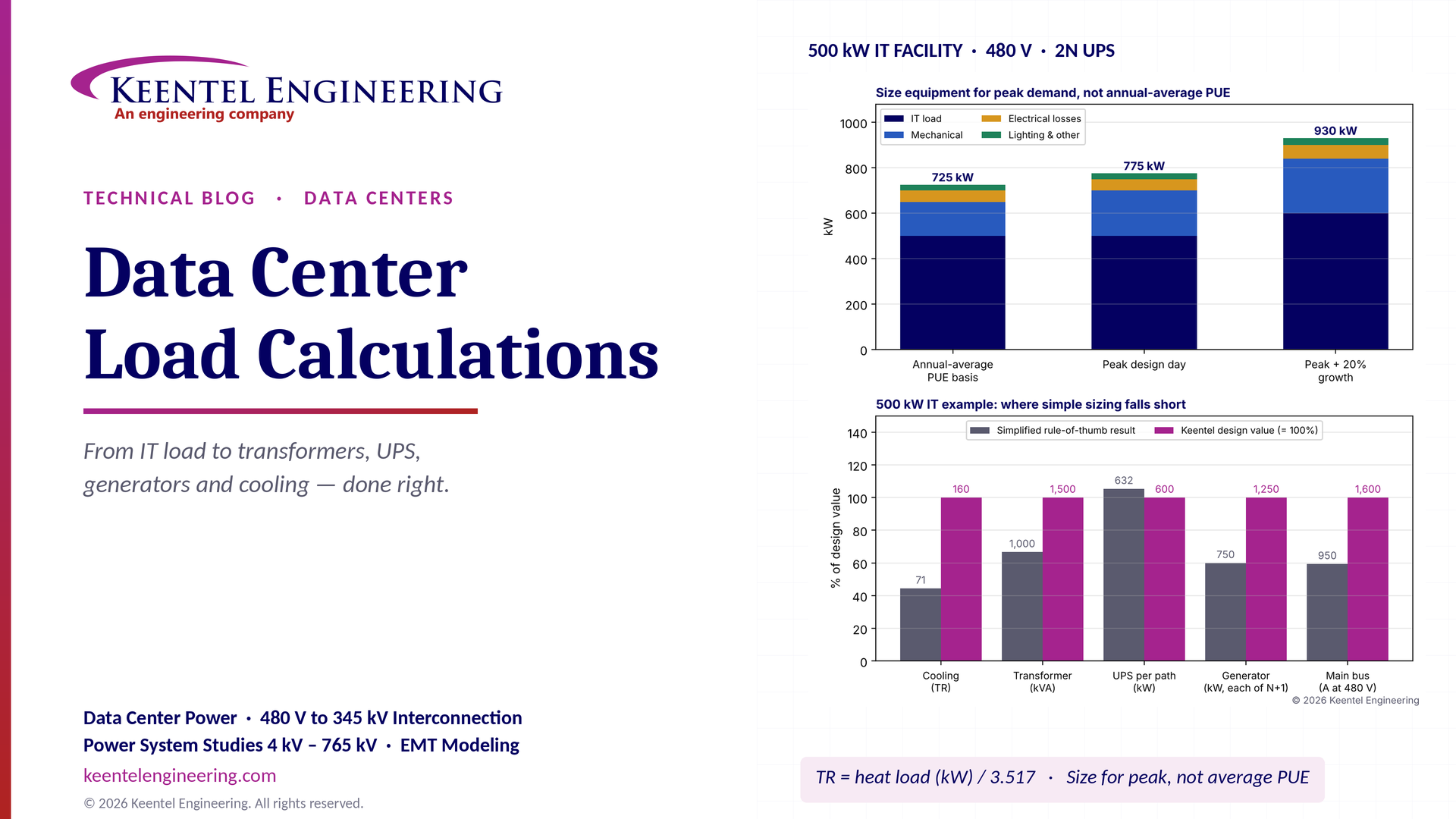
Learn data center electrical load calculations, including IT demand, PUE, UPS and generator sizing, cooling loads, redundancy, and worked US examples.
By SANDIP R PATEL
•
October 20, 2026
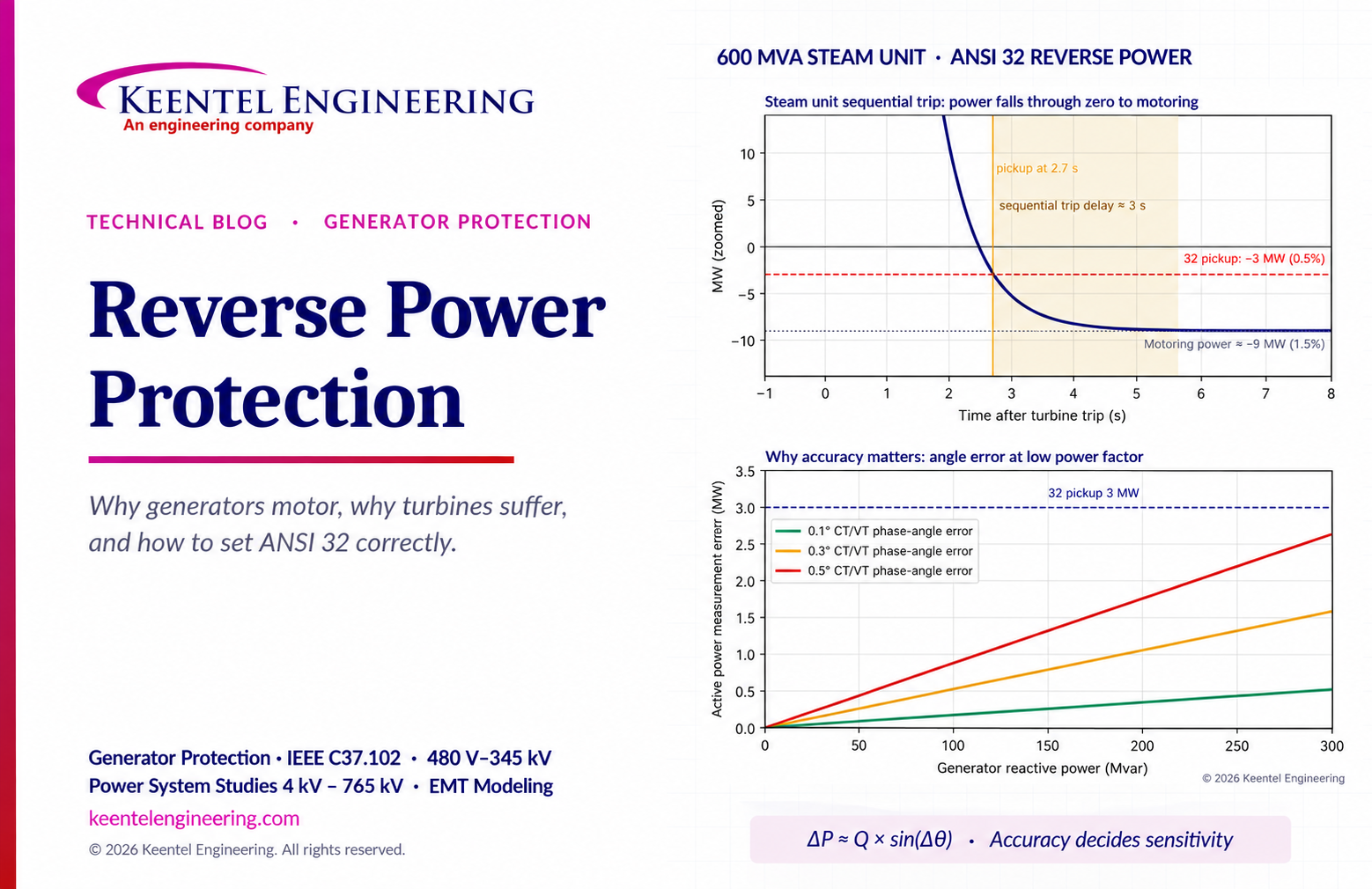
Learn reverse power protection (ANSI 32), generator motoring, relay pickup settings, time delays, sequential tripping and testing for US power plants.
Copy
By Team 2 Dexora
•
October 20, 2026
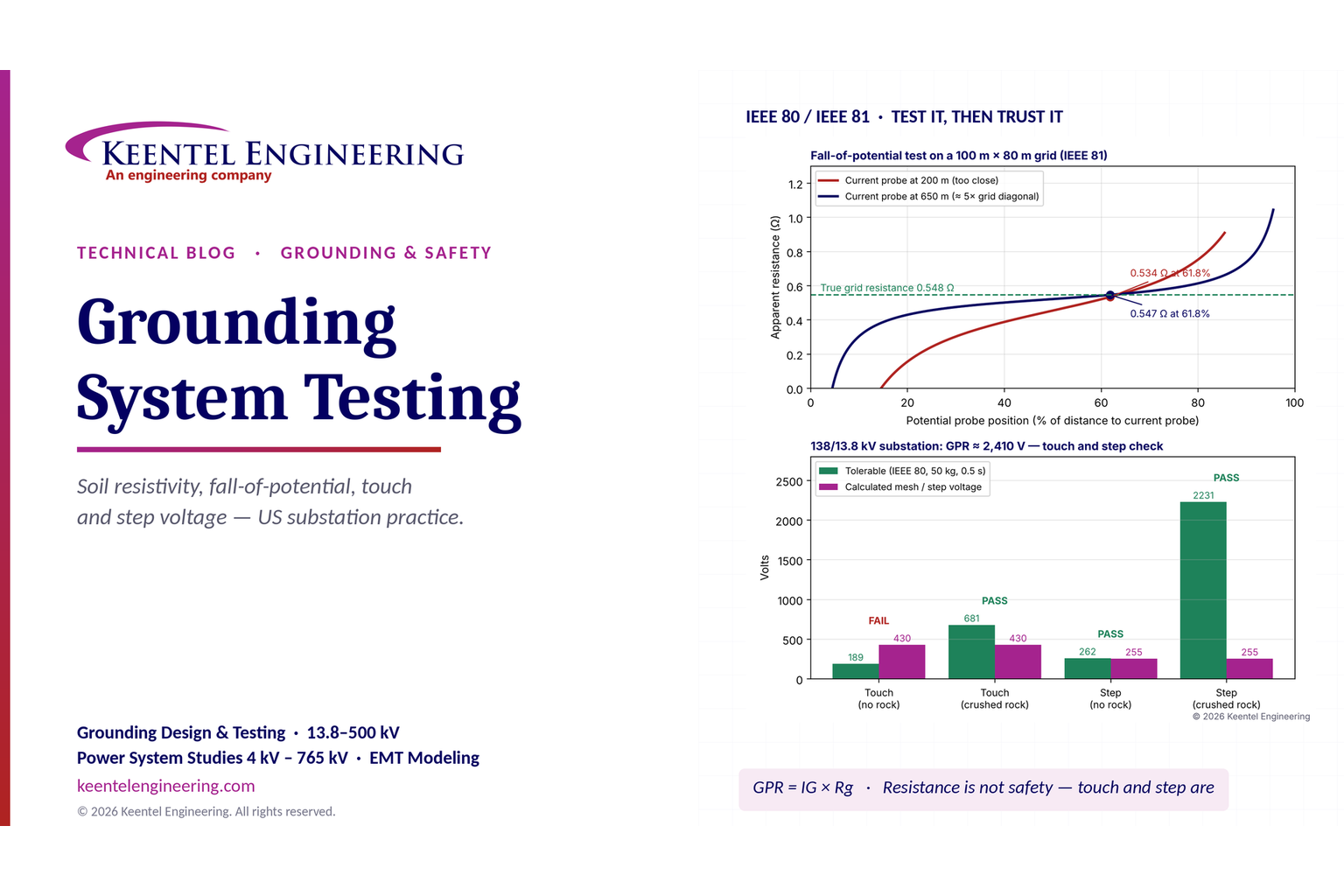
Explore grounding system testing with Keentel Engineering. Learn IEEE 80/81 methods, soil resistivity, ground resistance, and touch and step voltage safety.
By SANDIP R PATEL
•
October 13, 2026
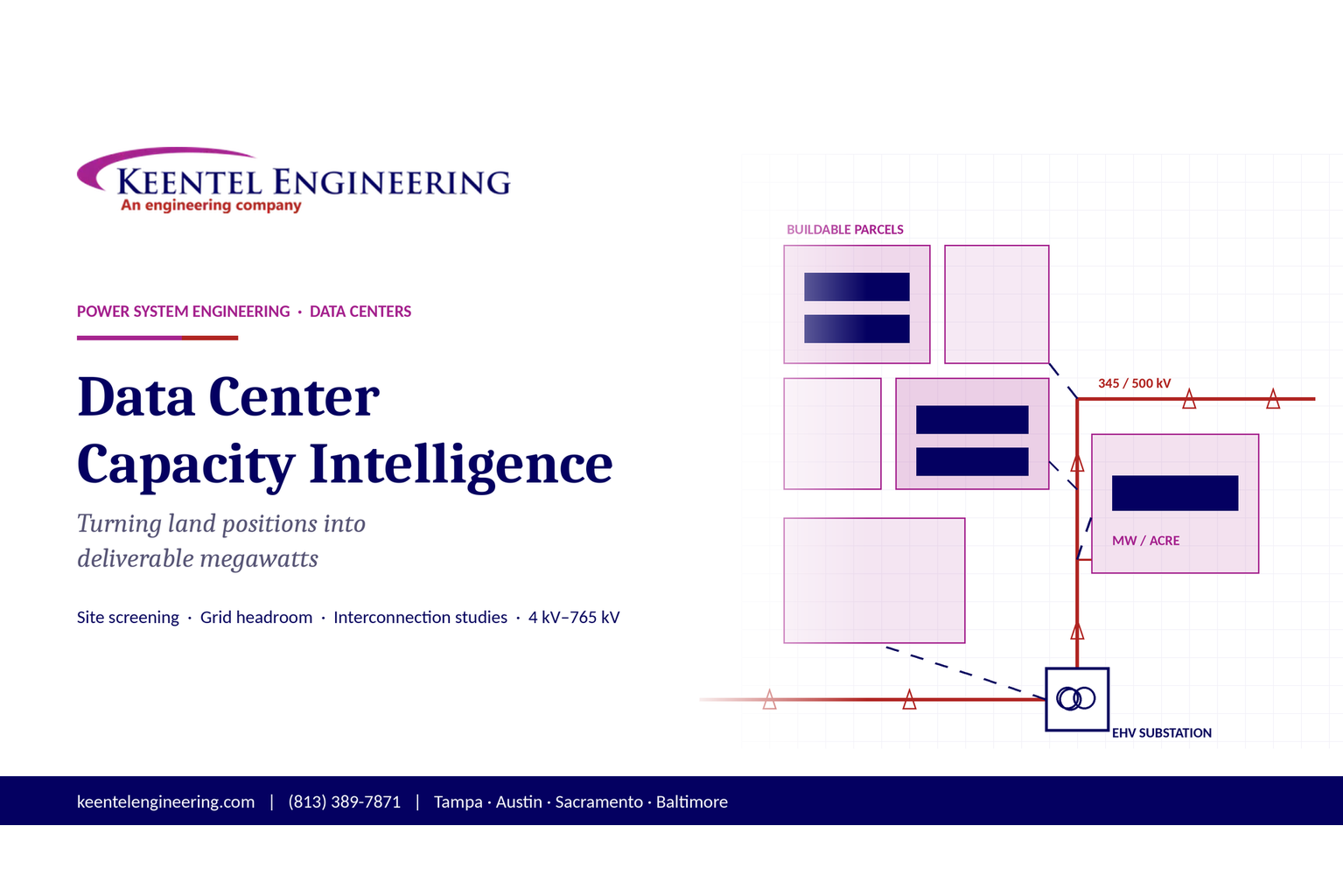
Plan data center capacity with land screening, MW-per-acre estimates, grid power availability and interconnection feasibility studies from Keentel Engineering.
By SANDIP R PATEL
•
October 11, 2026
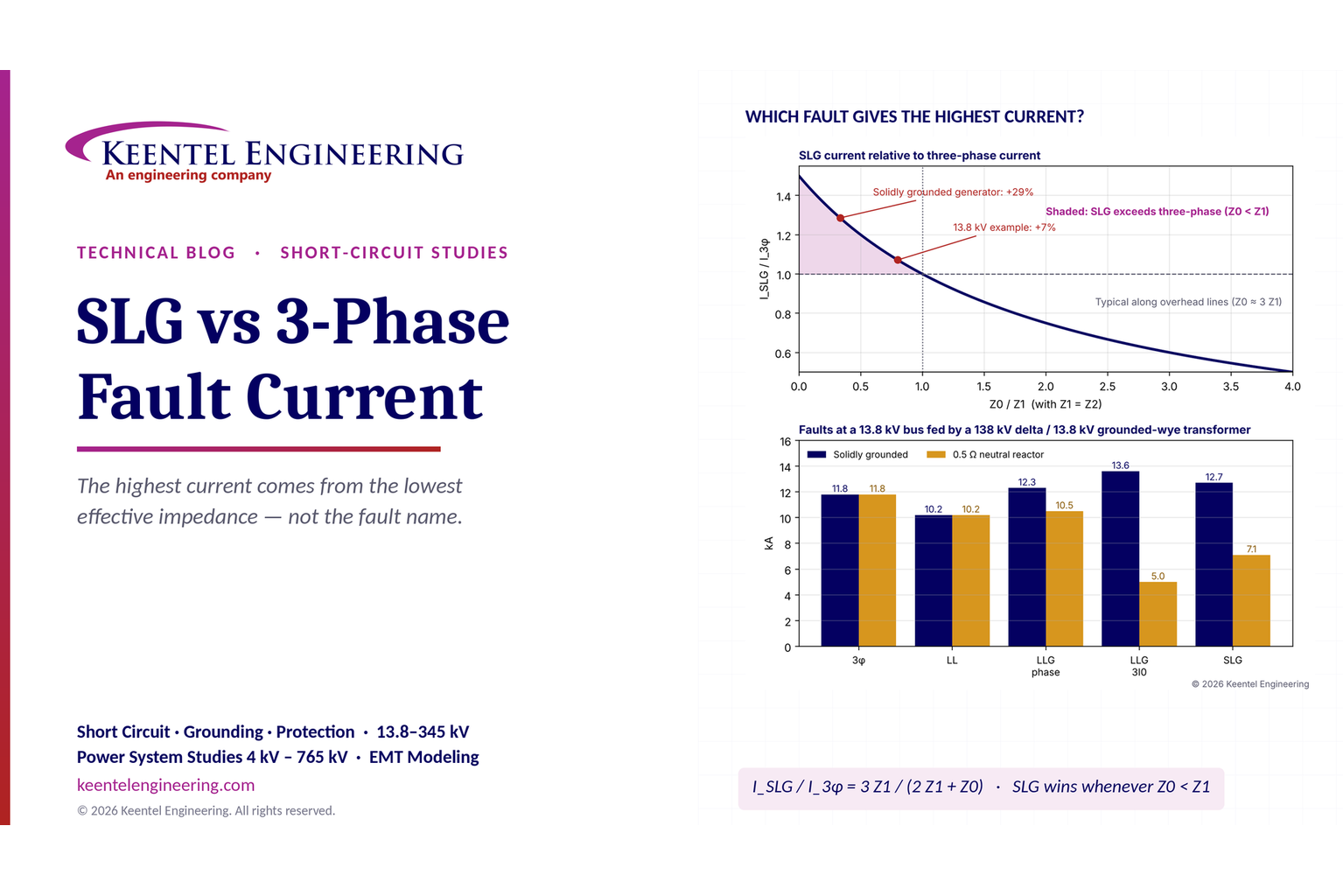
Learn which fault produces the highest current at a bus, why SLG faults can exceed three-phase faults, and how symmetrical components determine fault duty.
By SANDIP R PATEL
•
October 11, 2026
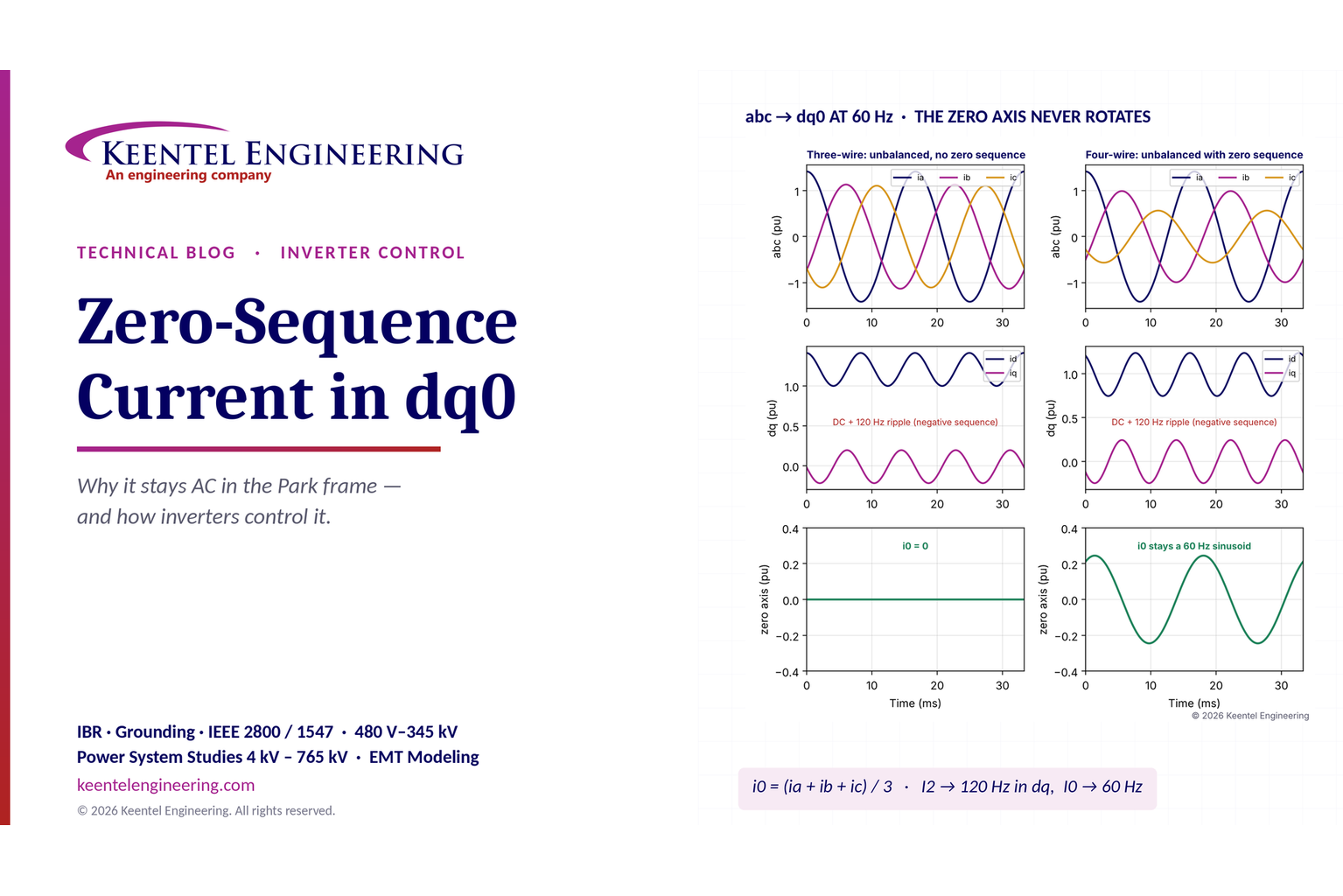
Learn why zero-sequence current pulsates in the dq0 frame, how Park's transformation works, and how inverter controls handle unbalance and ground faults.
By SANDIP R PATEL
•
October 11, 2026
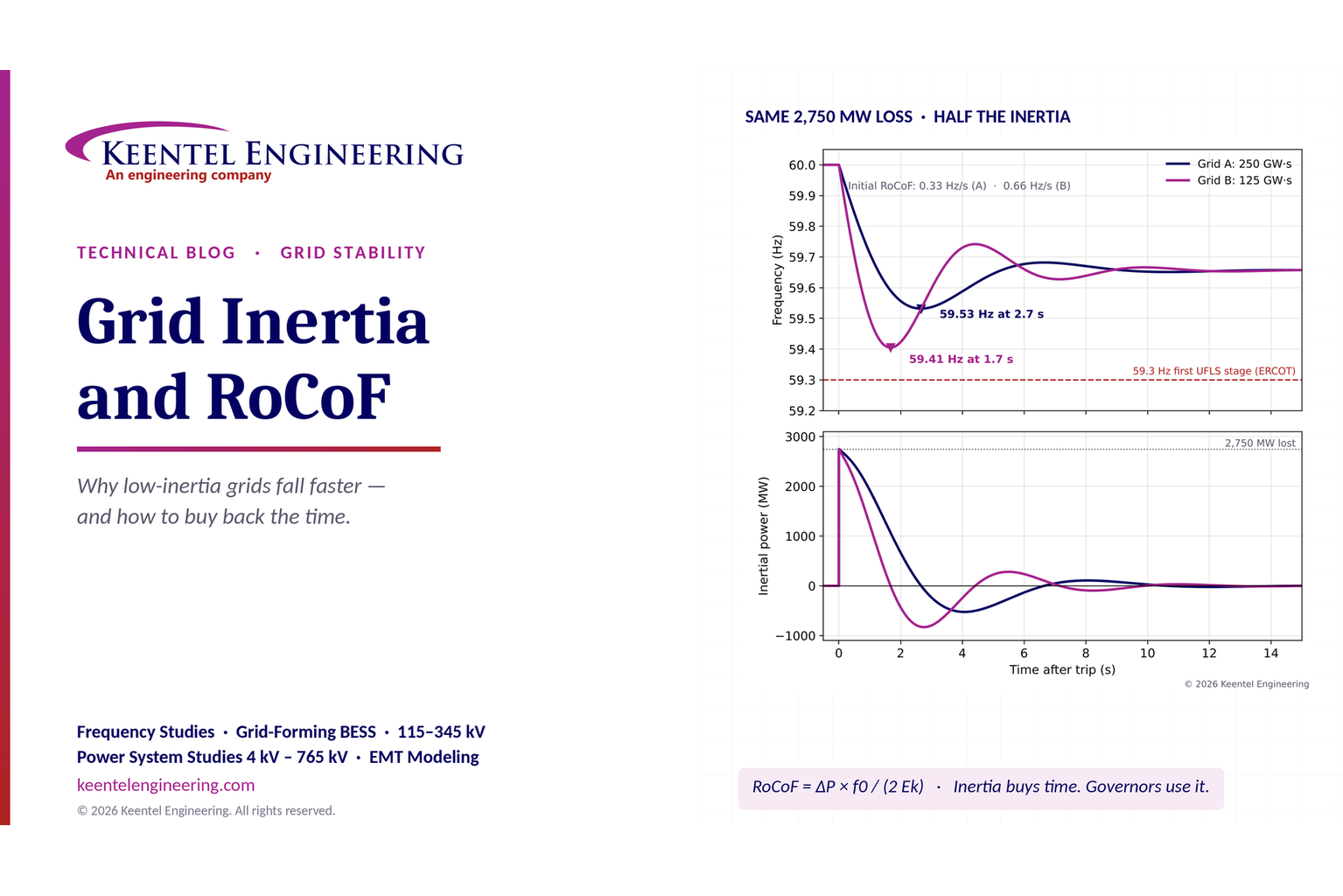
Explore grid inertia, RoCoF and frequency response, with swing equation calculations, frequency nadir analysis and US power system simulation examples.
By SANDIP R PATEL
•
October 11, 2026
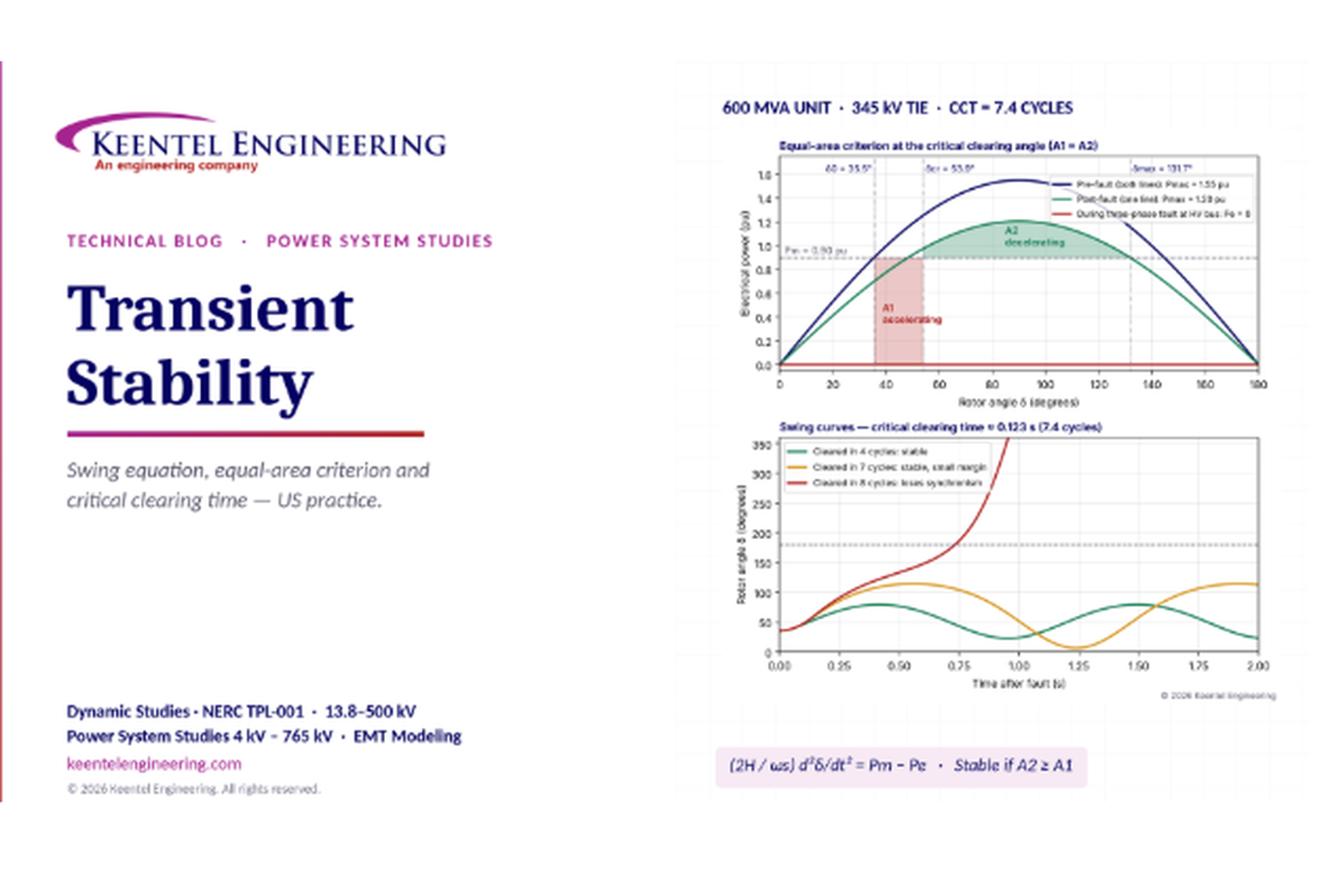
Learn transient stability analysis, swing equation, equal-area criterion and critical clearing time with a 345 kV worked example and NERC TPL-001 guidance.
By SANDIP R PATEL
•
October 11, 2026
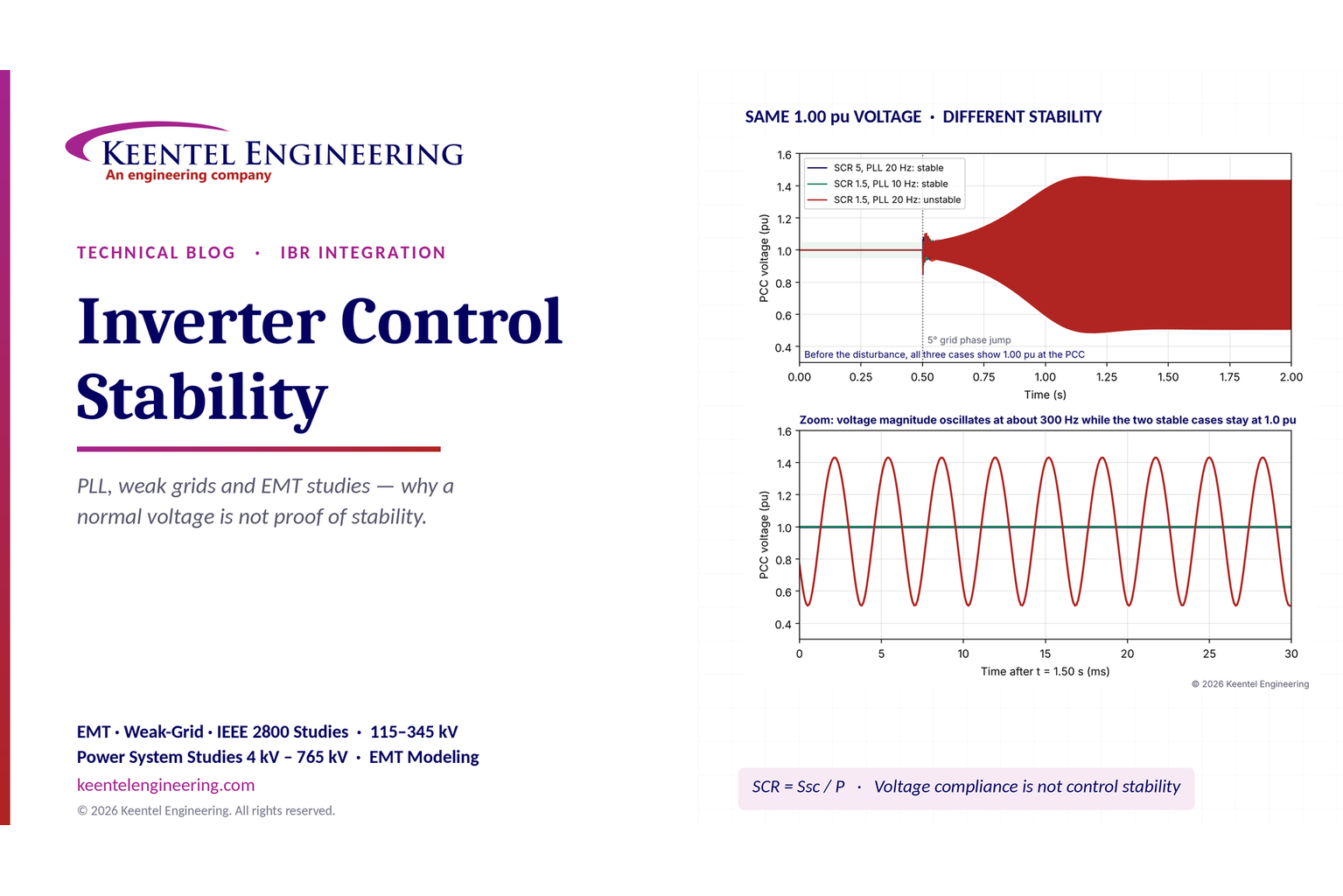
Learn why inverter controls become unstable in weak grids, how PLL bandwidth and SCR affect stability, and how PSCAD EMT studies identify and mitigate oscillations.